Technology (IJRASET)
Dynamic analysis of laminated composite plates
and shells by using a new higher-order shear
deformation theory and ABAQUS software
Bavane. N. U.1, Patil. S. B.2, Shinde. S. S.3, Kore. S. B.4, Kamble. R. P.5Sanjay Ghodawat Institute, Atigre- Civil Department, Shivaji University
Abstract— A new higher order shear deformation theory for elastic composite/sandwich plates and shells is developed. The new displacement field depends on a parameter ‘‘m’’, whose value is determined so as to give results. Static and dynamic results are presented for cylindrical and spherical shells and plates for simply supported boundary conditions. Results are provided for thick to thin as well as shallow and deep shells. The accuracy of ABAQUS software is verified by comparing it with various available
results in the literature.
Keywords— FSDT - First order shear deformation theory, HSDT - Higher order shear deformation theory, Dynamic, Doubly-curved shells.
I. INTRODUCTION
An increasing number of structural designs, especially in the aerospace, automobile, and petrochemical industries are extensively utilizing fiber composite laminated plates and shells as structural elements. The laminated orthotropic shell belongs to the composite shell category. One of the important factors in the analysis of the layered shells is its individual layer properties, which may be anisotropic, orthotropic or isotropic.
A shell is a curved, thin walled structure. Two important classes of shells are plates (shells which are flat when un-deformed) and membranes (shells whose walls offer no resistance to bending). Shells may be made of a single homogeneous or anisotropic material or may be made of layers of different materials.
The primary function of a shell may be to transfer loads from one of its edges to another, to support a surface load, to provide a covering, to contain a fluid, to please the eye or a combination of these.
A thin shell is defined as a shell with a thickness which is small compared to its other dimensions and in which deformations are not large compared to thickness. A primary difference between a shell structure and a plate structure is that, in the unstressed state, the shell structure has curvature as opposed to plates. Membrane action in a shell is primarily caused by in-plane forces (plane stress), though there may be secondary forces resulting from flexural deformations. Where a flat plate acts similar to a beam with bending and shear stresses, shells are analogous to a cable which resists loads through tensile stresses. The ideal thin shell must be capable of developing both tension and compression.
First order shear deformation theory (FSDT) is based on the kinematic field assumption postulated by Mindlin, in which the constant transverse shear strain components along the thickness is accounted. Higher order shear deformation theories (HSDTs) were developed to improve the analysis of shell responses and extensively used by many researchers. Normally, these well-known theories comply with the free surface boundary conditions and account for approximately parabolic distribution of shear stresses through the thickness of the shell.
Many higher order theories were proposed by Kant and Swaminathan, Reddy and Liu, Touratier, Soldatos. The present HSDT is simple in the sense that it contains the same dependent unknowns as in the first order shear deformation theory.
The present theory is based on a displacement field in which the displacements of the middle surface are expanded as a combination of exponential and polynomial functions of the thickness coordinate, and the transverse displacement is assumed to be constant through the shell thickness. The theory is constructed from 3D elasticity bending solutions of plates, by performing several computations of the present shell/plate governing equations, which has ‘‘m’’ parameter dependent.
A. Application Of Shells
Technology (IJRASET)
shells are used in civil field such as conoid, hyperbolic paraboloid and elliptical paraboloid shell. All are used for roofing to cover large column-free areas. Laminated composites are such type of material which has high strength to weight and strength to stiffness ratios. The mechanical properties of the laminated composites depend on the degree of orthotropy of the layers, ratio of the transverse shear modulus to the in-plane shear modulus and stacking sequence of laminates. Many of the classical theories developed for thin elastic shells are based on the Love-Kirchhoff assumptions in which thenormal to the mid-plane before deformation is considered to be normal and straight after the deformation.
Figure: 1.1 Elliptical Paraboloidal Shell
Figure: 1.2 Hyperbolic Paraboloidal Shell
Figure: 1.3 Cylindrical Shell
II. PROBLEMDEFINITION A. Introduction
In this chapter we are going to discuss about the problem taken for Paper.
B. Details of Problem
Technology (IJRASET)
Modulus of elasticity - E1= 2*105, E2= 2*104, E1/E2= 10, Modulus of rigidity - G12 = G13 =
0.6 * E2 = 1.2*104
G23 = 0.5 * E2 = 1*104
Poission’s Ratio - µ = 0.25, Mass Density - ρ = 1
Figure: 2.1 A Cross-ply of laminated shell Coares C.G., Mantari J.L., and Oktem A.S. (2011) C. Analytical Method
The equations of motion of first-order shear deformation shell theory (FSDT) of a laminated cylindrical shell are
Technology (IJRASET)
Substituting the expansions into equations of motion yields the equations,
For natural vibrations without structural damping, we set all Cij=0 and assume solution of the form
Sustituting all these solutions in the equations of motion we get,
Which is an eigen value problem. For nontrivial solution, the determinant of matrix in the paranthesis is set to be zero. This gives
values of ω2. ω is the fundamental natural freaquency of the shell under the given support condition using first order shear
Technology (IJRASET)
III. NUMERICALTECHNIQUEANDCOMPUTATIONALTOOL
A. Introduction
ABAQUS software has been used to study the vibrational analysis of laminated cylindrical shell with lamination scheme [0O/90O] with various
1) Radius-arc length ratio i.e. R/a ratio
2) Arc-length to thickness i.e. a/h ratio
B. Computational Tool 1) ABAQUS modelling
Figure: 3.1 a model of Cylindrical Shell in ABAQUS software 2) Meshing of model
Technology (IJRASET)
3) Support Condition
[image:7.612.174.454.96.226.2]
Figure: 3.3 Support condition of Cylindrical Shell in ABAQUS software
IV. RESULTS AND DISCUSSIONS A. Introduction
In this chapter we are going to discuss the result of the problem with analytical solution as well as the results obtained by ABAQUS. The comparisons of both the analytical and software results are tabulated along with results which are presented in the literature.
B. Analytical Solution
Mantari J.L., Oktem A.S., and Coares C.G. (2011) calculated the fundamental natural frequency for various types of composite laminated shells such as spherical, cylindrical and also for composite laminated plates. First they have checked their results with literature available on first order shear deformation theory (FSDT). They have used new higher order shear deformation theory. They worked on the fundamental natural frequency for various laminates for different ratios of
1) Radius to arc-length (i.e. R/a ratio).
2) Arc-length to thickness of shells (i.e. a/h ratio
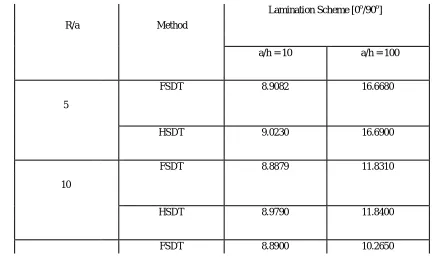
The results obtained by him for non-dimensional parameter are tabulated below.
Table No. 4.1 Comparison of Nondimensionalized fundamental frequencies of cross-ply cylindrical shells
Lamination Scheme [0o/90o]
R/a Method
a/h = 10 a/h = 100
FSDT 8.9082 16.6680
5
HSDT 9.0230 16.6900
FSDT 8.8879 11.8310
10
HSDT 8.9790 11.8400
[image:7.612.84.517.467.726.2]
Technology (IJRASET)
20
HSDT 8.9720 10.2700
FSDT 8.8951 9.7816
50
HSDT 8.9730 9.7830
FSDT 8.8974 9.7108
100
HSDT 8.9750 9.7120
Coares C.G., Mantari J.L., and Oktem A.S. (2011) C. Results from ABAQUS
Figure: 4.1 Result of Cylindrical Shell in ABAQUS software with R/a = 5 & a/h = 10
1) For R/a = 5, a/h = 10:ω = 0.0655391--- (From ABAQUS results) putting all other values we get, ω = 8.7341
Value of ωfor given type of problem in literature = 8.9082 (FSDT)
2) For R/a = 5, a/h = 100: ω = 0.0147773--- (From ABAQUS results) putting all other values we get, ω = 18.7203
Value of ωfor given type of problem in literature = 16.6688 (FSDT).
Figure: 4.2 Result of Cylindrical Shell in ABAQUS software with R/a = 5 & a/h = 10
Technology (IJRASET)
[image:9.612.78.538.116.606.2]frequency ω.
Table No. 4.2 Comparison of literature results of non-dimensional fundamental natural frequency (ω) of cross-ply cylindrical shells
Lamination Scheme [0o/90o]
R/a Method
a/h = 10 a/h = 100
FSDT 8.9082 16.6680
5
ABAQUS Results 8.7341 (1.95%) 18.7203 (12.31%)
FSDT 8.8879 11.8310
10
ABAQUS Results 9.0354 (1.65%) 13.4568 (13.74%)
FSDT 8.8900 10.2650
20
ABAQUS Results 9.0445 (1.74%) 11.5545 (12.56%)
FSDT 8.8951 9.7816
50
ABAQUS Results 9.0996 (2.3%) 11.1220 (13.7%)
100
FSDT 8.8974 9.7108
ABAQUS Results 9.0812 (2.07%) 10.8891 (12.13%)
Coares C.G., Mantari J.L., and Oktem A.S. (2011)
V. CONCLUSION
A. Introduction
In this chapter we are going to conclude the all our remarks based on the literature results and ABAQUS results obtained.
B. Concluding Remarks
1) Results obtained from ABAQUS are fairly close to the results that are obtained by analytical solution.
Technology (IJRASET)
laminated cylindrical shell.
3) As we increase the arc side to thickness ratio i.e. a/h, the results from ABAQUS software gives somewhat higher % of error. 4) If we try to obtain the solution by analytical method (Navier), then solution leads to very complex algebraic equations.
REFERENCES
[1] Swanson SR. Introduction to design and analysis with advanced composite materials. Prentice Hall Inc.; 1997. [2] Allen HG. Analysis and design of structural sandwich plates. Oxford: Pergam on Press; 1969.
[3] Jones RM. Mechanics of composite materials. 2nd ed. Taylor & Francis; 1999.
[4] Mouritz AP, Gellert E, Burchill P, Challis K. Review of advanced composite structures for naval ships and submarines. Compos Struct 2001;53:21–41. [5] Demasi L. 16 Mixed plate theories based on the generalized unified formulation. Part I: governing equations. Compos Struct 2009;87:1–11.
[6] Demasi L. 16 Mixed plate theories based on the generalized unified formulation. Part II: layerwise theories. Compos Struct 2009;87:12–22.
[7] Carrera E. An assessment of mixed and classical theories on global and local response of multilayered orthotropic plates. Compos Struct 2000;50:183–98. [8] Carrera E. Developments, ideas, and evaluations based upon Reissner’s mixed variational theorem in the modeling of multilayered plates and shells. Appl
Mech Rev 2001;54:301–29.
[9] Carrera E. Theories and finite elements for multilayered, anisotropic,composite plates and shells. Arch Comput Meth Eng 2002;9(2):87–140.
[10] Demasi L. Treatment of stress variables in advanced multilayered plate elements based upon Reissners’s mixed variational theorem. Compos Struct 2006;84:1215–21.
[11] Demasi L. 16 Mixed plate theories based on the generalized unified formulation. Part III: advanced mixed high order shear deformation theories. Compos Struct 2009;87:183–94.
[12] Demasi L. 16 Mixed plate theories based on the generalized unified formulation. Part IV: zig-zag theories. Compos Struct 2009;87:195–205. [13] Demasi L. 16 Mixed plate theories based on the generalized unified formulation. Part V: results. Compos Struct 2009;88:1–16.
[14] Carrera E. Theories and finite elements for multilayered plates and shells: a unified compact formulation with numerical assessment and benchmarks. Arch Comput Methods Eng 2003;10:215–96.
[15] Demasi L. 13 Hierarchy plate theories for thick and thin composite plates: the generalized unified formulation. Compos Struct 2008;84:256–70. [16] Mindlin RD. Influence of rotatory inertia and shear on flexural motions of isotropic elastic plates. J Appl Mech 1951;18:31–8.
[17] Reissner E. The effect of transverse shear deformation on the bending of elastic plates. J Appl Mech 1945;12:A-69–77.