Technology (IJRASET)
The Interrelation between the Shape of a
Building and its Potential Energy Performance
Omar Bourass1, Aziz Ettahir2
Mohammed V University, Mohammadia Engineering School - Rabat, (Morocco) Laboratory of Materials, Energetic and Environment
Abstract— Morocco is highly dependent on imported energy. Over 91% of energy supplied comes from abroad. However, renewable energy in this country may represent significant deposits as an Alternative energy. Indeed, an effective envelope can contribute to a reduction of energy consumption in buildings about 50%. Our research has been devoted to the study of the energy performance of a housing building in Rabat (Morocco), to analyze the performance in terms of economy and comfort depending on the envelope. We assessed the changes in temperature and humidity in these geographic area and we were able to study and analyze the influence of the type of the building floor plate, insulating material, overall rate of windows, glazing type and orientation.
Keywords—Building Envelope, Energy Efficiency, Sustainable Devlopment, Geometric Efficiency
I. INTRODUCTION
Since the Kyoto Protocol, the alarm was drawn to the problems of climate and environmental changes, emissions of CO2 and greenhouse gas and also the risk of depletion of natural resources that become increasingly rare, this scenario darkens when we learn that the housing sector represents a consumption of more than 40% of these energies and the equivalent of 30% of emissions of greenhouse gases [1].
Unlike some of its neighbors in the region, Morocco is highly dependent on imported energy. Over 91% of energy supplied comes from abroad: coal, oil and oil products from world markets; gas from Algeria; and imported electricity. This is a significant burden on the balance of payments, and, insofar as some energy supplies are subsidized, a drain on the budget. However, renewable energy in Morocco may represent significant deposits as an Alternative energy. By 2020 Morocco aims to derive more than 40 % of its electrical capacity from these sources, strengthening both energy security and sustainability [2].
II. THECONSUMPTIONOFENERGYINTHEBUILDINGSECTOR
A. In The World
The building sector is the largest consumer of energy in the world with a share of 34% followed by industry (28%) and transport (27%) (Table I). It is also responsible for a third of the emissions of greenhouse gases. Indeed, man spends today 90% of his time in buildings [2]. However it is a prime target for energy efficiency policies, rendered indispensable for all economies within the constraints related to the security of energy supply and climate change. The distribution of final consumption between sectors was as follows:
TABLEI
The distribution of final consumption between sectors in the world (IEA, 2013)
Share of final
Consumption in 2012
World Consumption in 2012 (Mtoe)
Final consumption 100% 8 979
Industry 28,3% 2 541
Transport 27,9% 2 507
Residential, agriculture and other sectors
34,8% 3 122
Excluding energy use 9,0% 809
B. In Morocco
Technology (IJRASET)
[image:3.612.204.456.149.298.2]in 2030 through the implementation of an efficiency plan Efficiency in different economic sectors [4]. Among these sectors, The construction sector represents about 36% of total energy consumption in the country, with 29% reserved for the residential sector and 7% for the tertiary sector) of the total energy in Morocco (a major consumer of energy fields were industry, transport and the tertiary sector) (Figure 1) [1]. This will be achieved in buildings of all kinds, incorporating all energy efficiency features such as: orientation, insulation, solar water heater and imposing for users to rationalize the use of energy.
Figure 1 Structure of energy consumption by sector in Morocco. [4]
III. THEBUILDINGENVELOPE
For centuries, the buildings were mainly used as a shelter for their occupants against the elements. The buildings are designed to recreate an internal microclimate Independent from external weather variations [5]. The shape, orientation and composition of the components of the various walls of the buildings, called the envelope, determine the characteristics of their indoor climate [6].The building envelope is the physical separator between the interior and exterior of a building. Components of the envelope are typically: walls, floors, roofs, fenestrations and doors.
The architectural form of buildings is defined, basically by floor plate (or plan) geometry and building height. The building envelope (windows, walls, roof and foundation) encloses the form and separates the interior environment from the exterior. Balconies and other features may also contribute to the architectural form of a building. Architectural form not only has an impact on space conditioning (heating and cooling) energy use but also determines the availability of roof and wall areas for solar energy collection [7].
IV. THECOMPACTNESSOFTHEBUILDINGANDITSENERGYCONSUMPTION
Considered individually, the impact of the aforementioned elements of architectural form on space conditioning energy consumption is relatively well understood. However, when considered collectively, the impact is more difficult to anticipate. For instance, the interrelationship between building height and floor plate geometry and resultant energy use and solar energy potential is not always readily apparent. The thermal characteristics of wall and window areas of the building envelope, as well as the relative proportion of window area to wall area, can have a significant impact on the annual heating and cooling loads of buildings [8].While solar heat gains through window glazing can be beneficial in reducing heating loads during the heating season, they can also impose excessive cooling loads during the cooling season [9].
At the level of the frame, the compactness is the ratio of the volume of an urban set with its outer surface in contact with the outside [10]. There is therefore a relationship between a volume heated or air-conditioned area and dissipating the energy consumed emphasize energy efficiency attributed to the built compact “energy-efficient architecture requires a good balance between measures for energy savings and those used to produce The first concern above. Compactness and good insulating jacket [...]. In terms of
design it is mainly the proportions of a building and its orientation are concerned”. [11]
In terms of energy performance related, some researchers relativize the qualities of urban compactness, which, according to them, is not the optimal shape because of the induced negative externalities. Thus, P. Fankhauser underlines the lowest ventilation urban centers induced by their compact structure [12]. In their analysis of the role of the shape of the buildings in the use of space, C. Ratti [13] recall that the compactness is a rough indicator of urban size and energy efficiency of urban form, since a low compactness increases heat loss in winter and heat gains due to solar radiation in summer.
29% 32% 6% 24% 7% 2% Residential Industry Agriculture Transport
The tertiary sector
Technology (IJRASET)
[image:4.612.84.531.205.401.2]There is also the research on the influence of the compactness of the buildings on consumption and energy loss of frame [13] [14], [15], [16] and [17] In particular, from the analysis of fourteen urban forms "monolithic" and "non-monolithic" Depecker P. [18] show a linear relationship between the compactness and space heating needs more building is compact, most of its heating requirements are reduced. Basically, monolithic buildings are among the most compact and more efficient. On the contrary, the three most energy configurations are not monolithic, the less efficient is the configuration consisting of sixteen separated units (or sixteen houses), which has the lowest compactness. Figure 2 shows explicitly that causal link to insulation qualities and technical identical heating, it is clear that the heating consumption is limited by the compactness [18]. In 2008, T. Laffont [17] also emphasizes the limiting effect of energy loss through compact urban forms and the heat exchange between the buildings. For Mr. Maïzia [10], the most relevant form of indicator is the compactness.
Figure 2 Relationship between compactness and heating consumption: comparative analysis of fourteen buildings morphologies [18]
The overall area ratio between opaque walls and the windows also has a significant effect on the “whole wall” thermal and solar heat gain performance and impacts the available facade area for solar energy collection. Housing bulidings frequently have balconies to provide outdoor living space. Depending on how balcony features are attached to the main building structure, the resultant thermal bridging effects can lower the effective thermal performance of the overall envelope.
From a thermal point of view, a heat bridge is part of the envelope of a building where the heat resistance is modified significantly [8]. However, during the summer months, balconies can provide shading to fenestration areas beneath them, thereby reducing solar heat gains through the glazing and reducing the resultant building cooling loads.
How each of these individual parameters impacts the energy performance of a Residential Buildings is reasonably well understood; what is less understood, however, is how they all interact with one another and impact space conditioning energy use and solar energy generation. To better understand these interrelationships, we initiated a research project to assess the relative impact of architectural form and envelope parameters on the energy performance and potential for solar energy collection of residential buildings.
V. METHODOLOGY
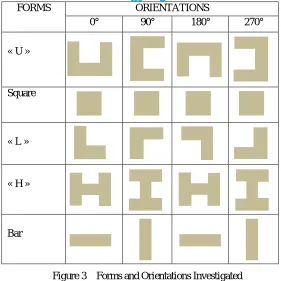
In this research study we used computerized building energy consumption modeling to assess the impact of the investigated parameters on heating and cooling loads. We investigated combinations of building architectural form (figure 3) and envelope parameters (table 2). The results were then analyzed to identify trends in how the design and characteristics of architectural form and envelope parameters can impact annual heating and cooling loads. In addition, the impact of architectural form and envelope options on the potential for accommodating solar energy collection on either the roof areas and/or sun-facing opaque wall areas was assessed for both photovoltaic and solar thermal systems (for domestic water heating) .
Technology (IJRASET)
reporting values in energy use per unit of area of the building (that is, annual heating and cooling load intensities).
This facilitates the comparison of buildings of differing total sizes and numbers of suites and occupants). The renewable energy potential results were calculated for their absolute output (MWh) and also normalized against the building gross floor area, a factor that does not influence the performance of the renewable energy system. However, normalizing the renewable energy system output to the building floor area provides context when comparing the building heating/cooling loads against the renewable energy potential.
TABLEIII
Architectural features and their details
Architectural Features Details
Form L-shaped
H-shaped
U-shaped
Bar-shaped
Square
Rise 2-storey , (Low-rise)
5-storey , (Mid-Rise)
10-storey (High-Rise)
Balcony No balcony
Cantilevered concrete balcony
Thermally broken balcony
Window performance levels : U-value and SHGC (window solar heat gain coefficient) combination
Double-glazed, high solar gain
Double-glazed, low solar gain
Double-glazed, high solar gain
Double-glazed, low solar gain
Triple-glazed, high solar gain
Triple-glazed, low solar gain
Wall RSI-values RSI: 1.6
RSI: 2.5
RSI: 0.8
Window-to-wall ratios 30%
60%
Technology (IJRASET)
FORMS ORIENTATIONS
0° 90° 180° 270°
« U »
Square
« L »
« H »
[image:6.612.159.440.75.356.2]Bar
Figure 3 Forms and Orientations Investigated
The annual heating and cooling loads are defined as heating or cooling energy (in watt-hours per square meter of conditioned building space) that is required to be supplied to the conditioned space by the heating or cooling system [19], [20]. It does not include the conversion efficiency (for example, boiler efficiency) or ancillary energy (for example, pumps and fans) required by the systems to deliver the heating and cooling to the conditioned space. It should not be confused with peak or design day loads, which are instantaneous values used to size space conditioning systems, or with annual energy consumption, which includes conversion efficiencies.
VI. RESULTSOFTHESTUDY
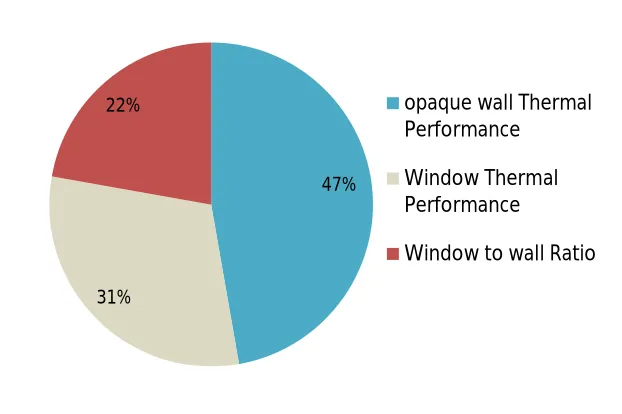
The study determined that several key architectural form parameters can result in significant reductions in annual heating and cooling load intensities. Floor plate geometry and building orientation were typically found to have very minor impacts on heating loads (that is, the results of the simulations of the impacts of different plate geometries and orientations on heating loads were always within close range of one another), and slightly bigger impacts on cooling loads. However, the overall combined building envelope factors, including wall insulation value, window U-value and window solar heat gain coefficient (SHGC) performance, and the window-to-wall ratio (WWR) have much greater impacts on heating and cooling loads than other factors (figures 4,5,6 and 7).
Figure 4 Impact of Architectural Features on Heating Loads
58% 27%
5% 6%
4%
Envelope parameters
number of storeys
balconies
[image:6.612.204.449.571.681.2]Technology (IJRASET)
Figure 5 Impact of Envelope Parameters on Heating Loads
So while the designer’s initial decisions concerning the floor plate geometry and orientation can and will affect the potential energy performance of the building, the overall thermal performance of the envelope (including the WWR) remains the most important factor to consider when designing to minimize heating and cooling energy loads.
The study indicated that there were no preferred combinations of architectural form (floor plate, orientation and number of floors) for any of the envelope parameters. The impacts on the heating and cooling loads from the various envelope parameters—including wall construction (RSI-value), windows (U-value and SHGC), WWR (overall solar gains and overall wall/window thermal conductance) and balconies (wall RSI-value and solar gains into the building)—were found to be relatively independent of the building geometry.
Not surprisingly, the best-performing envelopes with respect to the heating load utilized a low WWR (30 per cent), well-insulated walls and triple-glazed windows with high solar gain, e glazing. To minimize the summer cooling loads, triple-glazed low-SHGC, low-e windows could be used; however, this would sacrifice a significant amount of passive solar heat gains, leading to higher heating loads.
Figure 6 Impacts of Envelope Parameters on Heating Loads
47%
31%
22% opaque wall Thermal
Performance
Window Thermal Performance
Window to wall Ratio
47%
31%
22% opaque wall Thermal
Performance
Window Thermal Performance
Technology (IJRASET)
Figure 7 Impacts of Architectural Features on Cooling Loads
Buildings having a “courtyard” floor plate (the ‘U’ and ‘H’ floor plates) experience slightly reduced heating loads and significantly reduced cooling loads compared to the more commonly employed ‘Bar’ and ‘Square’ geometries. In this study, ‘L’-shaped floor plates were found to generally perform the poorest, as they tend to have the highest heating and cooling loads when normalized by floor area. While the orientation of each floor plate had little effect on the heating loads, a significant reduction in cooling loads was observed when orienting the ‘U’- and ‘H’-shaped buildings with the courtyards facing east or west.
The number of storeys in the buildings had a greater impact on the annual heating load intensity than either the floor plate or orientation of the building. Maximizing the number of storeys (that is, 10 storeys for the purpose of this study) showed a reduction in total load intensity approaching 20% per cent, with the large reduction of the heating load outweighing the increase in the cooling load. Reduced annual heating load intensity is due to the fact that, as the building increases in height, vertical envelope area (and thus heat loss) increases proportionally; however, the roof and floor slab areas (and heat loss) remain constant. With respect to solar potential relative to building height, shorter buildings are optimal for both solar thermal domestic hot water (DHW) and photovoltaics (PV), in terms of energy production per unit of floor area, on account of the higher ratios of roof area to total conditioned floor area. This is in contrast to higher buildings having reduced annual heating load intensity, while at the same time increased annual cooling load intensity.
Overall building designs targeting “net zero” site energy will need to seek a balance between building height and a larger floor plate (such as the ‘H’ and ‘U’ floor plates) to optimize the renewable energy potential. Further, the WWR has a significant impact on the available opaque wall area upon which to install vertical photovoltaic solar collectors, a higher WWR results in higher heating loads and lower solar energy potential because of an increase in window area over wall area.
Balconies can act as a shading device; however, depending on how the balcony slabs are attached to the main building structure, their (potential) thermal bridging can reduce the effective RSI-value of the surrounding wall system. The increase in heating loads due to the thermal bridge effect of the balconies is among the smaller effects investigated in this study (increases between 4 per cent and 8 per cent in heating load, depending on the WWR). However, when a balcony creates a thermal bridge, it will have a greater relative impact (that is, increase) on the heating load than the overall wall system (opaque walls and windows) RSI-value. This means that, with higher-performance envelopes, the thermal bridging due to the balconies matters and should be minimized by either using thermal breaks between the balcony slab and the building structure or limiting the length of the balconies. As balconies reduce annual cooling load intensity thanks to their shading effect, any measures that can reduce their adverse impact on heating loads would be beneficial.
The overall relative impacts of the architectural features on the heating loads and cooling loads are depicted in figures 4,5,6,7 respectively. The larger areas represent those elements that have a greater impact on heating and cooling loads and therefore warrant more attention at the design stage. For example, as can be seen in the figures, the envelope parameters (WWR, thermal performance) are the most important factors to consider with respect to controlling the annual heating and cooling load intensities of buildings. The number of storeys has more of an impact on heating load intensities than on cooling. The envelope parameters are relatively more important when considering the annual cooling load intensity impact (figure 6 and 7).
72% 6%
8% 11%
3%
Envelope parameters number of storeys
balconies
Technology (IJRASET)
VII. CONCLUSIONANDPERSPECTIVES
The results of this modeling study provide a contribution to the development of a predictive way that helps in making decisions for the improvement of energy efficiency of buildings in the area and proposals optimal solutions in terms of orientation, materials insulation used, overall rates of windows, type of glazing, ventilation. Our study of optimization of the envelope by combining some its key features allows the design of energy efficient envelope.
In the Other hand, our study indicates that designers seeking to reduce space conditioning loads in residential buildings should focus first on building envelope performance parameters. Other parameters of architectural form such as floor plate geometry, building orientation and height tend to have less impact on the energy performance of residential buildings and may be addressed once building envelope thermal performance has been optimized.
The results of this study present a huge potential for improvement of energy performance in buildings in Morocco but also in the world. In our case, we propose, first, to perform simulations in the aim to check all aspects of thermal regulation of buildings in Morocco, and then, improve the study on optimizing characteristics of the envelope by adding other parameters, and finally, to generalize our analysis and energy assessment for buildings of other climatic zones of Morocco.
REFERENCES [1] International Energy Agency, (2013), “Key World Energy Statistics”.
[2] International Energy Agency (2014), “Morocco 2014”.
[3] S. Laporthe “contribution to the qualification of ventilation system of buildings” 2000. [4] ADEREE « Opportunité d’investissement dans le secteur des ER et de l’EE au Maroc » 2013.
[5] M.Elamin « Contribution à l’évaluation énergétique des bâtiments au nord du Maroc: Cas de la ville de Tanger » 2014.
[6] A. Liebard Et A. D. Herde, « Traité d’architecture et d’urbanisme bioclimatiques : Concevoir, édifier et aménager avec le développement durable ». Paris, 2006. [7] Research Highlight (2014) “Impact of Architectural Form on the Potential Energy Performance of Multi-Unit Residential Buildings”
[8] P.-M. Patry et D. Molle: « Réglementation thermique et efficacité énergétique », 2e édition, 2013.
[9] L.Arantes, O.Baverel, P.Rollet, D. Quenard, "A simple method to consider energy balance in the architectural design of residential buildings", in: Attar R. (ed), Proceedings of the 2011 Symposium on Simulation for Architecture and Urban Design (SimAUD), VVol.8, 2011 Spring Simulation Multi-conference, SpringSim 2011, Boston, MA, USA, pp 76-83. , 2011.
[10] M. Maïzia, « Densité énergétique versus densité urbaine », Études foncières, No.145, pp. 37-38, (2010).
[11] R. Gonzalo and K.J. Habermann « Architecture et efficacité énergétique. Principes de conception et de construction », Bâle, Birkhauser. 2008).
[12] P. Frankhauser, "La morphologie des tissus urbains et périurbains à travers une lecture fractale", Revue Géographique de l’Est, Vol.45, No.3-4, pp 145-160. 2005. [13] C. Ratti, N. Baker and K. Steemers, "Energy consumption and urban texture", Energy and Buildings, Vol.37, No7, pp. 762-776. (2005).
[14] A.Mahdavi, B.Gurtekin, "Shapes, Numbers, and Perception: Aspects and Dimensions of the Design Performance Space", Proceedings of the 6thInternational Conference: Design and Decision Support Systems in Architecture, The Netherlands, pp 291-300, 2002.
[15] T.U. Aksoy, M. Inalli "Impacts of some building passive design parameters on heating demand for a cold region", Building and Environment, No.41, 1742-1754, 2006.
[16] W. Pessenlehner, A. Mahdavi, "Building morphology, transparence and energy performance", Eighth International IBPSA Conference, pp 1025-1032. 2003. [17] Laffont T., "Approche Environnementale de l’Urbanisme : premiers enseignements", Ademe Languedoc-Roussillon, 3ème rencontre interprofessionnelle régionale,
Développement et Ville Durable, Pas de Saporta, 2008.
[18] D. Depecker, analyse comparée de quatorze morphologies de bâtiments, 2001S. Farkh «Les Ponts Thermiques dans le Bâtiment », CSTB Edition, 2009.
[19] D. Jreijiry, « Modélisation numérique des systèmes de ventilation hybride et développement des stratégies de contrôle associées pour les bâtiments résidentiels », La Rochelle, 2004.
![Figure 1 Structure of energy consumption by sector in Morocco. [4]](https://thumb-us.123doks.com/thumbv2/123dok_us/8578016.859973/3.612.204.456.149.298/figure-structure-energy-consumption-sector-morocco.webp)
![Figure 2 Relationship between compactness and heating consumption: comparative analysis of fourteen buildings morphologies [18]](https://thumb-us.123doks.com/thumbv2/123dok_us/8578016.859973/4.612.84.531.205.401/relationship-compactness-consumption-comparative-analysis-fourteen-buildings-morphologies.webp)