Preparation and Characterization of Polyurethane
and its Composites based on Cardanol Modified
with Corn Starch and Coir Fiber
Dr. N. J. Sangeetha
Assistant Professor, Department of Chemistry, Women’s Christian College, Nagercoil-629001, Tamil Nadu, India
Abstract: This study presents the preparation of novel polyurethane and its composites from renewable resources of cardanol, corn starch and coir fiber. Corn starch was converted into glycoside through transglycosylation reaction with ethylene glycol. The prepared glycol-glycoside was analyzed by specific gravity, viscosity, hydroxyl value, molecular weight and FT-IR spectral study. Cardanol based-polyol was synthesized by condensing cardanol with formaldehyde in the mole ratio 1:5 using melodic acid as catalyst and subjected to epoxidation followed by hydrolysis. The glycol-glycoside were incorporated to the cardanol based-polyol with 4,4’-methylenebis(cyclohexyl) is ocyanate using coir fiber under NCO/OH molar ratio constant at 1.4. The products were characterized by spectral properties and thermal properties. These results reveal the high crosslink performance of polyurethane and its composites due to the presence of glycol-glycoside.
Keywords: Corn starch; glycol-glycoside; cardanol; 4,4’-methylenebis(cyclohexyl) is ocyanate; coir fiber; polyurethane composites.
I. INTRODUCTION
The use of renewable raw materials in the polyurethane synthesis has been given significant recently and vast efforts have been made in the search of new economically sustainable and environmentally friendlier alternatives to petrochemicals which are gradually cost [1].Starch is a natural polymer derived from corn and other crops possesses many unique properties and completely biodegradable in a wide variety of environments [2-6].
Transglycosylation reaction between starch and ethylene glycol produce a mixture of isomeric glycol glycosides that exhibits a potential use as a polyol raw material for surfactant and rigid urethane foam manufacture [7].The starch-based polymers are potential for applications in biomedical and environmental fields [8,9].Among renewable raw materials, cardanolis a phenolic compound with a C15 unsaturated aliphatic side chain in the meta position [10] obtained from cashew nut shell liquid [11]. It has-been widely used for making polyurethanes, polyesters, polyamides, composites, etc. [12-15].
Polyurethane is one of the polymer products made by reacting polyol with an is ocyanate [16,17]showing better thermal stability and mechanical properties [18].Polyurethane composites prepared from cardanol and formaldehyde in the presence of catalyst, in different molar ratios and natural fibers [19].
Coir fiber is the thickest and most resistant of all commercial natural fiber exhibit high tensile strength, high toughness, low density and recyclable [20,21].Fiber-reinforced composites are finding applications in diverse fields from appliances to spacecrafts [22].
II. EXPERIMENTAL
A. Materials and methods 1) Materials
Corn starch was purchased from Thermo Fisher Scientific India Pvt. Ltd., Mumbai. Ethylene glycol was obtained from Merck, Mumbai. Cardanol was obtained from M/s Satya Cashew Chemicals Pvt. Ltd., Chennai. Formaldehyde (40% solution), and malonic acid and methanol were received from Merck, Mumbai. 4,4’-methylenebis(cyclohexyl) is ocyanate and dibutlytindilaurate was received from Aldrich Chemicals, Bangalore. The chemicals were used as received. Coir fiber was procured from local sources.
2) Alkali treatment of coir fiber
3) Methods
Infrared spectra of the polyurethane and its composites were taken in a Shimadzu FT-IR-8400S spectrometer by KBr pellet method. Thermo gravimetric analysis (TGA)/differential thermal analysis (DTA) with DSC calculation, SIINTat a rate of 10 K/min in air/nitrogen were studied.
B. Synthesis of glycol-glycoside
Ethylene glycol was taken in a three-necked flask equipped with a reflux condenser, thermometer and nitrogen blanket with good stirring and added sulphuric acid and heated to 120oC. Then corn starch(dry basis) was added over a 40-minute period while maintaining a temperature of 120oC. When addition was completed, reduce the pressure to 40 mm Hg and continue heating and stirring for 30 minutes. Then, the mixture was cooled and neutralized the sulphuric acid with calcium carbonate. Again heated and removed the un reacted ethylene glycol at 5 to 10 mm Hg as the temperature was slowly raised to about 140oC. After stripping was completed, dissolved the glycoside in water, decolorized with charcoal, filtered and finally, adjusted the concentration to 70-80% solids in water. The prepared glycol-glycoside was clear and have a colour of Gardner 1 [25]. The glycol-glycoside was characterized by specific gravity, viscosity, hydroxyl value, molecular weight and FT-IR spectral analysis.
Scheme 1.Reaction of glycosylation of starch using ethylene glycol
C. Synthesis of cardanol based-polyol
D. Synthesis of polyurethane and its composites based on cardanol based-polyol, glycol-glycoside using coir fiber
Novel polyurethane (CDPGPU) was prepared from cardanol based-polyol using glycol-glycoside (10%), 4,4’-methylenebis(cyclohexyl) is ocyanate and dibutlytin dilaurate (0.12 wt. %) as catalyst keeping the is ocyanate index (NCO/OH mole ratio) constant at 1.4 (Scheme 3.5). The composites (CDPGPU 5 and CDPGPU 10) have been fabricated by incorporating the coir fiber (5% and 10%) into the obtained polyurethane. The spectral and thermal of the polyurethane sheets were evaluated.
Scheme 3.Formation of polyurethane based on glycol-glycoside
III. RESULTS AND DISCUSSION
A. Characterization of glycol-glycoside
[image:5.612.153.458.543.735.2]1) Physico-chemical properties of glycol-glycoside: Glycol-glycoside possess pale yellow colour and odorless. The relatively higher specific gravity and viscosity are due to the content of glycoside. The determination of molecular weight, hydroxyl number and FT-IR spectral analysis leads to predict the structure of glycol-glycoside as given in Table 1.
Table 1.Physico-chemical properties of glycol-glycoside Properties Glycol-glycoside
Colour Pale yellow
Odour Odourless
Specific gravity(g/cc at 30oC) 0.8519
Viscosity at 30oC (cps) 153
Hydroxyl value 182
Number of hydroxyl groups 5
2) FT-IR spectroscopy of glycol-glycoside
Figure 1.FT-IR spectrum of glycol-glycoside
FT-IR spectrum (Figure 1) of the synthesized glycol-glycoside show the sharp bands at 1080 and 1041 cm-1 are due to -O-C-O- linkage confirms glycosylation of starch. -OH stretching band at 3387 cm-1 reveals the presence of free hydroxyl groups in it. The bands at 2939 and 2885 cm-1 are due to -CH stretching.
B. Characterization of polyurethane and its composites
1) FT-IR spectroscopy of polyurethane and its composites: The FT-IR spectra of the polyurethane and its composites (Figure 2 – Figure 4) showed characteristic absorption at 3305-3315 cm-1 corresponding to urethane linkage (-NH stretching, bonded). The peaks at 1720-1745 cm-1indicates C=O stretching (free) in urethane, 1635-1650 cm-1corresponding to C=O stretching (bonded) in urethane and 1530-1550 cm-1indicates N-H bending in urethane. The peak at 1020-1110 cm-1 is due absorption band of the -O-C-O-group developed by the glycosylation of starch.
[image:6.612.64.537.484.724.2]Figure 3.FT-IR spectrum of CDPGPU 5 Figure 4.FT-IR spectrum of CDPGPU 10
C. Thermal properties of polyurethane and its composites
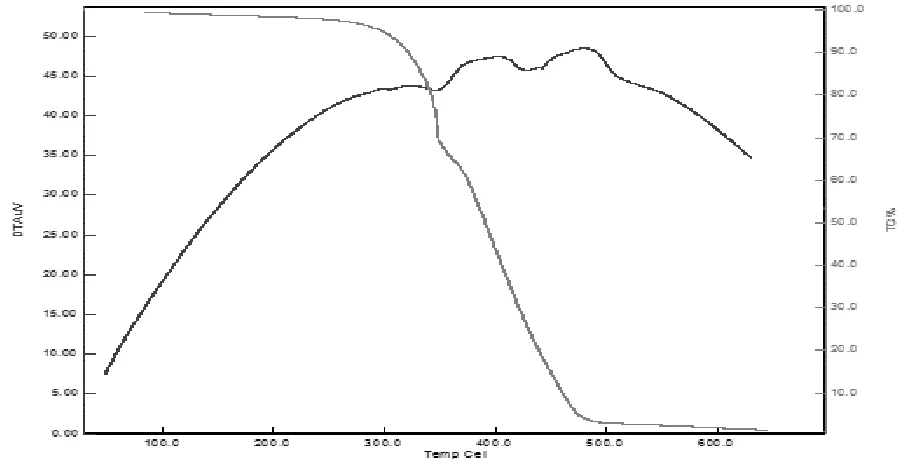
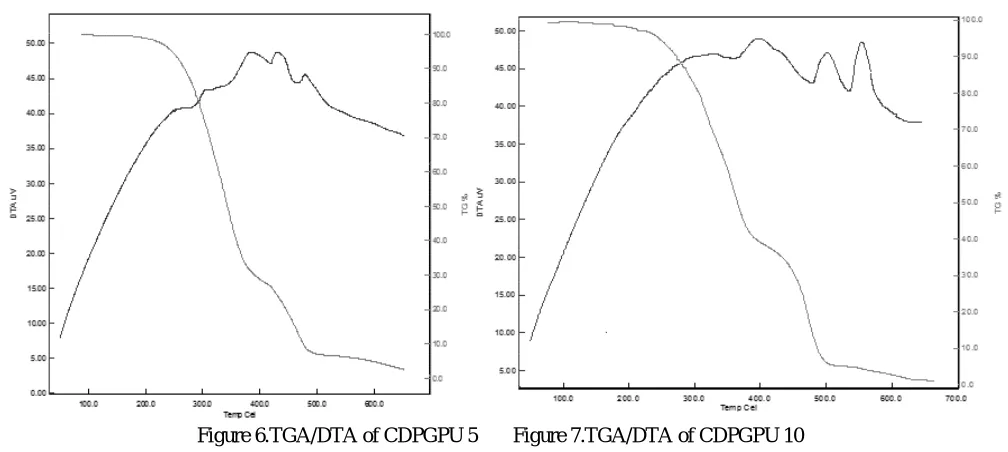
The polyurethane and the corresponding composites (Figure 5 – Figure 7) decomposed around 90-95% in the temperature range of 450-500°C.This is due to the strong network formed between polyurethane prepared from 4,4’-methylenebis(cyclohexyl) isocyanate with cardanol based-polyol and glycol-glycoside.
The DTA therm ogram does not show any endothermic peak for softening. But, two or three exotherms are invariably seen in both the urethanes. The first exothermis relatively weak. However, the second and the third exotherms are strong. The first exothermis attributed to the cleavage of long alkyl side chain of phenyl ring and also to the cleavage of allophanate linkages.
The TGA analysis of polyurethane composites based on cardanol based-polyoland polyol-glycoside possesses higher thermal stability when compared to neat polyurethane is due to higher crosslink density [26] and the data is presented in Table 2.
[image:7.612.82.532.490.724.2]Figure 6.TGA/DTA of CDPGPU 5 Figure 7.TGA/DTA of CDPGPU 10
Table 2.TGA/DTA data of polyurethane and its composites based on polyol-glycoside using coir fiber
Polyurethane and its composites
TGA data Temperature (oC) at the each stage of degradation
(weight loss %) Tstart1st2nd
DTA data
1stexo2ndexo3rdexo CDPGPU
CDPGPU 5
CDPGPU 10
292.4 341.5468 (6.2) (32.3) (94.5)
234.5 362.6481.2 (5.7) (66.4)(91.8)
232.4 376.2496.2 (4.7) (63.2) (92.1)
309.3401 471.6
306378.4 476.2
398 492.6556.5
IV. CONCLUSIONS
Polyurethane composites prepared from cardanol based-polyol modified with polyol-glycoside and coir fiber showed excellent thermal stability when compared to the neat polyurethane. The glycoside based-polyurethane and the corresponding composites exhibited a uniform polyurethane phase without any presence of starch particles which reveals the presence of high hydroxyl content of polyol-glycoside. This is due to the higher level of degree of cross linking in these networks.
REFERENCES
[1] P. Hoffer, P. Daute, R. Grutzmacher, A. Westfechtel, ‘Oleochemicalpolyols-A new raw material source for polyurethane coatings and flooring’, J. Coat.Techn., 69, 65-72, 1997.
[2] Z. Qiao, J. Gu, Y. Zuo, H. Tan, Y. Zhang, ‘The effect of carboxymethyl cellulose addition on the properties of starch-based wood adhesive’, Bio Resources, 9, 6117-6129, 2014.
[3] N. Teramoto, T. Motoyama, R. Yosomiya, M. Shibata, ‘Synthesis, thermal properties, and biodegradability of propyl-etherified starch’, European Polym.J., 39, 255-261, 2003.
[image:8.612.105.506.337.557.2]products in solution’, Biomaterials, 25, 2687-2693, 2004.
[6] R. A. Gross, B. Kalra, ‘Biodegradable polymers for the environment’, Green Chem., 297, 803-807, 2002.
[7] M. F. Valero, J. E. Pulido, J. C. Hernandez, J. A. Posada, A. Ramirez,‘Preparation and properties of polyurethanes based on castor oil chemically modified with yucca starch glycoside’, J. Elast. Plast., 41, 223-244, 2009.
[8] D. R. Lu, C. M. Xiao, S. J. Xu, ‘Starch-based completely biodegradable polymer materials’, eXPRESS Polymer Letters, 3, 366-375, 2009. [9] D. Primarini, Y. Ohta, ‘Some enzyme properties of raw starch digesting amylases from streptomyces’, Starch, 52, 28-32, 2000.
[10] P. S. Kumar, N. A. Kumar, R. Sivakumar, C. Kaushik, ‘Experimentation on solvent extraction of polyphenols from natural waste’, J. Mater.Sci., 44, 5894-5899, 2009.
[11] S. Gopalakrishnan, N. T. Nevaditha, C. V. Mythili, ‘Synthesis and characterization of bifunctional monomers for high performance polymers from renewable resource’, Inter. J. ChemTech Res., 4, 48-54, 2012.
[12] V. Athawale, N. Shetty N, ‘Synthesis and characterization of low cost cardanol polyurethanes’, Pig. ResinTechn.,39, 9-14, 2010.
[13] T. K. Das, S. Lenka, ‘Thermal and X-ray diffraction studies on interpenetrating polymer networks of castor oil-based polyurethane and cardanol based dyes’, Polym. Plast.Techn.Eng., 50, 481-484, 2011.
[14] T. T. M. Tan, ‘Thermoplastic composites based on jute fibre treated with cardanol formaldehyde’, Polym. Compos.,5, 273-279, 1997.
[15] S. Santeusanio, O. A. Attanasi, R. Majer, M. Cangiotti, A. Fattori, M. F. Ottaviani, ‘Effect of hydrogenated cardanol on the structure of model membranes studied by EPR and NMR’, Langmuir, 29, 11118-26, 2013.
[16] Harjono, P. Sugita, Z. A. Mas’ud, ‘Synthesis and Application of JatrophaOil based Polyurethane as Paint Coating Material’, Makara J. Sci., 16, 134-140, 2012. [17] S. Dworakowska, D. Bogdal, A. Prociak, ‘Microwave-assisted synthesis of polyols from rapeseed oil and properties of flexible polyurethane foams’, Polymers,
4, 1462-1477, 2012.
[18] K. I. Suresh, V. S. Krishanprasad, ‘Synthesis, structure, and properties of novel polyols from cardanol and developed polyurethanes’, Ind. Eng. Chem., 44, 4504-4512, 2005.
[19] A. Maffezzoli, E. Calo, S. Zurlo, G. Mele, A. Tarzia, C. Stifani, ‘Cardanol based matrix biocomposites reinforced with natural fibres’, Compos. Sci. Techn.,64, 839-845, 2004.
[20] Y. Prashant, C. Gopinath, V. Ravichandran, ‘Design and Development of Coconut Fiber Extraction Machine’, SAS TECH J., 13, 64-72, 2014. [21] A. K. Mohanty, M. Misra, L. T. Drzal, ‘Natural fibers, biopolymers and biocomposites’, CRC Press, Florida, Boca Raton, 2005.
[22] D. N. Saheb, J. P. Jog, ‘Natural fiber polymer composites: A review’, Adv. Poly. Tech., 18, 351-363, 1999.
[23] C. H. C. Rao, S. Madhusudan, G. Raghavendra, E. V. Rao,‘Investigation in to Wear behavior of coir Fiber Reinforced Epoxy Composites with the Taguchi Method’, Inter. J. Eng. Res. Appl., 2, 371-374, 2012.
[24] C. W. Shan, M. I. Idris, M. I. Ghazali, ‘Study of flexible polyurethane foams reinforced with coir fibres and tyre particles’, Inter. J. Appl. Phys. Math., 2, 123-130, 2012.