6
I
January 2018
Function of Artificial Intelligence in Production
Scheduling: A Critical Evaluation and
Comparison of Key Approaches
Brahma Datta Shukla 1
1
Ph.D. Scholar Swami Vivekanand University, Sagar (M.P.), India
Abstract: Production scheduling is an element of operational research that relies on combinational optimization explained by discrete methods. This extensive area covers diverse variety of problems as; vehicle routing problem, bin packing problem and job priority. With the intention of solving these problems, operational research applies two main principles: exact methods which give the complete finest solution but resolve merely small sized problems, and approximate methods which give only good solution except resolve near real life sized problem. The next category provides various methods separated into- problem dedicated methods entitled heuristics and general method entitled metaheuristics. Several of these metaheuristic methods are guiding the literature of production scheduling for past two decade, as; Genetic Algorithm, Neural Network, and Fuzzy Logic which will be discuss in this paper. This evaluation shows that there are simply few research works which compare heuristic techniques on scheduling problem.
Keywords: Production Scheduling, Artificial Intelligence, Metaheuristic Model, Genetic Algorithm, Fuzzy Logic
I. INTRODUCTION
Scheduling and sequencing is a structure of decision-making that plays a crucial task in manufacturing and service industries. In the existing competitive surroundings, efficient sequencing and scheduling has become a requirement for endurance in the marketplace. Companies have to congregate shipping dates who have been dedicated to customers, as malfunction to do so might consequence in noteworthy loss of benevolence. They also have to plan activities in such a mode as to employ the resources accessible in a well-organized way.
The major concerns connected with scheduling of FMSs are machine loading, tool planning, part routing and allocation, material handling device assignment, and routing in addition to task timing problems [34]. It is a decision making procedure with the objective of optimizing one or more objectives. The resources and tasks in an organization can obtain many forms. The task can be activated in a production process. Each task may have a assured priority level, an initial possible starting time, and a due date. The intentions also can take many appearances. One aim may be the reduction of completion time of the last task, [34] and one more may be the reduction of the number of tasks completed after their respective due dates. [30]
A. Production Scheduling Trend in Manufacturing
Scheduling begin to be taken sincerely in manufacturing at the commencement of 20th century, with the work of Henry Gantt and
other pioneers. Though, it took several years for the first scheduling publications to emerge in industrial engineering and operation research literature. A few of the first publication emerged in Naval Research Logistics Quarterly in the early on 1950s and contained consequences by S.M Johnson and J.R Jackson. Throughout the 1960s a noteworthy amount of works was done by dynamic programming and integer programming formulations of scheduling problems. After Richard Karp’s famous paper on complexity theory, the research in the 1970’s centered mostly on the complexity hierarchy of scheduling problems. In1980s, numerous different directions were trailed in academic world and industry with the augment amount of consideration paid to stochastic scheduling problems. In addition, as personal computers started to pervade manufacturing services, scheduling systems were being enlarged for the generation of usable schedule in practice. This system design and expansion was, and is, being completed by computer scientists, operations researchers and industrial engineers.
both from environmental uncertainties (machine breakdown or rush orders) and scheduling uncertainties (repercussions of which are exponential and thus too costly to evaluate) which measured by recent researchers [1, 6 and 30].
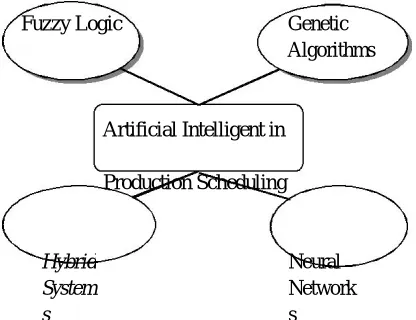
In this paper concise investigation has been done on modern literatures in production scheduling by utilizing Artificial Intelligence (AI) as a retort to scheduling uncertainties (see Figure 1). Three main AI methods amongst modern literature have been extending in next sections. Consequently, section 2 presents the application of fuzzy method, whereas section 3 presents the application of neural network in production scheduling problem while section 4 deals with genetic algorithm in this subject. Finally, a certain explore expanded for hybrid artificial intelligence in section 5.
Fuzzy Logic Genetic
Algorithms
Artificial Intelligent in
Production Scheduling
Hybrid Neural
System s
[image:3.612.180.388.190.350.2]Network s
Figure 1 components of an Intelligent Production Scheduling
II. FUZZY LOGIC SYSTEM
Fuzzy set theory was commenced in 1965 by Zadeh [32,33]. Fuzzy sets and their expansion to dealing with linguistic variables [33] were later on successfully engaged in many engineering applications. Fuzzy sets are as well mainly helpful in control problems, due to the advance of fuzzy logic systems (FLS), broadly described in the literature (e.g., [19, 21]). Using fuzzy logic to control flexible manufacturing systems seems very suitable due to its lenience in coping with unsure data, in company with the multi-objective nature of the problem. Hintz and Zimmermann [14] are most likely the first to suggest a production planning and control system that uses fuzzy set theory. The attractive part of their work consists in the application of fairly accurate reasoning methods to equally the sequencing and the priority setting problems. The authors build up a hierarchy of elements that are significant to make a choice in both cases. This methodology is fairly general, thus it can be easily customized and extended by altering the backgrounds. The resultant of the rules is the next job to be entered into the system (sequencing) or to be processed (priority setting).
The performance of this fuzzy controller is evaluated to common heuristics via discrete event simulations of a particular FMS configuration [14]. As a consequence, fuzzy expert systems seem to execute improved then heuristics in terms of mean waiting time, number of in-time (i.e., not late) parts and indicate machine utilization. This approach is very pioneering for introducing a fuzzy expert approach to scheduling, but it also endures from being an early approach, in that it merely considers sequencing and priority setting. Furthermore, the scheduling rules are predestined with human expert assist and no explicit design procedure is presented. The manifold objective nature of the problem is also not systematically investigated, since the comparison with heuristic approaches is completed on a limited number of production objectives.
Choobineh and Shivani [5] move toward the priority setting and routing problems using fuzzy set theory along with possibility theory. Fuzzy sets are utilized to model the improbability of data and the elusiveness involved with human planning. For every probable routing of a part, a collective prospect allocation is determined according to the possibility allocations of single characteristics of a resource. These possibility allocations are combined into one cumulative possibility allocation, via a weighted average, with weights being (trapezoidal) fuzzy numbers expressing the significance of the given aspect (i.e., indifferent, not important, somehow important, important, very important). In this study no evaluations with standard heuristics are presented, furthermore the multiple intention nature of the problem is not accounted for, since Work In Process (WIP), due dates, utilization and tardiness are not clearly measured.
clients stipulate and split the orders into three categories: normal, express and just in time (JIT). The projected fuzzy scheduler utilizes non-singleton fuzzifier, max-min inference and center of gravity defuzzifier. All the relationship functions are triangular. The fuzzy scheduler was afterward tested through computer simulations and measure up to general priority setting heuristics, specifically, SPT, LS and HPFS. In all the standard tests, FUZZY created the highest profit, but simply average delay performance. Watanabe's work is restricted to one scrupulous feature of scheduling and does not regard as some significant objectives like WIP, throughput and utilization. The anticipated fuzzy method is very restricted in that it merely uses two rules and two fuzzy sets for each predecessor.
Further, Angsana and Passino [2] appear to be the first to encompass a more organized move toward the problem. They proposed a fuzzy controller intended for the priority setting problem beside with a method that can be used for mutually design and adaptation. This comprises the real innovation of their work, although at a very beginning stage. The authors at first believed that the problem of a solitary machine and construct a fuzzy controller (FC) for it. Taking into consideration, an FMS where each machine has such a controller a distributed fuzzy controller (DFC) is attained. It is tacit that every machine has a diverse buffer for every part type. By using the buffer levels they employ a fuzzy version of the apparent largest buffer (CLB) heuristic policy. This policy tries to vacant the fullest buffer giving precedence to the parts it contains. The authors wrap up that it is not constantly better to use a large number of fuzzy sets.
Tavakoli-Moghadam et al. [27] endeavor to reduce the total weighted tardiness and makespan concurrently. In solitary machine scheduling problem, a projected fuzzy multi-objective linear programming (FMOLP) method is applied regarding the on the whole acceptable degree of the decision maker (DM) satisfaction.
In view of the complexity of scheduling problem [25] a variety of researches confirmed that fuzzy logic would be proficient technique to resolve production scheduling, as an NP hard problem.
III. ARTIFICIAL NEURAL NETWORKS
Artificial neural networks (ANNs) are presently extensively used in numerous engineering applications. These connectionist structures try to imitate the human brain by means of a distributed neural-synaptic-cognitive structure. Artificial neural networks have deeply full-fledged since the early discernment and associative memories. In a number of way they can be considered as a "overly parameterized" nonlinear function whose weights can be evaluated by optimizing some assessment of performance of the network (generally its "distance" by a set of given test points). For more comprehensive readings on ANNs, Kosko [19] and Haykin [13] are recommended. ANNs proposed advantages like the possibility of learning, the subsistence of several structures for the accomplishing of particular aims, high speed (in the utilization phase) and ultimate hardware implementation. Additionally, they might be sluggish to train and the set of "weights" (parameters) that they finally do not encompass an actual physical significance to the user. These, all along with the actuality that fuzzy systems can be considered as adaptive networks and thus trained with the similar exemplars used for neural networks, make fuzzy logic systems a more appropriate means for engineering applications. Nevertheless, some attractive applications of ANN to the scheduling problem subsist in the literature and they are momentarily appraised in the subsequent.
Lo and Bavarian [20] employ a Hopfield neural network to analytically solve the assignment problem of parts to resources. This neural network is extensive to a three dimensional structure called neuro box network (NBN) where the three axes correspond to time, machine and part. The authors diminish an energy function equivalent to the time needed to implement the schedule with the accumulation of some terms analogous to the feasibility of the given schedule. Thus, their approach comprises in using a Hopfield neural network to resolve a controlled minimization problem having as an objective function the span of the schedule. The consequences are presented in term of convergence of the technique but no comparison with general heuristics is given. Furthermore, merely one production objective is measured and the approach is prognostic. Although usually real-time approaches are chosen, in this case a vital factor is the learning speed of the network.
do not offered any evaluation result or testing of the approach, although the execution on a given FMS configuration is conversed. Within its own restrictions, this work is appealing as of the consideration of the stage division of the problem. Certainly such a structure is open to alteration of one or more of its stages, keeping the others the equivalent.
IV. GENETIC ALGORITHMS
Genetic algorithms are an optimization method that is proficient for multifaceted and high-dimension problems with asymmetrical
objective functions where usually gradient-based methods fall short. They were commenced by Holland 15in 1975 and afterward
developed by Goldberg [10] among others. These algorithms demeanor a random search starting from an initial population that iteratively develops via certain operators. This evolution corresponds to stirring in the direction of areas in the search space analogous to the greatest of a specified objective function that symbolize the fitness of a exacting individual (solution). Since of
their individuality GAs seem to be predominantly suited for scheduling problem, as also remarked by Tsang in a relative study of
scheduling approaches [28]. Given their nature, GAs is utilized for predictive scheduling, specifically, to determine an optimal schedule at the commencement of a fixed time horizon. This is most likely the limit in the use of GAs for scheduling purposes. With the rising computational power accessible at decreasing costs GAs may turn into particularly suited for a predictive scheduling that move towards reactive scheduling. Definitely by decreasing their embattled time horizon they might be used in a extrapolative fashion on very small time steps, thus resembling a real-time approach. The very key of this development of the role of GAs stands in the objective function assessment time. If very little assessment times can be accomplished then a quasi real-time solution can be established. Constraint representation and expression is one more problem with GAs, although some solutions subsist. In the subsequent a few examples of use of GAs in scheduling are scheduled very briefly to show some of the obtainable approaches. Gen et al. [6], Kim and Lee [17] and Asadzadeh and Zamanifar [3] employ a GA to determine a schedule for a job-shop. The objective function is the schedule span. Falkenauer and Bouffouix [8] use a GA to resolve a schedule for a job-shop where the objective is tardiness reduction and earliness maximization. Sittisathanchai et al. [26] proposed a GA for job-shop scheduling. The aim is the minimization of the schedule span along with its cost. The cost of the schedule is clear in stipulations of lateness and operations progress. Dorndorf and Pesch [6] use a GA as a training source for several standard heuristics. A job-shop scheduling problem is measured, where the purpose is the reduction of the schedule span. Holsapple et al. [16] use a GA to present random instances to a predictive AI based FMS scheduler. The scheduler be trained autonomously from these instances.
V. HYBRID SYSTEMS
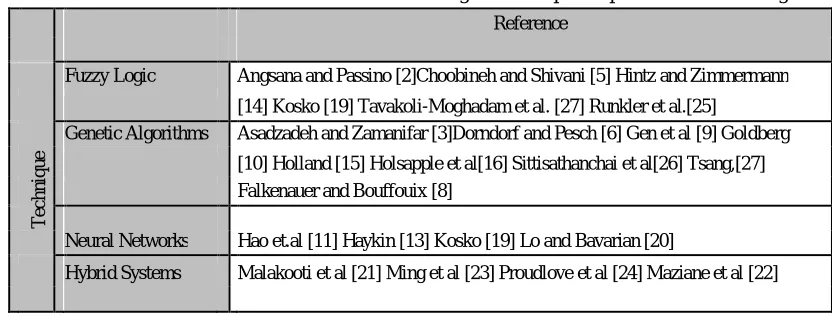
[image:5.612.95.511.555.716.2]Malakooti et al [21] expanded a scrutinizing and supervising system for machining operations using in-process deterioration for monitoring and adaptive feed forward ANNs for supervising. The monitoring system envisages tool life by means of diverse sensors for congregation information stand on regression model that permits for the distinctions involving tools and different machine setups [22]. The regression model constructs its forecast by using the narration of other tools and combining it with the information attained about the tool under contemplation. Ming et al. [23] has combined expert systems and NNs to build up a CAPP system. Other endeavors have been made to use AI in managing dependent demand inventories. A wider conversation can be originate in the appraisal of [24]. Table 1 is summarizing the evaluation techniques.
Table 1 : Artificial Intelligent techniques in production scheduling
Reference
Fuzzy Logic Angsana and Passino [2]Choobineh and Shivani [5] Hintz and Zimmermann
T
ec
hn
iqu
e
[14] Kosko [19] Tavakoli-Moghadam et al. [27] Runkler et al.[25]
Genetic Algorithms Asadzadeh and Zamanifar [3]Dorndorf and Pesch [6] Gen et al [9] Goldberg
[10] Holland [15] Holsapple et al[16] Sittisathanchai et al[26] Tsang,[27]
Falkenauer and Bouffouix [8]
Neural Networks
Hao et.al [11] Haykin [13] Kosko [19] Lo and Bavarian [20]
Hybrid Systems Malakooti et al [21] Ming et al [23] Proudlove et al [24] Maziane et al [22]
VI. CONCLUSIONS
In this paper an assessment of fuzzy methods for scheduling in flexible manufacturing system was made. Essentials of neural, AI based and GA based methods were presented also. Every fuzzy approach, in addition the one presented by Angsana and Passino [2], lacks of a methodical design procedure that could hold for diverse FMS configurations. On the contrary, all neural network based methods have a design procedure that fundamentally consists in the preparation of the network. This type of training has shortcomings in stipulations of speed and data collection. Deciding how to assess the reward for a given action is crucial in executing any of these methods and can be a quite multifaceted task. This comprises one of the major impediments in developing design and adaptation solutions. Every fuzzy approach, moreover the one of Hatono et al. [12], employ rules also based on some fuzzy version of offered heuristics or based on expert knowledge. This means already working and tested solutions can be personified in the fuzzy framework and optimized. Both neural and AI-hybrid based approaches are based on a few production objectives, usually only one of them. This is simply elucidated given the kind of neural network training or inductive learning. Not all the assessment methods were tested and compared to heuristic or already accessible solutions. Furthermore if they were, they would barely compared in conditions of a inadequate number of production objectives. This depiction of the state of the art in intelligent methods for scheduling in FMS illustrates the specific requirement for a systematic design process based on diverse intentions. Additionally the design procedure ought to also account for the stochastic and vibrant nature of the system. Some broad changeable structure for designing according to multiple production objectives with diverse degrees of significance is absent. Such a structure could be the first step towards a actually adaptive solution to the scheduling problem. On these principles, the use of fuzzy logic seems very appropriate. Certainly fuzzy multiple attribute decision making methods could propose the benefit of being capable to deal with multiple and divergent objectives. Fuzzy logic systems might be used to deal with vague and indistinct data and to code expert’s knowledge. Fuzzy methods can also take benefit of rules, as expert systems, and deal with elusiveness. Looking at fuzzy systems as some kind of viaduct between neural and AI based solutions it can be fulfilled that a fuzzy hybrid solution should be required.
VII.FUTURE RESEARCH DIRECTION
A present tendency in manufacturing plants is to move towards extremely flexible production systems that can react quickly to stipulate changes and to the dispensation of a variety of products. In luminosity of this truth new exemplar of Reconfigurable Manufacturing System (RMS) introduced [18]. By expansion of this new notion, further work should be scheduling to put RMS facets into consideration and accept different methods in reconfigurable surroundings.
REFERENCES
[1] Adonyi, R., Biros, G., Holczinger, T., and Friedler, F., 2008,“Effective scheduling of large-scale paint production system,” Journal of Cleaner Production, 16, 225-232.
[2] Angsana, A., and Passino, K.M., 1993,"Distributed intelligent control of flexible manufacturing systems," Proceeding of the 1993 American Control onference, 1520-1524.
[3] Asadzadeh, L., and Zamanifar, K., “An agent-based parallel approach for the job shop scheduling problem with genetic algorithms,” Mathematical and Computer Modeling. (in press)
[4] Berry, P.M., 1993, “Chapter 3: Scheduling and Uncertainty Reasoning,” appears in Scheduling of Production Processes, Dorn, J., Froeschl, K.A., (eds.), Ellis Horwood Publication, 31-47.
[5] Choobineh, F., and Shivani, M., 1992, "Dynamic process planning and scheduling algorithm," Proceedings of the Japan/USA Symposium on Flexible Automation, ASME, 429-432.
[6] Choy, K.L., Leung, Y.K., Chow, H.K.H., Poon, T.C., Kwong, C.K., Ho, G.T.S., and Kwok, S.K. “A hybrid scheduling decision support model for minimizing job tardiness in a make-to-order based mould manufacturing environment,” Expert Systems with Applications. (in press)
[7] Dorndorf, U, .and Pesch, E., 1995, “Evolution based learning in a job-shop scheduling environment,” Computers and Operations Research, 22(1), 25-40. [8] Falkenauer, E., and Bouffouix, S., 1991, "A genetic algorithm for job-shop," Proceedings of the IEEE International Conference on Robotics and Automation, 1,
824-829.
[9] Gen, M., Tsujimura, Y., and Kubota, E., 1994, "Solving job-shop scheduling problems by genetic algorithms," Proceedings of the IEEE International Conference on Systems, Man and Cybernetics, 2, 1577-1582.
[10] Goldberg, D.E., 1989, Genetic Algorithms in search, optimization and machine learning, Addison-Wesley.
[11] Hao, G., Shang, J.S., and Vargas, L.G., 1994, "A Neural network approach for the real time control of a FMS," Proceedings of the Hawaii International Conference on System Sciences, 3, 641-648.
[12] Hatono, I., Suzuka, T., Umano, M., and Tamura, H., 1992, "Towards intelligent scheduling for flexible manufacturing: application of fuzzy inference to realizing high variety of objectives," Proceedings of the Japan/USA Symposium on Flexible Automation, ASME , 1, 433-440,.
[13] Haykin, S., 1994, Neural Networks, Macmillan/IEEE Press.
[16] Holsapple C.W., Jacob, V.S., Pakath, R., and Zaveri, J.S., "A Genetics-based hybrid scheduler for generating static schedules in flexible manufacturing contexts," IEEE Transactions on Systems Man and Cybernetics, vol. 23, n. 4, July-August 1993, 953-972.
[17] Kim, G.H. and Lee, C.S.G., 1994, "An evolutionary approach to the job-shop scheduling problem," Proceedings of the IEEE International Conference on Robotics and Automation, 1, 501-506.
[18] Koren, Y., Heisel, U., Jovane, F., Moriwaki, T., Pritschow, G., and Ulsoy, G., (1999), “Reconfigurable manufacturing systems”. CIRP Annals - Manufacturing Technology, 48(2), 527-540.
[19] Kosko, B., 1992, Neural Networks and Fuzzy Systems - a dynamical system approach to machine intelligence, Prentice Hall.
[20] o, Z.P. and Bavarian, B., April 1991, "Scheduling with neural networks for flexible manufacturing systems," Proceedings of the IEEE International Conference on Robotics and Automation, 818-823.
[21] Malakooti, B.B., Zhou, Y.Q., and Tandler, E.C., 1995, “In-process regression and adaptive multicriteria neural networks for monitoring and supervising mechaning operation,” Journal of Intelligent Manufacturing, 6 (1), 53-66.
[22] Maziane, F., Vadera, S., Kobbacy, K., and Nathan, P., 2000, “Intelligent systems in manufacturing: current developments and future prospect,” Journal of Intelligent Manufacturing System, 11 (4), 218-238.
[23] Ming, X.G., Mak, K.L. and Yan, J.Q. 1999,”A hybrid intelligent inference model for computer aided process planning,” The International Journal of Manufacturing Technology Management, 10(6), 343-53.
[24] Proudlove, N.C., Vaders, S., and kobbacy, K.A.H., 1998, “Intelligent management systems in Operations: a review”, Journal of the Operational Research Society, 49(7), 682-99.
[25] Runkler, T.A., Sollacher, R., and Revery, W., 2004, “Distributed Fuzzy Decision making for production scheduling,” mathware and Soft Computing, 11, 211-244.
[26] Sittisathanchai, S., Dagli, C.H., and Lee, H.C., 1994, "A genetic scheduler for job shops," Proceedings of the Artificial Neural Networks in Engineering Conference, 351-356.
[27] Tavakoli-Moghadam, R., Javadi, B., Jolai, F., and Ghodratnama, A., 2010, “The use of multi-objective linear programming for solving a multi-objective single-machine scheduling problem,” Applied Soft Computing, 10(3), 919– 925.
[28] Tsang, E.P.K, January 1995, "Scheduling techniques - a comparative study," BT Technology Journal, 13(1), 16-28.
[29] Watanabe, T., Tokumaru, H,. and Hashimoto, Y., 1993,"Job-Shop scheduling using neural networks," Control engineering practice, 1( 6), 957- 961.
[30] Wu, D., and Ierapetritou, M., 2007, “Hierarchical approach for production planning and scheduling under uncertainty,” Chemical Engineering and Processing, 46(11), 1129–1140.
[31] Yalaoui, N., Dugardin, F., Yalaoui, F., Amondeo, L., and Mahdi, H., 2010, “Chapter 8: Fuzzy Project Scheduling,” appears in Production Engineering and Management under Fuzziness, Kahraman, C., Yauz, R. (eds.), Springer Berlin, Heidelberg, 143 – 170.
[32] Zadeh, L.A., 1965, "Fuzzy sets," Information and Control, 8, 338-353.
[33] Zadeh, L.A., January 1973, "Outline of a new approach to the analysis of complex systems and decision processes," IEEE Transactions on Systems, Man and Cybernetics, 3(1), 28-44.
[34] Zeballos, L.J., “A constraint programming approach to tool allocation and production scheduling in flexible manufacturing systems,” Robotic and Computer-Integrated Manufacturing, (in press).
ABOUT THE AUTHOR
Mr. Brahma Datta Shukla
M.Tech (C.T.A.), RGPV University, Bhopal (M.P.),India.
M.C.A. ,ICS,Vikram University ,Ujjain(M.P.),India