Defining a Core Genome Multilocus
Sequence Typing Scheme for the Global
Epidemiology of
Vibrio parahaemolyticus
Narjol Gonzalez-Escalona,aKeith A. Jolley,bElizabeth Reed,a Jaime Martinez-Urtazac
Center for Food Safety and Applied Nutrition, Food and Drug Administration, College Park, Maryland, USAa; Department of Zoology, University of Oxford, Oxford, United Kingdomb; The Milner Centre for Evolution, Department of Biology and Biochemistry, University of Bath, Bath, Somerset, United Kingdomc
ABSTRACT Vibrio parahaemolyticus is an important human foodborne pathogen whose transmission is associated with the consumption of contaminated seafood, with a growing number of infections reported over recent years worldwide. A
multi-locus sequence typing (MLST) database for V. parahaemolyticuswas created in 2008,
and a large number of clones have been identified, causing severe outbreaks world-wide (sequence type 3 [ST3]), recurrent outbreaks in certain regions (e.g., ST36), or spreading to other regions where they are nonendemic (e.g., ST88 or ST189). The current MLST scheme uses sequences of 7 genes to generate an ST, which results in a powerful tool for inferring the population structure of this pathogen, although with limited resolution, especially compared to pulsed-field gel electrophoresis (PFGE). The application of whole-genome sequencing (WGS) has become routine for trace back investigations, with core genome MLST (cgMLST) analysis as one of the most straightforward ways to explore complex genomic data in an epidemiological con-text. Therefore, there is a need to generate a new, portable, standardized, and more advanced system that provides higher resolution and discriminatory power among
V. parahaemolyticus strains using WGS data. We sequenced 92 V. parahaemolyticus
genomes and used the genome of strain RIMD 2210633 as a reference (with a total
of 4,832 genes) to determine which genes were suitable for establishing aV.
parah-aemolyticus cgMLST scheme. This analysis resulted in the identification of 2,254 suit-able core genes for use in the cgMLST scheme. To evaluate the performance of this scheme, we performed a cgMLST analysis of 92 newly sequenced genomes, plus an additional 142 strains with genomes available at NCBI. cgMLST analysis was able to dis-tinguish related and unrelated strains, including those with the same ST, clearly showing its enhanced resolution over conventional MLST analysis. It also distinguished outbreak-related from non-outbreak-outbreak-related strains within the same ST. The sequences obtained
from this work were deposited and are available in the public database (http://pubmlst
.org/vparahaemolyticus). The application of this cgMLST scheme to the characterization ofV. parahaemolyticusstrains provided by different laboratories from around the world will reveal the global picture of the epidemiology, spread, and evolution of this pathogen and will become a powerful tool for outbreak investigations, allowing for the unambiguous comparison of strains with global coverage.
KEYWORDS whole-genome sequencing (WGS), core genome multilocus sequence
typing, cgMLST,Vibrio parahaemolyticus, clinical, phylogenetic analysis, phylogeny,
single nucleotide polymorphism (SNP)
V
ibrio parahaemolyticusis an important human foodborne pathogen whosetrans-mission is associated with the consumption of contaminated seafood (1). MostV.
parahaemolyticus strains that are considered pathogenic carry genes encoding
ther-Received7 February 2017Returned for modification3 March 2017Accepted11 March 2017
Accepted manuscript posted online22 March 2017
CitationGonzalez-Escalona N, Jolley KA, Reed E, Martinez-Urtaza J. 2017. Defining a core genome multilocus sequence typing scheme for the global epidemiology ofVibrio
parahaemolyticus. J Clin Microbiol 55:1682–
1697.https://doi.org/10.1128/JCM.00227-17.
EditorRobin Patel, Mayo Clinic
Copyright© 2017 Gonzalez-Escalona et al. This is an open-access article distributed under the terms of theCreative Commons Attribution 4.0 International license.
Address correspondence to Narjol Gonzalez-Escalona,
crossm
on May 16, 2020 by guest
http://jcm.asm.org/
mostable direct hemolysin (tdh) and/or thermostable direct hemolysin-related
hemo-lysin (trh) (2). Usually, these potential pathogenic strains represent a small fraction of
all environmental strains (3). In addition to these two virulence genes, pathogenicV.
parahaemolyticusstrains carry other virulence-related genes, usually located in patho-genicity islands (4–7).
TheV. parahaemolyticus“pandemic clonal complex” has been the dominant clone causing diseases around the world (3, 8–14). The emergence and cross-border spread-ing of strains, mostly belongspread-ing to sequence type 3 (ST3), raised public health concerns
regarding the possibility of a pandemic spread, an uncharacteristic trait forV.
parah-aemolyticus. It was believed that this pandemic strain was the only strain that was spreading among distant regions. However, recent findings have shown that this was
not the case, and otherV. parahaemolyticusstrains belonging to diverse clonal
com-plexes have been spreading between Asia and other parts of the world (15–18). The dispersal routes of these strains remain uncertain at the moment, but at least three different mechanisms have been identified as being associated with the introduction of
pathogenicV. parahaemolyticus: ballast water, ocean currents, and transport of oysters
or other mollusks between regions (11, 15, 16).
A first glance into the population structure and diversity of V. parahaemolyticus
populations was accomplished by the establishment of the multilocus sequence typing
(MLST) scheme forV. parahaemolyticus(19) and a centralized database (http://pubmlst
.org/vparahaemolyticus) in 2008. This MLST database has enabled researchers from around the world to compare isolates. Currently, more than 2,477 strains from diverse regions of the world, belonging to 1,681 STs, are available for analyses. Genetic variants identified as prevalent in the different regions of the world can be mapped to identify potential connections between populations from diverse geographical areas and de-lineate potential routes of dispersion. Although useful, MLST is based on sequence analysis of 7 chosen housekeeping genes and therefore lacks enough resolution when used in outbreak scenarios to discriminate between related and unrelated strains at the ST level (19).
The prices for performing whole-genome sequencing (WGS) have decreased dra-matically during the last 5 years, with genomes costing around $50 to $100 USD. Scientists have been using WGS to reanalyze historical collections of pathogens and outbreak strains, resulting in a new way of performing outbreak investigations. WGS analyses, such as WGS-single nucleotide polymorphism (WGS-SNP) (20–26) and core genome MLST analyses (15, 16, 27–33), have been used extensively for epidemiological trace back investigations of outbreaks. WGS data analyses allow us to better understand both population dynamics and the mechanisms which contribute to increased viru-lence among foodborne bacterial pathogens.
cgMLST schemes have already been successfully used for the analysis of different
epidemiological investigations, such as the two recentV. parahaemolyticusoutbreaks in
Maryland (pandemic ST3 strains in MD in 2014 and a retrospective analysis of ST8
strains in MD in 2010) (15), the identification of a novel clone ofV. parahaemolyticus
causing infections in Peru (16), and the description of an emergentV. parahaemolyticus
pathogenic strain (ST631) causing illnesses in the North Atlantic coast of the United States (34). All of the cgMLST schemes used in these analyses were custom-made for each strain type and according to a specific epidemiological context where strains were
very similar and shared most of the genes with the reference strain (⬎83%) (12, 15, 16,
34). Therefore, there is a need to generate a portable, standardized, and more advanced
system for the analysis ofV. parahaemolyticusstrains. Using WGS data will introduce a
higher level of resolution and discrimination into the study of populations collected from all around the world, which can be analyzed using a universal cgMLST scheme for
V. parahaemolyticus.
To establish this universalV. parahaemolyticuscgMLST scheme, we sequenced 92V.
parahaemolyticusgenome representatives from the STs prevailing in different areas of the world. We used the genome of strain RIMD 2210633, which contained 4,832 total
genes, as a reference, of which 2,254 genes were selected to create the new V.
on May 16, 2020 by guest
http://jcm.asm.org/
parahaemolyticus cgMLST scheme after analyzing those 92 genomes. Additionally, another 142 genomes available at NCBI were included in the study to evaluate the performance of the new cgMLST scheme. The cgMLST analysis was able to distinguish related and unrelated strains, including those with the same ST, clearly showing its enhanced resolution over conventional MLST analysis. The sequences obtained from
this work were deposited and are available online in a public cgMLSTV.
parahaemo-lyticusdatabase (http://pubmlst.org/vparahaemolyticus).
RESULTS
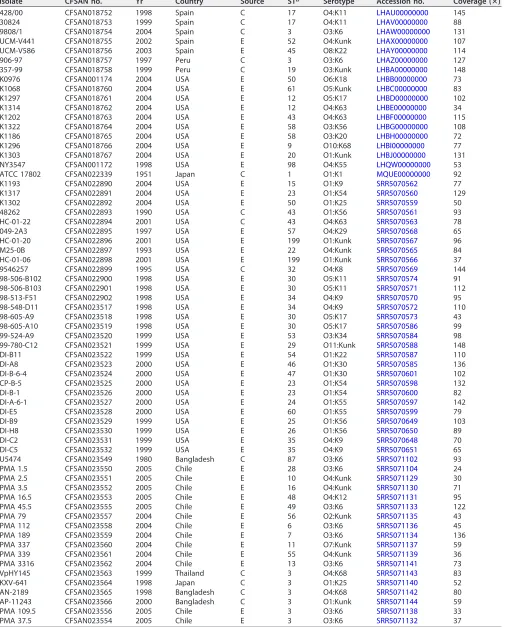
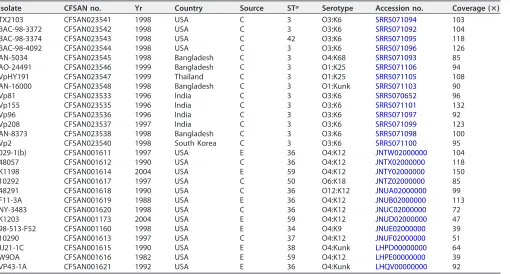
Sequencing of representative strains ofV. parahaemolyticusfor setting up the cgMLST scheme.Ninety-twoV. parahaemolyticusstrains, previously used for setting up
the MLST scheme for this bacterium (19), were sequenced to reach ⬎25⫻ average
coverage using MiSeq (Illumina) (Table 1). Genome sequences with low coverage
(⬍25⫻) usually result in low sequencing qualities and incorrect assemblies.
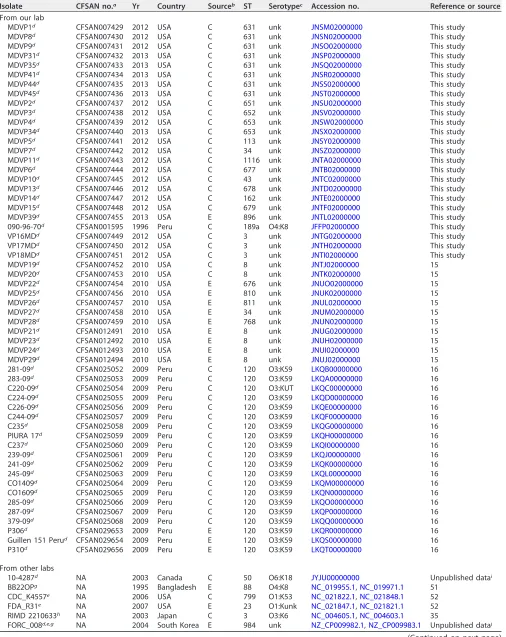
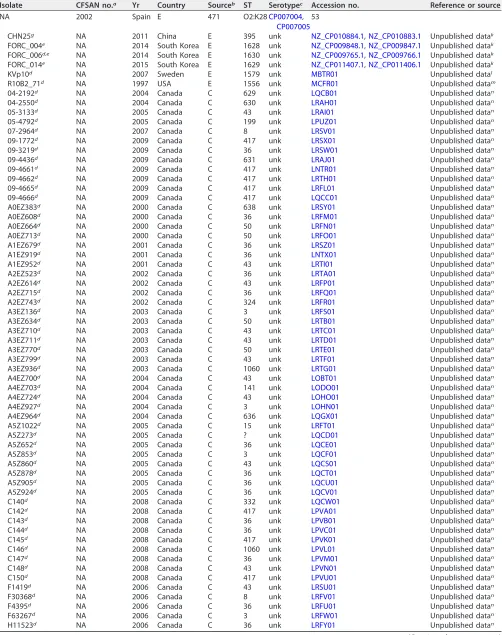
Forty-eight additional strains previously sequenced by Ion Torrent (5) were resequenced by MiSeq in order to generate better-quality genomes (Table 2) and to validate the
cgMLST scheme. In silico multilocus sequence typing (MLST; http://pubmlst.org/
vparahaemolyticus) analysis of thede novoassembled contigs confirmed the identity of
everyV. parahaemolyticusstrain (Tables 1 and 2).
Development of a cgMLST for V. parahaemolyticus. The initial setup of the
cgMLST for V. parahaemolyticus using the genome of strain RIMD 2210633 as the
reference genome (4,832 genes total) generated 3,709 potential core gene targets for use in the cgMLST scheme after eliminating duplicated, truncated, and accessory genes. RIMD 2210633 is a prototypic ST3 pandemic strain and was fully sequenced in 2003 using Sanger sequencing technology (35). Only core genes were used for constructing the cgMLST scheme. Of the 3,709 potential core genes identified in the
comparison of strain RIMD 2210633 with seven other V. parahaemolyticus strains
(BB22OP, CDC_K4557, FDA_R31, UCM-V493, FORC_008, FORC_006, and FORC_004),
only 2,254 genes were present in every genome of the additional 92 V.
parahaemo-lyticusstrains used to define the final cgMLST scheme (see Table S1 in the supplemental material). These 92 strains represented a diverse set of strains isolated from environ-mental and clinical sources, as well as from different locations (Table 1).
Implementation of theV. parahaemolyticuscgMLST website.The cgMLST scheme
was implemented into the BIGSdb database hosting the original MLST scheme forV.
parahaemolyticus (http://pubmlst.org/vparahaemolyticus). This database allows for
testing contigs of newV. parahaemolyticusgenomes for the presence and typing of
2,254 genes. Briefly, the BIGSdb genome comparator tool performs a cgMLST analysis, which produces a color-coded cgMLST output (e.g., see Table S2), facilitating compar-ison among isolates (see Materials and Methods for specific details).
Evaluation of the cgMLST target gene set. All V. parahaemolyticus genomes
generated in this study, as well as a collection of 142 additionalV. parahaemolyticus
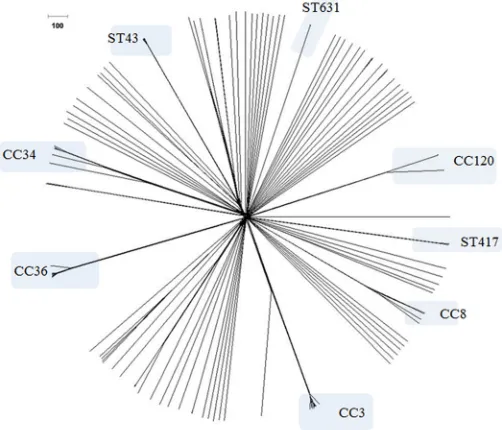
genomes available at NCBI (Table 2), were used to validate this cgMLST scheme (Fig. 1). The average percentage of cgMLST targets called was 99.21%. Only five assembled genomes contained incomplete loci: 97-10290 (two incomplete loci), Guillen_151_Peru (six incomplete loci), P310 (two incomplete loci), C148 (one incomplete locus), and HS-06-05 (seven incomplete loci). The output of this general analysis produced an informative Excel file (Table S2) composed of different sheets, with each one containing different results, as explained in Materials and Methods. cgMLST analysis for the 234
genomes available in the MLST database allowed a fast phylogenetic exploration ofV.
parahaemolyticusgenomes (Fig. 1), clearly differentiating strains belonging to different STs, clustering strains with same STs, and allowing for further discrimination among strains within a specific ST.
Evaluation of the cgMLST scheme using genomes of strains belonging to four known STs from outbreak-related and non-outbreak-related strains. The
perfor-mance of this cgMLST scheme was tested using six different sets of informative V.
parahaemolyticusstrains whose genomes were available and that clustered together in
on May 16, 2020 by guest
http://jcm.asm.org/
TABLE 1List ofV. parahaemolyticusstrains sequenced in this study
Isolate CFSAN no. Yr Country Source STa Serotype Accession no. Coverage (ⴛ)
428/00 CFSAN018752 1998 Spain C 17 O4:K11 LHAU00000000 145
30824 CFSAN018753 1999 Spain C 17 O4:K11 LHAV00000000 88
9808/1 CFSAN018754 2004 Spain C 3 O3:K6 LHAW00000000 131
UCM-V441 CFSAN018755 2002 Spain E 52 O4:Kunk LHAX00000000 107
UCM-V586 CFSAN018756 2003 Spain E 45 O8:K22 LHAY00000000 114
906-97 CFSAN018757 1997 Peru C 3 O3:K6 LHAZ00000000 127
357-99 CFSAN018758 1999 Peru C 19 O3:Kunk LHBA00000000 148
K0976 CFSAN001174 2004 USA E 50 O6:K18 LHBB00000000 73
K1068 CFSAN018760 2004 USA E 61 O5:Kunk LHBC00000000 83
K1297 CFSAN018761 2004 USA E 12 O5:K17 LHBD00000000 102
K1314 CFSAN018762 2004 USA E 12 O4:K63 LHBE00000000 34
K1202 CFSAN018763 2004 USA E 43 O4:K63 LHBF00000000 115
K1322 CFSAN018764 2004 USA E 58 O3:K56 LHBG00000000 108
K1186 CFSAN018765 2004 USA E 58 O3:K20 LHBH00000000 72
K1296 CFSAN018766 2004 USA E 9 O10:K68 LHBI00000000 77
K1303 CFSAN018767 2004 USA E 20 O1:Kunk LHBJ00000000 131
NY3547 CFSAN001172 1998 USA E 98 O4:K55 LHQW00000000 53
ATCC 17802 CFSAN022339 1951 Japan C 1 O1:K1 MQUE00000000 92
K1193 CFSAN022890 2004 USA E 15 O1:K9 SRR5070562 77
K1317 CFSAN022891 2004 USA E 23 O1:K54 SRR5070560 129
K1302 CFSAN022892 2004 USA E 50 O1:K25 SRR5070559 50
48262 CFSAN022893 1990 USA C 43 O1:K56 SRR5070561 93
HC-01-22 CFSAN022894 2001 USA C 43 O4:K63 SRR5070563 78
049-2A3 CFSAN022895 1997 USA E 57 O4:K29 SRR5070568 65
HC-01-20 CFSAN022896 2001 USA E 199 O1:Kunk SRR5070567 96
M25-0B CFSAN022897 1993 USA E 22 O4:Kunk SRR5070565 84
HC-01-06 CFSAN022898 2001 USA E 199 O1:Kunk SRR5070566 37
9546257 CFSAN022899 1995 USA C 32 O4:K8 SRR5070569 144
98-506-B102 CFSAN022900 1998 USA E 30 O5:K11 SRR5070574 91
98-506-B103 CFSAN022901 1998 USA E 30 O5:K11 SRR5070571 112
98-513-F51 CFSAN022902 1998 USA E 34 O4:K9 SRR5070570 95
98-548-D11 CFSAN023517 1998 USA E 34 O4:K9 SRR5070572 110
98-605-A9 CFSAN023518 1998 USA E 30 O5:K17 SRR5070573 43
98-605-A10 CFSAN023519 1998 USA E 30 O5:K17 SRR5070586 99
99-524-A9 CFSAN023520 1999 USA E 53 O3:K34 SRR5070584 98
99-780-C12 CFSAN023521 1999 USA E 29 O11:Kunk SRR5070588 148
DI-B11 CFSAN023522 1999 USA E 54 O1:K22 SRR5070587 110
DI-A8 CFSAN023523 2000 USA E 46 O1:K30 SRR5070585 136
DI-B-6-4 CFSAN023524 2000 USA E 47 O1:K30 SRR5070601 102
CP-B-5 CFSAN023525 2000 USA E 23 O1:K54 SRR5070598 132
DI-B-1 CFSAN023526 2000 USA E 23 O1:K54 SRR5070600 82
DI-A-6-1 CFSAN023527 2000 USA E 24 O1:K55 SRR5070597 142
DI-E5 CFSAN023528 2000 USA E 60 O1:K55 SRR5070599 79
DI-B9 CFSAN023529 1999 USA E 25 O1:K56 SRR5070649 103
DI-H8 CFSAN023530 1999 USA E 26 O1:K56 SRR5070650 89
DI-C2 CFSAN023531 1999 USA E 35 O4:K9 SRR5070648 70
DI-C5 CFSAN023532 1999 USA E 35 O4:K9 SRR5070651 65
U5474 CFSAN023549 1980 Bangladesh C 87 O3:K6 SRR5071102 93
PMA 1.5 CFSAN023550 2005 Chile E 28 O3:K6 SRR5071104 24
PMA 2.5 CFSAN023551 2005 Chile E 10 O4:Kunk SRR5071129 30
PMA 3.5 CFSAN023552 2005 Chile E 16 O4:Kunk SRR5071130 71
PMA 16.5 CFSAN023553 2005 Chile E 48 O4:K12 SRR5071131 95
PMA 45.5 CFSAN023555 2005 Chile E 49 O3:K6 SRR5071133 122
PMA 79 CFSAN023557 2004 Chile E 56 O2:Kunk SRR5071135 43
PMA 112 CFSAN023558 2004 Chile E 6 O3:K6 SRR5071136 45
PMA 189 CFSAN023559 2004 Chile E 7 O3:K6 SRR5071134 136
PMA 337 CFSAN023560 2004 Chile E 11 O7:Kunk SRR5071137 59
PMA 339 CFSAN023561 2004 Chile E 55 O4:Kunk SRR5071139 36
PMA 3316 CFSAN023562 2004 Chile E 13 O3:K6 SRR5071141 73
VpHY145 CFSAN023563 1999 Thailand C 3 O4:K68 SRR5071143 83
KXV-641 CFSAN023564 1998 Japan C 3 O1:K25 SRR5071140 52
AN-2189 CFSAN023565 1998 Bangladesh C 3 O4:K68 SRR5071142 80
AP-11243 CFSAN023566 2000 Bangladesh C 3 O1:Kunk SRR5071144 59
PMA 109.5 CFSAN023556 2005 Chile E 3 O3:K6 SRR5071138 33
PMA 37.5 CFSAN023554 2005 Chile E 3 O3:K6 SRR5071132 37
(Continued on next page)
on May 16, 2020 by guest
http://jcm.asm.org/
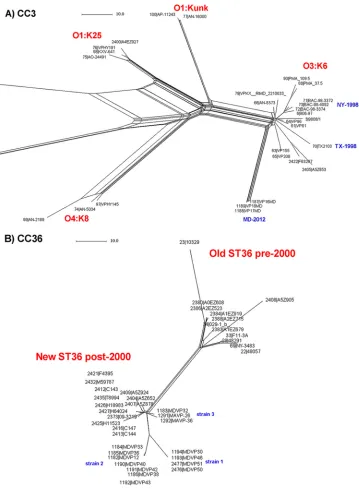
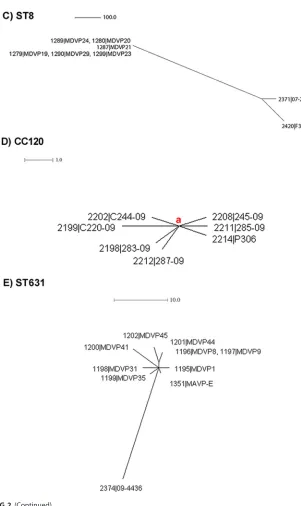
the global data set (Fig. 1). In addition to the unique pandemic clone ofV. parahae-molyticus identified to date (clonal complex 3 [CC3]), other major groups with a relevance on a local or transnational scale were also analyzed: (i) strains belonging to ST36 (CC36) (outbreak related and non-outbreak related) (5, 19, 36) (Fig. 2B), (ii) strains belonging to ST8 (CC8) that were outbreak related, isolated in MD in 2010 (15) (Fig. 2C), (iii) strains belonging to ST120 (CC120) from the same outbreak (Peru, 2009) and that were recently characterized (16) (Fig. 2D), and (iv) strains belonging to ST631, a new emergent clone in the East Coast of the United States (5, 34, 36) (Fig. 2E).
CC3.The first test of the new cgMLST was performed using strains belonging to the
pandemic clone CC3 using a panel of 30 strains (all ST3) epidemiologically unrelated, along with some additional strains collected in the course of a single epidemiological event (typically the same outbreak), including the recently reported strains MDVP16, MDVP7, and MDVP18 that caused a small outbreak in MD in 2014 (12) (Fig. 2A).
The cgMLST analysis of the genomes identified as CC3 by MLST consistently grouped the strains according to their serotype. Strains of serotypes O3:K6, O1:Kunk, O1:K25, and O4:K68 were efficiently discriminated and included in independent clus-ters. A high level of diversity was found within each cluster, even though these strains were highly related by PFGE profiling and random amplified polymorphic DNA (RAPD). The cgMLST was highly effective in separating strains that were less related to each other (e.g., see O3:K6 group). Noteworthy, cgMLST analysis showed that the first
reported outbreaks of pandemicV. parahaemolyticusin the United States in 1998 (NY
and TX) were caused by two different strains and differed by at least 14 loci from each other (detailed analysis can be found in Table S3). The strains causing the outbreak in MD in 2014 were grouped together and divergent from the original O3:K6 strains (old
ST3 strains) by ⬎30 loci. Strains MDVP17 and MDVP18 were undistinguishable and
differed from MDVP16 by 1 locus, confirming that this outbreak in MD in 2014 was caused by a single strain.
[image:5.585.43.553.82.356.2]CC36. CC36 includes strains typically causing infections in the Pacific Northwest United States and Canada (2, 19, 37). Figure 2B shows the analysis of strains belonging
TABLE 1(Continued)
Isolate CFSAN no. Yr Country Source STa Serotype Accession no. Coverage (ⴛ)
TX2103 CFSAN023541 1998 USA C 3 O3:K6 SRR5071094 103
BAC-98-3372 CFSAN023542 1998 USA C 3 O3:K6 SRR5071092 104
BAC-98-3374 CFSAN023543 1998 USA C 42 O3:K6 SRR5071095 118
BAC-98-4092 CFSAN023544 1998 USA C 3 O3:K6 SRR5071096 126
AN-5034 CFSAN023545 1998 Bangladesh C 3 O4:K68 SRR5071093 85
AO-24491 CFSAN023546 1999 Bangladesh C 3 O1:K25 SRR5071106 94
VpHY191 CFSAN023547 1999 Thailand C 3 O1:K25 SRR5071105 108
AN-16000 CFSAN023548 1998 Bangladesh C 3 O1:Kunk SRR5071103 90
Vp81 CFSAN023533 1996 India C 3 O3:K6 SRR5070652 96
Vp155 CFSAN023535 1996 India C 3 O3:K6 SRR5071101 132
Vp96 CFSAN023536 1996 India C 3 O3:K6 SRR5071097 92
Vp208 CFSAN023537 1997 India C 3 O3:K6 SRR5071099 123
AN-8373 CFSAN023538 1998 Bangladesh C 3 O3:K6 SRR5071098 100
Vp2 CFSAN023540 1998 South Korea C 3 O3:K6 SRR5071100 95
029-1(b) CFSAN001611 1997 USA E 36 O4:K12 JNTW02000000 104
48057 CFSAN001612 1990 USA C 36 O4:K12 JNTX02000000 118
K1198 CFSAN001614 2004 USA E 59 O4:K12 JNTY02000000 150
10292 CFSAN001617 1997 USA C 50 O6:K18 JNTZ02000000 85
48291 CFSAN001618 1990 USA C 36 O12:K12 JNUA02000000 99
F11-3A CFSAN001619 1988 USA E 36 O4:K12 JNUB02000000 113
NY-3483 CFSAN001620 1998 USA C 36 O4:K12 JNUC02000000 72
K1203 CFSAN001173 2004 USA E 59 O4:K12 JNUD02000000 47
98-513-F52 CFSAN001160 1998 USA E 34 O4:K9 JNUE02000000 39
10290 CFSAN001613 1997 USA C 37 O4:K12 JNUF02000000 51
JJ21-1C CFSAN001615 1990 USA E 38 O4:Kunk LHPD00000000 64
W9OA CFSAN001616 1982 USA E 59 O4:K12 LHPE00000000 39
VP43-1A CFSAN001621 1992 USA E 36 O4:Kunk LHQV00000000 92
aC, clinical; E, environmental.
on May 16, 2020 by guest
http://jcm.asm.org/
TABLE 2List ofV. parahaemolyticusgenomes from NCBI used for further testing of the newly created cgMLST
Isolate CFSAN no.a Yr Country Sourceb ST Serotypec Accession no. Reference or source
From our lab
MDVP1d CFSAN007429 2012 USA C 631 unk JNSM02000000 This study
MDVP8d CFSAN007430 2012 USA C 631 unk JNSN02000000 This study
MDVP9d CFSAN007431 2012 USA C 631 unk JNSO02000000 This study
MDVP31d CFSAN007432 2013 USA C 631 unk JNSP02000000 This study
MDVP35d CFSAN007433 2013 USA C 631 unk JNSQ02000000 This study
MDVP41d CFSAN007434 2013 USA C 631 unk JNSR02000000 This study
MDVP44d CFSAN007435 2013 USA C 631 unk JNSS02000000 This study
MDVP45d CFSAN007436 2013 USA C 631 unk JNST02000000 This study
MDVP2d CFSAN007437 2012 USA C 651 unk JNSU02000000 This study
MDVP3d CFSAN007438 2012 USA C 652 unk JNSV02000000 This study
MDVP4d CFSAN007439 2012 USA C 653 unk JNSW02000000 This study
MDVP34d CFSAN007440 2013 USA C 653 unk JNSX02000000 This study
MDVP5d CFSAN007441 2012 USA C 113 unk JNSY02000000 This study
MDVP7d CFSAN007442 2012 USA C 34 unk JNSZ02000000 This study
MDVP11d CFSAN007443 2012 USA C 1116 unk JNTA02000000 This study
MDVP6d CFSAN007444 2012 USA C 677 unk JNTB02000000 This study
MDVP10d CFSAN007445 2012 USA C 43 unk JNTC02000000 This study
MDVP13d CFSAN007446 2012 USA C 678 unk JNTD02000000 This study
MDVP14d CFSAN007447 2012 USA C 162 unk JNTE02000000 This study
MDVP15d CFSAN007448 2012 USA C 679 unk JNTF02000000 This study
MDVP39d CFSAN007455 2013 USA E 896 unk JNTL02000000 This study
090-96-70d CFSAN001595 1996 Peru C 189a O4:K8 JFFP02000000 This study
VP16MDd CFSAN007449 2012 USA C 3 unk JNTG02000000 This study
VP17MDd CFSAN007450 2012 USA C 3 unk JNTH02000000 This study
VP18MDd CFSAN007451 2012 USA C 3 unk JNTI02000000 This study
MDVP19d CFSAN007452 2010 USA C 8 unk JNTJ02000000 15
MDVP20d CFSAN007453 2010 USA C 8 unk JNTK02000000 15
MDVP22d CFSAN007454 2010 USA E 676 unk JNUO02000000 15
MDVP25d CFSAN007456 2010 USA E 810 unk JNUK02000000 15
MDVP26d CFSAN007457 2010 USA E 811 unk JNUL02000000 15
MDVP27d CFSAN007458 2010 USA E 34 unk JNUM02000000 15
MDVP28d CFSAN007459 2010 USA E 768 unk JNUN02000000 15
MDVP21d CFSAN012491 2010 USA E 8 unk JNUG02000000 15
MDVP23d CFSAN012492 2010 USA E 8 unk JNUH02000000 15
MDVP24d CFSAN012493 2010 USA E 8 unk JNUI02000000 15
MDVP29d CFSAN012494 2010 USA E 8 unk JNUJ02000000 15
281-09d CFSAN025052 2009 Peru C 120 O3:K59 LKQB00000000 16
283-09d CFSAN025053 2009 Peru C 120 O3:K59 LKQA00000000 16
C220-09d CFSAN025054 2009 Peru C 120 O3:KUT LKQC00000000 16
C224-09d CFSAN025055 2009 Peru C 120 O3:K59 LKQD00000000 16
C226-09d CFSAN025056 2009 Peru C 120 O3:K59 LKQE00000000 16
C244-09d CFSAN025057 2009 Peru C 120 O3:K59 LKQF00000000 16
C235d CFSAN025058 2009 Peru C 120 O3:K59 LKQG00000000 16
PIURA 17d CFSAN025059 2009 Peru C 120 O3:K59 LKQH00000000 16
C237d CFSAN025060 2009 Peru C 120 O3:K59 LKQI00000000 16
239-09d CFSAN025061 2009 Peru C 120 O3:K59 LKQJ00000000 16
241-09d CFSAN025062 2009 Peru C 120 O3:K59 LKQK00000000 16
245-09d CFSAN025063 2009 Peru C 120 O3:K59 LKQL00000000 16
CO1409d CFSAN025064 2009 Peru C 120 O3:K59 LKQM00000000 16
CO1609d CFSAN025065 2009 Peru C 120 O3:K59 LKQN00000000 16
285-09d CFSAN025066 2009 Peru C 120 O3:K59 LKQO00000000 16
287-09d CFSAN025067 2009 Peru C 120 O3:K59 LKQP00000000 16
379-09d CFSAN025068 2009 Peru C 120 O3:K59 LKQQ00000000 16
P306d CFSAN029653 2009 Peru E 120 O3:K59 LKQR00000000 16
Guillen 151 Perud CFSAN029654 2009 Peru E 120 O3:K59 LKQS00000000 16
P310d CFSAN029656 2009 Peru E 120 O3:K59 LKQT00000000 16
From other labs
10-4287d NA 2003 Canada C 50 O6:K18 JYJU00000000 Unpublished datai
BB22OPg NA 1995 Bangladesh E 88 O4:K8 NC_019955.1,NC_019971.1 51
CDC_K4557e NA 2006 USA C 799 O1:K53 NC_021822.1,NC_021848.1 52
FDA_R31e NA 2007 USA E 23 O1:Kunk NC_021847.1,NC_021821.1 52
RIMD 2210633h NA 2003 Japan C 3 O3:K6 NC_004605.1,NC_004603.1 35
FORC_008d,e,g NA 2004 South Korea E 984 unk NZ_CP009982.1,NZ_CP009983.1 Unpublished dataj
(Continued on next page)
on May 16, 2020 by guest
http://jcm.asm.org/
TABLE 2(Continued)
Isolate CFSAN no.a Yr Country Sourceb ST Serotypec Accession no. Reference or source
NA 2002 Spain E 471 O2:K28CP007004,
CP007005 53
CHN25g NA 2011 China E 395 unk NZ_CP010884.1,NZ_CP010883.1 Unpublished datak
FORC_004e NA 2014 South Korea E 1628 unk NZ_CP009848.1,NZ_CP009847.1 Unpublished datak
FORC_006d,e NA 2014 South Korea E 1630 unk NZ_CP009765.1,NZ_CP009766.1 Unpublished datak
FORC_014e NA 2015 South Korea E 1629 unk NZ_CP011407.1,NZ_CP011406.1 Unpublished datak
KVp10d NA 2007 Sweden E 1579 unk MBTR01 Unpublished datal
R10B2_71d NA 1997 USA E 1556 unk MCFR01 Unpublished datam
04-2192d NA 2004 Canada C 629 unk LQCB01 Unpublished datan
04-2550d NA 2004 Canada C 630 unk LRAH01 Unpublished datan
05-3133d NA 2005 Canada C 43 unk LRAI01 Unpublished datan
05-4792d NA 2005 Canada C 199 unk LPUZ01 Unpublished datan
07-2964d NA 2007 Canada C 8 unk LRSV01 Unpublished datan
09-1772d NA 2009 Canada C 417 unk LRSX01 Unpublished datan
09-3219d NA 2009 Canada C 36 unk LRSW01 Unpublished datan
09-4436d NA 2009 Canada C 631 unk LRAJ01 Unpublished datan
09-4661d NA 2009 Canada C 417 unk LNTR01 Unpublished datan
09-4662d NA 2009 Canada C 417 unk LRTH01 Unpublished datan
09-4665d NA 2009 Canada C 417 unk LRFL01 Unpublished datan
09-4666d NA 2009 Canada C 417 unk LQCC01 Unpublished datan
A0EZ383d NA 2000 Canada C 638 unk LRSY01 Unpublished datan
A0EZ608d NA 2000 Canada C 36 unk LRFM01 Unpublished datan
A0EZ664d NA 2000 Canada C 50 unk LRFN01 Unpublished datan
A0EZ713d NA 2000 Canada C 50 unk LRFO01 Unpublished datan
A1EZ679d NA 2001 Canada C 36 unk LRSZ01 Unpublished datan
A1EZ919d NA 2001 Canada C 36 unk LNTX01 Unpublished datan
A1EZ952d NA 2001 Canada C 43 unk LRTI01 Unpublished datan
A2EZ523d NA 2002 Canada C 36 unk LRTA01 Unpublished datan
A2EZ614d NA 2002 Canada C 43 unk LRFP01 Unpublished datan
A2EZ715d NA 2002 Canada C 36 unk LRFQ01 Unpublished datan
A2EZ743d NA 2002 Canada C 324 unk LRFR01 Unpublished datan
A3EZ136d NA 2003 Canada C 3 unk LRFS01 Unpublished datan
A3EZ634d NA 2003 Canada C 50 unk LRTB01 Unpublished datan
A3EZ710d NA 2003 Canada C 43 unk LRTC01 Unpublished datan
A3EZ711d NA 2003 Canada C 43 unk LRTD01 Unpublished datan
A3EZ770d NA 2003 Canada C 50 unk LRTE01 Unpublished datan
A3EZ799d NA 2003 Canada C 43 unk LRTF01 Unpublished datan
A3EZ936d NA 2003 Canada C 1060 unk LRTG01 Unpublished datan
A4EZ700d NA 2004 Canada C 43 unk LOBT01 Unpublished datan
A4EZ703d NA 2004 Canada C 141 unk LODO01 Unpublished datan
A4EZ724d NA 2004 Canada C 43 unk LOHO01 Unpublished datan
A4EZ927d NA 2004 Canada C 3 unk LOHN01 Unpublished datan
A4EZ964d NA 2004 Canada C 636 unk LQGX01 Unpublished datan
A5Z1022d NA 2005 Canada C 15 unk LRFT01 Unpublished datan
A5Z273d NA 2005 Canada C ? unk LQCD01 Unpublished datan
A5Z652d NA 2005 Canada C 36 unk LQCE01 Unpublished datan
A5Z853d NA 2005 Canada C 3 unk LQCF01 Unpublished datan
A5Z860d NA 2005 Canada C 43 unk LQCS01 Unpublished datan
A5Z878d NA 2005 Canada C 36 unk LQCT01 Unpublished datan
A5Z905d NA 2005 Canada C 36 unk LQCU01 Unpublished datan
A5Z924d NA 2005 Canada C 36 unk LQCV01 Unpublished datan
C140d NA 2008 Canada C 332 unk LQCW01 Unpublished datan
C142d NA 2008 Canada C 417 unk LPVA01 Unpublished datan
C143d NA 2008 Canada C 36 unk LPVB01 Unpublished datan
C144d NA 2008 Canada C 36 unk LPVC01 Unpublished datan
C145d NA 2008 Canada C 417 unk LPVK01 Unpublished datan
C146d NA 2008 Canada C 1060 unk LPVL01 Unpublished datan
C147d NA 2008 Canada C 36 unk LPVM01 Unpublished datan
C148d NA 2008 Canada C 43 unk LPVN01 Unpublished datan
C150d NA 2008 Canada C 417 unk LPVU01 Unpublished datan
F1419d NA 2006 Canada C 43 unk LRSU01 Unpublished datan
F30368d NA 2006 Canada C 8 unk LRFV01 Unpublished datan
F4395d NA 2006 Canada C 36 unk LRFU01 Unpublished datan
F63267d NA 2006 Canada C 3 unk LRFW01 Unpublished datan
H11523d NA 2006 Canada C 36 unk LRFY01 Unpublished datan
(Continued on next page)
on May 16, 2020 by guest
http://jcm.asm.org/
to CC36 from the United States and Canada isolated over the last 20 years from clinical and environmental sources. The cgMLST analysis clearly separated them into two distinct groups: strains isolated before 2000 (old or classic clone ST36) and strains
TABLE 2(Continued)
Isolate CFSAN no.a Yr Country Sourceb ST Serotypec Accession no. Reference or source
H18983d NA 2006 Canada C 36 unk LRST01 Unpublished datan
NA 2006 CanadaC 36 unk LRFZ01 Unpublished datan
M59787d NA 2006 Canada C 36 unk LRJZ01 Unpublished datan
T8994d NA 2006 Canada C 36 unk LRGA01 Unpublished datan
W501d NA 2006 Canada C 635 unk LRFX01 Unpublished datan
HS-06-05d NA 2014 Canada E 614 unk LIRS01 Unpublished datan
ISF-29-3d NA 2011 Canada E 1518 unk LFYM01 Unpublished datan
ISF-54-12d NA 2011 Canada E 1631 unk LIRR01 Unpublished datan
S357-21d NA 2010 Canada E 102 unk LFYN01 Unpublished datan
S372-5d NA 2011 Canada E 324 unk LIRQ01 Unpublished datan
ISF-94-1d NA 2011 Canada E 1632 unk LIRT01 Unpublished datan
RM-14-5d NA 2014 Canada E 1663 unk LFXK01 Unpublished datan
Gxw_7004f NA 2007 China C 3 unk LPZS01 Unpublished datao
Gxw_9143f NA 2009 China C 265 unk LPZT01 Unpublished datap
K23d NA 2013 India E 1052 unk LQGU01 54
aNA, not applicable.
bC, clinical; E, environmental.
cunk– unknown.
dMiSeq sequencing platform.
ePacBio sequencing platform.
fHiSeq sequencing platform.
g454 sequencing platform.
hSanger sequencing platform.
iJ. Ronholm, N. Petronella, R. Kenwell, and S. Banerjee.
jJ.-H. Lee, D.-H. Lee, S. Kim, H.-J. Ku, H. Y. Chung, H. Kim, S. Ryu, and S.-H. Choi.
kC. Zhu, B. Sun, T. Liu, H. Zheng, and L. Chen.
lJ. W. Turner, R. N. Paranjpye, B. Collin, L. J. Pinnell, and J. Tallman.
mK. C. Liu.
nJ. Ronholm, N. Petronella, and S. Banerjee.
oY. Huang, H. Wang, Y. Pang, Z. Tang, Y. Zhou, and G. Sun.
pY. Huang, H. Wang, Y. Pang, Z. Tang, Y. Zhou, C. Qu, L. Lan, C. Wei, and C. Wang.
FIG 1cgMLST analysis of the 234V. parahaemolyticusgenomes available at theV. parahaemolyticus MLST database using the genome comparator tool implemented within the MLST database (Neighbor-Net phylogenetic network). Visualization of the nexus file exported from the cgMLST analysis report in Splits Tree software (48). The names at the nodes were removed for easy visualization. The original tree with the nodes names is available in Fig. S1 in the supplemental material.
on May 16, 2020 by guest
http://jcm.asm.org/
[image:8.585.80.331.472.687.2]isolated after 2000 (new clone ST36). The results of the cgMLST analysis can be found in Table S4. For illustration purposes here in this analysis, we focused on the known outbreak strains isolated in MD during the period of 2012 to 2013. In 2012, there was an outbreak on the East Coast of the United States caused by a unique ST36 clone (5, 38). This clone is represented by strain MDVP12 (grouped as strain 2 in the tree). However, as can be observed during the 2013 season, in the remaining MDVP strains, there were at least 3 different strains causing clinical cases during that year.
CC8. Strains belonging to this CC8 have been described as primarily causing
illnesses in Asia (15); however, strains belonging to CC8 caused a small outbreak in MD
FIG 2cgMLST analysis of representativeV. parahaemolyticusstrains from same outbreaks and/or non-outbreak related displaying the same ST identified in Fig. 1. (A) CC3 outbreak-related (12) and non-outbreak-related (19). (B) CC36-ST36 outbreak-related and outbreak-related strains (5, 19, 36). (C) CC8-ST8 outbreak-related and non-outbreak-related strains (15). (D) CC120 outbreak (Peru, 2009 [16]) strains 281-09, 241-09, 379-09, CO1409, CO1609, P310, Guillen_151_Peru, C226-09, C224-09, C235, PIURA_17, C237, and 239-09, were identical by cgMLST (repre-sented by letter a). (E) ST631 strains (5, 34, 36). The scale represents the number of allele differences.
on May 16, 2020 by guest
http://jcm.asm.org/
[image:9.585.43.402.69.558.2]in 2010 (15). Haendiges et al. (15) showed that these clinical ST8 strains were almost indistinguishable from strains isolated from oysters in MD and that they were different from other ST8 strains that were available at NCBI. Therefore, we chose these strains to
test the performance of the newly developedV. parahaemolyticuscgMLST. Figure 2C
shows the cgMLST analysis of these ST8 strains from an outbreak in MD in 2010 and their relationship to two other strains isolated in Canada. The qualities of the ST8 sequences available from NCBI were not “up to par” and were not included in this analysis, because they were sequenced at low coverage, and too many contigs were
generated in their assembly (⬎300), indicative of the low quality of the sequences. The
cgMLST analysis results (Table S5) clearly indicate that all ST8 strains from the MD outbreak in 2010 clustered together (differing up to 2 loci), revealing that the outbreak
was caused by the same strain and differed by⬎500 loci from the ST8 strains isolated
in Canada in 2006 and 2007.
FIG 2(Continued)
on May 16, 2020 by guest
http://jcm.asm.org/
[image:10.585.48.349.62.568.2]CC120.Strains belonging to this CC120 and that were ST120 suddenly emerged in Peru during the course of a cross-country epidemic event in 2009 causing infections in different cities throughout the country (16). Figure 2D shows the cgMLST analysis with a set of 20 strains belonging to ST120 previously characterized by another cgMLST (custom reference based), causing an outbreak of gastroenteritis in Peru in 2009 (16). The results from the cgMLST analysis (Table S6) identified 11 of the 20 strains as undistinguishable, and the remaining 9 strains differed by 1 to 3 loci, indicating the high clonality of these strains and that they were indeed part of the same outbreak.
ST631. Strains belonging to ST631, which were also previously characterized by
another custom-made cgMLST (34), were tested with theV. parahaemolyticuscgMLST.
These strains belong to a new emergentV. parahaemolyticusclone causing the second
highest number ofV. parahaemolyticusillnesses in the East Coast of the United States.
The cgMLST analysis results (Table S7) identified a highly clonal structure within this group (with two strains, MDVP8 and MDVP9, being undistinguishable) differing by between 1 and 10 loci, which contrasted with the differences found compared to ST631
strains isolated in Canada (⬎22 loci) (see Table S7).
DISCUSSION
This study describes the implementation and evaluation of a cgMLST scheme forV.
parahaemolyticususing a geographically diverse panel of V. parahaemolyticusstrains with global coverage. A database from this study was created and is freely available
online (http://pubmlst.org/vparahaemolyticus). The cgMLST scheme consisted of 2,254
target genes and was validated using 142 additionalV. parahaemolyticusstrains from
diverse sources and geographical locations. The new database is a valuable and reliable tool for the unambiguous comparison of data generated from laboratories around the world.
The resequenced 140 genomes provided by this study to the NCBI database encompass a diverse repertoire of strains of historical importance. These genomes were
instrumental in the creation of this universal cgMLST scheme forV. parahaemolyticus
and represent a diverse set that can be used for other research endeavors, such as virulence typing, PCR detection of specific lineages, evolution, and spreading of differ-entV. parahaemolyticusstrains around the world (39, 40). This database will allow for
testing contigs of newV. parahaemolyticusgenomes for the presence and typing of
2,254 genes. The steady incorporation of new genomes into this database will improve surveillance of this important foodborne pathogen worldwide and provide early de-tection of new variants being introduced into locations where they are not usually found, as was shown for ST189 (17), ST3 in MD 2014 (12), ST8 in MD 2010 (15), and ST120 in Peru 2009 (16), among others.
The suggested analysis starts with running a default cgMLST analysis with all of the
V. parahaemolyticus genomes available in the database, and the newV. parahaemo-lyticusgenomes being tested can be localized in the NeighborNet tree (Fig. 1). This type
of analysis allows for a fast phylogenetic examination ofV. parahaemolyticusgenomes.
Then, a more detailed analysis can be produced that includes only the relevant strains
contained in the initial tree that clustered with theV. parahaemolyticusgenomes tested
(Fig. 2). Also, two types of output of the analysis can be performed: a fast analysis output, in which only the allelic information is used, and a more detailed (although slower) output, where not only are the alleles differences, but also an alignment containing the sequences for all the variable genes (loci), are provided. The more detailed output (which is generated in order to be able to generate phylogenetic trees outside the website) can be used to perform additional tests, such as SNP-based phylogeny reconstruction using sequenced-based algorithms, such as maximum like-lihood (41), time of evolution (42), or to find a specific sequence signature for an specific lineage or clone.
The evaluation of this universalV. parahaemolyticuscgMLST was performed using
five sets of strains known to be part of the same outbreak or unrelated but having the same ST. As expected, cgMLST was extremely efficient in partitioning even
on May 16, 2020 by guest
http://jcm.asm.org/
among the highly clonal ST3 (pandemic strains), dividing the strains causing an outbreak in the United States in 1998 in two different locations (NY and TX) into two different groups (Fig. 2A). This result is in line with findings from other ongoing studies also identifying these two strains (TX and NY, 1998) having a different origin (our unpublished data). Furthermore, it partitioned the pool of strains in concordance with their serotypes, with all the O3:K6 strains clustering loosely together, while strains from each other serotype were grouped consistently according to serotype. This analysis also showed that the ST3 strains from the outbreak in MD in 2014 (12) were almost identical strains (only 1 SNP difference in one strain among the 2,254 genes analyzed) and very different from the other ST3 strains analyzed. This conclusion was not possible to arrive at previously due to the inherent problems with the sequence quality and analysis performed in the earlier publication (12).
A similar result was achieved with the other sets of strains employed for each individual analysis. Strains belonging to CC36 from the United States and Canada were
separated by the V. parahaemolyticus cgMLST analysis into two distinct groups, as
observed preliminarily elsewhere (5, 36), with strains isolated before 2000 (classic ST36 clone) and after 2000 (new ST36 clone). It also showed that ST36 strains causing an outbreak in 2013 in MD belonged at least to 3 different lineages. This example clearly shows the performance of the cgMLST for fast clustering and differentiation of strains during an outbreak. The overall MLST discriminatory power expressed by the formula of Simpson’s index of diversity (D) for the genomes analyzed was 0.947, which shows that MLST is quite discriminatory but is not enough to discriminate within strains of the same ST. Overall, however, the D of cgMLST was 0.9921, showing a significantly higher discriminatory power than MLST.
This cgMLST analysis has several advantages compared to SNP-based method-ologies: it is rapid, reproducible, there is no need for high-performance computers or bioinformatic skills, it allows easy visualization and location on the genome of the loci that differ between or among strains analyzed, the results can be easily transferred between different laboratories, and the information for each genome from all around the world will be stored in the database for future use. In contrast, a limitation of the cgMLST approach is that the analysis is reduced to only coding regions. Of the 4,832 open reading frames (ORFs) used as references (present in RIMD strain), only 50% are shared by the highly
diverseV. parahaemolyticusstrains used in this study, representing only a fraction of the
genome. Therefore, if more detailed or enhanced resolution is needed, whole-genome MLST (wgMLST) using an uploaded annotated reference of a related strain (supported within the website) or a genome-wide SNP analysis is recommended.
V. parahaemolyticusis a natural inhabitant of a wide range of marine habitats, with a life cycle encompassing different stages as free-living organism in seawater, as a component of the microbiota of a vast range of marine organisms, but also as a pathogen in the human gut (43). As a result of this complex lifestyle, this organism is extremely diverse in terms of genomic variation, with a large genomic repertory which enables it to adapt and survive in different habitats under the constant variations in the environmental conditions typical of coastal areas. In addition to mutation, homologous recombination and horizontal gene transfer have been found to represent
major contributions to genomic variation inV. parahaemolyticuspopulations in the
need for a rapid adaptation to new habitats under changing environmental con-ditions (17, 19, 44, 45). These particular features make the phylogenetic analysis of
V. parahaemolyticusespecially challenging where the identification of the different sources contributing to genetic variation of genomes is needed. For all these reasons, the cgMLST scheme described here represents a notable advance in the genomic
analysis of complex organisms, such asV. parahaemolyticus, providing a permanent
platform to store available genomes, streamlining the analytical process with the selection of the core genes shared by all the genome and a rapid identification of the variation within each gene, without the need to deal with complex and time-consuming bioinformatics tools, and enabling an urgent response within a context of epidemiological investigation.
on May 16, 2020 by guest
http://jcm.asm.org/
In conclusion, we have created a standardized cgMLST scheme that allows for fast
typing of V. parahaemolyticus from WGS data in a publicly available database. This
cgMLST scheme was tested with a diverse set of strains belonging to the same or unrelated outbreaks and was able to differentiate them accordingly, therefore showing a great potential for use in outbreak investigations. Application of this cgMLST scheme toV. parahaemolyticusstrains collected by different laboratories around the world will help define the global picture of the epidemiology, spread, and evolution of this pathogen. All of this information will be critical in its application to outbreak investi-gations, providing a unique repository of genomes that can be used for unambiguous
comparisons of data generated worldwide. Finally, sinceV. parahaemolyticusis a bacterium
highly intertwined with environmental changes, it is our goal to develop a tool that would be able to integrate the results obtained from the cgMLST scheme analysis of the entire database, as it continues to grow, into a geographical visualization that together with environmental variables (e.g., salinity and temperature) would help to determine worldwide dispersal rates of this pathogen and help in modifying risk assessments for this bacterium in different regions.
MATERIALS AND METHODS
Bacterial strains and media.TheV. parahaemolyticusstrains sequenced in this study are listed, along with their assigned CFSAN numbers, in Table 1. Strains were selected based on their origin, ST, and date of isolation, with representatives of all the major clinical clones ofV. parahaemolyticusprevailing in the different regions of the world. All isolates were retrieved from storage (⫺80°C freezer), transferred to Luria-Bertani (LB) medium with 3% NaCl, and incubated at 37°C with shaking at 250 rpm. Strains were confirmed in the original studies as belonging toV. parahaemolyticusand subsequently confirmed in this study byin silicoMLST andin silicopresence of aV. parahaemolyticus-specific gene (Vp-toxR-AB029907) in the genome.
DNA extraction and quantification.Genomic DNA from each strain was isolated from overnight cultures using the DNeasy blood and tissue kit (Qiagen, Valencia, CA). The concentration was determined using a Qubit double-stranded DNA high-sensitivity (HS) assay kit and a Qubit 2.0 fluorometer (Thermo Scientific, Waltham, MA), according to each manufacturer’s instructions.
Whole-genome sequencing, contig assembly, and annotation.Strains were sequenced (Table 1 and some in Table 2) using an Illumina MiSeq sequencer (Illumina, CA) with 2⫻250-bp paired-end chemistry, according to the manufacturer’s instructions, with⬎25⫻average coverage. The genome libraries were constructed using the Nextera XT DNA sample prep kit (Illumina). Genomic sequence contigs werede novoassembled using default settings within CLC Genomics Workbench version 8.5.1 (Qiagen), with a minimum contig size threshold of 500 bp in length. The draft genomes were annotated using the NCBI Prokaryotic Genome Annotation Pipeline (PGAP [http://www.ncbi.nlm.nih.gov/genomes/ static/Pipeline.html]) (46).
In silico MLST phylogenetic analysis.The initial analysis and identification of the strains were performed using an in silico V. parahaemolyticus MLST, based on information available at the V.
parahaemolyticusMLST website (http://pubmlst.org/vparahaemolyticus/) and using Ridom SeqSphere⫹
software version 3.1.0 (Ridom, Münster, Germany). Seven loci (dnaE,gyrB,recA,dtdS,pntA,pyrC, andtnaA), previously described forV. parahaemolyticus(19), were used for MLST analysis. The sameV.
parahae-molyticusMLST database was also used to assign numbers for alleles and sequence types (STs).
cgMLST target gene definition.The cgMLST scheme forV. parahaemolyticuswas created using Ridom SeqSphere software version 3.1.0, with the genome of strain RIMD 2210633 as a reference (Ridom, Münster, Germany). The cgMLST scheme was composed using the cgMLST target definer tool, using the default settings within the software. The reference genome contains 4,832 genes in total (35). The only seven closedV. parahaemolyticusgenomes available at NCBI were used to establish a list of core and accessory genome genes (strains BB22OP, CDC_K4557, FDA_R31, UCM-V493, FORC_008, FORC_006, and FORC_004). Core genes, genes shared by all the strains queried, and accessory genes that were only present in some, but not all, of the queried genomes were identified. Genes that were present in more than one copy in any of the eight genomes were removed from the analysis. A genome-wide gene-by-gene cgMLST comparison was performed with every genome queried against the reference.
Establishment of the cgMLST forV. parahaemolyticuswebsite.TheV. parahaemolyticusMLST website (http://pubmlst.org/vparahaemolyticus/) is run using the BIGSdb platform (47) designed for gene-by-gene analysis of whole-genome assemblies. Establishing the cgMLST scheme was a matter of defining the core gene loci within the database and grouping these into a scheme. The first allele (allele 1) for each locus was defined from the RIMD 2210633 strain and added to the database in order to seed it. New variants of each locus were found using the BIGSdb manual Web-based scan tools and automated offline allele definer. This identified new variants by performing a BLAST query of the genome assembly against a database of known alleles. New alleles were assigned automatically if they had an identity of
ⱖ98% with an existing allele over an alignment length ofⱖ98% of the allele and contained an initial start codon, a final stop codon, and were in frame with no internal stop codons. New alleles that did not match the description above were manually curated. Allele designations and positions for each locus in each genome assembly were recorded within the database.
on May 16, 2020 by guest
http://jcm.asm.org/
Genealogical reconstructions using the cgMLST scheme.Gene-by-gene analysis was performed using the BIGSdb Genome Comparator tool (47). This analysis produced an output showing allelic variation at each locus, further categorized into loci that are (i) varied among all strains, (ii) same among all strains, and (iii) incomplete in some isolates; also included in the output are (iv) unique strains, (v) a distance matrix, and (vi) the parameters used for comparison. The distance matrix generated by the analysis is based on allelic differences across the cgMLST loci, with every locus with a different allele counted as a single difference in pairwise comparisons of isolates. The genealogies were reconstructed from this distance matrix using the NeighborNet algorithm (48) implemented in SplitsTree4 (49) and were either integrated into the PubMLST website or the desktop package was used.
Evaluation of the cgMLST target gene set.A collection of 142 additionalV. parahaemolyticus genomes available at NCBI (Table 2) was used to validate the cgMLST scheme. Some of these genomes were sequencedde novo, because cgMLST performed best with high-quality sequences, which were those with⬎25⫻coverage and without indels due to homopolymers or sequencing errors that might arise from some sequencing techniques, such as 454 and Ion Torrent (Table 2). These strains have been isolated from various sources (environmental and clinical) around the world and constitute a diverse set
ofV. parahaemolyticusstrains. Some of them belonged to the same outbreak, and others belonged to
the same ST but were not epidemiologically related. All isolates have been previously evaluated by MLST (http://pubmlst.org/vparahaemolyticus). The index of discrimination or discriminatory power (D) of cgMLST and MLST was calculated using the Simpson’s index of diversity, as described previously (50).
Accession number(s).The draft genome sequences for all 129V. parahaemolyticusstrains used in our analyses are available in GenBank under the accession numbers listed in Tables 1 (92 strains) and 2 (37 strains).
SUPPLEMENTAL MATERIAL
Supplemental material for this article may be found athttps://doi.org/10.1128/JCM
.00227-17.
SUPPLEMENTAL FILE 1,XLSX file, 0.8 MB.
SUPPLEMENTAL FILE 2,XLSX file, 5.5 MB.
SUPPLEMENTAL FILE 3,XLSX file, 0.5 MB.
SUPPLEMENTAL FILE 4,XLSX file, 0.6 MB.
SUPPLEMENTAL FILE 5,XLSX file, 0.2 MB.
SUPPLEMENTAL FILE 6,XLSX file, 0.3 MB.
SUPPLEMENTAL FILE 7,XLSX file, 0.2 MB.
ACKNOWLEDGMENTS
This project was supported by the FDA Foods Program Intramural Funds. Develop-ment of the PubMLST site is supported by the Wellcome Trust. J.M.-U. was funded through an NERC project (NE/P004121/1).
REFERENCES
1. Mead PS, Slutsker L, Dietz V, McCaig LF, Bresee JS, Shapiro C, Griffin PM, Tauxe RV. 1999. Food-related illness and death in the United States. Emerg Infect Dis 5:607– 625.https://doi.org/10.3201/eid0505.990502. 2. Turner JW, Paranjpye RN, Landis ED, Biryukov SV, Gonzalez-Escalona N,
Nilsson WB, Strom MS. 2013. Population structure of clinical and envi-ronmentalVibrio parahaemolyticusfrom the Pacific Northwest coast of the United States. PLoS One 8:e55726.https://doi.org/10.1371/journal .pone.0055726.
3. DePaola A, Kaysner CA, Bowers J, Cook DW. 1998. 2000. Environmental investigations ofVibrio parahaemolyticusin oysters after outbreaks in Washington, Texas, and New York (1997 and 1998). Appl Environ Micro-biol 66:4649 – 4654.
4. Noriea NF, III, Johnson CN, Griffitt KJ, Grimes DJ. 2010. Distribution of type III secretion systems inVibrio parahaemolyticusfrom the northern Gulf of Mexico. J Appl Microbiol 109:953–962.https://doi.org/10.1111/j .1365-2672.2010.04722.x.
5. Haendiges J, Timme R, Allard MW, Myers RA, Brown EW, Gonzalez-Escalona N. 2015. Characterization ofVibrio parahaemolyticusclinical strains from Maryland (2012–2013) and comparisons to a locally and globally diverseV. parahaemolyticusstrains by whole-genome sequence analysis. Front Microbiol 6:125.
6. Park KS, Iida T, Yamaichi Y, Oyagi T, Yamamoto K, Honda T. 2000. Genetic characterization of DNA region containing thetrh anduregenes of
Vibrio parahaemolyticus. Infect Immun 68:5742–5748.https://doi.org/10
.1128/IAI.68.10.5742-5748.2000.
7. Boyd EF, Cohen AL, Naughton LM, Ussery DW, Binnewies TT, Stine OC,
Parent MA. 2008. Molecular analysis of the emergence of pandemic
Vibrio parahaemolyticus. BMC Microbiol 8:110.https://doi.org/10.1186/
1471-2180-8-110.
8. Matsumoto C, Okuda J, Ishibashi M, Iwanaga M, Garg P, Rammamurthy T, Wong HC, DePaola A, Kim YB, Albert MJ, Nishibuchi M. 2000. Pandemic spread of an O3:K6 clone ofVibrio parahaemolyticusand emergence of related strains evidenced by arbitrarily primed PCR andtoxRSsequence analyses. J Clin Microbiol 38:578 –585.
9. Okuda J, Ishibashi M, Hayakawa E, Nishino T, Takeda Y, Mukhopadhyay AK, Garg S, Bhattacharya SK, Nair GB, Nishibuchi M. 1997. Emergence of a unique O3:K6 clone of Vibrio parahaemolyticus in Calcutta, India, and isolation of strains from the same clonal group from Southeast Asian travelers arriving in Japan. J Clin Microbiol 35:3150 –3155.
10. Chowdhury NR, Chakraborty S, Ramamurthy T, Nishibuchi M, Yamasaki S, Takeda Y, Nair GB. 2000. Molecular evidence of clonalVibrio
parah-aemolyticuspandemic strains. Emerg Infect Dis 6:631– 636.https://doi
.org/10.3201/eid0606.000612.
11. González-Escalona N, Cachicas V, Acevedo C, Rioseco ML, Vergara JA, Cabello F, Romero J, Espejo RT. 2005.Vibrio parahaemolyticusdiarrhea, Chile, 1998 and 2004. Emerg Infect Dis 11:129 –131.https://doi.org/10 .3201/eid1101.040762.
12. Haendiges J, Rock M, Myers RA, Brown EW, Evans P, Gonzalez-Escalona N. 2014. PandemicVibrio parahaemolyticus, Maryland, USA, 2012. Emerg Infect Dis 20:718 –720.https://doi.org/10.3201/eid2004.130818. 13. Martinez-Urtaza J, Simental L, Velasco D, DePaola A, Ishibashi M,
Naka-guchi Y, Nishibuchi M, Carrera-Flores D, Rey-Alvarez C, Pousa A. 2005.