Analysis the Influence of Third-Party Funds, Return On
Assets, And Non Performing Financing toward Total
Financing Of Sharia Rural Bank in Indonesia
Suryani Evroza Komaria*, Nurlina Tarmizi** Sa’adah Yuliana**
*
*Faculty of Economics, Sriwijaya University, Indonesia. **Faculty of Economics, Sriwijaya University, Indonesia. **Faculty of Economics, Sriwijaya University, Indonesia.
DOI: 10.29322/IJSRP.8.8.2018.p8057 http://dx.doi.org/10.29322/IJSRP.8.8.2018.p8057
Abstract- This study examines the Influence of DPK, ROA and NPF to Total Financing at Sharia Rural Bank (BPRS) In Indonesia.
The independent variables in this research are DPK, ROA, and NPF while Variable in this research is Total of Sharia Financing. The data is the monthly data issued by the Financial Services Authority in the statistics of Islamic Banking Period 2011 - 2016. This research uses multiple linear regression model. The results of this study indicate that during the observation period the research data is normally distributed. This research uses multiple linear regression model. DPK positive, DPK previous year was negative, ROA of previous year was positive and NPF was negative to Total Financing at SRB in Indonesia. The value of the variable to the total loan amounted to 99.28 percent by the amount of Adjusted R2, while the remaining 0.72 percent by other factors not included in the research model.
Index Terms- Total financing, DPK, ROA, NPF
I. INTRODUCTION
SRB operates in districts or municipalities with limited scope as well as relatively small capital. The initial capital of BPRS establishment starts from Rp. 500 million, which is the undertaking of the Good Corporate Governance (GCG). (Ascarya, 2007)
One aspect that plays an important role in bank performance is the bank's ability to collect third party funds, which can be in the form of savings, time deposits, or current accounts. In this case, Islamic banks use a profit sharing ratio in attracting customers to deposit their funds in sharia banks (Maslahah, 2011).
Return On Asset is a ratio that is able to measure the company's ability to generate profits in the past. If the ROA of a larger bank, the better of the bank's position in terms of asset security (Dendawijaya, 2000)
Internal factors of the bank should also be considered in providing financing to the public, one of which is related to liquidity risk that is non-current financing (Riyadi, 2004).
Based on the above description, the authors are interested in researching and developing a thesis entitled "The Influence of Third Party Funds (DPK), Return on Assets, and Non Performing Financing (NPF), to Total Financing provided by Sharia Rural Banks in Indonesia."
II. IDENTIFY, RESEARCH AND COLLECT IDEA
positive effect on mudharabah financing, ROA has negative effect on mudharabah financing, and NPF has no positive effect on mudharabah financing. Research of Mizan (2017) shows that third party funds and Non Performing Financing (NPF) to the distribution of murabahah financing, Capital Adequacy ratio (CAR), Return On Assets (ROA), Debt to Equity Ratio (DER) variables do not affect the murabhahah financing in Syariah Commercial Bank in Indonesia. Differences in the results of this study that makes researchers interested in further research.
The type of data used in this study is secondary data. Secondary data used in this study is time series data, in monthly form in the period of January 2011 until December 2016. Data obtained from OJK.
RESEARCH VARIABLE
1. Financing
Financing is the growth in the total amount of financing disbursed by the SRB during the period January 2011 to December 2016 in the form of percent. The financing component consists of financing transactions using mudharabah and musyarakah contracts, ijarah transactions, murabahah transactions, salam, and istishna, and qardh transactions.
2. Third Party Fund (DPK)
Third party funds represent the growth of funds gained from the public in the form of percent. Where third party funds consist of savings deposits in the form of savings, as well as unrestricted investment funds in the form of mudharabah savings, mudharabah deposits and other unrestricted investments during the period January 2011 to December 2016.
3. Return on Assets (ROA)
Return on Assets (ROA) is the ability of the SRB to generate an overall profit. The calculation of ROA Ratio is the same as Profit before Tax in the last 12 months divided by Average Assets in the same period.
4. Non Performing Financing (NPF)
Non Performing Financing (NPF) is the ratio between NPF with total financing channeled by the SRB. The NPF in this study is measured from Total Troubled Financing divided by total financing
RESEARCH FRAMEWORK
Picture 1 Research Framework
Hypothesis in this research is formulated as follows: 1. Third Party Funds (DPK) affect the total financing 2. Return on Aseet (ROA) affect the total financing 3. Non Performing Financing (NPF) affects total financing
4. DPK, ROA, and NPF simultaneously have an effect on total financing
This research uses multiple linear regression model. Regression model to find out the independent variables (DPK, ROA, NPF) with independent variables (Total Financing), in general:
TP = f (DPK, ROA, NPF)
Furthermore, the econometric model used is:
DPK
(X1)
Total
Financing
(Y)
ROA
(X2)
TP = α + β1DPK + β3ROA + β4NPF + e
The formula that formed in this research as follows:
TPt = α + β2DPKt-1 + β3ROAt + β4NPFt + β5TPTt-1 + e Where:
TP : Total Financing DPK : Third Party Funds ROA : Return on Assets
NPF : Non Performing Financing
Α : Constants
Β : Regression coefficient t : Time Period
t-1 : previous time period e : Error (error term)
The magnitude of the constant is reflected by α and the magnitude of the regression coefficients of each independent variable shown
by β1, β2, β3.
III. FINDINGS 1. Normality test
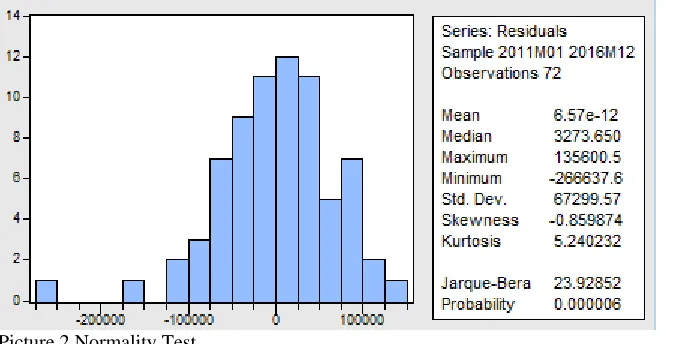
This normality test aims to test whether the dependent variable regression model, independent variable or channel is normally distributed or not. Good models are those that have normal distribution data
Picture 2 Normality Test
[image:3.612.37.384.329.501.2]Jarque-Bera analysis result shows 23.92 value while X2 value with significant value 0,05 or probability 0,95 is 51,73. Because the value of Jarque-Bera <X2 then indicates that the data is normally distributed.
Table 1 Multicollinearity Test Results
DPK DPKT_1 ROAT_1 NPFT_1
DPK 1.000000 0.074473 -0.119721 -0.240088 DPKT_1 0.074473 1.000000 0.037224 -0.357833 ROAT_1 -0.119721 0.037224 1.000000 -0.078762 NPFT_1 -0.240088 -0.357833 -0.078762 1.000000 Source: Processed data, 2017
A model is said to meet the assumption of non-multicolinearity that a relationship variable that has a value greater than 0.9 Based on the above table, it can be concluded that the model has met the assumption of non-multicollinearity.
Autocorrelation Tests
Heteroscedasticity Test
Table 2 Heteroscedasticity Test Results
Source: Processed data, 2017
Prob value. From F arithmetic and Chi-Square calculated from Glejser test results in this study is said to be free from heteroscedasticity because t-count value < t-table with probability significance above alpha 0.05.
Hypothesis Test Results
1) Test Result F
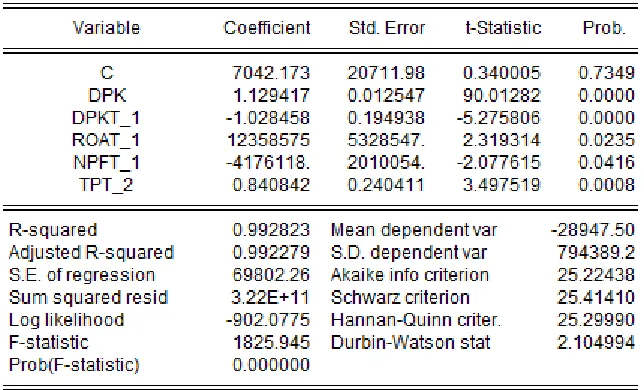
F test results can be seen in Table 4.3. Prob value. F (Statistic) of 0.00000 is smaller than the 0.05 significance level so it can be concluded that the estimated regression model is feasible to be used to explain the influence of Third Party Fund, Return on Assets, and Non Performing Financing on the dependent variable of Total Financing.
2) Coefficient Test Results Determination (R2)
Based on the estimate equation, the value of adjusted R squared is 0.9928. This indicates that the variation of the change of variable Y can be explained together by the variables of Third Party Fund, X2 Return On Asset and Non Performing Financing of 99.28 percent while the remaining 0.72 percent explained by other factors not described in the model of this equation.
3) Partial Test Results (t test)
Based on Table 3 then t test results are:
The third party fund variable is obtained by t-count 90.01 and probability 0.00. This shows that the DPK has a positive and significant effect on total financing
Variable of third party funds in the previous year was obtained t-count -5.27 and probability 0.00. This indicates that the previous year DPK had a negative and significant effect on total financing
The variable return on asset of the previous year is obtained t-count 2.31 and probability 0.02. This shows that the previous year's ROA has a positive and significant effect on the total financing
The variable of net performing financing of the previous year was obtained t-count -2.07 and probability 0.04. This indicates that the NPF of the previous year had a negative and significant effect on total financing.
The total variable of previous year's financing is obtained t-count 3.49 and probability 0.00. This indicates that the total financing of the previous year had a positive and significant impact on total financing
Tabel 3 Estimated Result
Source: Processed data, 2017
The multiple linear regression (equation) models that have been estimated below:
TP = 7042.173 + 1.129417DPK - 1.028458DPK t-1 + 12358575ROA t-1 - 4176118NPF t-1 + 0.840842TPT t-2
1. The Influence of Third Party Funds To Total Financing
Result of t test get statistical t value equal to 90.01 and value of probability equal to 0.00 (less than 0.05). This means that partial funds have a positive and significant effect on total financing.
Positive influence means that more DPKs make higher total costs. Vice versa, the lower the DPK then the total spending is also lower. Based on the regression coefficient, DPK yields a value of 1.129. This means that any increase in DPK by 1 percent will decrease the total financing by 1,129 percent.
The results of this study are Khatimah (2009) which states that the DPK has a positive and significant effect on financing. This analysis also shows that the amount of expenditure disbursed by an SRB in Indonesia depends on the funding factor that can be collected by an SRB from the community.
The positive effect of DPK on financing is also seen from the growth data every year. Where the growth of DPK rose from Rp. 1,640,651 million in January 2011 to Rp. 2.095.333 million in December 2011, this incident with an increase in financing which also increased from Rp. 2.084.220 million in January 2011 to Rp. 2.675.930 million as of December 2011.
As for the previous year DPK T test results get negative statistical t value and value of probability of 0.00 (smaller than 0.05). This means that third party funds is negative and significant to financing.
Negative influence means DPK year after making the total financing down. Vice versa, the higher the previous year DPK then the total cost is also lower.
2. Influence of ROA Against Amount of Financing
The result of t test gets the value of t equal to 2.31 and the value of probability is equal to 0.02 (less than 0.05). This means that the previous year's ROA has a positive and significant effect on total financing.
Positive influence means the higher the ROA of the previous year then the financing will also be higher. Vice versa, the more ROA makes the shopping lower. Based on the regression coefficient, the ROA of the previous year yields a value of 1235. This means that an ROA of 1 percent will increase total financing by 1235 percent.
The Research of Wahyudi (2010) which concludes that positive and significant ROA on mudharabah financing.
3. The Influence of Non Performing Financing To Total Financing
The result of t test get statistical t value equal to -0,026 and value of probability equal to 0.04 (less than 0,05). This means that NPFs in the previous year partially have a negative and significant effect on total financing.
Negative influence means that higher NPFs make financing down. Vice versa, the lower the NPF will rise. Based on the regression coefficient, the NPF of the previous year has a value of -4176. This means that each NPF stream of 1 percent will reduce total financing by 4176 percent.
The results of this study are similar to the authors' hypothesis which is also in line with previous research by Maula (2009) which states that NPF is characterized negatively on financing. This analysis also shows that the amount of expenditure disbursed by an SRB in Indonesia depends on the funding factor that can be collected by an SRB from the community.
IV. CONCLUSION
Based on the results of the research, it can be concluded that the DPK is positive and significant, DPK previous year is negative and significant, positive and significant ROA, and NPF have negative and significant effect to total financing in BPRS in Indonesia. The variable of variable Y is the variable that is adjusted to the variables of Third Party Fund, Return on Asset and Non Performing Financing equal to 99.28 percent while 0.72 percent by other factors not included in this model. Hopefully with this Research Sharia banking and practitioners can pay more attention to Sharia Financing Bank in Indonesia. In addition, the NPF rate of SRB is quite high above 5 percent need to be a concern in order to further improve productivity and effectiveness.
REFERENCES [1] Firdaus, Muhammad. 2012. Akuntansi Biaya. Yogjakarta:
[2] Jamilah. 2016. Faktor-Faktor yang Mempengaruhi Pembiayaan Mudharabah Pada BUS di Indonesia. Jurnal Ilmu dan Riset Akuntansi 3(3):1-20
[3] Khatimah, Husnul. 2009. Analisis Faktor-Faktor yang Mempengaruhi Penyaluran Dana Perbankan Syariah di Indonesia Sebelum dan Sesudah Kebijakan Akselerasi Perbankan Syariah Tahun 2007/2008. Jurnal Optimal 3(1):1-14.
[4] Maula, Khodijah Hadiyyatul. 200. Pengaruh Simpanan, Modal Sendiri, Marjin Keuntungan Dan NPF Terhadap Pembiayaan Murabahah Pada Bank Syariah Mandiri. Skripsi. Yogyakarta: Universitas Negeri Sunan Kalijaga
[5] Mizan. 2017. DPK, CAR, NPF, DER, dan ROA terhadap Pembiayaan Murabahah Pada BUS. Jurnal Balance 18(1):1-12
[6] .Wahyudi, Vicky. 2010. Analisa Faktor-Faktor yang Mempengaruhi Penyaluran Dana Bank Syariah (Studi kasus: Bank Syariah Mandiri). Tesis. Dipublikasikan. Padang: Universitas Andalasan
AUTHORS
First Author – Suryani Evroza Komaria, Student, Sriwijaya University, Indonesia, [email protected].
Second Author – Nurlina Tarmizi, Lecturer, Sriwijaya University, Indonesia, [email protected]
Third Author – Sa’adah Yuliana, Lecturer, Sriwijaya University, Indonesia, [email protected]