SEPT, Vol. I, ISSUE-II www.srjis.com Page 276 DOES LEARNING MUSIC AFFECT STUDY HABITS OF LEARNERS?
Sonal Chabra,
Aravali College of Advanced Studies in Education, Ballabgarh-Sohna road, Village Pali, Faridabad
Tulika Bansal,
PhD Scholar, Guru Gobind Singh Indraprastha University Mahima Misra,
Teacher, The Shriram School, Faridabad
Received: 22 August 2012 Accepted: 25 September 2012
Music is more pervasive now than at any other point in history, functioning not only as a pleasurable art form, but also serving many important psychological functions (MacDonald, Hargreaves and Miell, 2002). In Indian culture, music has always held a special place, whereby music has been regarded as a path to achieve salvation. With time, several things have changed and so has the importance of music also. However, learning music is still regarded not just a hobby but a discipline inducing activity. This study attempted to ascertain whether learning music does has any impact on the study habits of adolescents in this academic driven society. The sample of 80 was drawn from the school going adolescents from Delhi. The results failed to establish any significant correlation between learning music and study habits.
Key words: Learning, Music, Study habits, Learners
Introduction
There's music in the signing of a reed; There's music in the gushing of a rill; There's music in all things, if men had ears:
Their earth is but an echo of the spheres.
- By Lord Byron
These lines by Lord Byron very truly indicate that this universe is but a conglomeration of energies, sound energy being an important aspect of it. Music is one of the simple joys in life. A catchy beat or soothing melody can provide a sense of control, release
SEPT, Vol. I, ISSUE-II www.srjis.com Page 277 of negative feelings, and boost in mood and outlook. Music has been shown to bestow many benefits beyond simple listening enjoyment---studies have shown its positive effects on a person’s mood and memory recall. Classical music, considered high quality or “good” music has been associated with these behaviours and other aspects of brain function. While no scientific evidence has proved that listening to classical music will make a person more intelligent, numerous studies suggest that doing so can improve learning and cognition. Thus it can be safely said that music is a very powerful and awesome tool that can have positive effects, virtually life saving mentally and physically when used in the right context, but has equally destructive and detrimental potential if used negatively.
Music has touched the human soul across all boundaries of time, space, and genre. Music is more pervasive now than at any other point in history, functioning not only as a pleasurable art form, but also serving many important psychological functions (MacDonald, Hargreaves and Miell, 2002). In addition, music can play a powerful social role, facilitating communication (O’Donnell et al., 1999), influencing cognitive functioning (Rauscher et al., 1993), arousing deep emotions (Juslin and Sloboda, 2001), and influencing the establishment and maintenance of social groups (Hargreaves and North, 1997). “Music education opens doors that help children pass from school into the world around them a world of work, culture, intellectual activity, and human involvement. The future of our nation depends on providing our children with a complete education that includes music”, said Gerald Ford, former President, United States of America. Similarly U.S. Secretary of Education Richard W. Riley, July 1999 remarked that “Studying music and the arts elevates children’s education, expands students’ horizons, and teaches them to appreciate the wonder of life”. Study behaviour utilises several techniques of learning. This process is a planned program of subject matter mastery. The process includes a deliberate attempt to extend and facilitate learning. Amidst this context, study habits need to be understood as activities carried out by a learner during the learning process for the purpose of improving learning (Husen and Psotlethaite, 1994). Students often develop systems to support learning and committing information to memory. Examples of study strategies for reading a textbook may include underlining key terms, creating an outline and taking elaborative terms. In simple words, study habits are the ways that you study - the habits that you have formed during your school years. Study habits can be good ones, or bad ones. Good study habits include being organized, keeping good notes, reading your textbook, listening in class, and working every day. Bad study habits include skipping class, not doing your work, watching TV or playing video games instead of studying, and losing your work. The basis for a theory of study habits comes from the information processing approach of human learning. Further ACT network model of memory also supports the concept of study habits. Several studies have shown the significant relationship between study habits and academic achievement.
Purpose of the Study
SEPT, Vol. I, ISSUE-II www.srjis.com Page 278 generally critical to success in school, are considered essential for acquiring good grades, and are useful for learning throughout one’s life. The idealists believed that music is a good way to captivate your wandering brain and make it focus. Further recent research in neuropsychology suggests new ways music can enhance learning. Optimal learning occurs when the two hemispheres of the brain work together. Any teaching strategy, such as music, that integrates the functions of both hemispheres uses the natural design of the brain to make learning easier, faster, and more fun.
Unlike most studies that have been conducted to find out how music affects studying, i.e. the effect of music while a student is studying; this particular study is concentrating on the after effects of music. The study undertaken here concentrates on whether the study habits of a person, an adolescent student to be more specific, are better for those who are learning music or for those who are not learning music. This specifically means that the study wants to investigate whether music produces a kind of introspective humility and conscientiousness among the listeners which ultimately moves them to perform better or work more sincerely towards their goal in life.
Objectives
1. To study the study habits of adolescent students learning music. 2. To study the study habits of adolescent students not learning music.
3. To find out the difference in study habits of students learning music and those not learning music.
Research Method
The present study is a Descriptive Research as information is gathered from a sample of adolescent students drawn from a cross section of pre-determined population of adolescent students of schools in New Delhi, at one point of time.
Sample & Sampling Technique: In the present case the sample of survey were 40 students from classes 9th to 12th, learning music and 40 students from classes 9th to 12th not learning music. These students were selected from 4 different schools of South Delhi. Stratified random sampling was used for selection of sample.
Tools used: The tool used for the present study was Study Habits Inventory by Prof. M. Mukhopadhyay and Prof. D.N. Sansanwal. The inventory comprises of 52 items which characterize the basis of study habits. The items have been drafted in affirmative (32items) and negative (18 items) forms.
Data analysis: In the present study the data collected on study habits was analyzed by the means of descriptive statistics, i.e. mean, median and mode. To compare the study habits of adolescents learning music and those not learning music, t-test was applied.
Findings
SEPT, Vol. I, ISSUE-II www.srjis.com Page 279 1. Study habits of adolescents learning music – The adolescents learning music had achieved a total score of 1247 and the average score of 122.025. Study is not a one-dimensional behaviour, neither are study habits. Scores obtained on different skills are given in the following table and discussed below –
TABLE: 1
Study habit scores of adolescents learning music Category Obtained score
(Average)
Interpretation
Comprehension 31.18 Good
Concentration 24.15 Good
Task orientation 23.23 Good
Study sets 12.1 Poor
Interaction 5.93 Average
Drilling 8.33 Average
Supports 9.33 Above average
Recording 5.95 Good
Language 1.8 Average
Total score 122.025 Above average
Overall the adolescents learning music have above average study habits. This is a good indicator. Many psychologists in recent writings have mentioned the implications of study habits and the part these habits play in developing a well adjusted personality. The habits and work skills they develop now will not only impact their high school career, but also their adult life as they will use these same skills in college and/or the workforce. Their study habits in various skills have been discussed below -
Comprehension - The group scored an average score of 31.18, where the maximum score achievable in this area was 48. Therefore the group has scored an average of 64.9 % marks. This is quite a good score. The comprehension ability of the group is good. Comprehension is a much desired skill because of the increasing amount and sources of information children are exposed to.
Concentration - The group has scored an average of 24.16 marks, which indicates that they have good concentration. According to Princeton University’s Word Net, concentration means: “great and constant diligence and attention”. Learning music would contribute to good concentration among the learners.
Task orientation – The group has achieved an average score of 23.23. The group has therefore achieved 64.53% marks in this skill, which is again a good score.
SEPT, Vol. I, ISSUE-II www.srjis.com Page 280 is not used for further analysis. The poor score in this area does not account for much analysis.
Interaction - The sociability and gregariousness of a child helps him/her connect better with the people around him/her. This proves helpful when a child needs help in understanding some difficult or tricky portions of studies. The group has scored 5.93 where as the maximum achievable score was 12. The percentage score is 49.4% which is an average score. It has much scope for improvement.
Drilling - Practice makes a man perfect and who must understand this better, than those studying the creative arts. The music group has scored an average score of 8.3 out of the maximum score of 16. It is 52 percent approximately which is just an average score. Supports - This determines whether the students are able to use other sources of knowledge apart from the books prescribed for them. It means studying extra, and trying to gain knowledge for the sake of knowledge. The music group has scored an average score of 9.33, which is an above average score.
Recording or notes-making - The group has scored an average of 5.95, which is a very good score. This is again an important skill as it helps students keep a record of all they have learnt, help them arrange their information in order so that it can be available at the time of need or recall, i.e. exams or tests.
Language - The average score achieved in this category by the group is 1.8, which is just an average score.
Following graph would make the situation more clear.
Graph – Scores on different study habits of adolescents learning music
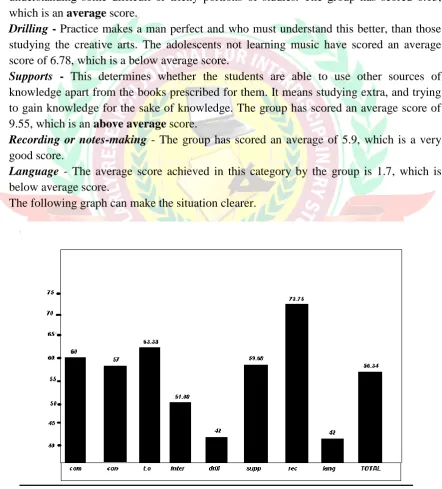
SEPT, Vol. I, ISSUE-II www.srjis.com Page 281 Comprehension - The group has scored an average score of 28.83, which is a good score. The comprehension ability of the group seems to be good.
Concentration - The group has scored an average of 23.1marks which lands the group in the above average category.
Task orientation - The group has achieved an average score of 22.8, which is again a good score.
Study sets - The average score in this skill is 12.4 with the maximum marks achievable 28. As indicated earlier, this was not accounted for analysis.
Interaction - The sociability and gregariousness of a child helps him/her connect better with the people around him/her. This proves helpful when a child needs help in understanding some difficult or tricky portions of studies. The group has scored 6.13, which is an average score.
Drilling - Practice makes a man perfect and who must understand this better, than those studying the creative arts. The adolescents not learning music have scored an average score of 6.78, which is a below average score.
Supports - This determines whether the students are able to use other sources of knowledge apart from the books prescribed for them. It means studying extra, and trying to gain knowledge for the sake of knowledge. The group has scored an average score of 9.55, which is an above average score.
Recording or notes-making - The group has scored an average of 5.9, which is a very good score.
Language - The average score achieved in this category by the group is 1.7, which is below average score.
[image:6.595.81.524.247.737.2]The following graph can make the situation clearer.
SEPT, Vol. I, ISSUE-II www.srjis.com Page 282 3. Comparison of study habits of adolescents learning music and not learning music.
The adolescents learning music and not learning music did not differ significantly on their study habits.
TABLE: 2
Comparison of Scores of Adolescents Learning Music and those not Learning Music.
CATERORY M1 M2 t-value INTERPRETATION
Comprehension 28.83 31.175 1.74 No significant difference
Concentration 23.1 24.15 0.596 No significant difference
Task orientation 22.8 23.23 0.347 No significant difference
Study sets - -
Interaction 6.13 5.93 0.34 No significant difference
Drilling 6.78 8.3 2.62 Difference is significant
Supports 9.55 9.33 0.384 No significant difference Recording 5.9 5.95 0.12 No significant difference
Language 1.7 1.8 0.79 No significant difference Total average score 117.18 122.025 1.1406 No significant difference
Conclusion
Study habits differ from person to person. Some find it more interesting and convenient to study late in the night where as some cannot awake late but find it more useful to get up early in the morning and study. Let there be any method or any time, main aim should be to get information through the media of newspapers, magazines, books and other method to enrich the knowledge besides using for benefits of the reader or student. The analysis of the present study left the researchers with the view that learning music does not affect the study habits of adolescent students in general. There was no significant difference found in the specific study skills mentioned in the tool except for drilling or practice. The students studying music showed a better score in the area of drilling as compared to those not learning music. Both the groups showed excellent results in the field of recording or notes making. The adolescent students seem to take interest in keeping the learnt information in order for future reference and use.
SEPT, Vol. I, ISSUE-II www.srjis.com Page 283 innumerable sources of knowledge available for children. Knowing how to study would make comprehension easier; study habits can be developed or rather pupils can be trained.
References
Hargreaves, D.J. & North,A.C. (Eds.) (1997). The social psychology of music. Oxford: Oxford University Press.
Harland, J., Kinder, K., Lord, P., Stott,A., Schagen, I. & Haynes, J. (2000). Arts education in
secondary schools: Effects and effectiveness. Slough: National Foundation for
Educational Research.
Husen, T., & Postlethwaite, T. (Eds.). (1994). The international encyclopedia of education (2nd ed., Vol. 7). Oxford, England: Permagon.
Juslin, P.N. and Sloboda, J.A. (eds) (2001) Music and Emotion: Theory and Research. London: Oxford University Press.
MacDonald, R.A.R., Hargreaves, D.J. & Miell, D. (Eds.) (2002). Musical identities. Oxford: Oxford University Press.
NCERT (2000). National curriculum framework for school education, New Delhi: NCERT. O’Donnell, P.J., MacDonald, R.A.R. and Davies J.B. (1999) ‘Video Analysis of the Effects
of Structured Music Workshops for Individuals with Learning Difficulties’, in D. Erdonmez and R.R. Pratt (eds) Music Therapy & Music Medicine: Expanding
Horizons, pp. 219–28. Saint Louis, MO: MMB Music.
Purdies & Hattie, J. (1999). The relationship between study skills and learning outcomes: A meta-analysis, Australian journal of education, 43, No.1, pp 72-85.
Rauscher, F., Shaw, G., Ky, K. (1993). Music and spatial task performance, Nature, 365 611. Retrieved 2009-04-29.