African-American Studies Theses Department of African-American Studies
Spring 4-20-2018
The Daughters of Baartman Return the Gaze:
Sexual Shaming and Africana Women's Perceptions
of and Speculations on their Sexual Agency and
Futures
Melanie Mccoy
Follow this and additional works at:https://scholarworks.gsu.edu/aas_theses
This Thesis is brought to you for free and open access by the Department of African-American Studies at ScholarWorks @ Georgia State University. It has been accepted for inclusion in African-American Studies Theses by an authorized administrator of ScholarWorks @ Georgia State University. For more information, please [email protected].
Recommended Citation
Mccoy, Melanie, "The Daughters of Baartman Return the Gaze: Sexual Shaming and Africana Women's Perceptions of and Speculations on their Sexual Agency and Futures." Thesis, Georgia State University, 2018.
AFRICANA WOMEN’S PERCEPTIONS OF AND SPECULATIONS ON THEIR SEXUAL
AGENCY AND FUTURES
by
MELANIE “ZALIKA IBAORIMI” MCCOY
Under the Direction of Sarita Davis, Ph.D., MSW
ABSTRACT
The objective of this research study is to examine the lives and sexual and social relationships of
400 Africana women between the ages of 18-65. The following research questions are: 1) How
do Africana women, based on their sexual and social relationships, believe they are perceived by
Africana communities? 2) How do Africana women, based on their sexual and social
relationships, imagine the creation of sexually and culturally affirming spaces for themselves and
other Africana women in the future? This study uses a mixed methods approach including
survey, interviews, and Photovoice to understand Africana women’s perceptions of the
possibility of a sexually affirmed future. Participants were selected using purposive sampling
methods. Afrofuturism is the guiding theoretical framework used for this study as well as
Womanism.
AFRICANA WOMEN’S PERCEPTIONS OF AND SPECULATIONS ON THEIR SEXUAL
AGENCY AND FUTURES
by
MELANIE “ZALIKA IBAORIMI” MCCOY
A Thesis Submitted in Partial Fulfillment of the Requirements for the Degree of
Master of Arts
in the College of Arts and Sciences
Georgia State University
Copyright by Melanie Ashley McCoy
WOMEN’S PERCEPTIONS OF AND SPECULATIONS ON THEIR SEXUAL AGENCY
AND FUTURES
by
MELANIE “ZALIKA IBAORIMI” MCCOY
Committee Chair: Sarita Davis
Committee: Lia T. Bascomb
Jennifer Williams
Electronic Version Approved:
Office of Graduate Studies
College of Arts and Sciences
Georgia State University
DEDICATION
I dedicate this to my ancestor, my mother, Lezlie McCoy. You are a woman who filled
me up with love and taught me never to hide. Thank you for guiding me through this process. I
love you.
I dedicate this to my father, Orrin McCoy. Daddy thank you for acceptance and
protection. I love you.
I dedicate this to my grandmother, Vencenia Walters. You instilled in me Grandma
Vennie Womanist Politics. I love you.
I dedicate this to Saartjie Baartman. Your story encouraged me to look inward and
outward. May your life influence the futures of Africana women.
Finally, I dedicate this to every jawn, hoe, hood girl, ratchet women, Black trans woman,
Black sex worker and Black queer woman- you are the reason for this thesis. You, my sisters, are
the daughters of Baartman.
ACKNOWLEDGEMENTS
I want to give thanks and honor to the Lord, the Orishas and my ancestors. Amen. Asé.
Thank you to my sister Nykia Harrison and my brother, Montez Smith. We have been through so
much together and you saved my life. I love you two. Thank you to my best friend, Brittany
Evans. May we forever be weird in piece. I love you sis. Thank you to the greatest scholarly
mother and thesis chair of all time, Dr. Sarita Kaya Davis. I cannot wait to read the book! Thank
you to my mentor and friend Dr. Jennifer Williams. I can see the future and YOU ARE IN IT.
Your mind is absolutely incredible and you are going to change the world of Afrofuturism
FOREVER. *Wakanda Forever* Thank you to my professor and committee member, Dr. Lia
Bascomb. Thank you for pushing me and urging me to take a deep breath. Thank you to Beza
Fekade and Dante Studamire for being part of the research team! *shouts* TU! *response* AF
AM! Thank you to my Temple University Africology family. Thank you to the faculty, staff and
students at Georgia State University. I would like to thank my godmother, Iya Darasia Selby.
Alaafia! Thank you to the Malcolm X Grassroots Movement! Thank you to every woman who
participated in the research study. Thank you to my family, church family and community.
Thank you to Rashida and Timothy Welbeck. I am so appreciative of all of your prayers. Thank
TABLE OF CONTENTS
PROLOGUE ... 1
1 INTRODUCTION ... 8
1.1 Purpose of the Study ... 8
1.2 Background ... 9
1.3 Problem Statement and Purpose ... 12
1.4 Significance of the Study ... 14
1.5 Nature of Study ... 16
1.6 Research Questions ... 17
1.7 Operational Terms ... 17
1.8 Conceptual Framework ... 22
1.9 Limitations, Delimitations, Assumptions and Scope ... 22
1.10 Conclusion ... 24
2 LITERATURE REVIEW ... 24
2.1 A History of the Racialized Sexual Subjugation of Africana Women ... 25
2.2 Her Sins, Their Salvation: Purity Culture and the Black Church ... 47
2.3 The Queers, Freaks, Hoes and THOTS as Other: Sexual Shaming as a Dehumanizing Effort and It’s Effects ... 59
2.3.1 Transphobia Against Black Trans Women ... 64
2.4 Deviant Blackness, Otherness, and Sex-Positivity ... 74
2.5 “My Own Term for Such Women Would Be…” : Womanism as the Praxis of Black Womanhood and Sanctuary for the Future ... 82
3 METHODOLOGY ... 95
3.1 Approaches ... 95
3.2 Research Questions ... 97
3.3 Participants ... 97
3.4 Recruitment ... 98
3.5 Measures ... 98
3.6 Survey ... 99
3.7 Interview ... 101
3.8 Photovoice ... 102
3.9 Data Collection ... 103
3.10 Reliability/Validity ... 104
3.11 Data Coding Interrater-Reliability ... 105
3.12 Summary ... 105
4 FINDINGS ... 106
4.1 Survey ... 108
4.1.1 Sociodemographics ... 108
4.1.2 Sexual Shaming ... 111
4.2 The Participants ... 116
4.3 The Interview ... 117
4.4 Overview of Themes ... 130
4.5 Data Collection Procedure Applied to Data Analysis ... 133
4.6 Data Presentation and Analysis ... 135
4.7 Photovoice ... 154
4.9 Afrofuturism ... 160
4.10 Conclusion ... 163
5 CONCLUSIONS ... 164
5.1 Implications for Africana Studies and Afrofuturism ... 171
5.2 Limitations of the Study ... 172
5.3 Recommendations for Future Research ... 173
5.4 Conclusion ... 174
REFERENCES ... 176
APPENDICES ... 183
Appendix A.1: Survey Informed Consent ... 183
Appendix A.2 Interview Informed Consent ... 186
Appendix B Flyer ... 190
Appendix C: Survey ... 191
Appendix D: Interview Demographics Form ... 193
Appendix E: Interview Guide ... 195
LIST OF TABLES
Table 1 Sociodemographic Description of Africana Women Survey Participants ... 109
LIST OF FIGURES
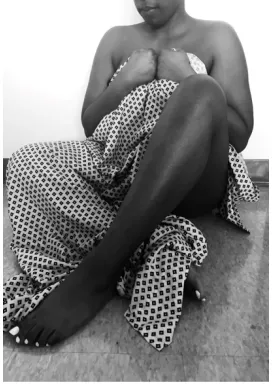
Figure 1 Photo 1 ... 155
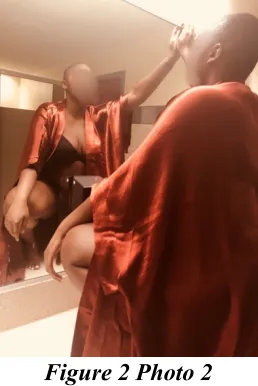
Figure 2 Photo 2 ... 156
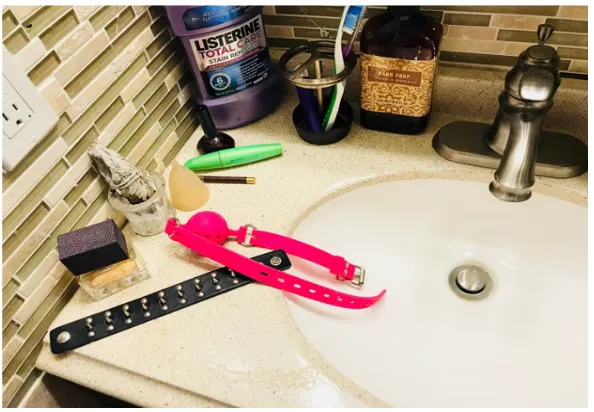
Figure 3 Photo 1 ... 157
PROLOGUE
At the age of 15, my rose-colored ideas about Black girlhood shifted. In the basement of
my high school gym, I was sexually assaulted by a 17-year-old athlete, who was well on his way
to his dream HBCU. As his dreams blossomed, my own dreams began to wither. I thought that
being the daughter of a pastor and a God-fearing mother would demonstrate my “goodness” as a
Black girl. I once believed that if I remained a virgin, I would one day be rewarded by God,
because I saved my gift for the man that “He” chose for me. If I received excellent grades and
went to college, all would be well in this imaginary exceptional world for Black women; that
irrevocably changed after my “run-in” with the athlete.
I sat in the gym, a bit confused by which part of that floor I was in. I would learn later
that it was a vacant boys’ bathroom. I tried to relieve myself with the thought of, “It’s only
molestation,” but that thought could only comfort me but for so long. I replayed how my fear
aroused him, and I recall the fluid-like residue from his excitement. I have lost aspects of my
memory from this time, but I remember the pressure on the back of my head as he pushed it-
“just kiss it.” All that I wanted to do was study for my World History exam; it was finals week
and the exam was about an hour away. I needed to ace this thing. I was doing what a “good
student” would do and he asked if he could speak to me. I heard those whispers behind a door- it
was his voice and he was asking me something, but I could not hear what he was saying. I
walked in unsuspecting, my wrist was pulled and suddenly another door shut behind me. Was I
losing my mind? This could not happen. Here I was a girl 4’10” and less than 100 lbs., and he
was closer to 200 pounds, or at least he looked that way, and a little over 6 feet tall. I can
remember his hands around my neck, my body being pressed against a cold wall, air and
except, I was not kissing back. I whispered, “Please stop.” Why the whisper? I was embarrassed
that someone would get the “wrong” idea, I was ashamed and I could not bear for the kids to find
out that the Christian girl was caught with some boy, even if she did not want it. I thought if I
spoke to him calmly he would stop. He was mostly quiet and I really wanted him to speak,
because my senses caused me to lose my ability to see. He told me something- he said that I was
“beautiful,” and ever since this time for years I found nothing but ugliness and grotesquerie
within the word. My mind went into shock. He was so quiet, and I could feel him all over me. It
reminded me of one of those Disneyworld attractions that my mother and father would take me
to as a little girl- the alien escaped and we all enjoyed the thrill of being scared as the lights were
turned out; we could hear the alien. But this time, there was nothing to enjoy, this was not
Disneyworld and I was not 7. This was no alien; this was a person that I knew, and the only thing
that felt alien was me.
In all honesty, I could not stand the boy. He observed me from September to June, and
because I would hang out with my brother, who identified as my lesbian sister at the time, he
would ask me vulgar questions. He asked me if I liked to go down on women and if I was a
lesbian, and I would respond that if this were the case I would not be interested in him. A few
days later, I would live out a day that would hollow my heart and my peace. Tuesday, June 12,
2007, he molested me and he came back a few minutes later to tell me that I was a waste of time
because he could not get my pants down. He told me that I had to leave the area, because he did
not want anyone to think that anything happened to me. I nodded in agreement; I just wanted a
moment recuperate. I called my brother. He was at high school graduation rehearsal, and when
he answered I told him that I felt strange. He was so worried and angry, because I was so
friends had already gotten to me and told me that he was a young Black man and that if I told
anyone that I would be ruining his future. What about mine?
I grew into silence, while finding refuge with “others”- Black girls with reputations:
“whores” and “queers.” I felt ashamed for the thoughts that I had about “other” Black girls,
because now with all of the rumors floating around about what he and I had “done,” there was no
recovery. High school was a nightmare for me, before I revealed my assault to my family. Black
boys offered to pay me money for sex, while Black girls would call me and ugly and sad ho. It
did not matter what the truth was, because within this community a lie being told repeatedly
became the truth. After my family found out the news, they tried their best to get justice for me,
but sadly, they could not get the information needed from me to do so. Over time, the rumor
circulated that I was a teenage sex worker who only had sex with older men; that broke my spirit.
I felt alien. Within an 8-year span, I was diagnosed by therapists with PTSD, struggled with
depression, and tried to take my life numerous times. My grades went from mostly A’s to mostly
F’s, and as a result I almost did not make it into college, despite going to one of the best high
schools in the city. The high school I attended cared more about their reputation than the fact that
a student was assaulted. If I did not attend therapy, I would have been kicked out of school for
my poor grades. Thankfully, my family advocated on my behalf and demanded justice. With the
love and support of my family and friends, I was able to begin to heal.
Today, when I reflect on what happened, I have a much different perspective. What if I
was the “hoe” everyone accused me of being; would that have meant that I was not worthy of
love, kindness, or being treated like a human being? Whether I was sexually assaulted or not
what if I did have sex with all of the boys that everyone said that I did - why would that alter the
attacker? I would not be the first Black girl or woman that this would happen to and I know that I
am not going to be the last. Today, I ponder the respectability of those young people. I consider
how their criticisms are the same criticisms against Black women with non-normative
expressions of sexuality, orientation or identity by adult Black people. Walking around the
streets of Philadelphia, it was then that I learned on Broad and Olney that a “bitch” was no
woman, or maybe on Girard Avenue that “these females have no respect for themselves.” In
West Philly, an “Afrocentric” man would say “Peace Queen” and even if I greeted him as long as
it was not met with reciprocal romantic interest, I would understand in about seven seconds or
less that I would go from being a “queen” to a “bitch.” This is equivocal to the echoes of “Hey
soul-sister,” heard by Fran Sanders as she walked down the street in “Dear Black Man”
(Bambara, 1970, p. 90). Like myself, she frequently heard this, and the initial feeling is to give
Black men the benefit of the doubt. Sometimes, like Sanders, I would crack a smile in response
and nod. However, most days I gained a mistrust after the hundredth “well, fuck you too then,
bitch.” Sanders in her essay, negotiated what those greetings meant and there were times, and
still are times, when those greetings are just euphemisms for “Hey, Bitch” (Bambara, 1970, p.
90). My brain rattles as I think about how Black men or even some women make it clear that not
all Black “females” are women, even though the socially-constructed gender category for
woman, for those who identify this way signifies human status. Misnaming, also affects women
in other ways, especially trans women; they often experience misgendering. This kind of
misgendering, and shaming, complicates what C. Riley Snorton identifies as the “psychic
dimensions of passing” for trans people as their race and gender intersects (Snorton, 2009, p. 77).
Misgendering is in opposition to the idea of passing, not as a physical characteristic, but one that
My Aunt is a Black trans woman and my brother, a Black trans man has shown me
another level of shaming that comes with not being cisgendered, straight, or a “model Black
citizen.” The constant misgendering they endure is based on a sexual shaming practice rooted in
a false notion of gender and sexuality. Although, experiencing sexual shaming from other Black
people, I have never faced this level of scrutiny as a cisgendered heterosexual Black woman.
What I do recognize is that what this comes with, whether it be from transphobia or the vilifying
of Black women to their sexual and social relationships, are the unfavorable politics of the
non-normative practices of Africana women.
Pertaining to sexual assault, it happened two more times between my college and early
adult years. My teenage attacker assaulted numerous women, by way of rape and was even
expelled from Morehouse because of it. Years later, he assaulted a young woman who went to
high school with us. She was brave and pressed charges. I was tracked down and asked if I could
testify against him. It ended up being a separate case. He got off with probation because 1) as a
15-year old Black girl of course I had sexual experience - that is what his Black lawyer implied
by stating with a smile, “So you were 15 and had never seen or been around a penis?’ and 2) the
other young women’s bisexual status and open sexual expression. This had everything to do with
the notion that Black girls are inherently sexual, and that Black women are over-sexualized and
deviant. The intersections of our race and gender, were being weaponized against us. In a study
conducted by PerryUndem in 2017, 28 percent of Black women, from a sample size of 1,003
adults, who participated in the study stated that someone had sex with them without their
consent. Other participants expressed something similar by using other language, which will be
However, it is important to my formative teenage years to acknowledge something - it
would be something that would protect me. I made over ten suicide attempts in high school.
While in therapy at Women Organized Against Rape, I had to fill out intake forms. One of the
questions was always about the future: “Do you believe you have a future?” / “Can you see
yourself in future?” Sometimes I answered with the choices reflecting that I could, because I just
wanted to get out of therapy even if I was lying, but most days I would say that I could not or
that I did not know. As a means to escape, I would write short sci-fi stories about overcoming all
of this sexual shaming and also about how this world of mine was so dystopian with my 15 to
16-year-old language. One day, I would be my own superheroine. Before the words Afrofuturism
came to be in my mouth, it was then that I realized that Afrofuturism was always there and saved
my life. It was Womanism, that provided to me sanctuary. I learned as a human how to become
what Toni Morrison in Sula, a literary work on the coming of age of two Black women friends,
one of whom is demonized by her community for her unconventional sexual relationships and
experiences, refers to as “something else to be” (Morrison, 1973, p. 52). I decided to not let the
past dictate my sexual future, even if it was upsetting to my community.
This thesis engages Afrofuturism, Womanism, and Black sexual politics to reconsider the
idea of the “flesh” as imagined by Hortense Spillers as “something else to be”: a space allowing
for practices that center Blackness and privilege sexual autonomy and pleasure. I am not the first
Black woman to experience sexual violence, it is part of the fabric of enslaved African women’s
history like Saartjie Baartman, who was not only placed on public display in London and Paris
for the white and male gaze on her nude body as primitive, but also placed on display for the
mutilated and displayed in a museum. However, Baartman has become the mother of those who
have chosen “something else to be.”
It is seminal to discussions of Black womanhood and feminism to consider the sexual
expression of Africana women that are deemed unacceptable, shameful and downright nasty.
However, in viewing Hip Hop, ratchet girl status, hood, ho culture, pornography, BDSM,
internet cam girls, and social media culture, some Africana women may actually be heroines by
broadening, reclaiming and reaffirming Black women’s sexuality and humanity. While racially
essentialist systems and techniques aim to vilify these women as deviant and disgraces to Black
communities, this same group of women aim to challenge the norms. Sexuality or sexual acts are
processes of initiation, that often alter the life paths of Africana women, which also is a
component of why sexual trauma is so devastating. Additionally, what some may categorize as
overtly sexual is often categorized as something stemming from a traumatic event; some of the
lives and practices of these women challenge that narrative. Sexuality should not share
synonymy with trauma, as the politics of pleasure should engage desire as a healthy practice.
Furthermore, not every sexual expression or act is immediately an act of pleasure, as it may be
for monetary compensation or resource.
Sexual shaming, an operation that seeks to recognize this particular group of Africana
women as anything less than fully-human, is not designed to uplift or sustain their capacity to
live. It is a violence, expressed physically, systemically, emotionally and verbally that seeks to
destroy any possible actualized or imagined future. It is an etymological fallacy that seeks to
deny the humanity of women who are emphatically human. Sexual shaming, if not physically
violent, can thrive off of rumor and falsehood as it pries into the sexual lives and histories of
ideation of sexuality through heterosexual pleasure, queer identity, or sex work, the victim of this
shaming will be othered.
My intent is to affirm and explore how non-normative expressions disrupt oppressive
systems and practices. I consider historically, the dichotomy of the perceived deviant nature of
Blues women in comparison to Black women and middle-class values, reveals that not every
historical Black woman figure reverted to tactics of respectability. Considering the efforts of the
Blues women and the women like them of today, these actions are celebrated as sexual
insurgency, as means to fight back and challenge the narrative that “goodness” or the political
tactic of asexuality means human for Black women and that “deviance” or sexuality means
otherness, inhuman, and a demotion of humanity for Black women. In reality, “difference”
should not mean deviance, but for some Africana women the thought of sexual subversion
through sexual practice, queer identity, occupation and rumor through reclamation is
empowering and serves as narratives that are counter-human and counter-sexual; a means to be
human, sexual and “something else to be.” This project is invested in understanding who
sexually shamed Black women believe they are in the eyes of Black communities. Most
imperative to this research study, the aim is to provide the space for them to carry out their
imaginings of what it looks and feels like to be something else that challenges the current space
of sexual shame- daughters of Baartman.
1 INTRODUCTION
1.1 Purpose of the Study
This chapter illustrates the role of sexual shaming and how it impacts Africana women,
particularly those who are marginalized by way of their sexual orientation and sexual and social
on the research problem as well as the significance and purpose of the study. This chapter
discusses the nature of the study, and the observation of the research questions and as a means to
operationalize terms, this chapter also includes a glossary. Finally, the chapter confronts the
assumptions, scope, limitations and delimitations of the research study.
1.2 Background
Sexual shaming is a dehumanizing endeavor. Sexual shaming can consist of: bullying or
shaming based on a person’s sexual orientation; acts of sexual violence; misgendering and
transphobia due to a person’s belief in strict boundaries for gender, sex, and sexual orientation. It
can also include harmful actions or insults that are based on the assumptions of women’s
allegedly inappropriate sexual practices, or negatively labeling women because of perceptions
about her sexual autonomy and/or her comfortability with pleasure. Although, women’s
practices are not the only people who can fall victim to sexual shaming, as men and gender
non-conforming people can be sexually shamed, Black women are the focus of the study. While
popularly known as slut-shaming, throughout this essay I will not refer to this shaming as “slut”
shaming. I agree with author Toni Bell, who states in “Black Women’s Sexuality: Let’s Stop
Trying to Reclaim the Past,” historically, Black women were the poster children of slut-shaming.
They are still misrepresented as hypersexual, and often labeled derogatory terms when they are
victims of sexual violence and harassment. I have no motivation to recover that labeling. The
term slut may minimize or inadequately describe all of the harm this sexual-behavior-based
shaming may cause women. This shaming is a dehumanizing practice, often in the form of verbal
or physical violence or some other traumatizing act, originating from dominant moral beliefs
about appropriate sexuality, particularly as they are influenced by a cisgendered
Although, there is a lack of statistical data to show the extent to which Africana women
are affected by sexual shaming, the literature found evidence of sexual shaming without the
language sexual shaming. Sexual shaming, is identified as a dehumanizing act, therefore, the
literature was able to find statistical data and historical evidence of sexual subjugation. Sexual
shaming is an underbelly of external abuse that internally affects victims. It is oppressive,
however, it could be connected and attached to sexual subjugation, which Patricia Hill Collins
argues in Black Sexual Politics, can span from coerced or consensual submission to sexual
intercourse (Collins, 2004, p. 236). There is overlap between sexual shaming and sexual
subjugation; although, subjugation may just be identified as being a physical act.
PerryUndem conducted a broad study of “1,003 Black adults 18 and older from July 18 to
August 7, 2017” regarding their views on racism, race and policy, the political climate, and the
policies that affect their adeptnesss to maintain healthy families and raise healthy children;
however, relevant to this study are the sections on “Black women and control over their bodies”
(PerryUndem, 2017, p. 2). Thirty-seven percent of surveyed Black women say someone has
pressured them to have sex when they did not want to, 33 percent have the feeling, at least once
in a while, that other people feel entitled to their body, and 28 percent say that someone had sex
with them without their consent (PerryUndem, 2017, p. 31). Additionally, “20 percent have been
made to have sex without a condom, 16 percent have been made to have oral or anal sex, and
half of Black women (51 percent) has experienced some type of sexual pressure or force
(PerryUndem, 2017, p. 31). The study also states:
Black mothers of children under 18 are particularly likely to have been unsafe in their
bodies. About six in ten (59 percent) have experienced sexual assault or pressure.
percent) says someone had sex with them without their consent. One in four (26 percent)
has been made to have sex without a condom. More than four in ten (46 percent) could
only afford to pay $10 or less for birth control if they needed it today. (PerryUndem,
2017)
These statistics represent examples of how sexual subjugation manifests into sexual shaming.
Black women feel uncomfortable and unsafe in their bodies. Although the study presents data to
support sexual pressure, how this pressure was implemented is unknown. Sexual shaming can
often lead to feelings of powerlessness, and pressure. The PerryUndem study provides a way to
further understand the layers of both sexual subjugation and shaming as some of these themes
could possibly appear within the collected data.
Sexual orientation and gender identity are also factors in how sexual shaming practices
are inflicted. With this factor present, Sexual shaming manifests in a different way for
transgendered populations of Black women. GLAAD, a media monitoring organization founded
by LGBTQIA people, regularly collects data on the murders of transgender people. As of 2017,
19 transgender women of color were murdered, 14 of which are Black (GLAAD). Additionally,
as reported by Erin Fitzgerald, Sarah Elspeth Patterson, Darby Hickey Cherno Biko, and Harper
Jean Tobin in Meaningful Work: Transgender Experiences in the Sex Trade, Black and Black
Multiracial NTDS (The National Transgender Discrimination Survey) respondents had the
highest rate of sex trade participation overall (39.9%), followed by those who identified as
Hispanic or Latino/a (33.2%)” (2015). In comparison to the 13.1 percent of sex workers and
transfeminine Black people, those identifying as “White only” had the lowest rate of
The literature that substantiates the study, not only reviews other statistical data but also
acknowledges the history of sexual shaming from the point of origin of the white construction of
imposed ideas of pathology, difference and otherness through biology on Africana people,
particularly the sexual histories of enslaved African women. The literature supports that these
classifications lead to the dehumanization of a people, who later in an effort to reaffirm the
humanities of themselves, as Africana people, problematize the lives of those who do not fit their
mold.
1.3 Problem Statement and Purpose
The purpose of this mixed method study is to investigate and examine Black women’s
perceptions of how their surrounding communities of Africana people perceive them as they
approach their social and sexual relationships through survey, interviews and the participatory
action research component, using Photovoice, considers how they imagine the creation of their
own sexually and culturally affirming spaces in the future, as a population who is marginalized
based on their intersections. Their race places them in marginalized positions, just as their gender
does. With the prevalence of Black women’s sexual stereotyping, it is important to recognize
Black women as full human beings, not limited to their communities’ expectations of them.
This research study visits the prevalence of the sexual shaming of Africana women
within Africana communities, as well as existing movements, such as sex-positivity and
frameworks that seek to push back against sexual shaming. However, when some of these
movements seek to push back against sexual shaming, their goals are expressed in such a
universal way, that it ignores the nuances and needs of some communities of non-white women.
For Black women, there might be a pressure to not disappoint, and to serve their community.
minimal room for the expression of their humanity. The incessant demand for Black women to
recount their historicized pain and trauma as collective memory facilitates as a function of the
erasure of their humanity - an erasure by way of the demonization of the recognition and
exploration of their sexualities. The terms gender and sexuality are not interchangeably used, as
they do differ from one another. In this study, gender will be recognized as a social construct,
and not one that is biological. However, sexuality, will be recognized as the sexual orientation
or expressions of Africana women who will be discussed in the study. In relationship to
transgender identity, this study recognizes that transphobia is not only just a hateful act, but is
often mislabeled and recognized as a sexual orientation. Although, gender and sexuality will not
be synonyms of one another, it is important to recognize that in this study that the two identities
may intersect. However, to fulfill the the larger goal of the study, the study seeks to answer the
following research questions: 1) How do Africana women, based on their sexual and social
relationships, believe they are perceived by Africana communities? And 2) How do Africana
women, based on their sexual and social relationships, imagine the creation of sexually and
culturally affirming spaces for themselves and other Africana women in the future? The 10
participants also participate in a data collection process known as Photovoice, which is explained
later in this chapter. I would like to clarify that my justification for using the term “Africana” is
because, the 400 participants can be from any part of the African diaspora. The justification for
the 10 participants who must be from the United States, being called “Africana,” is because the
United States is also part of the African diaspora. However, it is understood that participants may
identify in other ways. Participants will be compensated.
This study also considers and validates Black sexual politics and the politics of pleasure,
embrace of troublesome racial and sexual histories in the United States as guilt while
unproblematizing or simplifying the sexualities of Black women (Parlour Magazine, 2013).
However, the study will not erase the prevalence of sexual trauma and subjugation as these
histories of Africana women do matter. This study also acknowledges that the politics of
pleasure may not always be the only measure taken to uplift the sexual ability and consensual
practices of Black women, as the narrative may be different for the Africana sex worker
population.
Using a mixed-methods approach, this study includes interviews with 10 Africana
women between the ages of 18 and 65. They are identified through social networks such as
Twitter, Facebook and Instagram. Geographically, participants are from the United States.
Interviews are conducted in-person and via video calls through Apple’s FaceTime or Google
Hangouts.
1.4 Significance of the Study
Originally, this study took on various forms, considering theoretical frameworks, other
topics and with enough conversation, lived experience. I knew Afrofuturism would be in the
midst of this particular subject, but I experienced reluctance in attaching sexuality to
Afrofuturism. This was not because I did not find value within the pairing, but the reluctance was
due to just how this pairing related to my personal life. The innovation was in focusing on the
pockets of marginalized Black women, within already marginalized spaces. This was not to
uncover or make a case for victim statuses, but to expose and explore the taboo aspects of Black
women’s sexuality. I am among the number of Black women who are part of this marginalized
group I seek to explore- those who are shamed, due to their not heteronormative sexual and
Through film and literature, there were various Black women characters who possessed
these characteristics or experienced sexual shaming. Despite knowing women in my personal
relationships having these very real painful experiences, through research I found that there was
a large gap of this subject matter for women of all racial backgrounds. Sex-positivity was another
avenue, but through scholarship there was very little information on this subject. As a result,
there was an even larger gap in finding scholarship to support or recognize the intersections of
race, as well as affirming those within the sexually nuanced pocket of this subject.
This study intends to be liberatory, and aligns with the goals, aims, and mission of
Africana Studies. This study seeks to understand the envisioning of safe space as a means of
liberation and community. Additionally, not only does the research seek to answer the
overarching Black Studies question, “What does it mean to be human?,” it places an innovative
spin on the question. Within Black Studies, the discipline must show a willingness to explore
Africana women and gender and sexuality. Often the consideration of sexual-shaming falls under
the white gaze, and if Africana women are included sometimes the dynamic often does not move
toward seeking liberatory solutions. However, scholars such as Hortense Spillers, Sylvia Wynter,
Jennifer Nash, Mireille Miller-Young, Ariane Cruz, and countless other scholars have fought to
humanize Africana women in multiple ways. Afrofuturism, fairly young in coinage, but not in
concept, has been set with numerous boundaries and limitations. The stipulation of boxing
Afrofuturism into a singular practice is incompatible with the idea of imagination or speculation,
which should serve as a limitless practice for Africana people. This view of Afrofuturism, creates
a newer narrative and encourages the envisioning of other possibilities as it connects to gender
and sexuality. As there is a vein of Afrofuturism that considers race as a form of technology the
shamed Africana people as not being human, captures the grotesque otherworldly deliberation of
a sector of Afrofuturism, that seeks to dismantle and destroy any notion of Black people being
less than human, subhuman, through the veil of whiteness that makes biological race arguments
of their own superiority, and the reactionary response of some Africana scholars or people who
claim a super-humanness to claim adequacy or superiority for Africana people. Neither one
places Africana people in the position to be recognized as simply human.
This research could possibly expand and preserve Black Studies as it leans further into
the intersections of Blackness, a New Black Studies, creating inclusivity for future scholars who
desire to do work within the discipline, but feel their work may be better supported in other
disciplines. This research will also encourage Afrofuturists to explore and imagine their own
ideations of Black futures or Black future work. In considering the Black futures of Africana
women, the sexual pleasures of Africana women, and the biopolitics or constructions of Africana
women’s humanity, this work builds on the works of Alice Walker, Darlene Clark Hine, Sylvia
Wynter, Hortense Spillers, Jennifer Nash, Ariane Cruz, and Mirielle Miller-Young.
1.5 Nature of Study
This mixed method study explores sexual shaming as a dehumanization project against
self-identified Africana women of the diaspora and Africana women in the United States, as it
also considers how the participants, Africana women, believe they are sexually perceived by
their surrounding Africana communities. Methodologically, after examining the sexual
perceptions of 400 Black women through survey (Survey Monkey), and then the interview
process of ten of the participants, while using a method called Photovoice, participants will
speculate and imagine the formation of their own sexually and culturally affirmed futures
1.6 Research Questions
The objective of this study is to examine the lives and sexual and social relationships of
Africana women between the ages of 18-65. The following research questions are:
1) How do Africana women, based on their sexual and social relationships, believe they
are perceived by Africana communities?
2) How do Black women, based on their sexual and social relationships, imagine the
creation of sexually and culturally affirming spaces for themselves and other Black women in the
future?
1.7 Operational Terms
Africana- Lewis Gordon defines Africana as “any African descended person who
identifies as being part of the diaspora after modernity- “the sixteenth century onward” (2008).
African American- A person whose origins belong to Black ethnic groups in Africa (U.S.
Census Bureau, 2010).
Afrofuturism- Originally coined by social critic, Mark Dery, I define it “as a concept,
practice and movement that requires Africana people to ubiquitously conceptualize and deduce
time from the past, present and future from an African cultural center. This cultural center
operates as the technological component of African futures from which African people can
architect their agency in memory and in practice; referring to the Akan principle of Sankofa”
(McCoy, 2015).
Black- A type of “human being” with ancestral ties to Africa (Vocabulary).
BDSM (Bondage & Discipline/Dominance, Submission and Sadomasochism)- BDSM,
not always sexual in nature, is defined by the University of California Merced LGBTQIA
outside of practices that are typically regarded as social norms of sexuality and human
relationships. Ariane Cruz considers BDSM through a race lens, as pleasure surrounded in the
arousal of racial submission and domination for Black women. This view considers the diverse
nature of Black women’s sexual practice (Cruz, 2015, p. 14).
Cisgender/ Cis- One’s gender identity aligning with sex “morphology, s/he is said to be
cisgender” (Johnson, 2013). “These definitions emphasize that sex and gender are most
frequently identified in relationship to a stable and socially binding center when, in fact, the
categories of sex and gender are constructed and performed” (Johnson, 2013). Sex does not
denote gender.
Dehumanization- “To deprive of human qualities, personality, or spirit”
(Merriam-Webster).
Full-Human- Despite European racially constructed efforts of defining humanity, it is the
affirmation of claiming humanness or humanity of a marginalized group or person.
Ho/ Hoe- Typically a derogatory term to sexually shame a woman. However, it is also a
term that affirms the reclamation and acknowledgement of Black women and their sexual
expression and identities.
Human- “A person as distinguished from an animal or (in science fiction) an alien”
(Oxford); also distinguished from machines. As race was socially constructed, whiteness
mandated ideas of non-white’s alterity, and beliefs of their own superiority who was human.
Intersectionality- Oxford defines it as the interconnectedness or overlapping of social
classifications such as race, gender and class (As quoted in YW Boston Blog, 2017). Coined by
legal scholar Kimberlé Crenshaw in a 1989 essay “Demarginalizing the Intersection of Race and
Politics,” she asserts that antidiscrimination law, feminist theory, and antiracist politics all do not
acknowledge the experiences of Black women holistically, because of how they each look at
each factor singularly or separate. Intersectionality does not fragment race from gender; it
acknowledges the full subordination of Black women.
Other- Anything to marginalize or dehumanize a person through race, class, sex, gender,
sexuality and/or disability; separating them from ideas of what is considered “the norm.” It can
be used as both, a noun and verb.
Plaçage- This system was practiced in Louisiana and other French and Spanish
slaveholding territories, and was a system where women of color, not being allotted the legal
right to marry- entered into long-standing, concubinage, formalized relationships with white
European men (Kein, 2000, p. 58).
Purity Culture- No Shame Movement defines purity culture as the “simple view of any
discussion of things of a sexual nature outside of the context of heterosexual marriage as taboo”
within a Christian context (As quoted on the No Shame Movement website). It is the political
stance of people, especially women remaining virgin until they marry, and that if they partake in
any form of sexual pleasure they are committing acts of sin against God. Additionally, it insists
on female modesty and responsibility to protect boys and men from sexual temptation (As
quoted on the No Shame Movement website). It creates a fear of spiritual consequence.This
concept has been rejected by radical theologians from the Christian church as they argue it
comes from the virgin/whore paradigm. Within this fight and rejection, the idea of the virgin or
whore is eradicated. This is an aspect of sexual shaming.
(Sexual) Deviance- Richard Tewksbury defines it as the behaviors of people seeking
quoted in the Blackwell Encyclopedia of Sociology, 2007). Often used to describe a lack of
morality of individuals, Ariane Cruz, uses the term in conjunction with sexual perversion to
suggest insurgency against normative white heteropatriachy (Cruz, 2016). It is “a mode of
“oppositional politics” that might enable us to see power, agency, and resistance as well as
pleasure differently” (Cruz, 2016, p. 16).
Sex Positivity- Emerging from the 1980s as part of the larger feminist movement, sex
positivity has since energized people to accept all sexual identities and orientations as normal
and healthy (Jones, 2016). As a movement aking no moral stance, it embraces women’s sexual
and affirmatively consensual practices (@ZalUIbaorimi, 2017).
Sexual Shaming- Commonly referred to as slut-shaming, it is defined by the Huffington
Post as “the experience of being labeled a sexually out-of-control girl or woman (a “slut” or
“ho”) and then being punished socially for possessing this identity” (Tanenbaum, 2015).
Sex Work- “A broad term used to describe exchanges of sex or sexual activity. Sex work
is also used as a non-stigmatizing term for “prostitution,” but in this report [Meaningful Work:
Transgender Experiences in the Sex Trade] we use the term in its broader meaning. Using the
term “sex work” reinforces the idea that sex work is work and allows for greater discussion of
labor rights and conditions. Not every person in the sex trade defines themselves as a sex worker
or their sexual exchange as work. Some may not regard what they do as labor at all, but simply a
means to get what they need. Others may be operating within legal working conditions, such as
pornography or exotic dancing, and wish to avoid the negative associations with illegal or
informal forms of sex work. In addition to the exchange of money for sexual services, a person
may exchange sex or sexual activity, or things they need or want, such as food, housing,
Sex Industry- “An organized system of sexual exchange, which is not always the case
when people are trading sexual services. The terms ‘sex trade’ or ‘sex trades’ remain more open,
emphasizing the exchange aspect of these activities, while still allowing for both formal and
informal conditions” (Fitzgerald, Elspeth, Hickey, Biko, and Tobin, 2015).
Transgender/ Trans- It is an umbrella term for persons who challenge gender normativity
(Johnson, 2013). It is also defined by the University of California Merced LGBTQIA Resource
Center Glossary, as an adjective used to describe the numerous identities and experiences of
people whose gender and/or experiences deviate away from the sex or gender they were assigned
at birth. “Trans*- (asterisk and hyphen) to signify gender nonconformity in multiple ways and to
express that gender is best understood in its relationship with other courses of identity (Johnson,
2013). Gender does not denote sex.
Womanism- Building off of Black Feminism, and identifying feminism as an ideation
designated for white women, Alice Walker coins the terminology in 1979, with a broad
understanding of the praxis of Black womanhood and sisterhood, that also considers the
wholeness of an entire people, Africana people (Walker, 1983). Like Black Feminism it critiques
and seeks to dismantle the oppressions such as racism, sexism, classism and all that ails
marginalized groups of people, but especially Black women. It also affirms the varying sexual
identities of Black women without categorizing or placing limiters on them, as the Africana
woman loves women sexually and non-sexually, and sometimes also loves men sexually and
non-sexually (Walker, 1983). It centers Africana women with non-normative understandings of
1.8 Conceptual Framework
In considering methodology, Womanism, as coined by Alice Walker (1979), is the
guiding theoretical framework as it also serves as a transformational action component. Sexual
shaming is a symptom of oppression and marginalization, however, Womanism provides the
space for Black women to be affirmed and recognized. Womanism is important, because it
centers Black queer woman, and recognizes the everyday experiences of Black women outside of
the academy. There is a lovingness associated with Womanism, one that considers and is
committed to the wholeness of an entire people. It is solution oriented and affirms sisterhood as a
means for healing and positive transformation.
Afrofuturism is employed through the research study’s second question as it will support
the idea of how Africana women through photography and creativity come to understand a
culturally and sexually affirmed future.
1.9 Limitations, Delimitations, Assumptions and Scope
This study’s goal is to survey 400 Black women and examine in-depth information about
ten of the participants, without coming to any generalization. This study should gain insight on
Africana women’s beliefs on how they are perceived sexually by Africana communities.
Additionally, it should also gain insight on how Africana women imagine or envision futures that
culturally and sexually affirm not only themselves, but other Africana women. I hope that a
takeaway from this research study could be that Africana women, regardless of what they choose
to do with their bodies, are fully human. Additionally, by Africana women sharing what they
envision, perhaps readers will be able to find commonality. However, generalizations within the
study are not possible due to the study’s small sample size. Sexual shaming has been harder to
keywords to assess. Other limitations include the usage of social media and technology. By only
selecting research participants through social media, this means that people without access can
not participate in this research study. Additionally, Afrofuturism is definitively broad, and based
on the collected data it is possible that the definition will change.
Questions from the interview guide are carefully constructed in a way for participants to
share their experiences as well as their perceptions of certain ideas. The questions are
semi-formal, so that participants have the opportunity elaborate on their own stories and ideas about
how they are perceived within their communities. As the researcher, I consider how not to take
up space during the interview and allow for them to share more than I speak. Despite the
similarities found within the questions within the interview guide (Appendix B), by asking
questions in different ways each question may produce a different response. This may be a
beneficial approach to use. During the interviews, I ask questions regarding “sex-positivity” and
“Womanism,” however, I do ask participants directly about their knowledge of Afrofuturism.
There is a possibility participants’ knowledge on sex-positivity or Womanism might hold a
connection to social media or networking, as it has become not only an educational space, but the
speculative space for their needs, expectations, and desires as they imagine the praxis of these
concepts offline or as they approach the world. The social impact of social networks could be the
technological instrument used to recruit participants- this is one approach to Afrofuturism.
Participants will encounter aspects of Afrofuturism through the interview process. Questions are
proposed during the interview to participants regarding the idea of their sexuality and identity in
regards to the “future,” which is fundamental to the nature of Afrofuturism by way of Black
Efforts must be made not to pathologize participants, but show participants that the intent
and purpose of the study is to work toward Black liberatory practices to create better Black
futures for Africana women.
1.10 Conclusion
The introduction provided a synopsis for what is discussed within the research study,
which discusses the background, purpose and significance. In addition to the nature of the
research study being introduced the operational terms used, as well as the assumptions,
limitations and delimitations of the study. This thesis includes five chapters: this introduction
chapter being the first, Chapter 2: Literature Review, Chapter 3: Methodology, Chapter 4:
Findings, and Chapter 5: Conclusion. Chapter 2 reviews the literature that was discussed within
the Background section of this chapter and Chapter 3 provides information on data collection.
Chapter 4 consolidates the results found from the data and are discussed with analysis and
Chapter 5 will conclude with my future recommendations, results and other research.
2 LITERATURE REVIEW
In this chapter, I chronologically explore the history of the sexual subjugation of Africana
women, sexual shaming, and sex positivity. Although, this chapter acknowledges and affirms the
experiences Africana women face within Africana communities, this chapter centers the
experiences of those with a non-normative classification as result of their sexual and social
relationships and identities. This chapter engages the injustice of these women being classified as
subhuman based on their ways of being.
To understand sexual shaming as a violent and dehumanizing tool, this chapter will
review the stories of the very specific populations of Black women ranging from sex workers,
places who seek to mark or exclude them. The violence they experience ranges from the verbal
to the physical, which in some cases escalates to death. The sections consider the roles religious
and faith-based, homophobic, transphobic, media and entertainment, respectable, politically
pleasurable, gendered, and the racial and culturally valued notions play in the dehumanization of
Africana women, as a result of sexual shaming.
Some sections discuss the periods of U.S. chattel enslavement, Jim Crow, and Black
Liberatory Movements such as Civil Rights and Black Power and the practices of sexual
shaming and subjugation.
Using the theoretical framework of Womanism, recognized in this chapter as Africana
womanhood in praxis and a space for Black women, as a foundation, allows for a shift from the
defeatism of “othered” Africana women to the affirmative nature of humanizing them, as well as
moving toward the Afrofuturist vision that provides a space of healing, acceptance, restoration
and liberation. The literature explores Afrofuturism from an applied and practical perspective,
which recognizes race and sexuality as forms of technology that seek to understand and
challenge antithetical notions of Africana liberation.
2.1 A History of the Racialized Sexual Subjugation of Africana Women
This section reviews the historical timeline of the violence caused by sexual shaming and
subjugation through verbal and physical attacks, all acts with the intention of dehumanizing
women due to both their race and gender, through U.S. enslavement and plaçage, Jim Crow, the
long Civil Rights Movement and the Black Power movement. Additionally, this chapter
considers ideas of disability and Black sexuality as subhuman confronting the life of Saartjie
Baartman. These reinforced ideations of Blackness, as a form of alterity and inferiority, and
Harriet A. Washington in Medical Apartheid: The Dark History of Medical
Experimentation on Black Americans from Colonial Times to the Present states that “the science
of race has always been an amalgam of logic and culture”; race is important but “nebulous
shifting facet of scientific medical thought” (Washington, 2006, p. 33). Washington argues,
historically the term race was used to signify that biologically different types of mankind only
advanced in the eighteenth century, a period when the study of animal breeding augmented
awareness of animal subspecies and the possibility of breeding animals to vitalize desired traits.
It was not by chance, that the period harmonized with the spread of the slave trade - a time when
the biological uniqueness of men became economically vital (Washington, 2006, p. 33).
Taxonomists like Swedish naturalist, Carl von Linne-Carolus Linnaeus, categorized
Africans as Homo afer, “theorizing that Black men had different evolutionary forebears and had
evolved along a separate evolutionary track from white men.” In 1735, the first edition of his
Systema naturae, he “designated the subspecies Homo sapiens americanus for Native
Americans, whom he described as “ruled by superstition”; Homo sapiens asiaticus for Asians,
whom he believed were “ruled by ritual”; and Homo sapiens europaeus for whites, who were
“ruled by intelligence” (Washington, 2006, p. 33). Washington states:
The use of the word race in the sense of a biologically distinct subset of Homo sapiens
was popularized in 1749 by Georges-Louis Leclerc, Comte de Buffon, a wealthy French
intellectual who made contributions to medicine and natural history. He theorized that the
resemblance between apes and humans hinted at a common ancestor. (Washington, 2006, p. 34)
Other theories were developed by both polygenists and monogenists. Polygenists
believed “race indicated entirely different species of men, with different origins as well as
that Black and white people shared a common ancestor, were once inherently equal and
maintained that Black people’s inferiority was as a result of environmental and social pressures
(Washington, 2006, p. 34). Others believed that Black people’s delegation had imparted terminal
inferiority (Washington, 2006, p. 34). The seventeenth to the early eighteenth centuries, periods
when the theories of scientific racism were informed by the Bible as well as science, aided the
political nature of abolitionism (Washington, 2006, p. 34). Black and white abolitionists argued
that enslavement was inhumane and un-Christian; this shifted global perception (Washington,
2006, p. 34). However, pro-slavery physician-scientists such as Josiah Clark Nott, Samuel
George Morton, Louis Agassiz, and George Robins Gliddon worked hard to combat these
notions. Through the American school of ethnology, they responded by portraying the enslaved
African as inherently devalued permanently so that no amount of training, education, or good
treatment could make him the equal of a white man (Washington, 2006, p. 35).
Polygenists found that Blacks were physically inferior, liars, malingerers, hypersexual,
and indolent (Washington, 2006, p. 35). Africans were most often compared to beasts, and later
were compared to European children - children who could never grow up, and the slave became
Peter Pan in blackface (Washington, 2006, p. 35). Identified as pet theories, the many physical
differences between Black and white people suggested a hierarchy of humanity to scientific
racists: “Different” from whites meant “inferior”- documented in entire catalogs of Black flaws
that filled medical journals and textbooks (Washington, 2006, p. 35). In 1838, Samuel George
Morton published Crania Americana, to demonstrate how human skull measurements indicated a
hierarchy of racial stereotypes (Washington, 2006, p. 35).
By 1848, Samuel A. Cartwright, through articles on Black people and medicine and his
pro-slavery legacy claiming that Black people were inferior based on Christianity and science
(Washington, 2006, p. 35- 36). According to ethnologists of the American school, Black people’s
features marked them as a different species; the size of the skull and thick lips, suggesting an
“apelike nature,” Washington argues is ironic because apes and chimpanzees have the thinnest of
lips (Washington, 2006, p. 38). Black Americans were thought to be a race identical to the
“African race.” Mulattoes, the progeny of Black-white matings, were considered to be a separate
race as demonstrated in the system of plaçage (Washington, 2006, p. 38).
Physicians discovered many imaginary physical differences in Black people such as
fingernail anomalies, a distinctive structure of the breasts, elongated penises, disproportionably
large hands and feet and distended labia and clitorides - considered evidence of Black biological
primitivism. Additionally, large buttocks and genitals indicated hypersexuality (Washington,
2006, p. 38), which serves as a marker for the life and experiences of Saartjie Baartman.
Janell Hobson discusses in “The “Batty” Politic: Toward an Aesthetic of the Black
Female Body” representations of Black women's derrieres and utilizing a Black feminist
disability theory, she revisits the history of the Hottentot Venus, Baartman, which contributed to
the shaping of this representational trope (Hobson, 2003, p. 89). As reflected in the article,
Rosemarie Garland Thomson’s ideas around the pairing of “female” bodies and disabled bodies
within a disability theoretical framework, recognizes how these bodies are comparably "cast as
deviant and inferior" (Hobson, 2003, p. 89). Hobson argues that this is reminiscent of Sander
Gilman’s explanation of earlier racialized depictions by Europeans of Black bodies as “diseased”
(Hobson, 2003, p. 89). It is necessary to understand that the very notion of just a “Black body”
separates Africana people from their body, which is historically the intended purpose; evident in
Stereotypes of Sexuality, Race, and Madness that although earlier stereotypes were created of the
“Other” during the Enlightenment period regarding sexual fantasy, it is only the nineteenth
century that the sexual becomes the feature of systems that relate to difference and pathology
(Gilman, 1985, p. 38). Also, illness becomes linked to nineteenth-century European notions of
the “Other” (Gilman, 1985, p. 38). The illness of tobacco farmer and housewife, Henrietta Lacks,
aided in the engineering of human cells for medical treatment, is what Washington, argues is an
example of medical technology devised through research on Black people from which they
benefit less often than white people (Washington, 2006, p. 355). Dying from cervical cancer, her
illness, her otherness, after death, served as a pathological experiment that without the consent of
Lacks or her family resulted in the harvesting of her cells that would later transform medicine
forever (Washington, 2006, p. 355). Her body was no longer hers, but became the world’s as it
sold for research globally (Womack, 2013, p. 35). It is also important to highlight that it also
belonged to the Universe, as HeLa, Lacks’ cells, were even sent in the first space missions to see
what would happen to cells in zero gravity (Womack, 2013, p. 35).
Hobson shuns arguments of the stereotypical tropes of Black women such as "Hottentot
Venus," "Jezebel," "mammy," "Sapphire," "welfare queen," and more recently "quota queen" and
"baby mama" to understand Baartman and women like her who have been othered. She discusses
the role of what Patricia Hill Collins calls “controlling images” in Black Feminist Thought which
morphs the personal views of Black women and their views of other Black women; creating a
process of "unmirroring.” Battling between discourses of the bodies of Black women being
grotesque and the Black liberatory function of their bodies being beautiful, Hobson argues that
Black Feminists, and relevant to this literature I argue Womanists, must strive to make the latter
sexuality, and disability construct the cultural concepts projected onto certain bodies as "deviant"
(Hobson, 2003, p. 89). Mireille Miller-Young in A Taste for Brown Sugar:Black Women in
Pornography argues and agrees with Gilman, who embraces the label pornographer, that we
must look at and engage in discussion about sexualized images of Black women, even if this is at
times traumatic (Miller-Young, 2014, p. viii). “The idea that Black women could insert
subjectivity, agency or even resistance into oppressive and alienating representations like
pornography may seem unthinkable,” states Miller-Young (2014, viii). She argues that African
Americans adopted conservative respectable values to combat perceptions of Black sexual
deviance (Miller-Young, 2014, ix). Baartman, displayed as an aberration, becomes a public
spectacle in Europe, by way of London and Paris, because of her ethnicity as a Khoisan woman
of South Africa (Hobson, 2003, p. 90). Within the construction of her sexualized and "disabled"
body, she is considered racially and culturally inferior by Westerners as they glorify themselves
as superior beings (Hobson, 2003, p. 90). Robert Chambers recorded that only the most inferior
and inhuman men belonging to Baartman’s ethnic group could find her body and “ugliness”
attractive (Hobson, 2003, p. 91).
Hobson recounts the visual of “a white English- man ‘riding’” Baartman’s nude body
(Hobson, 2003, p. 93), and also highlights the role gender plays within the constructions of
difference and otherness. Considerations around the shape of Baartman's buttocks and genitalia
led to colonial society’s idea of her sexuality and the sexualities of other Black women as
deviant, despite her circumstances of sexual trauma (Hobson, 2003, p. 94). Even Baartman is
added to the collection of scientific experimentation as her body was thought to be curious to her
European spectators, even after her death at the age of twenty-six (BBC News Magazine, 2016).
Baartman at a party (BBC News Magazine, 2016). Her skeleton, brain and genitalia were placed
on display at Paris's Museum of Man (BBC News Magazine, 2016).
J. Marion Sims, a gynecologist, made the ownership of and scientific experimentation of
Wescott, Harris and Zimmerman his life’s work. If Sims is considered the father of gynecology,
then they are the mothers. Dr. Vanessa Gamble explains in her interview with NPR along with
poet and Black feminist scholar, Dr. Bettina Judd in “Remembering Anarcha, Lucy, and Betsey:
The Mothers of Modern Gynecology,” that Sims, in an effort to advance science, experimented
on these Black women unanesthetized. She argues that there was a belief that Black people could
not feel pain in the same way as white people (NPR, 2017).
Judd in Patient (2014) marries biopolitics with poetry, as a means to humanize these
women. She recognizes them in personal ways, referring to them by their first names, like they
are old friends. Readers get to know “Anarcha,” “Betsey,” and “Lucy” in this intimate way.
Betsey tells readers what love feels like, because there is more to her than going under Sims’
knife (Judd, 2014, p. 29). Lucy just wants to fix her dress, because perhaps that was the comfort
she desired in that particular moment (Judd, 2014, p. 28). Historically, even under oppressive
conditions Black women imagined and sought out ways to assert and affirm their own
humanities, despite European scientists and taxonomists attempts at scrutinizing it.
Additionally, Hobson highlights the role gender plays within the constructions of difference and
otherness. Baartman’s genitalia and buttocks as an indicator of deviant sexuality from the
perspective of European society could not have been duplicated by a “Hottentot” male even if in
a comparable manner his penis would have been deemed a signifier of racial difference,
hypersexuality, and danger (Hobson, 2003, p. 94). Hobson argues in agreement with historian