KAIZEN COSTING: A CATALYST FOR CHANGE AND CONTINUOUS COST
IMPROVEMENT
Manmeet Kaur
Assistant Professor in Commerce
Govt.College, Sector -14, Gurgaon [India]
Abstract ________________________________________________________________
The paper presents the application of kaizen costing as a tool of positive changes and
continuous cost improvement. There is confusion between concepts ‘Kaizen’ and ‘Kaizen
Costing’ in previous studies. The paper discusses that kaizen costing is the part of new
business concept ‘Kaizen’ and this method is based on the philosophy of ‘Kaizen’ a new way
of thinking. The paper also describes the main differences between kaizen costing and other
similar term ‘Innovation’. The paper discusses that kaizen costing is used as a modern
costing method for continuous cost improvement and this method is different from old cost
control techniques standard costing.
Introduction
The term kaizen is originated by the Japanese companies for continuous improvement.
According to Barnes (1996) the Japanese word kaizen is a composition of the words kai and
zen where kai, means “change” and zen, means “good or better” and can be translated as
improvement. The popular meaning of kaizen is continual incremental improvement in all
aspects of a company. Kaizen is a Japanese word meaning gradual, orderly, continual
improvement or change for better. The kaizen concept involves everyone in an organization
working together to make incremental improvements without large capital investment. Imai
(1986) defined kaizen as continuing improvement in personal life, home life, social life, work
like and when it is applied to the workplace then kaizen means continuing improvement
involving everyone from top managers to workers. In business culture and management
process the term kaizen refers for continual and gradual improvement. The kaizen approach is
According to Wellington (1995), kaizen originated as a new business concept in Japan.
Kaizen approach was initiated in Japan to survive in a special business environment.
Wellington (1995) revealed that kaizen as wholesome not acceptable in Western thinking and
behaviour, nor good in the best concern of employees. The Japanese companies are now
introducing group-oriented environments. Japanese embarked this to response the 1991
recession. Kaizen is not a new concept because companies and people are applying it from
last decades without knowing it. In the sense of management it is improvement and kaizen
offers far more chances of improvement. According to previous studies kaizen costing is
derived from kaizen concept and it is the part of kaizen philosophy. The kaizen costing
method is also based on the principles and philosophy of kaizen. Now after successful use of
kaizen costing in Japanese firms, it is also accepted and used as a very useful method of cost
reduction by manufacturing firms in other countries and also it is being accepted on
worldwide level for better management and performance.
Kaizen Costing
Kaizen costing was originated as cost management practice in Japanese companies after
World War II. Kaizen costing is known “Genkakaizen” in Japanese companies. Kaizen
costing method is used in manufacturing stage of the existing products as cost reduction
process. Kaizen costing focuses on continuous improvement in all processes, customers’
satisfaction and on involvement of all employees of company. Kaizen costing is derived by
Japanese automobile companies. In 1960 Toyota established the cost management technique
namely kaizen costing (Toyota Motor Corporation, 1987). Yasuhiro & John (1993)
commented that kaizen costing works on the establishment of a cost reduction target amount
through continuous improvement or kaizen activities in operations. Guilding et al. (2000)
stated that kaizen costing is a strategic management accounting practice which is
forward-looking and closely aligned to a quest for competitive advantage. According to Yasuhiro &
John (1993) kaizen costing activities maintain the current level of the existing production
costs and further reduce costs to an expected level based on the plans of firm.
The strong point of kaizen costing comes from its close connection with the profit planning
process of the company; hence company can examine its progress toward the long-term
goals. Kaizen costing activities involve continual small incremental product cost
design and development phase. Kennedy & Widener (2008) described the term kaizen
costing as continuous improvement and time improvement by eliminating waste and
reduction of costs. Kaizen costing is concerned with reducing the costs of existing products
and processes (Hansen & Mowen, 2003). Kaizen costing is a method that ensures a product
should meet customer requirements for quality, functionality and price to maintain product
competitiveness (Ellram, 2000). Kaizen costing focuses on continuous costs reductions,
which is realized for existing products in a company (Cooper, 1995). The kaizen costing
method of cost management involves the product design and development team after
establishing and implementing the product and process design in manufacturing phase, it also
focuses on the operational character of the process and production in efficient manner. This
method requires the focus and attention on cost reduction. Kaizen costing does not focus
mainly the product but it focuses on the production process and for this important factor is
communication capacity. According to Kaplan & Cooper (1998) kaizen costing is an
approach to develop a costing system to carry continuous improvement activities in a
company. Its purpose is to motivate operators to drive costs down, rather than to record
historic costs and variances. Standard costing system focuses on meeting cost standards and
avoiding adverse variances while kaizen costing focuses continuous cost reductions (Shank &
Fisher, 1999; Tanaka, 1993). Kaizen costing is about beating the current cost levels, not
matching standards and explaining variances (Bicheno, 2000). Kaizen costing is less worried
about accuracy and more worried about putting information in the hands of the people doing
the work for decision making. Thus, kaizen costing is a method of cost reduction during the
manufacturing phase of product and it focuses continuous improvement of the production
process to do better and reduce wastage part of cost of production. Kaizen costing involves
maintaining the levels of present costs to produce products and perform regular work to
reduce costs to reach the desired level. Kaizen costing is one of the productivity improvement
methods (Vincent, 2004). Kaizen costing technique is a method to improve productivity and
cost savings by continuous improvement in the manufacturing process.
Monden (1995) stated that kaizen costing as the maintenance of present cost levels for
products presently being manufactured through systematic efforts to achieve the desired cost
level. Kaizen costing is the inclusive and continuous approach to reduce costs after the
production stage of a product. In kaizen costing both the product and the production process
processes and cost reductions are resulting mainly through the improved efficiency of the
production process.
Monden & Hamada (1991) defined kaizen costing as “The system to support the cost
reduction process in the manufacturing phase of the existing model of product and is also
relevant to other downstream (non-manufacturing) costs”
Kaizen costing can be defined as small improvement in cost of existing products which is
slowly performed with succeeding performances and it is maintained by those persons who
are participating in activities. Basically in kaizen costing a cost reduction target is set which
is then applied with the actual costs of the previous year. In kaizen costing method cost
reduction are planned with continuing kaizen activities throughout the life cycle of product.
Participation of all members of the organization in kaizen targets can motivate employees
toward attaining the cost reduction targets. Kaizen costing forces changes in the ways or
production processes and it creates a link between cost reduction activities and manufacturing
processes to improve value of product and earnings of firm. Kaizen costing maintains the
current production level and further tries to reduce the cost at expected level. Thus, kaizen
costing includes two main aspects, (1) maintenance of current production conditions then (2)
improvement in current production conditions.
Kaizen and Kaizen Costing Connection
Kaizen means improvement in small steps was developed for quality improvement. On the
basis of kaizen concept, Yashuhiro Monden, from Japan, developed the kaizen costing
concept which is translated as enhancement estimation. Literature stated that kaizen
philosophy ensures continues improvement by sustaining the process of cost reduction in
manufacturing phase. Kaizen basically assume that every worker of company knows how the
task is undertaken and whether there is any better way of doing it. It is not so much a costing
routine as the outcome of developing an organizational culture of collaborative learning at all
levels of the company. Kaizen is based on thought and action through work-teams to search
for improvement. Kaizen system has precise cost improvement activities for each department.
Kaizen costing comprises cost reduction activities requiring changes in the manner a
company manufactures existing products. Kaizen is the process of seeking continuous
Kaizen involves small improvements as result of constant efforts of all level employees and it
works on PDCA (Plan, Do, Check, Act) concept. Literature states that when any Japanese
company follows the Plan, Do, Check and Act thinking, then firstly under this philosophy
they find a problem raised in the company like producing non standard product, then after
identification of problem management makes a plan for this, finally taking a solution to beat
the problem and changing the work procedures to remove the problem. The managers apply
the kaizen tool PDCA (Plan, Do, Check, Act) cycle for kaizen costing implementation.
Kaizen costing removes non-value added cost. Hassen & Mowen (2003) described two
recurring major sub-cycles in cost reduction process (1) continuous improvement cycle and
(2) maintenance cycle. According to Hassen & Mowen (2003) continuous improvement cycle
is defined by a plan-do-check-act sequence (PDCA). Improvement refers to activities directed
towards maintaining operating standard situation in good condition and upholding such
standards through training and discipline (Jagdeep & Harwinder, 2009). According to Hassen
& Mowen (2003) the maintenance cycle follows a traditional standard-do-check-act sequence
(SDCA). Jagdeep & Harwinder (2009) defined that maintenance refers to activities directed
towards to inspiring current standards. The important aspect of kaizen is improved the
business and product elements such as quality, cost, delivery etc. Quality improvement in
terms of product features, cost improvement in terms of production cost and delivery
improvement in terms of on time distribution of product. The improvement of cost part is
done by controlling and reducing cost inadequacy. For this kaizen costing technique can be
used to reduce the production cost and improve the product quality. Thus, kaizen term is used
for whole organization for continuous improvement and kaizen costing is the part of kaizen
term which is used for continuous cost reduction for existing products and it is based on the
ideology of kaizen. In some previous studies kaizen term is also used for kaizen costing.
Computation of Kaizen Cost Targets
Japanese companies computed the kaizen profit or profit improvement on the basis of
difference between target profits determined by top managers and estimated profit
determined by the lower level managers. Japanese automobile companies considered that cost
reduction in variable and fixed cost is necessary for cost savings. They think that kaizen cost
reduction can be achieved through the variable cost reduction in mainly manufacturing
also be decided. The kaizen costing takes last year’s actual cost as base for cost reduction,
and then a kaizen costing goal is established for the specific cost reduction rate during the
current year. The actual cost which has taken as base now compared with the preset kaizen
costing cost reduction goal. At the end of the current year the actual cost of this current year
will become the cost base for the next year, and in next year new lower kaizen cost reduction
rates are set and cost reduction efforts are continued in the organization. The kaizen cost
reduction goals are met through the removal of non value added activities costs, elimination
of wastes and improvement in time management. The improvement suggestions given by
employees are also taken sincerely by management, who implement these suggestions or
ideas. Kaizen costing provides continually more competent and cost-effective production
process (Hilton et al., 2006).
The ratio of cost reduction target is determined in considering kaizen profit and generally it is
ten percent. After three months of the start of production of new product after the use of
target costing process the next cost is reduced through the kaizen costing method. After this
the kaizen cost targets for each plant is decomposed among different divisions and smaller
units of the plants and these kaizen cost targets are achieved through daily kaizen activities.
The kaizen cost targets are decided in the kaizen cost committee and managers determine
policies (mainly non monetary measures) to achieve the kaizen cost targets. In kaizen costing
process through the assignment of kaizen cost targets to different departments company can
maintain the accounting control and the quality aspect can be achieved through the shop floor
members’ activities. The shop floor members are involved in daily kaizen activities through
suggestion schemes and quality circles. Therefore, kaizen costing helps in both shop floor
control and accounting control. According to previous studies like Tanaka (1990), Monden
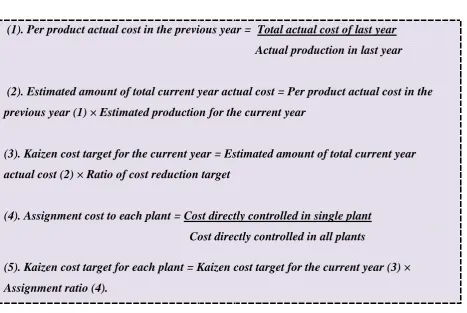
(1989) the amount of kaizen cost is decided in kaizen costing process and it is determined as
(1). Per product actual cost in the previous year = Total actual cost of last year
Actual production in last year
(2). Estimated amount of total current year actual cost = Per product actual cost in the
previous year (1) × Estimated production for the current year
(3). Kaizen cost target for the current year = Estimated amount of total current year
actual cost (2) × Ratio of cost reduction target
(4). Assignment cost to each plant = Cost directly controlled in single plant
Cost directly controlled in all plants
(5). Kaizen cost target for each plant = Kaizen cost target for the current year (3) ×
[image:7.595.68.536.123.436.2]Assignment ratio (4).
Table 1: Computation of kaizen cost targets
Source: Adapted from Monden & Hamada (1991)
Kaizen Costing Application Process
After a product is introduced, customers want increase in value of the product over time by
greater value and lower cost. Plan of business demand a chain of incremental cost reductions
(like 5% in a year) to stay in competition and cost-reduction activities are not ended with the
completion of product design, they move to a new phase. The kaizen costing process is
important and it is interactive process between management and work group employees. The
kaizen costing method uses the target cost for cost reduction and it is calculated according to
the principle of the standard cost. Kaizen costing system intends to reduce actual cost lower
than standard costs and to achieve cost reduction targets. This system defines the yearly
standard costs and checks the difference between standard and actual costs. When standard
1. Setting Cost Reduction / Kaizen Cost Targets
In kaizen costing cost reduction targets are set for the product. The overall cost-reduction
target is generally set at factory level then these targets are decomposed to departments and
workgroups levels. When cost reduction targets are fixed the work groups are empowered
with enough freedom to achieve these targets. Generally in kaizen costing only those product
costs (variable cost) are considered, which can be openly controllable by the shop floor
workers in company. The shop floor workers and supervisors involve in the cost-reduction
activities and they work in their own ways. The previous cost of product is used as a starting
baseline for kaizen cost reductions. Firstly the cost-reduction targets are set according to the
market and after this the firm assign cost reduction rate to each department but firm should
not assign a common cost reduction rate to every department because some areas may have
huge scope for cost reduction by use of new technology or manufacturing methods while
some areas may have little instant scope for improvement.
In kaizen costing management team leader sets cost-reduction goals for production processes
and gives freedom to the workforce to find new ways to achieve these goals. To achieve cost
reduction goals which are generally not easy but attainable, workers take a variety of actions
and find new ways to speed up manufacturing processes. This system starts when there is a
gap between total actual cost and kaizen cost, like equation:
(Total Cost – Kaizen Cost = Gap).
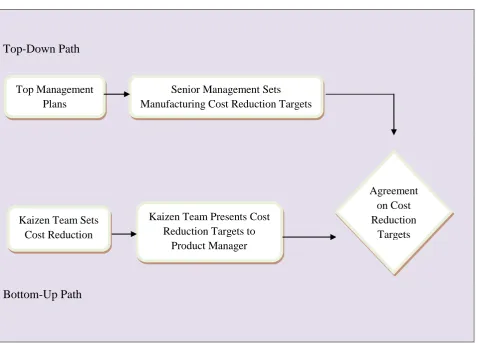
According to Modarress et al. (2005) there are two ways to set kaizen cost targets in the
company namely top down path and bottom up path. In the first way cost reduction targets
are set by senior management according to the plans of the top management then their cost
reduction target are accepted by kaizen teams after discussion. In the second way cost
reduction targets are set by kaizen team members then the team presents their cost reduction
targets for the approval of top and senior management. Kaizen cost reduction targets setting
Top-Down Path
[image:9.595.69.548.72.416.2]Bottom-Up Path
Figure 1: Cost reduction target or kaizen costing setting paths
Source: Modified from Modarress et al. (2005)
After the production or introduction of a new product Japanese companies usually predict
that production will need approximately three months to settle down or expect the target cost
can be achieved at that time. If the costs are still too high after this period then this is the
signal to initiate a major cost-reduction program. A project team is formed for the
consideration and management of all costs. The project team works on the value-analysis
approach that highlights and adjusts possible areas for cost savings. The project team may be
formed for considerable changes in the business environment such as increase in prices of
raw materials. The team focuses on the production processes and technology to meet the cost
targets. Then efforts are made to find the possibilities to reach that target. Major cost
reductions can be broken down into smaller reductions and then the activities are identified
and approved by the project or kaizen team and then workers or group members through their
own activities handle the work with suitable activities. Cost reductions are planned
throughout the life of product and a continuing series of kaizen activities are desired for this. Top Management
Plans
Senior Management Sets Manufacturing Cost Reduction Targets
Kaizen Team Sets Cost Reduction
Targets
Kaizen Team Presents Cost Reduction Targets to
Product Manager
Agreement on Cost Reduction
Kaizen activities and targets may vary depending on the type of cost like direct labour costs,
for instance may be tackled by more effective use of labour, better training and planning and
revised working practices. The results are measured after three months to evaluate the
progress toward achieving its target. After this if work groups are failing to meet these targets
causes are searched and these causes may be irrationally high targets, external factors beyond
control such as supplier constraints. Costs must be later reduced in each following period to
meet the target profit (Monden, 2000). To eliminate the suppliers constraints purchase
department must build relation with suppliers. By clearing the necessity for continual cost
reduction, determination of cost reduction targets and monitoring the targets can inspire the
staff toward achieving the cost reduction targets.
2. Consideration of Variable and Fixed Costs
Kaizen costing is applied by value analysis. In kaizen costing kaizen targets are set for all
plants and manufacturing processes. Cost of raw material is significant for cost reduction and
it can be reduced by better manufacturing processes. Purchased tools or items for product are
generally not allocated cost reduction targets for cost reduction point of view these can be
purchased at a low price with suppliers’ negotiation. Other variable cost is mainly centre of
attention for cost reduction in kaizen costing which are reduced through value analysis. Fixed
costs are not part of cost reduction. The cost reduction target rates are generally fixed for
each product component and department only small changes are made in these rates (Monden
& Lee, 1993). The company wide cost reduction target amount is allocated to each plant and
these assigned target cost reduction rates in each plant may be higher or lower than the
company wide rate (Monden & Lee, 1993). During decomposition of cost reduction targets
different meetings are held at different levels of each plant for best allocation of targets
(Monden & Lee, 1993). The total company wide target cost reduction target is actually
decomposed among all cost elements. The kaizen cost improvement activities are very
specific for every department in the company. Monden & Lee (1993) described that Japanese
automobile companies like Daihatsu Motor Corporation prepares following six plans for cost
reduction for the application of kaizen costing.
Production, distribution and sales plan for expected margins from sales of product.
Projected parts and material costs plan for purchasing department.
Personnel plan for labour cost reduction.
Facility investment plan for depreciation and purchase of fixed assets.
Fixed expense plan for non manufacturing costs reduction.
The general process of kaizen costing is shown in the following figure.
[image:11.595.70.530.169.502.2](Gap)
Figure 2: Kaizen costing process
Source: Own calculation of the researcher
According to Monden & Lee (1993) in kaizen costing method for the evaluation of each
department performance first actual cost reduction is computed then it compares with target
cost reduction amount and variances are noted. These variances may be positive and negative
and they are the indicators of performance. Variation in prices and wage rates are not
reflected in performance evaluation but reduction in labour hour, resource usage and
expenses are scrutinized (Monden & Lee, 1993).
Kaizen Costing and Innovation
Current Actual Cost Kaizen Cost Target
Cost Reduction
Value Analysis
Product Features Changes
According to Monden & Hamada (1991) kaizen the Japanese word and improvement the
English word are two distinct concepts. According to Monden & Hamada (1991) kaizen
refers to continuous accumulations of small betterment activities rather than innovative
improvement and kaizen costing includes cost reduction in the manufacturing stage of
existing products. Innovative improvement based on new technological innovations is usually
introduced in the developing and designing stage (Monden & Hamada, 1991). Improvement
can be defined as kaizen and innovation where kaizen is a strategy, maintains and improves
the working standard through small, gradual improvements and innovation calls for radical
improvements as a result of large investments in technology or equipment (Imai, 1986).
Kaizen is unequal to the classic western manner of improvement because it creates the
process for improvement by taking advantage of human factor and classic western approach
is based mainly on the innovative operations being characterized by necessity of executing
considerable investment in newest the instruments and technologies (Karkoszka &
Honorowicz, 2009).
Kaizen means continuous small activities than big innovations. Innovation means
introduction of new technological change in the developing and designing phase (Imai,
1986). Innovation involves an extreme improvement as an outcome of huge investment of
resources in new technology or equipment. Innovation is viewed as an immediate quantum
leap in technology while appropriate characterization of kaizen is to take baby step
improvements in processes or methods over an extended period of time. Major innovations
bring about remarkable results but they require large sums of money. On the other hand in
kaizen continuous improvement through employees’ suggestions represents an incremental
ongoing process as one small invention is added to another and everyone can participate in
using common sense to make logical improvements. When a constant stream of small
improvements flow from all employees, a powerful force is set in the minds of employees.
Kaizen involves a strategy of both maintenance and improvement. This is why kaizen has
become an important tool of managerial strategy. The continual improvement process is just
like a two wheeled vehicle or cart. One wheel of the cart is kaizen and the other is innovation.
Kaizen costing works on kaizen philosophy and engaged in continuous cost reduction but
without investment of high funds and technological innovation.
According to Monden & Lee (1993) the effectiveness of standard costing system is to control
costs and it is being used for the last several decades and some authors compared standard
with kaizen costing to reduce costs. Literature showed many differences between standard
costing system and kaizen costing system. Monden (1995) explained differences between a
standard costing system and kaizen costing and differences between these two terms are
shown in following table.
Standard Costing Kaizen Costing
• It is cost control system. • It is a cost reduction system.
• Its goal is to maintain current
manufacturing condition only not change.
• Its goal is continuous improvement in
manufacturing conditions or to reduce cost
lower than standard costs.
• Assume to meet cost performance
standards.
• Assume to achieve cost reduction targets.
• Cost variance analysis involving standard
costs and actual costs
• Cost variance analysis involving kaizen
cost targets and actual cost reduction amounts
• It checks the cost deviation and corrections
are made when standard costs have not been
achieved.
• It investigates and responds when kaizen
cost target amounts are not attained.
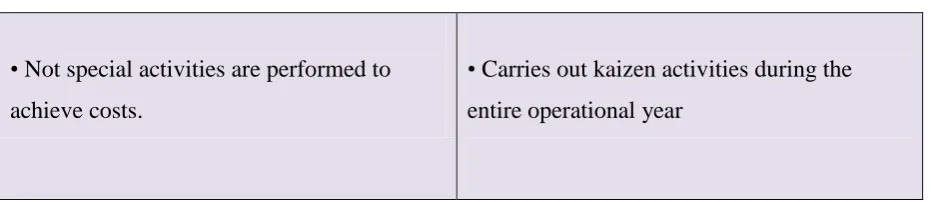
• In the procedures of standard system
standard costs are set for one or
two times every year means annually or
semiannually.
• Its procedure sets new cost reduction targets
each month through continuous activities to
attain target profits or to reduce the existing
• Not special activities are performed to
achieve costs.
• Carries out kaizen activities during the
[image:14.595.67.533.75.176.2]entire operational year
Table 2: Differences between kaizen costing and standard costing methods
Source: Adapted from Monden (1995), Monden & Lee (1993)
Conclusion
Kaizen is a way of thinking and this philosophy can be applied at any business. In previous
studies both kaizen and kaizen costing concepts were considered similar but kaizen costing is
different from kaizen. Kaizen costing is an important branch of this concept and it follows the
kaizen philosophy. Kaizen concept includes continuous improvement in any field and kaizen
costing is mainly related with cost improvement. Kaizen costing is an emerging method for
change in an effective way and for continuous cost improvement. The secret of success of
Japanese firms was the application of Kaizen philosophy and kaizen costing is accepted as
improved part of this concept. Kaizen costing is implemented in business with the
determination of cost reduction targets and with the involvement of all levels employees.
Kaizen costing assists in continuous cost reduction with positive changes in possible areas.
Kaizen costing is also different from innovation and cost control technique standard costing.
Kaizen costing is worldwide accepted by manufacturing firms as an effective and optimistic
way of working for continuous cost improvement. Kaizen costing is an economical way of
improvement and unlike innovation it requires less funds and unlike standard costing it
controls the costs of production with maintenance of existing performance level. Kaizen
costing is better than innovation for change and better than standard costing to reduce costs of
product. In competitive environment kaizen costing may be used by manufacturing firms as a
better way of working for change and continuous cost improvement.
References
Bicheno, J. (2000). The lean toolbox. Buckingham: 2nd edition, Picsie Books.
Cooper, R. (1995). When lean enterprises collide: competing through confrontation.
Boston: Harvard Business School Press.
Drury, C. (2008). Management and cost accounting. London: 7th edition, Cengage
Learning.
Ellram, L. M. (2000). Purchasing and supply management’s participation in the target
costing process. Journal of Supply Chain Management, Vol. 36, No. 2, pp. 39-51.
Guilding, C., Cravens, C. K. & Tayles, M. (2000). An international comparison of
strategic management accounting practices. Management Accounting Research, Vol. 11,
pp. 113-135.
Hansen, R. & Mowen, M. (2003). Cost management: accounting and control. 4th edition,
Ohio Thomson.
Hilton, R. W., Maher, M. W. & Selto, F. H. (2006). Cost management strategies for
business decisions. New York: 3rd edition, McGraw-Hill.
Jagdeep, S. & Harwinder, S. (2009). Kaizen philosophy: Review of literature. The Icfai
University Journal of Operation Management.
Imai, M. (1986). Kaizen: The key to Japanese competitive success. New York:
McGraw-Hill.
Kaplan, R. S. & Cooper, R. (1998). Cost and effect-using integrated cost systems to drive
profitability and performance. Boston: Harvard Business Press.
Karkoszka, T. & Honorowicz, J. (2009). Kaizen philosophy a manner of continuous
improvement of processes and products. Journal of Achievements in Material and
Manufacturing Engineering, Vol. 35, No. 2.
Kennedy, F. A. & Widener, S. K. (2008). A control framework: Insights from evidence
on lean accounting. Management Accounting Research, Vol. 19, pp. 301-323.
Modarress, B., Ansari, A. & Lockwood, D. L. (2005). Kaizen costing for lean
manufacturing: a case study. International Journal of Production Research, Vol. 43, No.
9, pp. 1751–1760.
Monden, Y. (1989). Total cost management systems in Japanese automobile
Monden, Y. (1995). Cost reduction systems: target costing and Kaizen costing. Portland:
Oregon, Productivity Press.
Monden, Y. (2000). Japanese cost management. London: Imperial College Press.
Monden, Y. & Hamada, K. (1991). Target costing and kaizen costing in Japanese
automobile companies. Journal of Management Accounting Research, Vol. 3, pp. 16-34.
Monden, Y. & Lee, J. (1993). How a Japanese auto maker reduces costs. Management
Accounting, (USA), Vol. 75, No. 2, pp. 22-26.
Shank, J. K. & Fisher, J. (1999). Case study target costing as a strategic tool. Sloan
Management Review, Vol. 41, No. 1. pp. 72-82.
Tanaka, T. (1990). Toyota no kaizen yosan. Kigyokaikei, Vol. 42, No. 3, pp. 59-66.
Tanaka, T. (1993). Target costing at Toyota. Journal of Cost Management, Spring, pp.
4-11.
Toyota Motor Corporation. (1987). History of Toyota Motor Corporation for 50 years.
Toyota Motor Corporation.
Vincent, K. O. (2004). The relationship between quality and quality cost for a
manufacturing company. International Journal of Quality and Reliability Management,
pp. 227-290.
Wellington, P. (1995). Kaizen strategies for customer care. London: Pitman.
Yasuhiro, M. & John, L. (1993). How a Japanese automaker reduces costs?. Health Care