implications
JoAnne S. Richards, Stephanie A. Pangas
J Clin Invest.
2010;
120(4)
:963-972.
https://doi.org/10.1172/JCI41350
.
The classical view of ovarian follicle development is that it is regulated by the
hypothalamic-pituitary-ovarian axis, in which gonadotropin-releasing hormone (GnRH) controls the
release of the gonadotropic hormones follicle-stimulating hormone (FSH) and luteinizing
hormone (LH), and that ovarian steroids exert both negative and positive regulatory effects
on GnRH secretion. More recent studies in mice and humans indicate that many other
intra-ovarian signaling cascades affect follicular development and gonadotropin action in a
stage- and context-specific manner. As we discuss here, mutant mouse models and clinical
evidence indicate that some of the most powerful intra-ovarian regulators of follicular
development include the TGF-
b
/SMAD, WNT/FZD/
b
-catenin, and RAS/ERK1/2 signaling
pathways and the FOXO/FOXL2 transcription factors.
Review Series
Find the latest version:
Review series
The ovary: basic biology and clinical implications
JoAnne S. Richards1 and Stephanie A. Pangas2
1Department of Molecular and Cellular Biology and 2Department of Pathology, Baylor College of Medicine, Houston, Texas.
The classical view of ovarian follicle development is that it is regulated by the hypothalamic-pituitary-ovarian axis,
in which gonadotropin-releasing hormone (GnRH) controls the release of the gonadotropic hormones
follicle-stim-ulating hormone (FSH) and luteinizing hormone (LH), and that ovarian steroids exert both negative and positive
regulatory effects on GnRH secretion. More recent studies in mice and humans indicate that many other
intra-ovar-ian signaling cascades affect follicular development and gonadotropin action in a stage- and context-specific
man-ner. As we discuss here, mutant mouse models and clinical evidence indicate that some of the most powerful
intra-ovarian regulators of follicular development include the TGF-
β
/SMAD, WNT/FZD/
β
-catenin, and RAS/ERK1/2
signaling pathways and the FOXO/FOXL2 transcription factors.
Introduction
The ovary is a highly organized composite of germ cells (oocytes or eggs) and somatic cells (granulosa cells, thecal cells, and stromal cells) whose interactions dictate formation of oocyte-containing follicles, development of both oocytes and somatic cells as follicles, ovulation, and formation of the corpus luteum (the endocrine structure that forms from the ovarian follicle after ovulation and is required for establishing and maintaining pregnancy) (Figure 1). Many events in the adult ovary are controlled by two hormones, follicle-stimulating hormone (FSH) and luteinizing hormone (LH), secreted from the anterior pituitary gland under the control of pulses of gonadotropin-releasing hormone (GnRH) from the hypothalamus (Figure 1). Low-frequency GnRH pulses stimulate a slight increase in FSH levels early in a woman’s menstrual cycle, enhancing follicle growth, while high-frequency GnRH pulses lead to a sharp rise in levels of LH just before mid-cycle (an event known as the “LH surge”), triggering ovulation and formation of the corpus luteum (Figure 1). The ovary also has a key role in these processes, ensuring the timely release of fertilizable oocytes and the maintenance of luteal cell function, a necessity for pregnancy, by directing feedback mechanisms to the hypothalamus and pitu- itary. For example, estrogen produced by the cells of the develop-ing follicle both inhibits GnRH production in the hypothalamus and elicits elevated GnRH pulses, which trigger the mid-cycle LH surge that initiates ovulation. Thus, fertility depends on highly orchestrated endocrine events involving multiple organ systems.
Disruption of this finely controlled network can lead to many clinical syndromes including premature ovarian failure (POF), polycystic ovarian syndrome (PCOS), ovarian hyperstimulation syndrome, ovulation defects, poor oocyte quality, and cancer. The goal of this Review is to cover some of the advances in our under-standing of the basic biology of the mammalian ovary that may shed light on specific ovarian dysfunctions that lead to infertility. We primarily focus on recent developments using mouse genet-ic models to study follicle growth and ovarian function because of the inherent difficulty of obtaining human ovarian tissue at defined stages of follicular growth. We emphasize the roles of bone morphogenetic proteins (BMPs), activins, and SMADs, WNT signaling, and recently uncovered aspects of the FSH and LH sig-naling cascades. We focus on these areas because specific mutant mouse models have unveiled how these signaling cascades regulate
critical events controlling follicular development, ovulation, and luteinization and because we believe that they have relevance to understanding ovarian dysfunctions in women.
Factors that control oocyte development, primordial follicle formation, and early follicle growth
Gonadal development. During embryogenesis, the mammalian gonad first develops adjacent to the urogenital ridges and is given the term the “bipotential” or “indifferent” gonad because it develops identically at this time in both male and female embryos. Differ-entiation into a testis (male) or ovary (female) does not occur until after the primordial germ cells (PGCs) have migrated from the yolk sac and colonized the indifferent gonad. In mice, colonization occurs approximately 9.5–11.5 dpc. Once the PGCs colonize the indifferent gonad, in female mice, they undergo a period of prolif-eration, followed by differentiation into oocytes that enter meiosis (at approximately E13.5), and in male mice, they differentiate into prospermatogonia that become quiescent until after birth. Devel-opment of germ cells into either male or female states depends on their interactions with the somatic cells of the gonad (see follow-ing paragraph) (Figure 2). Multiple growth factors modulate PGC mitosis, including members of the TGF-β family: activin, BMPs, and TGF-β1 (reviewed in ref. 1). In mice, BMPs have an important role in PGC proliferation, and BMP2 and BMP4 increase the num-ber of PGCs in culture (2, 3). Bmp7-null mice have reduced numbers of germ cells after 11.5 dpc, likely as a result of a proliferation defect between 10.5 and 11.5 dpc (4). In humans, activin increases female germ cell proliferation before the germ cells enter meiosis (5), while in mice, activin and TGF-β inhibit PGC proliferation (6), indicat-ing the possibility of species-specific regulation. In mouse ovaries, the regulation of activin or BMP function appears to be critical for germ cell survival, as mice lacking follistatin (which is encoded by the gene Fst), an extracellular antagonist of activin, have normal numbers of PGCs and germ cells at E11.5–15.5 but lose 90% of germ cells at E16.5, with an almost complete loss by birth (7).
Several factors determine whether the gonad will be an ovary or a testis, including members of the WNT/FDZ/β-catenin (which is encoded by the gene Ctnnb1) signaling cascade. Ovaries of Wnt4–/–
mice are abnormal and exhibit structures similar to testicular tubules (8), indicating that WNT4 is a determinant of the female gonad. Mutations in the human R-spondin homolog (RSPO1) gene, which encodes a WNT pathway adapter molecule, indicate that this molecule is also a primary female sex-determining fac-tor (9). Specifically, XX individuals with a mutant RSPO1 gene Conflict of interest: The authors have declared that no conflict of interest exists.
exhibit testicular-like gonads, lack Müllerian structures (oviduct and uterus), and present masculinized external genitalia as a con-sequence of testicular androgen biosynthesis. Moreover, female
Rspo1–/– mice also demonstrate gonadal sex-reversal and oocyte
loss (9–10). Remarkably, mice lacking both WNT4 and the tran-scription factor forkhead box L2 (FOXL2) exhibit complete and functional sex reversal of the ovary to a testis in the XX genotype (11). These intriguing recent results document unequivocally that there are organizers of ovary versus testis development and that
Rspo1, Wnt4, and Foxl2 are all important for ovary development, at least in mice. Furthermore, XY male mice engineered to express stable β-catenin, a downstream target of WNT signaling, exhibit partial male-to-female sex reversal with ovar-ian structures totally lacking germ cells or seminiferous tubule demise and germ cell loss (12). Thus, β-catenin also appears to be one key mediator of WNT signaling that is essential for normal ovary development, at least in the embryonic mouse gonad.
PGCs divide to form syncytia (nests or cysts) of oocytes that break down to form primordial follicles, which represent the quiescent follicle reserve in the ovary. Each primordial follicle contains an immature oocyte arrested early in meiosis, surround- ed by a flattened epithelium that will even-tually become the granulosa cells. Germ cell syncytia breakdown occurs prenatally in humans and shortly after birth in mice (Figure 2). It is associated with massive germ cell loss, such that oocyte numbers are reduced from approximately 6 million in the fetal human ovary to 1 million at birth (13–15). Inappropriate germ cell syn-cytia breakdown can lead to the generation of polyovular follicles (i.e., follicles that contain more than one oocyte). Polyovular follicles are present in some mouse strains (16, 17), in mice with certain TGF-β family member mutations (e.g., mice overexpress-ing the α subunit of inhibin, a TGF-β fam-ily member that inhibits FSH secretion [ref. 18], mice lacking activin in granulosa cells [ref. 19], and mice lacking oocyte-expressed
[image:3.585.41.372.81.433.2]Bmp15 [ref. 20]), and in mice with altered Notch signaling (21). Polyovular follicles are also seen in human ovaries at birth, but rarely in adults (22). Follicles with more than one egg can be identified in women undergoing in vitro fertilization (IVF) pro-cedures (23), but the clinical significance of polyovular follicles on fertility has not been established in humans; however, polyovular follicles are not a primary cause of infertil-ity in mice (24, 25). This might be because individual oocytes develop at different rates within the same follicle (23), and while multiple oocytes might be developing inside the follicle, only one may be at the appropriate maturation stage to be fertilized. Polyovular follicle formation can be induced by exposure of neonatal mice to estrogen (26–30). In this context, estrogen reduces activin expression, which suggests a direct role for activin in normal primordial follicle formation (19, 26). This effect of estrogen underscores the need for further research on the effect of endocrine disruptors — environmental and dietary com-pounds that act like hormones — in reproductive diseases. Along these lines, increasing evidence from rodent studies indicates that
Figure 1
review series
neonatal exposure to genistein, the phytoestrogen found in soy, disrupts normal reproduction (30–36). The effects of phytoestro-gens and other estrogen-like compounds on the reproductive tract, fertility, and reproductive cancers are not well understood.
Transcription factors and early follicle growth. A number of transcrip-tion factors whose expression, at least in adult tissues, appears to be restricted to germ cells or oocytes, are necessary for early follicu-logenesis (Figure 2) (37). Factor in the germline α (FIGLA) was the first of these transcription factors to be identified (38), and Figla–/–
mice are sterile because primordial follicles fail to form (39). Figla encodes a basic helix-loop-helix (bHLH) transcription factor that regulates expression of the zona pellucida genes Zp1, Zp2, and Zp3, which encode the egg coat (38). Other germline-expressed, bHLH transcription factor–encoding genes are known, including sper-matogenesis and oogenesis bHLH transcription factors 1 and 2 (Sohlh1 and Sohlh2). Mice null for either gene have a similar female phenotype: postnatal oocyte loss leading to female sterility (40, 41). Both Sohlh1–/– and Sohlh2–/–
mice have deficiencies in ovar-ian expression of other transcription factor–encoding genes: lim homeobox protein 8 (Lhx8), POU-type homeodomain-containing DNA-binding protein (Pou5f1; also known as Oct4), newborn ovary homeobox (Nobox), and Figla. Deletion of Nobox also causes female sterility and postnatal oocyte loss, and the gene product has been shown to directly regulate expression of growth differentiation fac-tor 9 (Gdf9) and Pou5f1 (42, 43). It is unclear how these transcrip-tional networks intersect to control oocyte development; however, if a woman were to have impaired expression of any one of these
transcription factors, evidence from mice indicates that she might develop POF. Indeed, while these transcription factors were first identified and functionally studied in mice, recent studies have discovered mutations in both NOBOX and FIGLA in women with POF (44, 45), highlighting the importance of mouse models for identifying candidate disease-causing genes in humans.
Disruption of the FOXL2-encoding gene leads to abnormal fol- licle development and POF in mice (46) and humans (47). As dis-cussed in the previous section, Foxl2 is expressed in the early stages of gonadal development and has been shown to direct ovarian and oppose testis development. In early postnatal Foxl2-null ovaries, the expression of some genes increases, e.g., nuclear receptor sub-family 0, group B, member 1 (Nr0b1; also known as Dax1) and
[image:4.585.51.534.84.282.2]Wnt4 , while the expression of others decreases, e.g., nuclear recep-tor subfamily 5, group A, member 2 (Nr5a2; also known as Lrh1), aromatase (Cyp19a1), Fst, and Apoa1. Additional genes regulated in the ovary by FOXL2 at later stages of follicle development include inhibin βB subunit (the product of which forms either inhibin B when in complex with inhibin α subunit or activin B when it homodimerizes), Nr5a2 , sterol regulatory element–binding tran-scription factor 1 (Srebf1), PPARγ coactivator 1α (Ppargc1a ), choles-terol side chain cleavage (Cyp11a1 ), and steroidogenic acute regula-tory protein (Star) (48–50). These results indicate that in addition to its role in embryonic ovarian development, FOXL2 likely affects specific basic metabolic aspects required for the proliferation and differentiation of somatic cells in the postnatal ovary. A missense mutation (402C→G) in human FOXL2 has been linked to adult
Figure 2
forms of ovarian granulosa cell tumors (GCTs), the most com-mon type of malignant ovarian sex cord–stromal tumor (51). This mutation is unlikely to disrupt FOXL2 DNA binding, but rather alters protein-protein interactions (51). While this study found that the 402C→G mutation rarely occurs in juvenile GCTs (51), juvenile GCTs show reduced expression of FOXL2 (52), indicating that FOXL2 may regulate multiple effects in granulosa cells that are context and stage specific.
Other members of the forkhead box transcription factor family also affect ovarian function. These include members of the FOXO family that are evolutionarily conserved and act downstream of insulin and IGF1, as well as FSH, to direct cell survival, apopto-sis, and proliferation. Disruption of the Foxo3 gene in mice leads to inappropriate oocyte activation, premature entry of primordi-al follicles into the growing pool, and POF (53) (Figure 2). Upon exhaustion of the primordial follicle pool, ovaries become devoid of growing follicles and the mice become infertile. Conversely, forced overexpression of Foxo3 in oocytes reduces the number of growing follicles (54). As PTEN is a negative regulator of PI3K, its removal enhances PI3K activity, leading to increased phosphorylation of downstream targets, including AKT and FOXO3. As a consequence, oocyte-specific disruption of the Pten gene generates an ovarian phenotype identical to that of Foxo3–/–
mice: premature oocyte acti-vation and release of primordial follicles into the growing pool (55). Specific targets of FOXO3 that restrict oocyte activation and pro-liferation of surrounding somatic cells remain to be defined (56). Although not yet observed in humans, mutation in the FOXO3 gene might be the underlying cause of unexplained POF or streak ova-ries (i.e., remnant gonadal tissue devoid of oocytes).
In contrast to FOXO3, which is expressed in oocytes, FOXO1 is expressed preferentially and at elevated levels in granulosa cells of growing follicles in mice and humans (Figure 2). Thus far, loss-of-function analysis of the role of this transcription factor in the ovary has been precluded because Foxo1-null mice are embryonic lethal (57). Although conditional alleles of Foxo1, Foxo3, and Foxo4 have been generated, they have not yet been disrupted in a cell-spe-cific manner in the ovary (58, 59). However, expression of FOXO1 mutants in granulosa cells indicates that FOXO1 may affect spe- cific genes controlling granulosa cell proliferation (60), differen-tiation (60), or metabolism (61). Expression of a constitutively active nuclear form of FOXO1 in granulosa cells both suppress-es expression of cyclin D2 (Ccnd2), Cyp19a1, FSH receptor (Fshr), and LH/choriogonadotropin receptor (Lhcgr) and acts as a potent negative regulator of essentially all genes in the cholesterol biosyn-thetic pathway, including Srebf1 and Srebf2 (60, 61). Thus, FOXO1 appears to be a critical factor in granulosa cells. Because FOXO1 is a downstream target of FSH and IGF1 and is presumed to be critical for metabolic homeostasis, and possibly apoptosis, modulation of FSH, IGF1, or insulin signaling might lead to clinical problems and may underlie some cases of infertility associated with diabetes.
New regulatory mechanisms that control follicle growth and differentiation
FSH signaling pathways. Although many of the early stages of follicle growth occur independently of pituitary gonadotropins (i.e., FSH and LH), FSH is required for granulosa cell differentiation and these cells rely on FSH to facilitate follicular growth (Figure 2 and Figure 3). Although FSH activates adenylyl cyclase, leading to pro-duction of cAMP and activation of PKA, FSH also activates other signaling cascades independently of cAMP: for example, pathways involving PI3K (likely via an SRC tyrosine kinase) (62), RAS (62), or glycogen synthase kinase 3β (GSK3β) (63). Activation of PI3K leads to phosphorylation and activation of AKT, which in turn phosphorylates and thereby inactivates FOXO1 (63). Although, as mentioned above, the effects of disrupting Foxo1 expression in granulosa cells have not yet been analyzed in vivo, disruption of
Pten
expression in granulosa cells, which leads to increased activa-Figure 3
[image:5.585.45.284.83.408.2]review series
tion of the PI3K pathway and therefore increased phosphorylation and degradation of FOXO1, results in enhanced proliferation of granulosa cells, ovulation, and formation of corpora lutea that persist for unusually prolonged periods of time (64). Surprisingly, although FOXO1 is expressed at elevated levels in granulosa cells, PTEN protein levels are remarkably low. Therefore, factors other than, or in addition to, PTEN are likely to control the PI3K pathway in granulosa cells. These results indicate that the functions of PI3K pathway components in granulosa cells are complex and likely to be stage and context specific (64). Consistent with this, disruption of Pten in somatic cells of the mouse ovary causes distinct effects from those observed when it is disrupted in oocytes, as described above (Transcription factors and early follicle growth ) (53–55). Further-more, although natural mutations or disruption of Pten in other tissues lead to tumor formation, disruption of Pten only in granu-losa cells does not lead to GCTs (64), perhaps because other factors affect the PI3K pathway in these cells. Because FOXO1 expression is high in human granulosa cells, this pathway is likely to be regu-lated in a manner similar to that in the mouse, but until we have
Foxo1–/– mice, the precise functions in vivo will remain unclear.
During the later stages of follicular growth (Figure 2), activins and estradiol, the predominant estrogen in humans, enhance the actions of FSH (65, 66) (Figure 2). In mice, activins activate the transcription factors SMAD2/3 and SMAD4, which coordinately regulate several FSH-induced genes including those encoding the cell cycle regulator CCND2 and the steroidogenic enzyme aromatase (67), which converts theca cell–derived androgens to estradiol. Estradiol, acting primarily via estrogen receptor beta (ERS2), has recently been shown to suppress expression of phos-phodiesterase 1C (Pde1c), thereby increasing intracellular levels of cAMP induced by FSH (66). Because activins facilitate prolif-eration of granulosa cells and enhance FSH actions, in part by increasing estradiol, these interactions may help explain why, when activin actions are unopposed by inhibins (as occurs in mice lacking inhibin α subunit, which is encoded by Inha ), activins pro-mote GCT growth. The WNT signaling target β-catenin has also recently been implicated in enhancing Cyp19a1 expression (68), indicating that FSH-induced phosphorylation of GSK3β may be physiologically relevant in activating this arm of the WNT signal-ing cascade (69). Although disruption of the Ctnnb1 gene in mice does not lead to overt changes in follicular development (70), proper activation of β-catenin in the adult ovary appears to be essential for normal tissue maintenance because overexpression of a constitutively active form of β -catenin leads to abnormal fol-licle development and, eventually, to development of GCTs (71). Moreover, the tumor phenotype induced by overexpression of the constitutively active form of β-catenin is enhanced when the tumor suppressor Pten is also concomitantly disrupted in granu-losa cells, and these mice die by 6 weeks of age (72).
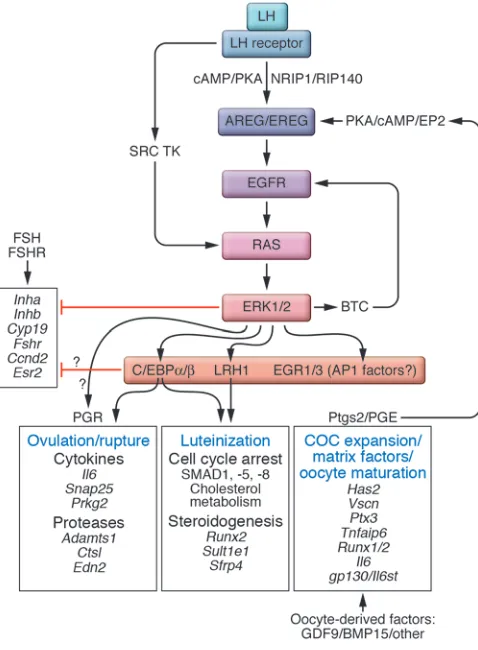
FSH and LH have recently been shown to activate RAS, in part via an SRC tyrosine kinase–mediated process, leading to the phos-phorylation and activation of downstream kinases, in particular MEK1 and ERK1/2 (62) (Figures 2 and 3). Strikingly, KRAS is expressed at high levels in the granulosa cells of both small follicles and antral follicles (follicles at the late stages of follicular develop-ment that are characterized by the presence of a fluid-filled cavity known as the antrum adjacent to the oocyte; Figures 1 and 2), but its role remains to be determined (73). Expression in granulosa cells of a constitutively active form of KRAS that is frequently
associated with various cancers, including ovarian surface epithe-lial (OSE) cell cancer (KRASG12D), does not stimulate proliferation
or tumor formation (73). Rather, KRASG12D-expressing granulosa
cells cease dividing, do not undergo apoptosis, and fail to dif-ferentiate; that is, they are cell-cycle arrested. As a consequence, small abnormal follicle-like structures devoid of oocytes persist and accumulate in the ovaries of the KRASG12D mutant mice.
Even when Pten is disrupted in KrasG12D mutant mice, GCTs do
not form (74), which indicates that granulosa cells are extremely resistant to the oncogenic insults of mutant Kras and loss of Pten. By contrast, if the Kras and Pten mutations are engineered in OSE cells, aggressive tumors appear within 6 weeks of age (74). These results indicate that the elevated levels of FSH or LH observed in patients with POF or PCOS may lead to increased activation of the RAS/ERK1/2 pathway as well as the PKA pathway, causing an imbalance in granulosa cell functions. These pathways need to be analyzed in more detail in clinical samples.
TGF-β family members. The TGF-β family of growth factors has wide-ranging roles in female reproduction (75). Although various family members are expressed by the major ovarian cell types (i.e., oocytes, granulosa cells, and thecal cells) (Figures 1 and 2), many of their effects center on the control of granulosa cell growth and differentiation, both of which affect folliculogenesis and oocyte development. Disruption in the ovarian function of the TGF-β family has resulted in mouse models that mimic human diseases such as POF. For instance, follistatin is an extracellular binding protein that binds to members of the TGF-β family and acts as a ligand antagonist. Fst conditional knockout female mice have been generated using Amhr2-cre, which expresses cre recombinase in adult female ovaries, predominantly in granulosa cells (76, 77). These mice demonstrate some aspects of POF, with few remaining follicles found by eight months of age (76). In addition, Fst con-ditional knockout mice show increased levels of gonadotropins, with decreased serum testosterone, mimicking the hormonal pro-file observed in women with POF. However, mutations associated with follistatin in human cases of POF have not been reported. The mechanism behind the premature loss of fertility in Fst condition-al knockout mice is unknown, but because follistatin is a strong inhibitor of activin, part of the phenotype potentially results from increased activin activity.
Lack of inhibin α also results in increased activin because inhibins and activins are related proteins that share common β subunits: inhibin A is a heterodimer of the inhibin α and βA subunits, and inhibin B is a heterodimer of the inhibin α and βB subunits, while activin A and B are homodimers of inhibin βA subunit and inhibin βB subunit, respectively. Inhibins are also functional antagonists of activins (78–80). Inha–/– mice develop sex
cord–stromal tumors as adults and die of cancer cachexia-like syn-drome (81, 82). In addition, Inha–/– female mice are infertile prior
to gross tumor development, as determined by their inability to ovulate and the lack of late-stage follicle development (83). Inhibin does not appear to be essential for embryonic oocyte development, germ cell syncytia breakdown, or primordial follicle formation because the ovaries of newborn Inha–/– mice have normal numbers
of oocytes and develop equivalent numbers of primordial follicles as the ovaries of wild-type mice in the three days after birth (84). However, marked changes in the ovaries of Inha–/– and wild-type
mice occur during the period of secondary follicle to early antral follicle development (Figure 2), which occurs after 6 days of age. At this point, ovaries in Inha–/– mice are much larger and contain
more advanced follicle types than those in wild-type mice. In addi-tion, granulosa cell growth is uncoupled from oocyte growth, as evidenced by overly large follicles containing inappropriately small oocytes. The lack of oocyte growth is likely related to decreased expression of Kitl, as the gene encoding the receptor for the Kitl gene product is expressed in oocytes and is critical for oocyte growth and development (85). Both GDF9 and activin are known to decrease expression of Kitl (19, 86), and both Gdf9 and the genes encoding inhibin βA and βB subunits are overexpressed in Inha–/–
ovaries (84). Additionally, there is loss of oocyte-expressed Bmp15 and granulosa cell–expressed anti-Müllerian hormone (Amh), two growth factors that also modulate follicle growth. Thus, deletion of Inha results in multiple changes in the local hormonal milieu and causes infertility.
Mice lacking inhibin βA subunit (and thus lacking activin A and inhibin A) die shortly after birth (87), while mice deficient for inhibin βB subunit (and thus lacking activin B and inhibin B) have normal size litters but defects in nursing (88). Ovaries from inhibin βB subunit–deficient females overproduce the inhibin βA subunit (88), suggesting a possible compensatory gain in activin A activity. However, activin A and activin B are not fully redundant. For example, generating a mouse that expresses inhibin β B sub-unit in place of inhibin βA subunit rescues the perinatal lethality and craniofacial defects of inhibin βA subunit deficiency but is insufficient for normal folliculogenesis and female reproduction to occur (89). Moreover, stepwise removal of activin subunits by conditional deletion in granulosa cells culminates in female steril- ity only when all activin subunits are absent (19). In the activin-deficient ovary (conditional deletion of inhibin βA subunit in granulosa cells with global deletion of inhibin βB subunit), there are multiple defects in folliculogenesis (19). The most obvious is the progressive accumulation of corpora lutea, which is accompa-nied by increases in serum FSH and progesterone. As noted above, in granulosa cells, activin appears to play a predominant role as a growth promoter, and in support of this hypothesis, no ovarian tumors develop in activin-deficient mice. The growth-promoting role of activin in GCTs has been established by demonstrating that GCT growth in Inha–/– mice is slowed by deletion of the gene
encoding the activin type II receptor; deletion of Smad3, which encodes a transcription factor that acts downstream of activin; or injection into mice of a chimeric activin binding receptor–murine Fc protein (81, 82, 90–93).
SMAD transcription factors are key intracellular mediators of the canonical TGF-β family signaling pathway: SMAD2 and SMAD3 (AR-SMADS) signal downstream of activin, GDF9, and TGF-β, while SMAD1, SMAD5, and SMAD8 (BR-SMADS) signal down-stream of the BMPs and AMH. An additional SMAD, SMAD4, participates in signaling triggered by all members of the TGF-β family. Conditional mutations of all SMADs have been generated in granulosa cells either as single or multiple mutations (94–96). Conditional deletion of Smad4 results in age-dependent infertility, and because SMAD4 is involved in mediating signals triggered by all members of the TGF-β family, the phenotype affects multiple stages of folliculogenesis. Ovaries in Smad4 conditional knockout mice show defects in steroidogenesis, ovulation, and the function of cumulus cells (which are a subpopulation of granulosa cells whose main functions in developing follicles are to support oocyte development), and the mice eventually develop POF (95). Unlike in activin-deficient mice, ovaries in Smad4 conditional knockout mice exhibit increased preantral follicle death, a decrease in the number of antral follicles, and no accumulation of corpora lutea.
Similar to the activin-deficient ovary, small follicles luteinized pre-maturely, and even though SMAD4 is a known tumor suppressor gene, no tumors developed in Smad4 conditional knockout mice.
A similar phenotype to Smad4 conditional knockout female mice is seen in female mice with granulosa cell conditional knockout of Smad2 and Smad3 (94). SMAD2 and SMAD3 have redundant functions in granulosa cells because mice with single conditional knockout of either Smad2 or Smad3 in granulosa cells have no repro-ductive phenotype (94). However, mice lacking both proteins have reduced litter sizes and become infertile after five months of age with disrupted follicle development (i.e., increased preantral follicle atresia and fewer antral follicles), luteinized follicles, reduced ovula-tion, and severe defects in cumulus cell function. The phenotypes of mice with conditional knockout of the BR-SMADs differ dra-matically from those of other SMAD conditional knockouts. Single granulosa cell conditional knockout of either Smad1 or Smad5 and global Smad8 knockout generates mice that are viable and fertile, as are double granulosa cell conditional knockout Smad1/Smad8 and
Smad5/Smad8 mice (96). However, double granulosa cell conditional knockout Smad1/Smad5 mice and triple granulosa cell conditional knockout Smad1/Smad5/Smad8 female mice demonstrate infertility with age and develop GCTs with full penetrance by three months of age. The BR-SMAD phenotype is similar to the juvenile form of human GCTs (97). In addition, the majority of double granulosa cell conditional knockout Smad1/Smad5 and triple granulosa cell conditional knockout Smad1/Smad5/Smad8 mice show peritoneal implants and lymphatic metastases over time. These mice were the first in vivo demonstration that the BR-SMADs may have a critical tumor suppressor function in ovarian granulosa cells (96).
The various phenotypes of the SMAD and activin/inhibin knockouts in the ovary suggest potential interactions between the BMP and TGF-β/activin signaling pathways, in particular the observation that Inha–/– and BR-SMAD conditional granulosa cell
knockout mice develop GCTs (Figure 2). Part of the phenotype of
Inha–/– mice can be attributed to the tumor-promoting activity of
activin via SMAD3 (94). In the BR-SMAD conditional granulosa cell knockout mice, an examination of the phosphorylation sta-tus of the AR-SMADs demonstrated that SMAD2 and SMAD3 are nuclear and phosphorylated, indicating pathway activation. Thus, it has been suggested that part of the phenotype of the BR-SMAD conditional granulosa cell knockout mice may be due to dysregu- lation of the AR-SMADs (i.e., SMAD2 and SMAD3) (96) that pro-motes granulosa cell proliferation. The role of additional signaling pathways in tumorigenesis in the BR-SMAD conditional granu-losa cell knockout mice is still under investigation. In addition, as members of the TGF-β family signal though SMAD-independent pathways — including ERK1/2, JNK, PI3K/mTOR, and p38 MAPK pathways (98–101) — it is possible that tumor development results from activation of one or more of these noncanonical pathways by the BMPs when the BR-SMADs are not present.
New insights into factors controlling ovulation and luteinization
review series
studies show that the LH surge stimulates not only PKA but also PI3K/AKT and RAS signaling cascades, and that each of these is critical for ovulation (73). LH rapidly induces in granulosa cells the expression of the EGF-like factors amphiregulin (AREG), beta-cellulin (BTC), and epiregulin (EREG) (104) in a PKA-dependent manner. These factors bind their cognate receptors present on granulosa cells and cumulus cells, activate RAS, and induce expres-sion of downstream target genes, including hyaluronan synthase 2 (Has2), prostaglandin-endoperoxide synthase 2 (Ptgs2), and TNF-α– induced protein 6 (Tnfaip6), each of which is a target of ERK1/2 in cultured cells (103). Disruption of the EGF ligand/receptor sig-naling pathway in mice compromises ovulation, indicating that activation of this pathway is essential for LH-induced ovulation to occur (105). Moreover, mice in which ERK1 and ERK2 have been disrupted in granulosa cells exhibit normal follicle growth, but in response to LH, the COCs fail to expand, oocytes fail to re-enter meiosis, and follicles fail to either ovulate or luteinize (106). Genes expressed in preovulatory follicles fail to be suppressed, and genes known to regulate COC expansion, ovulation, and luteinization fail to be induced or activated. Thus, ERK1/2 controls a master switch that mediates the global reprogramming of granulosa cells downstream of EGF-like–factor activation of the EGF receptor pathway. Strikingly, ERK1/2 are also essential in the female mouse pituitary to initiate the LH surge (107). Thus, both the pituitary and the ovary exhibit ERK1/2 dependence during this critical pro- cess of ovulation and luteinization. The extent to which the acti-vation of the ERK1/2 kinases is altered in infertile women has not been thoroughly examined.
Several transcriptional regulators are known to affect ovulation and appear to help mediate the effects initiated by ERK1/2 (Fig-ure 3). Mice lacking nuclear receptor–interacting protein 1 (Nrip1; also known as RIP140) exhibit impaired ovulation and reduced expression of Areg, Ereg, and other ovulation-related genes (108). Therefore, NRIP1 may regulate transcription of the Areg gene, a critical early event in the ovulation process. Targeted disruption of
Nr5a2 in granulosa cells blocks ovulation and luteinization with little effect on the early stages of follicular development (109), indicating that NR5A2 (also known as LRH1) may be an ERK1/2 target in preovulatory follicles. By contrast, NR5A1 (also known as SF1) is essential for pituitary, gonad, and adrenal formation (110). Conditional deletion of the Nr5a1 gene in granulosa cells shows that NR5A1 is essential for proper early follicle formation and development but does not appear to compensate for NR5A2 in granulosa cells of ovulating follicles (111). In this in vivo context, these two nuclear receptors appear to exhibit distinct, rather than overlapping, functions (112). The differences in the functions of NR5A1 and NR5A2 appear to be related to genes that are selec-tively regulated by NR5A1 (e.g., Amh and Inha) (111) compared with NR5A2 (e.g., Cyp19, Sult1e1, Cyp11a1, Nos3, and Ptgs2) (109). Targeted disruption of the NR5A2-regulated gene estrogen-spe-cific sulfo-transferase (Sult1e1) leads to impaired ovulation and cumulus expansion (113), suggesting that NR5A2 potently induc-es expression of this gene in response to the LH surge. Because endogenous estradiol levels are high in Sult1e1–/– mice, this may
contribute to the anovulatory phenotype, but the exact molecular mechanisms affected by high estradiol at this time have not yet been defined. One other mutant mouse in which both ovulation and luteinization are impaired is the CCAAT/enhancer-binding protein β (C/EBPβ)-deficient mouse (114). Importantly, C/EBPβ is a known phosphorylation target of ERK1/2 in granulosa cells
(106). Based on the genes regulated by ERK1/2, NRIP1, NR5A1, and C/EBPβ, it is tempting to speculate that NRIP1 may be an important co-regulator and/or activator of NR5A1 and/or C/EBPβ in the ovary and that ERK1/2 may be required for specific phos-phorylation events. Thus, it will be important to determine how ERK1/2, C/EBPβ, NR5A1, and NRIP1coordinately regulate a select number of genes that control ovulation versus luteinization. Clearly, ovulation defects in women could be attributed to altered functions in one or all of these factors.
The expression of genes frequently associated with innate immune responses, many potent cytokines, such as IL-6, and runt-related transcription factor 1 (RUNX1) and RUNX2 are also impaired in mice lacking ERK1/2 (103, 115–117) (Figure 3). Recently, IL-6 alone has been shown to stimulate COC expan- sion and induce the expression of specific genes encoding pro-teins involved in this process (115). These observations indicate that in clinical situations where levels of IL-6 are elevated, such as chronic infections, endometriosis, and possibly PCOS, this and other cytokines may disrupt normal granulosa cell and cumulus cell functions. Moreover, IL-6 and leukemia-inhibitory factor (LIF) increase the expression of Stat3 and IL-6 signal transducer (Il6st) in cumulus cells and the oocyte present in preovulatory follicles and enhance reproductive outcomes, suggesting that this pathway impacts oocyte quality (115). Mice lacking IL-6st exhibit defects in zygotic cell division, suggesting that IL-6 and related cytokines affect oocyte functions (118). Whereas inclusion of IL-6 or LIF might improve the quality of oocytes obtained in IVF procedures in women, abnormally elevated levels of cytokines, as occurs in endometriosis and chronic infections, might impair oocyte qual-ity in women. Because the induction of IL-6 is regulated not only by AREG (115) but also by progesterone receptor (PGR) (115, 119) and C/EBPβ, both of which are essential for ovulation, it is tempt- ing to speculate that IL-6 may mediate some key process down-stream of PGR and C/EBPβ in granulosa cells or cumulus cells. Moreover, the expression of synaptosomal-associated protein 25 (SNAP25), an important component controlling neuronal-like secretion of cytokines from granulosa cells, is also regulated by PGR (120). Thus, the importance of locally produced and secret-ed ovarian cell–derived cytokines during ovulation needs to be analyzed further, and these cytokines may affect several ovula-tion-related processes including follicle rupture, COC transport, and fertilization (117). In this regard it is important to note that cytokines have recently been shown to affect the fertilization pro-cess by enhancing sperm motility and capacitation.
Conclusions
microRNAs, should provide additional insights into the factors, and combined sets of factors, that regulate genes in a cell- and context-specific manner (124–128). Finally, advances in ovarian cancer research will continue to be made with mouse models that recapitulate tumors in women, as well as defining criteria for tumor progression (129). Acknowledgments This work was supported in part by NIH grants NIH-HD-16229, NIH-HD-16272, and NIH-HD-07945 (Specialized Cooperative Centers Program in Reproduction and Infertility Research) (to J.S. Richards) and by the Burroughs Wellcome Career Award in the Bio- medical Sciences, the Dan L. Duncan Cancer Center, and the Caro-line Weiss Law Fund for Molecular Medicine (to S.A. Pangas). Address correspondence to: JoAnne S. Richards, Department of Molecular and Cellular Biology, Baylor College of Medicine, One Baylor Plaza, Houston, TX 77030. Phone: 713.798.6238; Fax: 713.790.1275; E-mail: [email protected]. Or to: Stephanie A. Pangas, Department of Pathology, Baylor College of Medicine, One Baylor Plaza, Houston, TX 77030. Phone: 713.798.5898; Fax: 713.798.1493; E-mail: [email protected]. 1. De Felici M, et al. Experimental approaches to the study of primordial germ cell lineage and proliferation.
Hum Reprod Update. 2004;10(3):197–206. 2. Pesce M, Gioia Klinger F, De Felici M. Derivation
in culture of primordial germ cells from cells of the mouse epiblast: phenotypic induction and growth control by Bmp4 signalling. Mech Dev. 2002;112(1-2):15–24.
3. Puglisi R, Montanari M, Chiarella P, Stefa-nini M, Boitani C. Regulatory role of BMP2 and BMP7 in spermatogonia and Sertoli cell prolif-eration in the immature mouse. Eur J Endocrinol. 2004;151(4):511–520.
4. Ross A, Munger S, Capel B. Bmp7 regulates germ cell proliferation in mouse fetal gonads. Sex Dev. 2007;1(2):127–137. 5. Martins da Silva SJ, Bayne RA, Cambray N, Hartley PS, McNeilly AS, Anderson RA. Expression of activin subunits and receptors in the developing human ovary: activin A promotes germ cell survival and proliferation before primordial follicle formation.
Dev Biol. 2004;266(2):334–345.
6. Richards AJ, Enders GC, Resnick JL. Activin and TGFbeta limit murine primordial germ cell prolif-eration. Dev Biol. 1999;207(2):470–475.
7. Yao HH, et al. Follistatin operates downstream of Wnt4 in mammalian ovary organogenesis. Dev Dyn. 2004;230(2):210–215.
8. Vainio S, Heikkila M, Kispert A, Chin N, McMahon AP. Female development in mammals is regulated by Wnt-4 signalling. Nature. 1999;397(6718):405–409.
9. Parma P, et al. R-spondin1 is essential in sex deter-mination, skin differentiation and malignancy. Nat Genet. 2006;38(11):1304–1309.
10. Tomizuka K, et al. R-spondin1 plays an essen- tial role in ovarian development through posi-tively regulating Wnt-4 signaling. Hum Mol Genet. 2008;17(9):1278–1291.
11. Ottolenghi C, et al. Loss of Wnt4 and Foxl2 leads to female-to-male sex reversal extending to germ cells. Hum Mol Genet. 2007;16(23):2795–2804. 12. Chang H, Gao F, Guillou F, Taketo MM, Huff
V, Behringer RR. Wt1 negatively regulates beta-catenin signaling during testis development. Devel-opment. 2008;135(10):1875–1885. 13. Faddy MJ, Gosden RG, Gougeon A, Richardson SJ, Nelson JF. Accelerated disappearance of ovarian follicles in mid-life: implications for forecasting menopause. Hum Reprod. 1992;7(10):1342–1346.
14. Block E. Quantitative morphological investiga-tions of the follicular system in women; varia-tions at different ages. Acta Anat (Basel). 1952; 14(1–2):108–123.
15. Baker TG. A Quantitative and Cytological Study of Germ Cells in Human Ovaries. Proc R Soc Lond B Biol Sci. 1963;158:417–433.
16. Engle E. Polyovular follicles and polynuclear ova in the mouse. Anat Rec. 1927;35:341–343.
17. Jagiello G, Ducayen M. Meiosis of ova from poly-ovular (C58-J) and polycystic (C57 L-J) strains of mice. Fertil Steril. 1973;24(1):10–14.
18. McMullen ML, Cho BN, Yates CJ, Mayo KE.
Gonadal pathologies in transgenic mice express-ing the rat inhibin alpha-subunit. Endocrinology. 2001;142(11):5005–5014.
19. Pangas SA, et al. Intraovarian activins are required for female fertility. Mol Endocrinol. 2007;21(10):2458–2471.
20. Yan C, et al. Synergistic roles of bone morpho-genetic protein 15 and growth differentiation factor 9 in ovarian function. Mol Endocrinol. 2001;15(6):854–866.
21. Hahn KL, Johnson J, Beres BJ, Howard S, Wilson-Rawls J. Lunatic fringe null female mice are infertile due to defects in meiotic maturation. Development. 2005;132(4):817–828.
22. Papadaki L. Binovular follicles in the adult human ovary. Fertil Steril. 1978;29(3):342–350.
23. Dandekar PV, Martin MC, Glass RH. Polyovular fol-licles associated with human in vitro fertilization.
Fertil Steril. 1988;49(3):483–486.
24. Balciuniene J, Bardwell VJ, Zarkower D. Mice mutant in the DM domain gene Dmrt4 are viable and fertile but have polyovular follicles. Mol Cell Biol. 2006;26(23):8984–8991.
25. Telfer E, Gosden RG. A quantitative cytological study of polyovular follicles in mammalian ovaries with particular reference to the domestic bitch (Canis familiaris). J Reprod Fertil. 1987;81(1):137–147. 26. Kipp JL, Kilen SM, Bristol-Gould S, Woodruff TK,
Mayo KE. Neonatal exposure to estrogens suppress-es activin expression and signaling in the mouse ovary. Endocrinology. 2007;148(5):1968–1976.
27. Iguchi T, Fukazawa Y, Uesugi Y, Takasugi N. Poly- ovular follicles in mouse ovaries exposed neona-tally to diethylstilbestrol in vivo and in vitro. Biol Reprod. 1990;43(3):478–484.
28. Iguchi T, Takasugi N. Polyovular follicles in the ovary of immature mice exposed prena-tally to diethylstilbestrol. Anat Embryol (Berl). 1986;175(1):53–55.
29. Iguchi T, Takasugi N, Bern HA, Mills KT. Frequent occurrence of polyovular follicles in ovaries of mice exposed neonatally to diethylstilbestrol. Teratology. 1986;34(1):29–35.
30. Chen Y, Jefferson WN, Newbold RR, Padilla-Banks E, Pepling ME. Estradiol, progesterone and genistein inhibit oocyte nest breakdown and primordial fol-licle assembly in the neonatal mouse ovary in vitro and in vivo. Endocrinology. 2007;148(8):3580–3590. 31. Jefferson W, Newbold R, Padilla-Banks E, Pepling M. Neonatal genistein treatment alters ovarian differentiation in the mouse: inhibition of oocyte nest breakdown and increased oocyte survival. Biol Reprod. 2006;74(1):161–168. 32. Jefferson WN, Couse JF, Padilla-Banks E, Korach KS, Newbold RR. Neonatal exposure to genistein induces estrogen receptor (ER)alpha expression and multioocyte follicles in the maturing mouse ovary: evidence for ERbeta-mediated and nonestro-genic actions. Biol Reprod. 2002;67(4):1285–1296. 33. Jefferson WN, Padilla-Banks E, Newbold RR.
Adverse effects on female development and repro-duction in CD-1 mice following neonatal exposure to the phytoestrogen genistein at environmentally relevant doses. Biol Reprod. 2005;73(4):798–806.
34. Jefferson WN, Padilla-Banks E, Newbold RR. Dis- ruption of the developing female reproductive sys-tem by phytoestrogens: genistein as an example.
Mol Nutr Food Res. 2007;51(7):832–844.
35. Nikaido Y, Danbara N, Tsujita-Kyutoku M, Yuri T, Uehara N, Tsubura A. Effects of prepubertal exposure to xenoestrogen on development of estrogen target organs in female CD-1 mice. In Vivo. 2005;19(3):487–494. 36. Jefferson WN, Padilla-Banks E, Goulding EH, Lao SP, Newbold RR, Williams CJ. Neonatal exposure to genistein disrupts ability of female mouse repro-ductive tract to support preimplantation embryo development and implantation. Biol Reprod. 2009;80(3):425–431.
37. Pangas SA, Rajkovic A. Transcriptional regulation of early oogenesis: in search of masters. Hum Reprod Update. 2006;12(1):65–76. 38. Liang L-F, Soyal S, Dean J. FIGa, a germ cell spe-cific transcription factor involved in the coordinate expression of the zona pellucida genes. Develop-ment. 1997;124(24):4939–4947. 39. Soyal SM, Amleh A, Dean J. FIGa, a germ cell-specif-ic transcription factor required for ovarian follicle formation. Development. 2000;127(21):4645–4654.
40. Choi Y, Yuan D, Rajkovic A. Germ cell-specific tran-scriptional regulator Sohlh2 is essential for early mouse folliculogenesis and oocyte-specific gene expression. Biol Reprod. 2008;79(6):1176–1182.
41. Pangas SA, et al. Oogenesis requires germ cell-spe-cific transcriptional regulators Sohlh1 and Lhx8.
Proc Natl Acad Sci U S A. 2006;103(21):8090–8095. 42. Choi Y, Rajkovic A. Characterization of NOBOX
DNA binding specificity and its regulation of Gdf9 and Pou5f1 promoters. J Biol Chem. 2006;281(47):35747–35756.
43. Rajkovic A, Pangas SA, Ballow D, Suzumori N, Matzuk MM. NOBOX deficiency disrupts early fol-liculogenesis and oocyte-specific gene expression.
Science. 2004;305(5687):1157–1159.
44. Qin Y, Choi Y, Zhao H, Simpson JL, Chen ZJ, Rajkovic A. NOBOX homeobox mutation causes premature ovarian failure. Am J Hum Genet. 2007;81(3):576–581.
45. Zhao H, et al. Transcription factor FIGLA is mutat-ed in patients with premature ovarian failure. Am J Hum Genet. 2008;82(6):1342–1348.
46. Uda M, et al. Foxl2 disruption causes mouse ovar- ian failure by pervasive blockage of follicle develop-ment. Hum Mol Genet. 2004;13(11):1171–1181.
47. Crisponi L, et al. The putative forkhead transcrip-tion factor FOXL2 is mutated in blepharophi-mosis/ptosis/epicanthus inversus syndrome. Nat Genet. 2001;27(2):159–166.
48. Pisarska M, Bae J, Klein C, Hseuh AJ. Forkhead L2 is expressed in the ovary and represses the pro-moter activity of the steroidogenic acute regulatory gene. Endocrinology. 2004;145(7):3424–3433. 49. Uda M, et al. Foxl2 disruption causes mouse ovarian
failure by pervasive blockage of follicle development.
Human Molecular Genetics. 2004;13(11):1171–1181.