Citation:
Fabri, M and Andrews, PCS (2016) Human-Centered Design with Autistic University Students: Interface, Interaction and Information Preferences. Lecture Notes in Computer Science, 9747. pp. 157-166. ISSN 0302-9743
Link to Leeds Beckett Repository record: http://eprints.leedsbeckett.ac.uk/2538/
Document Version: Article
The aim of the Leeds Beckett Repository is to provide open access to our research, as required by funder policies and permitted by publishers and copyright law.
The Leeds Beckett repository holds a wide range of publications, each of which has been checked for copyright and the relevant embargo period has been applied by the Research Services team.
We operate on a standard take-down policy. If you are the author or publisher of an output and you would like it removed from the repository, please contact us and we will investigate on a case-by-case basis.
Human-Centered Design with Autistic University
Students: Interface, Interaction and Information
Preferences
Marc Fabri and Penny C. S. Andrews
Leeds Beckett University, United Kingdom
{m.fabri, p.c.andrews}@leedsbeckett.ac.uk
Abstract. This paper reports on a study aimed at creating an online support toolkit for young autistic people to navigate the transition from school to uni-versity, thereby empowering this group in developing their full potential. It is part of the Autism&Uni project, a European-funded initiative to widen access to Higher Education for students on the autism spectrum. Our particular focus is on the Human-Computer Interaction elements of the toolkit, namely the visual design of the interface, the nature of interactions and navigation, and the infor-mation architecture. Past research in this area tended to focus on autistic chil-dren, often with learning difficulties, and their preferences in terms of interface and interaction design. Our research revealed that the preferences of young au-tistic adults who are academically competent and articulate, differ considerably from those of autistic children. Key findings are that text is preferred over visu-al materivisu-al; visuvisu-al design should be minimvisu-al; content ought to be organized in a logical and hierarchical manner; the tone of language ought to be genuine yet not too negative or patronizing; and images or video are only useful if they il-lustrate places or people, in other words information that cannot easily be con-veyed in other ways.
Keywords: Interface Design, Information Architecture, Participatory Design, Design Thinking, Autism, Asperger Syndrome
1
Introduction
Autism is a pervasive development disorder that presents difficulties in the social use of communication and unusual patterns of behavior, due to e.g. interests of unu-sual intensity or focus, or unuunu-sual reactions to sensory input. Young people on the autism spectrum, like any other young people, want to grow up and lead full and in-dependent lives. But whilst autism on its own is not an indicator of academic ability, many young people on the autism spectrum find it difficult to enter university. And those who do start a degree course are prone to dropping out early.
of young adults on the autism spectrum to gain access to Higher Education (HE) and to navigate the transition successfully.
2
Initial Research
We conducted a multi-national survey across 5 European countries to investigate current provisions, aspirations and means by which autistic students are supported on their journey into Higher Education (cf. Fabri et al 2016). Participants included stu-dents, parents, teachers, tutors, disability advisors and autism support professionals. The purpose of this initial research was to gain a deeper understanding of the chal-lenges students face so that any new support tools would help students overcome the most pertinent of these challenges.
Students and graduates were asked whether or not they had been diagnosed with autism and who had made the initial diagnosis, alongside the challenges they face(d) and support they may have received, but were not expected to describe the ‘severity’ of their disability. ‘Functioning labels’, describing autistic people as ‘high-functioning’ or ‘low-‘high-functioning’, can be misleading and even offensive to autistic adults and their families (Kenny et al, 2015; Feminist Aspie, 2015). However, all students in this study were either realistically considering higher education or had some experience of higher education study, and therefore did not have a co-morbid intellectual impairment.
The research, based on 280 survey responses and 16 student case studies that looked in detail into individual experiences, revealed a number of key challenges faced by young autistic people, with five themes emerging:
1) The social and physical environment
o difficulty picking up unwritten social rules when interacting with tu-tors and fellow students
o difficulty tolerating background noise, lighting, crowding or other sensory aspects of the university environment
o handling the social isolation that often comes with living in a new en-vironment
2) Lack of appropriate support
o lack of access to appropriate support right from the start
o a focus on the ‘deficits’ of autism, rather than the strengths students can bring
o lack of consistency in reasonable adjustments, autism-specific ser-vices and personal support
3) Unrealistic expectations
o what university study is really like
o content of study subject or course
o performing at the same high standard as in secondary education
o fellow students’ interests and dedication
o difficulty interpreting ambiguous and open assignment briefs correct-ly
o lack of understanding why something needs to be done
o difficulty planning studies and revision
o uncertainty how much time to spend on a given task
5) Transitioning to adult life requiring more effort than it would for the average student
o moving away from home for the first time
o time management and establishing routines
o an unfamiliarity with advocating effectively for oneself
Arguably these are challenges for any new student. But while most can adapt rea-sonably quickly and draw from the support of their friends, for autistic students these challenges can rapidly lead to anxiety, further isolation, depression and eventually drop out from university (Liew et al 2014).
3
Early Design Considerations
A key aim of the Autism&Uni Online Tool was to support autistic students in nav-igating the transition to university. To provide some pointers towards the information and design preferences of the toolkit’s target group – students on the autism spectrum – the survey included a question regarding the websites they liked, and what they liked about them. 26 out of 77 eligible participants responded to this question. The most popular sites were wikis (6 times) and the Google family of sites such as website search, image search and YouTube (6 times). Other sites tended to appeal to people's special interests e.g. web comics, chemistry, food, sports or the British Dr Who tele-vision series.
The comments made about preferred sites had a strong bias towards simple and logical design, clear and easy navigation, organization of content in threads, lists or groups, the absence of non-functional sound or animation, and the ability to personal-ize the experience. This is somewhat in line with Grynszpan et al (2008) who found that simple interfaces are preferred by autistic learners. Complex interfaces that stimulated other users were found to be confusing and abstract, and they can have a negative impact on task performance and choice-making. Similarly, Biju et al (2013) argued that interfaces ought to be clean and unambiguous, without too many choices. Further, the link between interface elements and modalities, and the task at hand, must be made explicit (Grynszpan et al 2008).
4
Design Methodology
based on the premise that by combining empathy, creativity and analytical processes, true innovation can emerge.
This was considered a suitable approach because there are multiple variables in-volved, notably a large number of highly individual personal accounts of students who have told us what worked for them, and what stopped them from fulfilling their full potential in higher education.
A number of frameworks are available to help with the execution of a Design Thinking approach, including IDEO’s Field Guide (DesignKit 2015) and Stanford University’s d.school resources (d.school 2013). For this study, we chose the estab-lished five step d.school model with the steps: Empathize, Define, Ideate, Protoype and Test.
5
Procedure
What follows is a brief description of each step of d.school's model, how it was ap-plied in this study and a summary of findings.:
1. Empathize: To gain a deep understanding of end users’ needs and how their lives are affected, we conducted the surveys and interviews outlined above. The focus was on collecting stories about real events – problem cases and suc-cess stories, rather than speculate on what may be possible.
2. Define: The aim during this step to identify what is needed, in which context, and why. We looked for patterns in responses and, amongst others, identified the following recurring core themes:
• An awareness of one's autism condition but reluctance to talk about it • High levels of anxiety due to support not being in place when needed • Some coping strategies worked really well for interviewed students • Uncertainty about how to behave in certain university situations • Managing one’s expectations of what university is "really like". What stood out during consultations was the need for reliable information that went beyond universities’ marketing material and which could be accessed by students in their own time, at their own pace. There was also little mention of a need for academic support – students generally felt on top of their subjects and worried more about the non-academic aspects of student life.
3. Ideate: Considerable time was spent on generating ideas about how to meet end users’ needs. In a brainstorming session that included academics, design-ers, developdesign-ers, psychologists, support service staff and people on the autism spectrum, all stakeholders proposed toolkit content themes. Through a gradual selection process, the most promising content ideas were shortlisted and con-tent was developed further. Eventually, the following were agreed on as being the most pertinent topics to take back to the end users for feedback and co-design activities:
• Choosing the right subject and university
• Typical study situations
• Managing difficult social interactions
• How to talk about one's autism – the strengths and the difficulties • How to get support in place early
• Finding your way around campus
4. Prototype and Test: A number of toolkit prototypes were created to obtain feedback from end users on their design preferences and to carry out co-design activities during three workshops. The first workshop (held in the UK) focused on content and information hierarchy, the second (UK) and third (Finland) workshop focused on visual design and toolkit navigation. The remainder of the paper describes these workshops and discusses the findings.
6
Workshops
Several researchers have considered how best to design creative workshops and design activities with participants on the autism spectrum. Benton et al (2014) provide a framework for working with neuro-diverse people, considering the preparation of the physical environment and the planning of activities. They also put a strong em-phasis on tailoring activities to the individual. Benton et al (2012) report that younger autistic people tend to have a strong preference for, and well-developed skills in, vis-ual thinking. Braz et al (2014) examine the use of paper prototyping of interactive systems, which can pose challenges due to the un-finished nature of the prototype material itself, and the "what-if" nature of questions surrounding the prototype. Mar-tin (2015) points out that activities ought to be presented as optional open invitations, thereby reducing demand pressure on participants. The language with which partici-pants are addressed can also play an important role, e.g. considering them "experts" who are there to advise is preferable to "participants" who have come to test a new idea the researchers had. This body of research was considered in the design and exe-cution of both workshops.
For the first co-design workshop, content was carefully prepared based on the list of topics resulting from the Ideate stage. This consisted of background text, practical activities, prompts for reflection, image and video material. The toolkit consisted of loosely related toolkit items, each covering a different topic. Videos were commis-sioned to cover disclosing disability, myths and facts about university and an intro-duction to the library of the university campus where the workshop took place.
For the second workshop a visual design ‘skin’ was applied to the toolkit, informed by the initial design considerations and navigation preferences expressed by survey respondents.
2014), and by the assertion that activities should be specialized and situated in real practice, not general role play (Gulikers et al 2008).
3 participants took place in the first workshop, 5 in the second and another 4 in the third. Most were students who had either enrolled on a course but not yet started, were already studying or had recently graduated. The one exception was a person at the final workshop who was the mother of a young autistic female in the process of enrol-ing into university (without her daughter beenrol-ing present at the workshop). Durenrol-ing all three workshops, participants went through a series of planned activities which were designed to provide feedback on toolkit content, information hierarchy of toolkit items, image material, video content, navigation and visual design. Feedback was recorded partly through the activities (post-it notes, drawn wireframes, paper proto-typing) and by recording and taking notes of responses and discussions.
7
Results
An analysis of the activities and feedback obtained revealed recurring preferences by this group of autistic people, specifically relating to interface design, interaction design and the nature of the information presented. Below are key findings from all three workshops:
7.1 Interface Design Related
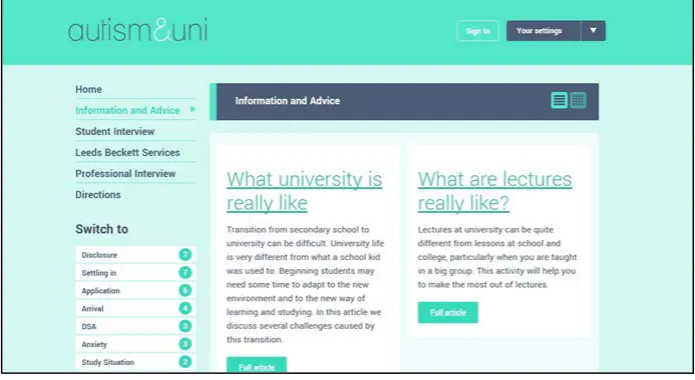
Fig. 1. Toolkit interface
The graphic design skin was well received, and comments revolved around how it was basic, muted and did not distract from the content. There were individual prefer-ences regarding colours, fonts and the style in which the text was displayed.
7.2 Interaction Related
Participants liked a flat navigation structure and ways to group and order content according to their needs. Animations and transitions were not rejected outright, but they needed to add a clear benefit to the interaction they supported (e.g. additional information sliding in when hovering over an image).
[image:8.595.125.473.149.339.2]A simple interactive feature that appealed to all participants was the option of viewing longer text either as a single page or divided into smaller sections, with quick links at the top of the toolkit item.
Fig. 2. Ability to switch between page view and slide view
option of pre-setting this choice based on a user’s previous behavior, but decided against it following the feedback).
7.3 Information and language related
Participants told us that they tend to think logically, and that information needs to be presented in a clear and objective fashion for it to be both informative and believa-ble. They liked the idea of having easy access to large amounts of information – and accessible ways to get at that information and process it at their own speed. The con-cept of introductory ‘tasters’ or ‘teasers’, which we presented in the form of videos, was less popular.
Having large amounts of information at one’s disposal creates challenges, e.g. how to guide the user through the wider narrative and information architecture. During the workshops, various suggestions were made about topics that should be added, but at the same time there was a sense of concern about keeping the toolkit navigable. This was expressed in the UK workshop as a wish to have related toolkit items linked or grouped, making connections more visible, and in the Finnish workshop as a request for a toolkit-wide search mechanism, as well as the option of customizing the toolkit to only show selected items on the basis of the student’s location and the current stage of their study career.
Participants challenged wording that made assumptions that they would find things difficult, preferring a more neutral tone that provided information without judgement. Negative depictions of autism and ‘doom-and-gloom’ scenarios were generally not well-liked. Rather than raising awareness and willingness to find out more, they in-creased anxiousness and discouraged engagement with the toolkit material. The same applies to generalizations about autism – participants were keen to see the individual nature of their experiences acknowledged and liked to hear about other autistic stu-dents’ accounts, and about variations of such accounts.
Quotes and case studies must be genuine – authenticity is paramount, not just in the writing but also regarding the use of photographs of students, study situations and places. Any typographic errors, repeated content or inappropriate language was im-mediately picked up and we were told that this would severely distract from the rest of the toolkit.
[image:9.595.132.485.558.646.2]
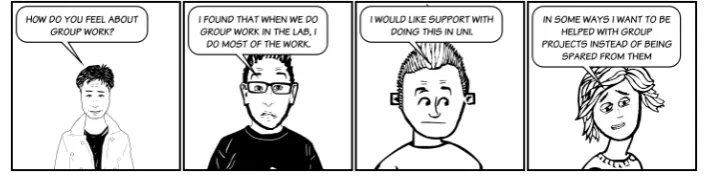
Participants liked prompts that encouraged reflection or taking action, e.g. how to get support, where to ask, who to ask and how. Anything that promoted self-advocacy was considered positive. However, some called for more concrete advice on how to proceed in solving a problem, rather than the general thoughts and questions to pon-der that were offered in some of the toolkit items. Such proposed action needs to be specific, practical and pragmatic – e.g. “try to buddy up with another student” is clear-ly too vague.
8
Discussion
The feedback received from workshop participants was relatively consistent, de-spite students being located in two countries (UK and Finland) and coming from a range of academic disciplines. There are strong indications that a considerable propor-tion of autistic students share similar preferences with regard to certain design fea-tures, particularly a clean and minimal overall look, architecture that allows easy nav-igation of large amounts of data, and the opportunity to adjust the amount of infor-mation displayed on the screen. Further, the uniformity of the feedback suggests that participants were able to express their views effectively in the workshops, and were thus contributing to the design process in a meaningful way.
However, there are validity concerns considering the limited number of partici-pants. It is not clear how representative these were of the autism community in gen-eral, and where contradictory preferences were expressed, it is difficult to determine which ones are the most likely to serve the needs of other autistic people. The use of a control group in future co-design activities could be a useful way to determine wheth-er autistic participants are actually taking the design process in a direction whwheth-ere it might not otherwise go.
One of the most ubiquitous oversimplifications concerning autistic people is that they are predominantly ‘visual thinkers’, combined with the assumption that they are likely to prefer images rather than text to convey information. The results of our study suggest the opposite is true for autistic people who are academically capable and of average of higher intelligence. While many may share perceptual strengths such as visual reasoning, they consistently preferred text with a minimum of visual distrac-tions. This has clear implications on future work, especially in the area of interface design and user experience design for people on the autism spectrum.
Acknowledgements
We would like to thank the survey and workshop participants for dedicating their time and sharing their experiences. The research leading up to this paper has been made possible thanks to the AUTHEW (Autism&Uni) project, part of the Erasmus Lifelong Learning Programme.
cannot be held responsible for any use, which may be made of the information con-tained therein.
References
1. Benton, L., Johnson, H., Ashwin, E., Brosnan, M., Grawemeyer, B., 2012. Developing IDEAS: supporting children with autism within a participatory design team. ACM Press, p. 2599. doi:10.1145/2207676.2208650
2. Benton, L., Vasalou, A., Khaled, R., Johnson, H., Gooch, D., 2014. Diversity for design: a framework for involving neurodiverse children in the technology design process. ACM Press, pp. 3747–3756. doi:10.1145/2556288.2557244
3. Biju, S.M., Todd, C., Tchantchane, L., Yakoob, B., 2013. E-Learning Software for Stu-dents with Autism, in: Sobh, T., Elleithy, K. (Eds.), Emerging Trends in Computing, In-formatics, Systems Sciences, and Engineering. Springer New York, pp. 403–410.
4. Braz, P., David, V.F., Raposo, A., Barbosa, S.D.J., de Souza, C.S., 2014. An Alternative Design Perspective for Technology Supporting Youngsters with Autism, in: Foundations of Augmented Cognition. Advancing Human Performance and Decision-Making through Adaptive Systems. Springer, pp. 279–287.
5. DesignKit (2015) The Field Guide to Human-Centered Design, IDEO Publishing, ISBN 978-0-9914063-1-9
6. d.school (2013) Design Thinking Bootcamp Bootleg, http://dschool.stanford.edu/wp-content/uploads/2013/10/METHODCARDS-v3-slim.pdf
7. Fabri, M., Andrews, P.C.S. (2016) Hurdles and drivers affecting autistic students' higher education experience: Lessons learnt from the multinational Autism&Uni research study, presented at 10th Annual International Teaching, Education and Development Conference (INTED), 7-9 March 2016, Valencia, Spain
8. Feminist Aspie, https://feministaspie.wordpress.com/2015/03/13/functioning-labels-101-whats-the-big-deal/ (2015)
9. Grynszpan, O., Martin, J.-C., Nadel, J. (2008) Multimedia interfaces for users with high functioning autism: An empirical investigation. Int. J. Hum.-Comput. Stud. 66, pp628–639 10. Gulikers, J., Kester, L., Kirschner, P., Bastiaens, T., 2008. The effect of practical experi-ence on perceptions of assessment authenticity, study approach, and learning outcomes. Learn. Instr. 172–186.
11. Kenny, L., Hattersley, C., Molins, B., Buckley, C., Povey, C., Pellicano, E., 2015. Which terms should be used to describe autism? Perspectives from the UK autism community. Autism 1362361315588200.
12. Liew, S.M., Thevaraja, N., Hong, R.Y., Magiati, I., (2014) The Relationship Between Au-tistic Traits and Social Anxiety, Worry, Obsessive–Compulsive, and Depressive Symp-toms: Specific and Non-specific Mediators in a Student Sample. Journal of Autism and Developmental Disorders. doi:10.1007/s10803-014-2238-z
13. Martin, J.A., 2015. Research with adults with Asperger’s syndrome--participatory or emancipatory research? Qual. Soc. Work 14, 209–223. doi:10.1177/1473325014535964 14. Plavnick, J., Hume, K., 2014. Observational learning by individuals with autism: A review