
© Association of Academic Researchers and Faculties (AARF)
A Monthly Double-Blind Peer Reviewed Refereed Open Access International e-Journal - Included in the International Serial Directories.
Page | 20
A STUDY ON SECURITY CONCERNS RELATED TO DATA BASE
Faiz Baothman, Associate Professor Dept. of Computer Science, College of Computers and Information Technology, Taif
University, Taif, Saudi Arabia
Muzammil H Mohammed, Associate Professor
Department of Information Technology, College of Computers and Information
Technology
Taif University, Taif, Saudi Arabia
Abstract
Security models, produced for databases, contrast in numerous viewpoints since they center
around various highlights of the database security issue or on the grounds that they make
various suppositions about what comprises a protected database. This prompts disconnected
and fragmented comprehension of the authoritative security methodology. This makes it
hard to accommodate distinctive security necessities. This paper talks about the different
security issues in databases. This methodology is valuable for the arranging of unequivocal
and mandate based database security necessities. The study is about the security
arrangement of database the board (DBMS) and proposed technique. Data is a basic
component in database the board framework where the clients trust specialist organizations
will have a safe framework to shield and keep their data from noxious assault or taking data.
There are not many kinds of strategy connected to upgrade the database security level.
Keywords: Security models, secure database, database security.
I. INTRODUCTION
Database is an aggregation of data formed in a way that a PC program can quickly pick liked
bits of data. Client can consider a database an electronic reporting system. It's a lot of data
which can be access by customers or approved client in different technique. The data are
process and put away as data in database the executives framework (DBMS). The data are International Research Journal of Mathematics, Engineering and IT
ISSN: (2348-9766) Association of Academic Researchers and Faculties (AARF)
© Association of Academic Researchers and Faculties (AARF)
A Monthly Double-Blind Peer Reviewed Refereed Open Access International e-Journal - Included in the International Serial Directories.
Page | 21 exceedingly classified and restrictive of customers. Customers furnish the data with trust in the
security administrations of the database that the data will put away securely. A thorough
technique to verify a database is more than data security [4]. The use of security instrument
supports security organizations, perceive and keep a security strike. Security of data put away
in database is vital so as to evade unapproved get to. In addition, the execution of security
administration is to recognize the unapproved get to, distinguish any assault on data and part of
counteractive action process. A fitting strategy ought to be apply to verify the data from hack or
abuse of data. Data director need to give a well-structured framework to customers and
individual who have the approval are permit to login to the database the executives framework
to include, erase, alter and update the data. There are not many kinds of technique can be apply
to build the security dimension of the data, for example, restricting the entrance control where
the client need to check the subtleties with validation, the timeframe used to get to the data
ought to be decline and the data overseer can distinguish the client to counteract take of data
amid the entrance time. Other than that, keeping up the secrecy and respectability of the data
can apply through watermarking into database. The center is to recognize malevolent assaults
and for proprietorships assurance of the data. Watermarking of data can build the flexible to
data control assaults and maintain a strategic distance from adjustment of data without
confirmation
II. REVIEW LITERATURE
D. E. Denning at, al [1] portrays the significance of cryptography to verify the data
access in electronic condition, they propose the utilization of mystery key encryption to be
connected to database tables to scramble the data contained in the table.
Agrawal at, al [2] clarified it is preposterous to precisely gauge unique qualities in
individual data record in RDBMS they propose a novel reproduction technique to precisely
assess the first data esteems.
Hacigumus, H.[3] investigate a novel worldview for data the board wherein an outsider
specialist organization has "database as an administration", furnishing its clients with consistent
components to make, store, and access their databases at the host site. They distinguish data
protection as an especially essential issue and propose elective arrangements based on data
© Association of Academic Researchers and Faculties (AARF)
A Monthly Double-Blind Peer Reviewed Refereed Open Access International e-Journal - Included in the International Serial Directories.
Page | 22 Kadhem, H [4] propose blended cryptography database (MCDB), a novel structure to
encode databases over untrusted arranges in a blended structure utilizing many keys claimed by
various gatherings. The clarify encryption process is based on another data grouping as per the
data proprietor. The proposed system is valuable in reinforcing the insurance of delicate data
regardless of whether the database server is assaulted at different focuses from within or
outside.
Jaw Chen Chang [5] introduced two new database encryption frameworks. The two
frameworks are based on the idea of the RSA (Rivest, Shamir, Adleman) ace key. The first
proposed framework is a field-arranged encryption framework with client ace keys that
compare to the entrance privileges of numerous fields. The second proposed framework is a
recordoriented encryption framework with a client ace key. Utilizing expert keys, we present a
strategy that sets up a correspondence between the subsets of a given set and a lot of whole
numbers.
III. RESEARCH METHODOLOGY PROPOSED METHOD
These days, the advancement of computerized innovation quickly increments and
causes numerous duplication or change of data like content, picture, sound or video. In
advanced framework, duplication of data can produce new data that nearly resemble the first
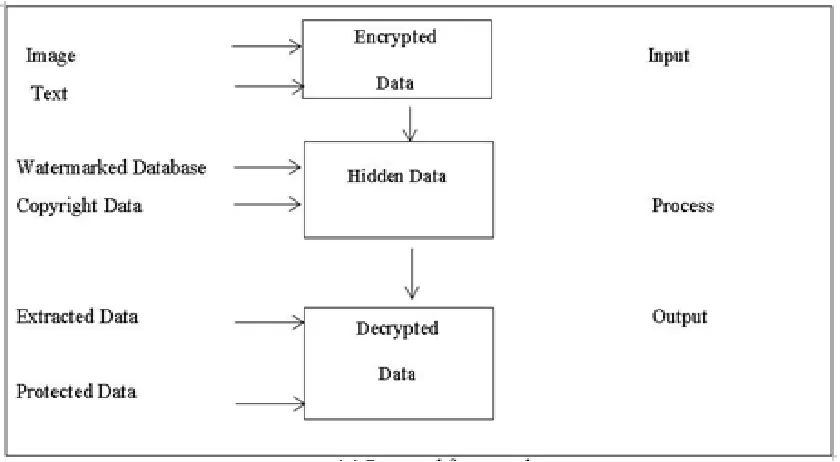
data. The proposed structure as appeared in Figure 1 is to maintain a strategic distance from the
control and duplication of data for the database security the executives framework (DBMS).
The points of this strategy is to secure the responsibility for data with execution of
watermarking into database. A picture and content will be embedded into the qualities of
database in paired structure. At that point, the imperceptible watermark picture will be inserted
with data for copyright reason. The data will be scrambled and covered up in the framework.
From that point onward, the encoded data will be put away and handled. In this manner, the
client must implant the data with letter set and numerical characters of mystery key. In any
case, the extraction of data will happen after confirm the responsibility for relate data. Client
must give precise data with the goal that the framework will unscramble the data for access
© Association of Academic Researchers and Faculties (AARF)
A Monthly Double-Blind Peer Reviewed Refereed Open Access International e-Journal - Included in the International Serial Directories.
Page | 23 Watermarking methods can be apply by client itself when they give their data to a framework.
The encryption technique will perform by making the watermark calculation before the
installing procedure. We will embed a watermark data into the first database and return
stamped [1]. This strategy will never show signs of change the secrecy and uprightness of the
first data. Moreover, executing mixed media watermark is simple for substantial quality
arrangement of data where it can improve the security of data.
[image:4.612.83.503.218.449.2]
© Association of Academic Researchers and Faculties (AARF)
A Monthly Double-Blind Peer Reviewed Refereed Open Access International e-Journal - Included in the International Serial Directories.
[image:5.612.81.404.76.431.2]Page | 24
Fig 2. Watermark Algorithm [1]
IV. ANALYSIS DATABASE SECURITY ISSUES
This area audits a portion of the issues that emerge in deciding the security
© Association of Academic Researchers and Faculties (AARF)
A Monthly Double-Blind Peer Reviewed Refereed Open Access International e-Journal - Included in the International Serial Directories.
Page | 25 Access to key fields:
Assume you have a client job with access rights to table An and to table C yet not to table B.
The issue is that the outside key in C incorporates sections from B. The accompanying inquiries
emerge:
1.Do you approach the remote key in C?
2.On the off chance that you do, you know in any event that a tuple exists in B and you know
some data about B that is confined from you.
3.Would you be able to refresh the outside key segments?
4.Provided that this is true, it must course, producing an update to B for which no benefits have
been given.
These issues don't straightforwardly emerge where the database is actualized by inward
pointers - as a client, you need have no information of the connections between the data you are
getting to. They emerge in light of the fact that connections are data esteems. Regularly,
knowing the outside key won't be delicate in itself. In the event that it is, at that point the
meaning of a view may take care of the issue.
4.1.Access to surrogate data
It isn't hard to imagine situations where the perspective on the data gave to a client job stretches
© Association of Academic Researchers and Faculties (AARF)
A Monthly Double-Blind Peer Reviewed Refereed Open Access International e-Journal - Included in the International Serial Directories.
Page | 26 A precedent should make the issue obvious.
In a retail situation, there are visit issues with pilferage. To manage these, private
investigators work covert. They are to all expectations and purposes representatives of the
business and alloted to ordinary business exercises as different individuals from staff. They get
pay checks or slips in the meantime as every other person, they show up in the executives data,
(for example, the pay examination) in a similar way. They have work title and take an interest
in the framework as somebody else. The store director is uninformed of the circumstance, as is
every other person aside from the corporate security administrator. At the point when the store
chief gets to the database, the criminologist should resemble an ordinary representative.
Questions may include:
"What leave is expected to …?"
The security staff have various questions:
"Do we have somebody in …?"
You can most likely conceive a wide range of entanglements. The investigator ought to get
a compensation slip with every other person, however ought not really be paid (or maybe
he/she ought to be paid something else from the ordinary pay for the activity).
You might need to deal with these circumstances on discrete databases. As an answer it
might be fitting, yet the bigger the issue the more extension there is for perplexity. One
proposed arrangement is the polyinstantiation of tuples - one individual is spoken to by more
than one tuple. The data recovered will rely upon the security characterization of the client.
Tuples will have the equivalent evident essential key however extraordinary real essential keys,
and all applications should be painstakingly incorporated with the security framework.
4.2. Issues with data extraction
Where data get to is pictured straightforwardly, the issue can be seen unmistakably
enough: it is to guarantee that verified clients can get to just data things which they are
approved to use for the reason required. At the point when the centre movements from the data
to the suggestions that can be drawn from that data, more issues emerge
4.3. Once more, a model should make things obvious.
You need to know the compensation of the CEO. You approach rights to the table, aside
© Association of Academic Researchers and Faculties (AARF)
A Monthly Double-Blind Peer Reviewed Refereed Open Access International e-Journal - Included in the International Serial Directories.
Page | 27 (PAY) over the entire table. You at that point make a view SELECT
MONTHLY-PAY … and issue a SUM on this view. Would it be a good idea for you to find a similar
solution in the two cases?
If not, you can accomplish your target by subtracting the two aggregates. In the event
that you recorded the regularly scheduled pay for all, what might you hope to see - all the
tuples aside from the one confined? Okay hope to be told by reference bullets that data was
missing which you were not permitted to see?
4.2. Another precedent.
You are attempting to follow an individual however have constrained data. You feed
your restricted data into the factual database (for example male, age more than 40, white, red
vehicle, lives in North London) and recover the tuples for all that meet these classifications. As
you get more data, the quantity of tuples lessens until just a solitary one is left. It is conceivable
to conclude individual data from a factual database in the event that you have a little data about
the structure, regardless of whether no regular individual identifiers are accessible (for example
no date of birth, government disability number or name).
A few answers for this security issue are to avert access to little quantities of tuples as
well as to create mistaken data (not erroneous but rather adequately off base to counteract
deductions being drawn).
V. OBJECTIVES OF THE STUDY
Toward the finish of this section you ought to have the option to:
1. Understand and clarify the spot of database security with regards to security
investigation and the board.
2. Understand, clarify and apply the security ideas significant to database frameworks.
3. Understand, recognize and discover answers for security issues in database frameworks.
4. Understand the essential language of security components as connected to database
© Association of Academic Researchers and Faculties (AARF)
A Monthly Double-Blind Peer Reviewed Refereed Open Access International e-Journal - Included in the International Serial Directories.
Page | 28 5. Analyse get to control necessities and perform genuinely straightforward
implementations utilizing SQL.
6. Appreciate the restrictions of security subsystems.
VI. CONCLUSION
Unequivocally, the investigations clarified on the sorts of strategy that can be utilized to
build the security dimension of a database the board framework (DBMS). The proposed
strategy is to gauge the privacy of data is successful or not utilizing this methodology. The
commitments of the procedure are the client can have a verified data without changes and
duplication. Notwithstanding, the calculation strategy is utilized by numerous data managers
being developed procedure. In addition, watermarking approach can be connected in distributed
computing administrations for high-security instrument in almost future. Recognizing
procedures for possession assurance is a significant and testing task. The proposed system can
be assessed utilizing database test.
In this paper, the security issues and necessities for optional and obligatory security
models for the assurance of ordinary database frameworks and article arranged database
frameworks are shown. We have additionally examined the issues related to security in article
arranged databases. A few recommendations for optional and required security models for the
assurance of regular databases and article situated database frameworks are displayed. All
things considered, there is definitely not a standard for structuring these security models. The
work introduced in this paper gives a gathered picture of various security issues of database; it
tends to be stretched out to characterize, plan and execute a powerful security strategy on a
database situation and gives a combined perspective on database security.
REFERENCES
[1] E. Bertino and E. Ferrari, “Administration Policies in a Multipolicy Authorization System,”
© Association of Academic Researchers and Faculties (AARF)
A Monthly Double-Blind Peer Reviewed Refereed Open Access International e-Journal - Included in the International Serial Directories.
Page | 29 [2] E. Bertino, S. Jajodia, and P. Samarati, “An Extended Authorization Model,” IEEE Trans.
Knowledge and Data Eng., vol. 9, no. 1, pp. 85-101, 1997.
[3] Mansour Zand, Val Collins, Dale Caviness, “A Survey of Current Object-Oriented
Databases,” ACM SIGMIS Database, Volume 26 Issue 1, February 1995.
[4] Elisa Bertino, “Data Hiding and Security in Object-Oriented Databases,” In proceedings
Eighth International Conference on Data Engineering, 338-347, February 1992.
[5] Martin S. Olivier, Sebastian H. Von Solms, “A Taxonomy for Object-Oriented Secure
Databases,” ACM Transactions on Database Systems, Vol. 19, No. 1, Pages 3-46, March
1994.
[6] Fausto Rabitti, Elisa Bertino, Won Kim, Darrell Woelk, ”A Model of Authorization for
Next-Generation Database Systems,” ACM Transactions on Database Systems (TODS),
Volume 16 Issue 1, March 1991.
[7] Pierangela Samarati, Elisa Bertino, Alessandro Ciampichetti, Sushil Jajodia, “Information
Flow Control in Object-Oriented Systems,” IEEE Transactions on Knowledge and Data
Engineering, vol.9, no.4, pp.524–538, July-August 1997.
[8] Ahmad Baraani-Dastjerdi, Josef Pieprzyk, Reihaneh Safavi-Naini, “Security In Databases:
A Survey Study,” Department of Computer Science, The University of Wollongong,
Wollongong, Australia, February 7, 1996.
[9] Sushil Jajodia, Boris Kogan, “Integrating an Object-Oriented Data Model with Multi-Level
Security,” Proceedings of the 1990 IEEE Computer Society Symposium on Research in
Security and Privacy, 7-9, May 1990.
[10] D. Elliott Bell, Leonard J. La Padula, “Secure Computer System - Unified Exposition
![Fig 2. Watermark Algorithm [1]](https://thumb-us.123doks.com/thumbv2/123dok_us/72763.1011393/5.612.81.404.76.431/fig-watermark-algorithm.webp)
