Journal of Chemical and Pharmaceutical Research, 2013, 5(11):1-5
Research Article
CODEN(USA) : JCPRC5
ISSN : 0975-7384
Using telecare system to construct medication safety mechanisms
for remote area elderly
J. Y. Wang
1, C. H. Tsai
2*and S. W. Wang
11
Department of Transportation and Logistics Management, National Chiao Tung University, China 2
Department of Health Administration, Tzu Chi College of Technology, 880, Sec.2, Chien-kuo Rd. Hualien City, Taiwan 970, ROC
_____________________________________________________________________________________________
ABSTRACT
This study focuses on the elderly patients living in remote areas of central Taiwan and surveyed their experience of telecare system since medication safety for elderly patients is an important issue on their lives and safety. We adopted the questionnaire survey for data collection, and examined our hypotheses by applying the structural equation modeling (SEM) method to validate the model. The results show that person-centered caring, communication, perceived ease of use, and perceived usefulness are key aspects affecting elderly use intention of telecare system. The result can help medical institutions construct medication safety mechanisms.
Keywords: Medication safety, Telecare, Person-centered caring, TAM model.
INTRODUCTION
Medication safety is an important issue for medical institutions. Joint Commission Accreditation of Health Care Organization set focus on medication safety in 2010. Taiwan Joint Commission on Hospital Accreditation (TJCHA) strengthens "chronic disease medication safety" and "enhance the safety of patients and caregivers the ability of medication" as key implementation strategies in 2010. Because people can easily obtain medication, medication use for the safety and appropriateness may not have the right attitudes and behavior. Moreover, according to the United States and Canada survey, there are 40% elderly who live at nursing homes and 37% elderly who live at home occurring inappropriate medication [1,7,9]. Inappropriate medication behavior includes failure to take medication by doctor visions, drug allergy, and taking other drugs at the same time [6]. Thus, medication safety for elderly patients is an important issue on their lives and safety.
Telecare system is an important auxiliary tool for medical institutions for elderly living in remote area. Elderly living in remote area, different from living in the metropolitan area, has less transportation and capital treatment resources. Therefore, telecare can be a medication counseling and supportive service platform. However, there are many barriers must be overcome for the elderly. For example, will elderly use telecare equipment? Do elderly person accept remote communication service model? Is telecare able to meet the psychological needs of the care? Consequently, this study focuses on the elderly living in remote areas of central Taiwan and surveyed their experience of telecare. The result can help medical institutions construct medication safety mechanisms.
Literature Review Telecare
country, the Department of Health, Executive Yuan, R.O.C. (Taiwan) started promoting the “Telecare Pilot Project” in 2007. Through telecare along with the combination and application of information and communication technology, three telecare service models, including community-based telecare, home-based telecare, and institution-based telecare, were developed. Moreover, an integration platform of telecare information was established. A summary of the literature review and the observation of industrial trends show that telecare is currently no longer just restricted to home monitoring. It also has the functions of advancing the active participation in self-health management, self-care, health education videos, and pharmaceutical consultations. Telecare can help elderly people who are in remote and underserved districts to have access to health care and supportive services.
Person-centered caring and communication
Swanson emphasized “person-centered caring” is an interactive relationship with the value of the care[11]. It allows the individual to feel entrusted with the responsibility and make the process of care, including five processes: knowing, being with, doing for, enabling, and maintaining belief. Person-centered caring help people to understand clients' needs, solve the problem cases, and teach the skills to reach self-realization. Telecare offers high-tech information technology services, but should be based on the individual needs of the elderly. Therefore, we considered person-centered caring is an important factor for the elderly people using telecare.
Moreover, instrumental (task-focused behavior), which is a part of the scope of emotion, and affective (social emotional behavior) is an important distinction in health communication. Bensing points out "doctor-patient communication purposes in the general case speaking, primarily physicians and patients hope that through the process of communication, to conduct disease information exchange and discussion of treatment-related decisions"[2]. This study suggests that interactive communication is an important factor between hospital and elderly to reach mutual trust. The elderly can reduce the likelihood of medication errors when they understand the doctor's medication principle.
Technology Acceptance Model
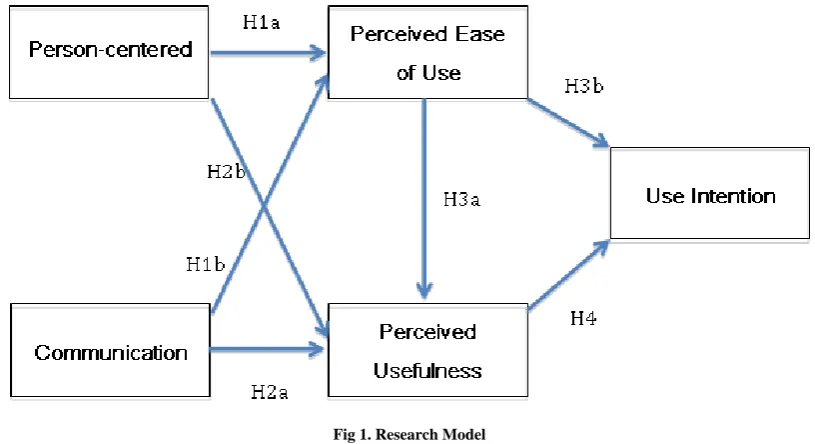
[image:2.595.101.509.499.721.2]The Technology Acceptance Model (TAM) mains to predict and explain a person’s adoption of information technology [4]. TAM identifies two relevant beliefs, that is, perceived ease of use and perceived usefulness. Perceived ease of use is defined as the extent to which an individual believes that using the system will be free of effort, while perceived usefulness is defined as the extent to which an individual believes that using the system will enhance the job performance. According to TAM, the usage of information technology is influenced by behavioral intention to use the information technology, while behavioral intention is determined jointly by perceived usefulness and attitude toward information technology usage. Furthermore, the attitude toward information technology usage is jointly determined by perceived ease of use and perceived usefulness. Perceived usefulness is also influenced by perceived ease of use and external variables. TAM has been widely applied in practice, extended in academics, and empirically tested in the field of information management in the last decade.
Fig 1. Research Model
model depicted in Figure 1.
EXPERIMENTAL SECTION
Research Method
We adopted the questionnaire survey for data collection, and examined our hypotheses by applying the structural equation modeling (SEM) method to validate the model. The measurement instruments for variables in the questionnaire were developed from previous studies to enhance the variability and reliability [10,12]. Responses to the various variables related to the perceptions of the individual subjects were measured using the Likert-type scale.
The survey subjects of the questionnaire were those residents who are the end users of a telecare system from Nantou County, Taiwan. The telecare system was developed and installed by a community hospital in Jhushang Township, namely Chu Shang Show Chwan Hospital.
RESULTS AND DISCUSSION
In this study, the subjects were lived in remote areas of central Taiwan. Of the recruited 350 subjects, there were 271 subjects who agreed to participate in the study. Of these respondents, 127 respondents are women (46.9%) and 144 respondents are men (53.1 %). Most of the respondents were 71-80 years of age (39.5%). Most respondents hold elementary school degrees (81.9%). A majority of the caregivers are spouses (41%). The mean scores for seven constructs are all almost on the middle point of 5-point Likert-type scales, and show a reasonable dispersion in their distributions across the ranges.
Table 1-Means, Standard Deviations, Cronbach’s α, and Correlations
Construct Mean Standard Deviation Cronbach α 1 2 3 4 5
1.Person-centered caring 4.2946 0.92357 .962 1
2.Communication 4.4750 0.63613 .962 .694*** 1
3.Perceived Ease of Use 4.5938 0.57015 .980 .278*** .204*** 1
4.Perceived Usefulness 4.5833 0.66856 .944 .450*** .410*** .316*** 1 5.Use Intention 4.2257 0.96590 .971 .328*** .337*** .390*** .491*** 1
Measurement Model Results
To validate the measurement model, three types of validity were assessed: content validity, convergent validity, and discriminant validity. Content validity was done by interviewing senior system user. And the convergent validity was validated by examining Cronbach’s α. The Cronbach’s α of every subscale range from 0.944 to 0.971 was above the acceptability value 0.7 [9]. In addition, all measures are significant on their path loadings at the level of 0.001. Therefore, the convergent validities of all seven constructs are confirmed (Table 1).
Structural Model Results
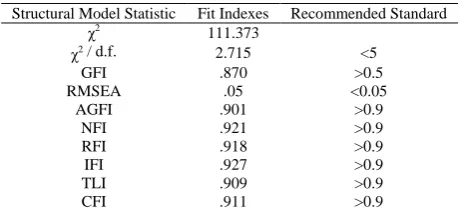
To validate the measurement model, we used AMOS 8.0 to assess the analysis. As shown in the Table 2, the goodness-of-fit indices are within the accepted thresholds. Generally, these fit indexes are all greater than or equal to 0.9 for GFI, AGFI, NFI, and CFI. Furthermore, χ 2
[image:3.595.191.422.590.695.2]/d.f. value is less than 5 and RMSEA value is less than 0.05. indices indicate an excellent fit of the model and data.
Table 2-Fit Indexes For The Model
Structural Model Statistic Fit Indexes Recommended Standard
χ2 111.373
χ2/ d.f. 2.715 <5
GFI .870 >0.5
RMSEA .05 <0.05
AGFI .901 >0.9
NFI .921 >0.9
RFI .918 >0.9
IFI .927 >0.9
TLI .909 >0.9
CFI .911 >0.9
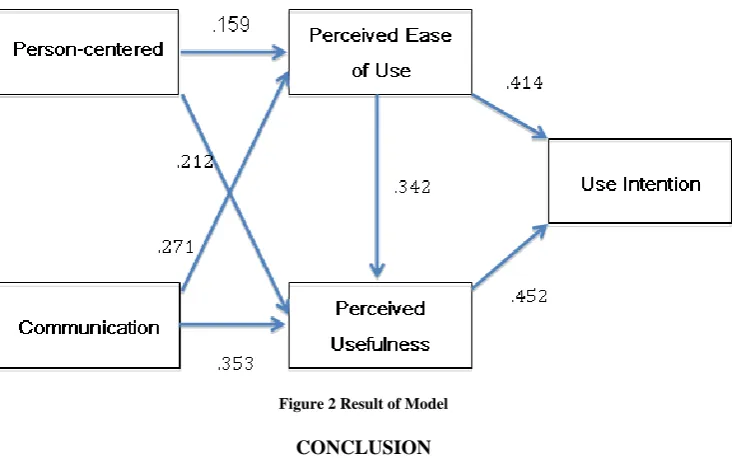
all significant effects on perceived usefulness. In addition, both perceived ease of use (β=0.414) and perceived usefulness (β=0.452) have significant effects on use intention. The results of the structural model show that person-centered caring, communication, perceived ease of use, and perceived usefulness are key aspects affecting use intention of telecare system.
Figure 2 Result of Model
CONCLUSION
Based on the TAM model, this study proposed a research model to better understand the older residents’ usage intention of telecare system. The model considered the relationships among person-centered caring, communication, perceived ease of use, perceived usefulness, and intention to use. Using SEM, the hypotheses are proposed to validate the fit of empirical data and model. The results show that the relationships proposed in the model are all supported. Our findings suggest that both perceived ease of use and perceived usefulness are two important antecedents that directly influence behavioral intention to use the telecare system. In addition, both person-centered caring and communication have significantly positive effects on perceived ease of use, and perceived usefulness separately. Furthermore, both person-centered caring and communication have significant impacts on use intention mediated by perceived ease of use, and perceived usefulness.
With an aging population, the care of older people and the role of the telecare system will become increasingly important [3]. Both perceived ease of use and perceived usefulness are crucial determinants to predict intention to use the telecare system. Accordingly, the perceptions and experiences of the elderly about telecare will influence their degree of acceptance. This implies that the managers of hospitals and designers of telecare system companies should pay more attention to understanding the perceptions of the elderly and improving the system quality of the system.
This study experienced limitations in the conceptualization and expansion of the theoretical model because our samples were from rural area in Taiwan, where cases could not be monitored continuously, samples were insufficient, and the vastness of the area impeded the distribution of questionnaires. The valid samples from this study were all elderly people who still using telecare for at least two years. Another possible limitation is the restricted time and space the patients had to use telecare. However, this study does still provide a unique contribution to the existing knowledge on use of telecare services in older people.
REFERENCES
[1] Balogun S. A., Preston M. and Evans J.. Journal of American Geriatrics Society, 2003, 51(S4), S103. [2] Bensing J. Social Science and Medicine, 1991, 32(11), 1301-10.
[3] Brownsell S, Blackburn S. and Aldred H. Housing, Care and Support, 2006, 9(2), 6-12. [4] Davis F. D., Bagozzi R. P. and Warshaw P. R.. Management Science, 1989, 35(8), 982-1002. [5] Demiris G., Doorenbos A. Z. and Towle C.. Research in Gerontological Nursing, 2009, 2(2), 128-36. [6] Fialova T., et al. The Journal of American Medical Association, 2005, 293(11), 1348- 58.
[9] Nunnally J. C.. Psychometric Theory. 2 ed. New York: McGraw-Hill; 1978. [10] Su S. P., Tsai C. H. and Hsu W. L.. Journal of Computers, 2013, 8(2), 525-32. [11] Swanson K. M. Nursing Research, 1999, 48(6), 288-98.