
P E R P U S T A K A A N U T H M
THREE-DIMENSIONAL PLANT MODELING AND SIMULATION: MOW
FAR DOES RECENT COMPUTER TECHNOLOGY EXPAND TO ASSIST
THE LANDSCAPE ARCHITECTURE PRACTICE.
GRADUATE RESEARCH PROJECT
HANITA BT. YUSOF
FACULTY OF BUILT ENVIRONMENT
ii
D E C L A R A T I O N
"I hereby declare that this thesis entitled Three-Dimensional Plant Modeling and Simulation: How Far Does Recent Computer Technology
Expand to Assist the Landscape Architecture Practice is the result of my
own research except as cited in the references."
Signature Author Date
iii
A C K N O W L E D G E M E N T
In t h e n a m e o f A l l a h , t h e A l m i g h t y , t h e M o s t G r a c i o u s a n d M o s t M e r c i f u l .
First and foremost, I wish to express my deepest and most sincere gratitude to my Graduate Project Research lecturer and also as my
supervisor, Jim Plume for his guidance, concern, comments and motivation throughout the whole process of this report writing. Thank you for sharing with me your indispensable knowledge, expertise and advice.
To all respectful lecturers of Architectural Department, Faculty of Built
Environment, UNSW Sydney, thank you for their valuable ideas and opinion.
To my beloved parents, Hj. Yusof Khalid and Hjh. Hazirah Ibrahim, whom I owed so much for their prayers and support, thank you very much for
their endless love, constant interest and advise. Every words of encouragement have always assisted me through rough times and shall always be my inspiration in facing tomorrow. Thank you for believing in me.
i
C O N T E N T S
PAGE
D E C L A R A T I O N ii
A C K N O W L E D G E M E N T iii
C O N T E N T S iv
F I G U R E S vii
1 . 0 I N T R O D U C T I O N
1.1 Landscape Architecture and Role of
Landscape Architect and Designer 1 1.2 Significance of Computer Based Technology
in Landscape Architecture 2 1.3 Integration of Conventional and Advance
Computing in Current Landscape Architecture
Work Process 2
1.4 Issues and Problem Statement 3 1.5 The Capability of the Latest Advance
Computer Application Related to Landscape
Architecture Field 5
2.0 P L A N T D A T A B A S E
V
3.0 P L A N T M O D E L I N G
3.1 Significance of Plant Modeling Application in
Planting Design Process 12 3.2 Rich Information Modeling 14
3.3 Plant as an Object-Based Modeling 14 3.4 Parametric Modeling Technology 15
4.0 P L A N T A N A L Y S I S A N D S I M U L A T I O N
4.1 Plant Shadow Casting/Underneath Shade 16
4.2 Plant as Landscape Function 17 4.3 Plant Bending and Swaying Simulation 17
4.4 Growth Simulation 20 4.5 Seasonal Simulation 24
5.0 A P P L I C A T I O N
5.1 Applications Available on Plant Modeling
5.1.1 TREE STORM 25 5.1.2 SpeedTree and SpeedTreeCAD 27
5.1.3 Bionatics and EASYnat by Bionatics 29
5.1.4 Lenne3D 31 5.2 Critical Review on the Application 33
6.0 P R E S E N T A T I O N , A N I M A T I O N A N D V I S U A L I Z A T I O N 34
8.0 C O N C L U S I O N 3 7
9.0 R E F E R E N C E S 39
V l l
F I G U R E S
F I G U R E NO. T I T L E P A G E
Figure 1: Examples of plant images in the database, (source:
Honjo, 2001) 8
Figure 2: Plant simulation via texture mapping: a tree image is mapped onto a simple rectangle. The background colour of the image is rendered as transparent. One
such "billboard" faces the viewer, a second one faces the sun and is only used to cast a correct
shadow, (source: Muhar, 2001) 9
Figure 3: Example of trees images made by two textured planes with transparent GIF and non-transparent
GIF. (source: Honjo, 2001) 10
Figure 4: Consecutive stages of development of a plant modeled by a simple L-system with production rule A —> l[L]A. The structure is represented by a string of characters that changes over time. I stands for an
internode, L represents a leaf and the apical meristem is symbolized by A. (source: Renton et al.,
2005) 11
Figure 5: Plant form and shape, (source: Renton et al., 2005) 13
Figure 6: The impact on colours in visualization (source:
viii
Figure 7: Bend of branch. (Source: Akagi and Kitajima, 2006) 18
Figure 8: Virtual resistance: (a) ordinary grids and boundary conditions to compute the wind; and (b) using virtual resistance to reduce the amount of grids. (Source:
Akagi and Kitajima, 2006) 19
Figure 9: Tree swaying versus wind velocity: (a) 0 m/s; (b) 5 m/s; (c) 10 m/s; and (d) 20 m/s. (Source: Akagi
and Kitajima, 2006) 19
Figure 10: Effect of tree on the upwind side on the sway of branches: (a) upper wind and (b) lower wind.
(Source: Akagi and Kitajima, 2006) 20
Figure 11: The results can also be differ affected by different impact on shade and light pattern. (Source: Renton
et al., 2005) 21
Figure 12: The results of simulations run with the standard version of the model to test adaptability to variable growth patterns adapting different shading conditions. Simulated of 20 years old trees growing (a) in isolation of full light, (b) left side shaded (c) in a forest and (d) in isolation with 75% annual defoliation simulated in the canonical model.
(Source: Renton et al., 2005) 21
Figure 13: Schematic presentation of a coniferous (left) and broad-leaved tree (middle) using structural units of LIGNUM. Also shown is the structure of a segment (right) for broad-leaved trees, (source: Perttunen
IX Figure 14 Figure 15 Figure 16 Figure 17 Figure 18 Figure 19 Figure 20
The different effects on same plant model resulted by seasonal simulation. (source: Bionatics
application, 2007) 24
Leaves from the specific leaf sub-object can be selected and replaced with external object within TRESS STORM application, (source: TREE
STORM application, 2007) 26
The movement resulted by wind with any value of wind speed from any angle and direction can be
previewed, (source: TREE STORM application,
2007) 26
The LoD options for leaves, branches, fronds and also LoD indicater shown in this SpeedTreeCAD window image, (source: SpeedTreeCAD application,
2007) 27
The parametric value for branches, leaves, fronds
and shape definition of length and radius profile can be set within SpeedTreeCAD application, (source:
SpeedTreeCAD application, 2007) 28
The model can be rendered to see the shadow effect. The parametric modification only applicable within TREE STORM application, (source: TREE
STORM application, 2007) 30
X
imported and visualized in any CAD application cannot apply any detail parametric modification except for positioning and scaling, (source: TREE
STORM and 3ds Max application, 2007) 30
Figure 21: The model can be modeled as in single and in
mass/group with natural real-time effect on spacing, distribution and appearance within Lenne3D
application, (source: Lenne3D application, 2007) 31
Figure 22: The 3D-Player of Lenne3D provides real-time interactive visualization of 3D animation within Lenne3D application, (source: Lenne3D application,
1.0 INTRODUCTION
There are some contradict perceptions on the issue of advance digital
application related to landscape architecture field. Either there is no advance digital application being invented for landscape architectural design purposes or another perception that there are probably few applications related to landscape architecture field but not being utilized by landscape practitioners
in landscape design practice. This particular research topic on 'three-dimensional plant modeling and simulation: how far does recent computer technology expand to assist the landscape architecture practice' will answer the perceptions based on literature studies done by researchers all over the
world as well as the recent information by the vendors which both related to this research topic will finally reveal the actual situation.
1.1 Landscape Architecture and Role of Landscape Architect and
D e s i g n e r
Landscape architecture is a field that involve with nature such as flora and
fauna, landform and ecology and it has very close connection to architecture field where a building project might have landscaping work within the same project. Landscape design includes both softscapes such as plants and water bodies and also hardscapes such as pavement and pergolas.
Landscape studies basically involves planting design, spatial arrangement, ecology, ecosystem, construction as well as master planning involving location, sizing, topography that can be an advantage in designing and planning a site for a stormwater management. It's also important to consider on landuse, zoning, circulation, utility and community of the surrounding. Site
should be analyzed through site inventory and mapped with a different suitability assessment layer for each relevant factor. It has the quite similar work process with architect basically from site inventory, analysis and design process up till the outcome of few design alternatives through several
sequence of design process where it involves design, crit, presentation, amendments, documentations and in that case it need to be at par with the architects when it comes to computer application. Obviously, all these process will be much more faster, easier and accurate if it can be done with
the help of computer technology.
1.2 S i g n i f i c a n c e o f C o m p u t e r B a s e d T e c h n o l o g y in L a n d s c a p e
A r c h i t e c t u r e
Landscape architecture often involves with large scale of projects having huge site like parks whether it is open public park or even theme park, urban greenbelt or green corridors, campus and site design for institutions or housing areas, waterfornt or promenade, botanical gardens, arboretums, and
nature preserves, recreation facilities like golf courses, amusement parks and even sports facilities. This is another good reason why it really needs a good computer application to assist the design process. Landscape design have so many element such as landform, plant materials, buildings,
hardscape structure, pavement to be utilized in the landscape design that will be much more inspired with the help of the advance computer application such as the object information modeling from conceptualizing stage and the making and analyzing their design.
1.3 I n t e g r a t i o n o f C o n v e n t i o n a l a n d A d v a n c e C o m p u t i n g in C u r r e n t
L a n d s c a p e A r c h i t e c t u r e W o r k P r o c e s s
J
of paper and transfer it to CAD software for two-dimensional plan, elevations and sections. Most of them still draw the three-dimensional drawings manually saying that the plants will look more natural in freehand unlike building. Probably the lack of knowledge on the recent advances software provided that has a lot of two and even three dimensional plant software available in the market.
Nevertheless, no doubt that many landscape architects now have used digital plant library in computer database to do plant selections but it only limited to still images not object modeling that can work for simulation and animation. As for presentation, the still drawings done in two-dimensional
CAD will then be rendered and coloured either manually or using computer. For photo-editing work landscape architects will make use of image-editing software (eg Photoshop and Photopaint). These programs encourage exploration of photomontage as a conceptual and graphic tool. Having said
that, there are a lot more opportunities to integrate even more computer technology available for landscape architecture field created in the market. However, there is no effort of taking the advantage of manipulating every advance computer application emerge recently and make full use of it in design process as early as possible. Danahy (2001) believed that the role of
a computer-aided-design system should be to assist the designer in developing and managing the information used in a complex environment design problem and to allow for accurate rendering of all design alternatives considered. Visual information generated by the computer will definitely
influence on decision-making when being used as early as possible in the design process. Sad but true, most of these advanced visualizations are developed only after the real work is completed, and often only to 'sell' the resulting proposals for marketing purposes.
1.4 I s s u e s a n d P r o b l e m S t a t e m e n t
4
utilization within their design process. Almost all landscape design
practitioners are still comfortable and satisfy using the manual approach in handling the design exploration and presentation techniques. These won't allow the landscape design professions to be able to expand to a collaborative design strategy. Within contemporary digital environments, there are increasing opportunities to explore, analyze and evaluate design
proposals which integrate both architectural and landscape aspects. The innovation of integrated design solutions exploring buildings and their surrounding context is now possible through the design development of shared three dimensional and even four dimensional virtual environments, in
which buildings no longer float in space.
There are presently still too many landscape architecture practitioners as well as in academic departments where computer based design activity is seen as an isolated from the whole design process where it is only be used more for two dimensional instead of three dimensional tasks. With recent technological developments in computing, there is a huge opportunity for a
range of landscape element and component template and rich information modeling to be explored. An increasing amount of online data is large and available compared to years before. A rapidly expanding area related to landscape architecture is Geographic Information Systems (GIS). Another
expanding area is the use of object-oriented technology in CAD.
Nevertheless, for this particular research paper, I will explore on plant as the main object for the information modeling and the possibilities to be applied in landscape architecture design practice towards better possibilities of having
an effective design and time consuming results. Eventhough plant is obviously one of the main elements in landscape design, there is still conventional method in addressing the plant in the design process.
5
vegetation is a prerequisite for realistic visual simulations of landscape sceneries. Furthermore, plant itself is the primary character in visual landscape simulation. This clearly stated that a digital application related to plant is vital.
The absence of plant information modeling software is a huge disappointment since choosing and analyzing plant is important. Without using the correct plant selection in addition of having a good landscape
design and planning, the level of success would not be so great. As Preece (1991, p.256) says that trees are joy, but the wrong tree in the wrong place is nuisance. Due to that reason, this research will mainly be focusing on the plant material particularly in three dimensional plant modeling and simulation
where this is main issue lacking in the landscape design application.
1.5 T h e C a p a b i l i t y o f t h e L a t e s t A d v a n c e C o m p u t e r A p p l i c a t i o n
R e l a t e d t o L a n d s c a p e A r c h i t e c t u r e F i e l d
6
through a total simulation of the lifecycle of the design proposal. The model may also be used to explore environmental/energy considerations and changes in the balance between the building and its context most immediately through the growth simulation of vegetation but also as part of a larger planning model. The latest one can predict what it may look like in future time for example the effect of the plant growth after five or ten years ahead. These will help to predict how the shading or visual created by plants will affect the building or even the landscape sceneries after few years.
Surprisingly, there are ample of interactive modeling of plant application nowadays. Observing the current landscape practice and educational exposures in academic level, one would think that there is no advance plant modeling software at all available but amazingly it does. In this digital modeling field a lot of method and system created to model a plant such as
Texture Mapping, Fractal and Lindenmayer system or known as L-system used in the earlier stage up till recent ones such as LIGNUM, Canonical GUI system and Lenne'3D system where these latest systems are an improvised version targeted at previous limitation and weakness of earlier invention.
Integration of more than one approach will give much better result. For instance the combination of L-system with LIGNUM or canonical modeling with L-system. More software applications which offer plant modeler application emerged based on some of this system such as TREESTORM by
Onyx TreeMaker, EASYnat by Bionatics, Lenne3D, SpeedTree, TreeMagik, PlantStudio, Plant-Life and XFrog. All these would be explained further in the following topics.
7
blow in the wind (digitally) is even more so. Some software has begun to approach these challenge, adding to fractal plant-form generation, plant growth or wind motion, and these are already essential utilities for digital landscape modelers such as those mentioned before.
2.0 P L A N T D A T A B A S E
2.1 I n t e l l i g e n t S o u r c e s o f D i g i t a l P l a n t D a t a b a s e
Plant or may also be termed as vegetation is consists in various categories. In landscape architecture field plants are categorized into trees, shrubs, palms, bamboos, vines (climbers and creepers), groundcovers and also aquatic plant. Those categorization are sort based on their physical
characteristic. In landscape practice, landscape architect or designer will need to choose an appropriate plant based on the design concept and theme, design principles and most importantly objectives because different plant serves different landscape function. Plants are selected based on its
characteristic and landscape function, suitability as well as aesthetic. Traditionally, all these information are gathered in books with all the images. Then there is electronic library or e-library where it is a digital library consists of plants species with every botanical information including still images.
Information of plants characteristics such as shape and profile, size of
maturity, nature of foliage, special features of value, rate and pattern of growth, strength of wood, flowering habit (can see what it looks like in summer, autumn, winter and spring effect whether its evergreen or deciduous) are included in the database.
s
generated by AMAP and simulated various landscapes using the AMAP system.
Honjo and Lim (2003) experimented a research digital plant modeling to express plant by texture mapping also using computer graphics images of plants made by AMAP where he claimed that AMAP is a high-performance
visualization system for landscape planning developed by Center Internationale Recherche Agricultural Development (CIRAD) that produces high precision three-dimensional plant shapes. AMAP is one of the outputs of the study of plants. AMAP generates very botanically realistic three-dimensional computer graphics where images of several growth stages can
be easily made and are used as a texture. This three-dimensional plants made by computer graphics by AMAP or other similar techniques consist of polygons. Branches, twigs, flowers and leaves are all described by sets of polygons. The number of the polygons varies between thousands to millions.
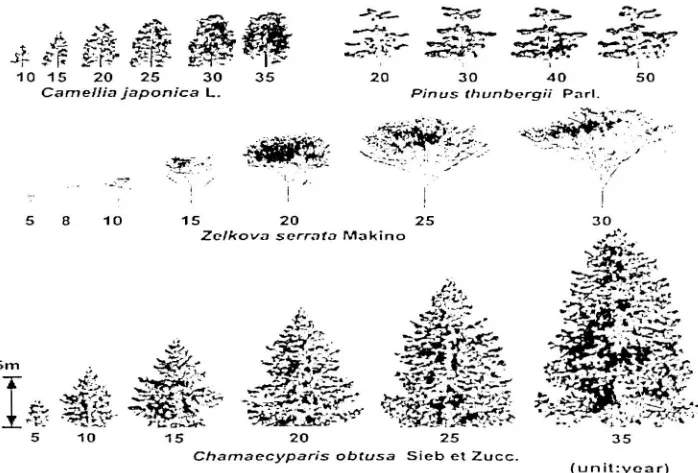
Such a polygon model is suitable for photo realistic expression of the plants but needs large amount of time for the rendering and additionally, walk-through simulation is difficult in VRML. Therefore, this method used only 2D textures and a 2D plant image database was developed. Examples of plant
images in the database are shown in Figure 1.
Chamaecyparis obtusa Sieb et Z u c c .
[image:20.600.123.472.508.745.2]( u n l t : y o a r )
9
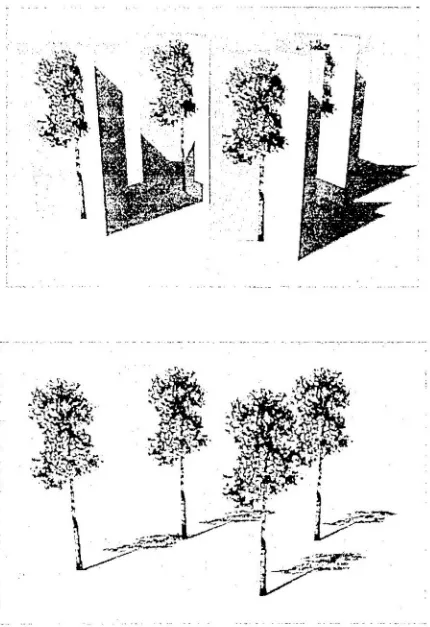
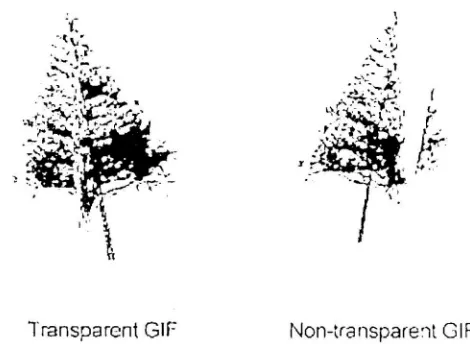
[image:21.600.190.405.384.698.2]This texture mapping method using the 2D image from AMAP database is one of the earliest method used. To make a fast rendering of plants, the texture of plants which are in a transparent GIF format are mapped on a plane and two planes are crossed to show the plants as shown in Figure 2. This method is very effective for the fast rendering of plants thus make it very popular. There are many methods to model plants. Muhar (2001) claimed that the use of texture mapping in connection with simple 3D-faces is a very popular method of plant visualisation in landscape architecture. Texture mapping implies the projection of raster graphics onto a modelled surface in order to alter the surface characteristics, such as the colour or the transparency. In the case of plant visualisation a photograph of a real tree can be mapped onto a rectangular vertical face (billboard); in the rendering process the areas of the image background are treated as transparent shown in Figure 2 and 3.
Figure 2: Plant simulation via texture mapping: a tree i m a g e is m a p p e d onto a simple rectangle. T h e b a c k g r o u n d colour of the image is rendered as transparent. O n e such "billboard" faces the viewer, a s e c o n d one faces the sun and is only used to cast a correct
Plants consist of a large number of individual elements, however, the
configuration of these elements follows relatively simple rules (e.g. the branching pattern within a genus is usually constant). Therefore, plant modeling algorithms have to find ways for a formal mathematical description of the 'genetic construction plan' of a plant.
T r a n s p a r e n t G I F N o n - t r a n s p a r e n t G I F
Figure 3: E x a m p l e of trees i m a g e s m a d e by two textured planes with transparent GIF and non-transparent GIF. (source: Honjo and Lim, 2001)
This texture mapping is a starting point of more inventions of plant modeling and rendering application. Danahy (2001) strongly believed that the
breakthrough for three-dimensional landscape simulations came when image-processing techniques were merged with geometric modeling. These techniques, referred to as texture mapping, have constituted a "profound improvement", as they have enhanced image quality and opened the door for
real-time rendering of virtual models. In this hybrid approach, much of the explicit, realistic information is sampled from the real world and is not computed (e.g. leaf texture in 3D plant models). Using an expression of a plant's genetic code, AMAP technology constructs virtual models of plants
[image:22.600.171.406.221.393.2]11
[image:23.600.77.525.44.393.2] [image:23.600.74.526.45.818.2]Another popular method for modeling a plant is L-system. Renton et al. (2005) explained that these L-system models can give a topological, geometrical and graphical representation of the plant. In L-system models the development of a plant's structure is expressed as a changing string of symbols where each symbol represents a plant component such as a leaf, internode or apical bud, with square brackets enclosing lateral structures in Figure 4.
Jr
l[L]A
Figure 4: C o n s e c u t i v e stages of d e v e l o p m e n t of a plant m o d e l e d by a simple L - s y s t e m with production rule A —• l[L]A T h e structure is represented by a string of characters that c h a n g e s over time I stands for an internode, L represents a leaf and the apical m e r i s t e m is
symbolized by A (source: Renton et al., 2005)
The dynamics of how the string symbols change is controlled by a set of growth or production rules. This resulting dynamic plant structure can then be visualized in realistic or schematic ways, easily related to the appearance and architecture of real plants.
I [ L ] I [ L ] A l [ L ] l [ L ] l [ L ] A
3.0 PLANT MODELING
12
distinguished. In other words saying that plants in the foreground of a scene have to be modeled as three-dimensional objects, while for the background other approaches can be applied, such as texture mapping. However, for landscape architectural design purposes, most plant would be modeled as single / individual instead of forest strand.
3.1 S i g n i f i c a n c e o f P l a n t M o d e l i n g A p p l i c a t i o n i n P l a n t i n g D e s i g n
P r o c e s s
As practical as it is, planting design is an art. Having determined what functions are necessary to it, the designer's next task is to apply the
principles of planting design in artistic composition. Up to this point, only size and general placement have been considered. Now it is time to furnish the design with real forms that can be sensed, felt, and seen.
Planting design process which includes planting design principle, planting design purpose, planting design arrangement and spacing (mass/group) really need such advance application. Planting design purpose would considered on aesthetic value such as flowers and foliage, an abstract value such as lines, shapes, forms, textures, colours and visuals, a functional value such as shade, barrier, hedges and screen. To choose and analyze the impact on this can be assist by advance application.
![Figure 4. Jr l[L]A](https://thumb-us.123doks.com/thumbv2/123dok_us/8783008.905282/23.600.74.526.45.818/figure-jr-l-l-a.webp)
