IMPROVING ON THE NETWORK LIFETIME OF CLUSTERED-BASED WIRELESS SENSOR NETWORK USING MODIFIED LEACH ALGORITHM
SALTIHIE BIN ZENI
A project report submitted in
fulfillment of the requirement for the award of the Degree of Master of Electrical Engineering
Faculty of Electrical and Electronic Engineering Universiti Tun Hussein Onn Malaysia
v
ABSTRACT
ABSTRAK
vii
CONTENTS
TITLE i
DECLARATION ii
DEDICATION iii
ACKNOWLEDGEMENT iv
ABSTRACT v
ABSTRAK vi
CONTENTS vii
LIST OF TABLES x
LIST OF FIGURES xi
LIST OF SYMBOLS AND ABBREVIATIONS xiii
LIST OF APPENDICES xiv
CHAPTER 1: INTRODUCTION
1.1 Motivation 1
1.2 Description 2
1.2.1 Wireless Sensor Networks 3
1.2.2 Advantages of Wireless Sensor Networks 4 1.2.3 Drawback of Wireless Sensor Networks 4
1.3 Objectives 5
1.4 Thesis Outline 6
CHAPTER 2: LITERATURE REVIEW
2.1 Introduction 7
2.2 A Wireless Sensor Network Model 8
2.2.1 Protocol Architecture 9
2.2.1.1 OSI Model 9
2.2.1.2 TCP/IP Model 10
2.2.2 MAC Protocol 10
2.3.1 Proactive Network 17
2.3.2 Reactive Network 17
2.3.3 Hybrid Network 17
2.4 Routing Protocol 18
2.4.1 Network Structure Based Protocol 19
2.4.1.1 Flat Routing 19
2.4.1.2 Hierarchical Routing 26
2.4.1.3 Location Based Routing 28
2.4.2 Protocol Operation Based Protocol 29 2.4.2.1 Multipath Routing Protocols 29
2.4.2.2 Query Based Routing 30
2.4.2.3 Negotiation Based Routing Protocols 31
2.4.2.4 QoS-Based Routing 31
2.4.2.5 Coherent and Non-coherent Processing 32
2.5 Conclusion 33
CHAPTER 3: NETWORK SIMULATOR
3.1 Introduction 34
3.2 Comparison of Network Simulator 34
3.2.1 Network Simulator NS-2 34
3.2.2 TOSSIM 35
3.2.3 OPNET 35
3.2.4 OMNeT++ 36
3.2.5 Advantages of OMNeT++ 36
3.3 Description of OMNeT++ Simulator 37
3.3.1 Overview 37
3.3.2 Modeling Concept 37
3.3.3 OMNeT++ Integrated Developement Environment 39
3.3.4 Running a Simulation 39
3.4 Wireless Sensor Networks Simulation Model 40
3.4.1 Network Model 41
3.4.2 Node Model 42
3.5 Conclusion 43
CHAPTER 4: IMPLEMENTATION OF ROUTING PROTOCOL
ix
4.2 The LEACH Protocol 45
4.2.1 Description of LEACH Algorithm 45
4.2.1.1 Cluster Head Algorithm Selection 46
4.2.1.2 Cluster Set-Up Phase 50
4.2.1.3 Schedule Creation 51
4.2.1.4 Data Transmission 51
4.2.2 Limitation in LEACH 52
4.2.3 Implementation of LEACH Algorihtm 53
4.2.3.1 LEACH NED Implementation 54
4.2.3.2 LEACH C++ Implementation 54
4.2.3.3 Initialization of the module network parameters 55
4.3 The Modified LEACH Protocol 55
4.3.1 Overview 55
4.3.2 Modified LEACH Description 56
4.3.2.1 Set-up Phase 57
4.3.2.2 Steady State Phase 57
4.3.2.3 Pre Set-up Phase 58
4.3.3 Implementation of Modified LEACH 58
4.4 Conclusion 61
CHAPTER 5: EVALUATION OF RESULTS
5.1 Introduction 62
5.2 Simulation Parameters 62
5.2.1 Parameters for Simulation Testing 64
5.3 LEACH and Modified LEACH Results and Analysis 65
5.3.1 First Node Dead (FND) 65
5.3.2 Half Node Dead (HND) 69
5.3.3 Effect of Number of Node to the Network Lifetime 74
5.3.4 Improvement of Modified LEACH 77
5.3.5 Distribution of energy in LEACH and modified LEACH 78
5.4 Conclusion 79
CHAPTER 6: CONCLUSION
6.1 Conclusion 80
6.2 Future Work 81
LIST OF TABLES
5.1 Parameters for simulation 63
5.2 Improvement of network lifetime in (%) over LEACH 78 for first node dead
xi
LIST OF FIGURES
1.1 Smart sensor architecture 2
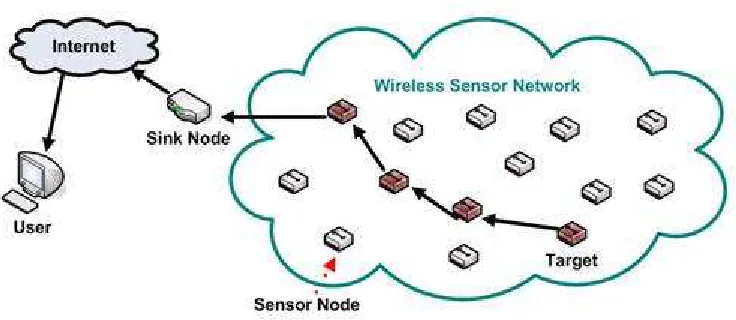
2.1 Wireless sensor network architecture 8
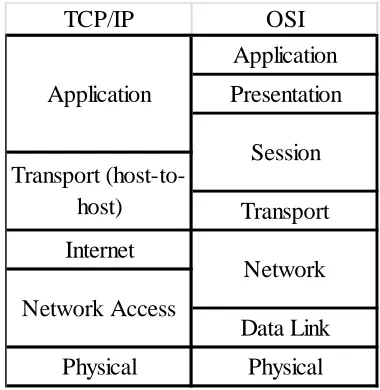
2.2 A comparison of the OSI and TCP/IP protocol architecture 9
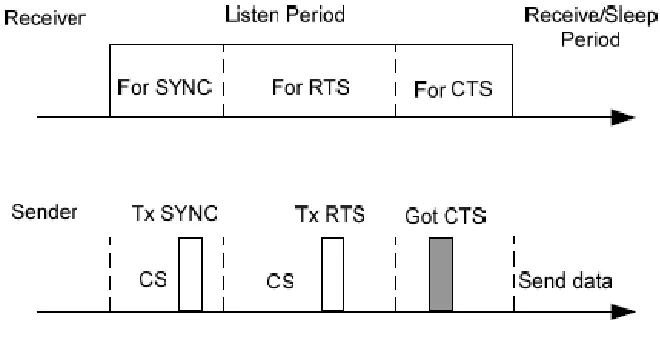
2.3 SMAC messaging scenario 12
2.4 WiseMAC concept 13
2.5 A data gathering tree and its DMAC implementation 15
2.6 DSMAC duty cycle dubling 16
2.7 Classification of routing protocols in WSNs 18
2.8 The implosion problem 21
2.9 The SPIN-PP protocol 22
2.10 A schematic for Directed Diffusion 24
3.1 Simple and compound modules of an OMNeT++ network 38
3.2 OMNeT++ main window 41
3.3 Wireless sensor network model 41
3.4 Tier-based node model 42
4.1 The LEACH protocol for Wireless Sensor Network 45 4.2 Flowchart for LEACH algorithm set-up phase 50
4.3 LEACH operation time-line 52
4.4 Flowchart of the steady-state operation for LEACH 53 4.5 Graphical and source view for LEACH implementation in 54
GNED editor
4.6 Modified LEACH algorithm TDMA frame 58
4.7 Pre set-up phase for modified LEACH algorithm 59
5.1 First order radio model 63
5.2 omnetpp.ini file for parameter setting 65
distance
5.4 Number of rounds when the first node dead in LEACH 68 and modified LEACH for 10 frames with different BS
distance
5.5 Number of rounds when the first node dead in LEACH 69 and modified LEACH for 20 frames with different BS
distance
5.6 Number of rounds when the first node dead in LEACH 70 and modified LEACH for 25 frames with different BS
distance
5.7 Number of rounds when the half node dead in LEACH 71 and modified LEACH for 5 frames with different BS
distance
5.8 Number of rounds when the half node dead in LEACH 72 and modified LEACH for 10 frames with different BS
distance
5.9 Number of rounds when the half node dead in LEACH 73 and modified LEACH for 20 frames with different BS
distance
5.10 Number of rounds when the half node dead in LEACH 74 and modified LEACH for 25 frames with different BS
distance
5.11 First node dead results for different nodes implemented 76 in different network size a) 500 x 500 m2 b) 1000 x 1000 m2
and c) 1500 x 1500 m2
5.12 Half node dead results for different nodes implemented 77 in different network size a) 500 x 500 m2 b) 1000 x 1000 m2
and c) 1500 x 1500 m2
xiii
LIST OF SYMBOLS AND ABBREVIATIONS
WSNs - Wireless Sensor Networks
CHs - Cluster Heads
BS - Base Station
LEACH - Low-Energy Adaptive Clustering Hierarchy TDMA - Time Division Multiple Access
CSMA - Carrier Sense Multiple Access MAC - Medium Access Control OSI - Open System Intercopnnection
TCP/IP - Transmission Control Protocol/ Internet Protocol FND - First node dead
HND - Half node dead
p - Desired percentage of cluster head
r - Current round
k - Number of cluster
T (n) - Threshold value for cluster head selection
n - Number of nodes
G - Number of node that not yet become cluster head
Eresidual - Node residual energy
LIST OF APPENDICES
APPENDIX TITLE PAGE
A Code for LEACH 86
B Code for modified LEACH 91
C Snapshot of OMNET++ Simulation for LEACH algorithm 97
D1 Results for different number of TDMA frames 100
CHAPTER 1
INTRODUCTION
1.1 Motivation
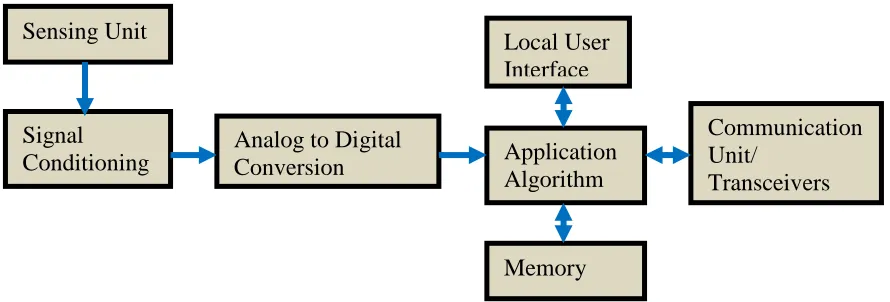
Wireless Sensor Networks (WSNs) are widely used to create a smart environment that relies on sensory data from real world. The application of wireless sensor networks provides an enormous wirelessly connected infrastucture facilitating the function of monitoring a physical and enviromental conditions, such as temperature, sound, vibration, pressure, humidity, acidity, motion and pollutants. The advent of smart environments relies heavily on sensor network for data acquisition and dissemination whether in building, shipboard, intelligent transportation system, habitat monitoring, healthcare monitoring, home automation, traffic control, or elsewhere (Lewis F. , 2004) (Ali, Abdulmaowjod, & Mohammed, 2011). A smart sensor used in WSNs is a combination of sensing, processing and communication technologies.
Figure 1.1: Smart sensor architecture
(Dietrich & Dressler, 2009) stated in their study stated that network lifetime is a key characteristic to evaluate a sensor network. The effectiveness of WSNs de-pends on the functionality of all sensors in the network. If the sensor node is active, it proceeds to perform a duty to sense, communicate and process information (tempera-ture, humidity etc). There are two major factors that affect the network lifetime: how much energy it consumes over time and how much energy is available for the partic-ular node. The proposed technique to deal with network lifetime called clustering, which is an important method. Additionally, a good performance WSNs is highly dependent on energy-efficient clustering routing algorithm (Liu, et al., 2010). The development involve a clustering-based hierarchy protocol that optimizes the energy-efficiency in WSNs is called Low-Energy Adaptive Clustering Hierarchy (LEACH) (Heinzelman, Chandrakasan, & Balakrishnan, 2000).
1.2 Description
The aim of this thesis is a research about the network lifetime of WSNs. Using an appropriate algorithm in routing protocol, power consumption can be achieved. The research presented in this thesis focussed on the implementation of Low-Energy Adaptive Clustering Hierarchy (LEACH) algorithm within the WSNs routing protocol, in which original work and was introduced by (Heinzelman, Chandrakasan,
Sensing Unit
Signal Conditioning
Analog to Digital
Conversion Application
Algorithm Local User Interface
Memory
Communication Unit/
3
& Balakrishnan, 2000). Although LEACH algorithm provides an improvement in the network lifetime for WSNs, there are still areas that need to be developed so that more energy can be conserved. There are many researches that were conducted based on LEACH algorithm for example Energy LEACH (E-LEACH) (Xiangning & Yulin, 2007), Two-Layer LEACH (TL-LEACH) (Loscri, Morabito, & Marano, 2005), Centralize LEACH (C-LEACH) (Heinzelman, Chandrakasan, & Balakrishnan, 2002) and V-LEACH (Yassein, Al-zou'bi, Khamayseh, & Mardini, 2009).
In this thesis, some modifications were introduced based on LEACH algorithm and various performance comparisons were made to illustrate the improvements of this algorithm. Common features were maintained in the simulated network which were already present in the majority of the up-to-date WSN implementations. Furthermore, advanced features and parameters will be analyzed in order to obtain an energy consumption improvement. Therefore, it is essential to analyze and study the original LEACH algorithm through reviewing the literatures, building the simulation test-bed and performing the simulation on the existing algorithms. After that, the modification of LEACH will be implemented in the simulation test-bed and the most used simulation environments will be evaluated and analyzed.
1.2.1 Wireless sensor networks
healthcare applications or traffic control. WSNs are composed of a set of sensor nodes, typically equipped with some sensors, a radio transceiver or other wireless communications device, a small microcontroller, and an energy source, usually a battery. Therefore, these devices make up a network with sensing, data processing and routing capabilities.
1.2.2 Advantages of wireless sensor networks
Knowing about the advantages of WSNs, it is enough to be conscious of the wide variety of applications where WSNs are present. Typically, WSNs applications involved in some kind of monitoring, tracking, or controlling. Some of the numerous applications and the benefits that WSNs bring are:
i. Environmental Monitoring: watershed management, forest fire prediction or irrigation management. It helps to preserve and maintain the natural resources.
ii. Structural Health and Industrial Monitoring: machinery failure detection. It reduces the maintenance costs and prevents from catastrophic failures. iii. Civil Structure Monitoring: health monitoring of large civil structures, like
bridges or skyscrapers. It prevents from human catastrophes.
iv. Medical Health-care: telemedicine, remote health monitoring. Allows doctors in remote and rural areas to consult with specialists in urban areas, remote handling of medical equipment (tele-surgery), etc.
1.2.3 Drawbacks of wireless sensor networks
5
i. Power consumption: this constraint affects directly on the nodes’ operating lifetime. With energy-aware and transmitting power adjusting capacity protocols, the energy consumption can be highly reduced, and thus increased the network lifetime.
ii. Self-configuration capability and good scalability: this issue can be solved by choosing and implementing the suitable network protocol. iii. Fault tolerance: if all the devices process the same signal (temperature,
humidity, etc.), the network will offer replication in a native manner. If the devices do not develop the same function, the device replication can solve the fault tolerance problem, and this solution shouldn’t affect the scalability due to the nature of the network.
This thesis proposed a mechanism to will counter the first drawback of WSNs which is the power consumption by designing and implementing the appropriate algorithm in a routing protocol.
1.3 Objectives
The main objectives of this thesis are:
i. To implement and simulate a wireless sensor networks (WSNs) using OMNeT++ network simulator.
ii. To implement a modified LEACH algorithm that solves the energy consumption problem in wireless sensor networks.
1.4 Thesis Outline
As an introduction (Chapter 1), the motivation of the research and general description on WSNs including the advantages and drawbacks are presented in this chapter. Objectives of the research are also included as a guideline to complete this research.
Chapter 2 desribed the previous works of other researchers. The work on WSNs including the MAC protocol and the classification of WSNs are discussed in this chapter. Additionally, a comparison between various routing protocol are elaborated and the rationale for implementing LEACH protocol also identified.
Chapter 3 compare a number of network simulator that available to implement the proposed algorithm. An explanation of OMNeT++ simulator step by step done starting form building a network until running the simulation.
Chapter 4 explains abaout the implementation of LEACH algorithm and modified LEACH algorithm in OMNeT++ network simulator. Besides, the details abaout the algorithm are also included.
Chapter 5 is about the analysis and evaluation of results from the simulation. In the first section, the parameters for the simulation is explains. Second section is about the analysis of first node dead and half node dead to determine the improvement of network lifetime.
CHAPTER 2
LITERATURE REVIEW
2.1 Introduction
2.2 A wireless sensor network model
WSNs consist of a set of many sensors with sensing, wireless communication and computation capabilities. These sensors are scattered in the preserved environment and located far from users. The architecture of WSNs includes three entities as in (Karl & Willig, 2005). There are:
• Sensors which make up the network: its function is based on taking local measures through a discrete system, creating a wireless network in an unat-tended environment, gathering data and sending them to the final user through the BS.
• Base station or gateway node: it is located near the sensor field. The data or information gathered by the sensor field is sent to the base station through a multihop infraestructureless architecture, which communicates with the user via Internet or satellite communication.
[image:19.595.135.503.468.628.2]• User: it is the entity interested in obtaining the information about a specific phenomenon by means of measuring or monitoring the environment.
9
2.2.1 Protocol architecture
[image:20.595.223.413.332.527.2]Protocol architecture is the layered structure of hardware and software that support the exchange of data between two systems. When communication is desired among computers from different vendors, the data must be transmit in the specific format because different vendors use different data format and data exchange protocols. The key fucntions normally performed by a protocol include encapsulation, segmentation and reassembly, connection control, ordered delivery, flow control, error control, addressing and multiplexing. There are two protocol architecture have served as the basis for the protocol standards which is TCP/IP and OSI model (Stalling, 2004). Figure 2.2 indicates the different between TCP/IP and OSI model.
Figure 2.2: A comparison of the OSI and TCP/IP protocol architecture
2.2.1.1OSI model
OSI model was developed by ISO which would allowed the exchange of data between various platform of different vendors. It has seven layers where each layer perform a certain internetworking function. The function of each layer described as follows:
TCP/IP OSI
Application Presentation
Transport Internet
Data Link
Physical Physical
Session Application
Transport (host-to-host)
i. Physical Layer: Transmits the bit stream over the physical medium. ii. Data Link Layer: Provide reliable transfer of information.
iii. Network Layer: Provides transmission & switching technologies. iv. Transport Layer: End-to-end error recovery and flow control. v. Session Layer: Establishes, manages & terminates connections. vi. Presentation Layer: Represent the data.
vii. Application Layer: Provides access to the OSI environment for users.
2.2.1.2TCP/IP protocol architecture
The TCP/IP model organizes the communication task into five relatively independent layers:
i. Physical Layer: Physical interface between a data transmission device (e.g. computer) and a transmission medium or network. This layer concerned with the characteristics of transmission medium, signal level and data rates.
ii. Network Access Layer: Perform the data exchange between an end system. The destination address provision so thet the network can send the data to the appropriate destination.
iii. Internet Layer: Provides the routing function across multiple networks. This function uimplemented in the end system and routers.
iv. Transport Layer: This layer corcerned on end-to-end data transfer. The Transmission Control Protocol (TCP) is the most commonly used protocol to performed this functonality.
11
2.2.2 MAC protocol
The MAC layer is a sublayer of the data link layer and it is used in networks where multiple machines need to communicate via a single communication channel. MAC layer must be energy-efficient to improve the network lifetime which become the main objectives of current research and study. In (Ye, Heidemann, & Estrin, 2001), there are several causes of energy waste corcerning MAC layer. There are are collisions, overhearing, control packet overhead, idle listening and overemitting.
Collisions consist on the reception of more than one packet at the same time which resulted in packets being dropped and retransmission was initiated. Overhearing occurs when a node receives packets destined to other nodes. The control packet overhead or the number of control packets should be minimized as far as possible in a data transmission. Idle listening is produced when a node listens to an idle channel to receive possible traffic. On the other hand, overemitting is caused by the transmission of a message when the destination node is not ready. A correctly-designed MAC protocol should avoid these facts in order to obtain the best performance and minimum energy consumption.
A survey done by (Demirkol, 2006) presented the advantages and disadvantages of several MAC protocols. These protocols are:
i. Sensor-MAC (S-MAC)
The basic idea of this MAC protocol consists on locally managed synchronizations and periodic sleep listen schedules based on these synchronizations. Nodes sleep and wake up periodically introducing the term of duty cycle. This MAC protocol shows a disadvantages when two neighbor nodes reside in two different virtual clusters which set up a common sleep schedule, they wake up at listen periods of both clusters.
exchanges prevent from the hidden node problem, and adaptative listening can be used in order to reduce the sleep relay and thus the overall latency.
[image:23.595.155.485.234.410.2]The advantages of this MAC protocol, includes the implementation simplicity and its reduced energy consumption through sleep schedules. Besides, there are another disadvantages which are the increment of collision probability when broadcasting does not use RTS/CTS, the efficiency loss with its constant and predefined sleep and listen periods, overhearing and idle listening problems.
Figure 2.3: SMAC messaging scenario (Ye, Heidemann, & Estrin, 2001)
ii. Wireless sensor MAC (WiseMAC)
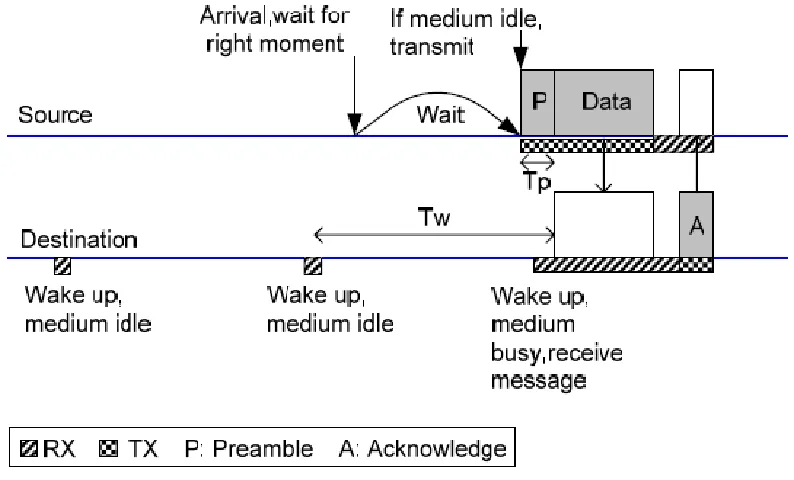
13
[image:24.595.123.520.190.430.2]transmitter node’s direct neighbors. The drawbacks of wiseMAC is the difficult of broadcast communication due to the decentralized duty cycle planning and the hidden terminal problem apparition are the main inconvenients. Figure 2.4 shows the wiseMAC concept.
Figure 2.4: WiseMAC concept (Demirkol, 2006)
iii. Traffic-Adaptive MAC Protocol (TRAMA)
which will be used by nodes are announced by a schedule packet and the bitmap message scheduled receivers.
The advantages of TRAMA is higher percentage of sleep time and less collision probability is achieved compared to CSMA based protocols. Meanwhile a disadvantages is transmission slots are set to be seven times longer than the random access period. Even so, TRAMA duty cycle is at least of 12.5%, a considerable high value.
iv. SIFT
This protocol is proposed for event-driven sensor network environment (Demirkol, 2006). The main idea of this protocol is when an event is sensed, the first R of N potential reports is the most crucial part of messaging and has to be relayed with low latency. SIFT uses a non-uniform probability distribution function. This function helps to the slot acquisition within the slotted contention window: if nodes don’t transmit on the first window slot, all nodes increment exponentially its transmission probability on the next slot considering limited the number of competitors.
One of advantages in this MAC protocol is very low latency is achieved with many traffic sources. This parameter can be set properly to the environment requirements. Thus, it could be possible to obtain a power consumption decrement losing some features as low latency when network life time is the main objective. One of the main drawbacks is increased idle listening caused by listening to all slots before sending as well as overhearing.
v. DMAC
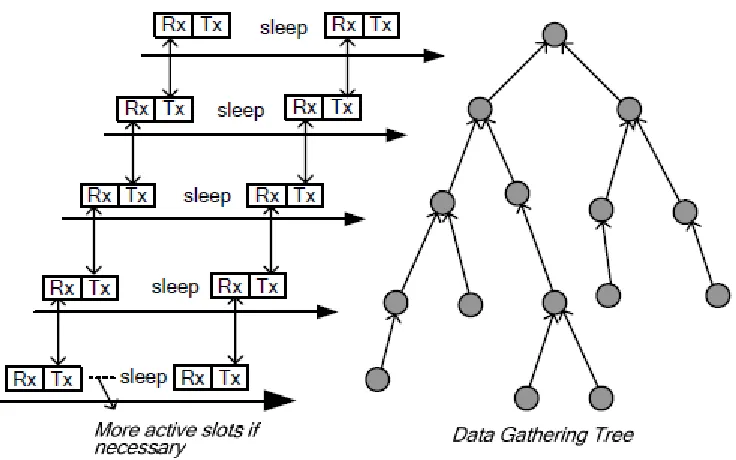
15
[image:26.595.130.498.162.392.2]also the same transmission period and they compete for the media. Thus, this protocol provides low latency by assigning contiguous slots to the consecutive nodes along the transmission path.
Figure 2.5: A data gathering tree and its DMAC implementation (Demirkol, 2006)
The advantage of DMAC is it achieves very good latency compared to other sleep/listen period assignment methods. Meanwhile, this protocol doesn’t use collision avoidance. For this reason, when a considerable number of nodes on the same level try to send data to the same node, collisions will happen.
vi. DSMAC
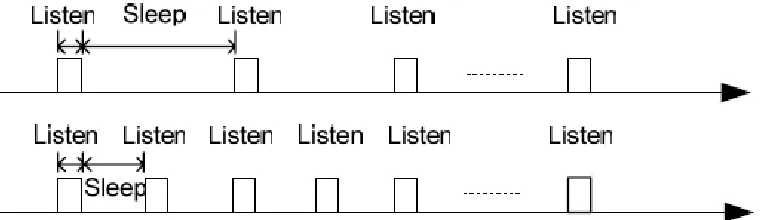
duty cycle when its battery level is above a specified threshold. The duty cycle dubling is as shows in Figure 2.6.
Figure 2.6: DSMAC duty cycle dubling (Demirkol, 2006)
i. CSMA
In Carrier Sense Multiple Access (CSMA), the nodes verify the absence of other traffic before transmitting on a shared transmission medium (Rom & Sidi, 1989). Two versions of CSMA exist which are non-persistent CSMA and p-persistent CSMA. In non-persistent CSMA, a backoff is performed before attempting to transmit if the sensed channel is busy, and the transmission is carried out immediately if the device senses no activity on the channel. In p-persistent CSMA, a node continues sensing the channel if it detects activity instead of delaying and checking again later. When the device senses no activity on the channel, it transmits a message with probability p and delays the transmission with probability 1 − .
17
2.3 Classification of wireless sensor networks
A Wireless Sensor Network can be classified based on their mode of functioning and the type of target application.
2.3.1 Proactive network
The nodes in this type of network periodically switch on their sensors and transmitters, sense the environment and transmit the data to the interest. This sort of network is suitable for application requiring periodic data monitoring. Some known instances of this kind are the LEACH protocol (Heinzelman, Chandrakasan, & Balakrishnan, 2000) and some improvement of LEACH protocol (Xiangning & Yulin, 2007) (Loscri, Morabito, & Marano, 2005) (Yassein, Al-zou'bi, Khamayseh, & Mardini, 2009).
2.3.2 Reactive network
The nodes of the networks according to this scheme react immediately to sudden and drastic changes in the value of a sensed attribute. They are well suited for time critical applications. Typical instances of this sort of networks are (Manjeshwar & Agrawal, 2001) and (Ping, Yu, & Hao, 2006).
2.3.3 Hybrid network
the network in the form of historical, one-time and persistent queries respectively. Some instances of this kind of networks are (Manjeshwar & Agrawal, 2002) and (Younis & Fahmy, 2004).
2.4 Routing protocol
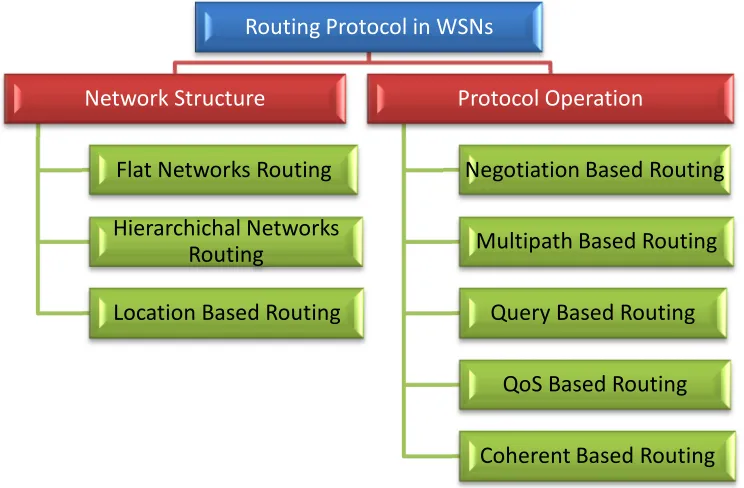
The objective of routing protocol is to render the network useful and efficient. In general, routing in WSNs can be divided into three groups depending on the network structure: flat-based routing, hierarchical-based routing, and location-based routing depending. In flat-based routing, all nodes are typically assigned equal roles or
functionality. In hierarchical-based routing, however, nodes will play different roles in the network. In location-based routing, sensor nodes' positions are exploited to route data in the network. A routing protocol is considered adaptive if certain system parameters can be controlled in order to adapt to the current network conditions and available energy levels. Furthermore, these same protocols can be classified into multipath-based, query-based, negotiation-based, QoS-based, or coherent-based
[image:29.595.134.506.487.731.2]routing techniques depending on the protocol operation.
Figure 2.7 : Classification of routing protocols in WSNs Routing Protocol in WSNs
Network Structure
Flat Networks Routing
Hierarchichal Networks Routing
Location Based Routing
Protocol Operation
Negotiation Based Routing
Multipath Based Routing
Query Based Routing
QoS Based Routing
19
In the rest of this section, a detailed overview of the main routing paradigms in WSNs are presented.
2.4.1 Network structure based protocols
The underlying network structure may play an important role in the operation of routing protocols in WSNs. In this section, the most detailed research protocols that fall under this category are presented.
2.4.1.1 Flat routing
The first category of routing prorocols are multihop flat routing protocols. In flat networks, each node usually plays the same role and sensor nodes cooperate together to carry out sensing task. Due to large number of nodes, it is not entitled to set global identifier for each node. This consideration has led to focused data path, where the BS sends queries to certain areas and wait for data from sensor located in the selected area. Since data is being requested through queries, attribute-based name is necessary to specify the data attributes. In flat routing group, we can find a huge variety of protocols:
i. Sensor Protocols for Information via Negotiation (SPIN)
has the same data, and therefore there is a need for other nodes only forward data do not have. SPIN family of protocols to use data negotiation and resource-adaptive algorithm. Nodes running SPIN assign a high-level name to completely describe their data collected (called meta-data) and perform the meta-data negotiations before any data is transmitted. This guarantees that there is no redundant data sent across the network. Semantic meta-data format is application-specific and not specified in SPIN. For example, the sensor may use a unique IDs to report meta-data if they cover a certain known region. In addition, SPIN has access to the current node energy level and adapt the protocol is running based on how much energy is remaining. This protocol works in time-driven fashion and distributes information across the network, even when the user does not request any data. This protocol is designed to address the deficiencies of classic flooding by negotiation and resource adaptation. The SPIN family of protocols is designed based on two basic ideas:
1. Sensor nodes operate more efficiently and conserve energy by sending data that describe the sensor data instead of sending all the data; for example, image and sensor nodes must monitor the changes in their energy resources. 2. Conventional protocols like flooding or gossiping based routing protocols
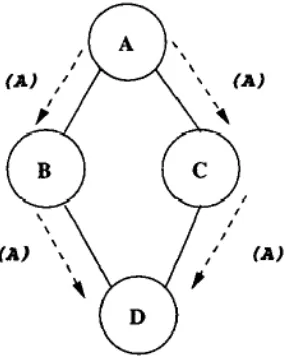
(Hedetniemi, Hedetniemi, & Liestman, 1988) waste energy and bandwidth when sending extra and unnecessary copies of data by sensors covering the overlapping areas. The deficiencies of flooding include implosion, which is caused by duplicate messages sent to the same node, overlap when two nodes sensing the same region will send similar packets to the same neighbor and resource blindness by consume large amounts of energy without consider for an energy constraints. In Figure 2.8, node A starts by flooding its data to all of its neighbors. Two copies of data arrive at node D will cause the wastes of energy and bandwidth in a system for one necessary transmits and receives. Gossiping avoids the problem of implosion by just selecting a node randomly and sends the packet to rather than broadcasting the packet blindly. However, this causes delays in propagation of data through the nodes.
21
[image:32.595.254.397.269.451.2]own resource manager which keeps track of resource consumption, and is polled by the nodes before data transmission. The SPIN-1 protocol is a 3-stage protocol, as described above. An extension to SPIN-1 is SPIN-2, which incorporates threshold-based resource awareness mechanism in addition to negotiation. When energy in the nodes is overflow, SPIN-2 communicates using the 3-stage protocol of SPIN-1. However, when the energy in a node starts approaching a low energy threshold, it reduces its participation in the protocol, i.e., it participates only when it believes that it can complete all the other stages of the protocol without going below the low-energy threshold.
Figure 2.8: The implosion problem (Heinzelmen, Kulik, & Balakrishnan., 1999)
In conclusion, SPIN-l and SPIN-2 are simple protocols that efficiently disseminate data, while maintaining no per-neighbor state. These protocols are well-suited for an environment where the sensors are mobile because they base their forwarding decisions on local neighborhood information. Besides these two protocols, there are other protocols in SPIN family as described in (Heinzelmen, Kulik, & Balakrishnan., 1999) and (Kulik, Heinzelmen, & Balakrishnan, 2002).
i. SPIN-BC: This protocol is designed for broadcast channels.
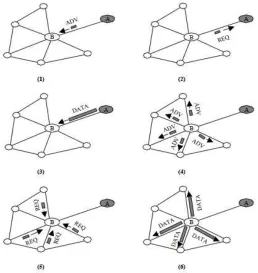
ii. SPIN-PP: This protocol is use for a point to point communication, i.e., hop-by-hop routing. The example of SPIN-PP protocol is as shown in figure 2.9. iii. SPIN-EC: This protocol works similar to SPIN-PP, but with an energy
iv. SPIN-RL: When a channel is lossy, a protocol called SPIN-RL is used where adjustments are added to the SPIN-PP protocol to account for the lossy channel.
[image:33.595.216.474.368.641.2]One of the advantages available in SPIN is that topological changes are localized since each node needs to know only its single-hop neighbors. SPIN provides much energy savings than flooding and meta-data negotiation almost halves the redundant data. However, SPINs data advertisement mechanism cannot guarantee the delivery of data. To see this, consider the application intrusion detection where reliable data are reported more regular intervals and assume that the nodes that are interested in data that is located away from the source node and the node between the source and destination nodes are not interested in these data, the data did not will be sent to the destination at all.
Figure 2.9: The SPIN-PP protocol. Node A starts by advertising its data to node B (1). Node B responds by sending a request to node A (2). After receiving the requested data (3), node B then sends out advertisements to its neighbors (4), who in turn send requests back to B (5,6). (Kulik, Heinzelmen,
23
ii. Directed Diffusion
(Intanagonwiwat, Govindan, & Estrin, 2000) proposed a popular data aggregation paradigm for WSNs, called directed diffusion. Directed diffusion is a data-centric (DC) and application-aware paradigm in the sense that all data generated by sensor nodes is named by attribute-value pairs. The main idea of the DC paradigm is to combine the data coming from different sources enroute (in-network aggregation) by eliminating redundancy, minimizing the number of transmissions; thus saving network energy and prolonging its lifetime. Unlike traditional end-to-end routing, DC routing finds routes from multiple sources to a single destination that allows in-network consolidation of redundant data.
(a) Interest propagation
(b) Initial gradients Set-up
[image:35.595.214.418.94.655.2](c) Send data and path reinforcement
Figure 2.10: A schematic for Directed Diffusion (Intanagonwiwat, Govindan, & Estrin, 2000)
83
REFERENCES
Abdullah, J. (2011). Effect of Maximum Node Velocity on GA-Based QOS Routing Protocol (QOSRGA) for Mobile Ad-Hoc Network. Communication and Networking Communication in Computer and Information Science, 2011, Vol. 266, 301 - 311.
Ali, Q. I., Abdulmaowjod, A., & Mohammed, H. M. (2011). Simulation and
Performance Study of Wireless Sensor Network(WSN) Using Matlab. Iraq J. Electrical and Electronic Engineering Vol. 7 No. 2, 112-119.
Chang, J. H., & Tassiulas, L. (2000). Maximum Lifetime Routing in Wireless Sensor Networks. Proceeding Advanced Telecommunications and Information Distribution Research Program (ATIRP2000). College Park, MD.
Chen, B., Jamieson, K., Balakrishnan, H., & Morris, R. (2001). SPAN: An Energy-Efficient Coordination Algorithm for Tppology Maintenaince in Ad-Hoc Wireless Networks. Proceedings of 7th ACM International Conference on Mobile Computing and Networking, (pp. 85 - 96).
Chu, M., Haussecker, H., & Zhao, F. (2002). Scalable Information-Driven Sensor Querying and Routing for Ad Hoc Heterogeneous Nensor Network. International Journal on High Performance Computing Applications. Demirkol, I. (2006). MAC Protocols for Wireless Sensor Network: A Survey.
Communications Magazine, IEEE, 115 - 121.
Dietrich, I., & Dressler, F. (2009). On the Lifetime of Wireless Sensor Network. ACM Transaction on Sensor Network Vol. 5,No. 1, 1-38.
Estrin, D., & Braginsky, D. (2002). Rumor Routing Algorithm For Sensor Networks. Proceedings of First Workshop on Sensor Networks and Applications.
Atlanta, GA.
Fall, K., & Varadhan, K. (2012, June 11). The ns Manual. Retrieved from http://www.isi.edu/nsnam/ns/ns-documentation.html
Hedetniemi, S. M., Hedetniemi, S. T., & Liestman, A. L. (1988). A survey of Gossiping and Broadcasting in Communication Networks. IEEE Networks, vol. 18, No. 4, 319 - 349.
Heinzelman, W. R., Chandrakasan, A., & Balakrishnan, H. (2000). Energy-Efficient Communication Protocol for Wireless Microsensor Networks. Proceedings of the 33rd Hawaii International Conference on System Sciences (pp. 1-10). Hawaii: IEEE Explore.
Heinzelman, W., Chandrakasan, A., & Balakrishnan, H. (2002). An application-specific protocol architecture for wireless microsensor networks. Wireless Communications, IEEE Transactions on , vol.1, no.4, 660 - 670.
Intanagonwiwat, C., Govindan, R., & Estrin, D. (2000). Directed Diffusion: A scalable and Robust Communication Paradigm for Sensor Network. Proceedings of ACM MobiCom, (pp. 56 - 67). Boston.
Karl, H., & Willig, A. (2005). Protocol and Architecture for Wireless Sensor Networks. Wiley.
Kulik, J., Heinzelmen, W. R., & Balakrishnan, H. (2002). Negotiation-based Protocols for Disseminating Information in Wireless Sensor Networks. Wireless Networks, Volume 8, 169 - 185.
Lewis, F. (2004). Wireless Sensor Network. Smart Environments: Tecnologies, Protocols and Application. New York.
Lewis, P., N.Lee, Welsh, M., & Culler, D. (2003). TOSSIM: Accurate and Scalable Simulation of Entire TinyOS Applications. Proceedings of the First ACM Conference on Embedded Networked Sensor Systems.
Liu, Y., Xiong, N., Zhao, Y., Vasikalos, A., Gao, J., & Jia, Y. (2010). Multi-Layer Clustering Routing Algorithm for Wireless Vehicular Sensor Network. IET Communication Vol. 4, Iss. 7, 810-816.
Loscri, V., Morabito, G., & Marano, S. (2005). A two-levels hierarchy for low-energy adaptive clustering hierarchy (TL-LEACH). Vehicular Technology Conference, 2005. VTC-2005-Fall. 2005 IEEE 62nd (pp. 1809- 1813). IEEE Explore.
Manjeshwar, A., & Agrawal, D. (2002). APTEEN: A Hybrid Protocol for Efficient Routing and Comprehensive Information Retrieval in Wireless Sensor Networks. Proceedings of the 2nd International Parallel and Distributed Computing Issues in Wireless Networks and Mobile Computing, (pp. 195 - 202). Ft. Lauderdale.
Manjeshwar, A., & Agrawal, D. P. (2001). TEEN: A Routing Protocol for Enhanced Efficiency in Wireless Sensor Networks. Proceedings of the 15th
International Parallel and Distributed Processing Symposium, vol. 3, p. 30189a. Los Alamitos, Calif, USA.
Ping, Y., Yu, B., & Hao, W. (2006). A Multipath Energy-Efficient Routing Protocol for Ad hoc Networks. Communications, Circuits and Systems Proceedings, 2006, (pp. 1462 - 1466). Guilin.
Rom, R., & Sidi, M. (1989). Multiple Access Protocols: Performance and Analysis. Springer-verlag.
Schurges, C., & Srivasta, M. B. (2001). Energy Efficient Routing in Wireless Sensor Networks. Proceedings of MILCOM (pp. 357 - 361). IEEE.
Shah, R. C., & Rabaey, J. M. (2002). Energy Aware Routing for Low Energy Ad Hoc Sensor Networks. IEEE Wireless Communications and Networking Conference (WCNC), vol.1, (pp. 350 - 355). Orlando.
Sohrabi, K., Gao, J., Ailawadhi, V., & Pottie, G. J. (2000). Protocols for Self-Organization of a Wireless Sensor Network. IEEE Personal
Communications, vol. 7, (pp. 16 - 27).
Sohraby, K., Minollil, D., & Znati, T. F. (2007). Wireless Sensor
Network:Technology, Protocol and Application. Wiley-Interscience.
Stalling, W. (2004). Data and Computer Communication. United States of America: Prentice Hall International.
85
Tao, L., Qing-Xin, Z., & Luqiao, Z. (2010). An Improvement for LEACH Algorithm in Wireless Sensor Network. 2010 5th IEEE Conference on Industrial
Electronics and Application (pp. 1811-1814). IEEE Explore.
Varga, A. (2011). OMNeT++ Manual. Retrieved from http://www.omnetpp.org Voigt, T., Dunkels, A., Alonso, J., Ritter, H., & Schiller, J. (2004). Solar-aware
Clustering in Wireless Sensor Networks. Proceedings of the Ninth
International Symposium on Computers and Communications 2004, (pp. 238 - 243).
Xiangning, F., & Yulin, S. (2007). Improvement on LEACH Protocol of Wireless Sensor Network. Sensor Technologies and Applications, 2007. SensorComm 2007. International Conference (pp. 260 - 264). IEEE Explore.
Xu, Y., Heidemann, J., & Estrin, D. (2001). Geography-informed Energy Conservation for Ad-Hoc Routing. Proceeding of the Seventh Annual
ACM/IEEE International Conference on Mobile Computing and Networking, (pp. 70 - 84).
Yassein, M. B., Al-zou'bi, A., Khamayseh, Y., & Mardini, W. (2009). Improvement on LEACH Protocol of Wireless Sensor Network (VLEACH). JDCTA: International Journal of Digital Content Technology and its Applications, Vol. 3, No. 2, 132 - 136.
Ye, W., Heidemann, J., & Estrin, D. (2001). An Energy-efficient MAC Protocol for Wireless Sensor Networks. Proceedings of 1st International Conference on Embedded Vol. 3, (pp. 1567 - 1576).
Younis, O., & Fahmy, S. (2004). HEED: A Hybrid, Energy-Efficient, Distributed Clustering Approach for Ad-hoc Sensor Networks. IEEE Trans. Mobile Computing, Vol. 3, No. 4, 366 - 379.