© 2016, IRJET | Impact Factor value: 4.45 | ISO 9001:2008 Certified Journal
| Page 1808
SEISMIC VULNERABILITY OF MULTISTORY BUILDING WITH AND
WITHOUT BRACINGS USING PUSHOVER ANALYSIS
Nagaraj.B
[1], V.S.Jagadeesh
[2]1
Post Graduate Student, Department of civil engineering, S.J.M.I.T Chitradurga, Karnataka, India
2
Professor, Dept. of Civil Engineering, S.J.M.I.T,Chitradurga, Karnataka, India
---***---Abstract - Now a day’s earthquake is the major problem for
every kind of structures in different regions. To overcome this phenomenon, there are so many controlling measures are developed to the buildings. In this study we are going to control the earthquake effect on the structure by applying some bracing systems. In the present study G+10, G+15, G+20 buildings are provided with X, V, and K bracing systems with soft stories and a single set of buildings are keep it as bare frames. Pushover and static analysis is being carried out in this study. Displacement, story drift and base shear of the building are compared and the suitable bracing systems can be selected among the different bracings. Base shear vs displacement graph provides the information about the performance of the building.
Key Words: Pushover Analysis, Equivalent Static Analysis, X, V and K Bracing Systems, Displacement, Story Shear, Story Drift
1. INTRODUCTION
Usually the civil engineering infra structures are subjected to two classes of loads static and dynamic loads. The static loads such as dead load, live load are independent with respect to time In case of dynamic loads, loads are changing with respect to time. Most of the cases the structures are designed with the assumptions that all the loads applied are static. Generally the dynamic loads i.e. earthquake loads are not taking an account in the design because the buildings are not regularly subjected to earthquakes, and also it takes more time to solve these parameters in the analysis and also its more difficult to solve the solution. Carelessness of the earthquake forces in the analysis may cause destruction of the structure. In the last few decades records have been proved that major earthquakes are happened throughout the world causing the failure of the structure eventually the loss of life and property.
Steel braced frames are the structural components of the most significant earthquake resistant systems used to resist the earthquake loads. Most of the present building are need be retrofitting to overcome the deficiencies and resist seismic loads. Steel bracings are not so expensive, easily
fixed to the structures, it takes small space to occupy and it has versatile character to design to get required strength and desired stiffness. In the present study bracing system is introduced into the high rise building those bracings are effectively increases stiffness and stability there are many types of bracings are designed they are X(cross) bracings, V bracings, K braced systems. The X and V bracing system are usually increases the strength of the frame and decreases the lateral drift.
This method is nonlinear procedure to estimate the seismic structural deformations. To understand the structural behavior of the building by study of the static load deformation response that identifies the elastic and inelastic behavior characteristic of structures. The nonlinear static analysis (pushover analysis) is become most popular for this purpose. In this pushover analysis, building frame is subject to gravity loads is laterally loaded until either a predefined target displacement is met, or the modal collapses. Post yielding material modal is important in this analysis. The evaluation is based on assessment of important parameters such as inter story drift, inelastic story deformations, deformation between elements and elements and connection forces. The process involves application of horizontal loads, in a prescribed pattern, to the structure incrementally, that means the structure has to be pushed until the structure collapse or collapse condition with plotting the total applied shear force and associated lateral displacement at each increments.
1.1
DETAILS OF THE STRUCTUREA) Modeling and Analysis
The main objective of this study is to determine the performance level of the building by providing different types of bracings using pushover and static analysis. This analysis is carried out in the ETABS software. Results obtained are base shear, displacement, story drift are compared with different bracing types and finally conclude the better bracing system which controls the seismic loads effectively
B) Assumptions
© 2016, IRJET | Impact Factor value: 4.45 | ISO 9001:2008 Certified Journal
| Page 1809
Plan of the building is regular soft story 36mX36m hasconsidered and each story height is 3m, situated at zone III with medium soil condition,
C) Group properties
Beam : 0.3x0.6m Column : 0.6x0.6m Slab : 0.175m Bracing : 0.2x0.2m Concrete Grade : M30 Steel Grade : Fe500
D) Loading
Gravity loading: Member load and floor load is calculated as per IS 456 part1 and Live load on the floor is taken as 3 Kn/m2. And the live load at the terrace is taken as 1.5 Kn/m2.
E) Pushover hinges
Pre-determined default hinges are applied to the beam and columns are M3 and P-M-M respectively.
Fig 1.0 Bare framed building
Fig 1.2 K braced building
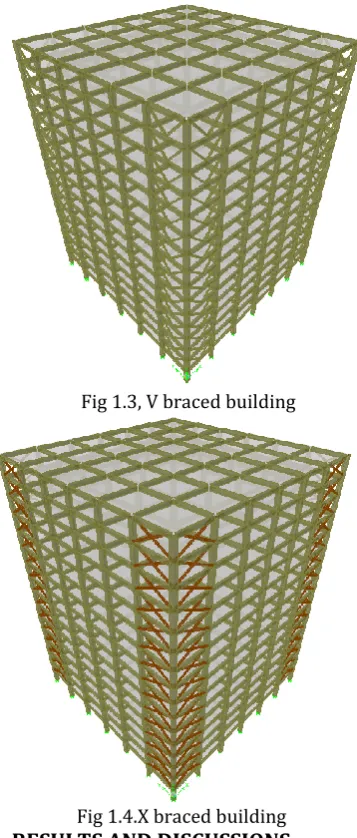
Fig 1.3, V braced building
Fig 1.4.X braced building
2. RESULTS AND DISCUSSIONS
[image:2.595.314.493.99.519.2]In the present study Pushover analysis of the buildings of different heights are studied and only G+15 buildings are considered here for the calculation.
Table -1: Pushover curve along x axis of the building (g+15) with and without bracing system
STEPS 1 V BRACINGS 2 X BRACINGS
D(mm) V(Kn) D(mm) V(Kn)
0 0 0 0 0
1 36.2 4140.1299 34.4 4007.7124
2 64.7 7085.8535 64.7 7153.6533
3 79.2 7759.5459 78.3 7776.4312
© 2016, IRJET | Impact Factor value: 4.45 | ISO 9001:2008 Certified Journal
| Page 1810
STEPS 3 K BRACING 4 NO BRACING
D(mm) V(Kn) D(mm) V(Kn)
0 0 0 0 0
1 44.6 4576.459 56.8 5022.3994
2 61.8 6239.9448 58.2 5131.0005
3 89.9 7224.5908 60.2 5218.7446
4 175.1 8601.3936 82.7 5538.6807 5 211.4 8947.5098 191.3 6173.6973
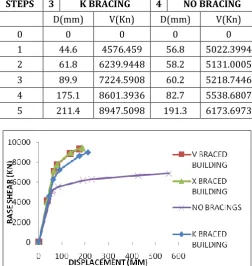
Chart -1: performance points of (g+15)buildings.
Chart-1 showing the performance points of G+15 building. Base shear carrying capacity of the structure without bracing system decreases above the elastic range. In case of braced buildings base shear carrying capacity will be comparatively better than the no bracing systems. Up to 4000KN (within the elastic range) all frames have shown their base shear is directly proportional to displacement. Base shear up to 4000KN all the frames shown same behavior within the elastic range, type of bracing will not effect on base shear. Non braced frames have shown enormous displacement in non linear range, which is due to load and stiffness of the frame. However, K bracing frame have shown stiffness when compared to V and X braced frames structure with no bracing structure.
2.1- COMPARISON OF BASE SHEAR AT ULTIMATE CAPACITY POINT
Chart 2 and 3 gives the ultimate base shear of the different models by static and pushover methods. Among the four types of building such as V,X.K and no braced buildings, X braced building in non linear analysis got highest base shear i.e.61.8% of base shear compared to static analysis. It concludes that X braced building is good enough to resist seismic loads, the next preference goes to V bracings its having high stiffness next to X bracings. Base shear of the V and X braced models analyzed from the pushover analysis is 2.6 times greater than the V and X braced models analyzed from the Equivalent static analysis. Similarly base shear of K braced building is 2.4 times higher than the static analyzed
buildings and the building with no bracings have less base shear compare to static analysis.
Chart-2: Ultimate base shear in Equivalent static method
[image:3.595.34.287.104.371.2]Chart-3: Ultimate base shear in pushover analysis
TABLE 2: Point displacement at ultimate capacity point in Equivalent static analysis
Models Displacements
V bracing 31.41
K bracing 35.144
X bracing 30.98
© 2016, IRJET | Impact Factor value: 4.45 | ISO 9001:2008 Certified Journal
| Page 1811
Chart -4: Story drift along X direction in the Equivalent static analysis models
TABLE- 3: Story drift along X direction in the Equivalent static analysis models
Models Story drift
V bracing 0.000693
K bracing 0.000833
X bracing 0.000658
No bracing 0.00099
Chart-5: Comparison of story drift along X axis
X and V braced building are showing relatively similar story drift along the building height which indicates the stiffness factor will remain almost same in both cases. But the V bracing is 5% more than X bracing. From this we concluded that X bracings are good enough for resisting seismic loads. In case of no bracing systems it showing more than 63.9% of story drift when compared to X bracings. And story drift at
the 3, 4, 5, story are higher first then it get decreased this may be due to lack of stiffness in terms of bracings. K bracing systems are showing the property in between unbraced and ‘X and V’ braced buildings, Which forms intermediate system between bracing and no bracing systems.
3. CONCLUSIONS
Conclusions are made on the basis of present study,
Results withdrawn from the pushover analysis gave us insights about the performance of the building in terms of formation of plastic hinges.
The base shear of the X braced building obtained from the pushover analysis is 2.6 times higher than the Equivalent static analysis.
Base shear of the X braced building is greater hence it can be used as effective seismic resistant building. If X bracing affecting the placement of openings that time instead of X bracing we can use V bracings.
Story drift of the V and X braced buildings are relatively similar and X bracings are more efficient to prefer for the earthquake resistance of building.
From the analysis it can be concluded that performance of the braced model specifically X braced building is improved when compared to the model with no bracings and other braced models.
IS code is not given any guidelines about the analysis of RC frame with Bracings hence to analyze the behavior of the structure under seismic forces pushover analysis is the effective too
REFERENCES
1. Shachiindra Kumar Chadhar, Dr. Abhay Sharma.(2015) “Seismic Behavior of RC Building Frame With Steel Bracing System Using Various Arrangements.” International research journal of engineering and technology Vol 2.PP 479-483.
2. H.R. Tavakoli, A. Rashidi Alashti & G.R. Abdollahzadeh.(2012) “ 3-D Nonlinear Static Progressive Collapse Analysis of Multi-story Steel Braced Buildings.” WCEE LISBOA 2012.
3. Amol V. Gowardhan, Pof. G. D. Dhawale, Prof. N. P, Shende.(2015) “A Review on Comparative Seismic Analysis of Steel Frame With And Without Bracing By Using Software.” International journal of engineering research Vol. 3, S3, 2015 PP 219-225.
4. Adithya .M, Swathi rani K.S, Shruthi H. K, Dr. Ramesh B.R (2015). “Study On Effective Bracing System For High Rise Steel Structures.” SSRG International journal of Civil Engineering (SSRG-IJCE) – volume 2 Issue 2 February 2015. PP 19-21.
© 2016, IRJET | Impact Factor value: 4.45 | ISO 9001:2008 Certified Journal
| Page 1812
BIOGRAPHIES
Nagaraj.B
M.Tech (Structural Engineering) S.J.M.I.T, Chitradurga,
Karnataka, India,
V.S.Jagadeesh
M.Tech (Structural Engineering) Professor in S.J.M.I.T