© 2015, IRJET ISO 9001:2008 Certified Journal
Page 968
Automatic Classification of Anterio-Posterior and Lateral Views of Leg X-rays
G.N. Balaji
1, T.S. Subashini
2, A. Manikandarajan
31
Research Scholar, Department of Computer Science and Engineering, Annamalai University
2Associate Professor, Department of Computer Science and Engineering, Annamalai University
3
Lecturer, Department of orthopaedics, Annamalai University
- ***
---Abstract: Automating the X-ray view identification is the first step in automating the detection and diagnosis of fractures in bones. In this paper, an attempt has been made to classify the anterio-posterior (AP) and lateral (LAT) views of leg X-rays. Two methods namely model based and template based is proposed to classify the AP and LAT views. In the model based method the X-rays are preprocessed, and then the histogram and statistical features are extracted. The support vector machine and probabilistic neural network were employed to classify the views. In the template based method the speed up robust features (SURF) is used for classification. SURF is effective in collecting more class-specific information and robust in dealing with partial occlusion and viewpoint changes. To authenticate the generalizability and robustness, the proposed methods are tested on a dataset of 50 X-ray images, and among the two, SURF achieves a higher classification rate of 91.8%.
Keywords: Anterio-Posterior (AP), Lateral (LAT), Speed Up Robust Features (SURF), Support Vector Machine (SVM), Probabilistic Neural Network (PNN).
1.
Introduction
Radiographic positioning is highly standardized, so as to help the physician and radiologists to correctly interpret and to make diagnosis. Hence, it plays a pivotal
role in viewing the particular portions or areas to be examined. Radiographic positions viz. lateral view, oblique view, anterior-posterior view, posterior-anterior view etc., which are all so classified based on the way the X-ray images are radiographed with respect to the object and the film. When the X-rays have passed through the object from front to back of the patients, it is referred as anterio-posterior (AP) view. If it is taken from back to front of the patient it is said to be posterio-anterior (PA) view. When it is passed through the object from the side of the patients, it is said to be lateral view. In oblique view, X-rays is passed through the object based on the angle. Hence, it is quite inevitable that there needs to be suitable computational algorithms for the detection of the orientation of the X-ray images. In this work, an attempt has been made to classify AP view and LAT view of leg X-rays, which will aid the radiologist or orthopedicians to get accurate and faster results. A sample image of AP view and LAT views taken in this work is shown in Fig. 1. In this work, two methods are proposed for automatic classification of leg X-rays, model based and template based. In model based approach the statistical features and histogram feature are extracted and the support vector machine and probabilistic neural networks are used for classification purpose. In the template based approach SURF is used for classification purpose.
© 2015, IRJET ISO 9001:2008 Certified Journal
Page 969
This paper is organized as follows Section 1 gives an outlay of the general introduction and the need of the proposed work. Review of the existing literature is presented in Section 2. Section 3 elaborates the Proposed Methodology, while the Performance Measures and Experimental results are described in Section 4 which is followed by the conclusion in Section 5.
2. Previous work
Few research efforts are reported in the literature for identifying the X-ray image views [1-5] however, they are not fully automated systems. The authors in [6] proposed a method to determine the image view based on the similarity of the image to reference images, but used four distance measures and K-nearest-neighbor classifier. The classification of views in medical images will aid the radiologist in diagnosing diseases [7]. The work in [2] proposes a method to identify the frontal/lateral view using a template matching technique, the similarity measures were based on the cross correlation coefficient. The speedup robust features are used for the classification of cardiac views in echocardiogram in [8]. Random forests with local binary patterns are used to classify the X-ray images in [9]. A segmentation algorithm based on the kernelized weighted C-means clustering and automatic segmentation correctness coefficients is proposed in [10]. Fuzzy‑based Medical X‑ray Image Classification is proposed in [11]. A novel shape texture feature extraction technique to classify medical X- ray images is proposed in [12].
3. Methodology
The block diagram of the proposed system is shown in Fig. 2. When the leg X- ray image is given as an input to the proposed method, the image is preprocessed with median filter to remove the noise.
3,1 Median Filter
[image:2.612.327.553.92.407.2]The best known order statistic filter is the median filter which replaces the value of the pixel by the median of the gray levels in the neighborhood of that pixel [13]. The median filter is a non-linear digital filtering technique, often used to remove noise and is particularly effective in the presence of impulse noise, also called ‘salt and pepper’ noise. In this paper 3×3 median filter is used and it illustrated in Table 1.
[image:2.612.329.509.476.547.2]Fig. 2 Block diagram of the proposed system
Table 1. 3 × 3 Median filter
(x-1,y-1) (x,y-1) (x+1,y-1)
(x-1,y) (x,y) (x+1,y)
(x-1,y+1) (x,y+1) (x+1,y+1)
Where (x,y) is the center pixel which is replaced with the median value.
3.2 Model based classification
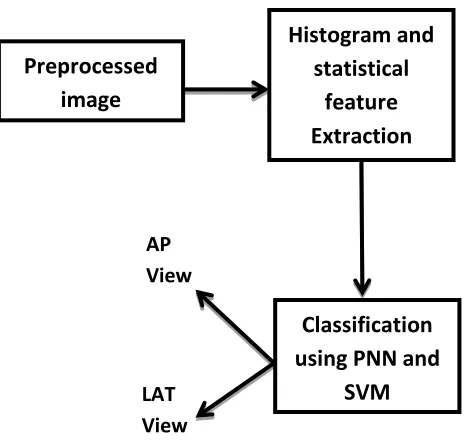
Fig. 3 shows the block diagram of model based classification method. Two different texture features namely 32 bin gray scale histogram and statistical features such as entropy, kurtosis, skewness, mean and standard deviation are extracted from the region of interest. The histogram gives an idea about the contrast of the image and distribution of the gray values. For gray level
Preprocessing
Model based
classification
Template
based
classification
AP or LAT
View
© 2015, IRJET ISO 9001:2008 Certified Journal
Page 970
histograms, the tonal distribution is from 0 to 255 while 0 represents black and 255 represents white. The statistical texture characteristics provide information about the properties of the level of the intensity distribution in the image like the smoothness, contrast, uniformity, flatness, and brightness. In this work statistical features mean, standard deviation, entropy, skewness and kurtosis are extracted. Mean returns the average value of the extracted region of interest. The standard deviation gives the information regarding how the data is dispersed from the mean. Entropy is a statistical measure of randomness that can be used to characterize the texture of the input image. Kurtosis gives an idea about the shape of the probability distribution. Skewness is a measure which tells how the data are symmetrically arranged about its mean.
Fig. 3 Block diagram of model based classification method
The usages of these features in correctly classifying the two different X- ray views were tested with PNN and SVM classifiers. PNNs can be used for solving classification problems. In this setting, a training set consisting of known input variables and corresponding outputs, is used to estimate a probability density function (PDF). Each output in the training set belongs to some class. When evaluated on data outside the training set, the PNN then classifies the input variables using the estimated PDF. A class is assigned, corresponding to that with the
highest probability of occurrence. Support vector machine is a supervised machine learning algorithm that uses kernel function to map linearly inseparable data to linearly separable data by mapping given data in higher dimension. A hyperplane is constructed in such a way that the margin between the two classes is maximum. The data vectors lying near the hyperplane are called support vectors which are alone then used in classification rather than considering all data points unlike clustering algorithms.
3,3 Template based classification
SURF [14] is becoming one of the most popular feature detector and descriptor in computer vision field. It is able to generate scale-invariant and rotation-invariant interest points with descriptors. Evaluations show its superior performance in terms of repeatability, distinctiveness, and robustness. SURF is selected as the interest point detector and descriptor for the following reasons: 1) X- ray image could be taken under the conditions of i) Within-view variation, ii) Between-view variation and iii) Structure localization. Interest points with descriptors generated by SURF are invariant to variation and location changes. 2) Computational cost of SURF is small, which enable fast interest point localization and matching. The block diagram of template based classification system is shown in Fig. 3.
The SURF detector is based on the Hessian matrix for its good performance in computational cost and accuracy. For a point (x,y) in an image I, The Hessian matrix H(σ) with is defined as
Modern feature extractors select prominent features by first searching for pixels which demonstrate rapid changes in intensity values in both the horizontal and vertical directions. Such pixels yield high Harris corner detection scores and are referred to as keypoints.
Keypoints are searched over a subspace of {x,y,𝜎} £ R3. The variable σ represents the Gaussian scale space at
which the keypoint exists. In SURF, a descriptor vector of length 64 is constructed using a histogram of gradient orientations in the local neighborhood around each keypoint. The proposed method extracts salient features and descriptors from images using SURF. This extractor is
AP
View
Preprocessed
image
Histogram and
statistical
feature
Extraction
Classification
using PNN and
SVM
[image:3.612.41.274.311.532.2]© 2015, IRJET ISO 9001:2008 Certified Journal
Page 971
preferred over SIFT due to its concise descriptor length. Whereas the standard SIFT implementation uses a descriptor consisting of 128 floating point values, SURF condenses this descriptor length to 64 floating point values. The template consists of a sample image (without artifacts) of each view to be classified from which the proposed system extracts knowledge. SURF first detects the interest points and generates corresponding descriptors. The pre-computed SURF descriptors of template images in each category are then used to match
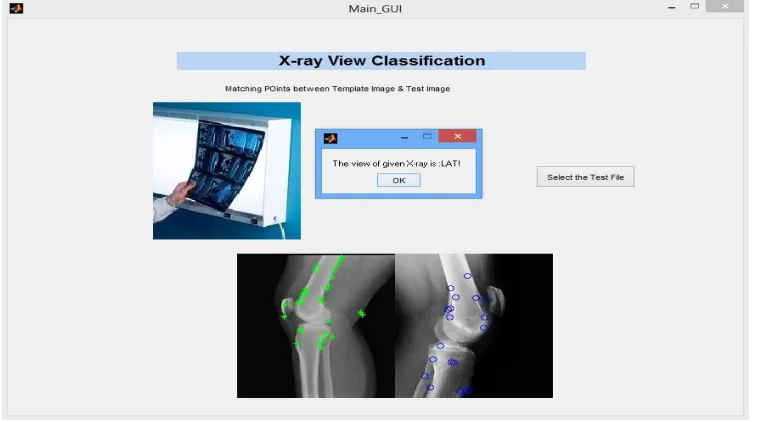
[image:4.612.61.495.240.406.2]with the extracted descriptors of the input X- ray image. The number of matched points between the input X- ray image and template images of different categories is determined. Then the Euclidean distance between the matched points in the template and the X- ray image is calculated and the average is taken. The template image with the shortest distance with the input X -ray image is classified as the corresponding view i.e anterio-posterior or lateral view and the result is displayed as shown in Fig. 5.
[image:4.612.58.439.447.658.2]Fig. 4 Block diagram of template based classification system
Fig. 5 Snapshot of X- ray view classification system
Preprocessed X– ray
Image
Feature Extraction
using SURF
Feature matching
Template X– ray
Images
Feature Extraction
© 2015, IRJET ISO 9001:2008 Certified Journal
Page 972
4.Results and Discussion
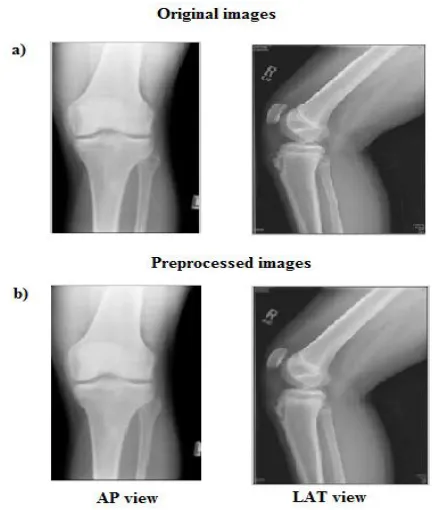
A set of 100 X- ray images were collected which consist of 50 anterio- posterior views and 50 lateral views. The resolution of the images is 1024 × 768 pixels. The first step in the proposed method is preprocessing, which
[image:5.612.312.542.171.307.2]removes the noise in the image and smoothens the image using median filter. The variation of histogram due to the presence of noise is also reduced during the preprocessing. Fig. 6 shows the preprocessed images.
[image:5.612.45.281.171.310.2]
[image:5.612.52.268.351.606.2]
Fig. 7 Gray level histogram of each views
Fig. 6 Sample preprocessed images
In model based classification method, the histogram features are extracted since the histogram pattern varies according to the structural variation which will make the classification easier. The gray level histogram using 32 bins of the sample is shown in Fig. 7
and it can be seen that the histogram pattern of each view varies.
Among the 50 X- ray images of a particular view, 30 images were taken for training purpose and 20 were taken for testing purpose, i.e., 60 images for training and 40 images for testing totally.
Table 2a) Classification accuracy of PNN classifier with histogram features
Test Image view AP view LAT Accuracy (%)
AP view (20) 16 4 80
LAT view (20) 17 3 85
Overall accuracy 82.5
Table 2b) Classification accuracy of SVM classifier with histogram features
Test Image view AP view LAT Accuracy (%)
AP view (20) 17 3 85
LAT view (20) 17 3 85
[image:5.612.328.547.489.571.2] [image:5.612.337.558.608.699.2]© 2015, IRJET ISO 9001:2008 Certified Journal
Page 973
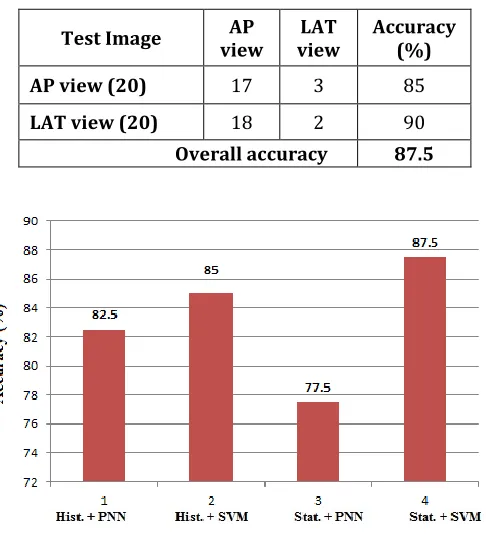
When the histogram features are used for classification the SVM classifier gives a better accuracy of 85%. The confusion matrix of histogram features with PNN and SVM classifiers are tabulated in table 2 a) and b). The SVM classifier performs well in classifying the views comparing to the PNN classifier, when using the statistical features the accuracy is improved to 87.5%. The confusion matrix of statistical features with the PNN and SVM classifiers are shown in Table 3 a) and b) respectively. Fig. 8 shows the performance of classifiers with histogram and statistical features with PNN and SVM classifiers.
Table 3a) Classification accuracy of PNN classifier with statistical features
Test Image view AP view LAT Accuracy (%)
AP view (20) 15 5 75
LAT view (20) 16 4 80
Overall accuracy 77.5
Table 3b) Classification accuracy of SVM classifier with statistical features
Test Image view AP view LAT Accuracy (%)
AP view (20) 17 3 85
LAT view (20) 18 2 90
Overall accuracy 87.5
Fig. 8. Performance comparison of PNN and SVM using histogram and statistical features
[image:6.612.332.545.237.322.2]To further improve the accuracy, an attempt has been made to classify the views using template based method. In each view one image is chosen randomly and used as a template. The efficiency of the proposed method is tested with the remaining 98 images. The Template based classification method gives an overall accuracy of 91.8% in classifying X- ray views. The confusion matrix of the X- ray view classification system is shown in Table 4.
Table 4 Classification accuracy of template based method using SURF
Test Image view AP view LAT Accuracy (%)
AP view (49) 43 6 87.7
LAT view (49) 45 4 93.8
Overall accuracy 91.8
4. Conclusion
In this work, classification of anterio-posterior and lateral views in leg X-rays is automated using model based method and template based methods. In the model based method the histogram features and statistical features are extracted and classified using the classifiers PNN and SVM. The SVM classifier performs well in classifying the X- ray views when statistical feature is given as input. When the SURF features is used for classification, the accuracy of the proposed method increased to 91.8% which is highest among the classification methods employed. The results indicate that, in future bone fracture detection can be automated and content based X-ray retrieval systems could also be implemented.
References
[1] J. M. Boone, S. Seshagiri, and R. M. Steiner, “Recognition of chest radiograph orientation for picture archiving and communication systems display using neural networks,” J. Dig. Imag., vol. 5, no. 3, pp. 190–193, 1992.
[image:6.612.31.261.277.359.2] [image:6.612.22.265.405.674.2]© 2015, IRJET ISO 9001:2008 Certified Journal
Page 974
[3] E. F. Kao, C. Lee, T. S. Jaw, J. S. Hsu and G. C. Liu, “Projection profile analysis for identifying different views of chest radiographs,” Acad. Radiol., vol. 13, pp. 518–525, 2006.
[4] E. Pieka and H. K. Huang, “Orientation correction for chest images,” J. Dig. Imag., vol. 5, no. 3, pp. 185–189, 1992.
[5] E. F. Kao, W.C. Lin, J. S. Hsu, M.C. Chou, T. S. Jaw, G. C. Liu, “A computerized method for automated identification of erect posteroanterior and supine anteroposterior chest radiographs,” Phys Med Biol., vol. 56, no. 24, pp.7737-7753, 2011.
[6] T. M. Lehmann, O. Guild, D. Keysers, H. Schubert, M. Kohnen, and B. B. Wein, “Determining the view of chest radiographs,” J. Dig. Imag., vol. 16, no. 3, pp. 281--291, 2003.
[7] Balaji, G. N., T. S. Subashini, and N. Chidambaram. "Automatic Classification of Cardiac Views in Echocardiogram Using Histogram and Statistical Features." Procedia Computer Science 46 (2015): 1569-1576.
[8] Balaji, G. N., T. S. Subashini, and N. Chidambaram. "Cardiac View Classification Using Speed Up Robust Features." Indian Journal of Science and Technology 8.S7 (2015): 1-5.
[9] Kim, Seong-Hoon, et al. "X-ray image classification using random forests with local binary patterns." Machine Learning and Cybernetics (ICMLC), 2010 International Conference on. Vol. 6. IEEE, 2010.
[10] M. Bugdol, J. Czajkowska, and E. Pietka, “A novel model-based approach to left ventricle segmentation,” in Computing in Cardiology (CinC). Krakow, Poland: IEEE, 2012, pp. 561-564.
[11] Ghofrani, Fatemeh, et al. "Fuzzy-Based Medical X-ray Image Classification." Journal of medical signals and sensors 2.2 (2012): 73.
[12] Mohammadi, Seyyed Mohammad, Mohammad Sadegh Helfroush, and Kamran Kazemi. "Novel shape-texture feature extraction for medical X-ray image classification." Int J Innov Comput Inf Control 8 (2012): 659-76.