Murine V lambda x and V lambda x-containing
antibodies bind human myelin basic protein.
F S Galin, … , J N Whitaker, J E Blalock
J Clin Invest.
1996;
97(2)
:486-492.
https://doi.org/10.1172/JCI118439
.
Myelin basic protein (MBP) is highly immunogenic and a known autoantigen capable of
inducing experimental allergic encephalomyelitis (EAE), the animal model of multiple
sclerosis. We have previously described a murine monoclonal antibody (mAb), F28C4,
directed against the encephalitogenic MBP peptide acetyl (Ac) 1-9, which contains a V
lambda x light chain. Considering the rarity of V lambda x usage, we determined whether
other Abs having V lambda x light chains shared similar antigen (Ag) specificity. We
screened a panel of V lambda x-containing monoclonal and polyclonal Abs, of unknown
specificity for reactivity with MBP. All such Ab, but not heavy chain isotype matched
controls, bound MBP but were not polyreactive with other potential self Ags. The binding of
a recombinant form of V lambda x alone to MBP demonstrated the important contribution of
the V lambda x light chain to the reaction. With the exception of mAb F28C4 which
recognizes MBP Ac1-9, the epitope specificity of all other V lambda x-bearing Abs was
localized to MBP residues 25-34. These results demonstrate a unique association between
V lambda x expression and MBP reactivity. Given that V lambda x shares sequence
homology with T cell receptors (TCR) from encephalitogenic T lymphocytes, these results
imply a potential role for V lambda x in the pathogenesis of EAE.
Research Article
Find the latest version:
http://jci.me/118439/pdf
J. Clin. Invest.
© The American Society for Clinical Investigation, Inc. 0021-9738/96/01/486/07 $2.00
Volume 97, Number 2, January 1996, 486–492
Murine V
l
x and V
l
x-containing Antibodies Bind Human Myelin Basic Protein
F. Shawn Galin,* Curtis C. Maier,** Shan-Ren Zhou,‡i John N. Whitaker,‡§i¶ and J. Edwin Blalock*‡§
*Department of Physiology and Biophysics, ‡Center for Neuroimmunology, §Comprehensive Cancer Center, and iDepartment of
Neurology, University of Alabama at Birmingham, Birmingham, Alabama 35294; ¶Neurology and Research Services of the Birmingham Veterans Medical Center, Birmingham, Alabama 35233; and **Department of Pathology and Laboratory Medicine, University of Pennsylvania School of Medicine, Philadelphia, Pennsylvania 19104
Abstract
Myelin basic protein (MBP) is highly immunogenic and a known autoantigen capable of inducing experimental aller-gic encephalomyelitis (EAE), the animal model of multiple sclerosis. We have previously described a murine mono-clonal antibody (mAb), F28C4, directed against the enceph-alitogenic MBP peptide acetyl (Ac) 1-9, which contains a Vlx light chain. Considering the rarity of Vlx usage, we de-termined whether other Abs having Vlx light chains shared similar antigen (Ag) specificity. We screened a panel of Vlx-containing monoclonal and polyclonal Abs, of un-known specificity for reactivity with MBP. All such Ab, but not heavy chain isotype matched controls, bound MBP but were not polyreactive with other potential self Ags. The binding of a recombinant form of Vlx alone to MBP dem-onstrated the important contribution of the Vlx light chain to the reaction. With the exception of mAb F28C4 which recognizes MBP Ac1-9, the epitope specificity of all other Vlx-bearing Abs was localized to MBP residues 25–34. These results demonstrate a unique association between Vlx expression and MBP reactivity. Given that Vlx shares sequence homology with T cell receptors (TCR) from en-cephalitogenic T lymphocytes, these results imply a poten-tial role for Vlx in the pathogenesis of EAE. (J. Clin. Invest. 1996. 97:486–492.) Key words: experimental allergic en-cephalomyelitis • light chain • multiple sclerosis • B cells •
autoimmune disease
Introduction
Experimental allergic encephalomyelitis (EAE)1 is a CD41 T
cell–mediated inflammatory demyelinating disease of the cen-tral nervous system (CNS) that can be induced by immuniza-tion with CNS components. EAE is considered to be a prime
animal model for the human autoimmune disorder multiple sclerosis (MS) (for review see reference 1). Myelin basic pro-tein (MBP), a molecule of 170 residues which comprises 30% of CNS myelin proteins, is encephalitogenic in actively or pas-sively inducing EAE in a variety of animals. Although T cells clearly play a central role in the pathogenesis of EAE, B cells may be important in modulation of the disease. In both EAE and MS, B cells infiltrate the CNS, transform into plasma cells, and can locally synthesize Ig some of which is anti-MBP (2, 3). Antibodies (Ab) appear after active immunization with CNS antigens (Ag) but titers do not correlate with the presence of EAE. In Lewis rats, Ab is initially detected during the onset of EAE and is maximal after recovery (4). Subsequent to recov-ery from EAE, Lewis rats are resistant to reinduction of active disease. CD41 T cells isolated during the recovery phase can
transfer resistance only if cotransferred with MBP-primed B cells (5). Such B cell modulation of resistance is paralleled by the finding that sera from rats recovered from EAE pas-sively protect against active EAE (6). Collectively, these data suggest that humoral responses may play an important regula-tory role in the pathogenesis of EAE.
Multiple immunogenic and encephalitogenic epitopes re-side in MBP (7). For PL/J mice, the I-Au restricted, dominant
encephalitogenic epitope is MBP peptide acetyl (Ac) 1-9 (8). In PL/J mice and Lewis rats the T cell receptor (TCR) reper-toire of the encephalitogenic T cell response to different MBP epitopes is similarly restricted by TCR Va2.3b8.2 (9). A mAb, F28C4, raised in the PL/J mouse to MBP Ac1-9 shares a cross-reactive idiotope (CRI) with the PL/J Vb8.21 TCR
recogniz-ing the same MBP peptide (10). This CRI has been defined us-ing the anti-Id mAb, F30C7, which can block both peptide recognition by F28C4 (11) and peptide stimulation of MBP Ac1-9-specific T cells (10). These and other findings suggest that the CRI resides at or near the combining site of F28C4 and the TCR and is not a public Id. A role for this CRI and the related Id network in EAE is suggested by the ability of mAb F30C7 anti-Id to lessen clinical EAE in the adoptive transfer model of EAE in PL/J mice (10), possibly by T cell anergy (12). The structure and fine specificity of F28C4 appear to be crucial for its paratope and Id characteristics. Similar to the re-action of the encephalitogenic T cell clone, PJR-25, optimal binding of mAb F28C4 requires an extended conformation of the MBP peptide Ac 1-9 so that the central residues are more tightly bound than the terminal residues (13). Furthermore, there is a sequence homology of 75% found between comple-mentarity determining region (CDR) 3 of F28C4 VL and VH and the V-D-J junction of the TCR Vb8.2 from encephalito-genic T cells. This homology is not shared by other Ig CDR3 regions and arises, in part, because F28C4 uses an unusual L chain V region known as Vlx (14, 15). Before the demon-stration that an Ab with Vlx could bind MBP, no Ab with such an L chain had any known specificity. Vlx is an unusual V
Address correspondence to J. Edwin Blalock, Ph.D., Department of Physiology and Biophysics, 896 Basic Health Science Building, Uni-versity of Alabama at Birmingham, Birmingham, AL 35294-0005.
Received for publication 16 August 1995 and accepted in revised form 9 October 1995.
gene segment that was discovered in 1987 in polyclonally acti-vated B cells (14, 15). Vlx rearranges with Jl2-Cl2 and dis-plays at least three unique features: First, its amino acid se-quence is only 30–33% homologous to any other known Vl
and/or V-kappa (k) genes. Second, the last codon of the Vlx gene is a TAA termination codon that must be disrupted by Jl2 to create a functional codon. Third, the modified joining at the V-J junction results in a CDR3 extended by an additional four amino acids. Homologous sequences have been found in various mammalian species, including man, suggesting that Vlx existed before the speciation of mammals (16). Consider-ing the rarity of Vlx usage, , 0.5% of all Ig in normal mice sera, it is tempting to speculate that the expression of Vlx in response to an encephalitogenic immunogen was not a coinci-dental event but represents an important structural component involved in the immunopathogenesis of CNS myelin damage.
We now report on the inherent affinity of Vlx-bearing Abs and Vlx alone for MBP with a preference for its amino-termi-nal end. The recognition step between Vlx and an encephali-togenic epitope of MBP may reflect the structural features of an Id network that affects both T and B cells in autoimmune demyelination.
Methods
Antigens. Human MBP and its citrullinated isoform, termed C8, were prepared by previously described techniques (17). Briefly, hu-man MBP (1-170) was isolated from huhu-man brain by delipidation, acid extraction at pH 3, and carboxymethylcellulose chromatography at pH 10.6. MBP-C8 was purified from the fraction of delipidated brain extract which had not been retained on carboxymethylcellulose at pH 9.6 or pH 10.6. The human MBP peptide acetyl Ac1-9 was syn-thesized in our laboratory on a Biosearch Peptide Synthesizer (Model 9500; Cambridge, MA) and purified by reverse-phase high-perfor-mance liquid chromatography. Human MBP peptides 10–19, 14–24, 25–34, and 80–89 were synthesized by Peninsula Laboratories (San Carlos, CA). Sequences of MBP peptides are shown in Table I.
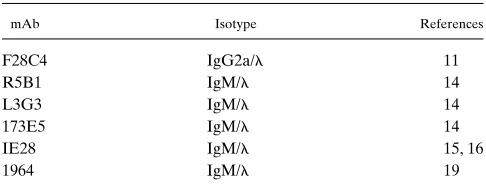
mAbs. The preparation and characterization of all mAbs used in this study have been previously described (for reference see Table I).
The Vlx-containing mAbs R5B1, L3G3, and 173E5 were kindly pro-vided by K. Rajewsky and the Vlx-bearing mAbs IE28 and 1964 were gifts from P. Sanchez and J. Erikson, respectively. The IgM/l2 (non-Vlx) mAbs A10, A34, LC51, A3L, and B11 were kindly pro-vided by J. Kearney.
Polyclonal monospecific Ab to Vlx. A New Zealand white rabbit (Myrtle Laboratories, Thompson Station, TN) was injected subcuta-neously (four sites, every 2 wk over a 6-wk period) with purified F28C4 (50 mg/injection), first in Freund’s complete adjuvant and twice in incomplete adjuvant. Serum was obtained before the first injection and 2 wk after each booster to monitor anti-F28C4 titers by ELISA. F28C4 is of the g2a isotype and, as with all Vlx-bearing Abs, is a l2 isotype. In order to make the antiserum light chain (i.e., Vlx) spe-cific, it was exhaustively absorbed on a polyclonal IgG2a Sepharose 4B affinity column to deplete heavy chain reactivity. Next, the Jl2Cl2 reactivity was removed using a MOPC 315 (IgA, l2) Sepharose 4B affinity column. Monospecific Ab to Vlx was collected after binding to and elution from an F28C4 affinity column. The spec-ificity of the resulting anti-Vlx Ab was determined by Western analy-sis (see Results).
Isolation of Vlx-bearing Ig from normal BALB/c mouse se-rum. Vlx-containing Ig from normal BALB/c mouse sera (Sigma Chemical Co., St. Louis, MO) was purified over a anti-Vlx Ab Seph-arose 4B affinity column prepared using the monospecific rabbit anti-Vlx Ab described above. Vlx-containing Abs represented z 0.5% of
total Ig as previously described (15).
Enzyme-linked immunosorbent assay (ELISA). Microtiter wells (96-well ELISA plates; Corning Glass Works, Corning, NY) were coated with human MBP (1–170) (10.0 mg/ml in PBS), various other self Ags (concentrations equimolar to MBP), or MBP-related pep-tides (10.0 mg/ml in PBS) at 48C for 16 h and plates were blocked with 2% casein in PBS. Washings were performed with PBS containing 0.05% Tween 20. Abs were diluted in PBS containing 1.0% BSA and allowed to bind for 2 h at room temperature. Ab binding was detected with an appropriate alkaline phosphatase conjugated anti-mouse heavy chain specific Ab (Southern Biotechnology, Birmingham, AL) or with rabbit anti-Vlx Ab followed by an alkaline phosphatase con-jugated anti–rabbit IgG Ab (Southern Biotechnology, Birmingham, AL). Reactions were developed using p-nitrophenyl phosphate (Sigma Chemical Co.) and color development was quantitated as absorbance at 405 nm on a UVmax Kinetic Microplate Reader (Mo-lecular Devices, Menlo Park, CA). Background optical density was the mean of wells where coating Ag was omitted. Controls were also performed with Ag-coated wells and all ELISA components except the primary Ab. These were always negative.
[image:3.612.56.299.497.593.2]PCR amplification, cloning, and expression of Vlx. Oligonucle-otide primers used for cloning Vlx were synthesized on a Dupont Coder 300 DNA Synthesizer (Dupont, Wilmington, DE) and were purified on Nensorb Prep columns (NEN, Boston, MA). Sequences of primers used for specific amplification of Vlx from the F28C4 hy-bridoma by PCR each contained a restriction site (XhoI and Bpu 1102I for the sense and antisense primers, respectively) at the 59 ends to facilitate cloning of the PCR products. F28C4 Vlx was amplified using a Vlx-specific sense primer corresponding to nucleotides 229– 242 which has the sequence 59-d(CCG CTC GAG CAA CTT GTG CTC ACT CAG TCA TC) (GenBank Accession No. M34597). The antisense primer is specific for l2 and is complementary to the J-C junction of F28C4 (13). It has the sequence 59-d(GGA CTT GGG CTG AGC TAG GAC AGT GAC). Detailed methods used for re-verse transcriptase-polymerase chain reaction (RT-PCR) amplifica-tion of Ig V regions have been previously provided (18). The result-ing double-stranded DNA sequence was then restriction digested and directionally cloned into the expression vector, pET-15b (Novagen, Inc., Madison, WI), and expressed according to the manufacturer’s protocol. Purification of the recombinant protein was facilitated by the addition of a polyhistidine tag to the 59 end of the cloning site. The authenticity of the recombinant protein was verified using West-ern gel analysis employing rabbit anti-Vlx Ab (see Results). Table I. MBP Peptides and Vlx-containing mAbs
mAb Isotype References
F28C4 IgG2a/l 11
R5B1 IgM/l 14
L3G3 IgM/l 14
173E5 IgM/l 14
IE28 IgM/l 15, 16
1964 IgM/l 19
MBP peptide acetyl 1-9
Ac-Ala-Ser-Gln-Lys-Arg-Pro-Ser-Gln-Arg MBP peptide 10-19
His-Gly-Ser-Lys-Tyr-Leu-Ala-Thr-Ala-Ser MBP peptide 14-24
Tyr-Leu-Ala-Thr-Ala-Ser-Thr-Asp-His-Ala MBP peptide 25-34
Arg-His-Gly-Phe-Lys-Pro-Arg-His-Arg-Asp MBP peptide 80-89
Thr-Gln-Asp-Glu-Asn-Pro-Val-Val-His-Phe
Results
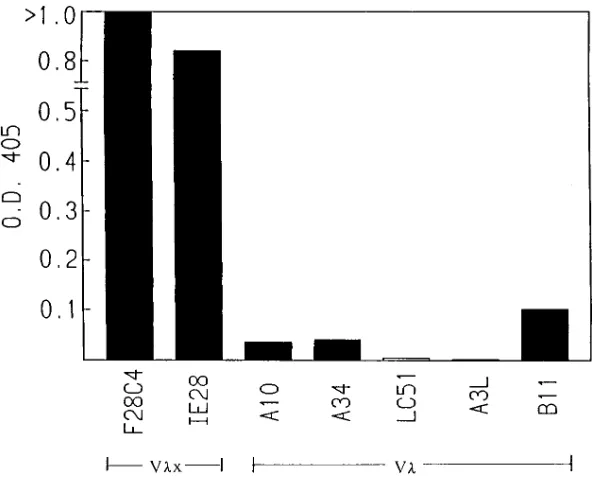
To investigate whether Vlx could confer MBP reactivity to an Ig, we collected and screened the known Vlx-containing mAbs for binding to MBP. Of six such mAbs that are known, five were of previously unknown Ag specificity while F28C4, which was raised against MBP Ac 1-9, served as a positive con-trol. By ELISA, all Vlx-bearing mAbs bound human MBP (1-170) but, with the one exception of IE28, did not bind other common auto Ags including cytochrome c, thyroglobulin, ac-tin, or stranded DNA (Fig. 1). IE28 bound single-stranded DNA. This reactivity with MBP was not observed with other IgM/l2 (non Vlx) mAbs (Fig. 2). These results sug-gest that Vlx-containing IgMs are not polyreactive but rather have a measure of specificity for MBP. The lack of reactivity with cytochrome c is notable since it, like MBP, carries a basic
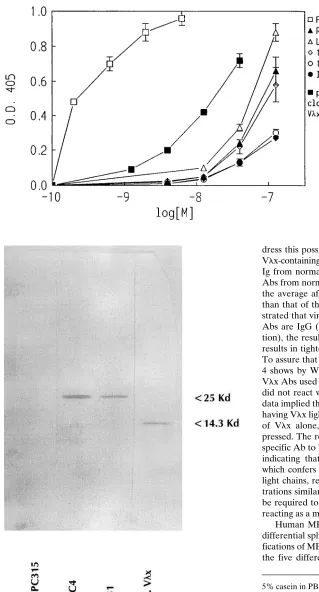
charge. This suggests that the interaction is not merely electro-static. The Vlx-bearing IgMs displayed a spectrum of Kas,
ranging from at least 106 to 107 l/m, which likely reflects
differ-ences in VH usage (Fig. 3). The much higher affinity of F28C4 (Kaz 109) undoubtedly results from its being selected for by
MBP immunization. However, considering that Vlx is the common denominator shared between these mAbs, the results suggest that their inherent ability to bind MBP may largely re-side with the light chain while the affinity is governed by the heavy chain.
Four out of the six mAbs used in these studies were derived from polyclonally activated B cells whereas mAb 1964 was ob-tained from a mouse transgenic for the VH3H9 chain previ-ously described in the autoimmune MRL/lpr mouse (19). Thus, in a sense, these mAbs were somewhat artificial in their selection and might not occur in a more natural setting. To
[image:4.612.55.401.60.302.2]ad-Figure 1. Polyreactivity profile of Vl x-containing mAbs with potential self Ags. ELISA microtiter wells were coated with equimolar concentrations (540 nM) of the indicated Ags. Both thyroglobulin and ss-DNA were also coated at 10-fold lower concentrations. The mAbs were diluted in PBS containing 1.0% BSA to a final con-centration of 30 mg/ml, except for F28C4 which was diluted to 2 mg/ml. The results are the mean6SEM of three experiments, each done in duplicate.
[image:4.612.58.354.502.746.2]dress this possibility and to determine whether MBP reactive Vlx-containing Abs occur naturally, we purified Vlx-containing Ig from normal BALB/c sera. Fig. 3 shows that Vlx-bearing Abs from normal mouse sera bind human MBP. Interestingly, the average affinity of these Abs is much higher (z 10-fold)
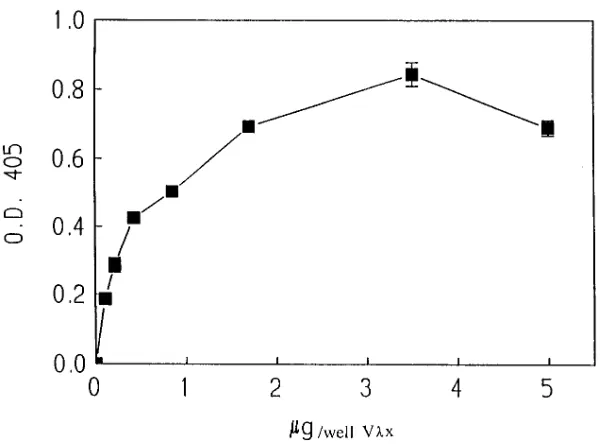
than that of the IgM mAbs. Since other studies have demon-strated that virtually all of the Vlx-bearing polyclonal murine Abs are IgG (Galin et al., manuscript submitted for publica-tion), the results suggest that Vlx association with g isotypes results in tighter binding than those with m (data not shown). To assure that we were only measuring Vlx-bearing Abs, Fig. 4 shows by Western analysis that the polyclonal rabbit anti-Vlx Abs used for purification were monospecific for Vlx and did not react with l2 light chains or g2a heavy chains. These data implied that Vlx-containing Abs bound MBP by virtue of having Vlx light chains. In order to examine the MBP binding of Vlx alone, Vlx from mAb F28C4 was cloned and ex-pressed. The recombinant Vlx reacted with the rabbit mono-specific Ab to Vlx (Fig. 4). It also bound human MBP (Fig. 5) indicating that it is the light chain of Vlx-containing Abs which confers affinity for human MBP. Unlike most isolated light chains, recombinant Vlx interacts with MBP at concen-trations similar to that of intact IgM/Vlx. Further studies will be required to determine whether the recombinant protein is reacting as a multimer.
[image:5.612.53.372.68.660.2]Human MBP exists in five major isoforms that represent differential splicing of the MBP gene. Post-translational modi-fications of MBP result in a microheterogeneous population of the five differentially charged isomers. Among the modified
Figure 3. Reactivity of Vlx-containing mAbs and purified polyclonal Vlx-bearing Abs from normal mouse sera with human MBP (1-170). The Vlx-containing IgM mAbs, mAb F28C4, which served as a pos-itive control, and the purified Vl x-contain-ing Ab fraction from normal BALB/c mouse serum were diluted in PBS contain-ing 1% BSA at the indicated concentra-tions. Reactivity of the Vlx-containing mAbs with human MBP was detected us-ing an appropriate goat anti–mouse H chain-specific Ab (Southern Biotechnol-ogy) whereas reactivity of the Vlx-bearing Abs purified from normal mouse sera was monitored using rabbit polyclonal mono-specific Ab to Vlx (diluted in PBS con-taining 1% BSA to a final concentration of 1 mg/ml) and detected with an alkaline phosphatase conjugated goat anti–rabbit IgG-specific Ab (Southern Biotechnol-ogy). The results are the mean6SEM of three experiments, each done in duplicate.
Figure 4. Western gel analysis verifying the specificity of rabbit anti-Vlx Ab and the authenticity of recombinant Vlx. Purified recombi-nant Vlx, F28C4 (g2a, Vlx), MOPC 315 (a, l2), and mAb R5B1 (m, Vlx) were separated by 20% SDS-PAGE and electrophoretically transferred onto nitrocellulose. After blocking for 16 h at 258C with
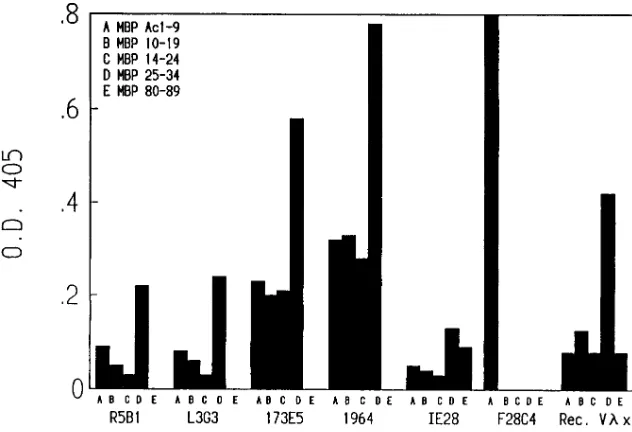
isomers, one termed C8 has undergone deimidation of at least six of the arginyl residues (positions 25, 31, 122, 130, 159, and 170) generating citrulline in these positions (20). Because of the number of altered residues, reactivity with C8 was tested in an attempt to restrict the interactive site of the aforemen-tioned Vlx-containing Abs. We have found that, with the ex-ception of F28C4, the Vlx-bearing Abs do not recognize the C8 isomer of MBP (Fig. 6). Thus, citrullination may disrupt or mask specific epitopes on MBP. Since F28C4 is specific for MBP Ac 1-9, and no citrullination occurs within this region, it is not surprising that F28C4 recognizes C8 MBP. In order to further localize potential epitopes within human MBP for Vlx and Vlx-containing Abs, we assayed binding to synthetic pep-tides representing human MBP residues Ac 1-9, 10-19, 14-24, 25-34, and 80-89 of the MBP molecule (Fig. 7). With the excep-tion of F28C4, all Vlx-bearing mAbs as well as recombinant Vlx showed preferential binding to MBP peptide 25-34 as compared with the other peptides. Interestingly, mAbs 173E5 and 1964, as well as the recombinant protein, seem to be polyreactive with different regions of MBP. On the other hand, F28C4 only shows reactivity with Ac 1-9. Thus, the
heavy chain seems to contribute to epitope specificity as well as affinity for MBP. These data also demonstrate that the dominant epitope recognized by recombinant Vlx and most Vlx-containing IgMs can, in part, be defined by a particular region in MBP which includes residues 25–34. This result is, of course, consistent with the loss of binding that occurs when Arg25 and Arg31 are deimidated (Fig. 6).
Discussion
Evidence for the role of an Id network in EAE rests on the demonstration of a CRI on the TCR of encephalitogenic T cells and modulation of disease by anti-Id (10, 12). The reagent central to the recognition of these immune events is mAb F28C4, an IgG2a/l anti-MBP Ac 1-9 (10–12). The realization that the L chain of mAb F28C4 was Vlx, an unusual and phy-logenetically old protein, led to the investigations reported herein. In brief, Vlx confers binding to MBP whether in nor-mal poyclonal murine Ig, a mAb, or as a recombinant product. It’s binding to MBP is not a polyreactive phenomenon, but it can be modified by the heavy chain type. The MBP site
[image:6.612.57.357.56.278.2]prefer-Figure 5. Binding of recombinant Vlx to human MBP (1–170) as determined by ELISA. The recombi-nant Vlx was diluted at various concentrations rang-ing from 50 mg/ml to 1 mg/ml in PBS and was allowed to bind for 2 h at 258C. Reactivity was monitored us-ing rabbit polyclonal monospecific Ab to Vlx (1 mg/ ml in PBS containing 1% BSA) and detected follow-ing incubation with alkaline phosphatase labeled goat anti–rabbit IgG-specific Ab (Southern Biotechnology, Birmingham, AL). The results are the mean6SEM of three experiments each done in duplicate.
[image:6.612.56.429.547.744.2]entially bound is the amino terminus itself or in the region en-compassing residues 25–34. Until the present report nothing was known about the specificity of Vlx bearing Abs because they were originally described in polyclonally activated B cells. Current dogma associated with EAE, and perhaps apply-ing to MS, essentially dictates that the encephalitogenic re-sponse to MBP, particularly with regard to T cell activation, is restricted to certain TCR usage and may be predominantly di-rected against limited immunodominant epitopes. Here we have shown that the reactivity of Vlx-containing Abs with MBP can be largely localized to the amino-terminal end, par-ticularly in the region of residues 25–34. Although no formal studies were done using peptides representing the carboxy-ter-minal half of the MBP molecule, it seems unlikely that this re-gion of the molecule is involved in the binding activity of these mAbs since, quantitatively, the reactivity of these mAbs with peptide 25–34 accounts for that seen with the intact molecule. This is further supported by the lack of binding seen with the most amino-terminal peptide of the carboxy-terminal half of MBP, peptide 80–89. Since it is known that Vlx and Vl x-bear-ing mAb share sequence homology and specificity with en-cephalitogenic TCRs, it is tempting to speculate that peptide 25–34 may represent yet another encephalitogenic epitope. MBP 25–34 has, to our knowledge, never been shown to be en-cephalitogenic, thus this possibility is intriguing, especially since we now know that multiple MBP peptides can be en-cephalitogenic even within an inbred strain of mice (21). Fur-thermore, new MBP epitopes are emerging as encephalito-genic even in the context of multiple MHC molecules (22). Thus, there is still the potential for identification of novel en-cephalitogenic peptides that may have been previously over-looked. On the other hand, Vlx may have a protective role with MBP 25–34, evoking a beneficial B cell response. This is particularly intriguing since MBP 21–40 has been shown to trigger TGF-b release and can suppress active induction of EAE (23). In addition, recent data suggests that virulent, re-stricted T cell responses predominate only during active dis-ease whereas the initial anti-MBP and recovery responses are marked by non-pathogenic heterogeneity (24). Thus, a Vlx response to MBP 25–34 could perhaps alter or reduce the
en-cephalitogenic T cell response through the induction of anti-idiotypic antibodies or T cells responding to Vl x-idiopep-tides (25).
[image:7.612.57.373.59.275.2]Although the specificity of most Abs results from a precise match between H and L chains, cooperation between the two chains is not always necessary for tight and specific Ag bind-ing. Particular VH domains have now been shown to modulate binding to DNA, cardiolipin (26), and lysozyme (27). How-ever, in some of these cases, different L chains could dramati-cally alter binding specificities (26). These results suggest that, as in the case for Vlx, a single V region may contain most or all of the necessary determinants required for efficient bind-ing, but that certain H or L association can either enhance or abolish such Ag recognition or change specificity. The results of our investigation support this notion in that there is clearly an inherent or intrinsic quality associated with Abs bearing Vlx that results in MBP binding and the MBP reactivity re-sides mostly with Vlx. Moreover, the H chain seems responsi-ble for apparent differences in affinity between the Vl x-con-taining Abs for MBP and could certainly account for the shift in epitope specificity for F28C4. It is important to note that F28C4 was originally selected for Ac1-9 specificity and, thus, it is not surprising that F28C4 does not bind peptide 25–34. On the other hand, the various Vlx-containing IgM’s were not ini-tially generated to exhibit MBP reactivity, therefore these mAbs may not have both H and L chain contributions to MBP specificity and, based on the findings presented here, bind MBP and MBP peptide 25–34 solely by virtue of bearing a Vlx L chain. This is consistent with the ability of recombinant Vlx alone to preferentially bind peptide 25–34. Considering this, clonal expansion of certain MBP-specific B cells could be initi-ated via a threshold stimulation of surface Igs with Vlx light chains by MBP. The exact MBP specificity and affinity would then be determined by the particular VH and heavy chain iso-type. This type of scenario would seem to explain why many MBP reactive Igs in normal mouse sera have Vlx light chains. If this idea is correct, it suggests that a skewed distribution of Vlx containing MBP specific antibodies may eventually be ob-served in EAE. With regard to MS, the observation of a hu-man equivalent to Vlx suggests that our findings in the mouse
may in fact apply to humans (16). If found, such Abs could be markers for MS and EAE much like certain Ig V regions are associated with SLE and rheumatoid arthritis. Indeed, a hu-man Vlx-like light chain could, in part, explain certain oligo-clonal light chain bands in the cerebral spinal fluid of MS pa-tients (28, 29).
Although it is often assumed that Ab responses to self Ags result only in pathogenicity, there is also evidence to the con-trary. For instance, sera obtained from animals that have re-covered from EAE are able to suppress EAE when given to naive recipients at the time of active disease induction (30). This is entirely consistent with the ability of antiserum from animals immunized with MBP or its encephalitogenic peptides to inhibit the disease (6). Considering that mAbs specific for MBP can, in vitro, inhibit the proliferation and cytotoxicity of human MBP-specific T cell clones (31), these data suggest that the humoral response to MBP, in vivo, can potentially modu-late the T cell-mediated immune response through a T cell/B cell network. Thus, we cannot overlook the possibility that Vlx may play a role in such regulation. In fact, our preliminary results suggest that the Vlx containing Ab F28C4 is a very po-tent idiotypic vaccine against adoptively transferred EAE in the Lewis rat model of disease (Galin et al., manuscript in prep-aration). If extended to humans, such results could suggest a new therapeutic regimen for MS. In any event, further investi-gation into the regulation of Vlx expression, particularly in re-sponse to MBP, may provide critical insight into the potential function of this unique V region and its role in EAE and MS.
Acknowledgments
The authors thank Diane Weigent for editorial assistance and for typ-ing this paper.
This work was supported by a Multiple Sclerosis Society Postdoc-toral Fellowship Award to F. S. Galin; National Institutes of Health grant PPG P01 NS-29719 to J. E. Blalock, S.-R. Zhou, and J. N. Whi-taker; National Institutes of Health grant DK38024, Tobacco Council grant 2222, and a Multiple Sclerosis Society Pilot Grant to J. E. Bla-lock; National Institutes of Health Training grant T3207335 to C. C. Maier; and National Institutes of Health grant NS-23240 and the Re-search Program of the Veterans Administration to J. N. Whitaker.
References
1. McFarland, H. F., and D. E. McFarlin. 1995. Immunologically mediated demyelinating diseases of the central and peripheral nervous system. In Samter’s Immunologic Diseases. M. M. Frank, K. F. Austen, H. N. Claman, and E. R. Unanue, editors. Little, Brown, and Company, Boston, New York, Tor-onto, and London. 1081–1101.
2. Ewan, P. W., and P. J. Lachmann. 1979. IgG synthesis within the brain in multiple sclerosis and subacute sclerosing panencephalitis. Clin. Exp. Immunol. 35:227–235.
3. Catz, I., and K. G. Warren. 1986. Intrathecal synthesis of autoantibodies to myelin basic protein in multiple sclerosis. Can. J. Neurol. Sci. 13:21–24.
4. Day, E. D., and O. M. Pitts. 1974. The antibody response to myelin basic protein in Lewis rats: the effect of time, dose, and dose of Mycobacterium bu-tyricum. J. Immunol. 113:1958–1967.
5. Karpus, W. J., and R. H. Swanborg. 1991. Protection against experimen-tal allergic encephalomyelitis requires both CD41 T suppressor cells and myelin basic protein-primed B cells. J. Neuroimmunol. 33:173–177.
6. Macphee, I. A. M., M. J. Day, and D. W. Mason. 1990. The role of serum factors in the suppression of experimental allergic encephalomyelitis: evidence for immunoregulation by antibody to the encephalitogenic peptide. J. Immu-nol. 70:527–534.
7. Day, E. D., and N. T. Potter. 1986. Monoclonal and polyclonal antibodies to myelin basic protein determinants. J. Neuroimmunol. 10:289–312.
8. Zamvil, S. S., D. J. Mitchell, A. C. Moore, K. Kitamura, L. Steinman, and J. B. Rothbard. 1986. The T cell epitope of the autoantigen myelin basic protein that induces encephalomyelitis. Nature (Lond.). 324:258–260.
9. Zamvil, S. S., and L. Steinman. 1990. The T lymphocyte in experimental allergic encephalomyelitis. Annu. Rev. Immunol. 8:579–621.
10. Zhou, S.-R., and J. N. Whitaker. 1993. Specific modulation of T cells and murine experimental allergic encephalomyelitis by monoclonal anti-idio-typic antibodies. J. Immunol. 150:1629–1642.
11. Zhou, S.-R., and J. N. Whitaker. 1992. Interstrain cross-reactive idio-types on monoclonal antibodies to an encephalitogenic myelin basic protein peptide. Clin. Immunol. Immunopathol. 63:74–83.
12. Zhou, S.-R., J. N. Whitaker, Q. Han, C. C. Maier, and J. E. Blalock. 1994. A cross-reactive idiotope on T cells from PL/J mice and Lewis rats recog-nizing different myelin basic protein encephalitogenic epitopes but restricted by Vb8.2. J. Immunol. 153:2340–2351.
13. Maier, C. C., F. S. Galin, M. A. Jarpe, P. Jackson, R. N. Krishna, A. M. Gautam, S.-R. Zhou, J. N. Whitaker, and J. E. Blalock. 1994. A Vlx-bearing monoclonal antibody with similar specificity and sequence to encephalitogenic T cells. J. Immunol. 153:1132–1140.
14. Dildrop, R., A. Gause, W., Müller, and K. Rajewsky. 1987. A new V gene expressed in lambda-2 light chains of the mouse. Eur. J. Immunol. 17:731– 734.
15. Sanchez, P., P. N. Marche, C. LeGuern, and P. A. Cazenave. 1987. Structure of a third murine immunoglobulin l light chain variable region that is in laboratory mice. Proc. Natl. Acad. Sci. USA. 8:9185–9188.
16. Sanchez, P., P. N. Marche, D. Rueff-Juy, and P. A. Cazenave. 1990. Mouse Vlx gene sequence generates no junctional diversity and is conserved in mammalian species. J. Immunol. 144:2816–2820.
17. Whitaker, J. N., K. A. Kirk, P. K. Herman, S.-R. Zhou, R. R. Goodin, M. A. Moscarello, and D. D. Wood. 1992. An immunochemical comparison of human myelin basic protein and its modified citrullinated form, C8. J. Neuroim-munol. 36:135–146.
18. LeBoeuf, R. D., F. S. Galin, K. Hollinger, S. C. Peiper, and J. E. Blalock. 1989. Cloning and sequencing of immunoglobulin variable region genes using degenerate oligodeoxyribonucleotides and the polymerase chain reaction. Gene. 82:371–377.
19. Chen, C., M. Z. Radic, J. Erikson, S. A. Camper, S. Litwin, R. R. Hardy, and M. Weigert. 1994. Deletion and editing of B cells that express antibodies to DNA. J. Immunol. 152:1970–1982.
20. Wood, D. D., and M. A. Moscarello. 1989. The isolation, characteriza-tion, and lipid-aggregating properties of a citrulline containing myelin basic protein. J. Biol. Chem. 264:5121–5127.
21. Rajan, A. J., A. H. Cross, C. S. Raine, and B. Diamond. 1993. Multiple encephalitogenic peptides of myelin basic protein in A.CA mice. Cell. Immu-nol. 147:378–387.
22. Jones, R. E., D. Bourdette, H. Offner, and A. A. Vandenbark. 1992. The synthetic 87-99 peptide of myelin basic protein is encephalitogenic in Buf-falo rats. J. Neuroimmunol. 37:203–212.
23. Miller, A., A. Al-Sabbagh, L. M. B. Santos, M. Prabhu Das, and H. L. Weiner. 1993. Epitopes of myelin basic protein that trigger TGF-b release after oral tolerization are distinct from encephalitogenic epitopes and mediate epitope-driven bystander suppression. J. Immunol. 151:7307–7315.
24. Mor, F., and I. R. Cohen. 1993. Shifts in the epitopes of myelin basic protein recognized by Lewis rat T cells before, during, and after the induction of experimental autoimmune encephalomyelitis. J. Clin. Invest. 92:2199–2206.
25. Bogen, B. 1993. Processing and presentation of immunoglobulin idio-types to T cells. Immunologist. 1:121–125.
26. Radic, M. Z., M. A. Mascelli, J. Erikson, H. Shan, and M. Weigert. 1991. Ig H and L chain contributions to autoimmune specificities. J. Immunol. 146: 176–182.
27. Ward, E. S., D. Gussow, A. D. Griffiths, P. T. Jones, and G. Winter. 1989. Binding activities of a repertoire of single immunoglobulin variable do-mains secreted from Escherichia coli. Nature (Lond.). 341:544–546.
28. Walsh, M. J., and W. W. Tourtellotte. 1986. Temporal invariance and clonal uniformity of brain and cerebrospinal IgG, IgA, and IgM in multiple sclerosis. J. Exp. Med. 163:41–53.
29. Ebers, G. C. 1984. Oligoclonal banding in MS. Ann. NY Acad. Sci. 436: 206–212.
30. Killen, J. A., and R. H. Swanborg. 1982. Regulation of experimental al-lergic encephalomyelitis. IV. Further characterization of postrecovery suppres-sor cells. J. Neuroimmunol. 3:159–166.