© 2016, IRJET | Impact Factor value: 4.45 | ISO 9001:2008 Certified Journal | Page 996
MEDI-RING FOR SENIOR CITIZEN
ISHWAR MALAPUR
1, DR. SIVA YELLAMPALLI
2, MR. C. KANAGASABAPATHI
31
PG Scholar VLSI Design and Embedded System, VTU, VTU Extension Centre, UTL technologies LTD, Bangalore
2
HOD and Principle, VLSI Design and Embedded System, VTU, VTU Extension Centre, UTL technologies LTD,
Bangalore
3
Associate Professor, VLSI Design and Embedded System, VTU Extension Centre, UTL technologies LTD, Bangalore
---***---Abstract - In India the hospitals throughout the country is
not networked and the medical history of patients are not centralized because of this each and every time, whenever a patient visits the doctor he/she has to carry all the previous medical records to ensure the proper treatment. Particularly for the senior citizens it is always must to carry all the medical records to tackle the emergency situation. Presently the medical records are maintained in papers, so it is not possible for the senior citizens to always carry the set of papers, which leads to improper medication, delay in treatment or loss of lives in emergency situation. There is a huge need for a compact system which carries all the medical records.
Here we propose Medi-Ring which has NFC, memory and a controller, where the NFC technology is used for transferring the data, the memory is used to store the medical records which includes patient’s details, doctor’s prescription, lab reports, emergency medication and all other medical details. And controller is used to control the whole system. As the proposed Medi-Ring is wearable, compact and flexible, it can be used as a medical companion for senior citizens, especially during emergency situation.
Key Words: USB, NFC, ARM, Keil, JTAG, Embedded C…
1. INTRODUCTION
In this project we have to transfer a file, receive a file and to store in memory. Three components are required to build this model.
1.1
Transceiver module to transmit and to receive
the data.
Choosing transceiver model we have two medium, wired and wireless. Wired is not preferred because of its high cost and circuit complexity. So the advantage of wireless transceivers like low cost and less area overhead made us to adopt wireless transceivers. In wireless transceiver there are multiple option like WIFI, ZigBee, Bluetooth, NRF, RF, NFC, etc. In this project NFC transceiver is used due to following requirement and advantage.
Requirements are that the patients have to transfer his report only in front of doctor avoiding long distance data communication. This will be possible only by adopting NFC, because NFC communicate within the range of 10cm. Advantage of NFC is that it is user friendly, secured data
transmission, small in size and compared to other transceivers it is low cost.
In this project TRF7970A NFC module from Texas instruments is used. It works at 13.56 MHz, supports all standards of NFC, it is a low power device, operate at 2.7 to 5.5 VDC and it is easily available and easy to interface with the controller. So for prototyping we used this model. It is having SPI protocol to communicate with other devices.
1.2
SD (secured digital) card/Memory/ Pen drive to
store the data.
In this project it is needed to have memory to store file/ data. SD card is highly preferred due to high availability; low cost, easy interfacing with controller and it can be made communicate with SPI protocol. And depends on memory requirements here we used USB drive.
1.3
A controller to control whole operation.
In this system we do not need a high-end controller for the operation since this project includes only file transferring and receiving. This can be done by using basic controller. Here we used ARM Cortex-M3 LPC1768 controller from NXP is used for prototyping. It is 32 bit controller. It works up to 100MHz. We already have this development board, also for future enhancement we used this board. The project requires SPI and USB protocols which are used to transfer data between NFC to controller and from controller to SD card or vice versa.
1.4
Problem Definition
© 2016, IRJET | Impact Factor value: 4.45 | ISO 9001:2008 Certified Journal | Page 997
2. Block Diagram
Fig -1:Block Diagram of Vehicle monitoring
As seen in the fig 1. Controller is the heart of the system and here used flash drive for strong data/files and TRF7970ATB is used for sending & receiving data or files from other NFC based devises NFC is wireless protocol.
In this system the request is made to sending or receiving a file if first date/files is read it will send to NFC module and other active NFC module is receive data. If you choose to receive data first data read by NFC module from other NFC active devise and controller will read the data from NFC module and stored in USB flash drive by using USB protocol.
In this project SPI and USB protocols are used for communication with NFC module and flash drive.
3. SYSTEM DESIGN
Design of proposed system need the three components, those are controller, NFC module and UUB flash drive, so here we choose the controller as ARM cortex-m3 LPC1768 controller from NXP, NFC module as the TRF7970ATB and Flash memory as a USB pen drive, so each component features are explained below section.
In this project the design is divided into two sections 1. Interfacing USB flash drive with controller 2. Interfacing NFC module with controller In first one USB protocol is used to communicate with USB flash drive to controller, and second one SPI protocol is used for communicating NFC module with controller and LCD is used for testing of the design.
3.1 LPC1768 ARM Cortex-m3
[image:2.595.310.555.110.305.2]Table 1 shows the feature of lpc1768 controller used in the design
Table -1: feature of ARM3controller
3.2 NFC module TRF7970ATB
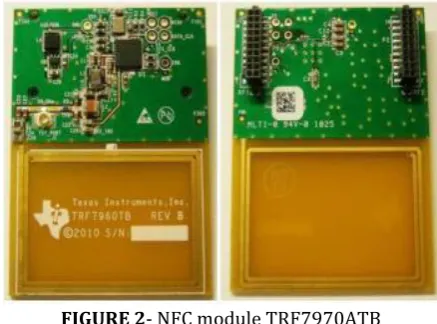
[image:2.595.43.283.129.321.2]Near field communication is based on inductive-coupling. NFC works using magnetic induction between two antennas located within each other's 'near field’.
FIGURE 2- NFC module TRF7970ATB
As in the Figure 2, one side is passive device other side is active device, communicating using Coupling. There are two modes in NFC.
1. Active Mode (device having power source)
2. Passive Mode (device don’t have power source it needs active device to communicate)
3.2 USB Flash memory
[image:2.595.323.542.398.560.2]© 2016, IRJET | Impact Factor value: 4.45 | ISO 9001:2008 Certified Journal | Page 998 In our project we are going to use a USB Pendrive as
[image:3.595.72.253.160.253.2]a memory unit. Figure 1 show the USB memory stick used in the project.
Figure 3: USB memory stick/USB Pendrive.
This type of memory sticks are used for portability, also we need to test our system is writing and reading data from the USB stick, by connecting to computer.
3.2 Specification
Controller ARM
Size 16/32 bit
USB Flash drive/memory
Speed 10Mbps
Supply voltage 5 V.
Supply current 100μA
Memory 2GB
NFC module
Supply voltage 2.5 to 5.5 v
Speed 102,212,424Kbps
Operating frequency 13.56MH.
Requirements
ARM Cortex M3 Lpc1768 Controller operating 100MHz frequency
Power Supply 5v DC
Microcontroller LPC1768-ARM 16bit
USB drive/memory 2GB
NFC module TRF7970ATB
LCD 16x2 Display, buzzer.
Software use
Keil μ-Vision4 IDE
Flash magic 4.5
JTAG
JTAG flash software
Embedded C
4. RESULT
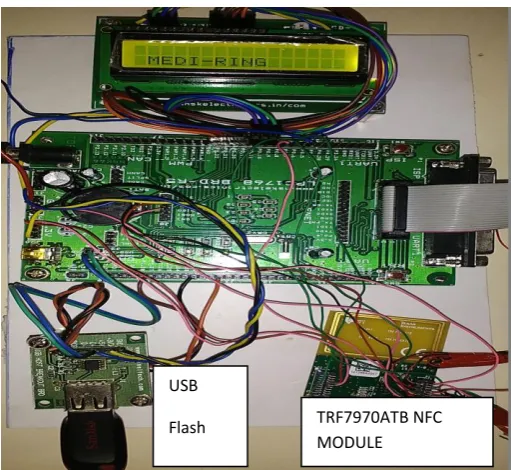
As show in the figure 3 final hardware prototype of the design
Fig-4 Final Hardware prototype.
Fig-5 USB host initialization.
TRF7970ATB NFC MODULE USB
[image:3.595.308.564.336.571.2]© 2016, IRJET | Impact Factor value: 4.45 | ISO 9001:2008 Certified Journal | Page 999 Fig-6 USB Host Init completed
Fig-7 NFC Module interfacing with controller
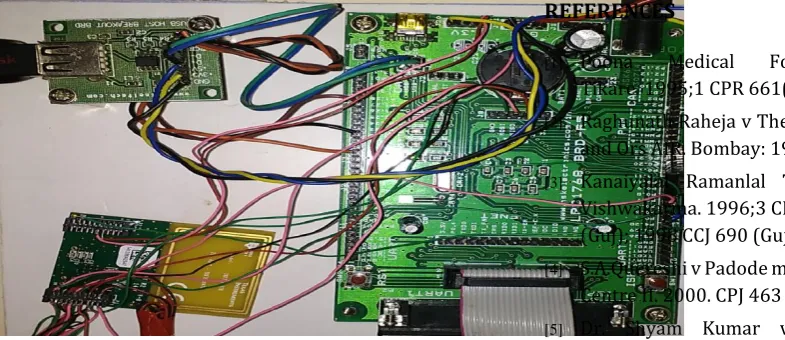
As in the Figures 4,5,6,7 are the final implementation of each component interfacings and hardware prototypes of the design. As in the Figure 4 shows the first USB host get initializing , if USB flash drive is not connected to host device it will not get initialized, once flash drive is connected it will.
Figure 7 show the interfacing between NFC module to controller, here for communication SPI protocol is used.
Finally in the result SPI communication id done with NFC module and USB Host is interfaced with USB flash drive.
5. CONCLUSIONS
Detailed overview of the project is discussed. Importance of each block and their necessity in the design system architecture is discussed. The system is developed on
this embedded firmware is a satisfactory prototype. The developed system is very economical because the cost of the implementation is very low. It is very helpful for the any for the patient to keep the medical files and prescription safely and this device is having good security.
ACKNOWLEDGEMENT
The work presented here was supported by Mr. C. Kanagasabapathi for giving the opportunity to carry out the research work. Form VTU Extension Centre, UTL Technologies Limited, Bengaluru, for their technical support and guidance.s
REFERENCES
[1] Poona Medical Foundation v Marutturao Tikare. 1995;1 CPR 661(NC)
[2] Raghunath Raheja v The Maharashtra Medical Council and Ors AIR. Bombay: 1996. p. 198.
[3] Kanaiyalal Ramanlal Trivedi v Dr. Satyanarayan Vishwakarma. 1996;3 CPR 24 (Guj); I (1997) CPJ 332 (Guj); 1998 CCJ 690 (Guj)
[4] S.A.Quereshi v Padode memorial Hospital and Research Centre II. 2000. CPJ 463 (Bhopal)
[5] Dr. Shyam Kumar v Rameshbhai, Harmanbhai Kachiya. 2002;1 CPR 320, I (2006) CPJ 16 (NC)
[6] Force v. M Ganeswara Rao. 1998;3 CPR 251; 1998 (1) CPJ 413 (AP SCDRC)
[7] Ortiz, C. Enrique (June 2006). "An Introduction to Near-Field Communication and the Contactless Communication API". Retrieved 2008-10-24
[8] Kasper, Timo; Dario Carluccio; Christof Paar (May 2007). "An embedded system for practical security analysis of contactless smartcards". Springer LNCS. Workshop in Information Security Theory and Practices 2007, Heraklion, Crete, Greece. 4462: 150–60
[9] International Telecommunication Union (ITU), “Itu internet reports 2005: The internet of things, executive summary,” november 2005, last visited on January 19th 2012.
[10] J. Zou, C. Zhang, C. Dong, C. Fan, and Z. Wen, “Mobile payment based on rfid-sim card,” in Computer and Information Technology (CIT), 2010 IEEE 10th International Conference on, 29 2010-july 1 2010, pp. 2052–2054
[11] nfc-forum.org
[image:4.595.61.263.99.237.2] [image:4.595.36.429.283.453.2]© 2016, IRJET | Impact Factor value: 4.45 | ISO 9001:2008 Certified Journal | Page 1000 [13] "USB 'A' Plug Form Factor Revision 1.0". USB
Implementers Forum. 23 March 2005. p. 1. Retrieved 2012-04-04. "Body length is fully 12 mm in width by 4.5 mm in height with no deviations".