.'
\' ~In this . . port:
Modes of Operation ... 2 Frame Structure ....•...•... 2 Control Field
Procedures ...•...•... 4 Additional CommandsJ Responses ...•... 4
Note: The subject of this report is a mature stan-dard. No significant de-velopments are antici-pated, but Datapro will provide a new report when the topic warrants it.
DATA PRO
Data NetworkingISO
2780 Standards
1
High-Level Data
Link Control (HDLC)
Oatapro Summary
The International Organization for Standardization (ISO) Technical Committee 97 (TC 97, Computers and Information Processing) developed the High-Level Data Link Control (HOLC) protocol. HOLC addresses the physical connection standards for layer two of the International Organization for Standardization's (ISO's) Open Systems Interconnection (OSI) model. It permits synchronous, bit-oriented, independent data transmission. It pro-vides simplex, half-duplex, or full-duplex communication. Network configurations may be point-to-point or multipoint over switched or nonswitched facilities. HOLC is approved as an international standard.
HDLC covers a wide array of applications. It permits simplex, half-duplex, or full-duplex transmission, configured point-to-point or multi-point, over switched or nonswitched facilities. It does not define a single system and should not be regarded as a specification for a data commu-nications system. It is intended to provide a high degree of compatibility between data terminal equipment (DTE).
Several protocols, such as Unisys' Burroughs Data Link Control (BDLC), IBM's Synchrpnous Data Link Control (SDLC), and Unisys' Sperry (Univac) Universal Data Link Control (UDLC), are based on the HDLC concept. HDLC's capa-bility of transmitting up to 127 frames before an acknowledgment is required makes it possible to transmit information via satellite, as well as via terrestrial facilities.
Stations
HDLC defines two types of stations on the data link. The station assuming the responsibility for the organization of data flow and for link-level error recovery functions is the primary station. All other stations on the link are secondary sta-tions. The primary station transmits command frames, and the secondary stations transmit re-sponse frames.
For data transfer, HDLC considers two cases of data link control. The first case is when the primary station performs the primary data link control functions by controlling the secondary
station through select commands. The second case is when the primary station controls the sec-ondary station through poll commands.
1\vo terms are used to describe the data flow. The data source is the station currently transmit-ting information; the data sink is the station ac-cepting the information. Information always flows from the data source to the data sink; ac-knowledgments flow in the opposite direction.
Classes of Procedures!
Configurations
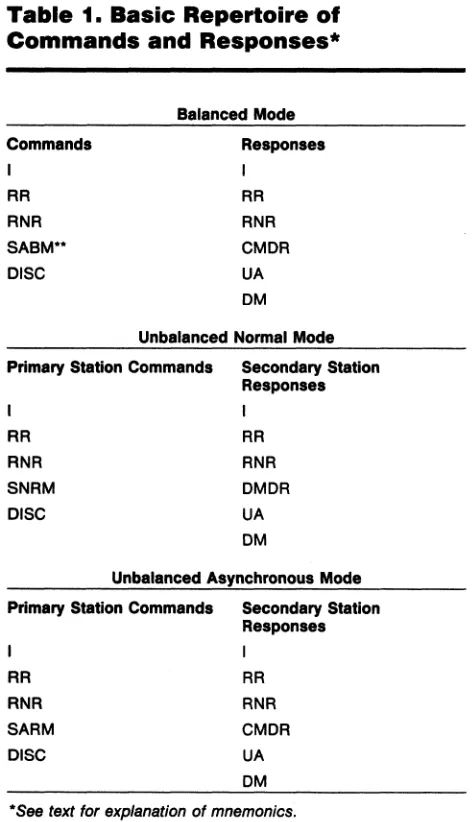
A class of procedures is the basic repertoire of steps to which a station conforms in order to communicate. HDLC defines two classes of pro-cedures and associated station configurations: balanced and unbalanced. Table 1 outlines the basic repertoire of commands and responses for each mode.
In the unbalanced class of procedures, the configuration consists of one primary station and one or more secondary stations. The primary sta-tion's responsibilities include setting up and dis-connecting the link; sending information frames, supervisory, and unnumbered commands; and checking received frames. The secondary station checks received frames and sends supervisory information, as well as unnumbered responses. The communications link may be half or full du-plex, switched or nons witched. Control proce-dures operate in either normal or asynchronous
@ 1993 McGraw-Hili, Incorporated. Reproduction Prohibited. Datapro Information Services Group. Delran NJ 08075 USA
2 2780 Standards
Table 1. Basic Repertoire of Commands
and Responses*
Balanced Mode
Commands Responses
I
RR RR
RNR RNR
SABM** CMDR
DISC UA
DM
Unbalanced Normal Mode Primary Station Commands Secondary Station
Responses
I I
RR RR
RNR RNR
SNRM DMDR
DISC UA
DM
Unbalanced Asynchronous Mode Primary Station Commands Secondary Station
Responses
I
RR RR
RNR RNR
SARM CMDR
DISC UA
DM
'See text for explanation of mnemonics.
"Set Asynchronous Balanced Mode-used to set up the connection.
response mode. Only one secondary station at a time can be placed in asynchronous response mode.
In the balanced class of procedure, the link consists of two combined stations and operates in the asynchronous balanced m~e. A combined stat~on acts as both a primary and a secondary statlon, .sends and recelves both commands and responses, and is responslble for error recovery. This type of operation provides for equal control by both stations on the link; both stations share link management. The HDLC balanced class of procedure applies to point-to-point configurations over switched or leased facilities. Commands are sent with the remote station address; responses
Flag Address Control
01111110 8 bits 8 bits
JULY 1993
ISO
Hlgh .... vel Data
Link Control (HDLCI
Data Networking
are sent with the local station address. The combined station at either end may initiate link connection or disconnection.
Under either type of procedure, the data link exists in one of two channel states. The active condition occurs when the primary or the secondary station is actively transmitting a frame, abort sequence, or interframe time flIl. In this state, the right to continue transmission is reserved. In the idle state, the station has termi-nated transmission. The idle state is characterized by the trans-mission of at least 15 consecutive one bits.
Modes of Operation
1\\'0 primary modes of operation are defined in HDLC. In the
normal response mode (NRM), the secondary station may ini-tiate transmission only after receiving permission from the pri-mary station; upon receiving permission, the secondary station issues a response transmission. The last frame of this transmis-sion is indicated explicitly by the secondary station. After com-pleting its transmission, the secondary station must wait until it again receives permission to transmit from the primary station.
In asynchronous response mode (ARM), the secondary sta-tion may initiate transmission without permission from the pri-mary station. The frames transmitted by the secondary station during ARM may be used to transfer information and/or to indi-cate status changes.
Three secondary modes of operation are also defined in HDLC. These include two disconnected modes, which are pro-vided to prevent a secondary station from appearing operational during unusual situations or exception conditions. Normal dis-connected mode (NDM) logically disconnects the station from the link; while in NOM, the secondary station remains ready to respond in normal response mode. The same situation exists dur-ing asynchronous disconnected mode (ADM), except that the secondary station remains ready in asynchronous response mode. The third secondary mode is the initialization mode (1M). During 1M, the link control of the secondary station is initialized or regenerated, or other parameters may be exchanged. 1M is in-voked when the primary station detects that the secondary station is not operating normally or that the link control program needs to be upgraded at the remote station. 1M may also be requested by the secondary station for the same reasons.
Frame Structure
The HDLC frame structure consists of FLAG-ADDRESS-CONTROL-INFORMATION (Optional)-FRAME CHECK SEQUENCE-FLAG.
All frames must start and end with a Flag that consists of the bit sequence 01111110. All stations attached to the data link con-tinuously search for this sequence. In this manner, the flag is used for frame synchronization. (A single flag may be used as the clos-ing flag for one frame, as well as the openclos-ing flag for the next frame.)
Frames that do not begin and end with a flag, or frames that are too short (shorter than 32 bits between flags) are invalid and therefore, ignored. Any frame that ends with an all "I" bit se: quence that is equal to or greater than seven bits in length will also be ignored. Therefore, one method to abort a frame would be to transmit eight contiguous "I " bits.
Information FCS Flag
An unspecified 16 bits 01111110 length; usually a
multiple of eight bits
[image:2.612.60.297.119.541.2]Data Networking ISO
[image:3.612.65.282.107.289.2]High-Level Data Unk Control (HDLC)
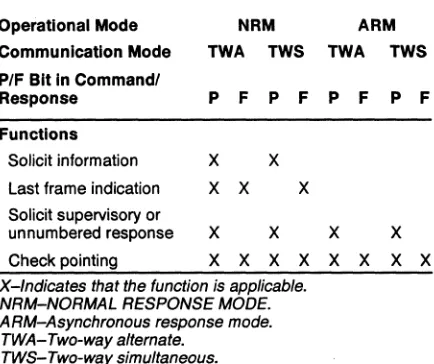
Table 2. Control Field Extensions
Operational Mode NRM ARM
Communication Mode TWA TWS TWA TWS P/F Bit In Commandl
Response P F P F P F P F
Functions
Solicit information X X
Last frame indication X X X
Solicit supervisory or
unnumbered response X X X X
Check pOinting X X X X X X X X
X-Indicates that the function is applicable. NRM-NORMAL RESPONSE MODE. ARM-Asynchronous response mode. TWA-Two-way alternate.
TWS-Two-way simultaneous.
Interframe time fill is accomplished by transmitting either consecutive flags, a minimum of seven contiguous "1 " bits; or a combination of both. Selection of interframe time fill methods depends on system requirements.
Since it is possible for six or more binary "I s" to be contigu-ous elsewhere in the frame, HDLC provides a mechanism that achieves transparency for these nonflag-related sequences using the process of zero insertion. The transmitter examines the frame content including the address, control, and FeS fields and inserts a zero after all sequences of five contiguous "1" bits. This en-sures that a flag sequence is not simulated. At the receiving end, the incoming frames are examined and any "0" bit directly fol-lowing five "1" bits is discarded.
The flag is followed by the Address field. In command frames, the address must identify the station(s) for which the command is intended. In response frames, the address must iden-tify the station sending the response.
Normally, a single octet (eight-bit) address would be used, making a total of 256 combinations available. The address range can be extended, however, by reserving the first transmitted bit (low order) of each address octet, which is set to binary zero. This indicates that the following octet is an extension of the basic ad-dress. The format of the extended octet(s) must be the same as that of the basic octet, and, in this way, the address field may be recursively extended.
When extensions are used, the presence of a binary "I" in the first transmitted bit of the basic address octet indicates that only one address octet is used. Thus, the use of address extension re-stricts the range of single octet addresses to 128.
HDLC outlines three conventions for addressing frames, aside from assigning each station its own address.
The global address is a single address field combination that instructs all stations to accept and take action on the associated frame. When the command is intended for more than one station, the acknowledging stations must not respond simultaneously. The global address is also used for global polling. A response with the assigned station address may be given to a command with a glo-bal address when there is only one station for which the command is intended. This convention may be used to receive an unknown station's identification, as in switched or reconfigured situations. The combination 11111111 is reserved as the global address.
The address combination OOOOOOOO in the first octet of the address field is never assigned to a station. This is the reserved no
@ 1993 McGraw-Hili, Incorporated. Reproduction Prohibited.
Datapro Information Services Group. Delran NJ 08075 USA
2780 Standards
3
station address which in a command may be used for testing purposes, such as testing line loop fault.
One or more stations may be assigned a group address, as well as an individual address. This address may be used to broadcast to the assigned group of stations. Any address combination, except the global and the no-station address, may be assigned as a group address.
The Information field is an unspecified number of bits that need not follow any particular character structure. In most cases, however, a convenient structure, such as an octet, is used. Theo-retically, there is no limit to the length of the information field; however, certain factors, like buffer size, may impose limitations. The Frame Check Sequence (FCS) is a 16-bit field which appears prior to the closing flag. It detects errors in the frame and is the ones complement (modulo 2) of the sum of:
• The remainder of Xk (XIS
+
Xl4+
Xl3+ ... +
x+
x+
1)divided (modulo 2) by the generator polynomial Xl6
+
Xl2+
XS+
1, where k is the number of bits in the frame existing between, but not including, the final bit of the opening flag and the first bit of the FeS, excluding bits inserted for transparency; and• The remainder after multiplication by x 16 and then the division
(modulo 2) by the generator polynomial X 16 + X 12 + XS + I of
the content of the frame, existing between, but not including, the final bit of the opening flag and the first bit of the FCS, excluding bits inserted for transparency.
As a typical implementation (at the transmitter), the initial re-mainder of the division is preset to all ones and is then modified by division by the generator polynomial (as described above) on the Address, Control, and Information fields. The ones comple-ment of the resulting remainder is transmitted as the 16-bit FCS sequence.
HDLC permits the FCS field to increase by multiples of eight bits (octets) if further protection against errors is needed. Such a suggestion also has been drafted into the revision of the ANSI Advanced Data Communications Control Procedures (ADCCP). It calls for a 32-bit FCS which, although it would increase over-head by 16 bits, would eliminate errors that may pass undetected using the 16-bit FCS. An example of such an error would be a scrambled single flag between frames when only a single flag between frames is used.
The Control field contains either commands or responses and sequence numbers. The control field functions to convey a com-mand to the addressed station for the performance of a particular operation or to convey a response to such a command from the addressed station.
Three formats are defined for the control field, each perform-ing a different function. In the information transfer format, or I format, the transfer of information is permitted. Only frames using the I control field format may contain an information field. Each I frame contains three elements: a send variable (S), a re-ceive variable (R), and a polVfinal bit set to either 1 or O. A dis-cussion of frame variables (numbering) and the poll/final bit ap-pears later in this report.
In the supervisory formal, or S format, link supervisory con-trol functions are transmitted. Examples of supervisory functions include the acknowledgment of I frames and the request for re-transmission of I frames.
The unnumbered format, or U format, provides additional link control functions. The control format's U format contains no se-quence numbers; as a result, five modifier bits allow the defini-tion of up to 32 addidefini-tional command funcdefini-tions and 32 addidefini-tional response functions. See Table 2 for an illustration of the extended control field.
4 2780 Standards
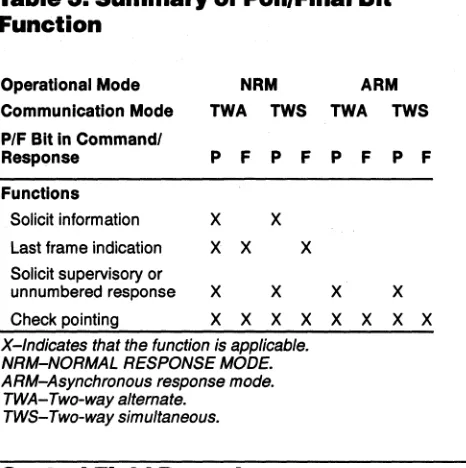
Table 3. Summary of Poll/Final Bit
Function
Operational Mode NRM ARM
Communication Mode TWA TWS P/F Bit In Commandl
Response P F P F
Functions
Solicit information X X Last frame indication X X X Solicit supervisory or
unnumbered response X X Check pointing X X X X X-Indicates that the function is applicable. NRM-NORMAL RESPONSE MODE. ARM-Asynchronous response mode. TWA-Two-wayaltemate.
TWS-Two-way simultaneous.
Control Field Procedures
TWA TWS P F P F
X X
X X X X
Four supervisory commands and responses perfonn functions such as acknowledgment, polling, and temporary suspension of infonnation transfer (see Figure 2 for bit encoding).
Receive Ready (RR), used by the primary and secondary sta-tions, indicates readiness to receive an infonnation frame or to acknowledge previously received infonnation frames numbered up to N(R)-l. The primary station may also use RR with the poll bit set to "1" to solicit responses from a secondary station.
Reject (REJ) requests retransmission of infonnation frames, beginning with the frame numbered N(R). Only one REI condi-tion from a given stacondi-tion may be established at one time. The REJ is cleared when the infonnation frame that has an N(S) equal to the N(R) of the REI command/response is received.
Receive Not Ready (RNR) indicates a busy condition or the inability to accept any additional infonnation frames. A second-ary station that receives an RNR while in the process of transmit-ting must stop transmittransmit-ting infonnation frames at the earliest pos-sible time.
Selective Reject (SREJ) is used to request retransmission of an infonnation frame numbered N(R). It is cleared when an infonna-tion frame is received that has an N(S) count equal to the N(R) of the received SREJ command/response. Until the first SREI error condition is cleared, no other sequence error commands can be transmitted.
Unnumbered commands and responses extend the number of link control functions. The transmission of frames in the un-numbered fonnat, or U fonnat, does not increment the sequence counts at either the primary or secondary station. Although this pennits the addition of up to 32 additional functions, only 5 func-tions are defined; all others are reserved. The five unnumbered commands are briefly described below.
Set Normal Response Mode (SNRM) is a command that places the secondary station in NRM. No infonnation field is pennitted. Set Asynchronous Response Mode (SARM) is a command that places the addressed secondary station in ARM. No infonnation field is pennitted.
The Disconnect (DISC) command tenninates a previously set operational mode. It infonns the secondary stations that the pri-mary station is suspending its operation and that the secondary stations should place themselves in disconnected mode. No infor-mation field is pennitted.
JULY 1993
ISO
Hlgh.Level Data Link Control (HDLC)
Data Networking
Set Normal Response Mode Extended (SNRME) is a command that places the secondary station in the extended nonnal response mode (NRME). In this mode, all control fields are two octets
long. .
Set Asynchronous Response Mode Extended (SARME) is a command placing the secondary station in the extended asynchro-nous response mode (ARME), where all control fields are two octets long.
In addition to the unnumbered commands, two unnumbered responses are defmed:
The Unnumbered Acknowledgement (UA) response, used by the secondary station, acknowledges that it has received and ac-cepted one of the unnumbered fonnat commands. It is the
re-sponse to SNRM, SARM, DISC, SNRME, and SARME. No in-fonnation field is pennitted with the UA response.
The Command Reject (CMDR) response, also used by the sec-ondary station, reports one of the following conditions: an invalid or not implemented command has been received, an infonnation frame has been received which exceeds the size of the buffer available, or a frame with an invalid N(R) has been received from the primary station. The response includes an infonnation field to provide the reason for the CMDR.
Frame Numbering
Every infonnation frame is numbered sequentially. In the unex-tended control field I fonnat, the numbering modulo is eight; up to seven messages may be outstanding before an acknowledg-ment is required. The message numbers continually cycle through the entire seven-combination range of the three-bit field available for numbering.
In the extended control field fonnat, seven bits are available for message numbering (see Table 2). This is an important char-acteristic of HDLC, since it increases the numbering modulo to 128. Modulo 128 pennits up to 127 messages to be outstanding before an acknowledgment is required, and it is an effective coun-teraction against propagation delay. The modulo can be set to ensure a steady flow of infonnation, even on facilities with long propagation delays, such as satellites.
Four tenns are associated with the frame numbering function of the control field. Each data station maintains independent send and receive sequence numbers on the infonnation frames it sends and receives. The send state variable V(S) denotes the receive sequence number N( R) of the next in-sequence infonnation frame received. The value ofV(R) and the corresponding N(R) is incre-mented by one when an error-free in-sequence equals the receive state variable. All infonnation and supervisory frames contain the N(R), the expected sequence number of the incoming infonnation frame.
Additional CommandS/Responses
Four commands and five responses are defined for the secondary operational modes.
The Set Initialization Mode (SIM) command causes the ad-dressed secondary station to initiate procedures that initialize its link-level control functions. No infonnation field is pennitted.
The Unnumbered Poll (UP) command solicits response frames from either a group of secondary stations (group poll) or an individual secondary station (individual poll). No infonnation field is pennitted. The response frame to the UP contains the station address, plus the N(S) and N(R) numbers as required. If the primary station detects an idle state (15 ones), or no response is given to the UP command within a given period of time, it is assumed that the secondary station has either completed or will not initiate transmission.
(
"'-.Data Networking ISO
Hlgh.Level Data Link Control (HDLCJ
The Unnumbered Information (UI) command is used to trans-mit information to a secondary station or group of secondary sta-tions without changing the V(S) or V(R) variables. No response is required.
The Exchange Identification (XID) command causes the ad-dressed secondary station to identify itself. It may also be used to provide primary station identification and/or characteristics to the addressed secondary station. An information field is optional.
The Disconnect Mode (DM) response reports the status of a secondary station that is disconnected from the link. Such a sta-tion is in NDM or ADM. No informasta-tion field is permitted. On a switched network where the call is initiated by the secondary station, the OM is sent as a request for a mode-setting command. The Request Disconnect (RD) response indicates to the pri-mary station that the secondary station wishes to be placed in one of the disconnected modes, ADM or NDM.
The Request Initialization Mode (RIM) response is used by the secondary station to report a need for initialization. After the RIM response, no further transmissions are accepted or transmitted u~ til a SIM or DISC command is received. No information field IS
permitted.
The Unnumbered Information (UI) response is used by the secondary station to transmit information to the primary station without impacting the V(S) and V(R) variables at either end.
The Exchange Identification (XID) response is transmitted in reply to an XID command. An information field, which contains the secondary station's identification and/or characteristics, is op-tional.
@ 1993 McGraw-Hili. Incorporated. Reproduction Prohibited. Oatapro Information Services Group. Delran NJ 08075 USA
Time-Outs
2780
Standards
5
TIme-out procedures are dermed for both the unbalanced and bal-anced classes of procedure. For the unbalbal-anced class, time-out is used to detect a no-reply or lost-reply condition. In ARM, each secondary station provides a command time-out function. The expiration of a specified time initiates error recovery proce?ures. The duration of a time-out is system dependent and subject to agreement by communicating stations. To resolve possible con-tention situations, the secondary station's timer interval is lon~er
than that of the primary station. In NRM, the secondary station waits for the primary station to initiate error recovery.
For the balanced class, each combined station provides a re-sponse time-out to detect a no-reply condition. The. expiration of the time initiates error recovery procedures. The tIme-out dura-tion is system dependent and subject to agreement by both sta-tions. The interval of the timer in each station is unequal in order to resolve possible contention situations that might occur, espe-cially in a two-way alternate operation. The timer starts when a station transmits a frame to which a reply is required. When the expected reply is received, the timer stops .•
,.('.'
I'
DATAPRO
Data NetworkingISO
2780
Standards
1
High-Level Data
Link Control (HDLC)
In this report:
Modes of Operation ... 2
Frame Structure ... 2
Control Field
Procedures ... 3
Additional Commands/ Responses ... 4
Note:
The subject of this report is consid-ered as a mature stan-dard. No significant developments are an-ticipated, but because of its importance in the industry, coverage is being continued.Synopsis
HDLC, a protocol that addresses the physi-cal connection standards for layer two of the International Organization for Stan-dardization's (ISO's) Open Systems Inter-connection (OSI) model, permits synchro-nous, bit-oriented, independent data transmission. It provides simplex, half-duplex, or full-duplex communication. Network configurations may be point to point or multipoint over switched or non-switched facilities.
Report Highlights
The International Organization for Stan-dardization (ISO) Technical Committee 97 (TC 97, Computers and Information Pro-cessing) developed the High-Level Data Link Control (HOLC) protocol. Upon adoption by TC 97, the draft document was circulated to member bodies of the ISO for approval. HOLC has been approved as an international standard by member bodies from 23 countries; no member body ex-pressed disapproval.
HDLC covers a wide array of applica-tions. It permits simplex, half-duplex, or full-duplex transmission, configured point-to-point or multipoint, over switched or nonswitched facilities. It does not define a single system and should not be regarded as a specification for a data communications system. It is intended to provide a high de-gree of compatibility between data terminal equipment (OTE).
Several protocols, such as Unisys' Bur-roughs Data Link Control (BDLC), IBM's Synchronous Data Link Control (SOLC), and Unisys' Sperry (Univac) Universal Data Link Control (UOLC), are based on the HDLC concept. HOLC's capability of transmitting up to 127 frames before an ac-knowledgment is required makes it possible to transmit information via satellite, as well as via terrestrial facilities.
@ 1991 McGraw-Hili, Incorporated. Reproduction Prohibited. Datapro Information Services Group. Delran NJ 08075 USA
Analysis
Stations
HOLC defines two types of stations on the data link. The station assuming the respon-sibility for the organization of data flow and for link-level error recovery functions is the primary station. All other stations on the link are secondary stations. The primary station transmits commandframes, and the secondary stations transmit response frames.
For data transfer, HDLC considers two cases of data link control. The first case is when the primary station performs the pri-mary data link control functions by control-ling the secondary station through select commands. The second case is when the primary station controls the secondary sta-tion through poll commands.
Two terms are used to describe the data flow. The data source is the station cur-rently transmitting information; the data
sink is the station accepting the informa-tion. Information always flows from the data source to the data sink; acknowledg-ments flow in the opposite direction.
Classes of
Procedures/Configurations
A class of procedures is the basic repertoire of steps to which a station conforms in or-der to communicate. HDLC defines two classes of procedures and associated station configurations: balanced and unbalanced.In the unbalanced class of procedures, the configuration consists of one primary station and one or more secondary stations. The primary station's responsibilities in-clude setting up and disconnecting the link; sending information frames, supervisory, and unnumbered commands; and checking received frames. The secondary station
2 2780
Standards
checks received frames and sends supervisory informa-tion, as well as unnumbered responses. The communica-tions link may be half- or full-duplex, switched or nons-witched. Control procedures operate in either normal or asynchronous response mode. Only one secondary station at a time can be placed in asynchronous response mode.
In the balanced class of procedure, the link consists of two combined stations and operates in the asynchronous balanced mode. A combined station acts as both a primary and a secondary station, sends and receives both com-mands and responses, and is responsible for error recov-ery. This type of operation provides for equal control by both stations on the link; both stations share link manage-ment. The HOLC balanced class of procedure applies to point-to-point configurations over switched or leased facil-ities. Commands are sent with the remote station address; responses are sent with the local station address. The com-bined station at either end may initiate link connection or disconnection.
Under either type of procedure, the data link exists in one of two channel states. The active condition occurs when the primary or the secondary station is actively transmitting a frame, abort sequence, or interframe time fill. In this state, the right to continue transmission is re-served. In the idle state, the station has terminated trans-mission. The idle state is characterized by the transmission of at least 15 consecutive one bits.
Modes of Operation
Two primary modes of operation are defined in HOLe. In the normal response mode (NRM), the secondary station may initiate transmission only after receiving permission from the primary station; upon receiving permission, the secondary station issues a response transmission. The last frame of this transmission is indicated explicitly by the secondary station. After completing its transmission, the secondary station must wait until it again receives permis-sion to transmit from the primary station.
In asynchronous response mode (ARM), the secondary station may initiate transmission without permission from the primary station. The frames transmitted by the second-ary station during ARM may be used to transfer informa-tion and/or to indicate status changes.
Three secondary modes of operation are also defined in HOLe. These include two disconnected modes, which are provided to prevent a secondary station from appearing operational during unusual situations or exception condi-tions. Normal disconnected mode (NDM) logically discon-nects the station from the link; while in NOM, the second-ary station remains ready to respond in normal response mode. The same situation exists during asynchronous dis-connected mode (ADM), except that the secondary station remains ready in asynchronous response mode.
The third secondary mode is the initialization mode (1M). During 1M, the link control of the secondary station is initialized or regenerated, or other parameters may be exchanged. 1M is invoked when the primary station detects that the secondary station is not operating normally or that the link control program needs to be upgraded at the re-mote station. 1M may also be requested by the secondary station for the same reasons.
DECEMBER 1991
ISO
High-Level Data Link Control (HDLC)
Frame Structure
Data Networking
The HOLC frame structure consists of FLAG-AOORESS-CONTROL-INFORMA TION
(Optional)-FRAME CHECK SEQUENCE-FLAG. All frames must start and end with a Flag that consists of the bit sequence 01111110. All stations attached to the data link continuously search for this sequence. In this manner, the flag is used for frame synchronization. (A sin-gle flag may be used as the closing flag for one frame, as well as the opening flag for the next frame.)
Frames that do not begin and end with a flag or frames that are too short (shorter than 32 bits between flags) are invalid and, therefore, ignored. Any frame that ends with an all "1" bit sequence that is equal to or greater than seven bits in length will also be ignored. Therefore, one method to abort a frame would be to transmit eight contig-uous "1" bits.
Interframe time jill is accomplished by transmitting ei-ther consecutive flags, a minimum of seven contiguous "1" bits, or a combination of both. Selection of interframe time fill methods depends on system requirements.
Since it is possible for six or more binary "Is" to be contiguous elsewhere in the frame, HOLC provides a mechanism that achieves transparency for these nonflag-related sequences using the process of zero insertion. The transmitter examines the frame content including the ad-dress, control, and FCS fields and inserts a zero after all sequences of five contiguous" 1" bits. This ensures that a flag sequence is not simulated. At the receiving end, the incoming frames are examined and any "0" bit directly following five" 1" bits is discarded.
The flag is followed by the Address field. In command frames, the address must identify the station(s) for which the command is intended. In response frames, the address must identify the station sending the response.
Normally, a single octet (eight-bit) address would be used, making a total of 256 combinations available. The address range can be extended, however, by reserving the first transmitted bit (low order) of each address octet, which is set to binary zero. This indicates that the follow-ing octet is an extension of the basic address. The format of the extended octet(s) must be the same as that of the basic octet, and, in this way, the address field may be recursively extended.
When extensions are used, the presence of a binary" 1 " in the first transmitted bit of the basic address octet indi-cates that only one address octet is used. Thus, the use of address extension restricts the range of single octet ad-dresses to 128.
HOLC outlines three conventions for addressing frames, aside from assigning each station its own address.
The global address is a single address field combination that instructs all stations to accept and take action on the associated frame. When the command is intended for more than one station, the acknowledging stations must not respond simultaneously. The global address is also used for global polling. A response with the assigned sta-tion address may be given to a command with a global address when there is only one station for which the com-mand is intended. This convention may be used to receive an unknown station's identification, as in switched or configured situations. The combination 11111111 is re-served as the global address.
The address combination 00000000 in the first octet of the address field is never assigned to a station. This is the
Data Networking ISO
High-Level Data Link Control (HDLC)
reserved no station address which in a command may be used for testing purposes, such as testing line loop fault.
One or more stations may be assigned a group address, as well as an individual address. This address may be used to broadcast to the assigned group of stations. Any address combination, except the global and the no station address, may be assigned as a group address.
The Information field is an unspecified number of bits that need not follow any particular character structure. In most cases, however, a convenient structure, such as an octet, is used. Theoretically, there is no limit to the length of the information field; however, certain factors, like buffer size, may impose limitations.
The Frame Check Sequence (FCS) is a 16-bit field which appears prior to the closing flag. It detects errors in the frame and is the ones complement (modulo 2) of the sum of:
• The remainder ofxk (X 15 + Xl4 + X l3 + ... + x + x +
q
divided (modulo 2) by the generator polynomial
x
6 + X 12 +x
5 +1, where
kis the number of bits in
the frame existing between, but not including, the
final bit of the opening flag and the first bit of the
FCS, excluding bits inserted for transparency; and
• The remainder after multiplication by X 16 and then the division (modulo 2) by the generator polynomial X 16 + X 12 + x5 + 1 of the content of the frame, existingbe-tween, but not including, the final bit of the opening flag and the first bit of the FCS, excluding bits inserted for transparency.
As a typical implementation (at the transmitter), the initial remainder of the division is preset to all ones and is then modified by division by the generator polynomial (as de-scribed above) on the Address, Control, and Information fields. The ones complement of the resulting remainder is transmitted as the 16-bit FCS sequence.
HDLC permits the FCS field to increase by multiples of eight bits (octets) if further protection against errors is needed. Such a suggestion also has been drafted into the revision of the ANSI Advanced Data Communications Control Procedures (ADCCP). It calls for a 32-bit FCS which, although it would increase overhead by 16 bits, would eliminate errors that may pass undetected using the 16-bit FCS. An example of such an error would be a scram-bled single flag between frames when only a single flag be-tween frames is used.
The Control field contains either commands or re-sponses and sequence numbers. The control field func-tions to convey a command to the addressed station for the performance of a particular operation or to convey a re-sponse to such a command from the addressed station.
Three formats are defined for the control field, each performing a different function. In the information
trans-fer format, or I format, the transfer of information is per-mitted. Only frames using the I control field format may contain an information field. Each I frame contains three elements: a send variable (S), a receive variable (R), and a polllfinal bit set to either 1 or O. A discussion of frame variables (numbering) and the poll/final bit appears later in this report.
In the supervisory format, or S format, link supervisory control functions are transmitted. Examples of supervi-sory functions include the acknowledgment of I frames and the request for retransmission of I frames.
© 1991 McGraw-Hili. Incorporated. Reproduction Prohibited. Datapro Information Services Group. Delran NJ 08075 USA
2780
Standards
3
The unnumbered format, or U format, provides addi-tional link control functions. The control format's U for-mat contains no sequence numbers; as a result, five modi-fier bits allow the definition of up to 32 additional command functions and 32 additional response functions.
Control Field Procedures
Four supervisory commands and responses perform func-tions such as acknowledgment, polling, and temporary sus-pension of information transfer.
Receive Ready (RR), used by the primary and secondary stations, indicates readiness to receive an information frame or to acknowledge previously received information frames numbered up to N(R) -1. The primary station may also use RR with the poll bit set to "1" to solicit responses from a secondary station.
Reject (REJ) requests retransmission of information frames, beginning with the frame numbered N(R). Only one REJ condition from a given station may be established at one time. The REJ is cleared when the information frame that has an N(S) equal to the N(R) of the REJ com-mand/response is received.
Receive Not Ready (RNR) indicates a busy condition or the inability to accept any additional information frames. A secondary station that receives a RNR while in the pro-cess of transmitting must stop transmitting information frames at the earliest possible time.
Selective Reject (SREJ) is used to request retransmis-sion of an information frame numbered N(R). It is cleared when an information frame is received that has an N(S) count equal to the N(R) of the received SREJ command/ response. Until the first SREJ error condition is cleared, no other sequence error commands can be transmitted.
Unnumbered commands and responses extend the num-ber of link control functions. The transmission of frames in the unnumbered format, or U format, does not incre-ment the sequence counts at either the primary or second-ary station. Five modifier bits are defined. Although this permits the addition of up to 32 additional functions, only 5 functions are defined; all others are reserved. The five unnumbered commands are briefly described below.
Set Normal Response Mode (SNRM) is a command that places the secondary station in NRM. No information field is permitted.
Set Asynchronous Response Mode (SARM) is a com-mand that places the addressed secondary station in ARM. No information field is permitted.
The Disconnect (DISC) command terminates a previ-ously set operational mode. It informs the secondary sta-tions that the primary station is suspending its operation and that the secondary stations should place themselves in disconnected mode. No information field is permitted.
Set Normal Response Mode Extended (SNRME) is a command that places the secondary station in the ex-tended normal response mode (NRME). In this mode, all control fields are two octets long.
Set Asynchronous Response Mode Extended (SARME)
is a command placing the secondary station in the ex-tended asynchronous response mode (ARME), where all control fields are two octets long.
In addition to the unnumbered commands, two un-numbered responses are defined:
The Unnumbered Acknowledgement (UA) response, used by the secondary station, acknowledges that it has
4 2780
Standards
received and accepted one of the unnumbered format commands. It is the response to SNRM, SARM, DISC, SNRME, and SARME. No information field is permitted with the UA response.
The Command Reject (CMDR) response, also used by the secondary station, reports one of the following condi-tions: an invalid or not implemented command has been received, an information frame has been received which exceeds the size of the buffer available, or a frame with an invalid N(R) has been received from the primary station. The response includes an information field to provide the reason for the CMDR.
Frame Numbering
Every information frame is numbered sequentially. In the unextended control field I format, the numbering modulo is eight; up to seven messages may be outstanding before an acknowledgment is required. The message numbers continually cycle through the entire seven-combination range of the three-bit field available for numbering.
In the extended control field format, seven bits are available for message numbering. This is an important characteristic of HDLC, since it increases the numbering modulo to 128. Modulo 128 permits up to 127 messages to be outstanding before an acknowledgment is required, and it is an effective counteraction against propagation delay. The modulo can be set to ensure a steady flow of informa-tion, even on facilities with long propagation delays, such as satellites.
Four terms are associated with the frame numbering function of the control field. Each data station maintains independent send and receive sequence numbers on the information frames it sends and receives. The send state
variable V(S) denotes the receive sequence number N(R) of the next in-sequence information frame received. The value of V(R) and the corresponding N(R) is incremented by one when an error-free in-sequence equals the receive state variable. All information and supervisory frames contain the N(R), the expected sequence number of the incoming information frame.
Additional Commands/Responses
Four commands and five responses are defined for the sec-ondary operational modes.The Set Initialization Mode (SIM) command causes the addressed secondary station to initiate procedures that ini-tialize its link level control functions. No information field is permitted.
The Unnumbered Poll (UP) command solicits response frames from either a group of secondary stations (group poll) or an individual secondary station (individual poll). No information field is permitted. The response frame to the UP contains the station address, plus the N(S) and N(R) numbers as required. If the primary station detects an idle state ( 15 ones), or no response is given to the UP command within a given period of time, it is assumed that the secondary station has either completed or will not ini-tiate transmission.
DECEMBER 1991
ISO
High-Level Data Link Control (HDLC)
Data Networking
The Unnumbered Information (UI) command is used to transmit information to a secondary station or group of secondary stations without changing the V(S) or V(R) vari-ables. No response is required.
The Exchange Identification (XID) command causes the addressed secondary station to identify itself. It may also be used to provide primary station identification and/or characteristics to the addressed secondary station. An information field is optional.
The Disconnect Mode (DM) response reports the status of a secondary station that is disconnected from the link. Such a station is in NDM or ADM. No information field is permitted. On a switched network where the call is initi-ated by the secondary station, the DM is sent as a request for a mode-setting command.
The Request Disconnect (RD) response indicates to the primary station that the secondary station wishes to be placed in one of the disconnected modes, ADM or NDM.
The Request Initialization Mode (RIM) response is used by the secondary station to report a need for initialization. After the RIM response, no further transmissions are ac-cepted or transmitted until a SIM or DISC command is received. No information field is permitted.
The Unnumbered Information (UI) response is used by the secondary station to transmit information to the pri-mary station without impacting the V(S) and V(R) vari-ables at either end.
The Exchange Identification (XID) response is trans-mitted in reply to an XID command. An information field, which contains the secondary station's identification and/or characteristics, is optional.
Time-Outs
Time-out procedures are defined for both the unbalanced and balanced classes of procedure. For the unbalanced class, time-out is used to detect a no-reply or lost-reply condition. In ARM, each secondary station provides a command time-out function. The expiration of a specified time initiates error recovery procedures.
The duration of a time-out is system dependent and subject to agreement by communicating stations. To re-solve possible contention situations, the secondary tion's timer interval is longer than that of the primary sta-tion. In NRM, the secondary station waits for the primary station to initiate error recovery.
For the balanced class, each combined station provides a response time-out to detect a no-reply condition. The expiration of the time initiates error recovery procedures. The time-out duration is system dependent and subject to agreement by both stations. The interval of the timer in each station is unequal in order to resolve possible conten-tion situaconten-tions that might occur, especially in a two-way alternate operation. The timer starts when a station trans-mits a frame to which a reply is required. When the ex-pected reply is received, the timer stops . •
In this report:
Classes of Proceduresl Configurations ... 2
Modes of Operation .. 3
Frame Structure ... 3
Control Field
Procedures ... 7
Additional
Commandsl
Responses ... 8
DATAPRO
Data NetworkingISO
2780
Standards
1
High-Level Data
Link Control (HDLC)
Synopsis
Editor's Note
HDLC, a protocol that addresses the physical connection standards for layer two of the International Orga-nization for Standardization's (ISO's) Open Systems Interconnec-tion (OSI) model, permits synchro-nous, bit-oriented, independent data transmission. It provides simplex, half-duplex, or full-duplex communi-cation. Network configurations may be point-to-point or multipoint over switched or nonswitched facilities. Report Highlights
The International Organization for Standardization (ISO) Technical Committee 97 (TC 97, Computers and Information Processing) devel-oped the High-Level Data Link Con-trol (HDLC) protocol. Upon
adoption by TC 97, the draft docu-ment was circulated to member bod-ies of the ISO for approval. HDLC has been approved as an interna-tional standard by member bodies from 23 countries; no member body expressed disapproval.
HDLC covers a wide array of appli-cations. It permits simplex, half-duplex, or full-duplex transmission, configured point-to-point or mul-tipoint, over switched or nons-witched facilities. It does not define a single system, and should not be regarded as a specification for a data communications system. It is in-tended to provide a high degree of compatibility between data terminal equipment (DTE).
Several protocols, such as Unisys' Burroughs Data Link Control (BDLC), IBM's Synchronous Data Link Control (SDLC), and Unisys' Sperry (Univac) Universal Data Link Control (UDLC) are based on the HDLC concept. HDLC's capability of transmitting up to 127 frames be-fore an acknowledgment is required makes it possible to transmit infor-mation via satellite, as well as via terrestrial facilities.
@ 1991 McGraw-Hili, Incorporated. Reproduction Prohibited. Datapro Information Services Group. Delran NJ 08075 USA
2 2780 Standards
Analysis
Stations
HDLC defines two types of stations on the data
link. The station assuming the responsibility for
the organization of data flow and for link level
er-ror recovery functions is the primary station. All
other stations on the link are secondary stations.
The primary station transmits
command frames,
and the secondary stations transmit
response
frames.
For data transfer, HDLC considers two cases
of data link control. The first case is when the
pri-mary station performs the pripri-mary data link
con-trol functions by concon-trolling the secondary station
through select commands. The second case is when
the primary station controls the secondary station
through poll commands.
Two terms are used to describe the data flow.
The
data source
is the station currently
transmit-ting information; the
data sink
is the station
ac-cepting the information. Information always flows
from the data source to the data sink;
acknowledg-ments flow in the opposite direction.
Classes of Procedures/Configurations
[image:12.612.76.548.668.716.2]A class of procedures is the basic repertoire of steps
to which a station conforms in order to
communi-cate. HDLC defines two classes of procedures and
associated station configurations: balanced and
unbalanced. Table 1 outlines the basic repertoire of
Figure 1.
The HDLC Frame Structure
Flag Address Control
01111110 8 bits 8 bits
APRIL 1990
ISO
Hlgh-Leve' Data Link Control (HDLC,
Data Networking
commands and responses for each mode; Table 3
depicts the optional commands and responses to
supplement the basic repertoire.
In the unbalanced class of procedures, the
configuration consists of one primary station and
one or more secondary stations. The primary
sta-tion's responsibilities include setting up and
dis-connecting the link; sending information frames,
supervisory, and unnumbered commands; and
checking received frames. The secondary station
checks received frames and sends supervisory
in-formation, as well as unnumbered responses. The
communications link may be half- or full-duplex,
switched or nonswitched. Control procedures
oper-ate in either normal or asynchronous response
mode. Only one secondary station at a time can be
placed in asynchronous response mode.
In the balanced class of procedure, the link
consists of two combined stations and operates in
the asynchronous balanced mode. A
combined
tion acts as both a primary and a secondary
sta-tion, sends and receives both commands and
responses, and is responsible for error recovery.
This type of operation provides for equal control
by both stations on the link; both stations share
link management. The HDLC balanced class of
procedure applies to point-to-point configurations
over switched or leased facilities. Commands are
sent with the remote station address; responses are
sent with the local station address. The combined
station at either end may initiate link connection
or disconnection.
Under either type of procedure, the data link
exists in one of two channel states. The active
con-dition occurs when the primary or the secondary
station is actively transmitting a frame, abort
se-quence, or interframe time fill. In this state, the
right to continue transmission is reserved. In the
idle state, the station has terminated transmission.
The idle state is characterized by the transmission
of at least 15 consecutive one bits.
Information FeS Flag
An unspecified 16 bits 01111110
length; usually a multiple of eight bits
(-Data Networking
Modes of Operation
ISOHigh-Level Data Link Control (HDLC)
Two primary modes of operation are defined in
HDLC. In the normal response mode (NRM), the
secondary station may initiate transmission only
after receiving permission from the primary
tion; upon receiving permission, the secondary
sta-tion issues a response transmission. The last frame
of this transmission is indicated explicitly by the
secondary station. After completing its
transmis-sion, the secondary station must wait until it again
receives permission to transmit from the primary
station.
In asynchronous response mode (ARM), the
secondary station may initiate transmission
with-out permission from the primary station. The
frames transmitted by the secondary station during
ARM may be used to transfer information and/or
to indicate status changes.
Three secondary modes of operation are also
defined in HDLC. These include two disconnected
modes, which are provided to prevent a secondary
station from appearing operational during unusual
situations or exception conditions. Normal
discon-nected mode (NDM) logically disconnects the
sta-tion from the link; while in NDM, the secondary
station remains ready to respond in normal
re-sponse mode. The same situation exists during
asynchronous disconnected mode (ADM), except
that the secondary station remains ready in
asyn-chronous response mode.
The third secondary mode is the initialization
mode (1M). During 1M, the link control of the
sec-ondary station is initialized or regenerated, or
other parameters may be exchanged. 1M is invoked
when the primary station detects that the
second-ary station is not operating normally or that the
link control program needs to be upgraded at the
remote station. 1M may also be requested by the
secondary station for the same reasons.
Frame Structure
The HDLC frame structure consists of
FLAG-ADDRESS-CONTROL-INFORMATION
(Optional)-FRAME CHECK
SEQUENCE-FLAG (see Figure 1).
All frames must start and end with a Flag that
consists of the bit sequence 01111110. All stations
attached to the data link continuously search for
this sequence. In this manner, the flag is used for
frame synchronization. (A single flag may be used
@ 1991 McGraw-HIli, Incorporated. Reproduction Prohibited. Datepro Information Services Group. Delran NJ 08075 USA
2780 Standards
as the closing flag for one frame, as well as the
opening flag for the next frame.)
Frames that do not begin and end with a flag
or frames that are too short (shorter than 32 bits
between flags) are invalid and, therefore, ignored.
Any frame that ends with an all "1" bit sequence
that is equal to or greater than seven bits in length
will also be ignored. Therefore, one method to
abort a frame would be to transmit eight
contigu-ous "1" bits.
Interframe time fill
is accomplished by
trans-mitting either consecutive flags, a minimum of
seven contiguous" 1 " bits, or a combination of
both. Selection of interframe time fill methods
de-pends on system requirements.
3
Since it is possible for six or more binary" 1 s"
to be contiguous elsewhere in the frame, HDLC
provides a mechanism that achieves transparency
for these nonflag-related sequences using the
pro-cess of
zero insertion.
The transmitter examines the
frame content including the address, control, and
FCS fields and inserts a zero after all sequences of
five contiguous" 1 " bits. This insures that a flag
sequence is not simulated. At the receiving end, the
incoming frames are examined and any "0" bit
directly following fi ve "1" bits is discarded.
The flag is followed by the Address field. In
command frames, the address must identify the
station(s) for which the command is intended. In
response frames, the address must identify the
sta-tion sending the response.
Normally, a single octet (eight-bit) address
would be used, making a total of 256 combinations
available. The address range can be extended,
how-ever, by reserving the first transmitted bit (low
or-der) of each address octet, which is set to binary
zero. This indicates that the following octet is an
extension of the basic address. The format of the
extended octet(s) must be the same as that of the
basic octet, and, in this way, the address field may
be recursively extended.
When extensions are used, the presence of a
binary" 1 " in the first transmitted bit of the basic
address octet indicates that only one address octet
is used. Thus, the use of address extension restricts
the range of single octet addresses to 128.
HDLC outlines three conventions for
ad-dressing frames, aside from assigning each station
its own address.
The
global address
is a single address field
combination that instructs all stations to accept
4 2780 Standards
Figure 2.
Encoding of HDLC Control Field Commandsl Responses
Supervisory Control Field
2
o
T
Supervisory format
Commands
RR - Receive
ready
REJ -Reject
RNR - Receive not ready
SREJ - Selective reject
Control field bits - - - -.... _
3 4
S
00
01 10
11
5 6
P/F
T
Command poll Response final
Responses
7 8
N(R)
i
Receive sequence number
(0-7)
RR -Receive
ready
REJ - Reject
RNR - Receive not ready
SREJ - Selective reject
Unnumbered Control Field
.. _ - - - Control field bits - - - 1 1 . . _
2 3 4
j
1M MI Unnumberedformat
5
r
Command poll Response final
6
M 7 M
8
M
5 "modifier" bits
Information Control Field
..
Control field bits-1 2 3 4 5 6 7 8
0 N(S) P/F N(R)
I-T
T
,
IReceive
transfer sequence
format number
Send Command (0-7)
sequence poll number
Response (0-7)
final
APRIL 1990
ISO
High-Level Data Link Control (HDLC)
Data Networking
and take action on the associated frame. When the
command is intended for more than one station,
the acknowledging stations must not respond si- .
multaneously. The globaladdress is also used for
global polling. A response with the assigned station
address may be given to a command with a global
address when there is only one station for which
the command is intended. This convention may be
used to receive an unknown station's
identifica-tion, as in switched or reconfigured situations. The
combination 11111111 is reserved as the global
address.
The address combination 00000000 in the
first octet of the address field is never assigned to a
station. This is the reserved
no station address
which in a command may be used for testing
pur-poses, such as testing line loop fault.
One or more stations may be assigned a
group
address,
as well as an individual address. This
ad-dress may be used to broadcast to the assigned
group of stations. Any address combination, except
the global and the no station address, may be
as-signed as a group address.
The Information field is an unspecified
num-ber of bits that need not follow any particular
char-acter structure. In most cases, however, a
convenient structure, such as an octet, is used .
Theoretically, there is no limit to the length of the
information field; however, certain factors, like
buffer size, may impose limitations.
The Frame Check Sequence (FCS) is a 16-bit
field which appears prior to the closing flag.
Itde-tects errors in the frame and is the ones
comple-ment (modulo 2) of the sum of:
• The remainder ofxk
(X15 + X14 + X l3 + ... +x
+
x
+1) divided (modulo 2) by the generator
polynomial
X l6 + Xl2 +x
5 +1, where
k is the
number of bits in the frame existing between,
but not including, the final bit of the opening
flag and the first bit of the FCS, excluding bits
inserted for transparency; and
• The remainder after multiplication by
Xl6and
then the division (modulo 2) by the generator
polynomial
X l6 + Xl2 +x
5 +1 of the content of
the frame, existing between, but not including,
the final bit of the opening flag and the first bit
of the FCS, excluding bits inserted for
transpar-ency.
As a typical implementation (at the transmitter),
the initial remainder of the division is preset to all
(
Data Networking ISO
[image:15.612.72.309.75.486.2]High-Level Data Link Control (HDLC)
Table 1. Basic Repertoire of
Commands and Responses*
Commands
RR RNR SABM"" DISC
Balanced Mode Responses I
RR RNR CMDR UA OM
Unbalanced Normal Mode Primary Station Commands Secondary Station
Responses
I I
RR RR
RNR RNR
SNRM OM DR
DISC UA
OM
Unbalanced Asynchronous Mode Primary Station Commands Secondary Station
Responses
RR RNR SARM DISC
I
RR RNR CMDR UA OM
"See text for explanation of mnemonics.
• "Set Asynchronous Balanced Mode-used to set up the connection.
ones and is then modified by division by the
gener-ator polynomial (as described above) on the
Ad-dress, Control, and Information fields. The ones
complement of the resulting remainder is
transmit-ted as the 16-bit FCS sequence.
HDLC permits the FCS field to increase by
multiples of eight bits (octets) if further protection
against errors is needed. Such a suggestion also has
been drafted into the revision of the ANSI
Ad-vanced Data Communications Control Procedures
(ADCCP).
Itcalls for a 32-bit FCS which, although
it would increase overhead by 16 bits, would
elimi-nate errors that may pass undetected using the
16-bit FCS. An example of such an error would be a
@ 1991 McGraw-Hili, Incorporated. Reproduction Prohibited. Datapro Information Services Group. Delran NJ 08075 USA
2780 Standards
scrambled single flag between frames when only a
single flag between frames is used.
5
The Control field contains either commands
or responses and sequence numbers. The control
field functions to convey a command to the
ad-dressed station for the performance of a particular
operation or to convey a response to such a
com-mand from the addressed station.
Three formats are defined for the control
field, each performing a different function (see
Figure 2). In the
information transfer format,
or
I format, the transfer of information is permitted.
Only frames using the I control field format may
contain an information field. Each I frame
con-tains three elements: a send variable (S), a receive
variable (R), and a polllfinal bit set to either 1 or O.
A discussion of frame variables (numbering) and
the polllfinal bit appears later in this report.
In the
supervisory format,
or S format, link
supervisory control functions are transmitted.
Ex-amples of supervisory functions include the
ac-knowledgment of I frames and the request for
retransmission of I frames.
The
unnumbered format,
or U format,
[image:15.612.320.554.472.673.2]pro-vides additional link control functions. The control
format's U format contains no sequence numbers;
as a result, five modifier bits allow the definition of
up to 32 additional command functions and 32
additional response functions. See Table 2 for an
illustration of the extended control field.
Table 2. Control Field Extensions
Control Field Fonnat tor
Information transfer command! response (I frame)
Supervisory commands! responses
(S frame) Unnumbered commands! responses
1
0
1
Control Field Bita
1st Octet 2nd Octet
2 3 4 5 6 7 8 9 10 11 12 13 14 15 16
N(S) P/F N(R)
o
S S X X X X P!F N(R)(U frame) 1 1 M M U M M M P!F X X X X X X X
Note: X bits are reserved and set to zero and the value of U is unspecified. Bit 2 and bit 10 are the low-order bits of the sequence numbers.