(
(
DATAPRO
Data Networking3501
1
Protocol Converters
Protocol Conversion
Systems: Overview
In this report:
Future Directions ... 3
Technology Basics ... 3
Selection Guidelines ... 6
Note:
This report
fo-cuses on the protocol
conversion systems
market.
It
describes the
industry's origins,
iden-tifies market leaders,
presents market and
technology trends,
de-scribes available types
of products, explains
the component
pro-cesses of protocol
con-version, and offers
product selection
guidelines.
Market Analysis
Market Highlights
The market for protocol conversion
sys-tems developed as a solution to the
incom-patibility problems between IBM and
non-IBM devices and hosts. non-IBM made its part
of the world synchronous. Most end-user
devices, such as display terminals, printers,
and personal computers, are asynchronous,
as are a high percentage of the modems in
the United States. Connecting peripheral
equipment from other vendors to IBM
hosts spawned a new industry dedicated to
connecting incompatible devices. Since
asynchronous displays are generally less
ex-pensive than IBM products, protocol
con-version also allowed users to inexpensively
connect large numbers of displays to IBM
systems.
In 1971, KMW Systems of Austin, TX
(acquired by Andrew Corp. in 1990) began
developing asynchronous-to-synchronous
protocol conversion products. Thereafter,
other companies, such as Local Data (also
now part of Andrew Corp.) and Netlink
en-tered the market, each bringing its own
ex-pertise to the field. Protocol conversion
manufacturers flourished until 1982, when
IBM released its own protocol conversion
products, thereby capturing much of the
market.
Early protocol converters were
stand-alone (floor or desktop) units that provided
a single type of conversion (e.g.,
asynchro-nous ASCII to IBM 3270) for multiple
-By Martin Dintzis
Assistant Editor
@ 1992 McGraw·HiII, Incorporated. Reproduction Prohibited. Datapro Information Services Group. Delran NJ 08075 USA
asynchronous display terminals and
print-ers. The increasing need to link multiple
IBM and non-IBM devices, however, has
triggered the development of a variety of
conversion systems, including board-level
products for PCs and printers.
Manufactur-ers have applied the same board-level
tech-nology to large, multiport terminal
control-lers, producing multi protocol
communica-tions processors capable oflinking a variety
of computer environments, including IBM
midrange (5250), IBM 3270, token-ring
and Ethernet LANs, and X.25
packet-switching networks.
Because display terminals have largely
been replaced by personal computers,
which can emulate displays through
inter-nal hardware, the traditiointer-nal protocol
con-verter (designed primarily for "dumb"
ter-minals) is on the verge of extinction. Niche
products, such as Macintosh- or IBM
PC-emulation boards, continue to thrive;
mul-tiprotocol communications controllers,
however, have absorbed most market
prof-its.
Market Leaders
Andrew
Corp.
Andrew Corp. acquired Local Data, a
lead-ing protocol conversion manufacturer, in
1987. Local Data developed the DataLynx,
InterLynx, and VersaLynx product lines,
which provide access to IBM midrange,
3270 BSC, 2780/3780 BSC RJE, and SNAI
SDLC environments for multiple or
indi-vidual asynchronous displays, printers, and
PCs emulating displays. Andrew still
mar-kets these products.
Having acquired KMW Systems in
1990, Andrew also markets a number of
2
3501
Protocol Converters
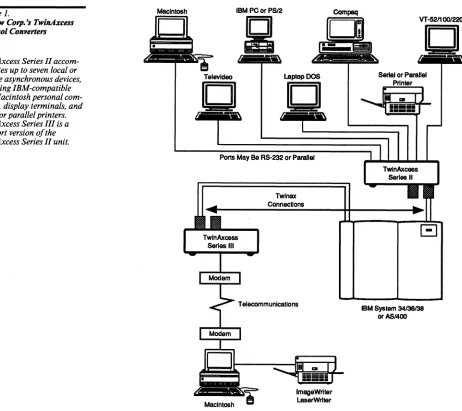
Macintosh connectivity products. NetAxcess is an adapter
board that transforms a Macintosh II personal computer
into a gateway capable of linking an entire AppleTalk
net-work with an IBM midrange host. Macintosh net-workstations
appear as IBM 52XX or 31XX displays, while Apple
print~
ers emulate IBM 52XX printers. Each Macintosh user has
access to up to seven concurrent IBM midrange host
appli-cations and any number of Macintosh-resident
applica-tions. Andrew also supports Macintosh access to IBM
midrange environments through its TwinAxcess Series II
(multiport) and TwinAxcess Series III (single port)
proto-col converters.
IBM
[image:2.612.82.544.334.745.2]IBM provides bidirectional conversion between
synchro-nous and asynchrosynchro-nous environments through the 3174
Establishment Controller, which also supports a
token-ring gateway, X.25 network access, and an ISDN basic rate
interface. IBM continues marketing its older protocol
con-version solutions: the 3708 Network Concon-version Unit and
the 7171 Protocol Converter. A lO-port unit, the 3708
con-verts a 3270 datastream to and from ASCII code. Up to 18
asynchronous devices appear as Model
317X1327X
dis-plays and Model 3287 printers to an IBM SNA host. The
Figure 1.
Andrew Corp. 's T",i#IAxce.rs
Protocol Converten
TwinAxcess Series II
accom-modates up to seven local or
remote asynchronous devices.
including IBM-compatible
and Macintosh personal
com-puters. display terminals. and
serial or parallel printers.
TwinAxcess Series III is a
one-port version of the
TwinAxcess Series II unit.
JANUARY 1992
Protocol Conversion
Syatema: Overview
Data Networking
7171 connects from 16 to 64 asynchronous ASCII devices
to the block multiplexer channel of an IBM host via an
RS-232-C interface.
Netlink
Netlink offers SNA-Gate, a versatile product that
func-tions as a protocol converter, a cluster controller, a line
concentrator, and a remote job entry station. Connecting
to an IBM 37XX communications controller, SNA-Gate
provides async-to-BSC, async-to-SNAlSDLC, or
BSC-to-SNAlSDLC conversion, accommodating up to 250 devices
over multidrop lines.
Additional Vendors
Other major 3270-compatible communications
control-lers offering multiprotocol support include Apertus
Tech-nologies' Datastar 5000, IDEA Courier's Concert
Control-ler, McDATA Corp.'s Linkmaster 7100 Network
Controller, and Memorex Telex's 1174 Network
Control-ler. All support up to four concurrent IBM mainframe host
connections, multiple asynchronous host connections, a
token-ring gateway, and various combinations of
synchro-nous and asynchrosynchro-nous peripheral devices. Additionally,
the Datastar 5000 and the Concert Controller support
IBM PC
or
PS/2
Q
LaptopOOS
Ports
May Be RS-232or
ParallelTwlnax
Connections
VT -52/1 001220
Serial
or
ParallelIBM System 34136138 orASI400
Data Networking Protocol Conversion Systems: Overview
Ethernet LAN attachment. Except for the 1174 Network
Controller, all support Digital LAT devices.
Future Directions
Since the mid-1980s, user migration from host-controlled
"dumb" terminals to intelligent LAN-attached PCs has
driven traditional protocol conversion products (ones
de-signed primarily for linking asynchronous display
termi-nals to IBM hosts) to virtual extinction. Many of the
re-maining protocol conversion vendors have turned to niche
markets, offering Macintosh-to-IBM AS/400,
async-to-Unisys PolUSelect, HP LaserJet-to-IBM 3270, IBM 2780/
3780 BSC RJE-to-IBM SDLC, or some other type of
unique conversion capability.
Other vendors applied their knowledge of IBM
proto-cols to X.25 communications and now manufacture
multi-protocol packet assemblers/disassemblers (PADs) and
packet switches. Already a commodity item, the X.25
PAD will eventually experience the same fate as the
proto-col converter; board-level PAD functionality is now
avail-able in packet switches, multiplexers, LAN bridges,
com-munications controllers, and other equipment, making
dedicated PADs unnecessary.
A third group of vendors, already discussed, has
diver-sified, marketing multipurpose communications
proces-sors that address the multivendor networking
require-ments of a wide variety of users. The growing number of
multi protocol bridge/router products will reduce this
mar-ket over time. At present, however, the communications
controller is the most popular method of interconnecting
multiple environments.
Protocol conversion is no longer a single function
per-formed by a dedicated product.
It
has become a
compo-nent process within increasingly intelligent processors that
perform many different data processing and data
conver-sion functions concurrently.
Technology Analysis
Technology Highlights
Data communications protocols specify the methods of
data encoding, data transmission, device control, and
er-ror correction. Some common protocols are the ASCII
(Teletype or TTY), IBM 3270 Bisynchronous
Communi-cations (Bisync or BSC), IBM Synchronous Data Link
Control (SDLC), IBM 2780/3780 Bisynchronous Remote
Job Entry (BSC RJE), Unisys Poll/Select, and the CCITT's
High-Level Data Link Control (HDLC).
In protocol conversion, one protocol is reformatted or
converted to another. The most common type of
conver-sion addresses incompatibilities between the synchronous
communications methods used by IBM mainframes and
asynchronous communications. Once limited to
stand-alone devices performing only a single type of conversion,
protocol conversion is now available through software and
board-level hardware for printers, PCs and LAN servers,
communications controllers, and X.25 packet assemblers/
disassemblers (PADs).
@ 1992 McGraw-Hili, Incorporated. Reproduction Prohibited. Datapro Information Services Group. Delran NJ 08075 USA
3501
3
Protocol Converters
There are different levels of protocol conversion. Some
devices perform a limited combination of physical
inter-face, speed, and code conversion. Other products perform
all of these, along with device emulation and error
correc-tion.
Technology Basics
Protocols govern the format of a data exchange, remote
connection recognition, transmitting and receiving
loca-tion identificaloca-tion, transmission sequencing, interruploca-tion
handling, error-checking methods, device and session
con-trol, data blocking, and security procedures. They range
from simple character-by-character communications with
no error checking to complex algorithms moving data
among many devices.
In general, protocols specify the following three major
areas.
• The method in which data is to be represented or
encoded-the code set. Most data processing systems
use either the American Standard Code for Information
Interchange (ASCII) or IBM's Extended Binary Coded
Decimal Interchange Code (EBCDIC).
• The method in which the codes are transmitted and
received-asynchronous or synchronous. In
asynchro-nous transmission, data is sent at random intervals with
no specific timing, with start and stop bits between
indi-vidual characters. In synchronous transmission,
charac-ters or bits are sent at a fixed rate; transmitting and
re-ceiving devices are synchronized, eliminating the need
for start/stop bits.
• The exchanges of information by which the two devices
establish control, detect failures or errors, and initiate
corrective action.
Using hardware or software control, the sending device
au-tomatically formats the data and adds the required control
bits before transmitting each character or block. The
re-ceiving device automatically checks each of the appended
bits before acknowledging receipt of data. After detecting
failures, the protocol initiates error-control procedures.
Types of Protocols
Byte-oriented protocols
require transmission of data in
bytes or eight-bit blocks; each transmitted block requires
an acknowledgment before the next block can be sent.
Bit-oriented protocols
allow data to be transmitted in blocks of
any length up to a specified maximum; an
acknowledg-ment can take place after one or several blocks have been
received, depending on the protocol.
ASCII or Teletype (TTY),
a byte-oriented protocol,
tra-ditionally relates to teletypewriter equipment and services.
An asynchronous protocol, ASCII provides very little error
checking. ASCII transmission includes a start bit, a
num-ber of data bits (usually five to eight), and one or more stop
bits. Data in ASCII protocol enters the communications
line at any time. The receiving device is synchronized by
the specification of a common line speed and detection of
the start bits at the beginning of the transmission. ASCII
requires an acknowledgment after each block is sent.
IBM's Synchronous Data Link Control (SDLC)
is a
bit-oriented protocol that uses a synchronized series of
frames. Each frame contains a synchronization flag
fol-lowed by an address field, a control field identifying the
purpose of the transmission, the data itself, a frame-check
4
3501
Protocol Converters
field, and a trailing flag. The flag character marks
synchro-nization. SDLC permits up to 127 frames to be
outstand~ing before requiring an acknowledgment. Private-line
net-works use SDLe.
IBM Binary Synchronous Communications,
a
chru:-acter-oriented synchronous protocol also referred to as
BI-sync or BSC,
forwards data and control characters in
eight-bit bytes. A transmission in BSC incorporates a
numbe~of
synchronizing (SYN) characters that ensure
synchronIza-tion at both ends of the communicasynchronIza-tions link. These
char-acters are followed by a start-of-text (STX) character, a
block of text, an end-of-text (ETX) character, and a block
error-checking character (BCC). BSC does not support
full-duplex transmission, nor is it supported by IBM's
Sys-tems Network Architecture (SNA). An acknowledgment
must follow each block of data. The BSC protocol works in
multipoint applications over private lines.
.
Other communications protocols include High-Level
Data Link Control (HDLC) , a CCITT-specified,
bit-oriented protocol on which most other bit-oriente?
pr?to-cols are based; Digital's Digital
Dat~CommunIcatIOns
Message Protocol (DDCMP), a byte-orIented
proto~ol.that
can accommodate 255 unacknowledged transmissions;
and CCITT X-Series protocols, which govern transmission
of data packets across an X.25 packet switched network.
The OSI Model
The International Organization for Standardization (ISO)
Open Systems Interconnection (OSI?
referenc~model
pr~vides a framework for understandmg the dIfferences m
conversion products. Each of the OSI model's layers
de-fines a particular aspect of the entire data communications
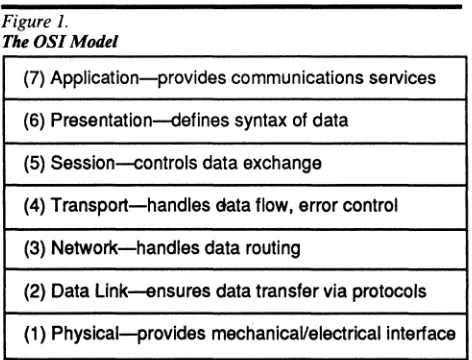
process. Figure 2 illustrates the
seven-Iay~rhierarchy ..
Layer i-Physical Connection
provides
mechan~cal
and electrical specifications and procedures to estabhsh,
maintain and end physical connections. This layer defines
physical interface, code, speed, and
sync~1roniza~ion
.func-tions. Layer 1 is associated, therefore, wIth physical
mter-face, code, speed, and synchronization conversion.
Layer 2-Data Link Control
ensures that the
da~a
passes without error from one computer to another. ThiS
process involves protocols that specify the format for
d~tatransmission. Parameters such as modem control and rIng
signaling are defined on this level.
Layer 3-Network Layer
allows two
sy~temsto
ex-change data. This layer defines packet addressmg and
rout-ing of data to the final destination. Units
tha~handle
con-version in this layer include gateway deVices, such as
packet assemblers/disassemblers (PADs). Front-end
pro-cessors (FEPs) and terminal controllers with protocol
con-version capabilities also fall into this category.
Layer 4-Transport Layer
handles
end-t?-e~derror
and flow control to ensure that the commUnIcatIOns
ex-change is orderly and reliable. PAD devices are the major
products associated with this layer.
Layer 5-Session Layer
furni~hes
the structure f?r d:'lta
exchange by managing connectIons between
a~phcatIonprocesses, establishing and terminating
conn~ctIons,and
sending end-to-end messages and controller dIalogs. .
Layer 6-Presentation Layer
defines the way data IS
as-sembled and provides a systematic arrangement for the
communications. exchange to occur. This layer defines
functions that convert coded data to display formats for
terminal or microcomputer screens, printers, and other
pe-ripherals. In this layer, data is expanded or compressed
and structured for file transfer or command translation.
Emulators, which allow one type of terminal to appear as
JANUARY 1992
[image:4.612.321.555.74.259.2]Protocol Conversion
Systems: Overview
Figure 2.
The OSI Model
Data Networking
(7) Application-provides communications services
(6) Presentation--defines syntax of data
(5) Session-controls data exchange
(4) Transport-handles data flow, error control
(3) Network-handles data routing
(2) Data Link-ensures data transfer via protocols
(1) Physical-provides mechanicaVelectrical interface
Layers One through Three define the interface between the
host computer and the network. Layers Four through Seven
provide compatibility to data format and exchange.
another type, operate within the Presentati,?n Layer.
P~oducts in this category include printer and display termmal
adapters; personal computer 3270 emulation. boards; and
word processor interfaces that handle conversIOns between
dissimilar word processors.
.
Layer 7-Applications Layer
supp~rts
,!ser and
~pphca
tion tasks by providing the commUnIcatIons services for
specific computer applications. Basically, this layer
pro-vides the meaning to the message.
Converters often provide translations on more than ?ne
level in the model. Conversion at one layer generally
Im-plies a need for compatibility in lower layers. For example,
a protocol converter working on Level 2 functions also
as-sumes responsibility for physical interface, code, speed,
and synchronization.
The Mechanics of Protocol Conversion
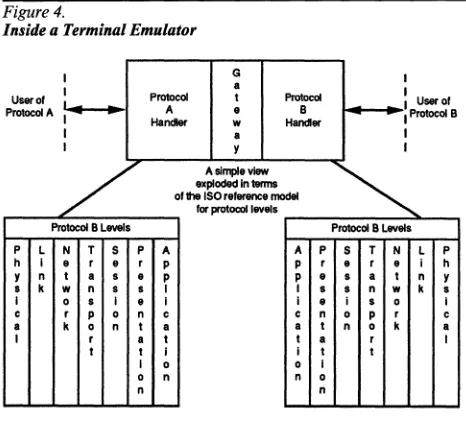
Protocol converters translate for dissimilar devices by
sim-ulating the appropriate protocol for each. As Figure. 3
shows, this functionality gives protocol converters a
dIS-tinctive, double-ended structure. For each end of the
con-version process, a local protocol handler
us~sthe protocol
required by the attached device. Connectmg these
han-dlers is a gateway task that implements the movement of
user data between the handlers.
If all communications protocols were structured in
ac-cordance with the OSI Reference Model, the converter
would implement a set of seven-layer OSI protocols joined
by the gateway task. Because the central task of
~he ~SI
protocol suite is to isolate users from the
c?mmunIca~lOnsenvironment a protocol converter dealmg exclUSIvely
with the OSI'model would be fairly simple to develop and
could operate with few restrictions. With non-OSI
proto-cols such as those commonly used in today's networks, the
foll~wing
issues complicate the conversion process.
The format of the user data.
If the data is easily
sepa-rated from communications and device control protocols,
it is more easily transferred to another environment.
Spe-cial features, such as data compression, complicate
proto-col conversion if they do not exist in the other protoproto-col.
The degree of layering in the protocols.
Although full
compliance with the OSI model is
~nli~elr,
any
amoun~
of
OSI-like layering in the protocols Will aid In the separatIon
(
'"
[image:5.612.59.293.78.189.2]Data Networking
Figure 3.
The Protocol Con"ersion Process
Protocol Conversion SystemslOverview
1
-1
I
T1
I
I
I
1
I
I
I
~---
_ _ _ _ _ _ I
of useful data from control information that must not be
introduced into the other environment.
The availability of common jUnctions in the protocols
involved.
Data exchange between the users requires a
de-gree of synchronization between the two foreign protocols.
For example, most older protocols operate in half-duplex
mode-only one station at a time can send information.
It
is necessary for converters operating between half-duplex
protocols to ensure that both stations are not given
permis-sion to send at the same moment, since neither could
re-ceive under those circumstances.
When protocol converters allow devices to simulate
other devices, device control protocol translation may be
needed. IBM's popular 3270 series of terminals is often
emulated by lower cost asynchronous devices, but the
3270 has special features, such as the capability to return
only modified fields to the host computer. This capability
must be emulated within the protocol converter. Figure 4
shows the structure of a terminal emulator protocol
con-verter.
Products
Interface, Code, and Speed Converters
An interface provides the physical connection between two
devices. Interface conversion offers the lowest level of
es-tablished compatibility. Data and control lines from
de-vices terminate at a connector that handles assigned signal
functions. For example, the RS-232-C interface connector
has 25 pins-l pin per function. The interface also
pre-scribes voltage levels for electrical signals passing over the
data and control lines.
Interface converters
serve as adapters for different
phys-ical interfaces, translating signals, pin assignments, and
voltage levels of one interface to those of another. Interface
conversions commonly occur between RS-232-C and
MIL-STD-188 or between RS-232-C and V.35.
Code converters
translate one communications code to
another. The most common codes are ASCII and
EBCDIC. Conversion from one code to another may be
simple, involving only the addition or deletion of control
bits or the alteration of parity. A more complex code
con-version might require changing the data character's bit
pattern.
Basic code conversion hardware consists of two
uni-versal synchronous/asynchronous receiver/transmitters
(USARTs), a translation table contained in read-only
memory (ROM), and control circuitry. Characters
re-ceived by the USART in one code are mapped in the ROM
table into a corresponding character in the destination
de-vice's code. Converted data goes to the other USART,
which transmits it to the destination device.
@ 1992 McGraw·HiII, Incorporated. Reproduction Prohibited. Datapro Information Services Group. Delran NJ 08075 USA
3501
5
Protocol Converters
Asynchronous-to-synchronous converters
perform
physi-cal interface and speed conversion for asynchronous
de-vices, enabling those devices to communicate across
syn-chronous facilities.
Protocol Converters
Protocol converters, one of the largest categories of
con-version devices, perform changes at the Data Link Layer to
ensure device compatibility. Protocol converters connect
incompatible peripheral devices to hosts via
microproces-sors. A protocol converter actually changes one protocol to
another by separating control characters from data and
as-sembling the new datastream according to new
specifica-tions.
During the conversion sequence, the converter accepts
blocks of data, adds or deletes the necessary control
char-acters, reformats the block, and calculates the required
check characters so the receiving device receives
charac-ters formatted according to its requirements. For example,
in an ASCII-to-SDLC conversion, the converter accepts a
character string, eliminates start and stop bits, assembles
characters into a block, and adds headers and trailers to
create complete frames. In a BSC-to-SDLC conversion,
the converter changes the first four SYN bits of the bisync
algorithm to the first flag bit of the SDLC algorithm.
Since protocol converters must stop, store, process, and
retransmit data, they usually increase response time. The
devices generally accept low-speed input to a buffer; work
with the data; and then transmit it out in short, high-speed
bursts.
Gateways and PADs
[image:5.612.314.547.521.733.2]Gateways and PADs perform conversions on OSI Layers
Three and Four (the Network and Transport Layers) and
also perform lower layer functions. Gateway devices allow
communications between incompatible networks, such as
SNA and DECnet, SNA and Ethernet, or an IBM 3270
device and an X.25 packet switched network. Gateways
also extend compatibility to the inherent protocols, codes,
and interfaces of network architectures. By far the largest
subset of gateway products is packet
assembler/disassem-blers (PADs).
Figure
4.
Inside a Terminal Emulator
I G I
I a I
User 01
p -
I ProtocolProtocol A
~
A e B ,UserolHa_
w
Handler~ ~ ,Protocol B
I a I
I Y I
/ '
AslmpJe_~
exploded In terms
011he ISO reIerance model
far protoc:aIl ...
ProtocoIBLewels P_BLevels
P L N T S P II A P S T N L P
h I e r e r p p r e r e I h
Y n t a
•
•
p p e•
a I n y•
kw
n s•
I I•
•
nw
ks
I 0
•
I e I I e I s 0 Ic r p 0 n c c n 0 p r c
a k 0 n I a a t n 0 k a
I r a t t a r I
t t I I t I
I 0 0 I
0 n n 0
n n
6
3501
Protocol Converters
Emulation Devices
An emulator resolves incompatibilities in protocol, code,
physical interface, device characteristics, and link
charac-teristics. The emulator alters control sequences from a
dis-play terminal, printer, plotter, or other device to simulate
the emulated device's operations. The equivalent control
sequences of various terminals and printers differ widely.
For example, no asynchronous ASCII keyboard provides
all ofthe special 3270 function keys.
Most IBM-compatible terminal controllers support
em-.. ulation capability for attached asynchronous devices
through some combination of adapter cards and software.
As an alternative, an emulation product-such as a
per-sonal computer 3270 terminal adapter-can connect to a
terminal controller. The PC terminal adapter accumulates
an asynchronous datastream in its buffer until a
1,920-character screen image (the screen capacity for an IBM
Model 3277 display terminal or compatible) is filled, or
until the emulator receives an end-of-record, end-of-block
control character. The emulator converts the ASCII
termi-nal protocol and PC data format to those required by the
terminal controller. The emulator then transfers the
refor-matted screen image to the controller, which recognizes
the data as that of an IBM 3277 display. The terminal
con-troller still performs all of its traditional functions: data
concentration, device polling, flow control, buffering,
er-ror detection and correction, and interfacing of multiple
attached terminals.
Although most protocol conversion systems perform
ASCII-to-IBM conversions, other products provide the
conversion required between IBM BSC protocols and IBM
SDLC protocols. Users of older IBM BSC equipment who
plan to migrate to an
~NNSDLC ~nviroJ?~~nt
ben<:fit
from these products wIthout replacmg theIr old
equIp-ment. BSC-to-SDLC conversions occur between 2780/
3780 BSC RJE or 3270 BSC protocols and SDLC
proto-cols.
Selection ·Guidelines
Terminal Controllers
When selecting a terminal controller with emulation
capa-bilities, users should consider the capacity and versatility
of the product. Some terminal controllers support only one
device per port. Others support multidrop capability,
al-lowing several devices to access a single controller port via
a multidrop line. In either case, the maximum number of
devices supported, as well as the maximum aggregate input
rate (the maximum data handling capacity) of the
control-ler, must be considered. Another key issue is the internal
memory capacity, in bytes of RAM, of the unit.
Some communications controllers, including the IBM
3174 Establishment Controller, support only a predefined
JANUARY 1992
Protocol Conversion
Systems: Overview
Data Networking
set of asynchronous terminal and printer models. Other
products allow user-defined conversion schemes for
non-standard devices-including terminals with custom
key-board layouts. Products offering this capability include
IBM's 3708 Network Conversion Unit and Andrew
Corp. 's DataLynxl317 4. Some protocol converters
accom-modate Apple Macintosh personal computers as well as
IBMPCs.
Connections to ISDN networks, token-ring and
Ether-net LANs, X.25 and X.25 packet switched Ether-networks, in
addition to traditional IBM and asynchronous systems,
will provide a future migration path to other
communica-tions solucommunica-tions.
Printer and Terminal Adapter Products
Unlike a communications controller, a terminal or printer
adapter provides emulation for a single device, such as a
personal computer, display terminal, or printer. For PCs
and printers, adapter products are available as plug-in
boards as well as desktop units. Emulation software,
usu-ally supplied by the vendor, works along with the adapter.
Board-level IBM 3270 and 5250 terminal emulators for
personal computer products are designed to accommodate
only one type of device (an IBM-compatible or Macintosh
PC). Directly connected to the PC bus, however, they
pro-vide faster processing capability and multiple concurrent
host sessions. Desktop units generally limit the user to one
or two host sessions, but can accommodate a greater range
of devices.
Some 3270/5250 terminal emulators and printer
adapt-ers provide asynchronous pass-through capability, in
which both an IBM host and an asynchronous computer
can share the device. For a display terminal, async
pass-through allows the user to switch between an IBM host
session and an asynchronous host session via a hot key.
For an asynchronous printer, this feature allows control of
the printer either by the IBM host or by a locally attached
personal computer.
A key factor to consider when selecting an emulation
device for a personal computer is its compatibility with
off-the-shelf emulation software supporting distributed
and cooperative processing, such as IBM's AS/400 PC
Support. Functionally different from its predecessor,
IBM's PC Support/3X software, AS/400 PC Support
con-forms to IBM Systems Application Architecture (SAA)
and Advanced Peer-to-Peer Networking (APPN)
stan-dards for the implementation of distributed and
coopera-tive processing applications. As users migrate from
hierar-chical (host-to-terminal) processing to distributed
LAN-based systems, this level of functionality will become
increasingly important. •
@ 1992 McGraw-Hili, Incorporated. Reproduction Prohibited. Datapro Information Services Group. Delran NJ 08075 USA
(
In this report:
Market Overview ...
Market Leaders ... .
Future
Directions ... .
DATAPRO
Data Networking3501
1
Protocol Converters
Protocol Conversion
Systems:
Market Overview
Synopsis
2
Editor's Note
This report focuses on the protocol
2
conversion systems market.
It
de-scribes the industry's origins, the
market leaders, and market trends.
3
For information on the technology
of protocol conversion, see
"Proto-col Conversion Systems: Technology
Overview" (Report
3502).
Compari-son columns listing detailed
charac-teristics of more than 120
conversion products from
33
differ-ent vendors can be found in
"Proto-col Conversion Systems:
Comparison Columns" (Report
3503).
Highlights
Protocol conversion technology
pro-vides a way to link incompatible host
computers and devices. A major
por-tion of this market addresses
incom-patibilities between IBM
(synchronous) and non-IBM
(asyn-chronous) hosts, displays, and
print-ers. Conversion is also necessary for
device and host access to
packet-switching networks; communications
between PCs or LANs and host
com-puters; and connection of devices
-By
Martin Dintzis
Assistant Editor
using different physical interfaces,
data codes, and communications
speeds.
Until IBM entered the market in
1982, other vendors of protocol
con-version products flourished. Another
setback to the industry has been the
shift away from host-controlled
dis-play terminals in favor of personal
computers configured for terminal
emulation.
The traditional protocol converter
has largely given way to
communica-tions controllers capable oflinking
multiple environments and devices.
Niche markets, such as
Macintosh-to-IBM connectivity, also provide
the most inventive vendors with
fresh avenues for business.
II!) 1991 McGraw-HOI, Incorporated. Reproduction Prohibited. Datapro Information Services Group. Delran NJ 08075 USA
2
3501
Protocol Converters
Analysis
Market Overview
The market for protocol conversion systems
devel-oped as a solution to the incompatibility problems
between IBM and non-IBM display terminals,
printers, and hosts. IBM made its part of the world
synchronous, while other vendors made theirs
asynchronous. Connecting peripheral equipment
from other vendors to IBM hosts spawned a new
industry dedicated to smoothing out the
differ-ences between the two worlds. Since asynchronous
displays were generally less expensive than IBM
products, protocol conversion also became a
popu-lar means to inexpensively connect popu-large numbers
of displays to an IBM system.
After recognizing the need for
asynchronous-to-synchronous transmission solutions, KMW
Sys-tems of Austin, TX (now known as Andrew/KMW)
set out to fill the void, thereby establishing itself in
1971 as the pioneer of the protocol conversion
market. Thereafter, other companies, such as Local
Data (now known as Andrew Corp.), Micom
Com-munications, and Netlink, entered the market,
each bringing its own expertise to that field.
These protocol conversion manufacturers
flourished until 1982, when they received a setback
initiated by IBM. Presumably acting under the
dic-tum, "If you can't beat them,join them," IBM
re-leased its own line of protocol converters.
The proliferation of private and public
pack-et-switching networks in the latter half of the
1980s increased the need for conversion between
the CCITT X.25 packet data mode and IBM BSC,
IBM SNAlSDLC, and asynchronous transmission
modes. As a result, some vendors of
asynchro-nous-to-IBM protocol conversion products,
in-cluding Memotec Data, Micom, and Plantronics
Futurecomms, also offer to-IBM and
X.25-to async connectivity.
The increasing need to link multiple
incom-patible computers and devices has spawned the
JANUARY 1991
Protocol
Conversion
Syatema:
Merket Overvle.
Data Networking
development of other conversion products,
includ-ing software for front-end processors, emulation
cards, interface adapters, multifunction
communi-cations controllers, and gateways.
Market Leaders
Andrew Corp. acquired Local Data, a leading
pro-tocol conversion manufacturer, in 1987. Local
Data had developed the DataLynx, InterLynx, and
VersaLynx product lines, which provide
conver-sion between asynchronous and IBM BSC or
SNAI
SDLC environments for displays, printers, and
PCs emulating displays. These devices are still
marketed under Andrew's name.
Within the past two years, Andrew has
re-leased a steady stream of conversion products for
both IBM mainframe and midrange environments,
including the InterLynx/400 Protocol Converter
and the Newport/Coax and Newport/Twinax
syn-chronous adapters for Hewlett-Packard LaserJet
printers. InterLynx/400 allows up to seven
asyn-chronous display terminals, printers, or personal
computers emulating displays to access an IBM
AS/400 or System/3X host.
Andrew's protocol converters and display
ter-minal adapters provide concurrent user access to
both synchronous and asynchronous computers.
The vendor's printer adapters allow a display- or
PC-attached printer to be shared by both a host
computer and the workstation user.
Andrew/KMW (formerly KMW Systems,
which was acquired by Andrew Corp. in 1990)
con-tinues to blaze trails in the protocol conversion
market by offering Macintosh connectivity
prod-ucts. Last year, the vendor introduced NetAxcess,
the first adapter board that transforms a
Mac-intosh II personal computer into a gateway capable
of linking an entire AppleTalk network with an
IBM midrange host. Macintosh workstations
ap-pear as IBM 52XX or 31XX displays, while Apple
printers emulate IBM 52XX printers. Each
Mac-intosh user has access to up to seven concurrent
IBM midrange host applications and any number
of Macintosh-resident applications.
Andrew/KMW also supports Macintosh
ac-cess to IBM midrange environments through its
TwinAxcess Series II (multiport) and TwinAxcess
Series III (single port) protocol converters. Series II
(multiport) and Series HI (single port) products for
Data Networking
Macintosh
Protocol Conversion
System.:
Market Owarvle.
IBM PC or PS/2
~
Ports May
Be
RS-232 or ParallelTwlnax
Connections
VT
-5211001220
3501
3
Protocol Converters
Figure 1.
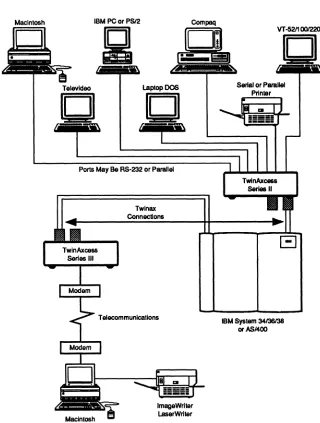
AndrewlKMW's TwinAxcess
Protocol Converters
TwinAxcess Series II
accom-modates up to seven local or
remote asynchronous
de-vices, including
IBM-compatible and Macintosh
personal computers, display
terminals. and serial or
par-allel printers. TwinAxcess
Series III is a one-port
ver-sion of the TwinAxcess
Se-ries II unit.
BM
System 34J36J38 orASl4003270 (IBM BSC, SNAlSDLC, and RJE)
connectiv-ity form another part of the vendor's product line.
IBM provides bidirectional conversion for
both synchronous and asynchrOn01JS devices
through the 3174 Establishment Controller, which
also provides token-ring gateway functionality.
IBM also continues to market the 3708 Network
Conversion Unit and the 7171 Protocol Converter.
The 3708 converts a 3270 datastream to and from
ASCII code, allowing asynchronous devices to
ap-pear as 3270 displays and printers to an IBM SNA
host. The 7171 can support from 16 to 64
asyn-chronous ASCII devices via an RS-232-C interface
to the block multiplexer channel of an IBM host.
Micom Communications markets the Micom
Box'Type 3 unit, a network processor that can be
configured, through a selection of software
car-tridges, for operation as an async-to-SNAlSDLC or
@ 1991 McGraw-Hili. Incorporated. Reproduction Prohibited. Datapro Information Services Group. Delran NJ 08075 USA
async-to-BSC protocol converter; an async, SNAI
SDLC, BSC, or multiprotocol (async/SNA or
async/BSq packet assembler/disassembler (PAD);
or an X.25 packet switch or switching PAD.
Netlink offers SNA-Gate, a versatile product
that can function as a protocol converter, a cluster
controller, a line concentrator, and a remote job
entry station facility. Connecting to an IBM 37XX
communications controller, SNA-Gate provides
async-to BSC, async-to-SNAlSDLC, or
BSC-to-SNAlSDLC conversion, accommodating up to 250
devices over multidrop lines.
Future Directions
Replacing older display terminals with
microcom-puters configured for terminal emulation has
be-come a common practice. Users want access to
[image:9.612.68.388.67.490.2]4
3501
Protocol Converters
more than one computer system but do not want
two terminals taking up space on their desks. By
the early 1980s, organizations confirmed their
preferences for micros over display terminals,
in-stalling them at a rapid rate and benefiting from
their programmability. The shift from host-based
systems to local area networks has heightened this
trend, thereby weakening both the display terminal
and protocol conversion industries.
The need for protocol conversion remains
strong, however, because of the increasing need to
link mUltiple dissimilar environments.
Microcom-puters have encouraged the development of new
terminal emulation hardware and software
prod-ucts, including LAN gateway solutions. Products
that link Macintoshes to IBM host environments,
for example, are in demand, as evidenced by the
product introductions of Apple Computer,
Andrew/KMW, and other vendors.
JANUARY 1991
Protocol
Conve .... on
.,...
.arket Overview
Data Networking
While the sale of traditional protocol
convert-ers is on the decline, vendors throughout the IBM
display system market, including AT&T, Apertus
Technologies (formerly Lee Data), IBM, IDEA
Courier, and Memorex Telex, have been successful
in marketing large communications controllers
ca-pable of transparently linking multiple IBM hosts
with large numbers of devices distributed across
IBM 3270/5250, asynchronous, and tokring
en-v·ironments. Some of these systems also provide
enhanced functionality, such as multiple sessions
with windowing for attached display terminals.
As businesses continue to expand and merge,
the use of packet-switching networks to link
multi-ple remote IBM and non-IBM environments
re-mains a widespread practice. The sale of
multi protocol PADs, therefore, will continue to be
a major source of revenue to many vendors of
pro-tocol conversion products . •
(
In this report:
Vendors ... 2
Protocol Conversion
Systems{ferminal
Controller
Columns ... 6
Code, Speed,
Interface, and
Async/Sync Converter
Columns ... 23
DATAPRO
Data Networking3502
1
Protocol Convertars
Protocol Conversion
Systems:
Technology Overview
Synopsis
Editor's Note
This report concentrates on the
technology of standalone hardware
products that perform protocol
con-versions. For an examination of
protocol conversion market trends,
see "ProtoC'.o1 Conversion Systems:
Market Overview" (Report 3501).
Comparison columns displaying
de-tailed charrcteristics of more than
120 protocol converters offered by
33 different vendors are located in
"Protocol Conversion Systems:
Comparison Columns" (Report
3503).
Highlights
Protocol conversion reformats or
converts one protocol to another. In
most instances, a protocol converter
takes asynchronous data and alters it
for transmission on a synchronous
data link. The device can also
per-form the opposite function (i.e.,
re-formatting synchronous data for
transmission on an asynchronous
data link).
-By Martin Dintzis
Assistant Editor
Some of the most common protocols
are the American Standard Code for
Information Interchange (ASCII),
IBM's Extended Binary Coded
Deci-mal Interchange Code (EBCDIC),
IBM's Binary Synchronous
Commu-nications (BSC), and the CCITT's
High-Level Data Link Control
(HDLC).
Protocol conversion systems
origi-nated as "passports" into the IBM
communications world, which IBM
designed in a synchronous mode.
Most terminals on the market,
how-ever, are asynchronous, as are a high
percentage of the modems in the
United States. Protocol converters
maintain peaceful coexistence
be-tween terminals and IBM hosts,
al-lowing information to flow freely.
As demand increased, other methods
of protocol conversion evolved, such
as software in front-end processors,
adapter devices, X.25 converters,
cluster controllers, data switches,
packet assemblers/disassemblers
WADs), gateways, and network
pro-cessors. Emulation devices also
re-solve incompatibility problems such
as differences in protocols, codes,
interfaces, and device and link
char-acteristics.
o 1991 McGraw·HIH, Incorporated. Reproduction Prohibited.
Oatapro Infonnatlon Services Group. Delran NJ 08075 USA2
3502
Protocol Converters
Analysis
Protocol conversion often involves far more than
simply translating one protocol to another. The
process can occur through mUltiple products, such
as emulation devices, gateways, and packet
assemblers/disassemblers (PADs), that foster
com-patibility among communications devices, local
area networks, packet switched networks, or
com-puter operating systems. Products can range from
microprocessor-based circuit boards to front-end
processors (FEPs) capable of performing
conver-sion functions through software. Some devices
per-form only code or interface conversions, while
others perform protocol conversion, device
emula-tion, and/or code and interface translations in the
same unit.
This report focuses on standalone hardware
products that perform conversions allowing
equip-ment from one manufacturer to communicate with
equipment from another. The largest market
seg-ment addresses incompatibilities between the
syn-chronous communications used by IBM
mainframes and asynchronous ASCII terminals.
Technology Basics
Protocols
Protocols govern the format of a data exchange,
recognition of a remote connection, identification
of the transmitting and receiving locations,
trans-mission sequence, handling of interruptions,
error-checking methods and control, methods of
blocking data, and security procedures. They range
from single character-by-character
communica-tions with no error checking to complex algorithms
moving data among many devices.
In general, protocols specify thi:ee major
ar-eas:
• The method in which data is to be represented
or encoded-the code set. Most data processing
systems use either the American Standard Code
JANUARY 1991
Protocol Conv_lon
S,atama:
Technolog, OVervle.
Data Networking
for Information Interchange (ASCII) or IBM's
Extended Binary Coded Decimal Interchange
Code (EBCDIC).
• The method in which the codes are transmitted
and received-asynchronous or synchronous.
In asynchronous transmission, data is sent with
start and stop bits between individual
charac-ters at random intervals with no specific timing.
In synchronous transmission, characters or bits
are sent at a fixed rate; transmitting and
receiv-ing devices are synchronized, eliminatreceiv-ing the
need for start/stop bits.
• The nondata exchanges of information by
which the two devices establish control, detect
failures or errors, and initiate corrective action.
Through hardware or software, the sending device
automatically formats the data and adds the
re-quired bits before transmitting each character or
block. The receiving device automatically checks
each of the appended bits before acknowledging
receipt of data. After detecting failures, the
proto-col initiates error-control procedures.
Types of Protocols
Byte-oriented protocols
require transmission of
data in eight-bit blocks; each transmitted block
re-quires an acknowledgment before the next block
can be sent. Bit-oriented protocols allow data to be
transmitted in blocks of any length up to a
speci-fied maximum; an acknowledgment may take place
after one or several blocks have been sent,
depend-ing on the protocol. Some of the most common
protocols are ASCII or Teletype (TTY), IBM's
Syn-chronous Data Link Control (SDLC), and IBM's
Binary Synchronous Communications (BSC).
ASCII or TTY
-ASCII or TTY protocol
tra-ditionally relates to teletypewriter equipment and
services. An asynchronous protocol, ASCII
pro-vides very little error checking. Transmission
oc-curs in the form of a start bit, a number of data bits
(usually five to eight), and one or more stop bits.
Data in ASCII protocol enters the communications
line at any time. The end of the link is
synchro-nized through the specifications 'of a common line
speed and detection of the start bits and the begin,..
ning of the character transmission. ASCII requires
an acknowledgment after each block is sent.
IBM's Synchronous Data Link Control
(SDLC)-a
bit-oriented synchronous protocol that
uses a synchronized series of frames. Each frame
(
Data Networking
Protocol COnv .... lon
Syst.m.:
T.chnology Ov.rvI.w
has a synchronization flag, followed by an address
field, a control field identifying the purpose of the
transmission, the data itself, a frame-check field,
and a trailing flag. The flag character marks
syn-chronization. SDLC permits up to 127 frames to
be outstanding before requiring an
acknowledg-ment. Private-line networks use SDLe.
IBM Binary Synchronous Communications
(BSC)-a character-oriented synchronous protocol,
also referred to as
bisync. Binary synchronous data
and control characters consist of eight-bit bytes. A
transmission in BSC incorporates a number of
syn-chronizing (SYN) characters that ensure
synchroni-zation at both ends ofthe communications link.
These characters are followed by a start-of-text
(STX) character, a block of text, an end-of-text
(ETX) character, and a block error-checking
char-acter (BCC). BSC does not support full-duplex
transmission, nor is it supported by IBM's Systems
Network
Architectu~e
(SNA). An acknowledgment
must follow each block of data. The BSC protocol
works in multipoint applications over private lines.
Other communications protocols include
High-Level Data Link Control (HDLC), a
CCITT-specified, bit-oriented protocol on which most
other bit-oriented protocols are based, and
Digi-tal's Digital Data Communications Message
Proto-col (DDCMP), a byte-oriented protoProto-col that can
accommodate 255 unacknowledged transmissions.
The OSI Model
The International Organization for
Standardiza-tion (ISO) Open Systems InterconnecStandardiza-tion (OSI)
reference model provides a framework for
under-standing the differences in conversion products.
Each of the model's layers defines a particular
as-pect of the entire data communications process.
Figure 1 illustrates the seven-layer hierarchy.
Layer I-Physical Connection provides
me-chanical and electrical specifications and
proce-dures to establish, maintain, and end physical
connections. This layer defines interface, code,
speed, and synchronization functions. Layer 1
cov-ers interface, code, and
asynchronous-to-synchronous converters.
Layer 2-Data Link Control ensures that the
data passes without error from one computer to
another. This process involves protocols that
spec-ify the format for data transmission. Protocol
con-verters handle conversions in this layer.
@ 1991 McGraw-Hili. Incorporated. Reproduction Prohibited. Datapro Information Services Group: Delran NJ 08075 USA
3502
3
Protocol Converters
Figure 1.
The OSI Model
(7) Application-provides communications services
(6) Presentation-defines syntax of data
(5) Session-controls data exchange
(4) Transport-handles eata flow, error control
(3) Network-handles data routing
(2) Data Llnk-ensures data transfer via protocols
(1) Physical-provides mechanicaVelectrical interface
Layers One through Three define the interface
between the host computer and the network.
Layers Four through Seven provide
compati-bility to dataformat and exchange.
Parameters such as modem control, ring signaling,
and dedicated connections fall into this category.
Layer 3-Network Layer allows two systems
to exchange data. This layer defines packet
ad-dressing and data routing to final destination.
Units that handle conversion in this layer include
gateway devices, such as packet assemblers/
disassemblers (PADs) that provide access to X.25
networks or between local area networks.
Front-end processors (FEPs) with protocol conversion
functions also fall into this classification.
Layer
4-
Transport Layer handles
end-to-end error and flow control to ensure that the
com-munications exchange is orderly and reliable. PAD
devices, a type of gateway product, are the major
products in this layer.
Layer 5-Session Layer furnishes the
struc-ture for a data exchange by managing connections
between application processes, establishing and
terminating connections, and sending end-to-end
messages and controller dialogs.
Layer'6-Presentation Layer defines the way
data is assembled and provides a systematic
ar-rangement for the communications exchange to
occur. This layer defines functions that translate
coded data and convert it into display formats for
terminal or microcomputer screens, printers, and
other peripherals. In this layer, data is expanded or
compressed and structured for file transfer or
com-mand translation. Emulators, which allow one type
of terminal to appear as another type, operate
within the Presentation Layer. Products in this
cat-egory include ASCII-to-3270 emulators, interfaces
[image:13.612.309.545.77.257.2]4
Figure 2.
3502
Protocol Converters
The Protocol Convenion Process
---,
TI •
H
I
o
•
tI
I~~""'"'
I
L ____________________ _
that allow personal computers to act as 3270-type
devices or to access public networks, and word
pro-cessor interfaces that handle conversions between
dissimilar word processors.
Layer 7-Applications Layer
supports user
and application tasks by providing the
communi-cations services for specific computer applicommuni-cations.
Basically, this layer provides the meaning to the
message.
Converters often provide translations on
more than one level in the model. Conversion at
one layer generally implies a need for compatibility
in lower layers. For example, a protocol converter
working on Level 2 functions also assumes
respon-sibility for compatibility in the interface, code, and
synchronization functions.
The "echanics of Protocol Conversion
Protocol converters translate for dissimilar devices
by simulating the appropriate protocol for each. As
Figure 2 shows, this functionality gives protocol
converters a distinctive, double-ended structure.
For each end of the conversion process, a local
pro-tocol handler uses the propro-tocol required by the
at-tached device. Connecting these handlers is a
gateway task that implements the movement of
user data between the handlers. If all
communica-tion protocols were structured in accordance with
the OSI Reference Model, the converter would
im-plement a set of seven-layer OSI protocols joined
by the gateway task. Because the central task of a
fully structured OSI protocol is to isolate users
from the communication environment, a protocol
converter dealing exclusively with full OSI model
protocols would be fairly simple to develop and
could operate with few restrictions. With non-OS I
protocols, such as those commonly used in today's·
networks, the following issues complicate the
con-version process:
JANUARY 1991