implementing benefits realisation and
management
Yates, K, Sapountzis, S, Lou, ECW and Kagioglou, M
Title
BeReal : tools and methods for implementing benefits realisation and
management
Authors
Yates, K, Sapountzis, S, Lou, ECW and Kagioglou, M
Type
Conference or Workshop Item
URL
This version is available at: http://usir.salford.ac.uk/2142/
Published Date
2009
USIR is a digital collection of the research output of the University of Salford. Where copyright
permits, full text material held in the repository is made freely available online and can be read,
downloaded and copied for noncommercial private study or research purposes. Please check the
manuscript for any further copyright restrictions.
BeReal: TOOLS AND METHODS FOR IMPLEMENTING BENEFITS REALISATION AND MANAGEMENT
Kathryn Yates, Stelios Sapountzis, Eric Lou and Mike Kagioglou (University of Salford)
ABSTRACT
The need to identify, monitor and manage benefits throughout a programme/projects lifecycle is being accepted as a way to ensure the success of that programme or project. Major capital investment programs and projects within both the private and public sector are conventionally measured upon their performance relating to tangible outputs such as cost, quality and time of delivery and not on the benefits they deliver. Benefits
Realisation and Management is a method which is changing this way of thinking and focuses upon using benefits to drive, manage and measure the performance of a programme or project. Since 2006, The Health and Care Infrastructure Research and Innovation Centre (HaCIRIC) has been working towards developing a Benefit Realisation Management process (BeReal) which uses both ICT in collaborative environments and tools and methods to meet the above demands, by providing facilitation for evidence-base decision making, aiming to promote continuous improvement and organisational learning. BeReal has been developed focusing upon capital investments within healthcare infrastructures. The research project presented is a result of a literature review and action research which involved a close working relationship and dialogue with an advisory group and multiple case studies. The paper will present the importance of managing the realisation of benefits throughout a programme’s or project’s lifecycle by adopting BeReal during the planning, development, delivery and operational phases. The paper also argues why appropriate ICT tools using collaborative environments are developed to facilitate a simple and ‘user friendly’ implementation of the BeReal methodology.
1. INTRODUCTION
Complex public and private organisations, programmes and projects are driven by the need to realise benefits throughout their life cycle. A vagueness to identify as well as define these benefits at the conception stage makes it difficult to achieve and manage benefits which can result in the failure of the organisation, programme or project (Payne, 2007; Bartlett, 2006; Reiss et al., 2006). With a growing understanding that the lack or inadequate use of benefits realisation and management can lead to failure the use of benefits realisation and management practices has risen. This seeks to move forward from the traditional investment appraisal approach and focus on the active planning of how benefits will be realised and measured (Glynne, 2007).
Healthcare progammes are classic examples of complex systems (Carruthers, 2005; Sweeney and Griffiths, 2002). They are also notoriously long, with a great number of different stakeholders involved this along with changes in policy during the lifecycle of a project mean that what is delivered seldom matches the vision set out at the initial stages of a programme stage. This can result in the need for changes which were not anticipated leading to an increase on the budget and time spent on the project. This failure can be due to either a lack of or poor benefits management (Sapountzis et
al.,2007). Benefits Realisation and Management is a method that can be used to stop this
kind of failure (Glynne, 2007) through monitoring reporting and measuring benefits throughout the life-cycle of a programme or project.
development and delivery of successful healthcare infrastructure projects. The research project presented is a result of an initial literature review in Benefits Realisation and Management, a review of the literature on ICT tools used, an ongoing dialogue through workshops with an advisory group which includes: MaST LIFT, Community Health
Partnerships, CABE, SHIFT, Eric Wright Group, NHS Confederation, Skanska Technology, OGC, NAO, Salford PCT, Tribal, Salford RHT, Trafford NHS, ActivePlan Solutions Ltd, Sir Robert McAlpine, Urban Vision, Manchester City Council and multiple case studies at different stages of a healthcare programme lifecycle. Initial discussions around the tools have been focused upon the penultimate stage of a healthcare programme lifecycle which is the Post Occupancy Evaluation stage. This has been generated from a case study at MaST LIFT.
The paper presents the importance of managing benefits throughout a programme’s whole lifecycle using a process such as BeReal and how the adaptation of an IT collaborative environment can assist to easily implement such a methodology and facilitate a new way of thinking.
2. BENEFITS REALISATION AND MANAGEMENT
There are many different definitions given to the term benefit, with even more meanings being provided due to the different classifications these are discussed in depth in
Sapountzis et al. (2008a). For the purpose of this paper a benefit is defined as ‘an
outcome whose nature and value are considered advantageous by an organisation’ (OGC, 2007b; Thorp, 1998; Ward et al., 1995) which are owned by individuals or groups who want to obtain value from an investment (Glynne, 2007). Whilst a ‘disbenefit’ in generic terms can be said to be the opposite to a benefit, disadvantageous to an individual (Merriam-Webster, 2005; Encarta®, 2005).
Benefits realisation and management also have a number of definitions, example could be seen in Farbey et al. (1999), Bradley (2006), Reiss et al. (2006), Lin and Pervan (2001), OGC (2007b) and Ward et al. (1996). Although some of these differ in their context for example Ward et al. focus around benefits that arise only from IS/IT and Farbey et al. identify the importance of recognising unexpected benefits. Most follow the same line of thinking that Benefits Realisation and Management is a process that realises, prepares and manages for planned benefits through change. HaCIRIC, like Farbey et al., believe that the process should realise, prepare and manage for unplanned benefits, disbenefits and impacts throughout the programme/project’s lifecycle.
Benefits realisation and management was first developed and quickly emulated into the field of IT in the late 1980s and early 1990s (Farbey et al., 1999). Most of what was developed were practical guides around the investments these predominantly private IS/IT organisations made (Ward et al. 1995; Leyton 1995; Thorp 1998; Bradley 2006; Bartlett 2006; Payne 2007). Since then the importance of managing benefits has become increasingly recognised ‘Projects and programmes can only be regarded as successful if the intended benefits are realised’ (CITU, 2000). Recently the topic has been
theoretically linked to healthcare through organisations such as OGC (2007a) and writers such as Bradley (2006).
2.1 Benefits Realisation and Management Approaches and Models
Since 1995, due to the recognition of the importance of benefits realisation and management within different sectors, various approaches and models have been
Table 1. Benefits realisation and management approaches and models (adapted from Sapountzis et al., 2008b).
Approach/Model Details
Active Benefits Management
(Leyton, 1995) Sets the benefits management activity in the context ofbusiness change. Identifies continuous flow between change and benefits
The Cranfield process model of Benefits Management (Ward et al., 1996)
Key feature of this model is benefits monitoring this compares project results with the benefits realisation plan during the project and assesses if any internal or external changes have occurred that will affect the delivery of planned benefits. Potential benefits are identified, a plan is devised for their realisation, the plan is executed, the results reviewed and evaluated and feedback occurs. The Benefits Realisation
Approach (BRA) (Thorp, 1998)
Is based on two cornerstones:
1. The shift from stand alone project management to: Business Programme Management, Disciplined Portfolio Management, Full cycle governance.
2 The three necessary conditions for the successful implementation of the BRA are Accountability of activists, Relevant measure as in measuring the things that really count and Proactive management of change to give people ownership stakes in programs.
Active Benefit Realisation (ABR) (Remenyi and Sherwood-Smith, 1998)
A process for managing information systems’ development through a continuous evaluation approach. ABR requires a direct and continuous focus on business benefits
realisation and is based on a contingency philosophy, this is that information system outcomes development
activities, tasks and participating roles of the stakeholders are dynamic throughout the duration of the project principle stakeholders of the information system are identified at the onset and that they accept and agree their continuous involvement.
Towards best practice to Benefits Management (Ashurst and Doherty, 2003)
In this approach benefits realisation is a continuous process through an evolving organisational context. But it does not into account influences that external factors may have onto a project
Managing Successful programmes (MSP) (OGC 2007)
MSP represents the UK Government’s view on the programme management principles and techniques MSP identifies benefits management as ‘‘a core activity and a continuous ‘thread’ throughout the programme’’ (OGC, 2007a), and fundamental to the realisation of benefits from new capabilities delivered by projects within the programme. Emphasis is placed on identification,
quantification, assignment of owners and tracking, it has been heavily influenced by Cranfield’s Benefits
Management model and Bradley’s Benefits Realisation Management 2006.
The GatewaytmProcess The Gateway Review Process indicates, at a high level,
Table 1. Benefits realisation and management approaches and models (continued).
Benefits Management in the Handbook of Programme Management (Reiss et al., 2006)
This approach focuses the benefits management model in the delivery of benefits by projects (Nogeste and Walker, 2005). Reiss (2006) define the scope of benefits
management as “the management and monitoring of benefits during and after execution phase’ and depicts the “value path” relationship between benefits and projects as a Hierarchical Benefits structure (Nogeste and Walker, 2005)
Table 1 shows that there are already a number of different models and approaches that exist for realising and managing benefits, however these do not drive projects through benefits, many occur at the end of a project acting only as an evaluation, from which lessons are not learnt. Sapountzis et al. (2007) discuss that there is a need in the healthcare sector for a process that is integrated into business planning as well as:
· appropriate for those who operate it and those that use the information produced;
· robust enough to withstand change;
· balanced in its assessment of hard and soft benefits;
· cost effective by producing performance information that realises benefits in proportion to the investment required to collect it; and
· simple to implement.
As a result of Advisory group consultations and workshops outcomes within UK
healthcare organisations the need of a simplified, accessible and easy to follow process is evident. The use of a collaborative IT environment will be explored for this purpose.
3. COLLABORATIVE ENVIRONMENTS
Collaborative environments present an environment whereby various construction professionals involved in a construction project could come together and meet in the environment (Vlosky et al., 2000). This environment presents a standard platform for all parties involved for communication, data and information exchange, data storage and replication, archiving and much more. Most of all, it initiates a drive for IT integration through data and information interchange and reuse (Alshawi, 2007).
The internet, computing and information technologies are the main infrastructure used in collaborative environments. Users of the collaborative environments need a computer to access to the internet and in some cases, collaborative environment software. A ‘virtual’ working space is created for all members involved in a project and all information are shared in the environment are available 24 hours a day, 7 days a week as long as the user has the proper authorisation (Wilkinson, 2001). As the collaborative environments are based on the internet, it writes off the geographical factor whereby members of the project could access information from anywhere in the world – in office or at home (Jackson, 2004). Disputes and legislation cases could also be solved through user and programme archiving throughout the construction project life cycle.
The concept of collaborative environments have been around for quite some time but it is the wide availability of internet access, which is starting to transform them from
expensive, difficult-to-use bits of complex software into cheap and user-friendly business tools (Kumaraswamy et al., 2004). This environment also delivers a complete integration of information service for asset owners and operators, capturing all information
advantages of using collaborative environments is that it ensures that all members of the project team have access to the most up-to-date versions of the various project
documents. This means that traditional mistakes generated from someone working from an old document or drawing are removed in theory or at the very least reduced. More crucially project collaboration can reduce the opportunity for mistakes and disputes, the biggest causes of waste and inefficiency.
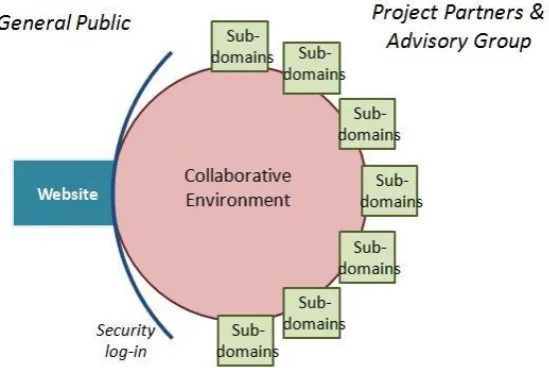
[image:6.595.163.438.312.496.2]Collaborative environments can help in achieving maximum impact on benefits realisation. The website is open to the general public, making information readily available to potential users and interested parties. This is the main tool to publicise awareness, engage in potential, information dissemination and provide the link to the collaborative environment. The collaborative environment itself is a secured area, which is open to registered project partners. Sub-domains are created for specific user groups or organisations participating in the benefits realisation exercise. These sub-domains also maintain a level of secrecy and security for the users. A security hierarchy is imposed on all members. Within each sub-domain, the benefits realisation exercise will go through a series of process protocols – users providing data and information through the system. The proposed collaborative environment architecture is as shown in Figure 1 as below.
Figure 1. Proposed collaborative environment architecture.
Collaborative environments have the opportunity to significantly improve the way the healthcare industry works, without needing to make real changes in the structure or practice of the industry. The simplification of the process with customised software tools and processes will help enhance work automation, realise specific benefits, and in hope to remove the bureaucracy which often comes with modern working practices.
4. PROJECT DESCRIPTION AND OBJECTIVES
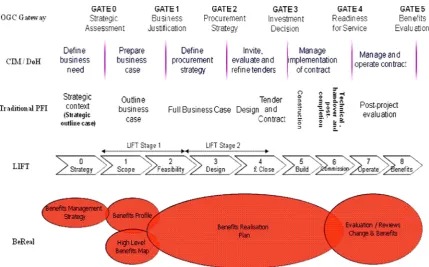
Figure 2: BeReal framework.
The framework aims to integrate with a collaborative tool that will assist in managing both healthcare programmes and projects driven by benefits. The tool aims to promote the knowledge sharing and organiszational learning for successful monitoring of the benefits as they were originally conceived throughout the programme and manage new/reviewed outcomes (Sapountzis et al., 2007). Figure 2 presents the four main phases of BeReal and how this can be aligned with traditional investment/development processes.
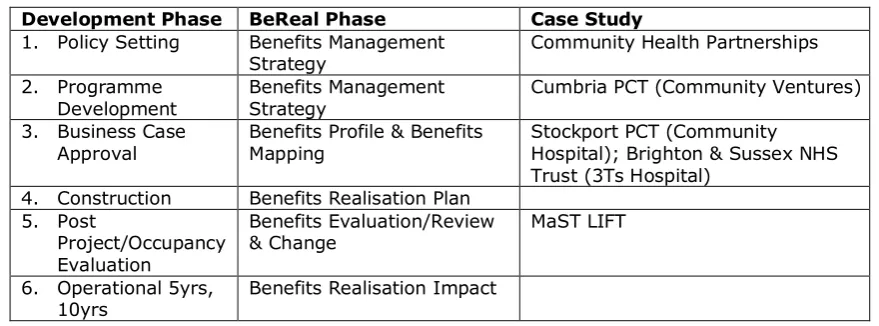
The tool is being informed and tested through case studies at different stages of the lifecycle of a healthcare programme. It would have been difficult to undertake one case study for the whole framework given time constraints, as the whole lifecycle of such projects spans from 20 to 30 years. The decision was made to undertake case study snapshots of the development of a healthcare infrastructure programme aiming to inform the framework in phases and by using different procurement routes within the healthcare sector (i.e LIFT for Primary Care, P21 for acute, Express LIFT for community ventures). The table below illustrates the how the different case studies inform the BeReal
framework and its correlation with a traditional development process.
The findings from the different stage case studies will assist in better future planning, so that policy setting can be adequately informed by evidence with a fuller appreciation of potential outcomes and impacts.
The project is formed on the underlying assumption that benefits planned at the initial stage of healthcare programmes/projects are not monitored throughout the project. That often these benefits are forgotten about once the business case has gone through
because traditional programme/project management approaches are often inflexible. The focus of the project is to develop, implement and evaluate a tool (BeReal) which goes beyond these traditional methods, and monitors benefits through a continuous
Table 2. BeReal case studies.
Development Phase BeReal Phase Case Study
1. Policy Setting Benefits Management
Strategy Community Health Partnerships
2. Programme
Development Benefits ManagementStrategy Cumbria PCT (Community Ventures) 3. Business Case
Approval Benefits Profile & BenefitsMapping Stockport PCT (CommunityHospital); Brighton & Sussex NHS Trust (3Ts Hospital)
4. Construction Benefits Realisation Plan 5. Post
Project/Occupancy Evaluation
Benefits Evaluation/Review
& Change MaST LIFT
6. Operational 5yrs,
10yrs Benefits Realisation Impact
4.1 Research methodology
The overarching research philosophy adopted for this research project is an actor based research philosophy (Berger and Luckmann, 1966) as used in the development of the Generic Design and Construction Process Protocol (Kagioglou et al., 2000) and it consists of the pre-understanding – understanding hermeneutic spiral (Odman, 1985). An action learning dimension is taken to enhance the research vision; this follows a cycle of planning a change, acting, observing the consequences, planning further action and repeating (Kemmis and Wilkinson, 1998). Action research is an interactive approach (Susman and Evered, 1978) and provides the platform where HaCIRIC’s research team and the industrial partners can agree on the issues, monitor the present situation,
analyse data, identify process improvements and subsequently reflect and evaluate upon impact.
Within this action research, multiple case studies are used to provide an area where the framework can be developed and the tools and techniques within it tested. Multiple case studies allows findings to be compared between the different cases, which allows the study to be more robust than if a single case study were to be used (Herriott and Firestone, 1983). This multi–site approach enables the transferability of the research findings to be measured at the same time as capturing wider user perspectives (Yin, 2003; Kagioglou et al., 2000). Inside the case studies a variety of quantitative and qualitative methods will be adopted, these include questionnaires, interviews and interactive workshops. These will be used to develop, implement and evaluate BeReal from the perspective of both service providers and users. It is anticipated that the combination of techniques will capture the perspectives of the case study target
population and the activity inside of the case study site to measure the effectiveness of the framework. The advantages of using two methods is that claims for the validity of conclusions are improved if the findings support one method can be counterbalanced with the strengths of the other another (Bryman, 1988; Punch, 2005).
5. RESEARCH RESULTS AND INDUSTRIAL IMPACT
· Phase 1 - Benefits Management Strategy & Benefits Realisation case. This first phase is concerned with identifying desired top benefits and developing a benefits management strategy in order to share and communicate these to the wider stakeholder group. The benefits management strategy forms the base of the development of a benefits realisation case of support should form the nucleus of the project’s business case.
· Phase 2 – Benefits profile & benefits mapping. Project group meetings and benefits mapping workshops with the appropriate group of stakeholders are critical for the success of this phase. The benefits mapping and profiling form the basis of an ongoing benefits realisation plan.
· Phase 3 – Benefits realisation plan. This phase focuses on the execution of a benefits realisation plan as that is developed and formulated in the first two phases it consists of measuring and tracking the benefits previously identified and incorporating emerging ones, through data collection and measurement.
· Phase 4 – Benefits evaluation and review. This phase consist of the evaluation of the benefits as these have been identified or emerged through the previous phases.
Most of the approaches reviewed in the literature tend to focus on the continuous improvement cycle of Plan–Do-Check-Act (PDCA). The same logic is adopted by the BeReal framework adding to the PDCA cycle the Evaluation entity and extending in to an EPDCA cycle. The process begins with an evaluation of the current situation, the
stakeholder’s requirements and the aim of the programme. The BeReal framework is designed to be flexible and adaptable to a key decision making process.
The BeReal framework being used within an ICT based collaborative environment is still at its early stages. However some of the activities within the different phases of the framework have taken place through different case studies, these include:
· Development of BeReal Project team
· Benefit identification workshops
· Benefit Relationship Mapping – to identify the relationship between the different relationships
· Benefit Dependency Mapping – enhanced relationship map to include methods of measurement, changes and enablers
· End user questionnaires – to assess if the benefits identified have been realised by different end-users
With Benefits Realisation becoming increasingly recognised as an important method of successful programme delivery, ensuring that what it sets out to do is achieved. By following an action research methodology which facilitates the development of a ‘user community’ as the project evolves it is envisaged that BeReal will have a real impact upon future programme delivery and policy making. BeReal, once automated through the ICT collaborative environment, could be a tool that governmental organisations such as the DoH, NAO and OGC and other organisations will direct people to for undertaking Benefits Realisation. In the long run using such a methodology and tool could help to direct funding for private and public infrastructure programmes towards delivering products and services that provide value for money.
6. CONCLUSIONS
environments shall provide a common platform to share, store and reuse information shared within the project team or organisation – the use of collaborative environments must be process-led, and not ICT led. The logical processes within the environment will enable the beneficiaries to “do less and get more”. BeReal is based on the key principal that effective communication and information flow within the organisation is vital. Team working, informed decision making and transparency of information are keys to its success and the use of an IT collaborative environment is believed to simplify BeReal’s implementation and enhance its possibilities for success.
The next important step for the project is to further test the integration of BeReal with an IT collaborative environment within current case studies and to explore the strengths and weaknesses the integration and identify more robust ways of its implementation. In parallel other activities that will be facilitated by this model include the development of a benefits quantification method (in collaboration with Herriot-Watt University) that will consist of a identifying a common currency, score and weighting of benefits.
7. REFERENCES
Alshawi, M. (2007), Rethinking IT in Construction and Engineering: Organisational
Readiness, Taylor and Francis, UK.
Bartlett, J. (2006) Managing programmes of business change, 4th edn., Project Manager Today, Hampshire, UK.
Berger, P.L. and Luckemann, T. (1966) The social construction of reality, Doubleday, Garden City, NY.
Bradley, G. (2006), Benefit Realisation Management – A practical guide to achieving
benefits through change, Gower, Hampshire.
Bryman, A. (1988) Quantity and quality in social research, Routledge, London. Carruthers, J., Ashill, N.J. and Rod, M. (2006) Mapping and assessing the key
management issues influencing UK public healthcare purchaser-provider cooperation, Qualitative Market Research: An international journal. ENCARTA® (2005) http://encarta.msn.com/dictionary/disbenefit.html.
Farbey, B., Land, F. and Targett, D. (1999) The moving staircase – problems of appraisal and evaluation in a turbulent environment, Information Technology and People
Journal, 12, 238-52.
Glynne, P. (2007) Benefits management-changing the focus of delivery, Association for
Progress Management Yearbook 2006/07, 45-49.
Herriott, R.E. and Firestone, W.A. (1983) Mutisite qualitative policy research: Optimizing description and generalizability, Educational Researcher, 12, 14-19.
Jackson, P. (2004) Adding the ‘e’ to Procurement, e-Procurement in the UK Public Sector: A guide to developments and best practice.
http://www.ipf.co.uk/egovernment/egovforum/docs/pauljackson/procurementrepor t.pdf.
Kagioglou, M., Cooper, R., Aouad, G. and Sexton, M. (2000) Rethinking construction: the generic design and construction process protocol, Engineering, Construction and
Architectural Management Journal,7(2), 141-53.
Kemmis, S. and Willkinson, M. (1998) Participatory action research and the study of practice in Atwech, B. Kimmis, S. and Weeks, P. (eds) Action Research in Practice
Partnerships for Social Justice in Education, Routledge, London.
Kumaraswamy, M.M., Ng, S.T., Ugwu, O.O., Palaneeswaran, E. and Rahman, M.M. (2004) Empowering collaborative decisions in complex construction project scenarios, Engineering, Construction and Architectural Management,11(2), 133– 42.
Lin, C. and Pervan, G. (2001) A review of IS/IT investment evaluation and benefits management issues, problems and processes, Information technology evaluation
methods and management, Idea Group Publishing, 22-24.
Central IT Unit (CITU) (2000) Successful IT: Modernising government in action Report, Cabinet Office UK.
Webster (2005) Webster online dictionary, Springfield, MA, Merriam-Webster.
Odman, P. (1985), Hermeneutics. In: The International Encyclopaedia of Education T. Husen and N.T. Postlethwaite (eds), Pergamon, Oxford, 2162-9.
OGC (2007a) Managing successful programmes MSP, The Stationery Office, London. OGC (2007b) STDK Home, Delivery Lifecycle: Benefits Management, Office of
Government and Commerce. http://www.ogc.gov.uk/sdtoolkit/ reference/deliverylifecycle/benefits_mgmt.html#benmanagement1.
Oh, W. and Pinsonneault, A. (2007) On the Assessment of the Strategic Value of Information Technologies: Conceptual and Analytical Approaches, MIS Quarterly,
31(2), 239–65.
Payne, M. (2007) Benefits management – releasing project value into the Business,
Project Manager Today, Hampshire, UK.
Punch, K.F. (2005) Introduction to social research: Quantitative and qualitative
approaches, 2nd edition, Sage, London.
Reiss, G., Anthony, M., Chapman, J., Leigh, G., Pyne, A. and Rayner, P. (2006) Gower
Handbook of Programme Management, Gower Publishing.
Sapountzis, S., Harris, K. and Kagioglou, M. (2007) Benefits Realisation Process for Healthcare, 4th International Research Symposium (SCRI), 359–71.
Sapountzis, S., Harris, K. and Kagioglou, M. (2008a) Benefits Management and Benefits
Realisation – A Literature Review, HaCIRIC, the University of Salford, May, Salford.
Sapountzis, S., Yates, K. and Kagioglou (2008b) Realising benefits through primary
healthcare settings, Facilities, in press.
Susman, G.I. and Evered R.D. (1978) An assessment of the scientific merits of action Research, Administrative Science Quarterly, 23, 582–603.
Sweeney, K. and Griffiths, F. (2002) Complexity and health care: An introduction, Radcliffe Medical Press.
Thorp, J. (1998) The Information Paradox – realising the business benefits of information
technology, Toronto, Canada, McGraw-Hill.
Vlosky, R.P., Fontenot, R. and Blalock, L. (2000) Collaborative environments: impacts on business practices and relationships, Journal of business and industrial marketing,
15(6), 438–57.
Ward, J., Taylor, P. and Bond, P. (1996) Evaluation and realization of IS/IT benefits: an empirical study of current practice, European Journal of Information Systems,4, 214–25.
Ward, J., Taylor, P. and Bond, P. (1995) Identification, realisation and measurement of IS/IT benefits: an empirical study of current practice, Brown, A. and Remenyi, D (eds.) Second European conference on IT investment evaluation, Henley
Management College, Henley on Thames.
Wilkinson, P. (2001) Kajima UK sets the standard for worldwide extranet usage, The
Architect’s Journal.
Yin, R. (2003) Case Study research: design and methods, 3rd edition, Sage Publications,