A preliminary version of this paper appeared in the Proceedings of the Thirteenth ACM Sympos -ium on Operating Systems Principles.
Authors’ address: Digital Equipment Corp., Systems Research Center, 130 Lytton Ave, Palo Alto, CA 94301. Internet address: [email protected].
Permission to copy without fee all of part of this material is granted provided that the copies are not made or distributed for direct commercial advantage, the ACM copyright notice and the title of the publication and its date appear, and notice is given that copying is by permission of the Association for Computing Machinery. To copy otherwise, or to republish, requires a fee and/or specific permission.
© 1992 ACM 0734–2071/92/1100-0000 $01.50
Authentication in Distributed Systems:
Theory and Practice
BUTLER LAMPSON, MARTÍN ABADI, MICHAEL BURROWS, and EDWARD WOBBER
Digital Equipment Corporation
We describe a theory of authentication and a system that implements it. Our theory is based on the notion of principal and a ‘speaks for’ relation between principals. A simple principal either has a name or is a communication channel; a compound principal can express an adopted role or delegated authority. The theory shows how to reason about a principal’s authority by deducing the other principals that it can speak for; authenticating a channel is one important application. We use the theory to explain many existing and proposed security mechanisms. In particular, we describe the system we have built. It passes principals efficiently as arguments or results of re -mote procedure calls, and it handles public and shared key encryption, name lookup in a large name space, groups of principals, program loading, delegation, access control, and revocation. Categories and Subject Descriptors: C.2.4 [ Computer-Communication Networks ]: General — Security and Protection , Distributed Systems; D.4.6 [ Operating Systems ]: Security and Protec tion— access controls, authentication, cryptographic controls; K.6.5 [ Management of Comput -ing and Information Systems ]: Security and Protection—authentication ; E.3 [ Data]: Data Encryption
General Terms: Security, Theory, Verification
Additional Key Words and Phrases: Certification authority, delegation, group, interprocess com -munication, key distribution, loading programs, path name, principal, role, secure channel, speaks for, trusted computing base
1. INTRODUCTION
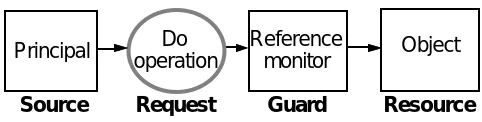
Most computer security uses the access control model [16], which provides a basis for secrecy and integrity security policies. Figure 1 shows the elements of this model:
—Principals: sources for requests.
Reference
monitor Object Do
operation Principal
Guard Request
[image:2.612.185.426.81.142.2]Source Resource
Fig. 1. The access control model.
—A reference monitor: a guard for each object that examines each request for the object and decides whether to grant it.
—Objects: resources such as files, devices, or processes.
The reference monitor bases its decision on the principal making the request, the operation in the request, and an access rule that controls which principals may perform that operation on the object.1
To do its work the monitor needs a trustworthy way to know both the source of the request and the access rule. Obtaining the source of the request is called ‘authentication’; interpreting the access rule is called ‘authorization’. Thus authentication answers the question “Who said this?”, and authoriza -tion answers the ques-tion “Who is trusted to access this?”. Usually the access rule is attached to the object; such a rule is called an access control list or
ACL. For each operation the ACL specifies a set of authorized principals, and the monitor grants a request if its principal is trusted at least as much as some principal that is authorized to do the operation in the request.
A request arrives on some channel, such as a wire from a terminal, a net-work connection, a pipe, a kernel call from a user process, or the successful decryption of an encrypted message. The monitor must deduce the principal responsible for the request from the channel it arrives on, that is, it must authenticate the channel. This is easy in a centralized system because the op -erating system implements all the channels and knows the principal respon-sible for each process. In a distributed system several things make it harder:
Autonomy : The path to the object from the principal ultimately responsi
-ble for the request may be long and may involve several machines that are not equally trusted. We might want the authentication to take ac count of this, say by reporting the principal as “Abadi working through a remote machine” rather than simply “Abadi”.
Size : The system may be much larger than a centralized one, and there
may be multiple sources of authority for such tasks as registering users.
Heterogeneity: The system may have different kinds of channels that are
secured in different ways. Some examples are encrypted messages,
physi-1The access control model is less useful for availability, which is not considered in this paper.
Workstation Operating
system Accounting
application
Server Operating
system NFS Server
keyboard/display channel
[image:3.612.201.422.68.180.2]network channel request
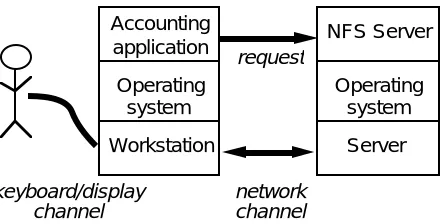
Fig. 2. A request from a complex source.
cally secure wires, and interprocess communication done by the operating system.
Fault-tolerance : Some parts of the system may be broken, off line, or
oth-erwise inaccessible, but the system is still expected to provide as much service as possible. This is more complicated than a system which is ei ther working or completely broken.
This paper describes both a theory of authentication in distributed systems and a practical system based on the theory. It also uses the theory to explain several other security mechanisms, both existing and proposed. What is the theory good for? In any security system there are assumptions about author-ity and trust. The theory tells you how to state them precisely and what the rules are for working out their consequences. Once you have done this, you can look at the assumptions, rules, and consequences and decide whether you like them. If so, you have a clear record of how you got to where you are. If not, you can figure out what went wrong and change it.
We use the theory to analyze the security of everything in our system except the channels based on encryption and the hardware and local operating system on each node; we assume these are trusted. Of course we made many design choices for reasons of performance or scaling that are outside the scope of the theory; its job is to help us work out the implications for security.
We motivate our design throughout the paper with a practical example of a request that has a complex source involving several different system compo-nents. Figure 2 shows the example, in which a user logs in to a workstation and runs a protected subsystem that makes a request to an object imple-mented by a server on a different machine. The server must decide whether to grant the request. We can distinguish the user, two machines, two operating systems, two subsystems, and two channels, one between the user and the workstation and one between the workstation and the server machine. We shall see how to take account of all these components in granting access.
problem, a theoretical analysis, a description of how our system solves the problem, and comments on the major alternatives known to us. Sections 4 and 5 describe two essential building blocks: secure channels and names for principals. Section 6 deals with roles and program loading, and Section 7 with delegation. Section 8 treats the mechanics of efficient secure interprocess communication, and Section 9 sketches how access control uses authentica-tion. A conclusion summarizes the new methods introduced in the paper, the new explanations of old methods, and the state of our implementation.
2. CONCEPTS
Both the theory and the system get their power by abstracting from many special cases to a few basic concepts: principal, statement, and channel; trusted computing base; and caching. This section introduces these concepts informally and gives a number of examples to bring out the generality of the ideas. Later sections define the concepts precisely and treat them in detail.
If s is a statement (request, assertion, etc.) authentication answers the question “Who said s?” with a principal. Thus principals make statements; this is what they are for. Likewise, if o is an object authorization answers the question “Who is trusted to access o?” with a principal. We describe some dif -ferent kinds of principals and then explain how they make statements.
Principals are either simple or compound. The simple ones in turn are named principals or channels. The most basic named principals have no structure that we care to analyze:
People Lampson, Abadi
Machines VaxSN12648, 4thFloorPrinter
Roles Manager, Secretary, NFS-Server.
Other principals with names stand for sets of principals:
Services SRC-NFS, X-server
Groups SRC, DEC-Employees.
Channels are principals that can say things directly:
Wires or I/O ports Terminal 14
Encrypted channels DES encryption with key #574897 Network addresses IP address 16.4.0.32.
A channel is the only kind of principal that can directly make statements to a computer. There is no direct path, for example, from a person to a program; communication must be over some channel, involving keystrokes, wires, ter-minal ports, networks, etc. Of course some of these channels, such as the IP
address, are not very secure.
There are also compound principals, built up out of other principals by op -erators with suggestive names (whose exact meaning we explain later):
Principals in roles Abadi as Manager. Delegations BurrowsWS for Burrows.
How do we know that a principal has made a statement? Our theory cannot answer this question for a channel; we simply take such facts as assumptions, though we discuss the basis for accepting them in Section 4. However, from statements made by channels and facts about the ‘speaks for’ relation de-scribed below, we can use our theory to deduce that a person, a machine, a delegation, or some other kind of principal made a statement.
Different kinds of channels make statements in different ways. A channel’s statement may arrive on a wire from a terminal to serial port 14 of a com-puter. It may be obtained by successfully decrypting with DES key #574897, or by verifying a digital signature on a file stored two weeks ago. It may be de-livered by a network with a certain source address, or as the result of a kernel call to the local operating system. Most of these channels are real-time, but some are not.
Often several channels are produced by multiplexing a single one. For in -stance, a network channel to the node with IP address 16.4.0.32 may carry UDP channels to ports 2, 75, and 443, or a channel implemented by a kernel call trap from a user process may carry interprocess communication channels to several other processes. Different kinds of multiplexing have much in common, and we handle them all uniformly. The subchannels are no more trustworthy than the main channel. Multiplexing can be repeated indefi-nitely; for example, an interprocess channel may carry many subchannels to various remote procedures.
Hierarchical names are closely connected to multiplexed channels: a single n a m e l i k e /com/dec/src c a n g i v e r i s e t o m a n y o t h e r s (/com/dec/src/burrows, /com/dec/src/abadi, ...). Section 5.2 explores this connection.
There is a fundamental relation between principals that we call the ‘speaks for’ relation: A speaks for B if the fact that principal A says something means we can believe that principal B says the same thing. Thus the channel from a terminal speaks for the user at that terminal, and we may want to say that each member of a group speaks for the group.2 Since only a channel can make a statement directly, a principal can make a statement only by making it on some channel that speaks for that principal.
We use ‘speaks for’ to formalize indirection; since any problem in computing can be solved by adding another level of indirection,3 there are many uses of ‘speaks for’ in our system. Often one principal has several others that speak for it: a person or machine and its encryption keys or names (which can change), a single long-term key and many short-term ones, the authority of a job position and the various people that may hold it at different times, an or-ganization or other group of people and its changing membership. The same
2 Of course the notion of speaking for a group can have many other meanings. For instance,
speaking for the U.S. Congress requires the agreement of a majority of both houses obtained ac cording to welldefined procedures. We use only the simplest meaning in this paper: every mem -ber speaks for the group.
idea lets a short name stand for a long one; this pays if it’s used often.
Another important concept is the ‘trusted computing base’ or TCB [9], a small amount of software and hardware that security depends on and that we distinguish from a much larger amount that can misbehave without affecting security. Gathering information to justify an access control decision may re-quire searching databases and communicating with far-flung servers. Once the information is gathered, however, a very simple algorithm can check that it does justify granting access. With the right organization only the checking algorithm and the relevant encryption mechanism and keys are included in the TCB. Similarly, we can fetch a digitally signed message from an untrusted place without any loss of confidence that the signer actually sent it originally; thus the storage for the message and the channel on which it is transmitted are not part of the TCB. These are examples of an end-to-end argument [24], which is closely related to the idea of a TCB.
It’s not quite true that components outside the TCB can fail without affect -ing security. Rather, the system should be ‘fail-secure’: if an untrusted com-ponent fails, the system may deny access it should have granted, but it won’t grant access it should have denied. Our system uses this idea when it invali-dates caches, stores digitally signed certificates in untrusted places, or inter-prets an ACL that denies access to specific principals.
Finally, we use caching to make frequent operations fast. A cache usually needs a way of removing entries that become invalid. For example, when caching the fact that key #574897 speaks for Burrows we must know what to do if the key is compromised. We might remember every cache that may hold this information and notify them all when we discover the compromise. This means extra work whenever a cache entry is made, and it fails if we can’t talk to the cache.
The alternative, which we adopt, is to limit the lifetime of the cache entry and refresh it from the source when it’s used after it has expired, or perhaps when it’s about to expire. This approach requires a tradeoff between the fre -quency (and therefore the cost) of refreshing and the time it takes for cached information to expire.
Like any revocation method, refreshing requires the source to be available. Unfortunately, it’s very hard to make a source of information that is both highly secure and highly available. This conflict can be resolved by using two sources in conjunction. One is highly secure and uses a long lifetime, the other is highly available and uses a short lifetime; both must agree to make the information valid. If the available source is compromised, the worst effect is to delay revocation.
A cache can discard an entry at any time because a miss can always be handled by reloading the cache from the original source. This means that we don’t have to worry about deadlocks caused by a shortage of cache entries or about tying up too much memory with entries that are not in active use.
3. THEORY
say things, and statements are the things they say. Here we present the es-sentials of the theory, leaving a fuller description to another paper [2]. A reader who knows the authentication logic of Burrows, Abadi, and Needham [4] will find some similarities here, but its scope is narrow er and its treatment of the matters within that scope correspondingly more detailed. For in stance, secrecy and timeliness are fundamental there; neither appears in our theory.
To help readers who dislike formulas, we highlight the main results by box-ing them. These readers do need to learn the meanbox-ings of two symbols:
A ⇒ B ( A speaks for B) and A|B ( A quoting B); both are explained below.
3.1 Statements
Statements are defined inductively as follows:
—There are some primitive statements (for example, “read file foo”).4 —If s and s´ are statements, then s ∧ s´ ( s and s´ ), s ⊃ s´ ( s implies s´ ), and
s ≡ s´ (s is equivalent to s´ ) are statements.
—If A is a principal and s is a statement, then A says s is a statement. —If A and B are principals, then A ⇒ B ( A speaks for B) is a statement.
Throughout the paper we write statements in a form intended to make their meaning clear. When processed by a program or transmitted on a channel they are encoded to save space or make it easier to manipulate them. It has been customary to write them in a style closer to the encoded form than the meaningful one. For example, a Needham-Schroeder authentication ticket [19] is usually written {Kab, A}Kbs. We write Kbs says Kab ⇒ A instead, viewing this as the abstract syntax of the statement and the various encodings as dif-ferent concrete syntaxes. The choice of encoding does not affect the meaning as long as it can be parsed unambiguously.
We write ” s to mean that s is an axiom of the theory or is provable from the axioms (we mark an axiom by underlining its number) . Here are the axioms for statements:
If s is an instance of a theorem of propositional logic then ” s. (S1 ) For instance, ” s ∧ s´ ⊃ s.
If ” s and ” s ⊃ s´ then ” s´. (S2 )
This is modus ponens, the basic rule for reasoning from premises to con-clusions.
” ( A says s ∧ A says ( s ⊃ s´ ) ) ⊃ A says s´. (S3 ) This is modus ponens for says instead of ”.
If ” s then ” A says s for every principal A. (S4 )
It follows from (S1)–(S4) that says distributes over ∧:
4 We want all statements to have truth values, and we give a truth value to an imperative
” A says ( s ∧ s´ ) ≡ ( A says s) ∧ ( A says s´ ) (S5)
The intuitive meaning of ” A says s is not quite that A has uttered the statement s, since in fact A may not be present and may never have seen s. Rather it means that we can proceed as though A has uttered s.
Informally, we write that A makes the statement B says s when we mean that A does something to make it possible for another principal to infer B says s. For example, A can make A says s by sending s on a channel known to speak for A.
3.2 Principals
In our theory there is a set of principals; we gave many examples in Section 2. The symbols A and B denote arbitrary principals, and usually C denotes a channel. There are two basic operators on principals, ∧ (and) and | (quoting). The set of principals is closed under these operators. We can grasp their meaning from the axioms that relate them to statements:
” ( A ∧ B) says s ≡ (A says s) ∧ (B says s) (P1 ) (A ∧ B) says something if both A and B say it.
” ( A | B) says s ≡ A says B says s) (P2 )
A | B says something if A quotes B as saying it. This does not mean B ac
-tually said it: A could be mistaken or lying.
We also have equality between principals, with the usual axioms such as re -flexivity. Naturally, equal principals say the same things:
” A = B ⊃ ( A says s ≡ B says s) (P3 )
The ∧ and | operators satisfy certain equations:
”∧ is associative, commutative, and idempotent. (P4)
” | is associative. (P5 )
” | distributes over ∧ in both arguments. (P6 )
Now we can define ⇒, the ‘speaks for’ relation between principals, in terms of ∧ and =:
” ( A ⇒ B) ≡ ( A = A ∧ B ) (P7 )
and we get some desirable properties as theorems:
” ( A ⇒ B) ⊃ ( ( A says s) ⊃ ( B says s) ) (P8)
This is the informal definition of ‘speaks for’ in Section 2.
” ( A = B) ≡ ( ( A ⇒ B) ∧ ( B ⇒ A) ) (P9)
only to statements about file foo. Neuman discusses various applications of this idea [20]. Or we can use roles (see Section 6) to compensate for the strength of ⇒, for instance by saying A ⇒ ( B as reader) instead of A ⇒ B.
The operators ∧ and ⇒ satisfy the usual laws of the propositional calculus. In particular, ∧ is monotonic with respect to ⇒. This means that if A ⇒ B then A ∧ C ⇒ B ∧ C. It is also easy to show that | is monotonic in both argu-ments and that ⇒ is transitive. These properties are critical because C ⇒ A is what authenticates that a channel C speaks for a principal A or that C is a member of the group A. If we have requests Kabadi says “read from foo” and
Kburrows says “read from foo”, and file foo has the ACL SRC ∧Manager, we
must get from Kabadi⇒Abadi ⇒SRC and Kburrows ⇒ Burrows ⇒ Manager to
Kabadi∧ Kburrows ⇒ SRC ∧Manager. Only then can we reason from the two
requests to SRC ∧Manager says “read from foo”, a request that the ACL
obviously grants.
For the same reason, the as and for operators defined in Sections 6 and 7 are also monotonic.
3.3 Handoff and Credentials
The following handoff axiom makes it possible for a principal to introduce new facts about ⇒:
” ( A says ( B ⇒ A) ) ⊃ ( B ⇒ A) (P10 )
In other words, A has the right to allow any other principal B to speak for it.5 There is a simple rule for applying (P10): when you see A says s you can con -clude s if it has the form B ⇒ A. The same A must do the saying and appear on the right of the ⇒, but B can be any principal.
What is the intuitive justification for (P10)? Since A can make A says ( B ⇒
A) whenever it likes, (P10) gives A the power to make us conclude that A says s whenever B says s. But B could just ask A to say s directly, which has the
same effect provided A is competent and accessible.
From (P10) we can derive a theorem asserting that it is enough for the prin-cipal doing the saying to speak for the one on the right of the ⇒, rather than being the same:
” ( ( A´ ⇒ A) ∧ A´ says (B ⇒ A) ) ⊃ (B ⇒ A) (P11)
Proof: the premise implies A says B ⇒ A by (P8), and this implies the conclu -sion by (P10). This theorem, called the handoff rule, is the basis of our meth-ods for authentication. When we use it we say that A´ hands off A to B.
A final theorem deals with the exercise of joint authority:
” ( ( A´ ∧ B ⇒ A) ∧ ( B ⇒ A´ ) ) ⊃ ( B ⇒ A)) (P12)
5 In this paper we take (P10) as an axiom for simplicity. However, it is preferable to assume only
From this and (P10) we can deduce B ⇒ A given A says ( A´ ∧ B ⇒ A) and A´ says B ⇒ A´ . Thus A can let A´ and B speak for it jointly, and A´ can let B ex -ercise this authority alone. One situation in which we might want both A and
A´ is when A is usually off line and therefore makes its statement with a
much longer lifetime than A´ does. We can think of the statement made by A´ as a countersignature for A’s statement. (P12) is the basis for revoking au -thentication certificates (Section 5) and ending a login session (Section 7).
The last two theorems illustrate how we can prove B ⇒ A from our axioms together with some premises of the form A´ says ( B´ ⇒ A´ ). Such a proof to -gether with the premises is called B’s credentials for A. Each premise has a
lifetime , and the lifetime of the conclusion, and therefore of the credentials, is
the lifetime of the shortest-lived premise. We could add lifetimes to our for-malism by introducing a statement form s until t and modifying (S2)–(S3) to apply the smallest t in the premises to the conclusion, but here we content ourselves with an informal treatment.
The appendix collects all the axioms of the theory so that the reader can easily survey the assumptions we are making.
4. CHANNELS AND ENCRYPTION
As we have seen, the essential property of a channel is that its statements can be taken as assumptions: formulas like C says s are the raw material from which everything else must be derived. On the other hand, the channel by itself doesn’t usually mean much—seeing a message from terminal port 14 or key #574897 isn’t very interesting unless we can deduce something about who must have sent it. If we know the possible senders on C, we say that C has integrity. Similarly, if we know the possible receivers we say that C has secrecy, though we have little to say about secrecy in this paper.
Knowing the possible senders on C means finding a meaningful A such that
C ⇒ A; we call this authenticating the channel. Why should we believe that C ⇒ A ? Only because A, or someone who speaks for A , tells us so. Then the handoff rule (P11) lets us conclude C ⇒ A. In the next section we study the most common way of authenticating C. Here we investigate why A might trust C enough to make A says C ⇒ A, or in other words, why A should be-lieve that only A can send messages on C.
Our treatment is informal. We give some methods of using encryption and some reasons to believe that these methods justify statements of the form “a channel implemented by DES encryption and decryption using key #8340923 speaks for lampson”. We do not, however, try to state precise assumptions about secrecy of keys and properties of algorithms, or to derive such facts about ‘speaks for’ from them. These are topics for another paper.
The first thing to notice is that for A to assert C ⇒ A it must be able to name C. A circumlocution like “the channel that carries this message speaks for A” won’t do, because it can be subverted by copying the message to anoth er channel. As we consider various channels, we discuss how to name them.
Encrypt with K
Decrypt with K s
Checksum
K says s
OK Checksum
K says s
–1
s
[image:11.612.179.434.70.181.2]=
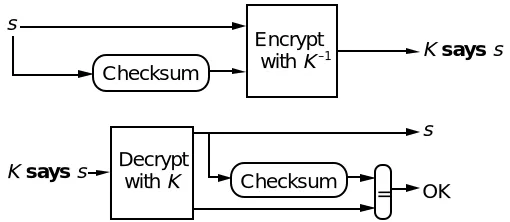
Fig. 3. Using encryption and checksums for integrity.
establish different subchannels. By (P2), C says X says s is the same thing as
C|X says s. Thus if C names the channel, C|X names the subchannel. We
will see many examples of this.
In what follows we concentrate on the flow of statements over secure chan-nels and on the state that each principal must maintain. Except in Section 8, we gloss over many details that may be important for performance but are not directly relevant to security, such as the insecure messages that are sent to initiate some activity and the exact path traversed by the bits of an encrypted message.
4.1 Encryption
We are mainly interested in channels that depend on encryption for their se -curity; as we shall see, they add less to the TCB than any others. We begin by summarizing the essential facts about such channels. An encryption channel consists of two functions Encrypt and Decrypt and two keys K and K–1. By convention, we normally use K to receive (decrypt) and K–1 to send (encrypt). Another common notation for Encrypt (K–1, x) is {x}
K–1.
An encryption algorithm that is useful for computers provides a channel: for any message x, Decrypt (K, Encrypt (K–1, x)) = x. The algorithm keeps the keys secret: if you know only x and Encrypt (K–1, x) you can’t compute K or K–1, and likewise for Decrypt . Of course “can’t compute” really means that the compu-tation is too hard to be feasible.
In addition, the algorithm should provide one or both of:
Secrecy: If you know Encrypt (K–1, x) but not K, you can’t compute x. Integrity: If you choose x but don't know K–1, you can’t compute a y such
that Decrypt (K, y) = x.
The usual way to get both properties at once is to add a suitable checksum to the cleartext and check it in Decrypt , as shown in Figure 3. The checksum should provide enough redundancy to make it very unlikely that decrypting with K will succeed on a message not produced by encrypting with K–1. Achieving this property requires some care [10, 28].
the result of applying a function Digest to the message. The Digest function produces a result of some fixed moderate size (typically 64 or 128 bits) no matter how large the message is. Furthermore, it is a one-way function; this means that you can’t invert the function and compute a message with a given digest. Two practical digest functions are MD4 [22] and MD5[23].
An algorithm that provides integrity without secrecy is said to implement digital signatures.
The secrecy or integrity of an encryption channel does not depend on how the encrypted messages are handled, since by assumption an adversary can’t compromise secrecy by reading the contents of an encrypted message, and can't compromise integrity by changing it. Thus the handling of an encrypted message is not part of the TCB, since security does not depend on it. Of course the availability of an encryption channel does depend on how the network handles messages; we have nothing to say about the vulnerability of the net-work to disruption.
There are two kinds of encryption, shared key and public key.
In shared key encryption K = K–1. Since anyone who can receive can also send under K, this is only useful for pairwise communication between groups of principals that trust each other completely, at least as far as messages on K are concerned. The most popular shared key encryption scheme is the Data Encryption Standard or DES [18]. We denote an encryption channel with the
DES key K by DES(K), or simply by K when the meaning is clear; the channel speaks for the set of principals that know K .
In public key encryption K ≠ K–1, and in fact you can’t compute one from the other. Usually K is made public and K–1 kept private, so that the holder of K–1 can broadcast messages with integrity; of course they won’t be secret.6 Together, K and K–1 are called a key pair. The most popular public key en -cryption scheme is Rivest-Shamir-Adleman or RSA [21]. In this scheme ( K–1)–1 = K, so anyone can send a secret message to the holder of K–1 by encrypting it with K.7 We denote an encryption channel with the RSA public key K by
RSA(K), or simply by K when the meaning is clear; the channel speaks for the principal that knows K–1.
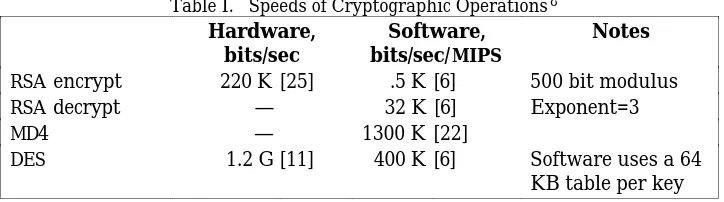
Table I shows that encryption need not slow down a system unduly. It also shows that shared key encryption is about 1000-5000 times faster than public key encryption when both are carefully implemented. Hence the latter is usu-ally used only to encrypt small messages or to set up a shared key.
4.2 Encryption Channels
With this background we can discuss how to make a practical channel from an
6 Sometimes K–1is used to denote the decryption key, but we prefer to associate encryption with
sending and to use the simpler expression K for the public key.
7 To send a message with both integrity and secrecy, encrypt it both with K–1
sender so that the re-ceiver can decrypt with Ksender to verify the integrity, and with Kreceiver so that the receiver (and only the receiver) will be able to decrypt with K–1
Table I. Speeds of Cryptographic Operations8 Hardware,
bits/sec
Software, bits/sec/MIPS
Notes
RSA encrypt 220 K [25] .5 K [6] 500 bit modulus
RSA decrypt — 32 K [6] Exponent=3
MD4 — 1300 K [22]
DES 1.2 G [11] 400 K [6] Software uses a 64
KB table per key
encryption algorithm. From the existence of the bits Encrypt (K–1, s) any one who knows K can infer K says s, so we tend to identify the bits and the statement; of course for the purposes of reasoning we use only the latter. We often call such a statement a certificate , because it is simply a sequence of bits that can be stored away and brought out when needed like a paper certificate. We say that K signs the certificate.
How can we name an encryption channel? One possibility is to use the key as a name, but we often want a name that need not be kept secret. This is straightforward for a public-key channel, since the key is not secret. For a shared key channel we can use a digest of the key. It’s possible that the re-ceiver doesn’t actually know the key, but instead uses a sealed and tamper-proof encryption box to encrypt or decrypt messages. In this case the box can generate the digest on demand, or it can be computed by encrypting a known text (such as 0) with the key.
The receiver needs to know what key K it should use to decrypt a message (of course it also needs to know what principal K speaks for, but that is a topic for later sections). If K is a public key we can send it along with the encrypted message; all the receiver has to do is check that K does decrypt the message correctly. If K is a shared key we can’t include it with the message because K must remain secret. But we can include a key identifier that allows the receiv -er to know what the key is but doesn’t disclose anything about it to oth-ers.
To describe our methods precisely we need some notation for keys and key identifiers. Subscripts and primes on K denote different keys; the choice of subscript may be suggestive, but it has no formal meaning. A superscripted key does have a meaning: it denotes a key identifier for that key, and the su-perscripts indicate who can extract the key from the identifier. Thus Kr de
-notes R’s key identifier for K, and if Ka and Kb are key identifiers for the two
parties to the shared key K, then Kab denotes the pair (Ka, Kb). The formula Kr
says s denotes a pair: the statement K says s together with a hint Kr to R
about the key that R should use to check the signature. Concretely, Kr says s
is the pair ( Encrypt (K–1, s), Kr). Thus the r doesn’t affect the meaning of the
8 Many variables affect performance; consult the references for details, or believe these numbers
statement at all; it simply helps the receiver to decrypt it. This help is some-times essential to the functioning of a practical protocol.
A key identifier Kr for a receiver R might be any one of:
—an index into a table of keys that R maintains,
—Encrypt (Krm, K), where Krm is a master key that only R knows,
—a pair ( K´r, Encrypt (K´ , K)), where K´r is a key identifier for the key K´ .
In the second case R can extract the key from the identifier without any state except its master key Krm, and in the third case without any state except what it needs for K´r. An encrypted key may be weaker cryptographically than a
table index, but we believe that it is safe to use it as a key identifier, since it is established practice to distribute session keys encrypted by master keys [19, 26, 28].
4.3 Broadcast Encryption Channels
We conclude the general treatment of encryption channels by explaining the special role of public keys, and showing how to get the same effect using shared keys. A public key channel is a broadcast channel: you can send a message without knowing who will receive it. As a result:
—You can generate a message before anyone knows who will receive it. In particular, an authority can make a single certificate asserting, for in-stance, that RSA( Ka) ⇒ A. This can be stored in any convenient place
(secure or not), and anyone can receive it later, even if the authority is then off line.
—If you receive a message and forward it to someone else, he has the same assurance of its source that you have.
By contrast, a shared key message must be directed to its receiver when it is generated. This tends to mean that it must be sent and received in real time, because it’s too hard to predict in advance who the receiver will be. An important exception is a message sent to yourself, such as the key identifier encrypted with a master key that we described just above.
For these reasons our system uses public key encryption for authentication, so that certification authorities can be off line. It can still work, however, even if all public key algorithms turn out to be insecure or too slow, because shared key can simulate public key using a relay . This is a trusted agent R that can translate any message m encrypted with a key that R knows. If you have a channel to R, you can ask R to translate m, and it will decrypt m and return the result to you. Relays use the key identifiers introduced above, and the ex-planation here depends on the notation defined there.
Since R simulates public key encryption, we assume that any principal A can get a channel to R. This channel is a key shared by R and A along with key identifiers for both parties. To set it up, A goes to a trusted agent,9 which
Table II. Simulating Public Key with Shared Key Encryption Using a Relay
Public key Shared key with relay
To send s, principal A encrypts with Ka–1 to make Ka says s.
encrypts with Kaar
to make Kar says s.
To receive s, principal B gets Ka says s and
decrypts it with Ka.
gets Kar says s,
sends it and Kbbr to R ,
gets back Kbb|Kar says s ,
and decrypts it with Kbb.
A certificate authenti -cating A to B is
Kca says Ka⇒ A. Kcar says K
bb|Kar⇒ A.
To relay a certificate
Kcar says Kaar ⇒ A
to Kbbr , R
is not needed. invents a key K and makes
Kbb|Kcar says Kab ⇒ A
where Kab = ( Ka, Kb) and
Ka = ( K
aa, Encrypt (Ka, K)),
Kb = ( K
bb, Encrypt (Kb, K)).
may be off line, and talks to it on some physically secure channel such as a hard-wired keyboard and display or a dedicated RS-232 line. The agent makes up a key K and tells A both K and Kr, R’s key identifier for K; to make Kr the
agent must know R’s master key. Finally, A constructs Ka, its own key
identifier for K. Now A has Kar, its two-way channel to R.
Given both Kar says s (a message encrypted by a shared key K
a together
with R’s key identifier for Ka) and Kbbr (the pair (K
bb, Kbr), which constitutes a
two-way shared-key channel between R and some B with the shared key Kb), the relay R will make Kbb|K
ar says s on demand. The relay thus multiplexes
all the channels it has onto its channel to B , indicating the source of each message by the key identifier. The relay is not vouching for the source A of s, but only for the key Ka that was used to encrypt s. In other words, it is simply identifying the source by labelling s with Kar and telling anyone who is inter
-ested the content of s. Thus it makes the channel Kar into a broadcast chan
nel, and this is just what public key encryption can do. Like public key en -cryption, the relay provides no secrecy; of course it could be made fancier, but we don’t need that for authentication. B’s name for the channel from A is
Kbb|K ar.
There is an added complication for authenticating a channel. With public keys, a certificate like Kca says Ka⇒ A authenticates the key Ka. In the simu-lation this becomes Kcar says K
ax⇒ A for some X, and relaying this to B is not
useful because B cannot extract Ka from Kax unless X happens to be B. But
given Kcar says K
aar ⇒ A and Kbbr as before, R can invent a new key K and
splice the channels Kaar and K
bbr to make a two-way channel Kab = ( Ka, Kb) be
-tween A and B. Here Ka and Kb are defined in the lower right corner of Table
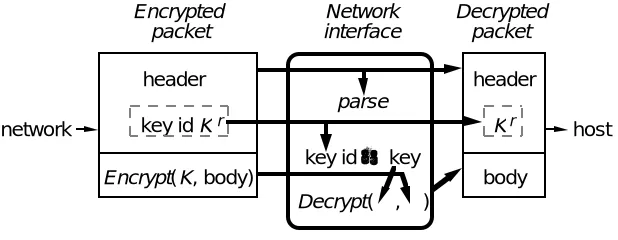
header key id K Encrypt(K, body)
parse
network host
header K body Encrypted
packet
Network interface
Decrypted packet
key id → key Decrypt( , )
[image:16.612.155.464.72.192.2]r r
Fig. 4. Fast decryption.
II; they are the third kind of key identifier mentioned earlier. Observe that A can decrypt Ka to get hold of K , and likewise for B and Kb. Now R can
trans-late the original message into Kbb|K
car says Kab ⇒ A, just what B needs for
authenticated communication with A. For two-way authentication, R needs
Kcar says K
bbr ⇒ B instead of just Kbbr; from this it can make the symmetric
certificate Kaa|K
car says Kab ⇒ B.
Table II summarizes the construction, which uses an essentially stateless relay to give shared key encryption the properties of public key encryption. The only state the relay needs is its master key; the client supplies the chan-nels Kar and K
bbr. Because of its minimal state, it is practical to make such a
relay highly available as well as highly secure.
Even with this simulation, shared key encryption is not as secure as public key: if the relay is compromised then existing shared keys are compromised too. With public key encryption a certificate like Kca says Ka ⇒ A which au -thenticates the key Ka can be both issued and used without disclosing Ka–1 to anyone. Public key also has a potential performance advantage: there is no common on-line agent that must provide service in order for authenticated communication to be established between A and B. The simulation requires the relay to be working and not overloaded, and all other schemes that use shared keys share this property as well.
Davis and Swick give a more detailed account of the scheme from a some-what different point of view [7].
4.4 Node-to-Node Secure Channels
A node is a machine running an operating system, connected to other ma -chines by wires that are not physically secure. Our system uses shared key encryption to implement secure channels between the nodes of the distributed system and then multiplexes these channels to obtain all the other channels it needs. Since the operating system in each node must be trusted anyway, us-ing encryption at a finer grain than this (for instance, between processes) can’t reduce the size of the TCB. Here we explain how our system establishes the node-to-node shared keys; of course, many other methods could be used.
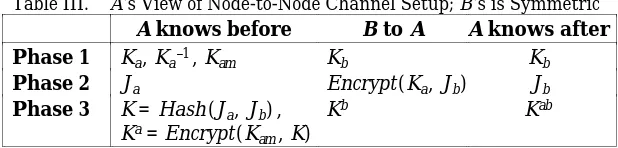
Table III. A’s View of Node-to-Node Channel Setup; B ’s is Symmetric
A knows before B to A A knows after
Phase 1 Ka, Ka–1, K
am Kb Kb
Phase 2 Ja Encrypt (Ka, Jb) Jb
Phase 3 K = Hash (Ja, Jb) ,
Ka = Encrypt (K am, K)
Kb Kab
key identifier for the channel, map the identifier to a DES key, and decrypt the packet on the fly as it moves from the wire into memory [14]. This makes it practical to secure all the communication in a distributed system, since en -cryption does not reduce the bandwidth or much increase the latency. Our key identifier is the channel key encrypted by a master key that only the receiving node knows. Figure 4 shows how it works.
We need to be able to change the master key, because this is the only way a node can lose the ability to decrypt old messages; after the node sends or receives a message we want to limit the time during which an adversary that compromis es the node can read the message. We also need a way to efficiently change the individual node-to-node channel keys, for two reasons. One is cryptographic: a key should encrypt only a limited amount of traffic. The other is to protect higher-level protocols that reuse sequence numbers and connection identifiers. Many existing protocols do this, relying on assump-tions about maximum packet lifetimes. If an adversary can replay mes sages these assumptions fail, but changing the key allows us to enforce them. The integrity checksum acts as an extension of the sequence number.
However, changes in the master or channel keys should not force us to reauthenticate a node-to-node channel or anything multiplexed on it, because this can be quite expensive (see Section 8). Furthermore, we separate setting up the channel from authenticating it, since these operations are done at very different levels in the communication protocol stack: setup is done between the network and transport layers, authentication in the session layer or above. In this respect our system differs from the Needham-Schroeder protocol and its descendants [15, 19, 26], which combine key exchange with au -thentication, but is similar to the Diffie-Hellman key exchange protocol [10].
We set up a node-to-node channel between nodes A and B in three phases; see Table III. In the first phase each node sends its public RSA key to the other node. It knows the corresponding private key, having made its key pair when it was booted (see Section 6). In phase two each node chooses a random
DES key, encrypts it with the other node’s public key, and sends the result to the other node, which decrypts with its own private key. For example, B chooses Jb and sends Encrypt (Ka, Jb) to A, which decrypts with Ka–1 to recover
Jb. In the third phase each node computes K = Hash(Ja, Jb),10 makes a key
10 Hash is a commutative one-way function. We use it to prevent a chosen-plaintext attack on a
identifier for K , and sends it to the other node. Now each node has Kab (the
key identifiers of A and B for the shared key K); this is just what they need to communicate.11 Each node can make its own key identifier however it likes; for concreteness, Table III shows it being done by encrypting K with the node’s master key.
A believes that only someone who can decrypt Encrypt (Kb, Ja) could share
its knowledge of K. In other words, A believes that K ⇒ Kb.12 This means that
A takes K ⇒ Kb as an assumption of the theory; we can’t prove it because it
depends both on the secrecy of RSA encryption and on prudent behavior by A and B, who must keep the J’s and K secret. We have used the secrecy of an
RSA channel to avoid the need for the certificate Kb says “The key with digest
D ⇒ Kb”, where D = Digest (K).
Now whenever A sees K says s, it can immediately conclude Kb says s. Thus
when A receives a message on channel K, which changes whenever there is rekeying, it also receives the message on channel Kb, which does not change
as long as B is not rebooted. Of course B is in a symmetric state. Finally, if either node forgets K, running the protocol again makes a new DES channel that speaks for the same public key on each node. Thus the DES channel behaves like a cache entry; it can be discarded at any time and later re-established transparently.
The only property of the key pair (Ka, Ka–1) that channel setup cares about
is that Ka–1 is A ’s secret. Indeed, channel setup can make up the key pair. But
Ka is not useful without credentials. The node A has a node key Kn and its
credentials Kn ⇒ A´ for some more meaningful principal A´ , for instance
VaxSN5437 as VMS5.4 (see Section 6). If Ka comes out of the blue, the node has
to sign another certificate, Kn says Ka⇒ Kn, to complete Ka’s credentials, and
everyone authenticating the node has to check this added certificate. That is why in our system the node tells channel setup to use (Kn, Kn–1) as its key
pair, rather than allowing it to choose a key pair.13
5. PRINCIPALS WITH NAMES
When users refer to principals they must do so by names that make sense to people, since users can’t understand alternatives like unique identifiers or
to be able to compute K, even if it sees the key establishment messages.
11 The third phase can compute lots of keys, for instance K, K+1, ..., and exchange lots of key
identifiers. Switching from one of these keys to another may be useless cryptographically, but it is quite adequate for allowing connection identifiers to be reused.
12 Actually K speaks for A or K
b, since A also knows and uses K. To deal with this we multiplex the encryption channel to make K|A and K|B (a single bit can encode A or B in this case), and A never makes K|B says s. Then A knows that K |B ⇒ Kb. To reduce clutter we ignore this compli -cation. There are protocols in use that encode this multiplexing in strange and wonderful ways.
13 Alternatively, the node could directly authenticate the shared key K by making K
keys. Thus an ACL must grant access to named principals.14 But a request arrives on a channel, and it is granted only if the channel speaks for one of the principals on the ACL. In this section we study how to find a channel C that speaks for the named principal A.
There are two general methods, push and pull. Both produce the same cre -dentials for A, a set of certificates and a proof that they establish C ⇒ A, but the two methods collect the certificates differently.
Push: The sender on the channel collects A’s credentials and presents them when it needs to authenticate the channel to the receiver. Pull: The receiver looks up A in some database to get credentials for A
when it needs to authenticate the sender; we call this name lookup .
Our system uses the pull method, like DSSA [12] and unlike most other au -thentication protocols. But the credentials don’t depend on the method. We describe them for the case we actually implement, where C is a public key.
5.1 A Single Certification Authority
The basic idea is that there is a certification authority that speaks for A and so is trusted when it says that C speaks for A, because of the handoff rule (P11). In the simplest system
—there is only one such authority CA,
—everyone trusts CA to speak for every named principal, and —everyone knows CA’s public key Kca, that is, Kca ⇒ CA .
So everyone can deduce Kca ⇒ A for every named A . At first this may seem too strong, but trusting CA to authenticate channels from A means that CA can speak for A, because it can authenticate as coming from A some channel that
CA controls.
For each A that it speaks for, CA issues a certificate of the form Kca says Ka ⇒ A in which A is a name. The certificates are stored in a database and in-dexed by A. This database is usually called a name service; it is not part of the
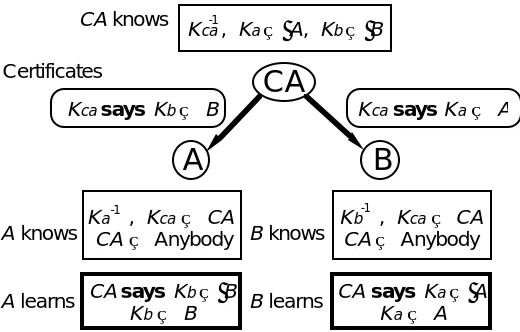
TCB because the certificates are digitally signed by Kca. To get A’s creden tials you go to the database, look up A, get the certificate Kca says Ka⇒ A, verify that it is signed by the Kca that you believe speaks for CA, and use the handoff rule to conclude Ka⇒ A, just what you wanted to know. The right side of Figure 5 shows what B does, and the symmetric left side shows what A does to establish two-way authentication.
The figure shows only the logical flow of secure messages. An actual imple-mentation has extra insecure messages, and the bits of the secure ones may travel by circuitous paths. To push, the sender A calls the database to get Kca says Ka⇒ A and sends it along with a message signed by Ka. To pull, the re -ceiver B calls the database to get the same certificate when B gets a message
14 Anonymous principals on ACLs are sometimes useful. For instance, a numbered bank account
CA
A
B
, Ka ⇒ A, Kb ⇒ B
, Kca⇒ CA
CA ⇒ Anybody CA says Kb ⇒ B
Kb⇒ B
CA knows
A learns A knows
Kca says Kb⇒ B Kca says Ka⇒ A
Kca-1
Kb-1
Ka-1 , Kca⇒ CA
CA ⇒ Anybody CA says Ka ⇒ A
Ka⇒ A
[image:20.612.176.436.70.236.2]B learns B knows Certificates
Fig. 5. Authenticating channels with a single certification authority.
that claims to be from A or finds A on an ACL. The NeedhamSchroeder proto col [19] combines push and pull: when A wants to talk to B it gets two certifi -cates from CA, the familiar Kca says Ka⇒ A which it pushes along to B, and
Kca says Kb⇒ B for A’s channel from B.
As we have seen, with public key certificates it’s not necessary to talk to CA directly; it suffices to talk to a database that stores CA’s certificates. Thus CA itself can be normally off line, and hence much easier to make highly secure. Certificates from an off line CA, however, must have fairly long lifetimes. For rapid revocation we add an on line agent O and use the joint authority rule (P12). CA makes a weaker certificate Kca says ( O|Ka∧ Ka) ⇒ A, and O coun -tersigns this by making O|Ka says Ka⇒ O|Ka. From these two, Kca ⇒ A, and (P12) we again get Ka ⇒ A, but now the lifetime is the minimum of those on
CA’s certificate and O’s certificate. Since O is on line, its certificate can time
out quickly and be refreshed often. Note that CA makes a separate certificate for each Ka it authenticates, and each such certificate makes it possible for O to convince a third party that Ka⇒ A only for specific values of Ka and A. Thus the TCB for granting access is just CA, because O acting on its own can’t do anything, but CA speaks for A; the TCB for revocation is CA and O, since either one can prevent access from being revoked.
Our system uses the pull method throughout; we discuss the implications in Sections 8 and 9. Hence we can use a cheap version of the joint authority scheme for revocation; in this version a certificate from CA is believed only if it comes from the server O that stores the database of certificates. To authen -ticate A we first authen-ticate a channel Co from O. Then we interpret the presence of the certificate Kca says ( O|Ka∧ Ka) ⇒ A on the channel Co as an encoding of the statement Co | Ka says Ka⇒ O |Ka. Because Co ⇒ O , this implies O|Ka says Ka⇒ O|Ka, which is the same statement as before, so we get the same conclusion. Note that O doesn’t sign a public-key certificate for
method. Or replace O by Ko everywhere. Either way, we can’t revoke O ’s au
-thority quickly; it’s not turtles all the way down.
A straightforward alternative to an on line agent that asserts O|Ka says Ka ⇒ O|Ka is a ‘black-list’ agent or recent certificate that asserts “all of CA’s
cer-tificates are valid except the ones for the following keys: K1, K2, ...” [5]. For
obvious reasons this must be said in a single mouthful. Such revocation lists are used with Internet privacy-enhanced mail.
Changing a principal’s key is easy. The principal chooses a new key pair and tells the certification authority its public key. The authority issues a new certificate and installs it in the database. If the key is being rolled over routinely rather than changed because of a suspected compromise, it may be de -sirable to leave the old certificate in the database for some time. Changing the authority’s key is more difficult. First the authority chooses a new key pair. Then it writes a new certificate, signed by the new key, for each existing cer-tificate, and installs the new certificates in the database. Next the new public key is distributed to all the clients; when a client gets the new key it stops trusting the old one. Finally, the old certificates can be removed from the database. During the entire period that the new key is being distributed, cer-tificates signed by both keys must be in the database.
The formalization of Figure 5 also describes the Kerberos protocol [15, 26]. Kerberos uses shared rather than public key encryption. Although its designers didn’t know about the relay simulation described in Section 4.3, the proto -col can be explained as an application of that idea to public key certificates. Here are the steps; they correspond to the union of Figure 5 and Table II. First A gets from CA a certificate Kcar says Kaar ⇒ A.15 Kerberos calls CA the
‘authentication server’, the certificate a ‘ticket granting ticket’, and the relay
R the ‘ticket granting server’. The relay also has a channel to every prin cipal
that A might talk to; in particular R knows Kbbr ⇒ B.16 To authenti cate a
channel from A to B, A sends the certificate to R , which splices Kaar and Kbbr
to turn it into Kbb says Kab ⇒ A. This is called a ‘ticket’,17 and A sends it on to
B, which believes Kb⇒ Anybody because Kb is B’s channel to CA . As a bonus,
R also sends A a certificate for B: Kaa says Kab ⇒ B.
In practice, application programs normally use Kerberos to authenticate network connections, which the applications then rather unrealistically treat as secure channels. To do this, A makes Kb says ci
a⇒ A, where cia is A’s net
-15 Ka is a login session key. CA invents Ka and tells A about it (that is, generates Kaa) by en -crypting it with A’s permanent key, which today is usually derived from A ’s password.
16 The Kerberos relay is asymmetric between A and B, since it knows K
bbr ⇒ B but gets its channel to A out of A’s certificate from CA. This is motivated by the application for which Kerber -os was originally designed, in which A is a workstation with plenty of cycles while B is a busy server. It is justified by the notion that there are only a few servers and they are friendly with R, but it’s unfortunate because asymmetry is bad and because R has to have some state for each B. There is an option (called ENC-TKT-IN-SKEY in [15]) for A to get Kca says Kbbr ⇒ B from B and give it to R, which can now be symmetric and stateless.
17 The ticket lacks the “ K
work address and connection identifier; this is called an ‘authenticator’. A sends both the ticket and the authenticator to B, which can then deduce cia ⇒
A in the usual way. The ticket has a fairly long lifetime so that A doesn’t have
to talk to R very often; the authenticator has a very short lifetime in case the connection is closed and cia then reused for another connection not controlled
by A. Kerberos has other features that we lack space to analyze.
Our channel authentication protocol is a communication protocol and must address all the issues that such protocols must address. In particular, it must deal with duplicate messages; in security jargon, it must prevent replays or establish timeliness. Because the statements in the authentication protocol are not imperative, it is not necessary to guarantee at-most-once delivery for the messages of the protocol, but it is important to ensure that statements were made recently enough. Furthermore, when the protocol is used to au-thenticate a channel that does carry imperative statements, it is necessary to guarantee at-most-once delivery on that channel.
The same techniques are used (or misused) for both security and communi-cation, sometimes under different names: timestamps, unique identifiers or nonces, and sequence numbers. Our system uses timestamps to limit the life-times of certificates and hence relies on loosely synchronized clocks. It also uses the fact that the shared key channel between two nodes depends on two random numbers, one from each node; therefore each node knows that any message on the channel was sent since the node chose its random number. The details are not new [4], and we omit them here.
5.2 Path Names and Multiple Authorities
In a large system there can’t be just one certification authority—it’s adminis -tratively impractical, and there may not be anyone who is trusted by every-body in the system. The authority to speak for names must be decentralized. There are many ways to do this, varying in how hard they are to manage and in which authorities a principal must trust to authenticate different parts of the name space.
If the name space is a tree, so that names are path names, it is natural to arrange the certification authorities in a corresponding tree. The lack of global trust means that a parent cannot unconditionally speak for its chil-dren; if it did, the root would speak for everyone. Instead when you want to authenticate a channel from A = / A1 /A2 /.../ An you start from an authority that
you believe has the name B = / B1 / B2 /.../ Bm and traverse the authority tree
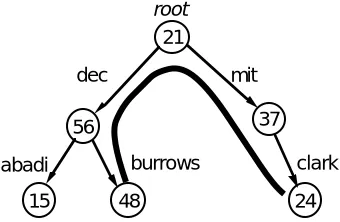
along the shortest path from B to A, which runs up to the least common an -cestor of B and A and back down to A. Figure 6 shows the path from /dec/burrows to /mit/clark; the numbers stand for public keys. The basic idea is described in Birrell et al. [3]; it is also implemented in SPX [27].
We can formalize this idea with a new kind of compound principal, written
root
dec
37 56
mit
burrows
15 abadi
48 24
[image:23.612.220.390.73.184.2]clark 21
Fig. 6. Authentication with a tree of authorities
We follow the usual convention and separate the simple names by ‘/ ’ sym-bols.18 Informally, P except N is a principal that speaks for any path name that is an extension of P as long as the first name after P isn’t N, and for any prefix of P as long as N isn’t ‘..’. The purpose of except is to force a traversal of the authority tree to keep going outward, away from its starting point. If in-stead the traversal could retrace its steps, then a more distant authority would be authenticating a nearer one, contrary to our idea that trust should be as local as possible. The axioms for except are:
” P except M ⇒ P (N1 )
So P except M is stronger than P; other axioms say how.
” M ≠ N ⊃ ( P except M) | N ⇒ P/ N except ‘..’ (N2 )
P except M can speak for any path name P/ N just by quoting N, as long as N isn’t M. This lets us go down the tree (but not back up by (N3), be-cause of the except ‘..’).19
” M ≠ ‘..’ ⊃ ( P/ N except M) | ‘..’ ⇒ P except N (N3 )
P/ N except M can speak for the shorter path name P just by quoting ‘..’, as long as M isn’t ‘..’. This lets us go up the tree (but not back down the same path by (N2), because of the except N).
The quoting principals on the left side of ⇒ prevent something asserted by P
except M from automatically being asserted by all the longer path names. Note that usually both (N2) and (N3) apply. For instance, /dec except burrows speaks for /dec/abadi except ‘..’ by (N2) and for / except dec by (N3).
Now we can describe the credentials that establish C ⇒ A in our system. Suppose A is /mit/clark. To use the (N) rules we must start with a channel from some principal B that can authenticate path names; that is, we need to
18 We follow Unix conventions and write / for the root rather than the empty string that our
ax-ioms produce.
19 By putting several names after the except rather than one, we could further constrain the
believe Cb ⇒ B except N. This could be anyone, but it’s simplest to let B be
the authenticating party. In Figure 6 this is /dec/burrows, so initially we be -lieve Cburrows ⇒/dec/burrows except nil, and this channel is trusted to au
-thenticate both up and down. In other words, Burrows knows his name and his public key and trusts himself.20 Then each principal on the path from B to
A must provide a certificate for the next one. Thus we need
Cburrows | ‘..’ says Cdec ⇒/decexcept burrows
Cdec | ‘..’ says Croot ⇒/except dec
Croot | mit says Cmit ⇒/mitexcept ‘..’
Cmit | clark says Cclark ⇒/mit/clarkexcept ‘..’
The certificates quoting ‘..’ can be thought of as ‘parent’ certificates pointing upward in the tree, those quoting mit and clark as ‘child’ certificates pointing downward. They are similar to the certificates specified by CCITT X.509 [5].
From this and the assumption Cburrows ⇒/dec/burrows except nil, we
de-duce in turn the body of each certificate, because for each A´ says C´ ⇒ B´ we have A´ ⇒ B´ by reasoning from the initial belief and the (N2-3) rules, and thus we can apply (P11) to get C´ ⇒ B´ . Then (N1) yields Cclark ⇒
/mit/clark, which authenticates the channel Cclark from /mit/clark. In the
most secure implementation each line represents a certificate signed by the public key of an off line certifier21 plus a message on some channel from an on line revo cation agent; see Section 5.1. But any kind of channel will do.
If we start with a different assumption, we may not accept the bodies of all these certificates. Thus if /mit/clark is authenticating /dec/abadi, we start with Cclark⇒/mit/clark except nil and believe the bodies of the certificates
Cclark | ‘..’ says Cmit ⇒/mitexceptclark
Cmit | ‘..’ says Croot ⇒/except mit
Croot | dec says Cdec ⇒/decexcept ‘..’
Cdec | abadi says Cabadi ⇒/dec/abadiexcept ‘..’
Since this path is the reverse of the one we traversed before except for the last step, each principal that supplies a parent certificate on one path supplies a child certificate on the other. Note that clark would not accept the bodies of any of the certificates on the path from burrows. Also, the intermediate results of this authentication differ from those we saw before. For example, when B was /dec/burrows we got Cdec⇒ /dec except burrows, but if B is
/mit/clark we get Cdec ⇒/dec except ‘..’. From either we can deduce Cdec ⇒
/dec, but Cdec’s authority to authenticate other path names is different. This
is because burrows and clark have different ideas about how much to trust dec.
20 You may find it more natural to assume that Burrows knows the name and public key of his
local certification authority. This corresponds to initially believing Cdec⇒/dec except nil. 21 A single certifier with a single key K can act for several principals by multiplexing its channel,