i
RISK LEVEL OF FACTORS CAUSING CONSTRUCTION WASTE GENERATION THROUGHOUT CONSTRUCTION PROJECT LIFE CYCLE
NOR SOLEHAH BINTI MD AKHIR
A thesis submitted in
fulfillment of the requirement for the award of the Degree of Master of Civil Engineering
Faculty of Civil and Environmental Engineering Universiti Tun Hussein Onn Malaysia
ABSTRACT
vi
ABSTRAK
viii
CONTENTS
TITLE i
DECLARATION ii
DEDICATION iii
ACKNOWLEDGEMENT iv
ABSTRACT v
CONTENTS vii
LIST OF TABLES xi
LIST OF FIGURES xiii
LIST OF SYMBOLS AND ABBREVIATIONS xiv
LIST OF APPENDICES xv
CHAPTER 1: INTRODUCTION
1.1 Research Background 1
1.2 Problem Statement 2
1.3 Aim and Objectives 4
1.4 Scope of Study 4
1.5 Research Methodology 4
1.6 Thesis Organization 5
CHAPTER 2: LITERATURE REVIEW
2.1 Introduction 6
2.2 Risk Management in Construction Project 6
2.3 Construction Wastes 9
2.3.1 Definition 9
2.3.2 Construction Wastes Generated 11
2.3.3 Waste Management 13
2.4 Causative Factors of Construction Waste Generation
19
2.5 Causative Factors in Construction Project Life Cycle
25
2.5.1 Construction Project Life Cycle (CPLC)
25
2.5.2 Incorporation of Causative Factors in CPLC
28
2.6 Mitigation Measures of Construction Wastes Generation
32
2.7 Summary 34
CHAPTER 3: METHODOLOGY
3.1 Introduction 35
3.2 Flow of the Research 35
3.3 Questionnaire Development 36
3.4 Data Collection 38
3.4.1 Pilot Study 38
3.4.2 The Delphi Method 38
3.5 Analysis Method 41
3.5.1 Reliability Test 41
3.5.2 Descriptive Analysis 41
3.5.3 Risk Matrix 42
CHAPTER 4: ANALYSIS AND DISCUSSION
4.1 Introduction 44
4.2 The Pilot Study Analysis 44
4.2.1 Experts‟ Demography 45
4.2.2 Reliability Test 45
x
4.3 Analysis of Delphi Survey 52
4.3.1 Respondents‟ Demography 52
4.3.2 Identification of Risk Level 55 4.3.3 Agreeability on Identified Risk
Level
60
4.4 Proposed Mitigations for Risk Factor 65
4.5 Summary 68
CHAPTER 5: CONCLUSION AND RECOMMENDATION
5.1 Introduction 70
5.2 Significant Findings 70
5.3 Limitations of the Study 74
5.4 Recommendations for Future Work 75
REFERENCES 76
LIST OF TABLES
2.1 Wastes definition 11
2.2 Construction wastes generated 13
2.3 Mapping of impact of construction waste 19
2.4 Mapping of factors contributing construction wastes generation
23
2.5 Comparison between proposed CPLC with others CPLC based on literature review
26
2.6 Factors of construction wastes according to CPLC 29 3.1 Scale represents the probability of occurrence and
level of severity
37
3.2 Applied Delphi method by researchers in construction research
39
3.3 Suggested Delphi method for this study 41
4.1 Expert‟s demography in pilot study 45
4.2 Reliability test results 46
4.3 AI value of factors in each phase 47
4.4 Significant factors in each phase 48
4.5 Risk level of causative factor in the planning phase
56
4.6 Risk level of causative factors in the design phase 56 4.7 Risk level of causative factors in the construction
phase
58
4.8 Risk level of causative factors in the finishing phase
xii
4.9 Percentage of agreeability for the risk level of causative factors in the planning phase and the design phase
61
4.10 Percentage of agreeability for the risk level of causative factors in the construction phase
62
4.11 Percentage of agreeability from panels for the risk level of causative factors in the finishing phase
64
LIST OF FIGURES
2.1 Six stage of waste management hierarchy 14 2.2 Construction project life cycle diagram 27
3.1 Research methodology flowchart 36
3.2 Process of the Delphi method 40
3.3 Risk matrix 43
4.1 Highest educational qualification of respondents
51
4.2 Respondents‟ working experiences 53
4.3 Respondents‟ position 53
4.4 Type of organization of respondents 54
4.5 Category of organization of respondents 54 4.6 Highest contract amount of projects that
respondents have dealt with
55
4.7 Risk level of causative factor in the planning phase
56
4.8 Risk level of causative factors in the design phase
57
4.9 Risk level of causative factors in the construction phase
59
4.10 Risk level of causative factors in the finishing phase
60
xiv
LIST OF SYMBOLS AND ABBREVIATIONS
AI - Average Index
CPLC - Construction Project Life Cycle
CWDCS - Construction Wastes Disposal Charging Scheme C&D - Construction and Demolition
DEL - Delivery/Procurement
EQP - Equipments
EXT - External/Unpredictable
GHG - Green House Gas
HRM - Human Resource/Manpower IBS - Industrialized Building System
ICT - Information, Communication, and Technology
MAT - Material
PCM - Project and Contract Management RIBA - Royal Institute of British Architects SPSS - Statistical Package for the Social Sciences WGR - Wastes Generation Rate
LIST OF APPENDICES
A Questionnaire Form: Pilot Study 91
B Questionnaire Form: Delphi Round 1 94
C Questionnaire Form: Delphi Round 2 97
CHAPTER 1
INTRODUCTION
1.1 Research Background
Construction is an imperative industry that plays a vital role in the socio-economic growth of a country. It provides necessary infrastructure and physical structure for activities such as commerce, services, and utilities (Khan, Liew, & Ghazali, 2014). Besides that, it also generates employment opportunities and enhances the nation‟s economy by creating foreign and local investment opportunities (Wibiwo, 2003). However, the industry is facing the problem of construction wastes generation. As reported by Kartam et al. (2004), based on statistics and assumptions, a total of Construction and Demolition (C&D) wastes production was estimated to be 1.6 million ton/year. According to Ferguson et al. (1995), over 50% of the wastes in a typical United Kingdom landfill is contributed by construction wastes. Bossink & Brouwers (1996) indicated that9% of the totally purchased materials ended up as wastes. Furthermore, Masudi et al. (2011) stated that wastage level for major materials in some projects in Malaysia may reach up to 10%.
There are various factors that contribute to generation of construction wastes. These factors pose different levels of risk in wastes generation. Various researchers have identified factors that contribute to wastes generation. As an example: A study conducted in Sri Lanka revealed that the domestic construction industry workforce is ignorant of the flow of activities that generated wastes (Senaratne & Wijesiri, 2008). In Malaysia, it was found that there were five significant factors that caused generation of construction wastes in this country. The factors are poor site management or supervision, lack of experience, inadequate planning and scheduling, mistakes and errors in design, and mistakes during construction (Nagapan, Rahman, & Asmi, 2012a). In addition, contractors and consultants agreed that three most important factors that contribute to generation of material wastes at construction site are rework contrary to drawings and specification, design changes and revision, and wastes from uneconomical shapes (Adeweyu & Otali, 2013).
A number of study highlighted that construction wastes are effectively generated during the whole Construction Project Life Cycle (CPLC) from start until completion of construction work (Kozlovská & Spišáková, 2013; Osmani, Glass, & Price, 2008). It may be generated during planning, design, procurement, and construction phase (Bossink & Brouwers, 1996; Ekanayake & Ofori, 2004; Wahab & Lawal, 2011). While, several studies highlighted that construction wastes is commonly generated during design and construction phase (Osmani, Glass, & Price, 2006; Panos & Danai, 2012).
Therefore, it can be concluded that construction wastes may be generated by various factors and it may occur in the whole of CPLC. It also contributes to a lot of negative impacts either to the project, environment or life. Thus, reducing wastes at the source is the most effective measure in wastes management (Masudi et al., 2011). By identifying the risk level of the factors and proposing the mitigations of the risky factors, it may help the practitioners to figure out the best way to control this problem.
1.2 Problem Statement
3
Pereira, 2010; Nasaruddin & Ravana, 2008). Out of these projects, the construction of residential building contributes the largest amount of construction wastes (Begum & Pereira, 2011; Foo et al., 2013).
According to Oh (2014) in The Star daily publication in March 2014, Solid Wastes Management and Public Cleansing Corporation highlighted that in 2007, Kuala Lumpur generated 1.04 million metric tonnes of construction wastes per year and this amount is expected to increase to 1.34 million metric tonnes a year by 2020. However, these wastes were not properly handled by the construction parties involved. Research studies have indicated that dumping of construction wastes in landfill is a common practice in Malaysia (Foo et al., 2013; Nagapan et al., 2012a).In 2007, a study conducted by Rahmat & Ibrahim (2007) showed that 42% of the wastes were dumped illegally in the district of Johor Bahru Tengah, Johor. The study also found 46 illegal dumping sites in the district and most of them were located near the road side. A study in the Klang Valley found only 20% of C&D wastes were disposed at legal landfills while others were disposed at illegal landfills or private lands (Begum & Pereira, 2011). There are also a number of contractors that disposed material wastes through open burning especially timber and packaging wastes, and also by burying concrete wastes (Masudi et al., 2011).
1.3 Aim and Objectives
The aim of this research is to assess the risk level of factors causing construction wastes generation throughout CPLC. In order to achieve this aim, three objectives have been established namely:
1) Identifying major factors causing construction wastes along the CPLC.
2) Determining the risk level of factor causing construction wastes along the CPLC.
3) Proposing mitigation of the risky factors.
1.4 Scope of Study
The scope of this research is limited to construction-related companies in Peninsular Malaysia. Data collection involves questionnaire survey using the Delphi method. The survey is start conducted in the early of 2014. The targeted respondents are the clients, consultants, and contractors whom are registered with CIDB between Grade 5 and 7. Respondents are selected among those who have more than ten years of working experience in the construction industry. Construction wastes are limited to material wastes only.
1.5 Research Methodology
5
1.6 Thesis Organization
This thesis is divided into five chapters as follows:
Chapter 1: This chapter describes the need of this study. It contains study background, problem statements, objectives, scope of study, research methodology, and thesis organization.
Chapter 2: This chapter elaborates on related literature through the published research work. It includes the definition, wastes generation scenarios, handling the wastes, and factors causing construction wastes generation. Besides that, the phases in CPLC are discussed.
Chapter 3: This chapter describes how this research is carried out. It explains the technique of data collection and the way to analyze them.
Chapter 4: The survey results will be illustrated in this chapter. It includes the factors of wastes generation throughout CPLC, level of occurrence, severity, and risk of the factors causing generation construction wastes throughout the CPLC. At the end of this chapter, the mitigation measures of high risk factors are presented.
LITERATURE REVIEW
2.1 Introduction
This chapter provides literature reviews that are related to this study. It is to gain an overview of the current study and to provide a theoretical basis in refining the research methodology and also the analysis approach for the current work. In this chapter, risk management in construction projects, the definitions of construction wastes, issues related to wastes generation, wastes management, impacts, and factors causing construction wastes generations are reviewed. In addition, the concept of four phases of CPLC is also discussed.
2.2 Risk Management in Construction Project
Project success can be defined by fulfilling the project objectives on the cost, time and quality. However, to achieve project success, it is subjected to various risks due to the unique features of construction activities, such as long period, complicated processes, abominable environment, financial intensity, and dynamic organizational structures (Zou, Zhang, & Wang, 2007; Akintoye & MacLeod, 1997). In addition, Husin, Ismail, & Memon (2013) stated that the construction industry is always faced with chronic problems such as time overrun, cost overrun, wastes generation, imposing negative impacts to the environment, and excessive resource consumption. Thus, risks in construction project have to be given serious attention so that the project is successfully accomplished.
7
Risk can be defined as a combination of the probability and the severity, and also the exposure of all hazards in the construction activity (Jannadi & Almishari, 2003). In managing risk, a systematic way is required to look into the areas of risk and consciously determining how to treat the risk. It is a management tool that aims at identifying sources of risk and uncertainty, determining their impact, and developing appropriate management responses (Uher, 2003). A process of risk management has been divided into three consecutive stages as stated by Perera et al. (2014) and KarimiAzari et al. (2011) which are;
i. risk identification, ii. risk analysis and
iii. risk response, where risk response has been further divided into four actions, i.e. retention, reduction, transfer, and avoidance
For risk identification and risk analysis, it specifies and predicts the likelihood and adverse impacts of risks; whereas for risk response, it is concerns on the measures taken by project management to reduce the probability and effects of risks (Perera et al., 2014).
Risk identification is a significant step in the risk management process, as it attempts to identify the various risks affecting a construction project. In this stage, risk factors that influence the project are detected, classified and documented (Gohar, Khandazi & Farmani, 2012). Source of the knowledge for risk identification phase is vital to the success of this stage and should elicit the viewpoints of experts with extensive experience in directly dealing with similar construction projects (Ruthankoon & Ogunlana, 2003). In this study, risk identification was accomplished through literature review and pilot study. A total of 33 factors causing construction waste generation were identified through literature review. Then, the identified factors were classified into four phase of CPLC through pilot study. From that, it presented one factor in planning phase, five factors in design phase, 32 factors in construction phase and nine factors in finishing phase.
There are two approaches used in risk analysis, which are quantitative risk analysis and qualitative risk analysis (Ehsan et al., 2010). Quantitative analysis involves more sophisticated techniques and methods to investigate and analyze construction project risks. Additionally, this analysis represents risks in mathematical form to quantify them in terms of performance in quality, time and cost (Morledge, Smith, & Kashiwagi, 2006). Quantitative risk analysis attempts to estimate the frequency of risks and the magnitude of their consequences by different methods such as the sensitivity analysis, decision tree analysis, the cost risk analysis, and Monte Carlo simulation (Mahendra, Pitroda, & Bhavsar, 2013; Ehsan et al., 2010; Modarres, 2006)
Qualitative risk analysis assesses the impact and likelihood of the identified risks and develops prioritized lists of the risks for further analysis or direct mitigation. A common qualitative approach is the precedence diagramming method, which uses ordinal numbers to determine priorities and outcomes. Another way of employing qualitative approach is to make a list of the processes of a project in descending order, calculate the risks associated with each process and list the controls that may exist for each risk (Ehsan et al., 2010). A risk matrix (or a probability/impact matrix) also is a tool commonly used in qualitative risk analysis (Mahendra et al., 2013; Zhou & Leung, 2012; Modarres, 2006). It is a table that contains several regions that indicate risk level based on the scale of probability and scale of impact or severity. Risks are qualitatively assessed according to the region it mapped. In this study, the risk levels for the factors that have been identified were assessed by using risk matrix which has been explained in section 3.5.3.
9
Basically, eliminating construction risks seems hardly doable (Siew & Abdul-Rahman, 2013). However, risk management should be applied into any construction project at the initial stage of the project to get maximum benefit in managing the risk. This is because, the awareness of the risks and appropriate strategies for dealing with the risks are imperative and contributes to the success of the projects (Zou et al., 2007).
2.3 Construction Wastes
There are a lot of researches in construction wastes generation that have been carried out in various countries. It includes the types of construction wastes, factors causing construction wastes, the impacts, and the way of handling the wastes. This subtopic comprises the definition of construction wastes, construction wastes generation in other countries, wastes management, and the impact of the wastes.
2.3.1 Definition
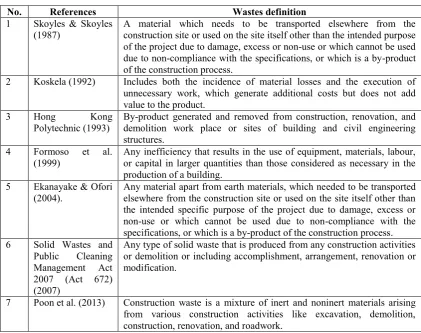
According to Poon et al. (2013), construction waste is a mixture of inert and non-inert materials arising from various construction activities like excavation, demolition, construction, renovation, and roadwork. Based on all highlighted definitions, it should be understood that construction wastes is in the form of materials losses while the construction project was being carried out.
However, according to new production philosophy, Koskela (1992) stated that construction wastes „includes both the incidence of material losses and the execution of unnecessary work, which generates additional costs but does not add value to the product. This was then was supported by Formoso, Isatto, & Hirota (1999) whom defined construction wastes as „any inefficiency that results in the use of equipment, materials, labour, or capital in larger quantities than those considered as necessary in the production of a building‟. This means that, besides material wastes; time, cost, and process wastes also can be described as wastes. It can be generated due to any inefficiency of activities such as waiting time, over production, and processing but do not add any value to the project. However, this research only focuses on construction material wastes. Although construction wastes generation contributes to high economic losses than material wastes (Formoso et al., 1999), the most important thing that we have to be concerned with is the adverse impact on the environment (Masudi et al., 2011) which is contributed by material wastes. Table 2.1 summarizes the various definitions given for construction waste.
11
Table 2.1: Wastes definition
No. References Wastes definition
1 Skoyles & Skoyles
(1987) A material which needs to be transported elsewhere from the construction site or used on the site itself other than the intended purpose of the project due to damage, excess or non-use or which cannot be used due to non-compliance with the specifications, or which is a by-product of the construction process.
2 Koskela (1992) Includes both the incidence of material losses and the execution of
unnecessary work, which generate additional costs but does not add value to the product.
3 Hong Kong
Polytechnic (1993)
By-product generated and removed from construction, renovation, and demolition work place or sites of building and civil engineering structures.
4 Formoso et al.
(1999) Any inefficiency that results in the use of equipment, materials, labour, or capital in larger quantities than those considered as necessary in the production of a building.
5 Ekanayake & Ofori
(2004).
Any material apart from earth materials, which needed to be transported elsewhere from the construction site or used on the site itself other than the intended specific purpose of the project due to damage, excess or non-use or which cannot be used due to non-compliance with the specifications, or which is a by-product of the construction process.
6 Solid Wastes and
Public Cleaning
Management Act 2007 (Act 672) (2007)
Any type of solid waste that is produced from any construction activities or demolition or including accomplishment, arrangement, renovation or modification.
7 Poon et al. (2013) Construction waste is a mixture of inert and noninert materials arising from various construction activities like excavation, demolition, construction, renovation, and roadwork.
2.3.2Construction Wastes Generated
The construction wastes become serious environmental problems in many countries and are becoming more critical recently. Through literature review, issues related to the construction wastes generation in various countries are discussed below.
aggregate, and rubbles followed by soil, wood, metals, and roofing materials. In 2013, a research that was conducted in three construction sites found that timber wastes was the dominant waste produced, followed by bricks, packaging wastes, and concrete (Nagapan et al., 2013).
While, in another research, the total wastes generated at two housing project sites was 154.31 m3 and the major wastes consists of timber (49%) (Foo et al., 2013). Besides that, Masudi et al. (2011) conducted a study intending to quantify the wastage level of several types of material wastes such as timber, concrete, reinforcement bar, tiles, screeds, and plaster. The results showed that the wastage level for major material is up to 10%. They also concluded that awareness among construction players in Malaysia on wastes minimization is still lacking.
Thailand: As reported by a research in 2009, the construction industry generated an average of 1.1 million tonnes of construction wastes per year between 2002 – 2005 (Kofoworola & Gheewala, 2009).
Indonesia: A research was conducted to determine quantities of construction wastes material. The study indicated that brick and sand wastes were the most wastes on the site which is 12.51% and 11.39% respectively. The cost modelling showed that the range of material wastes cost was between 3.33% to 4.67% of the total material cost (Intan, Alifen, & Arijanto, 2005).
Kuwait: Kartam et al. (2004) conducted a research to study the environmental management of C&D wastes. The results indicated that C&D wastes in Kuwait consist of concrete (30%), bricks (30%), sand (25%), wood (8%), steel (5%), and others (2%). According to statistics and assumptions, the total C&D wastes production was estimated to be 1.6 million ton/year (excluding solely earth and sand).
13
wastes, timber for formwork and false work, and concrete were the three largest components amongst the generated wastes (Lu et al., 2011).
Based on literature review, it can be seen that construction waste generation problem not only occur in Malaysia but also in other countries. It also can be concluded that construction waste is commonly contributed by timber, brick, concrete, sand, steel, and others, with majority of the wastes disposed into landfills. However, the amount of waste generated varies in each country. Table 2.2 summarizes the construction waste generated for the countries mentioned above.
Table 2.2: Construction wastes generated
Origin Reference Findings
Malaysia Rahmat & Ibrahim,
2007 A total of 46 sites of illegal dumping were found in the District of Johor Bahru Tengah, Johor.
Most of illegal dumping sites were located near the road side
corridor.
42% of the wastes originated from the construction industry. Begum & Pereira,
2011 Only 20% of C&D wastes were disposed in legal landsites 88% C&D wastes were generated from residential buildings, 9% from commercial buildings, and 3% from government buildings.
Masudi et al., 2011 Wastage level for major material is up to 10%.
Awareness among construction players in Malaysia on wastes
minimization is still lacking.
Foo et al., 2013 Total waste generated at two sites was 154.31 m3 and 49% were timber wastes.
Thailand Kofoworola &
Gheewala, 2009 1.1 million tonnes of construction wastes were generated per year between2002-2005.
Indonesia Intan et al., 2005 Brick and sand were the dominant wastes (12.51% and
11.39%)
Wastes generated in the range of 3.33% to 4.67% of the total
material cost.
Kuwait Kartam et al., 2004 Wastes in Kuwait consist of concrete (30%), bricks (30%),
sand (25%), wood (8%), steel (5%), and others (2%).
1.6 million ton/year construction wastes generated.
China Wang et al., 2008 Concrete, cement, brick, timber, tile, steel, and aluminium
wastes are the main wastes sources produced at construction sites.
Lu et al., 2011 Wastes Generation Rate (WGR) ranged from 3.275 to 8.791
kg/m2.
2.3.3Waste Management
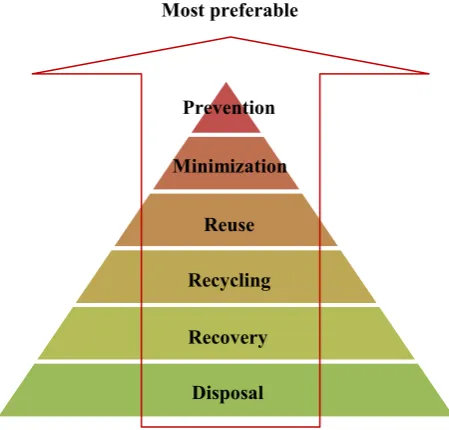
suggested that this adoption can be integrated into a six stage of waste management hierarchy which includes prevention, minimization, reuse, recycling, recovery, and disposal, as shown in Figure 2.1.
Figure 2.1: Six stage of waste management hierarchy (Adapted from Nagapan et al., 2012d)
Figure 2.1 shows the six stages of waste management hierarchy that can be adopted to handle the wastes. The stage of the waste management option is ranked based on what is best for the environment. The most preferred way is by preventing or reducing the generation of waste. However, if the waste generation cannot be prevented or reduced, it is recommended to recycle, reuse or recover the wastes as much as possible. But, if wastes are still being produced, then the last option is by disposing the wastes. However, the disposal method is not a preferred option because the role of waste management is to reduce the amount of waste that is discharged into the environment (Nagapan et al., 2012d). Below is the description for each stage of waste management hierarchy.
Prevention& Minimization: It refers to avoid or reduce producing waste, which is the best way to reduce the impact of waste on the environment (Egan, 1998; Ekanayake & Ofori, 2004; Esin & Cosgun, 2007) and for better economic savings (Al-Hajj & Hamani, 2011). Besides that, avoiding or minimizing from the source in construction project may reduce the amount of waste generation (Kozlovská &
Minimization
Reuse
Recycling
Recovery
15
Spišáková, 2013), raw material usage, and lessen transportation works (Nagapan et al., 2012d).
In order to prevent or minimize the generation of construction waste, a proper construction waste management approach should be planned before site operations begin. As stated by Lu & Tam (2013), contractors have to prepare a waste management plan as part of the overall environmental management plan, and set out waste reduction targets and programs. They also are advised to set up a good house-keeping practice and a waste management monitoring and audit program, throughout the whole construction processes (Lu & Tam, 2013). Al Hajj & Hamani (2011) have suggested four measures for efficient prevention of construction waste on site which are logistics management, supply chain management, modern construction method, and training and incentivizing.
In China, the government has taken various actions to tackle the issue of the increasing amount of construction waste generation. These actions include the alteration of the Waste Disposal Ordinance, issuance of a policy paper for a comprehensive 10 year plan to reduce construction waste, launching of a green manager scheme on construction sites, promulgation of a waste reduction framework plan, issuance of a practice note promoting the use of recycled aggregate, implementation of the policy of Waste Management Plan (WMP) at construction sites, commissioning of a pilot concrete recycling plant, and introduction of a charging scheme for the disposal of construction waste (Esin & Cosgun, 2007).In Malaysia, the implementation of prefabrication and Industrialized Building System (IBS) method in the construction industry was encouraged by the government as a solution to reduce the amount of waste generation (Abdullah & Malik, 2012). The adoption of this method can reduce construction waste generated by as much as 41% to 50%, which is a large amount of reduction (Hassan et al., 2012; Begum, et al., 2010). Though preventing waste production on site is not possible, we can, however, reduce its amount.
contractors to recycle and reuse their construction waste and this scheme has shown a significant reduction even after three years of implementation (Yu et al., 2013).
In Germany, a technology of drying distillation and burning is used to handle waste which will separate every kind of material that can be reprocessed cleanly from waste and reused again (Wang & Li, 2011).Besides that, some materials such as timber can be reused in the site for several times to avoid the cost of collection and disposal, and the extra cost of virgin material. Broken bricks and concrete can still be reused as a sub-grade of access road to the construction site (Nagapan et al., 2012d). This approach could help to reduce construction waste at site before it gets disposed.
Recycling: Recycling means separating, collecting, processing, marketing and ultimately using a material that would otherwise have been thrown away (Yeheyis et al., 2012). A study has shown that recycling reduces the amount of waste, Green House Gas (GHG) emission, saves energy, and reduces the use of virgin raw material (Pimenteira et al., 2005). Various countries have practised recycling very well in order to reduce the amount of waste. In Denmark, Estonia, Germany, Ireland, and the Netherlands the percentage of recycling rate is more than 80% while in France and Luxembourg the recycling rate percentage is between 40% to 50% (Calvo et al., 2014).
In Finland, the recycling rate of the C&D wasteincreasedto70% as the government imposed garbage tax to 30 euro per tonne in 2005 and planned on increasing the tax further more recently (Yunpeng, 2011). In Holland, the government had set up a series of laws of restricting dumping of waste and quality-control system of forcing recycling. The government also motivated contractors to recycle their waste by granting reward bonus if they used recycled materials in their project. However, the recycling rate of construction waste in Malaysia is still low at 10.5% (Solid Waste and Public Cleansing Management Corporation (PPSPPA), 2013), due to the lack of awareness among construction players (Goh et al., 2013; Masudi et al., 2011).
17
heavy metal in one tonne wastes after distillation and burning process. Thus, this method resolves the problem effectively from taking up space at the landfill. Moreover, the gas produced during the handling process is used to generate electricity.
Disposal: The most common disposal of material waste is by landfill (Nagapan et al., 2012d). This is the final option used for construction waste disposal. However, it is advised to dispose properly at a landfill to alleviate pollution to the surrounding. In Malaysia, the practice of construction waste management is still low as compared to other countries. Most of the waste ends up at landfills. It can be seen in Malaysia that about 261 to 291 landfill sites are in existence (Hamatschek, Tee, & Faulstich, 2010). Also in Thailand, most of construction waste are buried on site, disposed at landfill or illegally dumped. Reuse and recycle are less frequently practiced since the processing cost exceeds the cost of buying raw material (Manowong, 2012).
As a conclusion, it is seen that a waste management hierarchy offer a systematic and efficient waste management strategy which would minimize the generation of waste at different level. A waste management hierarchy should be applied in any construction project. The construction parties involved should try to prevent, reduce, reuse, and recycle the construction waste before it dispose to landfills. The approach will helps to reduce negative issues related to environment, social and economy.
2.3.4 Impacts of the Waste
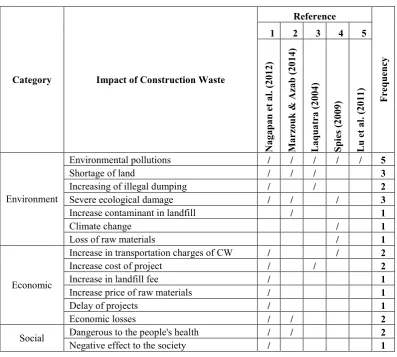
According to Marzouk & Azab (2014), the environmental problems due to waste generation include diminishing landfill space due to incremental quantities of these disposed wastes in it, depleted building materials, increase in contamination from landfills that leads to serious negative health effects, damage to the environment, and increase in energy consumption for transportation, and manufacturing new materials instead of those materials dumped and which require energy production. Another study revealed that the effects of construction waste on the environment are clear (Spies, 2009). It can cause water and soil pollution, air pollution, climate change, and adverse effects on flora and fauna. As mentioned by Laquatra (2004), the negative effects of construction waste on the environment includes landfill space becoming limited, faulty landfills polluting the air, earth, and water, and increase in illegal dumping of C&D waste. This shows that the majority of researchers have a consensus that the significant impact on the environment due to improper waste disposal is environmental pollution.
19
Table 2.3: Mapping of impact of construction waste
Category Impact of Construction Waste
Reference
F
re
qu
ency
1 2 3 4 5
Na ga pa n e t al . ( 20 12 ) M arz ouk & Az ab ( 20 14 ) L aqu at ra ( 20 04 ) Sp ies ( 20 09 ) L u e t al . ( 20 11 ) Environment
Environmental pollutions / / / / / 5
Shortage of land / / / 3
Increasing of illegal dumping / / 2
Severe ecological damage / / / 3
Increase contaminant in landfill / 1
Climate change / 1
Loss of raw materials / 1
Economic
Increase in transportation charges of CW / / 2
Increase cost of project / / 2
Increase in landfill fee / 1
Increase price of raw materials / 1
Delay of projects / 1
Economic losses / / 2
Social Dangerous to the people's health / / 2
Negative effect to the society / 1
2.4 Causative Factors of Construction Waste Generation
As waste impairs the efficiency, effectiveness, value, and profitability of construction activities, there is a need to identify the causes of wastes generation and to control them within reasonable limits. Wastes in construction projects can occur due to many reasons. The comprehensive literature reviews on causative risk factors regarding construction wastes generation are carried out to understand these issues.
wastes generation are „Poor site management or supervision‟, „Lack of experience‟, „Inadequate planning and scheduling‟, „Mistakes and errors in design‟, and „Mistakes during construction‟ (Nagapan et al., 2012c).
China: Yunpeng (2011) investigated the main causes of the generation of construction wastes and they are „Unimplemented wastes management measures and weak consciousness of material saving and environmental protection‟, „Low performance of building materials and backward construction technologies‟, „Lack of communication and coordination between building contractors‟, and „No irritation of market benefit and short of supervision‟.
Singapore: Ekanayake & Ofori (2004) have carried out a survey to determine the attributes according to their potential contributions to the generation of waste on site. The finding shows that under Design-related waste sources, four of the attributes have most significant impacts on construction wastes generation on site were „Lack of attention paid to dimensional coordination of products‟, „Design changes while construction is in progress‟, „Designer‟s inexperience in method and sequence of construction‟, and „Lack of knowledge about standard sizes available on the market‟. Under the Operational sector, the three attributes that had most significant impact on construction wastes generation at site are: „Errors by trades persons or labourers‟, „Damage to work done due to subsequent trades‟, and „Required quantity unclear due to improper planning‟. Six attributes under Material handling related waste sources and only one is the most significant impact which is „Inappropriate site storage‟. There were three attributes under Procurement and none of the attributes significantly contribute to construction wastes generation.
21
India: A research conducted by Kulatunga et al. (2006) using questionnaires survey to study the attitudes and perceptions of construction workforce on construction wastes in Sri Lanka. The findings indicated positive perceptions and attitudes of the construction workforce towards minimizing wastes and conserving natural resources. However, a lack of effort in practicing these positive attitudes and perceptions towards waste minimisation was identified.
Indonesia: Nazech, Zaldi, & Trigunarsyah (2008) also discussed the results of the study on the identification of construction wastes in road and highway construction projects in the greater Jakarta area. The study indicates that Work Execution has been identified as the most important group of causes of the construction wastes which „Inadequate proper construction equipment‟ has been suggested as the main contributor to this condition. The other dominant sources of wastes are Materials and Manpower. The study also shows that „Lack of management capability‟ as the main factor of the construction wastes, which indicates the correlation between the waste produced and management aspects related to project duration and labours.
Egypt: Garas, Anis, & Gammal (2001) whom conducted a research to address the incidence of material waste in the Egyptian Construction Industry has found that the most dominant causes are late information, uncompleted design, inadequate information, poor control, unnecessary people‟s moves, untrained labour, work not done, poor technology of equipment, changes to design, and damage during transportation.
site‟, „Accident, supplier error‟, „Criminal wastes due to damage or theft and equipment malfunction‟.
Turkey: A research was conducted by Polat & Ballard (2004) to study the main waste causes in the Turkish construction industry. The significant causes of material waste that were found are „Ordering of materials that do not fulfil project requirements defined on design documents‟, „Imperfect planning of construction‟, and „Workers mistakes during operation‟.
Nigeria: Wahab & Lawal (2011) have conducted a research to assess the forms, causes, and factors incidental to wastes. The result shows that among the factors incidental to wastes, „Last minute client requirement‟ was ranked highest as the factor that leads to design variation.
23
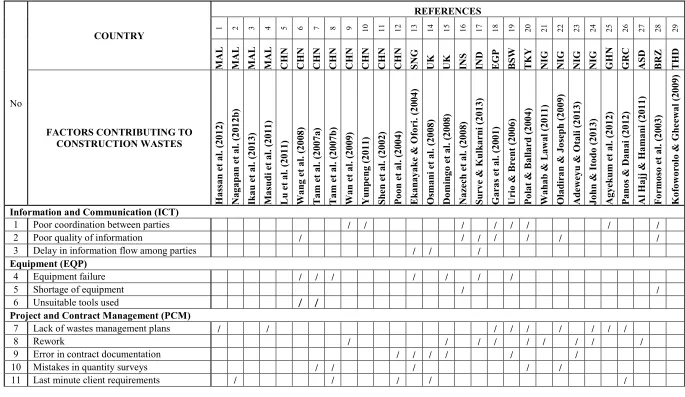
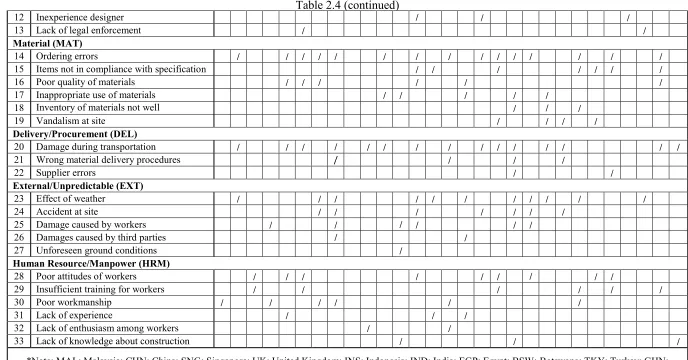
Table 2.4: Mapping of factors contributing construction wastes generation
No
COUNTRY
REFERENCES
1 2 3 4 5 6 7 8 9 10 11 12 13 14 15 16 17 18 19 20 21 22 23 24 25 26 27 28 29
M AL M AL M AL M AL CH N CH N CH N CH N CH N CH N CH N CH N
SNG UK UK INS IND EG
P B SW T K Y
NIG NIG NIG NIG GHN GRC ASD BRZ TH
D
FACTORS CONTRIBUTING TO CONSTRUCTION WASTES H as sa n e t al . ( 20 12 ) Na ga pa n e t al . ( 20 12 b) Ika u e t al . ( 20 13 ) M as ud i e t al . ( 20 11 ) L u e t al . ( 20 11 ) Wa ng et a l. (2 00 8) T am e t al . ( 20 07 a) T am e t al . ( 20 07 b) Wa n e t al . ( 20 09 ) Yunp eng ( 20 11 ) Sh en et a l. (2 00 2) P oo n e t al . ( 20 04 ) E ka na ya ke & O fo ri . ( 20 04 ) O sma ni et a l. (2 00 8) Do min go et a l. (2 00 8) Na ze ch et a l. (2 00 8) Su rv e & K ulk arni ( 20 13 ) G ara s et a l. (2 00 1) Urio & B re nt (2 00 6) P ola t & B alla rd (2 00 4) Wa ha
b & La
wa l ( 20 11 ) O la dira
n & J
os eph ( 20 09 ) Adewe
yu & O
ta li ( 20 13 ) Jo hn & Ito do ( 20 13 ) Ag yekum et a l. (2 01 2) P ano s & Da na i ( 20 12 ) Al H aj j & H ama ni ( 20 11 ) F ormo so et a l. (2 00 3) K of owo ro lo & G he ewa l ( 20 09 )
Information and Communication (ICT)
1 Poor coordination between parties / / / / / / / /
2 Poor quality of information / / / / / / /
3 Delay in information flow among parties / / /
Equipment (EQP)
4 Equipment failure / / / / / / /
5 Shortage of equipment / /
6 Unsuitable tools used / /
Project and Contract Management (PCM)
7 Lack of wastes management plans / / / / / / / / /
8 Rework / / / / / / / / /
9 Error in contract documentation / / / / / /
10 Mistakes in quantity surveys / / / / /
Table 2.4 (continued)
12 Inexperience designer / / /
13 Lack of legal enforcement / /
Material (MAT)
14 Ordering errors / / / / / / / / / / / / / / /
15 Items not in compliance with specification / / / / / / /
16 Poor quality of materials / / / / / /
17 Inappropriate use of materials / / / / /
18 Inventory of materials not well
documented / / /
19 Vandalism at site / / / /
Delivery/Procurement (DEL)
20 Damage during transportation / / / / / / / / / / / / / / /
21 Wrong material delivery procedures / / / /
22 Supplier errors / /
External/Unpredictable (EXT)
23 Effect of weather / / / / / / / / / / /
24 Accident at site / / / / / / /
25 Damage caused by workers / / / / / /
26 Damages caused by third parties / /
27 Unforeseen ground conditions /
Human Resource/Manpower (HRM)
28 Poor attitudes of workers / / / / / / / / /
29 Insufficient training for workers / / / / / /
30 Poor workmanship / / / / / /
31 Lack of experience / / /
32 Lack of enthusiasm among workers / /
33 Lack of knowledge about construction / / /
[image:36.842.74.762.116.476.2]76
REFERENCES
Abdullah, A. M., & Malik, S. A. (2012). Key indicators of SWOT analysis between Bumiputera and Non-bumiputera Industrialized Building System (IBS) contractors in Selangor. 2012 International Conference on Statistics in Science, Business and Engineering (ICSSBE) (pp. 1–6). IEEE.
Adeweyu, T. O., & Otali, M. (2013). Evaluation of causes of construction material wastes - Case of Rivers State, Nigeria. Ethiopian Journal of Environmental Studies and Management, 6(6), 746–753.
Agyekum, K., Ayarkwa, J., & Adinyira, E. (2012). Consultants‟ perspectives on materials wastes reduction in Ghana. Engineering Management Research, 1(1), 138–150.
Akintoye, A. S., & Macleod, M. J. (1997). Risk analysis and management in construction. International Journal of Project Management, 15(1), 31–38. Al-Hajj, A., & Hamani, K. (2011). Material wastes in the UAE construction
industry : Main causes and minimisation practices. Architectural Engineering and Design Management, 7(4), 221–235.
Alshubbak, A., Pellicer, E., & Catalá, J. (2009). A collaborative approach to project life cycle definition based on the Spanish construction industry. 3RD Conference on Engineering Work in Palestine November 3-5, 2009 (pp. 1–19). Alwi, S., Hampson, K., & Mohamed, S. (2001). Effect of quality supervision on
rework in the Indonesian context. Asia Pacific Building and Construction Management Journal, 1–9.
Abdullah, A. M., & Malik, S. A. (2012). Key indicators of SWOT analysis between Bumiputera and Non-bumiputera Industrialized Building System (IBS) contractors in Selangor. 2012 International Conference on Statistics in Science, Business and Engineering (ICSSBE) (pp. 1–6). IEEE.
Adeweyu, T. O., & Otali, M. (2013). Evaluation of causes of construction material wastes - Case of Rivers State, Nigeria. Ethiopian Journal of Environmental Studies and Management, 6(6), 746–753.
Agyekum, K., Ayarkwa, J., & Adinyira, E. (2012). Consultants‟ perspectives on materials wastes reduction in Ghana. Engineering Management Research, 1(1), 138–150.
Akintoye, A. S., & Macleod, M. J. (1997). Risk analysis and management in construction. International Journal of Project Management, 15(1), 31–38. Al-Hajj, A., & Hamani, K. (2011). Material wastes in the UAE construction
industry : Main causes and minimisation practices. Architectural Engineering and Design Management, 7(4), 221–235.
Alshubbak, A., Pellicer, E., & Catalá, J. (2009). A collaborative approach to project life cycle definition based on the Spanish construction industry. 3RD Conference on Engineering Work in Palestine November 3-5, 2009 (pp. 1–19). Alwi, S., Hampson, K., & Mohamed, S. (2001). Effect of quality supervision on
rework in the Indonesian context. Asia Pacific Building and Construction Management Journal, 1–9.
78
Alwi, S., Hampson, K., & Mohamed, S. (2002b). Non value-adding activities in Australian construction projects. Proceedings International Conference on Advancement in Design, Construction, Construction Management and Maintenance of Building Structure (pp. 270–278).
Alwi, S., Hampson, K., & Mohamed, S. (2002c). Non value-adding activities: A comparative study of Indonesian and Australian construction projects. Proceedings 10th of the International Group of Lean Construction Conference (pp. 627–638).
Arnold, P., & Javernick-will, A. (2013). Projectwide Access : Key to effective implementation of construction project management software systems. Journal of Construction Engineering and Management, 139(5), 510–518.
Augustine, S. (2011). Managing wastes and cost in the construction industry : a case study of the road construction. Kwame Nkrumah University of Science and Technology: Master's Thesis.
Barron, M., & Barron, A. R., (2013). Project management. Rice University, Houston, Texas: Connexions.
Bennet, F. L. (2007). The management of construction: a project lifecycle approach. Alaska: Routledge.
Begum, R. A., & Pereira, J. J. (2011). C&D waste profile of the Malaysian construction industry: Need a centralized database. Sustainable Technologies (WCST), 2011 World Congress on (pp. 73-76). IEEE.
Begum, R. A., Satari, S. K., & Pereira, J. J. (2010). Wastes generation and recycling : Comparison of Conventional and Industrialized Building Systems. American Journal of Environmental Sciences, 6(4), 383–388.
Begum, R. A., Siwar, C., Pereira, J. J., & Jaafar, A. H. (2009). Attitude and behavioral factors in wastes management in the construction industry of Malaysia. Resources, Conservation and Recycling, 53(6), 321–328.
Berg, R., & Hinze, J. (2005). Theft and vandalism on construction sites. Journal of Construction Engineering and Management, 131(7), 826–833.
Bossink, B. A. G., & Brouwers, H. J. H. (1996). Construction wastes: Quantification and source evaluation. Journal of Construction Engineering and Management, 122(1), 55–60.
policies based on economic incentives and tax penalties. Sustainability, 6(1), 416-435.
Chandrakanthi, M., & Ruwanpura, J. Y. (2002). Optimization of the wastes management for construction projects using simulation. Proceedings of the 2002 Winter Simulation Conference (pp. 1771–1777). IEEE.
Chan, D. W., & Kumaraswamy, M. M. (1997). A comparative study of causes of time overruns in Hong Kong construction projects. International Journal of Project Management, 15(1), 55-63.
Chan, A. P. C., Yung, E. H. K., Lam, P. T. I., Tam, C. M. & Cheung, S. O. (2001). Application of Delphi method in selection of procurement systems for construction projects. Construction Management and Economics, 19 (7), 699 - 718.
Dainty, A. R., & Brooke, R. J. (2004). Towards improved construction wastes minimisation: a need for improved supply chain integration? Structural Survey, 22(1), 20-29.
Domingo, N., Osmani, M., & Price, A. D. F. (2008). Reducing construction wastes in healthcare facilities : A project lifecycle approach. Association of Researches in ConstructionManagement, Cardiff, Wales.
Egan, J. (1998). Rethinking Construction. The Report of the Construction Task Force to the Deputy Prime Minister, John Prescott. United Kingdom.
Ehsan, N., Mirza, E., Alam, M., Ishaque, A. (2010). Risk management in construction industry. Computer Science and Information Technology (ICCSIT), 2010 3rd IEEE International Conference, 9, 16-21.
Ekanayake, L. L., & Ofori, G. (2004). Building wastes assessment score: Design-Based Tool. Building and Environment, 39(7), 851–861.
Engert, P. A., & Lansdowne, Z. F. (1999). Risk Matrix User‟s Guide. Bedford, MA: The MITRE Corporation.
Esin, T., & Cosgun, N. (2007). A study conducted to reduce construction wastes generation in Turkey. Building and Environment, 42(4), 1667–1674.
80
Ferguson, J., Kermode, N., Nash, C. L., Sketch,W. A. J., & Huxford, R. P. (1995). Managing and minimizing construction wastes - A practical guide. London: Institution of Civil Engineers.
Foo, L. C., Rahman, I. A., Asmi, A., Nagapan, S., & Khalid, K. I. (2013). Classification and quantification of construction wastes at housing project site. International Journal of Zero Wastes Generation, 1(1), 1–4.
Formoso, C. T., Soibelman, L., Cesare, C. D., & Isatto, E. L. (2003). Material wastes in building industry : Main causes and prevention. Journal of Construction Engineering and Management, 128(4), 316–325.
Formoso, C. T., Isatto, E. L., & Hirota, E. H. (1999). Method for wastes control in the building industry. Proceedings of the 7th Annual Conference of the International Group for Lean Construction (1999) (pp. 325–334).
Frame, J. D. (2003). Managing Risk in Organizations: A Guide for Managers. 1st ed. Jossey-Bass: A Wiley Imprint, San Francisco.
Frimpong, Y., Oluwoye, J., & Crawford, L. (2003). Causes of delay and cost overruns in construction of groundwater projects in a developing countries; Ghana as a case study. International Journal of Project Management, 21(5), 321-326.
Gannet Flaming Inc. (2009). Construction Project Management Handbook. Washington DC: Federal Transit Administration.
Garas, G. L., Anis, A. R., & Gammal A. (2001). Materials wastes in the Egyptian construction industry (pp. 1-8).
Garas, G. L. (2003). Estimating material wastes in the building construction industry using Artificial Intelligence. Cairo University: Ph.D. Proceeding.
Gavilan, R. M., & Bernold, L. E. (1995). Source evaluation of solid wastes in building construction. Journal of Construction Engineering and Management, 120(3), 536–552.
Gharaibeh, H. M. (2013). Cost control in mega projects using the Delphi Method. Journal of Management in Engineering, 30(5),1-24.
Goh, K. C., Tey, J. S., Seow, T. W., & Goh, H. H. (2013). Importance of sustainability and engineering economics in wastes infrastructure projects,
International Conference on Sustainable Building Asia (SB13 SEOUL). Seoul,
Gohar, A. S., Khanzadi, M., & Farmani, M. (2012). Identifying and evaluating risks of construction projects in fuzzy environment: a case study in Iranian construction industry. Indian Journal of Science and Technology, 5(11), 3593-3602.
Gündüz, M., Nielsen, Y., & Özdemir, M. (2013). Quantification of delay factors using the relative importance index method for construction projects in Turkey. Journal of Management in Engineering, 29(2), 133-139.
Hallowell, M. R., & Gambatese, J. A. (2010). Qualitative research : application of the Delphi method to CEM Research. Journal of Construction Engineering Management, 136(1), 99–107.
Hamatschek, E., Tee, S. S., & Faulstich, M. (2010). Current practice of municipal solid wastes management in Malaysia and the potential for Wastes-to-Energy implementation. The International Solid Waste Association (ISWA) World Congress, Hamburg, Germany.
Hasan, A. B. C., Ridzuan, A. R. B. M., Yusof, Z. B., Noordin, B. B., Atan, I. B., & Ghani, A. H. B. A. (2013). Estimation model of construction waste materials in Malaysia: Steel. In Business Engineering and Industrial Applications Colloquium (BEIAC), 2013 IEEE (pp. 709-713). IEEE.
Hassan, S. H., Ahzahar, N., Fauzi, M. A., & Eman, J. (2012). Wastes management issues in the Northern Region of Malaysia. Procedia - Social and Behavioral Sciences, 42, 175–181.
Hong Kong Polytechnic. (1993). Reduction of Construction wastes: final report. Hong Kong: The Hong Kong Construction Association Limited.
Hussin, J. M., Rahman, I. A., & Memon, A. H. (2013). The way forward in sustainable construction: issues and challenges. International Journal of Advances in Applied Sciences, 2(1), 15-24.
Ikau, R., Tawie, R., & Joseph, C. (2013). Initial findings on perspectives of local contractors on wastes minimization barriers and incentives on construction sites. 2013 IEEE Business Engineering and Industrial Applications Colloquium (BEIAC) (pp. 506–509). IEEE.
Intan, S., Alifen, R. S., & Arijanto, L. (2005). Analisa dan evaluasi sisa material konstruksi. Civil Engineering Dimension, 7(1), 36–45.
82
Jiu-yan, W., Yi-kun, S., & Jin-xin, T. (2009). Study on the construction project life-cycle Integrated Management System. 2009 International Conference on Management Science & Engineering (16th) (pp. 1976–1981).
John, A. O., & Itodo, D. E., (2013). Professionals‟ views of material wastage on construction sites and cost overruns. Organization, Technology & Management in Construction: An International Journal. 5(1). (pp. 747-757).
Jordan, E., & Javernick-Will, A. (2013). Indicators of community recovery: content analysis and Delphi approach. Natural hazards review, 14(1), 21-28.
KarimiAzari, A., Mousavi, N., Mousavi, S. F., & Hosseini, S. (2011). Risk assessment model selection in construction industry. Expert Systems with Applications, 38(8), 9105-9111.
Kartam, N. A. (1996). Making effective use of construction lessons learned in project life cycle. Journal of Construction Engineering and Management, 122(5913), 14–21.
Kartam, N., Al-Mutairi, N., Al-Ghusain, I., & Al-Humoud, J. (2004). Environmental management of construction and demolition wastes in Kuwait. Wastes management (New York, N.Y.), 24(10), 1049–59.
Katz, A., & Baum, H. (2011). A novel methodology to estimate the evolution of construction wastes in construction sites. Wastes management (New York, N.Y.), 31(2), 353–8.
Khan, R. A., Liew, M. S., & Ghazali, Z. (2014). Malaysian construction sector and Malaysia Vision 2020 : Developed Nation Status. 2nd World Conference On Business, Economics And Management - WCBEM 2013 (Vol. 109, pp. 507– 513). Elsevier B.V.
Kofoworola, O. F., & Gheewala, S. H. (2009). Estimation of construction wastes generation and management in Thailand. Wastes management (New York, N.Y.), 29(2), 731–8.
Koskela, L. (1992). Application of the new production philosophy to construction (No. 72). (Technical Report No. 72, Center for Integrated Facility Engineering, Department of Civil Engineering). Stanford, CA: Stanford University.