A Comparative Study of Adjustment of Adolescent Girls in Relation to
Intelligence and Self Concept
Jitender
Dept. of Education, M.D.U, Rohtak Sonu Saini
M.Phil Student
The purpose of this study was to determine the adjustment of adolescent girls in relation to intelligence and self concept. A random sampling method was followed. The sample consisted of 150 adolescent girls of Rohtak district.The data was collected personally. The tools Group Mental Ability Test by Dr. Jalota, AISS by Dr. A.K.P Sinha and Dr. R.P. Singh and Self concept Questionnaire were used .Result indicated significant differences on total adjustment and self concept of low and high intelligent adolescent girls. The adolescent girls having high intelligence are better adjusted compared to low intelligence girls.
Introduction:
The relationship, which becomes established among the biological heritage or organism, the environment and, the Personality is adjustment. The term adjustment refers to a harmonious related between the person and the environment. The degree of harmony depend upon two things: (1) certain potentialities within a person; and (2) character of the environment. A person is said to be adjusted when he is so related to reasonably adequate environment that he is relatively happy, efficient and has a degree of social feeling. In the simple words, adjustment is an all-inclusive term meaning relationship ‘between and his environment through which his needs are satisfied in accordance with social demands. The adjustment process is a universal sequence that can be identified in the behavior of organism from the lowest species up to man. Boring says that if a paramecium (single celled animal)
meets an obstruction while swimming, it will pack up, turn through a small angle and swim forward again.
If individual‘s experiences have so shaped his personality that he is well prepared to
play the roles which are expected of the status assigned to him within a given environment, and if his basic needs are met by playing such roles, then we say that he is well adjusted. On the other hand, if experience has not prepared him to play the roles of his assigned status, or if he environment is such that he is denied the normal status for which his experience has prepared him, and his fundamental heeds are met, then we say he is maladjusted.
Justification of the study
To meet standard of the society, family, friends one has to try constantly to fit in the roles assigned by society. Many times these standards are met and a person in such situation is said to be well adjusted and at times tinsions and conflicts lead to emotionally, society, educationally unstable person. This maladjustment can lead to neurosis or psychosis in extreme cases. Intelligence which makes a person act according and as per his capacities or capabilities is an important variable that increases chances of better adjustment grows with the process of maturation, with acquisition of knowledge, skills, learning and motivation. Some investigation have revealed that superior intelligence makes children adjust better as compared to those children having average intelligence. Sharma (1972) found that significant differences existed in achievement with regard to adjustment. Intelligence may be understood to be a mental energy available with an individual which enable him to cape with environment in terms of adaptation and dealing with novel situations as effectively as possible. Since adolescence is a stage which brings heightened sensitivity to sexual, social, educational demand of parents from their children it leads to many conflicts. Girls in Indian scenario face this pressure more than boys because of societies orthodox views; and gender bias. In such a condition a study of adjustment and self-concept in adolescent girls of low and high intelligence becomes imperative.
STATEMENT OF THE PROBLEM
“The term adjustment means a state of harmonious relationship between a person and his environment. It also means how efficiently an individual perform his duties in different circumstances.”
INTELLIGENCE
“Intelligence is the capacity and applies knowledge. It is only intelligence which makes a person behave properly to think regularly and continuously.”
ADOLESCENCE
“Adolescence is a transitional period of one’s life between childhood and adulthood,
during which some important biological, psychological and social changes take place.”
SELF CONCEPT
“Self concept is the way of looking at himself. It also signifies his way of thinking,
feeling and behaving”
OBJECTIVES
• To compare the adolescent girls with low and high intelligence on Total Adjustment. • To compare the adolescent girls with low and high intelligence on Emotional
Adjustment.
• To compare the adolescent girls with low and high intelligence on Social Adjustment. • To compare the adolescent girls with low and high intelligence on Educational
Adjustment.
• To compare the adolescent girls with low and high intelligence on total self-concept. HYPOTHESES
• There is no significant difference in total adjustment of adolescent girls with low and high intelligence.
• There is no significant difference in Emotional adjustment of adolescent girls’ with low and high intelligence.
• There no significant difference in Educational adjustment of adolescent girls with low and high intelligence.
• There is no significant difference in total self-concept of adolescent girls with low and high intelligence.
DELIMITATIONS
• The study has been done on adolescent girls of Rohtak district only.
• The sample of present study consists of 150 adolescent girls ( 75 girls each of low and high intelligence).
• The study has been limited to three variables i.e. adjustment, intelligence and self concept.
• The tools employed are Dr. S.S. Jalota’s group intelligence test and adjustment
inventory by A.K.P. Sfriha and R.P. Singh and self-concept inventory by R.K. Saraswat.
• The study of Adjustment has been delimited to three areas: Emotional, Social and Educational.
• Research Methodology Descriptive Method
Descriptive method is found suitable for testing the hypotheses and is the strongest available for development and understading new concept in education. Descriptive method established a systematic and logical association between manipulated factors and observed effects.
Sample
A sample of 150 adolescent girls from different schools were selected on the basis of availability. At first intelligence was measured and sample was taken of adolescent girls relation to intelligence.
Category No. of Adolescent Girls Selected Total
Low intelligent Girl 75 150
Independent variable
There are the conditions experimenter manipulation or control the attempt to as certain their relationship to be observed. Independent variable used here is intelligence.
Dependent Variable
There are the conditions change as the researcher removes or changes are termed as dependent variable one dependent variable was identified on the basis of which of which efficacy of the treatment is assessed. The dependent variables are adjustment and self concept.
TOOLS USED
Tool A
GROUP MENTAL ABILITY TEST (1972) BY S.S. JALOTA
This intelligence test is group verbal test which has been design by Dr. S.S. Jalota. By this test we can measure the intelligence of a group and classify in intelligent, average and dull categories.
The test consist 100 questions with multiple choice and the students should choose one answer among the given options. The test has five separate categories of 20 tasks –vocabulary, classification, number series, analogies and reasoning. The items are mixed.
This test was designed in 1951, then revised form published in 1960 and 1963.
The reliablity of the test is 0.938. The validity correlation was 6.95
Tool B
AISS BY Dr. A.K.P. SINHA AND Dr. R.P. SINGH
This adjustment inventory has been designed for use with Hindi knowing school students of India. This test helps to find out the poorly adjusted students who need further psycho-diagnostic study and counseling in the three areas of adjustment.
Emotional Adjustment Social Adjustment Educational Adjustment
The inventory contains 60 items, classification of which is given below 20 items related to Emotional Adjustment
20 items related to Social Adjustment 20 items related to Educational Adjustment
The items are in question form and the responses are tobe given as ‘Yes’ or ‘No’ on the
inventory. The items are in random order and the subject is unaware of the specific area for which he is responsible.Coefficient of reliability determined by split half method is 0.95 and validity cofficient for each items are determined by Biserial Correlation method.
Tool C
Self-Concept Questionnaire
obtained on the test booklet itself. There is no time limit but generally 20 minutes have been sufficient for responding to all the item. The reliablity is .91
Statistical Techniques
Mean
: A measure of central tendency representing the average of a date set. QUOTEWhere QUOTE = Total of Scores
N = No. of Sample/Students
Standard Deviation: The extent to which date depart from mean symbolized by QUOTE . S.D or QUOTE = QUOTE
QUOTE = Sum total square of the scores QUOTE = Total Scores
QUOTE 1 = Standard Deviation of the first sample
‘t’ test
[image:6.595.70.527.209.468.2]Analysis and interpretation of Data
Table 1
Category
Mean
S.D
“t”
Low
Intelligent Girls
21.8
4.5
8.9
High
Intelligent Girls
15.12
3.2
Interpretation
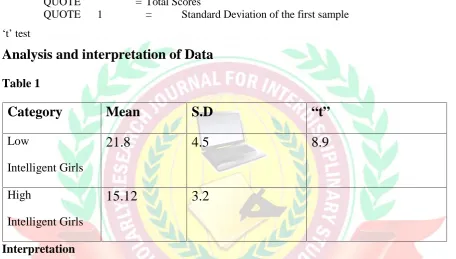
Table depicts the means, S.D. and ‘t’ of total adjustment of adolescent girls with low and high intelligence . The mean and S.D. of total adjustment of adolescent girls with low intelligence is 21.8 and 4.5. the mean and S.D. of total adjustment of adolescent girls with high intelligence is 15.12 and 3.2. The computed value of ‘t’ is 8.9 which is significant at
0.01 level of significance. This proves that there is significant difference in total adjustment of adolescent girls with low and high intelligence when compared. So the null hypothesis is rejected.
Category
Mean
S.D
“t”
Low
Intelligent Girls
7.78
0.9
7.8
High
Intelligent Girls
5.44
2.2
Interpretation
Table depicts the means S.D and ‘t’ Emotional adjustment of adolescent girls with
[image:7.595.73.520.71.211.2]low and high intelligence. The mean and S.D. of total adjustment of adolescent girls with low intelligence is 7.78 and 0.9. The mean and S.D of total adjustment of adolescent girls with high intelligence is 5.44 and 2.2. the computed value of ‘t’ is 7.8 which is significant at 0.01 or 0.05 both level of significance. This proves that there is significant difference in emotional adjustment of adolescent girls with low and high intelligence when compared.
Table 3
Category
Mean
S.D
“t”
Low
Intelligent Girls
6.88
3.6
3.8
High
Intelligent Girls
4.94
0.7
Interpretation
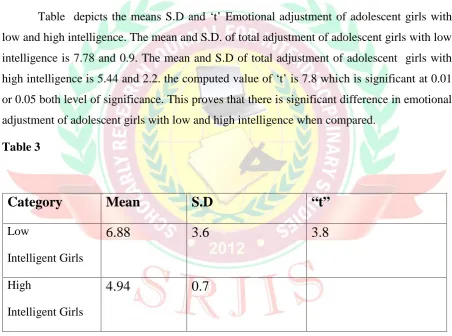
Table depicts the means, S.D. and ‘t social adjustment of adolescent girls with low
[image:7.595.70.523.255.591.2]high intelligence is 4.94 and 0.7 the computed value of ‘t’ is 3.8 which is significant at 0.01
level of significance. This proves that there is significant difference in social adjustment of adolescent girls with low and high intelligence
when compared. So the null hypothesis is rejected.
Table 4
Category
Mean
S.D
“t”
Low
Intelligent Girls
6.72
2.9
4.9
High
Intelligent Girls
4.74
1.8
[image:8.595.68.527.185.783.2]Interpretation
Table depicts the means, S.D. and ‘t’ of educatiional adjustment of adolescent girls with low and high intelligence. The mean and S.D. of total adjustment of adolescent girls with low intelligence is 6.72 and 2.9. the mean and S.D. of total adjustment of adolescent girls with high intelligence is 4.74 and 1.8.The computed value of ‘t’ is1.8 which is significant at 0.01
level of significance. This proves that there is significant difference in emotional adjustment of adolescent girls with low and high intelligence when compared. So the null hypothesis is rejected.
Table 5
Low
Intelligent Girls
84.25
7.8
4
High
Intelligent Girls
153
4.9
[image:9.595.73.520.73.182.2]Interpretation
Table depicts the mean, S.D and ‘t’ of total self-concept of adolescent girls with low and high intelligence. The mean and S.D of total self-concept of adolescent girls with low intelligence is 84.25 and 7.8. The mean and S.D of total self-concept of adolescent girls with high intelligence is 153 and 4.9. The computed value of ‘t’ is 4 which is significant at 0.05 level of significance. This proves that there is significant difference in self concept of adolescent girls with low and high intelligence when compared. So the null hypothesis is rejected.
FINDINGS
• There is significant difference in total adjustment of adolescent girls with low and high intelligence, when compared value ‘t’ value is greater than the critical value of
‘t’ therefore the null hypothesis is rejected.
• There is significant different in emotional adjustment of adolescent girls with low and high intelligence, when compared. The calculated value ‘t’ value is greater than the
critical value ‘t’ therefore the null hypothesis is rejected.
• There is significant difference in social adjustment of adolescent girls with low and high intelligence, when compared. The calculated value ‘t’ value is greater than the critical value of ‘t’ therefore the null hypothesis is rejected.
• There is significant difference in total self-concept of adolescent girls with low and high intelligence, when compared. The calculated value ‘t’ value is greater than the critical value of ‘t’ therefore the null hypothesis is rejected.
• Conclusion-The adolescent girls with high intelligence are better adjusted as compared to adolescent girls with low intelligence on emotional, educational and social adjustment.And alsoThe adolescent girls with high intelligence are better adjusted as compared to adolescent girls with low intelligence on total self-concept.
Educational Implications
Adjustment is a commonly used word in our everyday life. It is equally popular in the disciplines of psychology, sociology and education. Life is continues series of changes and challenges. Everyone is facing such situations for his survival or growth. Different persons use different ways to satisfy these needs. The strategy, used by the individual to manage this, is called adjustment. Sometimes, the effort of the individual are successful and satisfying, and then it is a case of good adjustment. But if a person meets frustration in his effort continually, fail to adjust to the needs of self and demands of the environment, the personality adjustment may not be proper, then it might be case of maladjustment.
Therefore, study of this problem can throw a light on how and why intelligent persons are better adjustment. If intelligence is positively affecting adjustment then early affecting adjustment then early measurement of this variable can lead to greater chances of adjusted in future. As adolescent girl are in a critical period of their life, this variable will surely make educationists, teachers and parents aware of their problems. Maladjusted girls (due to low intelligence) should be given positive social climate, recreational activities to ease tensions, pent-up feelings. Their needs, interest, abilities be identified and loving, integrated classes can work wonder for this disadvantaged group. Sympathetic behavior of the teacher towards these girls will minimize their adjustment problem to a great extent.
Aggarwal, J.C. (2003) : Essential of education psychology, Vikash Publishing House, Pvt. Ltd.
Best, J.W. : Research in Education, Prentice Hall of India Pvt. Ltd. Buck, M.B. (1978-1983) : Third Survey of Research in Education. Buch, M.B. (1988-92) : Fifth Survey of Educational Research Vol. 1. Buch, M.B. (1996-2000): Sixth Survey of Educational Research Vol. 1 & 2.
Chauhan, S.S (1992): Advanced Education Psychology, Vikash Publishing House Pvt. Ltd., New Delhi.
Dash, M. & Dash, Neena (2002) : Fundamental of Education Psychology, Atlantic Publishers and Distribution, New Delhi.
Garrett, H.E. (1966) : Statistics in Psychology and Education, Vikash, Feffer and Simons Ltd., Bombay.
Gupta, R. (2009): Popular Master Guide for UGC, NET, SLET Education. Indian Educational Abstracts, Vol. 6, No. 2, July 2006, NCERT.
Koul, Lokesh (1996) : Methodology of Education Research, Vikash Publishing House Pvt. Ltd., New Delhi.
Kundoo, C.L. & Tutoo, D.N. (2006) : Educational Psychology.
Mangal, S.K. (2005 : Psychology of Teaching and learning, Tandon Publication, Ludhiana. Mangal, S.K. (2005) : Advanced Educational Psychology, Prentice Hall of India, Pvt. Ltd.,
New Delhi.
Mathur, S.S. (1987) : Educational Psychology, Vinod Pustak Mandir, Agra-l.
Walia, J.S. (1985) : Foundation of Education Psychology, Paul Publishers, Jalandhar City, (Punjab).
Sarnoff Irving : “ Personality Dyanamics and Development”, New York.
Singh Mahipal : “A study of adjustment of student in the context of their attitude to