
1001
ANALYSIS OF THE COMPLEX MATERIAL FLOW
NETWORKS IN TYPICAL STEEL ENTERPRISE
1YEQING ZHAO, 2GUIHONG BI
1School of Computer and Information Engineering, Anyang Normal University, Anyang 455002, Henan, China
2Faculty of Power Engineering, Kunming University of Science and Technology, Kunming 650093, Yunnan, China
ABSTRACT
The aim of this paper is to present a new modeling method for complex material flow networks system of typical steel enterprise. Iron and steel industry is one of the most important industry in the country, especially, have a direct impact on the whole national economy. For the diversity and complexity of the production technique of the material flow system in the steel enterprise, the manufacturing process was defined as a complex networks based on complex networks theory and techniques, in which the devices were seen as nodes and the direct relationships between the devices were seen as edges. The statistical analysis of the network model of the production process in typical steel enterprise was provided to explore new methods and breakthrough for local path optimization and global planning, and that supply the instructions of theories and techniques for the further improving the topology structure of the material flow networks in steel enterprise.
Keywords: Material Flow System, Complex Networks, Degree Distribution, Shortest Path, Clustering
Coefficient
1. INTRODUCTION
Steel production is a very long typical productive process. Because of the high temperature and mixed with discreteness and continuity in the manufacturing process, the processes are numerous and the devices are quite complicated. In the steel productive process, the main reaction involved in all stages is different as a result of different goals of specifically phase. For example, in the smelting stage the chemical reactions are primary and the physical reactions are secondly, however, in the rolling stage, the physical reactions are prominent roles and the chemical reactions are subordinate roles. The whole manufacturing process must be a unity of coherence in form and cohesion in meaning, and possess the characteristics of complexity, mutability and uncertainty. The typical steel productive process mainly includes the process of ironmaking, steelmaking and steel rolling. In ironmaking process, iron ore, coke and auxiliary materials are mixed together by following some proportional relations and the mixture is fed into the blast furnace. Once the ingredients of the hot metal meet the standards, the hot metal will be transported into the next process such as steelmaking process by car or train as the raw materials. The hot metal by a series of pretreatment and steel scrap and other
raw materials are fed into converter to realize heating, decarburization and deoxidization treatment on purpose of removing various impurities and satisfying the standard requirements of steel composition in steelmaking process. According to customer requirements of products, in steel rolling process, steel billets are input the heating furnace to reach the set temperature and that are rolled into various types of steel products to meet customer requirements, for special requirements of steel products, further processing operations are implemented, and the final products are accessed to markets.
1002 However, the model for steel production system by utilizing complex networks theory and methods was rarely studied at current, especially, on the material flow system of the steel productive process. In this paper, in order to realize the goal of energy conservation and emissions reduction, enhance the competitive ability and adaptability, search for new breakthrough for further optimization of the material flow system, the model of steel production process was built by complex networks theory and methods in view of the characteristics of complex material flow system of steel enterprise.
The research ideas of complex system focus on the system structure and functions from the point of view of the systematic theory, and the structural properties of networks topology is the key for us to study by abstracting the real systems. Based on current requirements of energy conservation and emission reduction and the productions and material flow networks of the iron and steel enterprises adaptation to the changing needs of the market, we should how to gradually increase in size or adjust and improve the structure of production networks according to the complex system theory, further explore the relationship between production networks topology statistics and production process material flow for realizing optimization of the system performance in the iron and steel enterprise.
The main purpose of this paper is to establish the material flow networks model of production process of typical modern iron and steel enterprise, and perform a statistical analysis on the data of networks model by applying the complex networks theory and technology. We would explore the internal relationships between the static structure and dynamic evolution of the networks model of the production process and the system optimization of material flow in iron and steel enterprise, more explore new ideas, new methods and approaches for further optimizing the material flow system of production process.
The outline of this paper is as follows. In Section 2 we describe empirical studies of the structure of networks and complex networks, including the common properties. In Section 3 we describe some of the common properties of the manufacturing process in steel enterprise, especially, the dynamic and polytrope of the production technique. The model of complex material flow networks of the manufacturing process was built based on complex networks theory and techniques. In Section 4 we provide statistical analysis of the networks model for typical complex material flow of steel enterprise
that reveals the performance of the networks model and subnetworks, devices availability, material flow system, and so on. In Section 5 we give our conclusions and point to direction for future research.
2. COMPLEX NETWORKS
A network is a set of items, which are known as nodes (vertices), with connections between them, called edges, there is a simple network in figure 1(a), the network is composed of seven nodes and fourteen edges. Based on mathematical graph theory, the study of networks is one of the fundamental pillars of discrete mathematics. Now, the history of the networks is summarized into three stages, namely: (1) Networks early stage, it is the important mark for Euler to solve the Konigsberg bridge problem by the theory of networks in 1736, and during the twentieth century graph theory has developed into a substantial body of knowledge. (2) Networks middle stage, the experiment of six degrees of separation of Milgram [6] is the turning point to transform network science from pure graph theory to scientific research. (3) Networks modern stage, because of properties of static and dynamic of networks, network science must study both static attributes and dynamic attributes of networks. Emergence was defined by Holland in the book to describe the network evolution of what happened on detail, and it is playing a critical role of explaining the internal mechanism in modern network science. Watts and Strogatz [7] stimulated the interest in small world networks model by illustrating universality and practicality of the small world networks. Barabasi and Albert [8] focus particularly on work on scale-free networks and generating process of model on scale-free networks.
Graph theory is the natural framework of complex networks based on the mathematical theory and, formally, a complex network can be regarded as a graph.
Define 1 A undirected (directed) graph is a 2-tuple G=(N L, ),where:
(1) N {n i, 1, 2, , }m i
= = is a set of nodes of
the graph.
(2) L {l ,j 0,1, 2, , }k j
= = is a set of edges
of the graph.
Define 2 A complex networks is a 3-tuple ( , , )
CN = N L f ,where:
1003 (2) f :L→N×Nis the function to map the edge to nodes
A node is usually referred to by its order i in the setN . In undirected graph, each of the links is defined by a couple of nodes iand j , and is
denoted as ( , )i j orl
ij. The link is said to join the
two nodes, or to be causal relationship in nodesiand j . Two nodes joined by a link are referred to as adjacent or neighboring. In a directed graph, the order of the two nodes is important: the
link l
ijstands for a link from itoj, but ljimeans a
link from jto i. In figure 1 (a) and (b), a simple undirected graph and a directed graph with seven nodes and fourteen edges are shown respectively.
Figure 1: A Simple Undirected Graph (A) And Directed Graph (B)
Shortest paths play an important role in reality network environment, such as transport and communication. For such reason, shortest paths have also played an important role in the characterization of the internal structure of a graph. So, we can define the matrix Ain which the entry
d
ijis the shortest length of the geodesic from node
i
to nodej. The diameter of the graph is defined as the maximum value of dji , which is marked
as max
,
D dij i j
= . Average shortest path length is a
measure of the typical separation between two nodes in the graph, defined as the mean of geodesic lengths over all couples of nodes, namely:
1 ( 1)
L dij
N N i j
= ∑
+ ≠ (1)
Where dij is the geodesic distance from node ito
node j, and N is the number of the nodes in the graph.
Clustering, also known as transitivity, is a typical characteristic of acquaintance networks, where two individuals are likely to know each other while they are a common friend. In a general graph, transitivity represents the presence of a high
number of triangles. In order to describe the degree of aggregation of nodes in complex networks, clustering coefficient C was introduced by Watts and Strogatz in the paper [9], and defined as follows.
1
C c ci
N i N =< >= ∑
∈ (2)
The clustering coefficient C of the graph is
given by the average of
c
iover all the nodes ingraph. The clustering coefficient
c
i represents thelocal clustering coefficient of node
i
and expresseshow likely
a
jm=
1
for two neighbors j andm
ofnode
i
. The clustering coefficientc
iis defined asthe ratio between
e
i and the maximum possiblenumber of edges in subgraph of neighbors of
i
, 1( 1)
2k ki i− , namely:
2 ,
( 1) ( 1)
a aij jm mia ei j m N
ci k k k k
i i i i
∑ ∈
= =
− − (3)
By definition,
0
≤ ≤
c
i1
, and 0≤ ≤C 1,if andonly if complex networks is globally coupled, namely any two nodes are directly connected in complex networks, C=1.
The degree
k
iof a nodei
is the number of edgesincident with the node, and is defined as follows:
ki=∑aij (4)
In directed graph, the degree of node includes two components: the out-degree and in-degree, the
out-degree is defined as kiout aij j
=∑ and the number
of ingoing linkskiin a ji j
=∑ . So the total degree of
node i is defined aski=kiin+kiout.
Average degree, marked for< >k , is defined as the average of all the degree ki of nodes
i
in thenetworks. In a graphG,the most basic topological characterization can be gained by analyzing the degree distribution P k( ) ,which defined as the probability that a node chosen uniformly an random has degree kor , equivalently, as the fraction of
nodes in the graph having degree k. The three statistical properties are the basis of
1004 to be discovered in real networks, such as network resilience, betweenness and the relationship between degree and clustering coefficient. The resilience of a network is a measure of its reliability; it is the expected number of node pairs which can communicate [10]. Betweenness is a measure of the centrality of a node in a network, and is normally calculated as the fraction of shortest paths between node pairs that pass through the node of interest. Betweenness is, in some sense, a measure of the influence a node has over the spread of information through the network [11].
3. THE COMPLEX MATERIAL FLOW
NETWORKS MODEL OF TYPICAL STEEL ENTERPRISE
Steel enterprise is a process series-parallel complex system, which composed of variety of processes and devices with different functions of interrelation, mutual support and suppression. According to the analysis of typical steel productive process, we can find the features of continuous and discrete for the productive activities in the iron and steel enterprises, and the whole process shows up as multi-stage production, multi-segment transport and multi-stage storage large scale high temperature production process, production material flow has the characteristics of diversity, complexity and many periods. Therefore, production material flow system of the steel enterprise manifests as multiple production processes series-parallel material flow networks in macro, and manifests as continuous and discrete time queue networks in micro. So, production material flow system of the steel enterprise is a complex networks system, we must make use of the theory and methods of complex networks to research on complex material flow networks system of the steel production for solving time balance and temperature balance in the relationship between all aspects of interrelated and mutually influence each other constraints, and even balance problems of resource supply and material flow capacity.
Steel production is a process of manufacture which composed of smelting equipments and its interrelationships, and realized the changes from raw materials to the product; and is a process of functions ever-expanding and updating; and is a complex process of devices growing and relationship complicating. As a whole, the process of manufacture shows the function devices continues to add and delete, and the material networks are huge and complicated in the evolutionary process to meet the requirements of
the development of the market and social environment. Specifically, the steel production process is a complex networks including a number of nodes and links. At the initial stages, steel production process is comprised of several discrete simple processes, and the internal structure is very simple and the accessory equipment is more limited in the process. And that, the networks consisted of relationships of the station is uncomplicated in the processes. But, with the development of technology and market requirements, the processes and stations in the steel production are more and more sophisticated and cumbersome, and that the relationships of devices are usually miscellaneous and toilsome. So, we can defined the steel production process as a complex networks for describing the complex process and complicated relationships by utilizing the technology and theory of complex networks.
In the complex networks model of the steel manufacture process, the networks are composed of nodes and edges that connected between nodes. Where, the nodes are identified by the station (manufacturing equipment) of the manufacturing process and the station (transport equipment) of the transport process; the edges mainly show the direct contact with equipments. With the development of metallurgical technology and the accelerating process of global economic integration, the nodes and the edges are undergoing profound changes in the complex networks model of the steel manufacture process. The backward processes and its stations were eliminated from the networks, the more advanced processes and its stations are added in the networks. So, the complex networks model of steel manufacturing process shows a complicated process of relatively stable in specific period and continuous dynamic changes in the process of whole development.
1005
Step 1 system initialization: according to the size of systems, we establish the nodes of 2N-1, which is linked with edges of 2(N-1), and represent the manufacturing equipments of N and the transport equipment of N-1. In the networks, the coordinate position is random;
Step 2 growth rules: when the system function need to add station, a new node is generated and added to the networks based on the properties of station, and the edges is linked with the nodes of its upstream and downstream process;
Step 3 cutting rules: when the system functions need to update or maintain, the nodes and the related edges with the nodes are removed simultaneously.
4. TOPOLOGY ANALYSIS OF THE
COMPLEX MATERIAL FLOW NETWORKS IN TYPICAL STEEL ENTERPRISE
In the manufacturing process of steel enterprise, there are kinds of devices which responsible for different tasks. In order to reduce the complexity of the model of the complex material flow system, some minor nodes are ignored. So the networks model is a directed networks with (N=) 40 nodes and 140 directed links. It is represented by a binary adjacency matrix, A N N( × ) , whose elements
ij
a
take value 1 if there is material flow fromdevice
i
to device j and 0 otherwise. The asymmetric adjacency matrix A was used to find the some properties of networks which are sensitive to the direction, other properties of networks were calculated by symmetry operations of the adjacency matrix.Shortest path analysis is intended to give us an intuitive idea on the ease of travel in the network. Shortest path length from node ito j,Lij is the
number of edges needed to be taken to go from
i
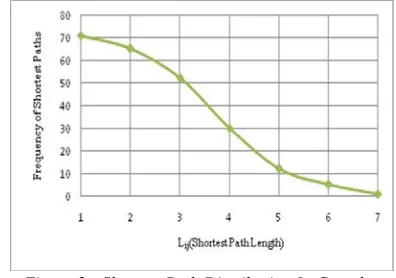
toj by the shortest route. We found the average shortest path length of the complex material flow networks in the typical steel enterprise to be (L=)2.81667, which is of the order of that of a random network of same size and average degree. The average clustering coefficient of the complex material flow networks in the typical steel enterprise was found to be (C=) 0.3421, which is an order of magnitude higher than that of the comparable random network. According to these two properties, we can regard the complex material flow networks is a small world networks. Figure 1
shows the distribution of the shortest paths in complex material flow networks of the typical steel enterprise. Table 1 summarizes the results of shortest paths analysis. Around 80% of paths are reachable by changing maximum of 3 devices. Around 58% of paths are reachable by changing maximum of 2 devices. Especially, about 31% paths are connected by direct devices. We also deduce that the diameter of the complex material flow networks in the steel enterprise is 7, which means that the raw material was transformed into the last product by seven different devices for achieving the physical and chemical changes.
[image:5.612.317.515.372.511.2]Degree, as defined in Equation 4, is one of measure of centrality of a node in the network. Degree symbolizes the importance of a node in the complex networks, namely, the larger the degree of the node, the more important it is. In the complex networks, the degree distribution is an important property which embodies the topology of the network. The topology structure may shed light on the process by which the complex networks has come into existence.
Figure 2: Shortest Path Distribution In Complex Material Flow Networks In Steel Enterprise
Table 1 Shortest Path And Their Percentage Of The Network Model
Shortest Path No. of Paths Percentage
1 71 30.0847
2 65 27.5424
3 52 22.0339
4 30 12.7119
5 12 5.0847
6 5 2.1186
7 1 0.4237
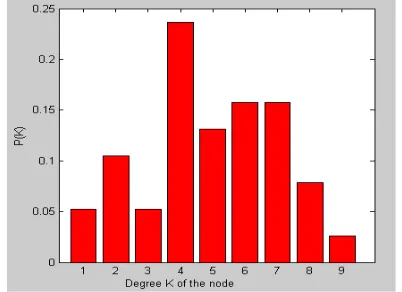
1006 9, and the value, in the degree K column of the maximum of the p k( ) which defined as the probability that a node chosen uniformly an random has degree k , against is 4, which means these nodes in the network is important for the material flow system. The different node stands for the device act as different role in the whole system, the larger the degree of the node, the more important it is. By analysis the figure 4, we can find the node 5 and the nodes 6,7,8 are the important role in the network, further research the structure of the real steel enterprise, we can find the node 5 stands for the process of ironmaking which receives all raw material and output the products to other next process. All material flows pass through this central hub, so the process of ironmaking is important, especially, the processing capacity of ironmaking directly determine the production capacity of the whole steel enterprise. By the same token, the nodes 6, 7, 8 stand for the different steelmaking and determine the material flow speed and rhythm of the systems respectively.
Figure 3: Degree Distribution In The Complex Material Flow Networks
Figure 4: Degree Of The Nodes In The Complex Material Flow Networks
5. CONCLUSION
In this paper, we have presented a complex networks model of the material flow system in the typical steel enterprise by introducing the complex networks theory and techniques. According to the structure properties of the material flow system, the devices were defined as nodes and the directed relationships between devices were defined as edges in the complex material flow networks of the typical steel enterprise. In order to analysis the topology structure of the complex networks model, we have created the adjacent matrix, in which the 1 means that there is the direct interrelationship between the nodes and 0 otherwise. The average shortest path and the clustering coefficient of the complex material flow networks model in the typical steel enterprise were solved and the results show that the complex networks model is a small-world network. Furthermore, the degree and degree distribution were carried out statistics and further analyze the topological properties of the complex material flow networks. The statistical analysis of the network model of the production process in typical steel enterprise was provided to explore new methods and breakthrough for local path optimization and global planning, especially, supply the instructions of theories and techniques for the further improving the topology structure of the material flow networks in steel enterprise, moreover, network behavior is the research topics in the future.
ACKNOWLEDGEMENTS
This work was supported by the National Natural Science Foundation of China (Grant No. 61064010).The authors would like to acknowledge Kunming Iron and Steel Co.Ltd for their help in collecting production data.
REFERENCES:
[1] J. D. Montgomery, “Social networks and labor-market outcomes: toward and economic analysis”, The American Economic Review, Vol. 81, No. 5, 1991, pp. 1408-1418.
[2] R. Albert, A. L. Barabasi, “Statistical mechanics of complex network”, Review of Modern
Physics, Vol. 74, 2002, pp. 47-97.
1007 [4] R. Guimera, S. Mossa, A. Turtschi, L. A. N.
Amaral, “The worldwide air transportation network: Anomalous centrality, community structure, and cities’ global roles”, Proc Nati
Acad Sci USA, Vol. 102, No. 2, 2001, pp.
404-409.
[5] M. E. J. Newman, “The structure of scientific collaboration networks”, Proc Nati Acad Sci
USA, Vol. 98, No. 22, 2005, pp. 7794-7799.
[6] S. Milgram, “The small world problem”, Psychology Today, Vol. 2, 1967, pp. 60-67. [7] D. J. Watts, S. H. Stroatz, “Collective Dynamics
of ‘small world’ networks”, Nature, Vol. 393, No. 6684, 1998, pp.440-442.
[8] A. L. Barabasi, R. Albert, “Emergence of scaling in random networks”, Science, Vol. 286, No. 5439, 1999, pp. 509-512.
[9] F. Ball, D. Millison, G. S. Tomba, “Epidemics with two levels of mixing”, Annals of Applied
Probability, Vol. 7, 1997, pp. 46-89.
[10] C. J. Colbourn, “Network resilience”, SIAM. J.
on Algebraic and Discrete Methods, Vol. 8, No.
3, 1987, pp. 404-409.
[11] M. E. J. Newman, “A measure of betweenness centrality based on random walks”, Social
![Assessment of Physiological Health Status in Relations to Different Anthropometric and Cardio respiratory Measures of Head Supported Load Carrying Male Porters of Sikkim, India [Article Retracted]](data:image/gif;base64,R0lGODlhAQABAIAAAP///wAAACH5BAEAAAAALAAAAAABAAEAAAICRAEAOw==)