Vitro
Susceptibility Testing of
Rhodococcus equi
Londa J. Berghaus,aSteeve Giguère,aKristen Guldbech,aEleanor Warner,aUkachi Ugorji,aRoy D. Berghausb
Department of Large Animal Medicineaand Department of Population Health,bCollege of Veterinary Medicine, University of Georgia, Athens, Georgia, USA
MICs of erythromycin, clarithromycin, azithromycin, rifampin, gentamicin, and doxycycline against 101 isolates ofRhodococcus equiwere determined by broth macrodilution, disk diffusion, and Etest. Categorical agreement ranged between 85.1 and 100%. Overall, the agreement between Etest and disk diffusion was better than the agreement between broth macrodilution and the agar-based methods.
R
hodococcus equi, a Gram-positive facultative intracellular pathogen, is one of the most important causes of disease infoals between 3 weeks and 5 months of age. R. equi has also
emerged as a common opportunistic pathogen in immunosup-pressed people, especially those infected with the human
immu-nodeficiency virus (1–3). Infection in either species is most
commonly characterized by life-threatening
pyogranuloma-tous pneumonia (3,4).
A wide variety of antimicrobial agents are active againstR. equi
in vitro. However, many of these drugs are reported to be ineffec-tivein vivo, likely because of poor cellular uptake and resulting low
intracellular concentrations (5). The combination of a macrolide
(erythromycin, azithromycin, or clarithromycin) and rifampin
has been the mainstay of therapy in foals infected withR. equi
since the early 1980s (6,7). Until recently, reports of macrolide
resistance have been rare. Over the past decade, there has been an increase in the frequency of detection of macrolide and rifampin
resistance in isolates ofR. equifrom pneumonic foals (8), and
resistant isolates were cultured from up to 40% of affected foals at
a large breeding farm (9). Because foals infected with macrolide
and rifampin-resistant isolates are significantly more likely to die
(8), it is of paramount importance to obtain accuratein vitro
sus-ceptibility testing results early in the disease process.
Antimicrobial susceptibility testing can be done using a variety of different methods, with broth dilution, disk diffusion, and Etest being commonly used by veterinary diagnostic laboratories. To date, there are no data comparing the performance of these
meth-ods for the determination of in vitro activity of antimicrobial
agents againstR. equi. In one study, 12R. equiisolates identified as
resistant to azithromycin, clarithromycin, erythromycin, or ri-fampin in a diagnostic laboratory using disk diffusion were deter-mined to be susceptible to these drugs upon subsequent retesting
with a different method (8). Therefore, the objective of this study
was to compare the results of broth macrodilution, disk diffusion,
and Etest forin vitrosusceptibility testing of
macrolide-suscepti-ble and macrolide-resistant isolates ofR. equi.
A total of 101 nonduplicateR. equiisolates obtained from
tra-cheobronchial aspirates or postmortem lung tissue from pneu-monic foals in the United States between March 2000 and January 2011 were used. Twenty isolates were randomly selected from a collection of isolates previously identified as resistant to one or
more macrolide antimicrobial agents. The other isolates (n⫽81)
were randomly selected from a collection of frozen stabilates.
Iso-lates were confirmed to beR. equiand to contain the virulence
plasmid by PCR amplification of thechoEandvapAgenes,
respec-tively, as previously described (10). Antimicrobial agents
investi-gated in this study (erythromycin, clarithromycin, azithromycin, rifampin, gentamicin, and doxycycline) were selected based on
excellentin vitroactivity against large numbers of isolates ofR.
equi(11,12) and frequency of use in foals (5,7,13). Reference
standards for antimicrobial agents were purchased from U.S. Pharmacopeia (Rockville, MD).
The isolates were removed from storage and subcultured on Trypticase soy agar. Each inoculum was prepared by the direct colony suspension method according to the guidelines established by the Clinical and Laboratory Standards Institute (CLSI),
result-ing in the recommended inoculum of approximately 5⫻105as
verified by CFU counting (14). For a given isolate, susceptibility
testing with all 3 methods was performed with the same inoculum. For each isolate, the MIC was determined by a dilution broth macrodilution technique in glass tubes in accordance to the
guide-lines established by the CLSI (15). Concentrations of
antimicro-bial agents tested represented 2-fold dilutions between 256 and
0.031g/ml. The MIC was defined as the first dilution with no
bacterial growth after 24 h of incubation at 35⫾2°C. Etest strips
(BioMérieux, Durham, NC) were used according to the manufac-turer’s recommendations for each antimicrobial. Concentrations of antimicrobial agents tested represented 2-fold dilutions
be-tween 256 and 0.016g/ml for all antimicrobial agents, with the
exception of rifampin, which had a concentration range between
32 and 0.002g/ml. Disk diffusion susceptibility testing was
per-formed using commercially available disks (BD, Franklin Lakes,
NJ) in accordance with the CLSI guidelines (14).
There are currently no CLSI approved interpretive criteria for
Received15 September 2014Returned for modification8 October 2014
Accepted28 October 2014
Accepted manuscript posted online5 November 2014
CitationBerghaus LJ, Giguère S, Guldbech K, Warner E, Ugorji U, Berghaus RD. 2015. Comparison of Etest, disk diffusion, and broth macrodilution forin vitro
susceptibility testing ofRhodococcus equi. J Clin Microbiol 53:314 –318.
doi:10.1128/JCM.02673-14.
Editor:B. W. Fenwick
Address correspondence to Steeve Giguère, [email protected]. Copyright © 2015, American Society for Microbiology. All Rights Reserved.
doi:10.1128/JCM.02673-14
on May 16, 2020 by guest
http://jcm.asm.org/
the susceptibility testing ofR. equiin people or horses. Thus, CLSI
interpretive criteria forStaphylococcus aureus, as commonly
re-ported forR. equiby many veterinary diagnostic laboratories and
widely reported in the literature (8,9,16–18), were used for
azi-thromycin, clariazi-thromycin, eryazi-thromycin, doxycycline, and
ri-fampin (Table 1). Equine-specific interpretive criteria established
by the Subcommittee on Veterinary Antimicrobial Susceptibility Testing of the CLSI for Gram-negative bacteria were used for
gen-tamicin (Table 1) (14). Control strains tested in parallel and on
each test occasion for all methods were Staphylococcus aureus
ATCC 29213 andEnterococcus faecalisATCC 29212.R. equiATCC
33701, a virulent strain with a knownin vitrosusceptibility profile,
was used as an additional control (19).
MIC90s and MIC50s were calculated for the Etest and broth macrodilution for each antimicrobial agent. For each antimicro-bial agent, MICs obtained with the Etest were compared to MICs obtained with the broth macrodilution method using the Wil-coxon signed-rank test. For each antimicrobial agent, the results obtained by the 3 methods tested were converted to qualitative
categories (Table 1). For a given antimicrobial agent, the
percent-age of susceptible isolates and the percentpercent-age of resistant isolates were compared between the 3 methods using the Cochran Q test for paired proportions. Categorical agreement between qualita-tive results for two test methods was achieved when an isolate was classified within the same category (i.e., susceptible, intermediate, or resistant) by both testing methods. Categorical discrepancies were recorded as minor (an intermediate result was obtained by only one of the methods compared), major (susceptible isolate misinterpreted as resistant) and very major (resistant isolate mis-interpreted as susceptible) errors. The broth macrodilution test was considered the reference method for these determinations except when comparing Etest to disk diffusion, when the Etest was considered the reference method.
Essential agreement between the Etest and broth macrodilu-tion was defined as the percentage of MIC pairs that differed by
⫾1 log2dilution or less. Bias between the Etest and broth
mac-rodilution was calculated using the method described by Bland
and Altman (20) on log2-transformed MIC data. For each drug,
bias was calculated as the mean difference between the log2MIC
determined using the Etest and the corresponding log2MIC
de-termined using broth macrodilution. A positive bias value indi-cated that the Etest tended to overestimate the MIC, whereas a negative bias value indicated that the Etest tended to underesti-mate the MIC, compared to the MIC determined via the broth
macrodilution. For all analyses, aPvalue of⬍0.05 was considered
significant.
Quality control data for each of the ATCC reference strains for all antimicrobial agents were within the acceptable range as spec-ified by the CLSI and manufacturers of the Etest and disk diffusion assays. MIC data and percentages of susceptible, intermediate,
and resistant isolates for each method are presented inTable 2.
The percentage of isolates classified as susceptible to gentamicin (93.1%) by the broth macrodilution method was significantly lower than that obtained with the Etest or the disk susceptibility
method (99%) (Table 2). The percentage of isolates classified as
resistant to erythromycin was significantly higher with the broth macrodilution method (25.7%) than with the Etest (19.0%), whereas the percentage of resistance to rifampin was significantly lower with broth macrodilution (25.7%) than with disk diffusion
(31.7%) (Table 2).
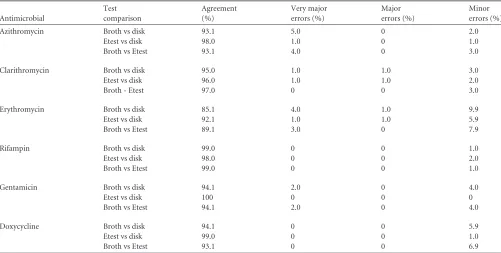
The overall categorical agreement between tests ranged be-tween 85.1 and 100%, with the lowest agreement being for the comparison of the broth macrodilution test with the disk diffu-sion test for erythromycin and perfect agreement being found for Etest versus the disk diffusion test for gentamicin. At least one very major error (falsely susceptible) was detected in 10 of 18 possible comparisons by antibiotic and test. Major errors (falsely resistant) were detected in 4 of 18 comparisons, and minor errors (all other
discrepancies) were detected in 17 of 18 comparisons (Table 3).
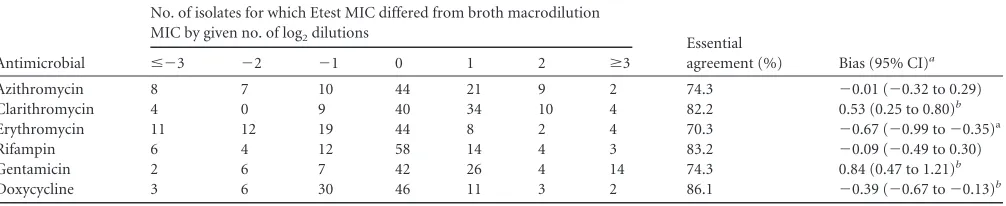
Essential agreement between Etest and broth macrodilution ranged between 70.3% for erythromycin and 86.1% for
doxycy-cline (Table 4). For clarithromycin, erythromycin, gentamicin,
and doxycycline, the MIC obtained using the broth macrodilution method was significantly different than that obtained with the
Etest (Table 4). MICs were not significantly different between the
2 methods for azithromycin and rifampin. Etest tended to overes-timate MICs relative to broth macrodilution for clarithromycin and gentamicin and underestimate MICs for erythromycin and
doxycycline (Table 4).
The importance of reliable antimicrobial susceptibility testing
methods forR. equicannot be overstated given that foals treated
with the traditional combination of a macrolide and rifampin de-spite being infected with macrolide- and rifampin-resistant iso-lates are approximately 7 times more likely to die than foals
in-fected with susceptible isolates (8). Disk diffusion and Etest were
selected for comparison to broth macrodilution in the present study because they are commonly used by veterinary diagnostic laboratories, with the disk diffusion method being the most widely used. There are currently no CLSI-approved interpretive criteria
for the susceptibility testing ofR. equi. However, comparison of
the performance of the disk diffusion method relative to that of the broth macrodilution or Etest required classification of the iso-lates as susceptible, intermediate, or resistant. The present study
used the CLSI interpretive criteria forStaphylococcus aureus as
commonly reported forR. equi by many veterinary diagnostic
laboratories and widely reported in the literature (16–18). It will
be up to the Subcommittee on Veterinary Antimicrobial Suscep-tibility Testing of the CLSI to determine whether these interpre-tive criteria are appropriate or not. However, in the interim, there is a need for data regarding the relative performance of
suscepti-TABLE 1Interpretive criteriaaused for the classification ofR. equi
isolates as susceptible, intermediate, or resistant to azithromycin, clarithromycin, erythromycin, rifampin, gentamicin, and doxycycline
Antimicrobial
Breakpoint
Susceptible Intermediate Resistant Broth/
Etest (g/ml)
Disk (mm)
Broth/ Etest (g/ml)
Disk (mm)
Broth/ Etest (g/ml)
Disk (mm) Azithromycin ⱕ2 ⱖ18 4 14–17 ⱖ8 ⱕ13 Clarithromycin ⱕ2 ⱖ18 4 14–17 ⱖ8 ⱕ13 Erythromycin ⱕ0.5 ⱖ23 1–4 14–22 ⱖ8 ⱕ13 Doxycycline ⱕ4 ⱖ16 8 13–15 ⱖ16 ⱕ12 Gentamicin ⱕ2 ⱖ16 4 13–15 ⱖ8 ⱕ12 Rifampin ⱕ1 ⱖ20 2 17–19 ⱖ4 ⱕ16
a
There are currently no CLSI-approved interpretive criteria for the susceptibility testing ofR. equi. Thus, CLSI interpretive criteria forStaphylococcus aureus, as commonly reported forR. equiby many veterinary diagnostic laboratories and widely reported in the literature, were used (8,9,16–18).
on May 16, 2020 by guest
http://jcm.asm.org/
bility testing methods with the interpretive criteria currently being used clinically.
Approximately 20 to 30% of the isolates tested in this study were resistant to macrolides or rifampin. This number is
artifi-cially inflated because 20 isolates were selected purposefully based on high MICs for macrolides and rifampin. In a prior study, the
prevalence ofR. equiisolates resistant to macrolide antimicrobial
[image:3.585.43.543.85.330.2]agents and rifampin in Florida and Texas was approximately 4%
TABLE 2Antimicrobial susceptibilities of 101 isolates ofR. equito azithromycin, clarithromycin, erythromycin, rifampin, gentamicin, and doxycycline, determined by broth macrodilution, Etest, and disk diffusiona
Antimicrobial Test MIC90(g/ml) MIC50(g/ml) Range (g/ml) S (%) I (%) R (%)
Azithromycin Broth 128 1 (0.03–256) 69.3 3.0 27.7 Etest 32 1.5 (0.016–⬎256) 74.3 1.0 24.8
Disk NA NA NA 73.3 2.0 24.8
Clarithromycin Broth 16 0.125 (⬍0.03–128) 75.2 3.0 21.8 Etest 16 0.125 (0.03–⬎256) 76.2 2.0 21.8
Disk NA NA NA 77.2 2.0 20.8
Erythromycin Broth 64 0.5 (0.06–256) 74.3 0 25.7c
Etest 16 0.38 (0.09–⬎256) 76.0 5.0 19.0
Disk NA NA NA 74.3 2.0 23.8
Rifampin Broth 32 0.25 (⬍0.03–⬎256) 72.3 2.0 25.7d
Etest 32 0.25 (0.012–⬎32) 70.3 0 29.7
Disk NA NA NA 68.3 0 31.7
Gentamicin Broth 1 0.5 (⬍0.03–⬎256) 93.1b 4.0 3.0
Etest 1.5 1 (⬍0.016–⬎256) 99.0 0 1.0
Disk NA NA NA 99.0 0 1.0
Doxycycline Broth 2 1 (0.03–4) 99.0 0 1.0
Etest 1.5 0.5 (0.016–32) 99.0 0 1.0
Disk NA NA NA 98.0 0 2.0
aS, susceptible; I, intermediate; R, resistant. NA, not applicable. b
Significant difference between the percentage of susceptibility obtained by broth macrodilution and that obtained with the Etest or disk diffusion (P⫽0.002).
cSignificant difference between the percentage of resistance obtained by broth macrodilution and that obtained with the Etest (P⫽0.029). d
Significant difference between the percentage of resistance obtained by broth macrodilution and that obtained with disk diffusion (P⫽0.034).
TABLE 3Agreement between broth macrodilution, Etest, and disk diffusion and percentage of each type of error for 101 isolates ofRhodococcus equi
Antimicrobial
Test comparison
Agreement (%)
Very major errors (%)
Major errors (%)
Minor errors (%) Azithromycin Broth vs disk 93.1 5.0 0 2.0
Etest vs disk 98.0 1.0 0 1.0
Broth vs Etest 93.1 4.0 0 3.0
Clarithromycin Broth vs disk 95.0 1.0 1.0 3.0
Etest vs disk 96.0 1.0 1.0 2.0
Broth - Etest 97.0 0 0 3.0
Erythromycin Broth vs disk 85.1 4.0 1.0 9.9
Etest vs disk 92.1 1.0 1.0 5.9
Broth vs Etest 89.1 3.0 0 7.9
Rifampin Broth vs disk 99.0 0 0 1.0
Etest vs disk 98.0 0 0 2.0
Broth vs Etest 99.0 0 0 1.0
Gentamicin Broth vs disk 94.1 2.0 0 4.0
Etest vs disk 100 0 0 0
Broth vs Etest 94.1 2.0 0 4.0
Doxycycline Broth vs disk 94.1 0 0 5.9
Etest vs disk 99.0 0 0 1.0
Broth vs Etest 93.1 0 0 6.9
on May 16, 2020 by guest
http://jcm.asm.org/
[image:3.585.41.542.469.722.2](8). However, up to 40% of theR. equiisolates at one farm in Kentucky were found to be resistant to these antimicrobial agents
(9). As documented with a smaller number of isolates in prior
studies (8,19), isolates ofR. equiresistant to macrolides and
ri-fampin in the present study were typically susceptible to
gentami-cin and doxycyclinein vitro. Because almost all isolates were
sus-ceptible to gentamicin and doxycycline, the present study was less likely to detect errors in categorical agreement for these antimi-crobial agents.
The present study demonstrated that the Etest tended to slightly underestimate MICs for erythromycin and doxycycline and to slightly overestimate MICs for clarithromycin and genta-micin relative to results with broth macrodilution. Overall, 70.4 to
86.1% of the paired MICs were within 1 log2dilution. However, 5
to 15% of the MIC pairs were more than 2 log2dilutions apart.
This discrepancy is more than expected based on studies compar-ing Etest to broth dilution testcompar-ing for various microorganisms and
antimicrobial agents (21–23). Despite sometimes marked
differ-ences in actual MICs, the categorical agreement between the 2 quantitative methods was better, ranging from 89.1% for erythro-mycin to 99.0% for rifampin. This indicated that most
discrepan-cies in MICs did not impair classification ofR. equias susceptible,
intermediate, or resistant. The proportion of very major errors was outside the target accuracy used by the U.S. Food and Drug
Administration (24) for azithromycin and erythromycin in this
study. It is unclear if these discrepancies reflect a higher rate of errors with the Etest, broth macrodilution, or a combination of both. Overall, the agreement between Etest and disk diffusion was better than the agreement between broth macrodilution and ei-ther agar-based method. These results suggest that broth macrodi-lution may not be a perfect gold standard to which other methods are being compared. Broth macrodilution was selected for use in this study because commercially available microtiter plates have a very limited range of dilutions which would have prevented quan-titative comparisons to the Etest over the entire range of possible MICs. There are multiple possible source for mistakes with the broth macrodilution method, and difficulties in reading broth
dilution assays at 24 h for some isolates ofR. equihave been
re-ported previously (25). A recent publication demonstrated that
addition of 2% (vol/vol) lysed horse blood to the cation-adjusted Mueller-Hinton broth facilitates the discrimination between
growth and no growth ofR. equi(26). Lysed horse blood was not
used in the present study because this information was not avail-able at the time this study was conducted. Additional studies will be necessary to determine if addition of lysed horse blood im-proves the agreement between broth macrodilution and Etest.
In conclusion, the present study documented important
discrepancies in the results ofin vitrosusceptibility testing ofR.
equidepending on the method used. These data demonstrate the
need for harmonization of antimicrobial susceptibility testing
methods forR. equiand establishment ofR. equi-specific
interpre-tive criteria.
ACKNOWLEDGMENTS
This work was funded by the Hodgson Equine Research Endowment of the University of Georgia.
We thank veterinarians and diagnostic laboratories who provided iso-lates.
REFERENCES
1.Arlotti M, Zoboli G, Moscatelli GL, Magnani G, Maserati R, Borghi V, Andreoni M, Libanore M, Bonazzi L, Piscina A, Ciammarughi R.1996.
Rhodococcus equiinfection in HIV-positive subjects: a retrospective anal-ysis of 24 cases. Scand J Infect Dis28:463– 467.http://dx.doi.org/10.3109 /00365549609037941.
2.Donisi A, Suardi MG, Casari S, Longo M, Cadeo GP, Carosi G.1996.
Rhodococcus equiinfection in HIV-infected patients. AIDS10:359 –362.
http://dx.doi.org/10.1097/00002030-199604000-00002.
3.Yamshchikov AV, Schuetz A, Lyon GM.2010.Rhodococcus equi infec-tion. Lancet Infect Dis10:350 –359.http://dx.doi.org/10.1016/S1473 -3099(10)70068-2.
4.Giguère S, Cohen ND, Keith CM, Hines SA, Hondalus MK, Prescott JF, Slovis NM.2011.Rhodococcus equi: clinical manifestations, virulence, and immunity. J Vet Intern Med25:1221–1230.http://dx.doi.org/10.1111/j .1939-1676.2011.00804.x.
5.Sweeney CR, Sweeney RW, Divers TJ.1987.Rhodococcus equi pneumo-nia in 48 foals: response to antimicrobial therapy. Vet Microbiol14:329 – 336.http://dx.doi.org/10.1016/0378-1135(87)90120-9.
6.Hillidge CJ.1987. Use of erythromycin-rifampin combination in treat-ment ofRhodococcus equipneumonia. Vet Microbiol14:337–342.http: //dx.doi.org/10.1016/0378-1135(87)90121-0.
7.Giguère S, Jacks S, Roberts GD, Hernandez J, Long MT, Ellis C.2004. Retrospective comparison of azithromycin, clarithromycin, and erythro-mycin for the treatment of foals withRhodococcus equipneumonia. J Vet Intern Med18:568 –573.http://dx.doi.org/10.1111/j.1939-1676.2004 .tb02587.x.
8.Giguère S, Lee E, Williams E, Cohen ND, Chaffin MK, Halbert N, Martens RJ, Franklin RP, Clark CC, Slovis NM.2010. Determination of the prevalence of antimicrobial resistance to macrolide antimicrobials or rifampin inRhodococcus equiisolates and treatment outcome in foals in-fected with antimicrobial-resistant isolates ofR. equi. J Am Vet Med Assoc
237:74 – 81.http://dx.doi.org/10.2460/javma.237.1.74.
9.Burton AJ, Giguère S, Sturgill TL, Berghaus LJ, Slovis NM, Whitman JL, Levering C, Cohen ND. 2013. Macrolide- and rifampin-resistant
Rhodococcus equion horse breeding farm, Kentucky, USA. Emerg Infect Dis19:282–285.http://dx.doi.org/10.3201/eid1902.121210.
10. Halbert ND, Reitzel RA, Martens RJ, Cohen ND.2005. Evaluation of a multiplex polymerase chain reaction assay for simultaneous detection of
[image:4.585.43.546.88.191.2]Rhodococcus equiand thevapAgene. Am J Vet Res66:1380 –1385.http: //dx.doi.org/10.2460/ajvr.2005.66.1380.
TABLE 4Comparison of MIC results obtained by Etest and the broth macrodilution method for 6 antimicrobial agents against 101 isolates ofR. equi
Antimicrobial
No. of isolates for which Etest MIC differed from broth macrodilution
MIC by given no. of log2dilutions Essential
agreement (%) Bias (95% CI)a
ⱕ⫺3 ⫺2 ⫺1 0 1 2 ⱖ3
Azithromycin 8 7 10 44 21 9 2 74.3 ⫺0.01 (⫺0.32 to 0.29) Clarithromycin 4 0 9 40 34 10 4 82.2 0.53 (0.25 to 0.80)b
Erythromycin 11 12 19 44 8 2 4 70.3 ⫺0.67 (⫺0.99 to⫺0.35)a
Rifampin 6 4 12 58 14 4 3 83.2 ⫺0.09 (⫺0.49 to 0.30) Gentamicin 2 6 7 42 26 4 14 74.3 0.84 (0.47 to 1.21)b
Doxycycline 3 6 30 46 11 3 2 86.1 ⫺0.39 (⫺0.67 to⫺0.13)b
aCI, confidence interval. b
Significant difference between broth macrodilution and Etest MIC (P⬍0.05).
on May 16, 2020 by guest
http://jcm.asm.org/
11. Jacks S, Giguère S, Nguyen A.2003.In vitrosusceptibilities of Rhodococ-cus equiand other common equine pathogens to azithromycin, clarithro-mycin and 20 other antimicrobials. Antimicrob Agents Chemother47:
1742–1745.http://dx.doi.org/10.1128/AAC.47.5.1742-1745.2003. 12. Riesenberg A, Fessler AT, Erol E, Prenger-Berninghoff E, Stamm I,
Bose R, Heusinger A, Klarmann D, Werckenthin C, Schwarz S.2014. MICs of 32 antimicrobial agents forRhodococcus equiisolates of animal origin. J Antimicrob. Chemother 69:1045–1049. http://dx.doi.org/10 .1093/jac/dkt460.
13. Venner M, Astheimer K, Lammer M, Giguère S.2013. Efficacy of mass antimicrobial treatment of foals with subclinical pulmonary abscesses as-sociated withRhodococcus equi. J Vet Intern Med27:171–176.http://dx .doi.org/10.1111/jvim.12030.
14. Clinical and Laboratory Standards Institute.2013. Performance stan-dards for antimicrobial disk and dilution susceptibility tests for bacteria isolated from animals; approved standards. CLSI document VET01-A4. Clinical and Laboratory Standard Institute, Wayne, PA.
15. Clinical and Laboratory Standards Institute.2011. Susceptibility testing of mycobacteria, Nocardiae, and other aerobic actinomycetes. CLSI doc-ument M24-A2. Clinical and Laboratory Standard Institute, Wayne, PA. 16. McNeil MM, Brown JM.1992. Distribution and antimicrobial
suscepti-bility ofRhodococcus equifrom clinical specimens. Eur J Epidemiol8:437– 443.http://dx.doi.org/10.1007/BF00158580.
17. Moore RM, Schneider RK, Kowalski J, Bramlage LR, Mecklenburg LM, Kohn CW.1992. Antimicrobial susceptibility of bacterial isolates from 233 horses with musculoskeletal infection during 1979 –1989. Equine Vet J24:450 – 456.http://dx.doi.org/10.1111/j.2042-3306.1992.tb02875.x. 18. Lavoie JP, Couture L, Higgins R, Laverty S.1991. Aerobic bacterial isolates
in horses in a university hospital, 1986 –1988. Can Vet J32:292–294. 19. Carlson K, Kuskie K, Chaffin K, Libal M, Giguère S, Lawhon S, Cohen
N.2010. Antimicrobial activity of tulathromycin and 14 other antimicro-bials against virulentRhodococcus equi in vitro. Vet Ther11:E1–E9.
20. Bland JM, Altman DG.1986. Statistical methods for assessing agreement between two methods of clinical measurement. Lanceti:307–310. 21. Di Bonaventura G, D’Antonio D, Catamo G, Ballone E, Piccolomini R.
2002. Comparison of Etest, agar dilution, broth microdilution and disk diffusion methods for testing in vitro activity of levofloxacin against
Staphylococcusspp. isolated from neutropenic cancer patients. Int J Anti-microb Agents 19:147–154. http://dx.doi.org/10.1016/S0924-8579(01) 00483-6.
22. Bolmstrom A, Karlsson A, Engelhardt A, Ho P, Petersen PJ, Bradford PA, Jones CH.2007. Validation and reproducibility assessment of tige-cycline MIC determinations by Etest. J Clin Microbiol45:2474 –2479.
http://dx.doi.org/10.1128/JCM.00089-07.
23. Tomlin P, Sand C, Rennie RP.2001. Evaluation of E test, disk diffusion and broth microdilution to establish tentative quality control limits and review susceptibility breakpoints for two aerobic actinomycetes. Diagn Microbiol Infect Dis40:179 –186.http://dx.doi.org/10.1016/S0732-8893 (01)00273-5.
24. Food and Drug Administration.2009. Class II special controls guidance document: antimicrobial susceptibility test (AST) systems— guidance for industry. Food and Drug Administration, Washington, DC.http://www .fda.gov/downloads/MedicalDevices/DeviceRegulationandGuidance /GuidanceDocuments/UCM388961.pdf.
25. Huang YT, Liao CH, Teng LJ, Hsueh PR.2007. Daptomycin suscepti-bility of unusual gram-positive bacteria: comparison of results obtained by the Etest and the broth microdilution method. Antimicrob Agents Chemother51:1570 –1572.http://dx.doi.org/10.1128/AAC.01352-06. 26. Riesenberg A, Fessler AT, Fromke C, Kadlec K, Klarmann D,
Kreien-brock L, Werckenthin C, Schwarz S.2013. Harmonization of antimicro-bial susceptibility testing by broth microdilution forRhodococcus equiof animal origin. J Antimicrob. Chemother68:2173–2175.http://dx.doi.org /10.1093/jac/dkt134.