University of East London Institutional Repository: http://roar.uel.ac.uk
This paper is made available online in accordance with publisher policies. Please scroll down to view the document itself. Please refer to the repository record for this item and our policy information available from the repository home page for further information.
Author(s):
Draganova, ChrisinaArticle title:
PHP and Wireless Web DevelopmentYear:
2006PHP & Wireless Web Development
Chrisina Draganova
Department of Computing, Communication Technology and Mathematics London Metropolitan University
100 Minories, London EC3 1JY [email protected]
Abstract
In this paper we consider how teaching traditional web development with PHP can be extended to wireless web development. Wireless technology is a new exciting development in the computing field and, as such, should be addressed in the computing curriculum. This paper suggests a way of introducing topics on wireless web devel-opment using wireless technologies and the server side programming language PHP; it gives an overview of the main wireless standards and presents examples using these technologies in conjunction with PHP. The exam-ples are aimed to be used in the “Internet Technologies” module for Foundation Degree students in Computing at London Metropolitan University.
1.
Introduction
Wireless technology is a significant development in the field of computing and it is used in all areas of our lives. Mobile devices such as personal digital assistants and mobile phones are part of our daily life communications, information and business transactions. Consequently the industry requires graduates to have knowledge and skills in developing applications for wireless devices and understanding of the specific usability issues related to these technologies.
This paper aims to share some ideas of how to introduce wireless web development with PHP and illustrates examples enabling students to understand the basic implementation issues. The paper is organised in four sec-tions including the introduction. The next section gives an overview of the main wireless standards and their use in conjunction with PHP. The third section discusses issues related to teaching wireless web development and demonstrates some practical examples and the last section gives the conclusions.
2. Overview of wireless technologies
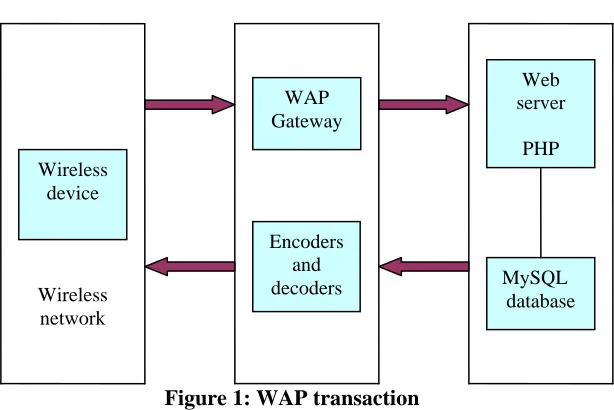
Figure 1: WAP transaction
Wireless device
WAP Gateway
Encoders and
decoders MySQL
database Web server
PHP
Wireless network
2.2 Wireless Markup Language(WML) is a markup language based on XML (eXtensible Markup Language) and is designed to be used on a variety of mobile devices. WML is similar to HTML, but the WML documents need to be well-formed (i.e. conform to the XML syntax rules). WML enables communication with wireless web browsers using the WAP protocol. The basic structure of an WML document includes three fundamental elements: a header indicating the version of XML and the XML document type definition (DTD), a root element called deck <wml> </wml>, and one or more elements- cards <card> </card> nested in the deck. Each card is displayed one at a time by a WML enabled browser. WML includes a number of tags which are similar to those in HTML such as paragraph tag <p> </p>, table tags <table> </table>, <tr> </tr>, <td> </td>, <input>, <se-lect>, <a>, <img>, etc. Elements responding to events include <do>, <onevent> and <timer>. Figure 2 illus-trates a simple WML document and how this document is displayed on a wireless device simulator. More in-formation on WML is available in [1], [2].
< ?xml version= »1.0 » ?>
< !DOCTYPE wml PUBLIC « -//WAPFORUM//DTD WML 1.2//EN » « http ://www.wapforum.org/DTD/wml12.xml »>
<!—begin deck
<wml>
<!—begin card
<card> <p> Hello World </p> </card> </wml>
http://meglos.lgu.ac.uk/~draganov/wireless/hello.wml
Figure 2: hello.wml - source code and a display on a Nokia simulator
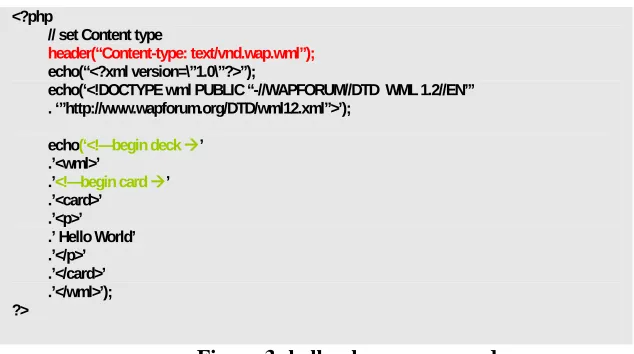
[image:3.612.50.560.454.589.2]2.4 PHP and WML. PHP is a scripting programming language, designed for Web development. It is used in combination with Apache’s Web server, which runs almost 70% of sites on the Web. PHP provides support for different database systems, it has extensive built in functions for common tasks in web development, it is avail-able on different OS platforms, and it is an open source product. The latest version is availavail-able free for download from [8]. PHP files may contain text, HTML tags and scripts and by default these are returned to the web browser as plain HTML. When developing a WML page that contains PHP script the file must include at the beginning the header (“Content-type: text/vnd.wap.wml”) function in order to set the Content-type HTTP header to the correct form; by default this is set to text/html [3]. The rest of the generated content must be a valid WML document. We can use all the Figure 3 illustrates the source code for hello.php script which gener-ates “Hello World” for display on a wireless browser.
<?php
// set Content type
header(“Content-type: text/vnd.wap.wml”); echo(“<?xml version=\”1.0\”?>”);
echo(‘<!DOCTYPE wml PUBLIC “-//WAPFORUM//DTD WML 1.2//EN”’ . ‘”http://www.wapforum.org/DTD/wml12.xml”>’);
echo(‘<!—begin deck ’ .’<wml>’
.’<!—begin card ’ .’<card>’
[image:4.612.139.456.222.399.2].’<p>’ .’ Hello World’ .’</p>’ .’</card>’ .’</wml>’); ?>
Figure 3: hello.php – source code
3. Teaching wireless web application development using PHP
Wireless and mobile computing is a major technology development and there are already a number of universi-ties which offer such degree courses. For example, a new degree course on Mobile and Wireless Computing has started recently at London Metropolitan University. However in existing computing courses topics on wireless technologies are not always considered or offered as options. Undoubtedly there is an interest among the stu-dents in Computing to learn and experience developing not only traditional web sites but wirelesses web appli-cations as well. For example this academic year we have a number of 3rd year computing students who choose to do their final year project namely in the area of wireless web development. Ideally we should offer these stu-dents an optional module that provides the necessary knowledge or at least consider the topic in existing web development modules.
In the Internet Technologies” module the students are introduced to dynamic web site development using PHP and MySQL. During lab sessions they gain experience with a range of PHP and MySQL examples demonstrat-ing fundamental techniques such as manipulation of form variables and arrays, use of PHP functions, code re-use, creating database connections and queries. More advanced topics are considered in later session including: authentication, security, cookies, sessions and shopping cart application. For each topic the students are given suitable practical examples that they have to modify slightly, deploy and test. Already having the knowledge and experience of HTML, XML, PHP and MySQL students have sufficient background to be introduced to the main wireless technology standards and to the development of wireless web applications using PHP. During the lec-ture session students are presented with an overview of WAP architeclec-ture and WML. By demonstrating and comparing HTML and WML simple examples students are introduced to the development of a wireless web application. To give students basic skills of how they can further develop the content of their web sites so these become accessible through wireless browsers and get hands on experience we suggest some simple PHP, WML and MySQL related examples demonstrating the structure of a WML document, navigation, form submission and accessing a database [1], [3]. During the lab sessions the students are typically asked to try these examples and to modify some parts of them in order to add more functionality and solve small problems. To test the ex-amples students could use a WAP simulator [6] or WAP enabled mobile phones. These exex-amples are easily translated to any other server-side language (e.g. JSP) and could be re-used in similar Web application develop-ment modules.
Introducing the topic of wireless web application development is relatively straight forward in this module given that the students have already quite extensive experience with the traditional web technologies. By doing so students are given the opportunity to gain insight in the rapidly expanding mobile technology area and reinforce the understanding of fundamental concepts in Internet computing such as data models, encapsulation, network protocols, distributed systems and usability issues.
Example 1 - Internal linking and external hyperlink This first example is a WML document which demon-strates how to do linking of two cards and an external link.The external link has the same syntax as HTML hy-perlink.
<?xml version="1.0"?>
<!DOCTYPE wml PUBLIC "-//WAPFORUM//DTD WML 1.2//EN" "http://www.wapforum.org/DTD/wml12.xml">
<wml>
<!-- using internal and external links -->
<card id = "card1">
<do type = "accept" label = "Next"> <!— internal link to card2
<go href = "#card2" /> </do>
<p>
This is the first card.
Press Next to go to the second card. </p>
</card> <card id="card2">
<p>
This is the second card. Press Back to go back or select the external link. </p>
<do type = "accept" label = "Back"> <!— internal link to card1
<go href = "#card1" /> </do>
<p>
<!—external link
<a href="http://live.vodafone.com">Live Vodafone</a> </p> </card>
</wml>
Figure 4 WML internal and external links for navigation
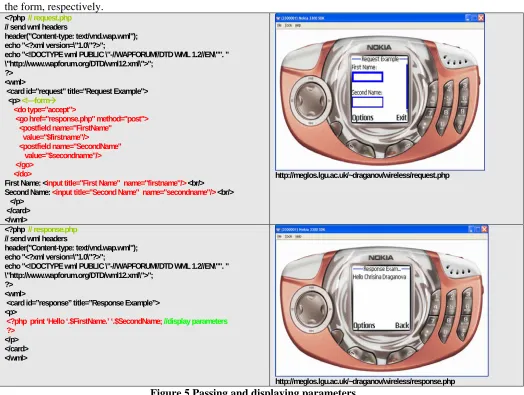
Example 2 - PHP, WML and passing parameters. This example has two files: request.php and
re-sponse.php which demonstrate a WML form with two parameters and rendering the parameters passed through the form, respectively.
<?php // request.php
// send wml headers
header("Content-type: text/vnd.wap.wml"); echo "<?xml version=\"1.0\"?>";
echo "<!DOCTYPE wml PUBLIC \"-//WAPFORUM//DTD WML 1.2//EN\"". " \"http://www.wapforum.org/DTD/wml12.xml\">";
?> <wml>
<card id="request" title="Request Example"> <p> <!—form
<do type="accept">
<go href="response.php" method="post"> <postfield name="FirstName" value="$firstname"/> <postfield name="SecondName" value="$secondname"/> </go>
</do>
First Name: <input title="First Name" name="firstname"/> <br/> Second Name: <input title="Second Name" name="secondname"/> <br/> </p>
</card> </wml>
http://meglos.lgu.ac.uk/~draganov/wireless/request.php
<?php // response.php // send wml headers
header("Content-type: text/vnd.wap.wml"); echo "<?xml version=\"1.0\"?>";
echo "<!DOCTYPE wml PUBLIC \"-//WAPFORUM//DTD WML 1.2//EN\"". " \"http://www.wapforum.org/DTD/wml12.xml\">";
?> <wml>
<card id=”response” title=”Response Example”> <p>
<?php print ‘Hello ‘.$FirstName.’ ‘.$SecondName; //display parameters
?> </p> </card> </wml>
[image:6.612.53.577.137.532.2]http://meglos.lgu.ac.uk/~draganov/wireless/response.php
Figure 5 Passing and displaying parameters
<?php
// search.php
header("Content-type: text/vnd.wap.wml"); echo "<?xml version=\"1.0\"?>";
echo "<!DOCTYPE wml PUBLIC \"-//WAPFORUM//DTD WML 1.2//EN\"". " \"http://www.wapforum.org/DTD/wml12.xml\">";
?> <wml>
<card id="search" title="Search Example"> <p><do type="accept"> <!—form <go href="results.php" method="post"> <postfield name="BookTitle" value="$book"> </go></do>
Search for a book title: <input title="Search" name="book"/> <br/> </p> </card>
</wml> http://meglos.lgu.ac.uk/~draganov/wireless/search.php
<?php // results.php
header("Content-type: text/vnd.wap.wml"); echo "<?xml version=\"1.0\"?>";
echo "<!DOCTYPE wml PUBLIC \"-//WAPFORUM//DTD WML 1.2//EN\"". " \"http://www.wapforum.org/DTD/wml12.xml\">";
?> <wml>
<card id="results" title="Results Example"> <p>
<?php
$link = mysql_pconnect("localhost","204user","204pass") or exit("Could not connect"); // mysql connection
mysql_select_db("qf204");
$query = "select title from books where title like '%$BookTitle%'"; $result=mysql_query($query) or die("Query failed"); //execute query
$num_results = mysql_num_rows($result); if ($num_results < 1) echo "No data found";
else{ echo '<b>Found book titles for query: </b> '.$BookTitle.' <br />'; $i=1;
while ($row = mysql_fetch_array($result)){ echo '<b>'.$i++.' </b>'.$row['title'].' <br />'; // render results
} }?></p> </card> </wml>
[image:7.612.56.561.85.459.2]http://meglos.lgu.ac.uk/~draganov/wireless/results.php
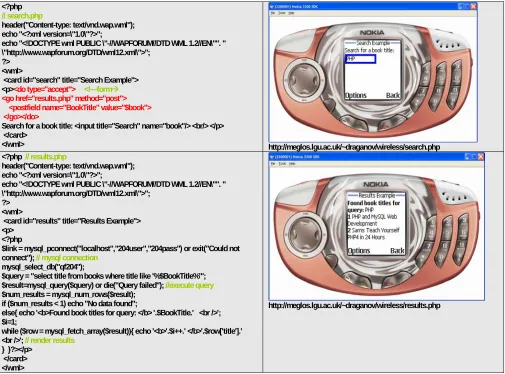
Figure 6 Search in MySQL database and display the results
Note: In order for the Apache server to make the correct interpretation of the MIME type extensions related to WML we add the following MIME types: AddType httpd-php .wml; AddType application/x-httpd-php3 .wml; AddType text/vnd.wap.wml .wml ; AddType image/vnd.wap.wbmp .wbmp into an .htaccess file and place this file into the directory where the WML pages reside [3]. Modifying the httpd.conf file if secu-rity permissions allow also could do this.
4. Conclusions
In this paper we have given short overview of WAP, WML and the use of WML with PHP. We have presented examples how to do navigation, form submission and accessing a database using WML, PHP and MySQL. This topic is included in a second year module "Internet Technologies" for the Foundation Degree in Computing at London Metropolitan University. The module is currently running and an evaluation will be made at the end of this semester.
wire-less technologies is a way of maintaining the relevance of web development modules and providing students with skills demanded in industry.
5. References
[1]
H. M. Deitel, P. J. Deitel, T. R. Nieto, K. Steinbuhler, Wireless Internet & Mobile Business, How to Pro-gram, Prentice Hall, 2002[2]
Dr Gordon W. Skelton, Wireless Application Development, Thomson Course Technology, 2003[3]
Building WML Applications Using PHP, http://www.zend.com/zend/tut/wap.php, W.J. Gilmore, 2000[4]
Designing Web content for mobile browsers UCD Recommendations for optimizing information presenta-tion on mobile devices http://www-128.ibm.com/developerworks/library/wi-web/, James Cotton, Patrick Commarford, 2005[5]
Final Report of the Joint ACM/IEEE-CS Task Force on Computing Curricula 2001 for Computer Sciencehttp://www.computer.org/education/cc2001/final/index.htm, 2001