Information Technology (IT) experts
In
Flexible Forms o f Employment
Katerina Voutsina
Ph.D. in Information Systems
Department o f Management
London School o f Economics and Political Science
UMI Number: U615680
All rights reserved
INFORMATION TO ALL USERS
The quality of this reproduction is dependent upon the quality of the copy submitted.
In the unlikely event that the author did not send a complete manuscript
and there are missing pages, th ese will be noted. Also, if material had to be removed, a note will indicate the deletion.
Dissertation Publishing
UMI U615680
Published by ProQuest LLC 2014. Copyright in the Dissertation held by the Author. Microform Edition © ProQuest LLC.
All rights reserved. This work is protected against unauthorized copying under Title 17, United States Code.
ProQuest LLC
789 East Eisenhower Parkway P.O. Box 1346
TW^SCS
P
<\o\%
m
Library
zJJ^yofPoiiftcaanoGoonomcSc
Declaration o f ownership
I declare that this thesis is my own work.
A cknowledgment
This thesis would have not been possible without the love and support o f my parents and family. I thank them from the bottom o f my heart.
I am m ost grateful to my supervisor professor Jannis Kallinikos for his continuous and precious guidance and support. His critique and feedback on my work have been crucial in the development o f my thought as a researcher. Most o f all, I thank him for his immense encouragement which means a lot during the difficult moments o f this research exercise. Thank you, Jannis.
I also thank my second supervisor Carsten Sorensen, who has supported me immensly in understanding the complex world o f Information Systems and Information Technology. He had always a few nice words to tell me in times o f trouble and confusion.
I am particularly grateful to Claudio Ciborra, his presence, spirituality and kindness has always been a constant source o f inspiration. I will miss him greatly.
I would like to thank Gideon Kunda, Susan Scott and Chrisanthi Avgerou for their valuable comments, which have helped me to improve this thesis.
I would like to thank my fellow students and friends. W ithout their moral support and encouragement, the completion o f this thesis would have been impossible. I particularly thank Aaron M artin for his immense help and advice, Maha Shaikh, Madga Hercheui and Aliki Velliou for their true friendship coming straight from the heart and Marinetta Tsirigoti for making me believe in m yself and pursue my dreams.
Copyright statement
In relation to copyrights, I state:
(a) The copyright o f this thesis rests with the author. Quotation from it is permitted, provided that full acknowledgement is made. This thesis may not be reproduced without prior written consent o f the author.
(b) I warrant that this authorization does not, to the best o f my belief, infringe the rights o f any third party.
(c) I understand that in the event o f my thesis not being approved by the examiners, this declaration will become void.
A B ST R A C T
TABLE OF CONTENTS
TABLE O F CONTENTS_______________________________________________ 7
CHAPTER 1: IN TR O D U C TIO N_______________________________________10
1.1 Background_______________________________________________________ 10
1.2 Motivation and scope of the research _________________________________ 12
1.3 Significance and Contributions of the Study____________________________ 18
1.4 Structure of the thesis_______________________________________________ 21
CHAPTER 2: LITERA TURE REVIEW_________________________________24
1.1 Introduction___________________________________________________ 24
2.2 Trends in the current workplace_____________________________________ 25
2.2.1 Flexibility__________________________________________________________________ 25
2.2.2 Individualization & self-m anagem ent_________________________________________ 29
2.3 Technology, organization and the new world of w ork___________________ 31
2.3.1 Technology and the organizational fabric: processes and relationships___________ 32
2.3.1.1 Autom ation and information technology__________________________________ 36
2.3.1.2 Informative capacity o f inform ation technology and the abstraction o f w o rk 38
2.3.1.3. Possibilities o f com munication, interaction and collaboration: networks and
distributed forms o f work_______________________________________________________41
2.3.1.4 Interpretive fle x ib ility __________________________________________________ 44
2.4 Information Technology experts and contractors______________________ 47
2.5 Contracting and IT contracting______________________________________ 48
CHAPTER 3: “ITPR O F E SSIO N A LS” AND THE NATURE OF IT W O RK50 3.1 Introduction_______________________________________________________ 50
3.2 Definition of ‘IT experts’ ____________________________________________50
3.3 Definition of IT Skills/Knowledge____________________________________ 52
3 .4 Processes of Knowledge Acquisition__________________________________ 53
3.5 Knowledge application, power relations and the nature of the IT work __ 56
3.5.1 .Unravelling the com plexity o f the nature o f IT w o r k ___________________________ 56
3.5.2 Power relations between the IT expert and his/her supervisory g ro u p s ___________ 59
CHAPTER 4: CONCEPTUAL FRAM EW ORK__________________________ 64
4.1 Introduction_______________________________________________________ 64
4.2 The governance of contractual relationships - the employer’s perspective _ 65
4.3 A critical view of Rational Action Theory______________________________ 68
4.4 Goldthorpe’s analytical framework___________________________________ 72
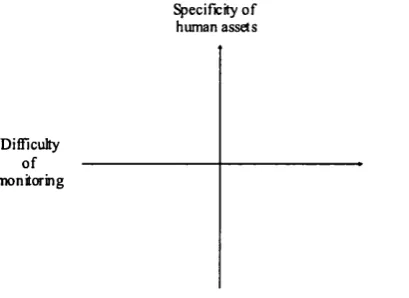
4.5.1 The dim ension o f “asset specificity” __________________________________________ 76
4.5.2 The dim ension o f “difficulty o f monitoring" in the IS sector. Constraints over the
possibility o f o p p o rtu n ism ________________________________________________________79
4.5.2.1 The assumption o f “difficulty o f m onitoring” ______________________________79
4.5.2.2. Sharm a’s analytical m o d e l____________________________________________ 81
CHAPTER 5: M ETH O D OLOG Y______________________________________ 87
5.1 Introduction_______________________________________________________ 87
5. 2 Constructivism ____________________________________________________ 88
5. 3 Constructivism and the study of technology___________________________ 92
5.4 Constructivism, the study of employment relations and methodological im plications___________________________________________________________93
5.5 Research strategy___________________________________________________ 95
5.5.1. The case study research strategy____________________________________________ 96
5.5.2 M ultiple Case Study research strategy and the study o f highly-skilled IT contractors
________________________________________________________________________________97
5.5.3 U nit o f analysis______________________________ ’____________________________ 100
5.5.3.1 D efinition____________________________________________________________ 100
5.5 4 Research M ethod: In te rv ie w s_______________________________________________ 101
5.5.5 Site S e le c tio n ____________________________________________________________ 102
5.5.6 Constructing an account o f the respondents’ s a y in g s __________________________ 103
CHAPTER 6 : F IELD W O RK_________________________________________108
6.1 Introduction______________________________________________________ 108
6.2 Empirical research-ethnographic interview s__________________________ 108
6.3 Research participants characteristics ^___________________________ 109
6.4 Stories from the field_______________________________________________ 111
6.4.1 The em beddedness o f the software production process in contingent work
arrangements (Regulators o f individual beh av io r)__________________________________ 112
6.4.2. The production process o f software d e v e lo p m e n t_____________________________125
6.4.2.1 Conclusive re m a rk s___________________________________________________ 141
CHAPTER 7: A N A LYSIS____________________________________________144
7.1 Introduction______________________________________________________ 144
7.2 The functional base of the IT work: programming methods and
programming tools ___________________________________________________ 145
7.2.1 The axiom o f modularity: independence and re-u sab ility _______________________ 147
7.2.2 The cognitive organization o f program m ing tools and methods: towards a process o f
codification____________________________________________________________________ 151
7.2.3.Possibilities o f adaptability and transference_________________________________ _ 157
7.2.4 An addendum to the re-producibility o f artifacts_____________________________ 162
7.2.4.1 G oodm an’s theoretical app ro ach ________________________________________ 162
7.2.4.2 The cognitive organization o f program m ing practices______________________ 165
7.3 Community and Networks: The Social Roots of Contingent Employment 170
7.3.1. Socio-econom ic conditions, formation o f networks and the em bedded role o f ICTs
171
7.3.2 Professional and virtual networks as generators and repositories o f know ledge 175
7.3.2.1 Professional identity and reputation and norm ative control m e c h a n ism s 179
CHAPTER 8: CONCLUSIONS-DISCUSSION_________________________ 187
8.1 Introduction______________________________________________________ 187
8.2 Overview of the research____________________________________________ 187
8.3 Discussion-Contribution____________________________________________ 197
8.3.1 Contingent em ploym ent patterns and the shifting nature o f the functional base o f IT
w o r k __________________________________________________________________________ 197
8.3.2 The Social Roots o f Contingent Em ploym ent revisited_________________________ 201
8.3.3 The contingent em ploym ent relationship and the broader socio-econom ic and
institutional se ttin g _____________________________________________________________ 202
8.4 Conclusion_______________________________________________________ 204
CHAPTER 1: INTRODUCTION
1.1 Background
Over the last few decades, the overall landscape o f work and employment has undergone tremendous transformations that the current academic and business discourse struggles to grasp or describe. The notions o f ‘flexibility’, ‘malleability’, ‘resilience’ and ‘adjustability’, widely used to illustrate various occasions o f individual and social life, denote the advent o f a new era where change and
discontinuity prove to be the only constants.
W ithin the contemporary working environment, the globalization o f production and the openness o f markets have dramatically increased competitiveness, challenging the way work has been traditionally organized and performed. The new social and economic order breaks sharply with the tenets o f bureaucracy and modernity (Bell, 1973; Kallinikos, 2003) and thus promotes the flexibilization o f production, the individualization o f work, and the fragmentation o f society (Cam oy and Castells, 1997; Camoy, 2000). Non-standard employment arrangements are on the rise, to the detriment o f permanent employment and salaried work (Hoque and Kirkpatrick, 2003; Kalleberg, 2000), while individual forms o f w orkers’ participation and involvement are largely encouraged.
It is noteworthy that the use o f time-limited contracts and the adoption o f non standard employment arrangements are not something new in the labor market. They have been repeatedly used by organizations to accommodate the needs o f low- skilled work and enhance organizational flexibility. Yet, nowadays, contracting and sub-contracting tend to be increasingly associated with the employment o f so-called knowledge and highly-skilled workers. This particular category o f workers have been traditionally hired in a permanent basis and used to have life-long careers within particular organizations (Cohany, 1996).
employment relationship between the highly-skilled IT contractor and her/his client- firm is sustained, spread and enacted in practice. To do that, it pays particular attention to the special conditions that frame the execution and organization o f specialized IT work.
The significance o f this study lies in the fact that the contracting o f highly-skilled IT individuals constitutes an exemplary case for understanding new forms o f organizing in knowledge-intensive sectors o f the economy. A thorough understanding o f the terms and conditions by which individuals are tied to organizations may provide insights with regard to the present and future configuration o f the workplace. The aforementioned claim can be justified by acknowledging the following five conditions underlying the modem workplace and referring to the nature o f IT work:
a) the new economy is characterized by the prevalence o f knowledge-intensive services and is largely populated by knowledge workers (Castells, 1996; Bell, 1973; Beck. 2000),
b) an increasing proportion o f knowledge workers is classified under the category o f contingent workforce (Abraham and Taylor, 1996, Cohany, 1996),
c) the occupational category o f knowledge workers and professionals displays certain characteristics which deviate from the traditional notion o f the ‘typical’ employee. The superiority o f their knowledge challenges the hierarchical authority o f managerial positions (Abbott, 1988) and poses a question with reference to the legitimacy o f power and control,
d) IT experts are considered knowledge workers and ‘semi-professionals’ (Scarbrough, 1999). Highly-skilled IT workers are software experts who are mainly responsible for the production o f sophisticated IT products and services. They possess particular skills and competencies which allow them to perform technically complex tasks in a way that few people could claim to understand, and,
their revenue; rather than being accidental, they display a rate o f turnover which usually exceeds 20% (Camoy et al., 1997; Joseph et al. 2007).
1.2 Motivation and scope of the research
Previous studies on IT freelancing examine the reasons which justify such a decision (i.e. the decision to outsource the IT functions o f the firm or the decision to become an IT freelancer) or analyze the implications o f such a decision for the organization or the contractor. In other words, the studies adopting the em ployer’s perspective tackle the question o f whether a firm should outsource a part or the sum o f its IT functions, or analyze the impact o f such a strategic endeavor on the overall performance o f the organization (Lacity and Hirscheim 1993; Mayer and Nickerson 2005; Wang et al., 1997). On the other hand, the studies adopting the contractor’s perspective present the perceived expectations and discuss the lived experiences related to the IT freelancing reality (Barley and Kunda, 2004; Kunda et al., 2002). In sum, prior research on IT freelancing practices addresses the two following concerns: a) what triggers the beginning o f such an employment arrangement (i.e. the motivation behind the decisions and activities o f individuals and organizations), and b) what is the final effect o f such an employment arrangement on the employing organization and the contracting individual.
Strangely enough, the existing literature seems to largely ignore or underplay the particular conditions which allow for the employment relationship between the highly-skilled contractor and his/her client-firm to sustain and spread. A fter the decision to embrace a flexible employment arrangement is made, and before its implications on organizational affairs or individual lives are considered, what does hold the two parties together and ensure the smooth running and diffusion o f the contingent employment relationship?
discretion. It involves the activation o f particular “skills and expertise which are equivalent to the ‘rules o f thum b’ that human experts refer to when they are asked how to solve problem s” (Dreyfus et al., 1986, p. xii). Quite often, these rules o f thumb cannot be articulated verbally and are acquired through contextual learning and in situ observations. They resist conceptual rationalization and reside in the individual’s tacit or esoteric knowledge. Therefore, the degrees o f freedom a knowledge worker possesses in carrying out a task and the power s/he enjoys in defining both the problem and the solution involved (Perrow, 1967) are expected to be high and at the expense o f her/his supervisor group. The above remarks are indeed applicable in the case o f highly-skilled IT workers where managers are not always able to explicitly articulate or describe the IT service they ask for (Barley and Kunda, 2004). It is up to the highly skilled IT individual to decide not only what needs to be done and how this will be done, but also what is asked to be done. Knowledge IT workers usually have to translate the blurring organizational needs and business imperatives into specific IT solutions, .since managers often lack even the basic technical knowledge.
Second, the knowledge worker is expected to perform better, the longer s/he stays within a particular organizational context or business sector and the more s/he interacts with fellow-peers (Abbott, 1988; Hilton, 2001). In line with the above argument, findings from relevant studies (Barley and Kunda, 2004) suggest that hands-on experience or contextual knowledge might have greater impact on IT experts’ performance than formal education has. Good knowledge o f the application domain is considered a necessary prerequisite for successful software systems design (Guindon et al., 1987). Furthermore, IT workers who are able to build communication ties with experienced workers in their field, increase their possibilities to display more successful job performance (Hilton, 2001).
control, how can the manager be sure that the highly-skilled contractor will act according to the terms and conditions o f the contract without cheating or shirking? Is there any guarantee or filter or control mechanism which ensures that the interests o f both parties will be aligned and the balance will be achieved? On the other hand, taking for granted that IT contractors are doomed to carry the burden o f professional isolation and are rather deprived o f contextual knowledge specific for the client-firm (Barley and Kunda, 2004), how can s/he deliver high-performing services tailored to the needs o f the particular client-firm? How does the contractor tackle the lack o f contextual knowledge (i.e. knowledge which is specific to the particular firm) if s/he has no prior acquaintance with the specific client-firm? How does the contractor cover the need for peer-to-peer learning (i.e. opportunities o f learning through informal discussions among peers)? Taking this into consideration, it can be argued that the sustainability and diffusion o f the contingent relationship between the IT expert and her/his client-firm is neither a simple nor a straightforward process which can occur effortlessly. Many questions remain to be answered and concerns to be tackled.
The current research aims at filling this gap in the literature, investigating the various kinds o f mechanisms that may partly account for the proliferation and diffusion o f highly-skilled IT contracting services in contemporary workplace. It seeks to identify and explore the technological and socio-economic conditions which are implicated in the blossoming o f the contingent relationship between the highly-skilled contractor and her/his client firm. In other words, the objective o f the study is to investigate the technological infrastructure and the socio-economic edifice which allow or facilitate such a controversial - a t first glance- employment arrangement to flourish and spread.
The main research question o f the study m ay be articulated as such:
The decision to explore the role o f technological conditions and socio-economic edifices in the restructuring o f work arrangements can be justified as follows: A brief look at the history o f work indicates that changes in the way work is organized and performed usually relates to changes in technology and shifts in customs, traditions and laws which govern society at certain points o f time (Barley, 1996; Iacono and Kling, 2001; Zuboff, 1987).
More precisely, new technological tools mediate organizational tasks and create new potentials and constraints for organizational players. From the era o f the industrial revolution until today the computerization or informatization o f the workplace has promoted a standardized way o f dealing with the complexity o f organizational affairs. The introduction o f information technology has been predicated upon a detailed division o f labor which in turn paved the way for the rationalization o f the production (Kallinikos, 2006). A number o f tasks which had been traditionally performed by individuals, were now undertaken by machines and computers (Iacono and Kling, 2001), while the rest o f the tasks have been depicted in abstract symbols and been broken into their constituent parts which in their turn have been assigned to various individuals (Kallinikos, 2003; Zuboff, 1987). Thus, the allocation o f human effort to the various steps o f production has been split into independent modules and became increasingly systematized. The output o f the production process has been decoupled from the particular individual effort and the immediate context o f practice. But such a standardization and abstraction allows for the exchangeability and transferability o f human labor (i.e. mostly factory work and routine office work) across time and space.
On the other hand, no matter how important the impact o f technology on the restructuring o f work tasks and organizational arrangements may be, it is inadequate to fully explain the transformation taking place in the current workplace. “The role o f non-technological factors in shaping when and with what effect technological and organizational changes are adopted and to what extent they are linked” is strikingly important and needs to be carefully highlighted (Yates and Van Maanen, 2001, p. 3). Prior research on the history o f work reveals that there are social, political, legal and economic factors that operate as enablers o f the emerging organizational structures and employment trends (W inter and Taylor, 1996). In this spirit, it is plausible to investigate the existence o f potential social triggers and economic contingencies which co-exist (i.e. favor/are favored, or support/ are supported) with technological trends and are commonly involved in configuring and structuring the contingent employment relationship between the highly-skilled expert and her/his client firm.
To address the aforementioned concerns and follow the tradition o f similar studies which investigated the transformation occuring in the workplace, this study adopts a qualitative research approach. The original framing o f the study lies against the background o f Rational Action Theory and Transaction Cost Theory (Coase, 1937; Goldthorpe, 1998; Williamson, 1975) and employs the basic concepts o f a theoretical model, developed by the British sociologist, John Goldthorpe (1998). The model links together types o f work contracts with particular work roles and -
work tasks that employees are expected to fulfill and perform, respectively. Differences in the types o f labor contracts are associated with the special conditions o f work that the contract accommodates (Kallinikos and Hasseldbladh, 2003). Strategies o f employee motivation and commitment (i.e. strategies anticipated and accommodated by long-term contracts) along with the lengthy in-situ training o f the employee, prove to be necessary for the effective management and performance o f knowledge workers.
efficiently in an organizational context s/he has no acquaintance with. Both considerations invite us to question the terms and conditions by which IT work is currently practiced and organized.
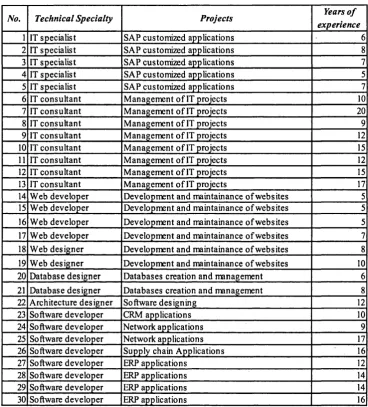
In an attempt to investigate the aforementioned considerations, thirty “ethnographic” interviews (Evans et al., 2004; Kunda et al., 2002) with highly- skilled IT contractors were conducted in Greece. The selection o f the informants followed the logic o f a snowball sampling, i.e., respondents were asked to provide details o f others whose working profile matched the unit o f analysis o f the current study (Evans et a l, 2004; Faugier and Sargeant, 1997).
Each contractor was considered as a single case-study, revealing certain aspects related to perceived realities o f IT contracting. The selection o f multiple cases aimed at replicating the findings stemming from the first case. Triangulation and juxtapositions o f the respondents’ views with regard to the same phenomenon intended to allow a rich variety o f topics and perspectives to emerge. The intention o f the study was not to prove the prevalence o f a phenomenon to a stated population, but rather ”to understand the deeper structure o f a phenomenon, which is believed can then be used to inform other settings” (Orlikowski and Baroudi, 1991, p. 5).
The topics discussed in the course o f the interviews evolved around the contractors’ career histories, the conditions which frame their everyday working lives, their work practices, their business ethics, the construction o f their professional identities, the management o f their relationships with client-firms, and their overall experiences and perceptions with regard to IT freelancing practices. Some informants were interviewed twice (when the initial transcription made a second round o f interviews necessary), and in some cases ad hoc observations in the respondents’ workplaces were made.
social and institutional conditions that rule the IT sector prove to partly account for the spread and maintenance o f IT freelancing techniques.
1.3 Significance and Contributions of the Study
This research promotes the view that an understanding o f employment forms cannot be fully achieved without the serious consideration o f both the technical and social/institutional conditions which underpin and mediate the material production o f goods and services. Under this scope this study puts into the center o f analysis the functional base and the intrinsic and extrinsic characteristics o f work: the way work is currently practiced and organized is considered a basic enabler o f today’s contracting practices.
In this sense, the research pays special attention to the way both particular
technological tools which mediate the production o f software, and specific social
and institutional form ations which frame the provision o f IT services, are involved in the reconfiguration o f current work settings and employment forms. In particular, the research findings suggest that there are two conditions which are inextricably intertwined with the feasibility and diffusion o f IT contracting practices.
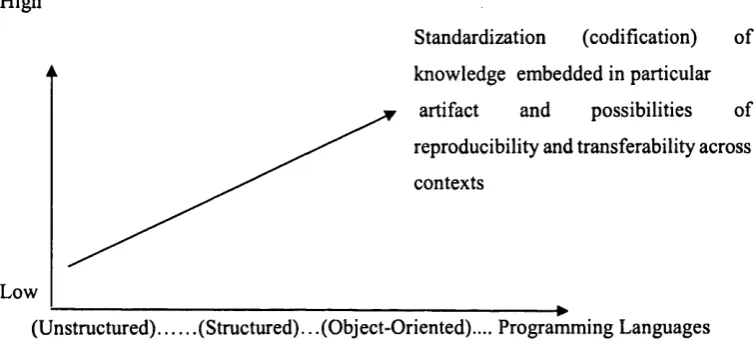
First, the technical functionalities which are embedded within the particular programming languages allow for the codification and transferability o f IT knowledge across organizational settings. The increased modularity o f code and the relative standardization o f the software development process bring about particular programming tools that create the possibility o f easier recombinability, scalability and integration o f independently developed software modules.
manipulate its own data and perform operations specific to itself. The communication or linkage among the various objects is relatively formalized and is realized through the exchange o f simple messages via carefully designed interfaces. Similarly, the inherent structure and incremental production o f slightly or strongly differentiated objects have been homogenized and standardized, following particular patterns o f classification and deductive logic (i.e. the concept o f inheritance). A great part o f the IT engineer’ s discretional choices with reference to what data should be manipulated by what function and how re-usability o f code is practically enacted has been codified and encapsulated within the structural principles o f object-oriented programming techniques. And such a codification o f IT knowledge opens the door to its subsequent transferability.
The increased modularity and the adoption o f standardized combinatorial rules have had the following immediate effects which were significantly involved in the provision o f contracting services:
a) an object can be transferred from one application to another without significant semantic alterations or distortions, since its operations are specific to itself and independent o f the rest o f the system,
b) various parts o f the system can be easily reshuffled, combined and separated, allowing the system to be easily decomposed and recomposed anew according to the imperatives dictated by the business objectives potentially undertaken by a particular contractor, and
c) various parts o f the system can be assigned to contractors and then can be easily integrated, since the work output o f each individual is independent and autonomous from the effort allocated by the rest the people on the team.
d) reusability o f code is anticipated and increased since brand new classes o f objects can be created just by abstracting out common attributes and behaviors. The variability and the spectrum o f the produced code is supported.
business and work arrangements to emerge (Andal-Ancion et a l, 2003; Pentland and Feldman, 2007).
Second, the emergence o f specific communities and social networks appear to support and decisively frame the provision o f IT contracting services. Informal professional networks and virtual communities, largely enabled by the use of internet technologies, counterbalance the negative aspects o f IT freelancing and ensure the viability o f the contingent employment relationship. They diminish information asymmetries between the two parties o f the transaction, by promoting the visibility o f market conditions and invoking normative mechanisms o f control.
In particular, the IT contractors’ membership into informal professional networks (Laubacher and Malone, 1997) (i.e. networks with ex-peers and friends who share the same professional interests and diverse kinds o f virtual IT communities available in the Internet) appeared to be a strong moderator o f contracting life. They constituted the contractors’ resources for: a) maintaining long-term employability in a shifting and volatile occupational labor market (Osnowitz, 2006), and b) updating their knowledge and enjoy the benefits o f traditionally co-located collegiality (Barley and Kunda, 2004).
Similarly, these virtual and professional networks become a great source o f easily accessible, timely and up-to-date information and a locus where contractors with similar interests could gather and exchange opinions about their work concerns. Through these networks, the contractors were able to gain access to the lived experience and cumulative knowledge o f an expert community. This capability is crucially important, since expert knowledge, apart from its reliance on formal education, it also depends upon the ongoing interaction o f members o f the same profession (Barley and Kunda, 2001).
In conclusion, the research findings indicate that current employment trends, such as the contracting o f highly-skilled IT services, should not be conceptualized as neutral ways o f organizing labor, largely prescribed by functionalistic criteria or utilitarian motives. They appear to be complex mechanisms for coordinating work, which usually coincide with the emergence o f particular technological conditions and social contingencies. Subsequently, their substantial understanding necessitates the parallel consideration o f the material and non-material circumstances which allow them to flourish and prevail.
1.4 Structure of the thesis
The thesis consists o f eight chapters. After this introduction chapter, Chapter 2 provides a synopsis o f the basic trends which characterize the modem workplace and ground the relevance and distinctiveness o f the research subject with regard to the prior research conducted in the field. More precisely, it discusses the notion o f workplace flexibility, individualization and technological/organizational transformation and pays particular attention to the contracting practices o f professional and knowledge workers. After providing an overview o f the research conducted to date on IT freelancing and outsourcing, it introduces the research question which constitutes the pillar o f the current research.
task structure o f this work. It presents how highly-skilled IT employees organize their resources and act upon the ‘raw m aterial’ to perform their job. A brief discussion about the ‘professionalization’ o f the IT occupation is also hinted.
Chapter 4 presents the theoretical framework which has been used to frame the research problem and guide the overall conduct o f the research. It introduces the main vocabulary in regard to employment relationships and contractual arrangements. It provides a critical presentation o f G oldthorpe’s model, the theoretical basis o f the research. And, finally, it associates the theoretical constructs o f the model with aspects o f IT freelancing presented in the literature.
Chapter 5 presents the epistemological premises that guided the selection o f the particular methodology, as well as the significance and appropriateness o f this methodology for the study o f the subject matter. It overviews the literature on constructivism and tackles its appropriateness for the social study o f technology and employment relationships. It further presents the selected research methodology; defines the unit o f analysis and describes how the fieldwork took place, as well as how the narrative o f the research was constructed.
Chapter 6 presents a narrative-based perspective o f IT contractors’ perceived experiences and work practices. It summarizes the particulars o f the interviews and displays the generic characteristics o f the respondents. Furthermore, the main axis around which the narrative has evolved is demonstrated and the corpus o f the narrative is presented.
CHAPTER 2: LITERATURE REVIEW
1.1 Introduction
Today’s workplace breaks sharply with the basic tenets o f the industrial era and modem society. Bureaucracies seem to be fading away, giving their place to network-like forms o f organizing. Buzzwords like the ‘boundaryless’ organization (Arthur and Rousseau, 1996), ‘virtual’ organization (Mowshowitz, 1997) and ‘network enterprise’ (Castells, 1996) are used to describe the advent o f a new socio economic era, where the trends o f the ‘salarization o f w ork’ and the ‘socialization of production’ are successively substituted by trends towards the ‘desegregation o f labour’ and ‘flexibilization o f production’ (Camoy, 2000).
Over the last few decades, flexible employment patterns have been growing faster than any other form o f work (Beck, 2000, p. 84; Kalleberg, 2000). “The traditional form o f work, based on full-time employment, clear-cut occupational assignments, and a life-long career pattern is being slowly but surely eroded away” (Castells, 1996, p. 290). Current organizations are no longer solely populated by full-time, permanent hourly or salaried employees; they increasingly utilize contingent workforce (Polivka and Nardone, 1989), such as temporary workers, independent contractors, consultants and part-time workers.(Lawler III and Finegold, 2000).
The flexibilization o f the terms and conditions o f employment has particular implications on the way individuals experience, interpret and perceive the world o f work; a shift in the premises according to which individuals are tied to organizations redefines the balance between distinct spheres o f social life (Kallinikos, 2003). The new economic and social order aims at “decentralizing management, individualizing work, and customizing markets, thereby fragmenting labor and segmenting societies” (Camoy and Castells, 1997, p. 9).
presents the basic characteristics o f the contemporary workplace. Section 2.3 reviews the literature on technology and the restructuring o f work. Section 2.4 stresses the significance o f the occupational category o f highly-skilled information technology (IT) contractors and section 2.5 reviews the literature on IT contracting and outsourcing practices.
2.2 Trends in the current workplace
2.2.1 Flexibility
Over the last few decades, western countries have experienced a steady growth in atypical or ‘non-standard’ forms o f employment (Camoy, 2000; Castells, 1996; Felstead et al., 1999; Hoque and Kirkpatrick, 2003, p. 668; Kalleberg, 2000; Mayne
et al., 1997). Castells, summarizing the transformations underlying current social and economic relations, argues that “the most important transformation in employment patterns concerns the development o f flexible work, as a predominant form o f work arrangements” (Castells, 2000, p. 11). Despite the differences in national legislations, context-specific labor market arrangements and cultural traditions “there is a clear and largely consistent trend among European companies to start taking initiatives in terms o f flexible pay systems and flexible work practices in order to increase competitiveness” (Kufidu and Michail, 1999, p. 486).
In the literature, the notion o f flexibility has several connotations and is used to label or signify several trends in the organization o f work and employment (Atkinson, 1984; Hunter etal., 1993; Kalleberg, 2001; Reilly, 1998; Smith, 1997). In particular, a burgeoning part o f the literature tackles the notion o f flexibility as being synonymous with the ‘flexible firm’ and studies the parallel utilization o f core and peripheral workforces, as well as their implications for the organization (Atkinson, 1984; Clegg, 1990; Hakim, 1990; Hunter et a l, 1993; Nesbit, 2005). Under this research agenda, the use o f a core-periphery model o f work is seen as an
employment strategy which allows the firm to better address concerns o f adaptability and high performance in unstable working environments. (Abercrombie
Another part o f the literature focuses on how flexible forms o f production, initiated and supported by the introduction o f new technologies can better serve the shifting needs o f a heterogeneous market (Castells, 1996; Gil-Molto and Poyago-Theotoky, 2008; Lash and Urry, 1987; Mathews, 1989). In this sense, flexibility is viewed as the em ployer’s attempt to “improve competitiveness and reduce operating costs” in a highly turbulent, unstable and globalized working environment (Gunnigle et a l,
1998, p. 431; Harrison and Kelley, 1993). For the aforementioned scholars, flexibility is considered a strategic choice which impinges upon the rationale o f efficiency.
Furthermore, other scholars are concerned with the impact o f flexible production on workforce and labor markets (Goldthorpe, 1998; Harvey, 1991; Kalleberg, 2000; McAlester, 1998; Smith, 1998; Warren and Walters, 1998). The focus o f this research lies in the study o f work conditions and power relations that emerge within non-standard employment relations; this type o f research often delineates a somber picture o f non-standard employment with regard to the benefits traditionally enjoyed by employees.
Generally speaking, a broad categorization o f the various meanings and connotations ascribed to flexibility is as follows:
Numerical or external flexibility refers to the capability o f the organization to adjust the size o f its workforce “quickly in line with the fluctuations in business demand” (Gunnigle et a l, 1998, p. 430; Kalleberg, 2003) by using external labor, such as part-time work, sub-contractors, and contingent or temporary employees.
Management. Functional flexibility was touted to create the fertile conditions for “the promulgation o f a new ethos o f participation” (Smith, 1997, p. 319) and a new pattern o f power delegation which would guarantee continuous improvement and long-term viability.
Temporal flexibility refers to the flexibilization o f working time and includes a variety o f time-related arrangements for non-conventional forms o f employment (Evans et a l, 2004; Glass and Estes, 1997; Perlow, 1999; Presser, 1999). Research on temporal flexibility addresses concerns related to the balance that employees can potentially achieve among distinct spheres o f social life.
Locational flexibility refers to the capability o f the organization to use employees who work outside the conventional workplace; this category o f employees includes teleworkers, partly home-based employees and employees who spend most o f their time outside the conventional office (Reilly, 1998).
And, finally, financialflexibility refers to the capability o f the organization to adjust the wages and economic benefits provided according to the economic conditions o f the market (Reilly, 1998).
It is noteworthy that “in most OECD countries, the fastest growing category o f work is ‘part-tim e’” (Cam oy and Castells, 1997, p. 16) and approximately, almost 30 percent o f the labor force o f the aforementioned countries has been employed in flexible, non-traditional work arrangements. In the relevant literature the term
contingent labor has become synonymous with “a wide range o f short-term employment arrangements, including part-time work, temporary employment, self- employment, contracting, out-sourcing and home-based work” (Camoy et a l, 1997; Kunda et al., 2002, p. 235). “The contingent workforce consists o f independent contractors; individuals brought in through employment agencies; on-call or day labor; and workers on the site whose services are provided by contract firms” (Matusik and Hill, 1998, p. 680). Alternatively, it is defined as “any job in which an individual does not have an explicit or implicit contract for long-term employment” and implies a variability and unpredictability in the settings and hours worked (Polivka and Nardone, 1989, p. 11).
O f particular interest is also the fact that although the notion o f temporary or contingent labor has been traditionally associated with the employment o f low- skilled employees or workers (Tilly, 1996), it is now used to describe the employment patterns o f managers and professionals (Abraham and Taylor, 1996; Cohany, 1996). Subcontracting and consulting is a fast growing form o f employment particularly linked to professional work (Castells, 2000; Cohen and Mallon, 1999; Hoque and Kirkpatrick, 2003; Laubacher and Malone, 1997; Mallon, 1998; M atusik and Hill, 1998; Millward et a l, 2000; Tilly and Tilly, 1998). In knowledge-intensive sectors o f the economy, such as high technology and entertainment, skilled workers operate outside the framework o f traditional employment arrangements, as independent contractors establish ongoing relationships with a number o f different firms (Laubacher and Malone 1997). “Stable employment is declining and contingent work is on the rise even among professionals and managers” (Barley 1996).
look at contingent work as an opportunity which enables firms to reduce their overhead and administrative costs, reducing or expanding their workforce accordingly to the changing market conditions and the staffing needs o f internal projects, and thus respond successfully to the competitive economic environment (Abraham and Taylor, 1996; Davis-Blake and Uzzi, 1993; Harrison and Kelley, 1993; Nollen and Axel, 1996; Slaughter and Ang, 1996; Welsh and Nayak, 1992). Others focus on the impact o f contingent work on the knowledge stock o f the firm, its ability to create value and its long-term competitive position (Matusik and Hill,
1998).
Conclusively, it could be argued that no matter what the justification or reason that legitimizes the spread o f flexible work may be, non-standard employment patterns appear to constitute a fundamental shaping force o f the labor market in the years to come. The flexibilization o f the terms and conditions according to which both low- skilled and professional work are organized bears evidence o f a significant socio economic trend which needs to be further investigated and understood.
2.2.2 Individualization & self-management
W ithin the current work environment, labor loses its collective identity and becomes increasingly individualized in the majority o f its manifestations (Castells, 1996; Deery and Mitchell, 1999). Personal contracts become the dominant form o f labor contract and the focus o f economic activity is the individual employee him/herself (Beck, 1992; Beck, 2000; Camoy, 2000);
‘flexible’ workers move between workplaces filling particular positions on demand, or are self employed, providing labor services on demand” (Cam oy et al., 1997, p. 27; Handy, 1994).
In an increasingly individualized economy, human agents are seen as autonomous, enterprising economic agents; they view themselves as the center o f their own life and pursue their personal interests through the exchange o f services and goods (Abercrombie et a l, 2000; Beck, 1992). They sell their services in a spot market and delineate their em ployment prospects according to the portfolio o f marketable skills and competencies they possess. The employment relationship is no longer based on expectations o f commitment and loyalty in exchange for long-term employment and continuous training; it rather builds upon monetisable and quantifiable types of exchange (Rousseau, 1996; Van Maanen and Barley, 1984). The emergence o f the ‘boundaryless’(Arthur and Rousseau, 1996), ‘post-entrepreneurial’ and ‘portfolio career’ aim at capturing “the notion o f fluidity, self-management and independence” (Mallon and Duberley, 2000, p. 35) which characterizes the conditions and trends of the contemporary labor market. Individuals move freely in and out o f the employment relationship according to the size, variety and supply o f projects available in the market.
Enterprising individuals or self-programmable labor (Castells, 2000) are responsible for the present and future situation they will find themselves in, since it is they who make the decisions about the portfolio o f their competencies and the final configuration o f their career paths. “This in turn implies human agents capable o f easily moving between varying and shifting roles, that is divisable and mobile humans” (Kallinikos, 2003, p. 605). That is. individuals who are able to invoke selectively and in a piecemeal fashion a set o f transferable skills and malleable behavioral characteristics which address the varying and shifting demands o f a heterogeneous and volatile market.
responsibility over their career management comes with the burden o f professional isolation, economic insecurity and personal training (Barley and Kunda, 2004).
It is noteworthy that the trend o f individualization leaves its mark on the management o f salaried workers, too. According to the rationale o f Human Resource M anagement (HRM), an em ployee’s performance is expected to increase, if his/her distinctive needs, abilities and expectations are handled in an appropriate and, often, distinct way (Jenkins, 1998; Welsh and Leighton, 1996). Once more, the labor contract loses its universal character and uniform form and becomes tailored to the particular needs and competences o f each employee. Job designs become more malleable, while career paths and trajectories are solely based on the em ployee’s assessed performance (Jeckins, 1998). Basic pay is no longer determined by the “job held” but by the portfolio o f skills and competences that the employee possesses. Just like part-time employees and contingent workers, salaried employees “focus on accomplishing individual deliverables and on doing high visibility work which brings personal advancement and rewards” (Gephart, 2002, p. 335; Perlow, 1997a, p. 34).
It could be argued that a great part o f the responsibilities in regard to the conditions and content o f work, traditionally held by the employing organization, is now transferred to the individual employee. The notion o f ‘m onad’ - regardless o f whether it refers to the notion o f the individual agent or the notion o f the individual work project — is rendered the main axis around which economy, work and employment are organized and evolved.
2.3 T echnology, organization and the new w orld o f w ork
“between 1996 and 2005, only 14 o f 1.187 (1.2%) articles published in three o f the field’ s top journals, ASQ, AMJ, and the Academy o f M anagement Review(AMR) focused on technology’s relationship to organizational form an function” (Zammuto
et al., 2007, p.750).
Whatever the reasons that justify the decline in organizational theorists’ interest in technology, technology does mediate the processes o f communication, coordination and control and subsequently becomes a fundamental component o f organizational life (Yates, 1989; Yates and Orlikowski, 1992; Zammuto et al., 2007). Technology supplants and reinforces the role o f hierarchy in coordinating and controlling activities and thereafter becomes unavoidably involved in the creation o f potentials for new forms o f organizing work (Fulk and DeSanctis, 1995; Zammuto et al., 2007). Prior research in the field shows that innovations in the organization o f work are usually accompanied by fundamental changes in technology as well as shifts in the way people perceive and interpret work (Barley, 1996; Zuboff, 1988).
And although technology has not been alone in triggering the transformation taking place in the current workplace and post-industrial society -complex social and institutional factors have co-contributed to the emergence and formation o f work and society (Iacono and Kling, 2001)- the involvement o f technological artifacts appears to be significant in the changes manifested during the last few decades. “If technology per se does not create or destroy employment, it does profoundly transform the nature o f work and the organization o f production” (Camoy and Castells, 1997, p. 9). In other words, even if the variety o f changes that the new work place undergoes cannot be fully attributed to technological evolution, new information and communication technologies do offer “occasions” for restructuring and enriching the spectrum o f possibilities for change (Barley, 1986).
2.3.1 T echnology and the organizational fabric: processes and relationships
-Reframin2 the functional base o f work: skills set and power relations
redefining the conditions under which work and production are organized in particular socio-economic and institutional contexts. In this sense, the literature describes and analyzes how the introduction o f new technologies is related to shifts in the premises by which individuals perform their tasks and are tied to organizations: how the structure o f the job tasks is redefined, the labor is de-skilled or up-skilled, the effort is weaken or intensified, the control is decentralized, the organizational structures are put under scrutiny and undergo subsequent changes, the governance mechanisms are challenged and the delegation o f power between the management and employees is significantly altered.
In particular, several studies are concerned with the impact o f ICTs on the workforce (Barley, 1988; Ettlie, 1986; Iacono and Kling, 2001; Mankin, 1983; Ranney and Cardner, 1984; Spenner, 1995; Walsham, 1998; Zuboff, 1988). These studies describe the way the introduction o f new technologies in the manufacturing and service industries contributes to the elimination o f semi-skilled and unskilled jobs, and the up-skilling and re-skilling o f jobs that remain. For instance, several studies refer to the impact o f new technologies on low and mid- level employees: the introduction o f computers implies that the clerical and secretarial employees have to learn new skills and undertake additional responsibilities (Buchanan and Boddy, 1982; Mumford, 1983). In the same way, the first-line supervisors are expected to take more initiatives, taking advantage o f the newly enabled decentralized decision making (Ranney and Cardner, 1984). Contrariwise, factory workers who used fully automated systems seemed to experience a feeling o f alienation and resentment towards their job (Ettlie, 1986). M assively computerized settings implied for some workers and employees reductions in the quality o f the work performed (Kling and Iacono, 1989). In some cases, mid-managers experience a similar feeling o f their work depreciation, since a large part o f the activities traditionally performed by them have been now embedded with the pre-programmed functions o f computer hardware and software (Jackson and Humble, 1994; Winter and Taylor, 1996).
power and identity (Brocklehurst, 2001; Graham and Wilkinson, 1992; Gray et al., 1993; Martino and Wirth, 1990).
Along the same lines, several studies are concerned with the impact o f technology on professional workers and reflect on the power relations occasioned in organizational settings. Barley (1986) documents how technology might trigger the emergence o f particular organizational structures by altering institutionalized roles and patterns o f interaction among individuals; while others (Lamb and Davidson, 2005; Walsham, 1998) focus on the way new ICTs challenge the construction o f scientific and professional identity.
Generally speaking, there is little or no consensus on the very way advances or changes in technology are implicated in the particular transformation in the sphere o f work and employment (Barley, 1988; Orlikowski and Scott, 2008b). Orlikowski (1992) notes that “while technology has been a central variable in organizational theory since the late fifties, there is little agreement about the nature and the definition o f technology, and no compelling evidence o f its distinctive role in and implications for organizational affairs” (Orlikowski and Scott, 2008a, p. 14).
Table: Dimensions o f work and the duality o f ICTs
Work dimensions The dual role o f ICTs
F u n c tio n a l b a s e o f w o rk -
R e s tru c tu rin g o f
o rg a n iz a tio n a l p ro c e sse s an d
fu n c tio n s
IC T s a u to m a te w o rk
(a u to m a tio n a n d
ra tio n a liz a tio n o f ro u tin e an d
q u a s i-ro u tin e c o g n itiv e
ta sk s)
IC T s in fo rm a te w ork:
g e n e ra te n e w stre a m s o f data
a n d in tro d u c e th e d im e n sio n
o f re fle x iv ity
In fo rm a tio n c o n te n t o f th e
ta sk s
IC T s d e c re a s e th e
in fo rm a tio n c o n te n t o f th e
ta s k
IC T s in c re a se th e
in fo rm a tio n c o n te n t o f th e
ta s k
N a tu re o f w o rk IC T s fa v o r th e m e tic u lo u s
sta n d a rd iz a tio n a n d
m e c h a n iz a tio n o f th e w o rk
IC T s c o n trib u te to th e
a b s tra c tio n a n d
m o d u la riz a tio n o f w o rk
W o rk In te n sity IC T s fa v o r th e
in te n sific a tio n o f e ffo rt-
a lie n a tio n a n d re s e n tm e n t
to w a rd s th e jo b
IC T s lib e ra te la b o r fro m th e
c o n s tra in ts o f te d io u s w o rk
a n d a llo w m o re sp a c e fo r
E m p o w e rm e n t a n d jo b
e n ric h m e n t
N a tu re o f S k ills IC T s d e -sk ill w o rk : less
ta le n t is n e e d e d
IC T s u p -s k ill w o rk (a b stra c t
a n d in te lle c tiv e sk ills-
in c re a s e s th e in fo rm a tio n
c o n te n t o f th e ta sk s)
P o w e r re la tio n s a n d
le g itim iz a tio n o f a u th o rity
IC T s su p p o rt o rg a n iz a tio n a l
tra n sp a re n c y
IC T s p o s e n e w c h o ic e s fo r
th e o rg a n iz a tio n a l te rra in
C o d ific a tio n a n d
e m b e d d e d n e s s o f th is
k n o w le d g e in to th e
te c h n o lo g y o f k n o w le d g e
E ro d e s a g r o u p ’s p o w e r A llo w fo r tra n s fe ra b ility an d
re -u s a b ility
T im e a n d sp a c e c o n s tra in ts Iso la tio n , u n c e rta in ty a n d
id e n tity re la te d issu es
F le x ib ility a n d fre e d o m o f
c h o ic e
Zuboff addresses the duality o f information technology, by arguing that technology
o f the organization. In the same respect, Bell (1973) distinguishes two basic categories o f technological infrastructure: a) intellectual technology which aims at supporting management to make complex decisions and more effectively rule the organization, b) machine technology which automates routine and repetitive tasks and allows continuity, consistency and control over the tasks performed.
Let me present how this dual character o f technology is related to particular occasions or possibilities o f transformation in the work sphere.
2.3.1.1 Automation and information technology
Broadly speaking, the introduction o f information technology in organizations has been regarded as a way to increase productivity, by automating the existing operations and intensifying the internal mechanisms o f control (Iacono and Kling, 2001). New technological tools mediated organizational tasks and created new potentials and constraints for organizational players. In many factories and offices, managers chose to employ technology as an attempt to reduce staffing and save operational costs. Reduced numbers o f lower paid workers were expected to perform more work with the aid o f technological tools (Iacono and Kling, 2001, p.
117).
and reframed the role o f human intervention in this process.
In particular, the programmability o f computers and machines reflected and im plicitly or explicitly promoted a standardized way o f dealing with the complexity o f organizational affairs. From the era o f industrial revolution until today the com puterization or informatization o f the workplace has both presupposed and implied the rationalization o f the production process. “The technologies... which firms and informal organizations have deployed for the management and control of the labor process in industrial capitalism have been extensively predicated upon the standardization o f physical and mental labor” (Kallinikos, 2006, p. 28). The rationalization o f routine tasks and standardization o f many work processes has been achieved through the detailed description o f the sequential steps which constituted organizational tasks and work processes; the task has been broken into its constituent parts which in their turn can be developed independently and potentially allocated to various individuals unrelated to one another (Kallinikos, 2003). A number o f tasks which had been traditionally performed by individuals, were now undertaken by machines and information technology and the role o f organizational actors was thus challenged.
The way the individual acts upon the material and participates in the overall process o f producing a service or product is rendered increasingly visible, while the area of responsibility o f each individual node o f the production circuit is more clearly delineated. In other words, the allocation o f human effort to the various steps o f production is split into independent modules and becomes increasingly systematized so as to be easily susceptible to scrutiny and control. Under this working climate, both factory and office workers felt that they are loosing the control over the production, their tasks and talents are increasingly de-codified and their present skills are rendered obsolete (Jackson and Humble, 1994; W inter and Taylor, 1996; Zuboff, 1987). The cognitive analyzability o f the work tasks contributed to the erosion o f the individual’s power and significantly challenged the functional base o f the work.
challenging decisively the traditional way o f doing things and conceiving oneself. Apart from simply being a tool for automating existing processes and a tool for improving and accelerating existing organizational activities, IT has been proved to be a potential enabler o f organizational change (Barley, 1986; Yates, 1989; Yates and Orlikowski, 1992), a dynamic condition which may significantly challenge the established order o f things. Thereafter, organizational actors, coping with advanced technologies, were soon faced with a new reality: apart from the fact that they had to learn how to cope with and operate new machinery in order to perform their tasks, they also had to reconsider their role in the organization and redefine their everyday working practices.
2.3.1.2 Informative capacity o f information technology and the abstraction o f work
Apart from the immediate and explicit impact o f automation on both the factory and office work, the introduction o f technology contributed towards the abstraction of work (Zuboff, 1987). And such an abstraction paved the way for the organization of production and the conceptualization o f work in ways which have not been possible before. It can be argued that the abstraction o f work had three immediate consequences: a) the output o f the production process was decoupled from the particular individual effort and personal characteristics, b) the production process was detached from the immediate context o f action, and c) the production process is decoupled from the production outcome; radically new possibilities o f organizing and conceptualizing work emerged.
In brief, information technology transformed sentient-based and action-centered work to abstract, electronically mediated work. The w orker’s or employee’s performance was no longer dependent upon his/her ability to act upon raw material; it was dependent almost solely on his/her ability to manipulate and make sense o f particular symbols which stood for particular variables o f production and were presented on a two-dimensional computer screen (Kallinikos, 1999; Zuboff, 1988).
the logic governing the computing machine; individual’s knowledge lost its tacit character and context specificity, while the necessary skills and competences to perform the job became to a great extent analyzable and formalized (Dreyfus and Dreyfus, 1986; Zuboff, 1987). In other words, workers were cut o ff from the particular context o f practice and their already acquired sentience-based knowledge was rendered almost useless; their experiential, context-specific knowledge was substituted by the need for referential reasoning, analytical skills and theoretical knowledge (Kallinikos, 1999; Zuboff, 1988). As a natural corollary, the production process eliminated its dependence on contextual idiosyncrasies and individual proclivities, since its running relied upon the manipulation o f abstract, commonly agreed symbols.
But such a reliance upon abstract symbols and the informatization o f the content of work set into motion a series o f changes in the way work was conceived, understood and practiced (Kallinikos, 1999). As long as administrative functions and organizational processes are amenable to symbolic-numerical representation, they automatically become increasingly homogenized, reducible to a common logic o f understanding and interpretation. Various organizational activities can be juxtaposed, evaluated against one another and progressively gain a new momentum regarding their overall significance for the organizational terrain (Kallinikos, 2006).
The abstraction-digitalization o f the production process allows a radically different and dynamic understanding and visualization o f the production process to occur (Zammuto et a l, 2007; Zuboff, 1988). Increased clarity and enhanced visibility o f the various components o f the work system reveals information about the underlying patterns o f productive and administrative processes (Zuboff, 1988). The potential o f interdependencies and supplementarity among organizational processes may be identified (Barki and Pinsonneault, 2005) and possibilities o f integration within the same business unit and across organizational boundaries may emerge.
organizational members” (Leonardi, 2007, p. 813). The abstraction o f the work and the digitalization o f production brought together and juxtaposed a large variety o f information items and sources that traditionally remained unrelated and irreducible one to another (Kallinikos, 2006; Lilley et al., 2004; Shiller, 2003).
At this point, it would be useful to point out that the effects o f computerization on the way work is currently organized and performed “would never have been possible without the deep and continuing segmentation o f tasks and operations produced over the course o f industrial capitalism” (Kallinikos, 2006, p. 109). Nevertheless, the spread o f digital technologies all over the work sphere transcends the effects traditionally associated with the effects o f specialization, division o f labor and process standardization (Kallinikos, 2006; Mowshowitz, 2002) and led to an almost dissolvability o f organizational life.
Unlike traditional technologies, new information and communication technologies are modular, recombinable and multi- purposed (Pentland and Feldman, 2007). “The potential significance o f new ICTs arises not just from their individual function, but from their potential o f recombination” (McAfee, 2006; O'Reilly, 2005; Pentland and Feldman, 2007, p. 783). For instance, through the potentials o f recombination o f alternative information sources and digital media, traditional organizational processes and functions can be transformed (Andal-Ancion et al., 2003; Pentland and Feldman, 2007). Increased interoperability o f structural technological tools opens a new spectrum o f possibilities for the organization o f business functions, such as logistics, sales and customer services.
decomposed, recomposed, integrated or recombined across the globe in an attempt to create a real-time or flexible product or service easily adjustable to the needs o f individual customers (Andal-Ancion et a l, 2003). Under the same scope, “Service- oriented architectures (SOAs) refer to the notion o f breaking up the software in a firm in its various services that can then be reused to rapidly create new applications” and innovative services (Zammuto et al., 2007, p. 754).
In conclusion, it can be argued that material features and properties o f new modular technology drew upon the heritage o f the division o f labor and specialization, favored the abstraction, digitization and dissolvability o f work processes, and thus allowed for new possibilities o f organizing to emerge. In this sense, new technologies “opened the door to new ways o f dealing with complexity and uncertainty because they created opportunities for emergent patterns o f interaction, in other words, new forms o f organizing.” (Zammuto et al., 2007, p.752).
2.3.1.3. Possibilities o f communication, interaction and collaboration: networks and distributed forms o f work
It has been common place in the literature to correlate the current trends occurring in the workplace with particular technological innovations or changes. According to some organizational theorists, the advent o f the post industrial society (Bell, 1973) and the constitution o f the information economy (Castells, 1996) cannot be adequately understood without consideration o f the communication and coordination opportunities brought about the spread o f new technologies.