http://dx.doi.org/10.4236/jmp.2015.67102
On Quarks and Gluons
Bin Liang
College of Science, Chongqing University of Posts and Telecommunication, Chongqing, China Email: [email protected]
Received 4 February 2015; accepted 27 June 2015; published 30 June 2015
Copyright © 2015 by author and Scientific Research Publishing Inc.
This work is licensed under the Creative Commons Attribution International License (CC BY). http://creativecommons.org/licenses/by/4.0/
Abstract
This article gives the potential energy function of quark in the gluon field, derives the wave func-tion of quark in stafunc-tionary state and the quark confinement and asymptotic freedom, shows that a quark is composed of two different color gluons, expounds the formation mechanism of the quark confinement and asymptotic freedom and the physical substance of “colors” of quark, and dis-cusses the stability of hadrons in the end.
Keywords
Gluon Field, Potential Energy and Wave Function of Quark, Confinement and Asymptotic Freedom, Composition of Quark, Substance of “Colors” of Quark
1. Introduction
2. The Potential Energy Function of Quark
Without missing generality, we discuss the proton as an example since the proton is the only stable hadron. As-sume that there is a spherical symmetrical gluon field of the radius R in the proton where the gluons are point particles. In order to have the confinement and asymptotic freedom for the valence quarks qf (the subscript f is a flavor index) we construct a spherical symmetrical potential energy function of quark in the following:
( )
2( ) ( )
,4π
f f
M r m r
g
V r
R r
= −
+ (1)
where r is the distance from the center to the quark qf, 0≤ ≤r R, and
( )
10
3 e R r
M r = M − (2) is the interactional mass of proton within the range of radius r, where the factor 3 is from that the quark has three kinds of “colors” in the proton whose mass is M0; and
( )
0 1 lnf f
r
m r m
R R r
λ
= −
−
(3)
is the interaction mass of quark and running, the constant mf0 is the mass of constituent quark whose mass is usually taken approximately as one third of nuclear mass;
2
4π
g
is the strong interaction constant, rq is the ra- dius of quark, and the constant eR rq
R
λ = , rq R.
It is not difficult to see that from Equations (2) and (3) since
( )
( )
0
lim f 0, lim 0,
r→Rm r = r→ M r = (4)
there are
( )
( )
0
lim f 0, lim f 0.
r→RV r = r→ V r = (5)
The above two equations show the gluon field is within the proton and limited.
3. The Probability Density of Quark
It is interesting that the mass distribution in the proton can tell us intuitively why there is the quark confinement and asymptotic freedom. From equation (2) we obtain the mass density in the proton
( )
( )
4 10 2
d 1
e ,
4π d
R r
M r R
r
r r r
ρ = =ρ −
(6)
where
( )
00 3
3 4π
M R
R
ρ =ρ = is both the mass density at the boundary and the average mass density in the proton, and shows that the introduction of factor of 3 is necessary in Equation (2). Write
( )
3 3 20
1 1
, f fc f c
r m
ρ ψ
= =
=
∑∑
(7)where ψfc=ψfc
( )
x is the wave function of quark with flavor f and color c in stationary state. As said pre-viously, the mass mf0 of constituent quark is one third of the nuclear mass, if assume the probability density2
fc
ψ is independent of flavor f and color c, then
( )
12
4 0
e ,
9 4π
R r fc
f
r R
m r
ρ
ψ = = − (8)
and it satisfies the normalization condition:
2 2
0
4π d 1. R
fc r r
ψ =
So the wave function of quark with flavor f and color c in stationary state is
( )
( )
112 2
1
e e e ,
4π
fc fc
R
iP x r iP x
fc fc
R
x r
r
ψ ψ
−
− −
= = (10)
where P xfc =E tfc −Pfc⋅r, the energy Efc=Tfc+Vfc
( )
r , Tfc is the free energy of quark and its potential energy( )
1 3
fc f
V = V r ,Vf
( )
r as shown in the Equation (1). Thus the probability density of quark distribution4 4
1 1
2 2
3
3 1
3 e e ,
4π
R R
r r
f fc
R R
R r r
ψ = ψ = − = −
Ω
(11)
where 4 π 3
3 R
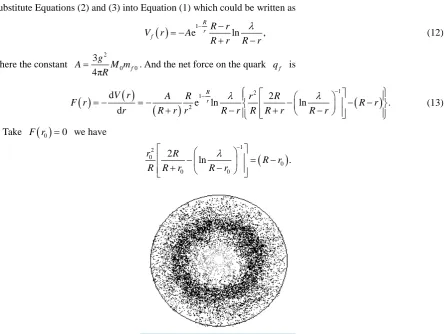
Ω = is the volume of proton. The above equation shows that the distribution of quarks or the con- struction of proton is independent of energy of quarks, and this is commonly referred to as the scaling. From the above equation we can know that the probability density ψf 2 has the maximum 12.73
Ω at r=0.25R, 1 Ω
at the boundary and zero at the center, as shown in theFigure 1. This implies that the distribution probability of quarks in the region of r>0.25R is greater far than that near the center. This is obviously because that the quarks are fermions. FromFigure 1 we could see that the formation of the quark confinement and asymptotic freedom is very natural, and we prove it directly in the following.
4. The Quark Confinement and Asymptotic Freedom
Substitute Equations (2) and (3) into Equation (1) which could be written as
( )
1e ln ,
R r f
R r
V r A
R r R r
λ
− −
= −
+ − (12)
where the constant
2 0 0
3
4π f
g
A M m
R
= . And the net force on the quark qf is
( )
( )
(
)
1 2 1(
)
2
d 2
e ln ln .
d
R r
V r A R r R
F r R r
r R r r R r R R r R r
λ λ −
−
= − = − + − + − − − −
(13)
Take F r
( )
0 =0 we have(
)
1 2
0
0 0 0
2
ln .
r R
R r
R R r R r
λ −
− = −
+ −
[image:3.595.94.540.374.708.2]
Note rq R and ln ln 1 q
R R
R r r R r
λ = +
− − , the second term in the brackets on the left side in above
equ-ation could be neglected, and
2 0
0 0
2
,
r
R r
R+r −
so the position of that the net force is zero
0
1
= 0.578 .
3
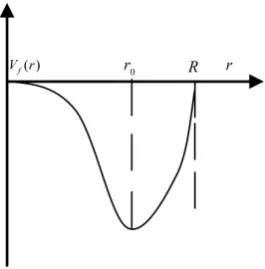
r R R (14) The function curve of the potential energy Vf
( )
r is shown as theFigure 2, where is F r( )
<0 at r>r0, the net force on the quark is the gravitation; and F r( )
>0 at r<r0, the net force is the repulsion.It is not difficult to see that from Equation (13)
( )
lim lim ln ,
2
r R r R
A F r
R R r
λ
→ = − → − = −∞ (15)
this is the quark confinement; and
( )
2 10 0
lim lim e 0,
R r
r r
q
A R
F r
r r
− −
→ →
= =
(16)
this is the asymptotic freedom. Thus, we have derived both the quark confinement and the asymptotic freedom from Equation (1). In order to find out the physical mining of the quark confinement and asymptotic freedom, let us discuss the coupling coefficient of quark with the gluon field.
5. The Running Coefficient of Coupling
Rewrite the net force on quark (see the Equation (13)) into Coulomb type:
( )
( ) ( ) ( )
2 ,f s
M r m r
F r r
r
α
= (17)
where
( )
2 2 2 2 13 2
ln 4π
s
g r R R
a r
R r R r R r R r
λ −
= − − + − − − +
(18)
is the coupling coefficient of quark qf with the mass M r
( )
. It is just the running coefficient of coupling to change with the movement of quark. Obviously, there is( )
lim s ,
r→R
α
r = −∞ (19) [image:4.595.247.380.571.706.2]this is identical with equation (15) in physical meaning and denotes the quark confinement, too. And
( )
20
lim 3 0,
4π s
r
g r
α
→ = > (20)
this shows that the net force on quark in the depths of gluon field is repulsion. The above equation is coincident with Equation (16) in physical meaning, and the reason the Equation (16) equals zero is that
( )
0
lim 0
r→ M r = , but
( )
0M r ≠ for the coupling coefficient a rs
( )
. What is the physical picture hidden behind the quark confine-ment and asymptotic freedom, then?6. The Composition of Quark
As shown in Equation (4) there is
( )
lim f 0,
r→Rm r = (21)
this shows that the mass of quark turns out to be zero near the boundary of the proton. What does that imply? Since Equation (1), from which the quark confinement and asymptotic freedom have been derived, is credible and mf
( )
r is one of important factors in it, so, we have to give a reasonable explanation about what is the physical meaning of the above equation.We know the gluons have no mass according to the quantum gauge theory. Thereby, the logical explanation of the above equation is that when a quark enters the region of r>r0, it gets closer and closer to the boundary of the proton, the gravitation on it is greater and greater, and it resolves into the gluons eventually. But this implies that a quark is composed of gluons. How do gluons constitute a quark, then?
Firstly, if we believe that quark consists of gluons, the gluons should be charged because quarks are charged. Otherwise, the conservation law of charge will be violated. In fact, quantum gauge theory did not conclude that gluons are not charged. It is inappropriate to equate the gluon and photon. However, a quark cannot be com-posed of two gluons with equal and opposite electric charges. If so, quark is electrically neutral.
Secondly, the gluons as quanta of non-Abelian gauge field should be fermions rather than bosons. In fact, be-cause the quarks are fermions of spin 1/2, the gluons to constitute a quark should be fermions, too. Therefore, two gluons of the same color are repulsive to each other and cannot constitute a quark according to Pauli exclu-sion principle. The gluons to constitute a quark can only be different gluons in color.
From the above analysis we could put eight kinds of gluons into two groups according to the electric charge of gluons. The gluon group consists of four kinds gl of gluons, their electric charges are
1 5
, ,
6 6
a c d b
Q =Q =Q = − Q = (22) the anti-gluon group consists of four kinds gl of anti-gluons, their electric charges are
1 5
, ,
6 6
a c d b
Q =Q =Q = Q = − (23) where the color index l=a b c d, , , . The spin of every gluon or anti-gluon is one fourth.
Assuming that only the two different color gluons or anti-gluons can constitute a quark or anti-quark, the two groups constitute justly 6 kinds of quarks or anti-quarks shown in the following, respectively.
Quarks:
, , , , , ,
a b a c a d b c b d c d
u=g g d=g g s=g g c=g g t=g g b=g g (24) Anti-quarks:
, , , , , .
a b a c a d b c b d c d
u=g g d =g g s =g g c =g g t=g g b =g g (25)
If the electric charge or spin of a quark equals the sum of that of its two constituent gluons, the charge of 6 kinds of quarks is
2 1 1 2 2 1
, , , , , ,
3 3 3 3 3 3
f
where f =u d s c t b, , , , , . Similarly, the charge of 6 kinds of anti-quarks is
2 1 1 2 2 1
, , , , , ,
3 3 3 3 3 3
f
Q = − − − (27)
and the spin of every quark or anti-quark is 1
2.
The gluons and anti-gluons could annihilate into different particles in different interactional courses when they met. For example, the meson π− composed of the anti-quark u and quark d, or the two gluons g ga, c and
two anti-gluons g ga, b, could annihilate into µ ν −+ ′ or
e−+ν [3].
7. The Formation of Quark Confinement and Asymptotic Freedom
According to the above composition rules of quarks, the formation mechanism of the quark confinement and asymptotic freedom could be explained clearly.
A quark composed of two different color gluons is repulsed by same quarks (or gluons) according to Pauli ex-clusion principle, and at the same time attracted due to the exchange of gluons with the rest quarks (or gluons). Since the number of the same gluons in color is only one eighth of the total gluons and anti-gluons, the probabil-ity of a quark to be attracted is greater than its probabilprobabil-ity to be repulsed in the general case. But when a quark is in the region of r<r0, especially, in the depths of gluon field, the gravitation from all directions is weaker and roughly balanced out due to the infrequent exchange of gluons with the rest quarks or gluons, the net force on the quark is repulsion, as shown in Equation (20), and the quark is in a state of approximate free motion, this is the asymptotic freedom. When a quark is in the region of r>r0, especially, in the fringe region, the stronger gravitation toward the inner region keeps the quark in bound state, or even disintegration into gluons due to the frequent exchange of gluons with the rest quarks or gluons, this is the quark (gluons) confinement. In short, the reason the quarks and gluons are in the stable bound state is that there is the internal repulsion and surface ten-sion in the proton.
8. The Physical Substance of “Color” of Quark
As said previously, gluons are fermions. So a quark composed of two different color gluons has three kinds of wave functions, or three kinds of “colors”. If the probability of the quark in each “color” state is equal, the ha-dron observed is in the singlet color state, or colorless state. This could be proved in the following.
Since a quark qf is composed of two different color gluons gl and gl′, its free energy could be written as
, fc l l ll
T = +ε ε′+u ′ (28) where ε εl, l′ are the respective energy of two gluons, and ull′ is their binding energy. According to the Ising
model [14], the binding energy of two gluons as point particles with spin sl (neglect their electromagnetic binding energy) could be written as
( )
1
4 2 .
2
ll f l l f
ll
u′ u s s′ u N++ N+ N
′
= − = − − +
∑
(29)where uf is the quantum of binding energy of two gluons and different for different quarks in flavor, so the mass is different for different quark. Substituting N =2 which is the number of gluons in the quark, N++=1
which is the number of states of that two spins equal 1
4
+ and N+=0,1, 2 which is the number of states of
that one spin equal 1
4
+ into the above equation, we obtain
( )
(
)
5 , 0
5 2 3 , 1
, 2
f
ll f l l f f
ll
f
u N
u u s s u N u N
u N
+
′ ′ + +
′
+
− =
= − = − − = − =
− =
∑
(30)f
ψ of quark qf has three different components, or the three kinds of “colors”:
1 2 3
. f
f f
f ψ
ψ ψ
ψ
=
(31)
Notice the probability density ψfc2 is independent of the binding energy ull′ or “colors”, there is
3
2 2 2 1
3 ,
f fc fc
c
ψ ψ ψ
=
=
∑
= (32) This is Equation (11) used previously, it shows that the valence quark qf is in the singlet color state. There-fore the hadron observed is in the singlet color state, or colorless state.9. The Stability of Hadrons
A lot of experiments show that the pseudoscalar mesons and baryons are unstable besides proton. According to the above composition rules of quarks, it is not difficult to see that from the equations (33) and (34) [15]-[17] the
reason the pseudoscalar mesons
(
)
(
)
0
0 0
0
1
, ,
2
, , ,
1
2 6
du uu dd ud
K su K sd K ds K us
uu dd ss
π π π
η
+ −
+ −
= = − =
= = = =
= + −
(33)
are unstable is that they contain gluons and anti-gluons annihilated each other in meeting, and the reason the ba-ryons are unstable besides proton is that they contain the same gluons repulsive to each other. The reason the proton is stable is that it is a lightest baryon in SU 3
( )
F octet.
(
)
(
)
0
0 0
1
, , , ,
2 1
, , ,
2
p udu n udd suu s ud du
sdd ssu ssd s ud du
+
− −
= = Σ = Σ = +
Σ = Ξ = Ξ = Λ = −
(34)
As for the so-called particles in SU 3
( )
F decuplet shown in Equation (35) [15]-[17], the reason they are un-stable is that they are in resonance or excited state unlike general particles, and transit naturally towards the ground state. Therefore, we cannot consider that the repulsion between same gluons makes the particles to be unstable only according to the form of Equation (35). The repulsion between same gluons should not be one of important factors in the transition.
0 0
0
, , ,
, ,
, ,
uuu uud udd ddd
suu sud sdd
ssu ssd sss
++ + −
∗+ ∗ ∗−
∗ ∗−
∆ = ∆ = ∆ = ∆ =
Σ = Σ = Σ =
Ξ = Ξ = Ω =
(35)
10. Conclusion
The above analysis shows that the potential energy function of quark and the assumption of that a quark which is composed of two different color gluons put forward in this article are in accordance with a lot of experiments, and so are reasonable and credible.
References
[1] Gell-Mann, M. (1962) Physical Review Letters, 125, 1067. http://dx.doi.org/10.1103/PhysRev.125.1067 Gell-Mann, M. (1964) Physical Review Letters, 8, 214-215. http://dx.doi.org/10.1016/S0031-9163(64)92001-3
[3] Bjorken, J.D. and Drell, S.D. (1964) Relativistic Quantum Mechanics. McGraw-Hill Bak Company, Chapter 10. [4] Landshoff, P.V. and Polkinghorne, J.C. (1979) Physics Reports, 5C, 1.
[5] Gross, D.J. and Wilczek, F. (1973) Physical Review Letters, 30, 1343. http://dx.doi.org/10.1103/PhysRevLett.30.1343
[6] Politzer, H.D. (1973) Physical Review Letters, 30, 1346. http://dx.doi.org/10.1103/PhysRevLett.30.1346
[7] Huang, J.S., Vernon, S. and Wong, N.C. (1974) Physical Review Letters, 33, 140.
http://dx.doi.org/10.1103/PhysRevLett.33.140
[8] Augustin, J.E., et al.,(SLAC-SP-017 Collaboration) (1974) Physical Review Letters, 33, 1406.
http://dx.doi.org/10.1103/PhysRevLett.33.1406
[9] Herb, S.W.,Hom, D.C., Lederman, L.M., Sens, J.C., Snyder, H.D., et al. (1977) Physical Review Letters, 39, 252.
http://dx.doi.org/10.1103/PhysRevLett.39.252
[10] Close, F.E. (1979) An Introduction to Quarks and Partons. Academic Press, Waltham. [11] Wilson, K.G. (1974) Physical Review D, 14, 2455.
Greutz, M. (1979) Physical Review Letters, 43, 533.
[12] Abe, F., Akimoto, H., Akopian, A., Albrow, M.G., Amendolia, S.R., Amidei, D., et al. (1995) Physical Review Letters,
74, 2626-2631. http://dx.doi.org/10.1103/PhysRevLett.74.2626
[13] Abachi, S., Abbott, B., Abolins, M., Acharya, B.S., Adam, I., Adams, D.L., et al. (1995) Physical Review Letters, 74, 2632-2637. http://dx.doi.org/10.1103/PhysRevLett.74.2632
[14] Zhang, X.W. (2008) The Quantum Statistical Mechanics. 2nd Edition, Science Press, Beijing. (In Chinese)
[15] Lee, T.D. (2006) Particle Physics and Introduction to Field Theory. Shanghai Science and Technology Press, Shanghai, 207-221, 320-379, 453-489, 577-669. (In Chinese)
[16] Dai, Y.B. (2005) The Gauge Theory of Interaction. 2nd Edition, Science Press, Beijing, 244. (In Chinese)