Improvements in the Current Setup of
Distance Learning in Pakistan through IPTV
Naveed Ghani
Isra UniversityHina Toor
Isra UniversityZainab Hussain
Isra UniversityABSTRACT
As per the Pakistan Economic Survey 2010-2011, the literacy rate of Pakistan in 2009-2010 is 57.7%. [1] This paper reveals the importance of equal access to learning in Pakistan where there is an educational gap between rich and poor, urban and rural and especially disabled ones. It offers great potential for improving distance learning in rural areas that often have less contact with educational trends and where it is the ‘only’ solution to acquire education. Initiatives are suggested to institutes providing distance education in order to educate people at a wider level. Broadcast media used for course delivery by various institutes in Pakistan to their distance learners of secondary and higher secondary level is inadequate. In order to facilitate rural society to acquire basic education, synchronous learning technology is used which integrates educational ‘television on demand’ on the government level. “Television on demand or IPTV is used for transmitting live transmission and video on demand contents using set top box (STB) over television or other displays via broadband connection.” [2]
The outcome of this research is to provide improvement tools and mechanisms to improve the basic literacy level of Pakistan and enhancing the skills of students already involved in secondary and higher secondary levels.
Keywords
Internet Protocol television, Voice over Internet Protocol, Quality of Service, Quality of Experience, Network Control Protocol, Transfer Control Protocol/Internet Protocol, Multichannel Video Programming Distribution, Video on Demand, Personal Video Recorder, Electronic Program Guide, Time Shift Television.
1.
INTRODUCTION
1.1
Distance Education
It is a new mode of education that is achieved by teaching and learning through media without face to face communication among teachers and students. [3]
Distance education provides the flexibility of educating in a way that teacher is removed from time and space from the students and it’s distinguishable in terms of course curriculum and access of it. [4]
1.2
Scope of distance learning in Pakistan
The value and importance of open and distance learning (ODL) has been clarified by the Ministry of Education (MOE), Pakistan as: “It has become very necessary to give equal and enhanced access of higher education to those who are unable to reach up to higher studies due to various kinds of cultural and some other barriers like the most noticeable one: expensive higher education. So to overcome all these, Distance and Open learning is a step ahead towards of providing higher education.” [5] Scope of distance education
in Pakistan is comprehensively explained by two ODL based institutes such as AIOU and VU and by giving the details of the institutes that are traditional education based but offering some distance learning programs.
Allama Iqbal Open University (AIOU) [6] Virtual University (VU) [7]
The Islamia University of Bahawalpur (Multan)[8]
Directorate for Distance Education funded by HEC[9]
1.3
Objectives
• Identify the present means of distance learning programs.
• To identify the limitations of distance learning in secondary and higher secondary programs in Pakistan.
To achieve these objectives, following are the milestones:
• To understand the academic background of Pakistan.
• To understand the factors that affects the literacy rate of Pakistan.
• To understand the importance of education in rural areas.
• To suggest the implication of IPTV for secondary and higher secondary programs.
Aim:
• To justify the use of IPTV as an improvement for distance learning for secondary and higher secondary programs.
1.4 Problem statement
the drop outs take place at secondary and higher secondary levels. Therefore, there is a need of effective distance education through appropriate broadcast medium like IPTV specifically designed for them, so that these two levels can contribute in the literacy rate of Pakistan in a better way and especially focusing on rural areas of Pakistan that are lacking this technology.
2.
LITERATURE REVIEW
2.1
Introduction of IPTV
A system of broadcasting TV signals by using IP protocol over computer networks is termed as IPTV. This technology is achieved by adding particular equipments like content manager, stream server and set-top box to the existing network. [10] IPTV benefits their users by providing them more TV channels, web surfing, video on demand and much more. Telecommunication companies provide their users packaging IPTV with internet access, wireless services and VoIP (voice over IP) simply known as Quadruple play. [11] IPTV system should be deployed by keeping in view,
attractiveness and ease of contents, Quality of service (QOS) and Quality of experience (QOE). [12]
2.2
IPTV Architecture
IPTV architecture includes four main components with distinct functionality and these are interdependent over each other. They are IPTV content provider, service provider, network provider, and last but not the least, subscriber. Content providers are basically the source of information mostly entertainment providers and many others in narrower sense like that of academics and military specific based information providers. They sell their content packages to IPTV service provider streaming their content through satellites as it benefits a larger content delivery and in such case IPTV service providers needs to set satellite receivers. Otherwise, content provider can sell their contents via physical media like DVDs; tapes etc. that facilitates limited number of an audience. Local content providers can use either cable or off-the-broadcast medium for their content delivery. The second component service provider receives contents, transforms them into IP contents and then sends them to subscribers through network provider. There is an agreement between IPTV service provider and content provider which decide that the contents will be video-on-demand or premium content and whether they would be scrambled or encrypted to maintain security. On receiving different contents, service providers convert them into digital video streams so they can be sent on TCP/IP networks. During transformation process,
the original content modifies via encoders to achieve lower bandwidth stream. When contents are ready to deliver, service provider sends content to subscribers via network providers. The network provider acts as a pathway for delivering of contents from IPTV service provider to their subscribers and delivering the contents requested by subscribers as well. Any IP network can act as a network provider if required bandwidth for the content is achieved and moreover, service provider can use different network providers that depend on market conditions or subscribers choice to deliver their contents to subscribers. The last component subscribers have special equipment configured to their TV sets that receives, interprets and displays the contents on TV screens. Subscribers are the main drivers of IPTV business and the service should be provided keeping in view their flexibility. [13]
International Telecommunication Union – Telecoms [14] has
channel service, enhanced selective service and interactive data service. Basic channel services are broadcasted like traditional TV channels and includes audio channels, audio and video channels and audio and video channels with data channels. Enhanced selective services includes the most demanding one Video on demand (VOD) services, personal video recorder(PVR), electronic program guide(EPG) and others. These services are related to customer’s ease regarding choice of various multimedia contents. The last, Interactive services are composed of T-information-commerce-communication-entertainment and T-learning. [15]
The unicasting technology used in IPTV is to send packets form one host to another and Broadcasting is transmission of packets form one host to all hosts. And Multicasting technology is about sending of packets from one machine to a group of hosts on the network. Multicasting is favorable in a way that it minimizes network traffic by preserving the bandwidth. [16]
2.3
Scope of IPTV in Pakistan
PTCL introduced its Smart TV service on 14 Aug. Currently, 125 channels along 500 movie titles via VOD service are being offered in metropolitan cities of Pakistan that includes Karachi - Lahore - Islamabad - Rawalpindi - Gujranwala - Faisalabad - Peshawar - Sialkot - Multan - Sargodha - Jhelum - Wah Cantt - Taxila - Hyderabad &- Abbotabad.[17]
In Pakistan, IPTV is mostly used for entertainment purpose but Virtual university of Pakistan is also contributing in providing access to academic services via IPTV and they have currently four channels VTV1, VTV2, VTV3 and VTV4 that provides help to the students of higher education and are coming in areas where PTCL is providing their Smart TV (IPTV) services such as metropolitan cities. [7]
2.4 Worldwide scope of IPTV
The IPTV is expected to become the foremost broadband application in the coming future. As cable operators and telecom as well have shown great interest in providing IPTV service to their customers because to fulfill the higher contentment of their customers and chiefly the reason of getting increase in their profits. [18] The prediction of Multimedia Research group says that the growth of subscribers for IPTV increases from 24.4 million to 92.8 million in 2008-2012 and $37.1 billion service revenues are forecasted in 2012.As per Yankee group that by 2014, subscribers for IPTV all around the world will go beyond 248 million. Analysts of Global industry have forecasted that by 2014 the total revenues for worldwide IPTV will surpass $42.6billion. [19]
Hypothesis
Present means of distance learning are not advanced in certain areas like Secondary school certificate (SSC) and higher secondary certificate (HSC) setup of Pakistan and by proper addressing of the limitations of distance learning at these two levels by providing education via IPTV can be a step ahead towards overcoming major decline in literacy rate of Pakistan.
3.
METHODOLOGY
from the targeted population. Sample is defined as below:
Sample Population: 190
Scope: students of schools and colleges
Age group: 16-20.
Area: Areas with little / no resources to education – Shahdadpur.
Testing: Descriptive statistics/analysis.
• Secondary data is collected from books, journals and online resources.
[image:3.595.113.558.73.670.2]4.
RESULTS
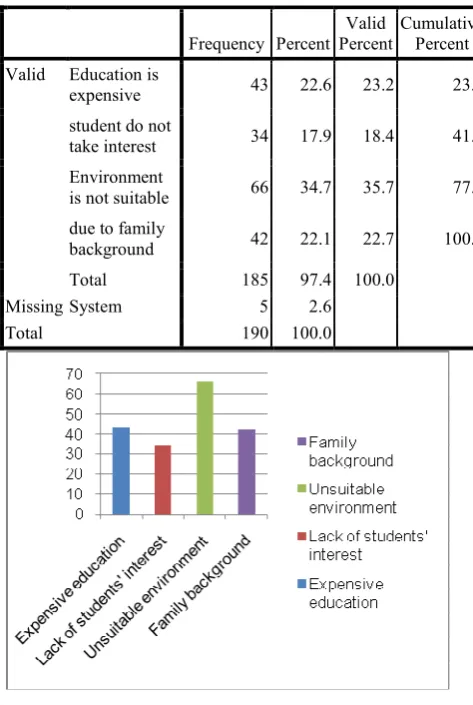
Table 1 Reason of low literacy in Pakistan
Frequency Percent Valid Percent
Cumulative Percent Valid Education is
expensive 43 22.6 23.2 23.2
student do not
take interest 34 17.9 18.4 41.6
Environment
is not suitable 66 34.7 35.7 77.3 due to family
background 42 22.1 22.7 100.0
Total 185 97.4 100.0
Missing System 5 2.6
Total 190 100.0
Figure 1 Reasons of low literacy in Pakistan
1. 43 people say that the reason of low literacy in Pakistan is that the education is expensive.
2. 34 people say that it is due to lack of students’ interest.
3. 66 people say that it is because the environment is not suitable.
4. 42 people say that due to family background, the students do not study which causes low literacy in Pakistan.
0 10 20 30 40 50 60 70 80 90 100
1 hour
2 hours
3 hours
More than 3
hours
More than 3 hours
3 hours
2 hours
1 hour
Figure 2 Hours spent on studies
1. 19 students spend only 1 hour on studies everyday. 2. 32 students spend 2 hours on studies everyday. 3. 50 students spend 3 hours on studies everyday. 4. 87 students spend more than 3 hours on studies
everyday.
Table 3 Availability in your area
Frequency Percent Valid Percent
Cumulative Percent
Valid TV 126 66.3 69.2 69.2
internet 22 11.6 12.1 81.3
radio 4 2.1 2.2 83.5
phone 30 15.8 16.5 100.0
Total 182 95.8 100.0
Missing System 8 4.2
Total 190 100.0
[image:3.595.316.573.82.388.2]
Table 2 Hours spent on studies
Frequency Percent Valid Percent
Cumulative Percent
Valid 1 hour 19 10.0 10.1 10.1
2 hours 32 16.8 17.0 27.1
3 hours 50 26.3 26.6 53.7
more than 3
hours 87 45.8 46.3 100.0
Total 188 98.9 100.0
Missing System 2 1.1
[image:3.595.53.290.286.639.2]Figure 3 Availability in the area
1. 126 students have TV available at their homes. 2. 22 students have easy access to the internet at their
homes.
3. Only 4 students have radio being used in their houses.
4. 30 students have phone available in their houses.
Table 4 Reason of using internet
Frequency Percent Valid Percent
Cumulative Percent
Valid Chatting 26 13.7 15.4 15.4
Surfing 15 7.9 8.9 24.3
Studying 115 60.5 68.0 92.3
Games 13 6.8 7.7 100.0
Total 169 88.9 100.0
Missing System 21 11.1
Total 190 100.0
Figure 4 Reason of using internet
1. 26 students use internet for chatting. 2. 15 students use internet for surfing.
3. 115 students use internet for the purpose of studying.
[image:4.595.72.266.70.272.2]4. 13 students use internet for playing games.
Table 5 Hours spent watching TV per day
Frequency Percent Valid Percent
Cumulative Percent
Valid 0 hour 30 15.8 15.9 15.9
1 hour 98 51.6 51.9 67.7
2 hours 54 28.4 28.6 96.3
3 or more hours
7 3.7 3.7 100.0
Total 189 99.5 100.0
Missing System 1 .5
Total 190 100.0
Figure 5 Hours spent watching TV per day
1. 30 students do not watch TV.
2. 98 students spend 1 hour watching TV everyday. 3. 54 students spend 2 hours watching TV everyday. 4. 7 students spend 3 or more hours watching TV
everyday.
Table 6 Your purpose of watching TV
Frequency Percent Valid Percent
Cumulative Percent
Valid News 49 25.8 26.1 26.1
Learning 30 15.8 16.0 42.0
entertainment 100 52.6 53.2 95.2
Other 9 4.7 4.8 100.0
Total 188 98.9 100.0
Missing System 2 1.1
Total
[image:4.595.310.553.74.534.2]0
20
40
60
80
100
120
Other purpose
Entertaintment
Learning
News
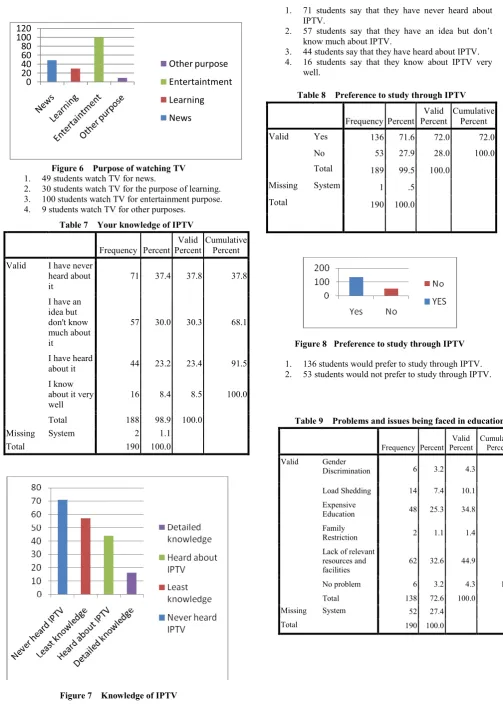
Figure 6 Purpose of watching TV
1. 49 students watch TV for news.
[image:5.595.48.552.67.773.2]2. 30 students watch TV for the purpose of learning. 3. 100 students watch TV for entertainment purpose. 4. 9 students watch TV for other purposes.
Figure 7 Knowledge of IPTV
1. 71 students say that they have never heard about IPTV.
2. 57 students say that they have an idea but don’t know much about IPTV.
3. 44 students say that they have heard about IPTV. 4. 16 students say that they know about IPTV very
well.
Table 8 Preference to study through IPTV
Frequency Percent Valid Percent
Cumulative Percent
Valid Yes 136 71.6 72.0 72.0
No 53 27.9 28.0 100.0
Total 189 99.5 100.0
Missing System 1 .5
Total 190 100.0
Figure 8 Preference to study through IPTV
1. 136 students would prefer to study through IPTV. 2. 53 students would not prefer to study through IPTV.
Table 7 Your knowledge of IPTV
Frequency Percent Valid Percent
Cumulative Percent Valid I have never
heard about it
71 37.4 37.8 37.8
I have an idea but don't know much about it
57 30.0 30.3 68.1
I have heard
about it 44 23.2 23.4 91.5
I know about it very well
16 8.4 8.5 100.0
Total 188 98.9 100.0
Missing System 2 1.1
[image:5.595.323.569.492.703.2]Total 190 100.0
Table 9 Problems and issues being faced in education
Frequency Percent Valid Percent
Cumulative Percent
Valid Gender
Discrimination 6 3.2 4.3 4.3
Load Shedding 14 7.4 10.1 14.5
Expensive
Education 48 25.3 34.8 49.3
Family
Restriction 2 1.1 1.4 50.7
Lack of relevant resources and facilities
62 32.6 44.9 95.7
No problem 6 3.2 4.3 100.0
Total 138 72.6 100.0
Missing System 52 27.4
0
10
20
30
40
50
60
70
G
e
n
d
e
r
d
is
cr
im
n
a
ti
o
n
Lo
a
d
s
h
e
d
d
in
g
E
xp
e
n
si
v
e
e
d
u
ca
ti
o
n
F
a
m
il
y
r
e
st
ri
ct
io
n
s
La
ck
o
f
re
le
v
a
n
t
re
so
u
rc
e
s
N
o
p
ro
b
le
m
No problem
Lack of
relevant
resources
Family
restrictions
Expensive
education
Load shedding
Gender
discrimnation
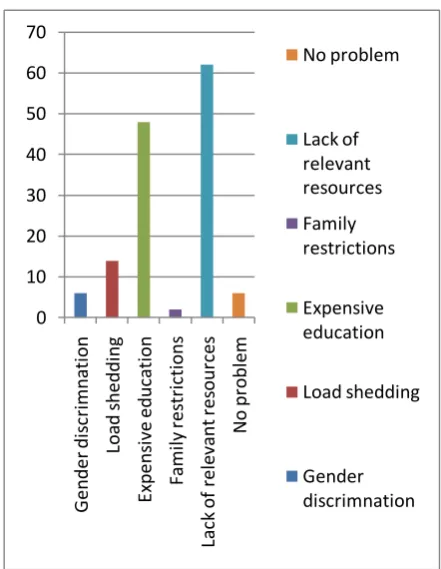
Figure 9 Problems and issues being faced in education
1. 6 students think that problems in education are being faced because of gender discrimination. 2. 14 students think that the problem is load shedding. 3. 48 students think that it is because education is
expensive and cannot be afforded by everyone. 4. 2 students think that family restriction is the
problem.
5. 62 students think it is due to lack of relevant resources.
[image:6.595.53.291.503.731.2]6. 6 students think that there is no problem at all.
Figure 10 Solution to the problems mentioned
1. 7 students say that the solution is to overcome load shedding.
2. 46 students say that government should take initiatives and should get involved to solve the problems.
3. 13 students say that the solution lies in minimizing the gender discrimination.
4. 56 students say that increase in relevant resources can solve the problems.
5.
DISCUSSION
The following details help to achieve first objective of our study that is to identify the present means of distant learning programs.
The Allama Iqbal University uses media namely print and electronic to cover all the provinces of Pakistan. [6] Virtual University course material is prepared by experts of knowledge by inserting all required visual stuff and text which are delivered through post in form of multimedia CDs and are also easily available via Internet and satellite. Students can also access them through streaming from Virtual University’s servers at any time. The university is massively using free to air television broadcast and Internet medium to access students all over the country. In addition to suggested text books, VU has also introduced Learning Management System (LMS) hosted from VU web servers and students are given specific identification by allocating them Id to access LMS over the Internet. [7] Teaching methodology of Islamia University of Bahawalpur includes E-mail, audio and video conference, mobile technology and local study centers. Workshops are also designed for distance learners and final examinations are taken at the end of every semester. Result includes 20% from assignments, 30% from midterm and 50% from final examination. [8]
The second objective of our study is to identify the limitations of distance learning in secondary and higher secondary programs in Pakistan. The study shows that only Allama Iqbal Open University offers secondary and higher secondary education programs but their broadcast medium is not efficient in providing full assistance to their students as they
Table 10 Solution to the problems mentioned
Frequency Percent Valid Percent
Cumulative Percent
Valid Overcome Load
shedding 7 3.7 5.7 5.7
Government initiatives and involvement
46 24.2 37.7 43.4
Minimize gender
discrimination 13 6.8 10.7 54.1
Increase in relevant resources
56 29.5 45.9 100.0
Total 122 64.2 100.0
Missing System 68 35.8
hour which is quite insufficient.[6] So there should be some alternative to meet the requirements of students.
The question no.1 of our survey was about the reasons of low literacy in Pakistan which satisfies our first milestone that is to understand the academic background of Pakistan. As we already know that the literacy rate in the rural areas of Pakistan is quite low, we wanted to enquire about the reasons behind the lack of education which causes the academy to stay backwards. As per the statistics shown in table 1, 34.7 percent of the students say that the reason behind low literacy is an unsuitable study environment which refers to the fact that there are no or very less institutions for learning, and even if the institutions are present, irregularity of teachers limits the students from learning. This question of the survey also satisfies our second milestone that is to understand the factors that affect the literacy rate of Pakistan. As from the table 1, we know that expensive education, lack of students’ interest, unsuitable environment and family backgrounds are the factors that are causing a continuous decrement in the literacy rate of Pakistan. The problem stated above can be solved with the implementation of IPTV, as the environment will be as desired by the students, and the resources will be readily available.
The question no.2 of our survey helped us to know the no of hours students spend on studying everyday so that our third milestone can be satisfied that is to understand the importance of education in rural areas. According to the table 2, 45.8 percent of the students spend more than 3 hours on studies everyday. It is because of the reason that teachers are very irregular and not well experienced and literate over there and due to that fact students have to study on their own which causes them to spend much more time to understand and learn things.
The question no.3 asked the students about the availability and accessibility of resources like TV, internet, radio and phone so that we may be able to know that what devices are already availableand which device has not yet gained access in their area. This question helped us to satisfy our fourth milestone that is to suggest the implication of IPTV for secondary and higher secondary programs. As per the table 3, 66.3 percent of the students say that TV is already available in their area which shows that studying through a TV channel would not be a problem and that IPTV can easily be implemented as the usage of internet is already common to them as well.
The question no.4 of the survey inquires about the reasons of Internet usage. As per the results in table 4, 115 students with maximum percentage of 60.5 use internet for the purpose of studying. But studying through internet is not sufficient as there is a lot of load shedding in the rural areas and those students who have to attend online lectures on the internet on a particular time are not able to study. On the other hand, the other category of students in rural areas who do not know about how to operate a computer cannot be educated from the internet and thus we have suggested the implication of IPTV for secondary and higher secondary programs as our fourth milestone.
The question no.5 asked from the students in the survey was about the no of hours being spent by the students watching everyday and the results shown in the corresponding table 5 of the question says that 98 students with 51.6% watch TV daily for an hour. Thus it is evident that prior to their daily life
activities, watching TV is an activity that majority of the students perform everyday. This shows the importance of TV in the everyday life of students belonging to the rural areas of Pakistan and thus our fourth milestone that is to suggest the implication of IPTV for secondary and higher secondary programs can be achieved.
The question no.6 is about the purpose of watching TV that whether the students watch TV for news, learning, entertainment or other purposes. From the table 6, it is evident that most of the students watch TV for entertainment. Although most of the students watch TV for entertainment purpose but their time and energies can be utilized for the cause of learning by motivating them to spend some of the entertainment hours for acquiring education through TV channels that can improve their education skills and knowledge. This question of the survey also favors our milestone # 4 that is to suggest the implication of IPTV for secondary and higher secondary programs.
The question no.7 of the survey was to know that whether the students in rural areas have knowledge about IPTV or not. The table 7 shows that 37.4% students do not know about this technology at all whereas 30% have an idea and 23.2% have just heard about this technology but 8.4% of the students are well familiar with IPTV. This is because of a reason that this is a new technology in Pakistan; therefore, its usage is not common to all. In Pakistan, people require awareness of IPTV in both urban and rural areas. When the people will become aware of it, they can easily get education via TV and the importance of education in rural areas with the introduction of this educational tool can be accomplished. These details answer sufficiently to our milestone # 3 that is about the importance of education in rural areas.
The question no.8 was meant to know about the willingness and preference of the students to study via IPTV. The results in the table 8 show that 71.6% of the students prefer to study through IPTV which means that if IPTV is properly introduced and implemented, it can raise the literacy level of Pakistan at SSC and HSC levels, for the students who are already enrolled at traditional institutes by helping them with study courses at TV and also for those doing self study at their homes. This fulfills our aim of study that is to justify the use of IPTV as an improvement for distance learning for secondary and higher secondary programs.
The question no.9 is to know about the problems and issues faced by the students in education. This query leads to important facts shown in the table 9 that 32.6% students complained about the lack of relevant resources and facilities in their area whereas 25.3% students said that education is expensive. By keeping in view such problems, IPTV is a better solution as it will facilitate huge population because most of the rural audience has easy access to TV and this solution is cheaper like it will be implemented on the existing TV sets in homes. Again, it benefits both the students of traditional and distance institutes. This question strongly satisfies our aim of study that is to justify the use of IPTV as an improvement for distance learning for secondary and higher secondary programs.
enhancement in education sector. Other students suggested minimizing gender discrimination and overcoming load shedding to solve the problems. As per our study and analysis, the solution we are proposing will be implemented with the co-ordination of Ministry of Education (Pakistan), and thus will meet the needs of the students of rural areas of Pakistan. As it is a government based solution and will ultimately increase the relevant educational resources by providing education to the students on their TV screens. This query favors the aim of our study and hence, justifies the use of IPTV as an improvement for distance learning programs for secondary and higher secondary levels.
6.
CONCLUSION
In this paper we highlight the challenges in current setup of distance learning in Pakistan that the students at secondary and higher secondary levels face due to ineffective broadcast medium. Based on the results of primary and secondary data collection, we have come to the point that both the students of traditional institutes and distance learning institutes can benefit from the proper implementation of IPTV with the coordination and cooperation of government of Pakistan as we have proposed. Our study shows that students are interested to use this medium to acquire education which will significantly contribute in increasing the literacy rate of Pakistan and thus, our hypothesis is proved.
7. REFERENCES
[1]. Farooq Omer , “Education” Chapter 10, pp# 133, Pakistan Economic Survey 2010-2011, Economic Adviser’s Wing, Finance Division, Government of Pakistan, Islamabad.
[2]. Cooper William and Lovelace Graham (Dec 2006), “IPTV” Chapter 2, pp# 7, IPTV Guide Delivering audio and video over broadband, ISBN 1-905360-12-6, London [3]. Holmberg Borje (March 2005), “Concepts and Terminology Student Bodies” Chapter 1, pp# 9, The Evolution, Principles and Practices of Distance Education, ISBN 978-3-8142-0933-3, Oldenburg [4]. UNESCO (2002), “The concept of Open and distance
learning” Chapter 3, pp# 22,Open and Distance learning Trends, Policy and Strategy considerations, France [5]. “Higher Education” Chapter 8, National Education policy
(2009), Ministry of Education, Pakistan, Islamabad [6]. Allama Iqbal Open University (AIOU). Available:
http://www.aiou.edu.pk
[7]. Virtual University (VU). Available: http://www.vu.edu.pk
[8]. The Islamia University of Bahawalpur (Multan) “Regulations for Distance Education undergraduate/Postgraduate/M.Phil/PhD academic programs under semester system”. Available: http://www.iub.edu.pk/Documents/distance_rules.pdf [9]. Higher Education Commission (22 Nov, 2007),
“Directorate for Distance Education funded by HEC”, Islamabad.
Available:http://app.hec.gov.pk/Press_Releases/2007/No vember/22_November.htm
[10]. Moravek Patrik, Jelinek Mojmir, Komosny Dan, Simek Milan (2008), “Visualization of a Hierarchical Aggregation in the IPTV Network Environment”, pp# 343, IJCSNS International Journal of Computer Science and Network Security, VOL.8 No.11
[11]. Liu Zhu, Gibbon David, Shahraray Behzad, “Uninterrupted Recording and Real Time Content based Indexing Service for IPTV Systems”, AT&T Labs - Research200 South Laurel Avenue Middletown, NJ 07748 USA
[12]. White paper: Cisco, “Evolving IPTV architecture”, pp# 2, USA
[13]. Ramirez, David (2008), “IPTV Architecture” chapter 3, pp#23-24, IPTV Security Protecting High-Value Digital Contents, ISBN 978-0-470-51924-0, England
[14]. Juniper Networks IPTV Security Solution: Integrated Security for Layered Protection, Juniper Networks, Sunnyvale, CA, White Paper 3510275-002-EN, Apr. 2010
[15] Zeadally Sherali, Moustafa Hassnaa and Siddiqui Farhan, “Internet Protocol Television (IPTV): Architecture, Trends, and Challenges”, IEEE SYSTEMS JOURNAL, VOL. 5, NO. 4, pp. 520-521, Dec 2011 [16]. Shohag Shoyeb Al Mamun and Bin Motalab Mozammel,
(Sep 2011), “An Observation and Analysis of IPTV and Multicasting Traffic”, International Journal of Computer Applications (0975 – 8887), Volume 30– No.1, pp # 1 [17]. Pakistan Telecommunication limited, Services: Home
and Personal, Smart TV Available: http://www.ptcl.com.pk/pd_content.php?pd_id=110 [18]. Radojicic Valentina, Bakmaz Bojan and Markovin
Goran (4 Sep, 2011), African Journal of Business Management Vol. 5(17), pp# 7230