© 2018, IRJET | Impact Factor value: 7.211 | ISO 9001:2008 Certified Journal | Page 2180
TESTING OF FLUIDIZED BED SAND COOLER FOR FOUNDRY
RECLAMATION
Mr.Rohitkumar S. Bharamgonda
1, Mr.Vishal J. Savant
2, Prof.P.N.Gore
3, Prof. (Dr). V.D.Shinde
41, 2Student D.K.T.E Society’s Textile and Engineering Institute, Ichalkaranji, Maharashtra, India
3,4 Professor, Dept. of Mechanical Engineering,D.K.T.E Society’s Textile and Engineering Institute, Ichalkaranji, Maharashtra, India.
-
---***---Abstract - In this study, a sand cooler for Circulating Fluidized Bed (CFB) has been designed and a 20 kg batch scaled test rig has been fabricated. Grain size characteristics and time required for cooling have been captured using a cold test rig. Taguchi method was used for parameter optimization. The model has been validated using the experimental data. The influence of quantity of sand and the temperature of sand on the grain size and time required for cooling have been studied. The results show that there is an increasing in quantity of sand on decreasing the present reclamation. Design of Experiment for parameter optimization has also been analyzed. It has been observed that the combination of temperature 600 0 C, holding time 20
mints and 15 kg of quantity are optimum values.
Key Words: sand reclamation, chemically bonded No-bake sand, DOE, Taguchi method, Quantity of sand, grain size etc.
1. INTRODUCTION
A continuous fluid-bed dryer/cooler is a machine in which a continuous flow of damp, granular material is conveyed over a perforated bed, through which air is blown to bring about fluidization. The drying and cooling sections of the machine form a single conveyor in which the hot and cool air flows are segregated. In the first stage of drying, free (surface) moisture is removed from the product and all available energy supplied as heat in the drying air is used for evaporation. The temperature of the air moving through the fluidized bed drops as it absorbs moisture up to its saturation point, whereas the temperature of the hot air supply remains constant. In the second stage of drying, after the free water has been evaporated, part of the incoming heat energy is used to remove the residual absorbed moisture and part is used to heat the product. In sand cooler various parameters are fined namely Temperature, Quantity, Mass flow rate of water, sand holding time, velocity of air etc. In this testing various parameters are studied which Temperature, Quantity and sand are holding time etc. Studies of sand cooler have done in commercial application. Sand cooling is possible naturally but force cooling gives bester results.
In this work, a chemically bonded No-bake sand was reclaimed sand cooler utilized the fluidization technology has been proposed. This sand cooler is intended for lab use. The proposed sand cooler does not recover waste sand all the heat is loos in atmosphere.
2. DESIGN OF FLUIDIZED BED COMBUSTOR
[image:1.595.299.579.401.578.2]Thermal conductivity of sand is move so, Sand in act as insulation. In direct type of heat exchangers sand stick to surface of heat exchangers. For design of fluidized bed cooler, study of existing coolers, heat exchangers, cooling towers etc., According to required parameters and properties the design modification is done.
Fig.2.1. Top view of sand cooler
1. Cold water inlet 2. Hot water outlet
3. Cooling pipes
Sand structure dimension is 450 × 450 × 450 mm and plate used for structure is 6mm. Nozzles are 15 mm length and outlet diameter is 300 microns.
1
2
© 2018, IRJET | Impact Factor value: 7.211 | ISO 9001:2008 Certified Journal | Page 2181 Fig.2.2.Side view of sand cooler
3. DESIGN OF EXPERIMENTS (DOE) AND TESTING
OF COOLER
Design of experiments is the design of any task that aims to describe or explain the variation of information under conditions that are hypothesized to reflect the variation. The term is generally related with experiments in which the design introduces conditions that directly affect the variation, but may also refer to the design of quasi-experiments, in which natural conditions that influence the variation are selected for observation.[10]
Developed system of sand reclamation is particularly used for chemically bonded no bake sand This type of foundry used sand binder is burn at temperature of 5000 c to 8000 c.[4] during testing of system we consider
temperature range 5000 c, 6500 c and 8000 c also holding
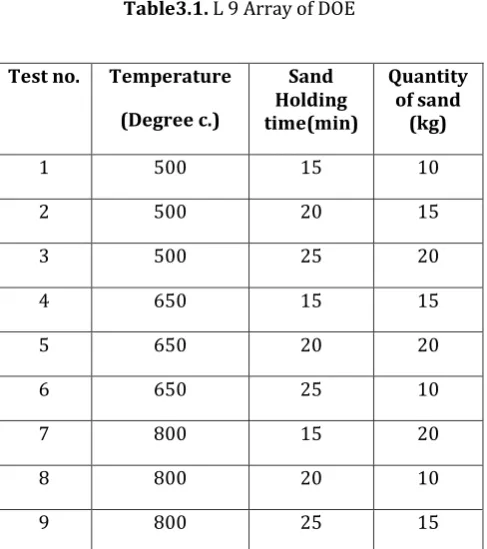
time of sand in system and quantity of sand varies between 15 min, 20 min, and 25 min and quantity is taken 10 kg, 15 kg and 20 kg of sand respectively. With the help of above values optimum combination of temperature, time and quantity of sand is obtain. Taguchi method is usedfor that optimum value. [5]
Table3.1. L 9 Array of DOE
Test no. Temperature
(Degree c.)
Sand Holding time(min)
Quantity of sand
(kg)
1 500 15 10
2 500 20 15
3 500 25 20
4 650 15 15
5 650 20 20
6 650 25 10
7 800 15 20
8 800 20 10
9 800 25 15
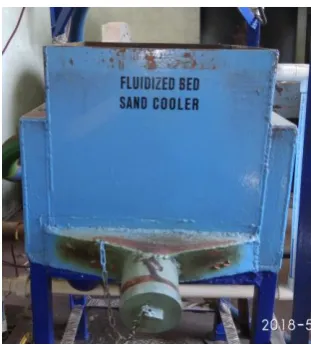
[image:2.595.314.558.100.375.2]The prototype of the sand cooler and cooling mechanism are shown in figs.2.1 and 2.2 respectively. A prototype has been used to simulate the cooling effect and after cooling properties of sand.
Table.3.2. Experimental data
Sr.
no. Parameters
1 Dimensions of sand cooler(mm) 450 × 450 × 450
2 Capacity of blower, hp 5
3 Partial size, µm 300
4 Velocity of fluidization, m/s 8
5 Mass flow rate of water, kg/s 0.3
6 Numbers of nozzles 210
7 Numbers of cooling tubes 83
© 2018, IRJET | Impact Factor value: 7.211 | ISO 9001:2008 Certified Journal | Page 2182
rate of water is 0.3 kg/sec [3]. Cooling coils holes were drilled at an interval of 20 mm from the bottom of the bed.
3.1. Boundary condition
[image:3.595.92.248.241.414.2]In this paper three parameters are tested temperature, mass of sand, sand holding time etc. by changing the factors effect on cooling time. Grain size that can we find. The boundary conditions corresponding to the cases are presented in Table 3.3 [7]
Fig.3.1 prototype of sand cooler
.
According to table no.3.1 tested sand reclaimed quantity, grain finesse number and cooling time are as follows:
Table3.3 Boundary condition for sand testing
From above testing result table we got idea about percent reduction of reclaimed sand and time required to cooling one working cycle with respect to temperature, time and sand quantity. Nine tests conducted in that the result nearest to sixth test. That is sand temperature 6500C, sand holding
time 25 minutes, but quantity of sand is 15 kg etc.
Table 3.4 Testing result table
4. Results of tested fluidized bed combustor system
By using Taguchi method we get optimum result. Result obtain from Mini-tab software are as follows
Graph 4.1 S N ratio graph
The factor levels corresponding to the highest S/N ratio were chosen to optimize the condition. From these linear graphs it is clear that the optimum values of the factors and their levels are as given table. Optimum result obtained from various test combination here we use Taguchi method to obtain result. Result obtains by using Taguchi method is as follows:
Sand weight before reclamati on (kg)
Reclaime d sand weight
(kg)
% weight reduction of sand
Grain finesse
no.
Cooling time (min.)
10 7.5 25 45.55 22
15 12 20 52.23 31
20 18 10 45.64 28
10 7.5 25 47.8 20
15 14.5 4 46.9 24
20 14.5 27.5 45.47 26
10 4 60 59.12 48
15 8 46.67 56.87 40
20 13.5 32.5 53.25 35
Sr.no. Name Boundary type Boundary condition
1 Primary air
inlet Velocity inlet V=4-8 m/s, t=303 k
2 Water
© 2018, IRJET | Impact Factor value: 7.211 | ISO 9001:2008 Certified Journal | Page 2183 Table 4.1 Optimum values of factors and their levels
Parameters Temperature (0 C)
Sand Holding time
Sand quantity
Optimum
Value 650 25 15
After Taguchi method combination is shown in above table, but sand quantity is not as we taken in test. Validation is done in the new combination.
By testing this result parameters combination on actual setup we get,
Table 4.2 optimum result from test
% weight
reduction of sand Grain finesse number time(minute) Testing
17.2 50.98 28
Testing of fluidized bed cooler gives results like optimum temperature, time and sand quantity combination by using Taguchi method also suitable grain size for foundry application are obtained by testing fluidized bed combustor.
Thermally reclaimed sand properties are compared to the fresh sand. AFS no.is 50.98 the standard grain size of foundry sand ranges from 35-55 gfn.Following is the sand test results
Table 4.4 Reclaimed sand properties
AFS NO. 50.98
V.M. 1.6%
L.O.I. 2.4%
Total clay 0.540%
5. CONCLUSION
In this study, concept of chemical bounded nobake sand cooler based on the concept of a bubbling bed has been proposed. The factors and their levels have been validated using the experimental test of the developed prototype.
The conclusions are summarized below.
Temperature of heating is 6500C and sand holding
time is 15 mints.
Cooling time is reduces by using forced cooling unit.
Tested reclaimed sand is useful in foundry for box molding application.
REFERENCES
1. S.Bolotin, B. Vager, V.Vasilijev(2015) “Comparative analysis of the cross-flow indirect evaporative air coolersSergey”International Journal of Heat and Mass Transfer, 88, 224-235.
2.A.Pécora and M.Parise(2006) “Heat Transfer Coefficient in a ShallowFluidized Bed Heat Exchanger with aContinuous Flow of Solid Particles”The State University of Campinas Faculty of Mechanical Engineering, 18,3-253.
3. R. Singh, K.Ghule(2016)“Design, development, experimental and CFD analysis of a prototype fluidized bed stripper ash cooler”Applied Thermal Engineering,107,1077-1090.
4.M.Joseph, F.Banganayi And D.Oyaombo(2017)“Moulding Sand Recycling And Reuse In Small Foundries” International Conference On Sustainable Materials Processing And Manufacturing,SMPM 2017,23-25 January 2017,Kruger National Park, procedia manufacturing ,7,86-91.
5. G.Lalagi,G.Adarsh ,V.Vedavyasa,M. Rajagopal (2016)“Thermal Analysis And Flow Visualization In Vacuum Furnace Using CFD” International Journal Of Science Engineering And Technology, 4,2348-4098.
6. J.Danko, R. Danko, M. Holtzer (2003) “Reclamation of used sand in foundry production”METALURGIJA ,42, 173-177.
7. R. Palkar and V. Shilapuram(2016)“Detailed parametric design methodology for hydrodynamics ofliquid–solid circulating fluidized bed using design of experiments” Chemical Engineering Department, National Institute of Technology, Warangal, 506004, Telangana, India.particuology, 10, 120-620.
8. J. Lim, K. Bae, J. Shin, J. Kim, D. Lee, J. Han, D. Lee (2015)“Effect of particle–particle interaction on the bed pressure drop andbubble flow by computational particle-fluid dynamics simulation ofbubbling particle-fluidized beds with shroud nozzle” School of Chemical Engineering, Sungkyunkwan University, 2066 Seobu-ro, Jangan, Suwon, Gyeonggi-do, 440-746, Republic of Korea.power technology , 288, 315-323.
© 2018, IRJET | Impact Factor value: 7.211 | ISO 9001:2008 Certified Journal | Page 2184
10.A. Ghosh (2013) “Modern Sand Reclamation Technologies for Economy, Environment Friendliness and Energy Efficiency” GM, the Wesman Engineering Co. Ltd, Kolkata, 51,200-313.
11. B Bhavani , I Swathi , K Prasanna , K Srinivasa (2013) “Design of cooling tower” International Journal of Scientific & Engineering Research,1560 ISSN 2229-5518.
BIOGRAPHIES
Rohitkumat S.Bharamgonda