Facilitating Access to Digital Records of Practice in Education with
Technology
Erica Crawford, Kara Suzuka, Rebecca D. Frank, Elizabeth Yakel
Note: This is a preprint version of a paper that appears in the 2018 Proceedings of Learn: World Conference on E-Learning in Corporate, Government, Healthcare, and Higher Education. Please cite the published version:
Crawford, E., Suzuka, K., Frank, R. D. & Yakel, E. (2018). Facilitating Access to Digital Records of Practice in Education with Technology. In Proceedings of E-Learn: World Conference on E-Learning in Corporate, Government, Healthcare, and Higher Education (pp. 1-10). Las Vegas, NV, United States: Association for the Advancement of Computing in Education (AACE). https://www.learntechlib.org/primary/p/185295/.
ABSTRACT
Many disciplines are changing their traditional approaches to data, encouraging data producers to share data and enable researchers and practitioners to reuse data to answer new research questions and address educational needs. In response, data repositories have emerged, and the availability of data has increased. Repositories build
infrastructure to facilitate data access and provide software tools for reuse. This paper analyzes the reuse of digital records of practice (DROP) in education through the lens of one software tool, Zaption, focusing on DROP reuse by teachers, teacher educators, and individuals involved in professional development activities. Using analytics data from one repository’s Zaption integration from 2012-2016, we found that producers and reusers of DROP preferred an array of rich communication tools over tools that added technical functionalities. The results contribute both to our knowledge of DROP reusers as well as inform repositories about software choices to facilitate reuse.
Keywords
Digital Records of Practice, Repository, Teacher Education, Data Reuse, Video Data
This work is licensed under a Creative Commons Attribution-NonCommercial-NoDerivatives 4.0 International License (CC BY-NC-ND 4.0). https://creativecommons.org/licenses/by-nc-nd/4.0/
Erica Crawford
School of Education, University of Michigan, 610 E University Ave., Ann Arbor, MI 48109; [email protected]
Kara Suzuka
College of Education, University of Hawai’i at Mānoa, 1776 University Ave., Honolulu, Hawai‘i 96822; [email protected]
Rebecca D. Frank
School of Information, University of Michigan, 3429 North Quad, 105 S. State St., Ann Arbor, MI 48109-1285; [email protected]
Elizabeth Yakel
Page 1 of 10
Facilitating Access to Digital Records of Practice in Education with
Technology
Erica Crawford School of Education University of Michigan, USA
Kara Suzuka College of Education
University of Hawai'i at Mānoa, USA [email protected]
Rebecca D. Frank School of Information University of Michigan, USA
[email protected] Elizabeth Yakel School of Information University of Michigan, USA
Abstract: Many disciplines are changing their traditional approaches to data, encouraging data producers to share data and enable researchers and practitioners to reuse data to answer new research questions and address educational needs. In response, data repositories have emerged, and the availability of data has increased. Repositories build infrastructure to facilitate data access and provide software tools for reuse. This paper analyzes the reuse of digital records of practice (DROP) in education through the lens of one software tool, Zaption, focusing on DROP reuse by teachers, teacher educators, and individuals involved in professional development activities. Using analytics data from one repository’s Zaption integration from 2012-2016, we found that producers and reusers of DROP preferred an array of rich communication tools over tools that added technical functionalities. The results contribute both to our knowledge of DROP reusers as well as inform repositories about software choices to facilitate reuse.
Introduction
Many disciplines are changing their traditional approaches to data and encouraging data producers to share that data. Researchers and practitioners, in turn, reuse that data to answer new research questions or leverage it for entirely new purposes. As a consequence, more disciplinary data repositories are emerging, providing infrastructure to facilitate data analysis and collaboration, and to provide software tools to facilitate reuse. As Borgman et al. claim, “If the potential of data-intensive science is to be realized, then appropriate systems, services, tools, content, policies, practices, and human resources are required to discover and exploit research products” (2015). However, it can be challenging for repositories to gain an adequate understanding of disciplinary practices and attitudes toward data reuse, make decisions about what tools to provide, what data analysis functionalities to support, and how best to facilitate multiple types of reuse in one repository. This is especially true for repositories in disciplines, such as education, where data sharing and reuse are new and academic norms and incentives around reuse are not well established. In this paper, we focus on one tool, Zaption (Stigler, Geller, & Givvin 2015), and investigate what we can understand about the data reusers in one repository through their use of this tool when reusing digital video records of practice.
Page 2 of 10 2002). However, DROP themselves encompass a wider variety of data types including not only video but also audio recordings from classrooms and other educational settings, still images from these settings, student work, lesson plans, and seating charts. For this paper, we explore how reusers utilize a repository-provided software when working with that digital video. Unlike data reusers in many disciplinary repositories, reusers of DROP in education include researchers as well as education professionals who use these materials for pre-service teacher education and professional development.
We critically examine different reuse cases by analyzing three groups of users utilizing a tool called Zaption to work with DROP at an educational data repository. Zaption was initially a stand-alone, online video authoring platform that allowed users to create multimedia products integrating streaming video, such as YouTube videos. Soon after its launch, it was further developed to work with the Basic Learning Tools Interoperability standard,1 allowing it to be integrated with other systems. Zaption was available as a commercial product (via subscription) from 2012 to September 2016, when it was discontinued after its acquisition by Workday.2 The repository used Zaption throughout this period and is currently investigating replacement tools. This study was done in part to understand reuser needs and practices to inform software selection. We ask two research questions:
● What disciplinary practices and reuse patterns can we discern among DROP reusers through analytic data? ● Given the patterns of reuse seen through Zaption, what key functionalities are necessary for a tool to
support these disciplinary practices?
Literature Review
Video has long been used to study learning and teaching in education (Carter 2015). Digital video records of practice capture complex instructional events, in which teachers and learners engage in a variety of activities and processes, such as problem solving (Marsh & Mitchell 2014).
There are unique benefits and challenges with video reuse (Frank, Suzuka, & Yakel 2016). Video records of practice facilitate multiple viewings by multiple people, provide opportunities to observe other teachers’ practice, and allow viewers to engage in comparative reflection (Zhang et al. 2011). They also make the practice of teaching visible with less disruption to the classroom environment than traditional observation (Marsh & Mitchell 2014). Yet, video records of practice alone are often “not able to capture the impact of the social context in which teachers work” (Borko 2016). Reusers may require additional documentation, such as demographic information about the class or school, lesson and unit plans, or other curriculum materials to provide context for reuse.
Improvements in technology have enabled greater use of digital video (Brunvand 2010), including capture, playback, editing, analyzing, storage, sharing, and reuse (Derry et al. 2010). Advancements have also allowed digital repositories/libraries to curate, preserve, and provide access to increasingly large collections of digital video (Uglean Jackson & McKinley 2016). In the United States, repositories such as Databrary (Simon et al. 2015), the Inter-University Consortium for Political and Social Research (ICPSR) (“Measures of Effective Teaching Longitudinal Database” 2017), Teaching Channel (Teaching Channel 2017), TIMSS Videos (from the Trends in International Mathematics and Science Study) (Stigler, Gallimore, & Hiebert 2000), the Teaching and Learning Exploratory (TLE) (University of Michigan School of Education 2014), and Virtual Learning Community (VLC) (Bates, Phalen, & Moran 2016) all preserve and provide access to digital video records of education practice. These are just a few of the growing number of repositories providing access to DROP.
In addition to providing access to videos, digital repositories provide space (physical and/or virtual) for users to collaborate around digital records of practice for both education and research (Pea & Hoffert 2007). They also often provide users with tools for working with the videos, although these tools can hinder rather than facilitate reuse (Frank et al. 2016). Albertson and Ju (2015) found user confidence to be a factor that influences the sustained use of information retrieval tools provided by digital repositories with video collections.
In many disciplinary repositories, hardware and specialized software tools (for analysis, visualization, collaboration, communication, etc.) are needed to reuse data. Reusers depend on tools, such as video editing software, to support their work, as these tools enhance records of practice in dynamic ways for collaboration or presentation. Bossewitch and Preston (2011) note the challenges that arise when these tools are not fully integrated into the repositories hosting the videos, thus failing to bridge the videos with the products and outcomes envisioned by reusers. The decision to provide the tools or to structure data to align with current practice is a repository decision. Repositories need to consider the range of user roles and use cases that may arise around the reuse of their
Page 3 of 10 videos in order to deliver a platform and services to meet these needs. Aubert, Prie, and Canellas (2014) discuss some of the challenges related to selection of video annotation tools for Massive Open Online Courses (MOOCs), one example of an effort to support video use and reuse. In the biological sciences, Chin and Lansing (2004) note that while a repository should not be tool centric, it must align tools with research practice.
In this paper, we investigate DROP reuse practices and patterns in one digital video repository. As DROP repositories are new, there are few existing models upon which to draw, and the provision and selection of tools to aid in video editing, annotation, and integration varies greatly. In order to facilitate the use of digital video records of practice, repositories must understand the behavior of their users. One method to understand how repository users find, access, and work with digital records of practice is analysis of analytics data from the repository system itself.
Methods
We used analytics data from one repository’s Zaption integration along with analyses of products created with Zaption to better understand reusers’ practices with digital video in educational research and teacher
professional education. Analytics are unobtrusively collected (Rice & Borgman 1983) and complement self-reported data, such as interviews, by capturing what users actually do rather than relying on memory (Diamond, Price, & Chandrasekar 2013). This eliminates self-reporting bias as well as observation bias on the part of the researcher (Webb, Campbell, Schwartz, & Sechrest 2000). However, analytics data do not indicate intent or how reusers would like to work with DROP – just how they used DROP within system constraints.
The repository we studied features over 1,000 full-length classroom lesson videos spanning grade levels and subject areas, mainly from mathematics and language arts classrooms in grades 4-9. The videos are organized into five featured collections, and most are tagged to help users locate teachers’ instructional practices and subject area standards that were identified in the videos. Repository members, as of October 2017, totaled nearly 600 users who had access to all featured collections as well as the Zaption tool. Users’ professional titles included: university faculty and staff (both research and teaching), graduate students, pre-service teachers, practicing K-12 teachers and administrators, K-12 instructional coaches, professional learning coordinators, and independent researchers. Data Collection and Analysis
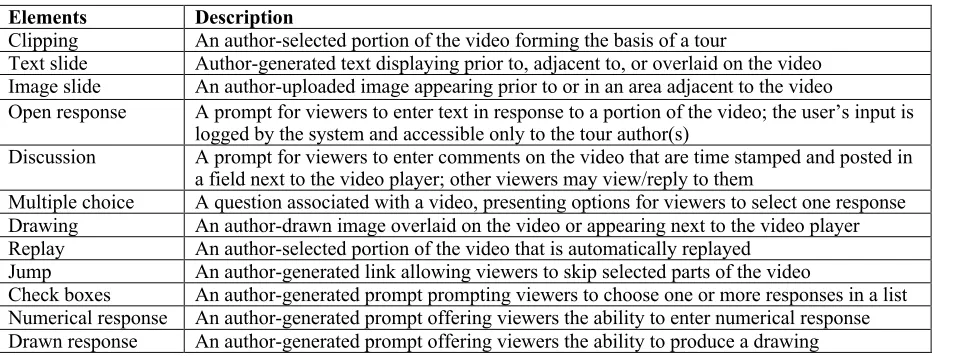
The repository’s Zaption integration allowed reusers to apply various playback and display effects
(“elements,” described in Table 1) to videos hosted within the repository or on an external platform (e.g. YouTube). Elements Description
Clipping An author-selected portion of the video forming the basis of a tour
Text slide Author-generated text displaying prior to, adjacent to, or overlaid on the video Image slide An author-uploaded image appearing prior to or in an area adjacent to the video
Open response A prompt for viewers to enter text in response to a portion of the video; the user’s input is logged by the system and accessible only to the tour author(s)
Discussion A prompt for viewers to enter comments on the video that are time stamped and posted in a field next to the video player; other viewers may view/reply to them
Multiple choice A question associated with a video, presenting options for viewers to select one response Drawing An author-drawn image overlaid on the video or appearing next to the video player Replay An author-selected portion of the video that is automatically replayed
Jump An author-generated link allowing viewers to skip selected parts of the video
Check boxes An author-generated prompt prompting viewers to choose one or more responses in a list Numerical response An author-generated prompt offering viewers the ability to enter numerical response Drawn response An author-generated prompt offering viewers the ability to produce a drawing
[image:4.612.79.560.437.617.2]Page 4 of 10 In Zaption’s lexicon, the multimedia products that integrated videos and Zaption elements3 were called “tours” and, for our analysis, we considered the reusers who created them to be the “authors” of these tours. Our data collection centered on the decisions authors made when designing and using the tours. In Zaption, authors were able to select from 12 different elements, such as video clipping, joining separate clips, adding layers (e.g. text slides), and incorporating interactive features (e.g. a discussion thread alongside the video). The resulting tour could be shared through the Zaption platform with other members by sending a tour-specific link.
For the audience (“viewers”) who viewed the Zaption tour, the video(s) were the main focal point; the additional elements served to shape the experience, based on the author’s goals. For example, an author could set their video to pause and restart at preset times, prompt viewers for input, and incorporate their comments and/or questions. After sharing a tour, authors could download a file containing information describing the viewing activity for the tour as well as viewer responses to the interactive elements embedded in the tour.
We focused our analysis on two types of data: (1) tour viewing analytics from the Zaption system, prepared by the Zaption support team; and (2) documentation of the videos and Zaption elements used in these tours compiled by repository staff. The first type of data, the tour viewing analytics data prepared by the Zaption support team, contained usage statistics for all 1,263 user-generated tours in the repository. 791 tours were excluded from our analysis because they were part of a joint research project with another university that utilized Zaption to code videos. The privacy restrictions on the videos and specific ways in which Zaption was used to carry out the analysis rendered them ineligible for inclusion in our study. The remaining 472 tours were examined for further analysis, criteria for which included the following:
(1) Analysis I: Tours viewed by 2 or more people; we focused our analysis on tours for which the number of unique viewers was at least 2 (i.e. those cases where the tour was shared with, and accessed by, at least one other person). This yielded 148 tours for the first analysis.
(2) Analysis II: Tours viewed by only ONE viewer for at least 1,000 seconds (~17 minutes) of viewing time; we were interested in the subset of tours that seemed to represent deeper engagement with the embedded video(s) by one viewer (i.e. the author or someone with whom the author shared the tour). This subset initially consisted of 16 tours that we believed might be instances of “personal study;” (i.e. those tours that were closely studied by one person). Two of these tours were excluded from our analysis due to privacy restrictions set by the creator. This yielded 14 tours for the second analysis.
As a result of these criteria, tours were excluded from our analysis for three reasons: they had zero viewers; they were viewed for an insignificant amount of time; or they were created purely for testing purposes by repository staff.
After applying these criteria, there were 162 total tours available for analysis – 148 in Analysis I and 14 in Analysis II. Both analyses focused on the contents of the tours – specifically the videos they featured as well as the Zaption elements that authors chose to incorporate – in order to better understand how authors manipulated videos using Zaption elements, and how viewers interacted with the resulting tours. This involved manually visiting each tour and recording (a) the media assets authors utilized and (b) the elements they used. It is worth noting that this was the only available process for gathering this data. The Zaption system did not capture the types and frequencies of elements used across a set of tours. The tour content information and Zaption-provided tour usage analytics resulted in the complete dataset on which our results and discussion focus.
The collection and coding of Zaption tour contents deserves some elaboration – particularly the variables we defined in the process. Each time our research team viewed a tour for either Analysis I or Analysis II, three different variables were recorded: (1) the titles of the videos used; (2) the Zaption elements used; and (3) and the repository group affiliation (if any) with which the tour author was associated (group affiliation was assigned within the repository system as part of the individual’s account creation or during his/her system request to access special collections). In many cases, the videos came from larger collections in the repository. In others, the footage was uploaded by the reuser (e.g. videos of their own teaching). The reuser’s group affiliation provided some information about how the repository and Zaption system were likely being used. Group membership, when considered in combination with the video collection utilized and Zaption elements used in each of the tours, revealed patterns of video reuse. We refer to these reuse “cases” later in our comparative analysis.
Page 5 of 10
Findings
Overview of Findings
A vast majority of the tours (97.5% or 158 tours) we analyzed included only a single video. Only four tours (2.5%) contained more than one video (integrating 2-6 videos within a single tour). Almost all the tours (93.8% or 152 tours) used video from either the Rounds program collection (107 tours or 72.8%) and/or the Measure of Effective Teaching Extension (METX) collection (34 tours or 21.0%); the latter was one of the repository’s five featured collections. Videos from other sources were far less common. The next most-used collection was only used in six tours (3.7%); other collections were used even less.
Table 2 shows the frequency and percentage of Zaption element usage across the 162 tours, all of which incorporated at least one element. The Zaption clipping element was by far the most commonly used, appearing in nearly all of the tours, with the text slide, open response, and discussion elements incorporated less frequently but still at a significant level. The image slide, multiple choice, and drawing elements appeared almost negligibly. The remaining five elements had not been employed in the tours we analyzed.
Zaption Functionalities Tour Count Percentage of Tours
Clipping 154 95.1%
Text slide 95 58.6%
Open response 53 32.7%
Discussion 44 27.2%
Image slide 11 6.8%
Multiple choice 6 3.7%
Drawing 3 1.9%
Table 2: Zaption Element/Functionality Usage (n=162)
Three Cases of Data Reuse
Through our analyses, we were able to discern distinct practices and patterns among several groups of DROP reusers. In this section we discuss three profiles of reuse that emerged from the Zaption data: Rounds, High Leverage Teaching Practices, and Personal Study.
Rounds
The “Rounds” group includes students, faculty, and staff from the university’s program for secondary teacher education majors. Teaching “interns” in this program are preparing to teach core content subjects in middle and high schools. Since 2005, Rounds faculty have been gathering, studying, and using video of teaching practice to help novices develop key teaching competencies. Their growing video collection is housed within the repository and has been used in diverse ways, including providing feedback to interns on their developing practice, offering professional development for “Attending Teachers” who mentor the interns, as well as conducting and
communicating research by the program’s faculty. One particularly noteworthy event for which the Zaption tours were routinely used was for “Grand Rounds,” a community event run by the program to discuss “cases” or “problems” of practice. These events typically include more than 100 participants.
The Rounds group created almost two-thirds of the tours we analyzed (109 out of 162), and they generally used them in more shared, interactive ways than others. The Zaption tours created by the Rounds group tended to be:
● Accessed andviewed by a small group of individuals (median of 3 people; average of 4.4 people), over a relatively short period of time (median of 7 days; average of 21.7 days)
Page 6 of 10 ● Interactive in nature, designed to engage viewers in thinking about the videos by (a) providing prompts
with the selected video through text slides: 56% of the Rounds group’s Zaption tours contained one – or (b) soliciting comments from viewers: 39% of the group’s Zaption tours utilized the “open response” element and 31% utilized the “discussion” element.
High Leverage Practices
High Leverage Practices (HLPs) are a set of critical and fundamental teaching practices used across grade levels and subjects, defined and developed by TeachingWorks4. The HLP Video Exemplars Collection in the repository was created by core staff at TeachingWorks as a way of representing these practices with high-quality video examples from real classrooms. The collection was trimmed from full-length, raw footage of classroom lessons into selections of annotated clips. Some of the video production work took place in Zaption where tours served as a means of communication between TeachingWorks staff and the professional video production company who produced the final, edited versions of the videos that are now a featured collection in the repository.
The HLP Video Exemplars project team created four Zaption tours that we analyzed for content and use of Zaption elements. While this is a small percentage of the full set of tours in our analyses, it represents a unique use of the platform for co-creation of a final product for broad audiences. The HLP Zaption tours served as a rough “storyboard” to guide the post-production work of the video editors. Each tour contained 1-3 video segments taken from a single, full-length video. The average HLP Zaption tour was a total of three minutes in duration and contained text slides inserted at various points to highlight a particular teaching practice captured in that portion of the video. The text slides indicated where in the final video text overlays should appear as well as the specific wording to be used. On average, these tours were viewed by two unique viewers over a period of 16 days. This likely represents the time period over which the post-production editing took place. Because these tours were not meant to be interactive, only the clipping and text slides elements were used, and they occurred in 100% of the tours.
Personal Study
In our initial analysis (see Analysis I, described in the Data Collection and Analysis section) we omitted Zaption tours that only had one viewer because we believed “single viewer” cases to be one-off efforts by
individuals to try out the Zaption system or to quickly save videos for themselves to revisit later (i.e. bookmarking). However, there were 14 Zaption tours, created by 6 different individuals, that stood out among the single-viewer tours. These tours were viewed much longer than other tours and logged more than twice the number of minutes-viewed than other tours with only one viewer (this was also true when comparing this small subset of tours with all
Zaption tours in our full data set). Something else seemed to be going on with this particular subset so we returned, in a second analysis, to examine them in more detail. In particular, we focused on those tours with more than 1000 seconds (~17 minutes) of average viewing time; these tours had average viewing times ranging between 18.9 minutes and 68.8 minutes.
These tours had a median duration (from start to finish) of 48.6 minutes and median viewing times (i.e. minutes watched) of 35.6 minutes. Although the data does not allow us to see what viewers watched or how they proceeded through the Zaption tour, viewers generally watched between 61% to 452% (i.e. repeated viewing) of the content that was available for viewing. (One outlier only watched 29%.) For this subset of tours, individuals tended to spend time with the content and, in some instances, viewed the content multiple times. Also, notably, many of these tours were designed for entering or displaying notes and comments. In 13 of the 14 tours, the video selections were accompanied by some form of note taking – specifically, these tours contained a space for discussion (eight tours or 57%), a text slide (four tours or 29%), or an “open response” field to collect comments (two tours or 14.3%). Because these cases are characterized by a single viewer who spent significant time with the content, they seem to be instances of “study” by one person or, what we call, “Personal Study.”
Other Use Cases
In addition to the Zaption tours created by the Rounds program, the HLP Video Exemplars project team, and the Personal Study subset, 35 tours were included in our analysis that were created by others who were not in any of these groups. While these 35 tours shared some commonalities with those in the other subsets – e.g. they made heavy use of “Clipping” element (94.3%) and Text Slide element (68.6%) – this “miscellaneous” (Misc.) group stands apart in a few ways. First, many of these tours had been shared and accessed by a relatively high number of unique viewers. Almost 40% of these tours had been accessed by 20 or more unique viewers – by
Page 7 of 10 contrast, a little less than 2% of the Rounds tours had been accessed by this many unique viewers, and none of the HLP Video Exemplar tours or the Personal Study tours had been accessed by this many viewers. Second, this subset of miscellaneous tours included instances where multiple videos – from different classroom lessons – had been integrated into a single Zaption tour. Such tours were very rare among the dataset we analyzed. Although the capacity for this type of video integration was readily available, less than 3% of all tours in our dataset utilized it. Notably, nearly all instances of this were found among this subset. Finally, nearly all (82.9%) of these miscellaneous tours drew from a single video collection accessible to all paid repository users. A few also featured video sources housed outside of the repository such as YouTube (2.9%) and a user-uploaded video (2.9%). Additionally, a few miscellaneous tours (14.3%) drew from a small private repository collection we did not discuss here.
Comparing Use Patterns Between Groups
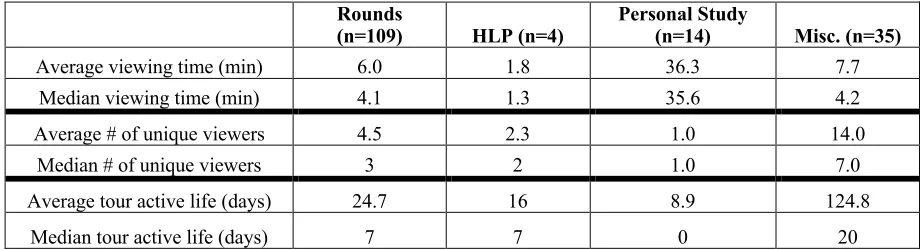
Looking across the use cases, we found similarities and differences. Table 3 provides descriptive statistics to compare viewing norms across the different groups, Rounds, HLP, Personal Study, and miscellaneous (Misc.). The average viewing time across all four groups ranged from 1.8 to 36.3 minutes, and the number of unique viewers per tour ranged from 1 to 35. The average active life, or the days a tour was actively used, ranged from 8.9 to 124.8 days. The difference between the mean and median was greatest for the ‘miscellaneous’ group, which supports the assumption that reuse patterns for individuals within this group varied more than within the other three groups. Our knowledge that the Rounds program group was using the videos for educational purposes and the value for the median active life (7 days) supports the pattern of giving an assignment to a student and turning it in the next week. Along with this, the average number of viewers per tour (3-4) in addition to the types of functionalities (open response and discussion) used in sharing indicates some effort to interact with others through tours – both privately and in small groups. This pattern of use seems consistent with an individual sharing video(s) with a teacher or mentor and with peers to get teaching feedback and comments.
Rounds
(n=109) HLP (n=4) Personal Study (n=14) Misc. (n=35)
Average viewing time (min) 6.0 1.8 36.3 7.7
Median viewing time (min) 4.1 1.3 35.6 4.2
Average # of unique viewers 4.5 2.3 1.0 14.0
Median # of unique viewers 3 2 1.0 7.0
Average tour active life (days) 24.7 16 8.9 124.8
Median tour active life (days) 7 7 0 20
Table 3: Comparison of Video and Viewing Practices Across the Use Cases
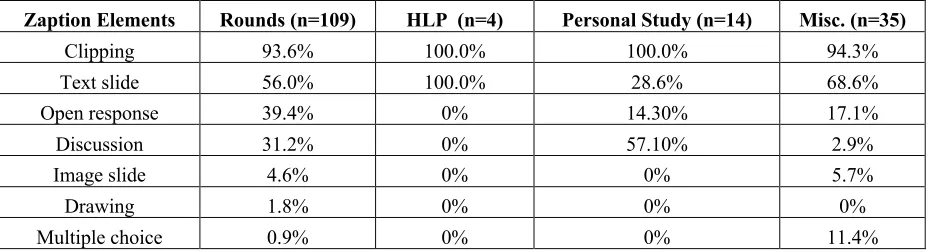
[image:8.612.80.540.346.471.2]Page 8 of 10 Zaption Elements Rounds (n=109) HLP (n=4) Personal Study (n=14) Misc. (n=35)
Clipping 93.6% 100.0% 100.0% 94.3%
Text slide 56.0% 100.0% 28.6% 68.6%
Open response 39.4% 0% 14.30% 17.1%
Discussion 31.2% 0% 57.10% 2.9%
Image slide 4.6% 0% 0% 5.7%
Drawing 1.8% 0% 0% 0%
Multiple choice 0.9% 0% 0% 11.4%
Table 4: Comparison of Element Usage Across the Use Cases
Zaption elements were used in conjunction with one another (see Table 5). Although clipping was common, it was most often paired with different functionalities across the groups. The Rounds and HLP groups most often paired clipping and text slides. These were the only elements used by the HLP group. The Personal Study group preferred a combination of clipping and discussion. The Rounds group regularly used more than two
functionalities during reuse; most often mixing clipping, open response, and text slides (29.4%).
Zaption Functionalities Rounds (n=109) HLP (n=4) Personal Study (n=14) Misc. (n=35)
Clipping + Text slide 51.4% 100.0% 21.4% 65.7%
Clipping + Open response 37.6% 14.3% 14.3%
Clipping + Open response + Text slide 29.4% 2.9%
Clipping + Discussion 28.4% 57.1% 5.7%
Clipping + Discussion+ Text slide 8.3% 2.9%
[image:9.612.75.541.72.198.2]Clipping + Multiple choice 11.4%
Table 5: Element Combinations use Across the Use Cases
Discussion
We began with two research questions focused on practices around reuse of DROP and the functionalities of the video tools that support those practices. In this section, we return to those questions to discuss what we can discern about disciplinary practices from the analysis and the type of tools needed to support those practices. In the conclusion, we comment on how this investigation has influenced our future system selection since Zaption’s discontinuation. We recognize that analytics data present only one perspective on data reusers and do not indicate motivations for these observed behaviors, which is one limitation of this study.
First, we found that only 7 of the 12 possible Zaption functionalities (elements) were used in the tours we analyzed, with only 4 (clipping, text slide, open response, and discussion) being used by over 30% of any group. Three of these functionalities (text slide, open response, and discussion) share certain characteristics: they all support communication and collaboration and they privilege written and descriptive communication. Elements that offered closed response options (multiple choice and check boxes) were rarely used. Finally, those featuring non-textual responses (numerical or drawn responses) or more advanced ways of interacting with the video (e.g. jump and replay) were not used at all. This resonates with other research findings that indicate a reluctance among video repository users to learn new programs with specialized features and functionalities to work with video data – instead, reusers opted for common and familiar tools that served their basic needs (Frank et al. 2016). For DROP reusers, less may be more; fewer overall tools may work if those selected align with practice (Frank et al. 2016).
Page 9 of 10 many learning activities. Additional evidence of this type of use was the average number of unique viewers for Rounds tours (4.5) as well as the tone of the dialogue that emerged in the discussion and open response elements. This insight into instructional formats and activity structures seems to be key to finding useful ways to support the use of DROP in teaching. On the other hand, the Personal Study group relied much more heavily on the discussion tool. When this tool was used by these single viewers, it served to facilitate communication between the author and a teaching coach/mentor. It appeared that privacy was controlled by issuing a single invitation to view the video. Notably, while both the Rounds and Personal Study groups were working with DROP to improve an individual’s teaching, they chose among these tools with different frequencies to support their online interactions. A rich array of communication and collaboration tools appears to be important in helping teachers reflect upon and improve their teaching.
Conclusions
Through the Zaption data, we saw indications of which tools are essential and which are embraced less frequently by the groups studied. This has been helpful for the repository to select a system to replace Zaption as well as for the refinement of DROP repository services. Our findings all indicate that a tool to replace Zaption should concentrate on providing options for rich communication and collaboration to support practice, but we understand that these interactions will be structured differently by various groups of reusers. Non-use does not necessarily mean that the functionalities are not needed in practice; it could additionally or alternatively indicate that there may be some barrier to using such tools – for example, individuals may lack understanding of or familiarity with the functionality, or there may be some design or implementation barriers. We continue to study the reusers of DROP through other research methods (e.g. interviews, surveys, and observations), to resolve these and other questions about reusers’ motivations and behaviors.
Acknowledgments
This project was made possible in part by the Institute of Museum and Library Services grant # LG-06-14-0122-14 awarded to Drs. Elizabeth Yakel and Kara Suzuka. The data presented, the statements made, and the views expressed are solely the responsibility of the authors. The authors also gratefully acknowledge the contributions of Zui Chen.
References
Albertson, D., & Ju, B. (2015). User and Topical Factors in Perceived Self-Efficacy of Video Digital Libraries (pp. 143–146). ACM Press. https://doi.org/10.1145/2756406.2756950
Aubert, O., Prié, Y., & Canellas, C. (2014). Leveraging Video Annotations in Video-Based E-Learning. In eprint arXiv:1404.4607. Barcelona, Spain. Retrieved from arXiv:1404.4607 [cs.CY]
Bass, H., Usiskin, Z., Burrill, G., National Research Council (U.S.), Mathematical Sciences Education Board, & United States National Commission on Mathematics Instruction (Eds.). (2002). Studying Classroom Teaching as a Medium for Professional Development Proceedings of a U.S.-Japan Workshop. Washington, DC: National Academy Press. Retrieved from
http://www.nap.edu/catalog/10289.html
Bates, M. S., Phalen, L., & Moran, C. G. (2016). If You Build It, Will They Reflect? Examining Teachers’ Use of an Online Video-Based Learning Website. Teaching and Teacher Education, 58, 17–27. https://doi.org/10.1016/j.tate.2016.04.004
Borgman, C., Darch, P., Sands, A., Pasquetto, I., Golshan, M., Wallis, J., & Traweek, S. (2015). Knowledge infrastructures in science: data, diversity, and digital libraries. International Journal on Digital Libraries, 16(3/4), 207–227.
https://doi.org/10.1007/s00799-015-0157-z
Borko, H. (2016). Methodological Contributions to Video-Based Studies of Classroom Teaching and Learning: A Commentary. ZDM Mathematics Education, 48(1–2), 213–218. https://doi.org/10.1007/s11858-016-0776-x
Bossewitch, J. S., & Preston, M. D. (2011). Learning Through Digital Media: Experiments in Technology and Pedagogy. Columbia University. https://doi.org/10.7916/D8TB1H9J
Page 10 of 10 Carter, D. (2015). Conceptions of Work and the Materiality of the Classroom. Presented at the iConference, Newport Beach, CA. Retrieved from https://www.ideals.illinois.edu/handle/2142/73657
Chin, G., & Lansing, C. S. (2004). Capturing and Supporting Contexts for Scientific Data Sharing via the Biological Sciences Collaboratory. In CSCW ’04 Proceedings of the 2004 ACM conference on Computer supported cooperative work (pp. 409–418). Chicago, Illinois, USA: ACM. https://doi.org/10.1145/1031607.1031677
Derry, S. J., Pea, R. D., Barron, B., Engle, R. A., Erickson, F., Goldman, R., … Sherin, B. L. (2010). Conducting Video Research in the Learning Sciences: Guidance on Selection, Analysis, Technology, and Ethics. Journal of the Learning Sciences, 19(1), 3– 53. https://doi.org/10.1080/10508400903452884
Diamond, T., Price, S., & Chandrasekar, R. (2013). Actions Speak Louder Than Words: Analyzing Large-Scale Query Logs to Improve the Research Experience. The Code4Lib Journal, (21), 1–16.
Frank, R. D., Suzuka, K., & Yakel, E. (2016). Examining the Reuse of Qualitative Research Data: Digital Video in Education. In Archiving Conference (Vol. 2016, pp. 146–151). Washington, DC: Society for Imaging Science and Technology.
https://doi.org/10.2352/issn.2168-3204.2016.1.0.146
Marsh, B., & Mitchell, N. (2014). The Role of Video in Teacher Professional Development. Teacher Development, 18(3), 403– 417. https://doi.org/10.1080/13664530.2014.938106
Measures of Effective Teaching Longitudinal Database. (2017, February 3). Retrieved February 3, 2017, from https://www.icpsr.umich.edu/icpsrweb/content/METLDB/step1/metx.html
Pea, R. D., & Hoffert, E. (2007). Video Workflow in the Learning Sciences. In R. Goldman, R. D. Pea, B. Barron, & S. J. Derry (Eds.), Video Research in the Learning Sciences (pp. 427–460). Mahwah, N.J.: Lawrence Erlbaum Associates.
Rice, R. E., & Borgman, C. L. (1983). The Use of Computer-Monitored Data in Information Science and Communication Research. Journal of the American Society for Information Science, 34(4), 247–256. https://doi.org/10.1002/asi.4630340404
Simon, D. A., Gordon, A. S., Steiger, L., & Gilmore, R. O. (2015). Databrary: Enabling Sharing and Reuse of Research Video. In Proceedings of the 15th ACM/IEEE-CS Joint Conference on Digital Libraries (pp. 279–280). New York, NY, USA: ACM. https://doi.org/10.1145/2756406.2756951
Stigler, J. W., Gallimore, R., & Hiebert, J. (2000). Using Video Surveys to Compare Classrooms and Teaching Across Cultures: Examples and Lessons From the TIMSS Video Studies. Educational Psychologist, 35(2), 87–100.
https://doi.org/10.1207/S15326985EP3502_3
Stigler, J. W., Geller, E. H., & Givvin, K. B. (2015). Zaption: A Platform to Support Teaching, and Learning about Teaching, With Video. Journal of E-Learning and Knowledge Society, 11(2), 13–25.
Teaching Channel. (2017). Teaching Channel Homepage. Retrieved February 3, 2017, from https://www.teachingchannel.org/
Uglean Jackson, L., & McKinley, M. (2016). It’s How Many Terabytes?! A Case Study on Managing Large Born Digital Audio-visual Acquisitions. International Journal of Digital Curation, 11(2). https://doi.org/10.2218/ijdc.v11i2.391
University of Michigan School of Education. (2014). Teaching & Learning Exploratory [Repository]. Retrieved February 3, 2017, from https://tle.soe.umich.edu/
Webb, E. J., Campbell, D. T., Schwartz, R. D., & Sechrest, L. (2000). Unobtrusive Measures. Thousand Oaks, Calif.: Sage Publications.
Zhang, M., Lundeberg, M., Koehler, M. J., & Eberhardt, J. (2011). Understanding Affordances and Challenges of Three Types of Video for Teacher Professional Development. Teaching and Teacher Education, 27(2), 454–462.