2019 International Conference on Applied Mathematics, Modeling, Simulation and Optimization (AMMSO 2019) ISBN: 978-1-60595-631-2
Study on the Mechanism of High-Pressure Jet Grouting Based on
Computational Fluid Dynamics
Ji-wei WEN
*College of Environment and Civil Engineering, Center for Postdoctoral Studies of Geological Resources and Geological Engineering, State Key Laboratory of Geohazard Prevention and Geoenvironment Protection, Chengdu University of Technology, Chengdu 610059, China
*Corresponding author
Keywords: High-pressure jet grouting, Mechanism, Nozzle, CFD.
Abstract. High-pressure jet grouting (HPJG) is an effective method to reinforce soil mass and to prevent seepage in the practical engineering. It has been used in the different fields for many years, and achieved the significant social and economic benefits. In this study, the processes and mechanisms of HPJG are discussed based on the computational fluid dynamics (CFD). The related results show that it is a good way to reveal the processes and mechanisms of HPJG. Using the suitable injection pressure and flow rate, nozzle structure and velocity of nozzle movement are the effective ways to increase the working efficiency of HPJG. Moreover, the effects of impacting, cutting, mixing, lifting, replacing, filling, extrusion, permeation, concretion, displacement and packing are the main mechanisms of HPJG.
Introduction
High-pressure jet grouting (HPJG) was developed from the static pressure grouting and high-pressure water jet technologies. It uses high-pressure cement-slurry jet to impact and break the underground soil mass directly. Then, the cement-slurry interacts with soil particles by a series of comprehensive actions of admixing, lifting and replacement, coagulation. Finally, the concrement will be formed in the formation which we need to treat. HPJG has widely used to reinforce the soil mass and to prevent seepage in many different fields, including civil engineering, geohazard treatment, hydraulic and hydropower engineering, etc. During the whole process of HPJG implementation, the crucial step is to break soil mass by high-pressure cement-slurry jet. The better the effect of high-pressure cement-slurry jet, the better HPJG implementation [1-7]. Computational Fluid Dynamics (CFD) is an effective method to study the various problems about fluid has been applied in the many fields by all over the world [8]. In this study, the mechanisms of HPJG are discussed based on CFD, especially for high-pressure cement-slurry jet.
Modeling
The first step of CFD to study HPJG is modeling. Because the whole model is axisymmetric, so it just needs to create half model. Figure 1 shows the entire model for CFD. In which, the zone was circled by a green circle means nozzle, its internal structure affects the effect of high-pressure cement-slurry jet directly. Actually, the straight cone nozzle is the most commonly used in the practical engineering. Its internal structure is formed by the zone of ABCDEFGH, it is the flow channel for high-pressure cement-slurry. The zone of EFGHIJK means the nozzle’s external wall. Moreover, the zone of
Figure 1. The entire model for HPJG based on CFD.
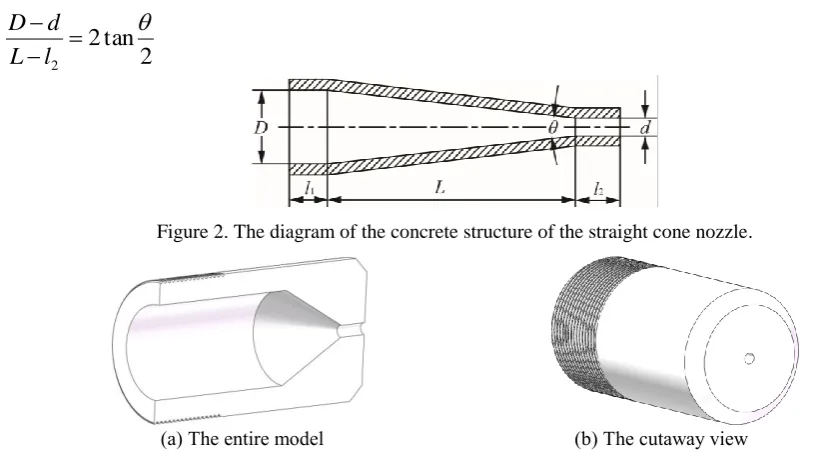
[image:2.595.99.500.74.175.2]The concrete structure and the three-dimensional model of the straight cone nozzle as shown in Figure 2 and Figure 3. Its parameters mainly include inlet diameter (D=32 mm), outlet diameter (d=4 mm), contraction angle (θ=60°), and the length to diameter ratio of the outlet section (l2/d=2.5).
Moreover, its internal structure needs to meet the following equation [3,9,10]:
2 tan 2
2
l L
d D
(1)
Figure 2. The diagram of the concrete structure of the straight cone nozzle.
(a) The entire model (b) The cutaway view
Figure 3. The diagram of three-dimensional model of the straight cone nozzle for high-pressure jet grouting.
Meshing and Boundary Condition Setting
[image:2.595.70.482.265.496.2]Figure 4. The situation of meshing for CFD.
The boundary conditions mainly include the Pressure Inlet (AH), the Pressure Outlet (IL, LM, MN,
NO and OP), the Axis (AB, BC, CD, DU, UQ and QP) and the wall (other areas). The jet grouting pressure is 30 MPa, the surrounding environmental pressure is 10132 Pa. The materials include two phases: cement-slurry (primary phase) and air (secondary phase). In which, the water-cement ratio (W/C) of cement-slurry is 1:1, the cement is P.O 42.5.
Post-Processing and Result Analysis
The jet velocity is the key factor of HPJG, the higher jet velocity, the higher working efficiency. The cement-slurry jet power (it reflects the working efficiency of HPJG) can be roughly calculated as the following equation:
0 0 v
F P Q P
N (2) Where N is the jet power, P is the jet pressure, Q is the flow rate, μ is the flow coefficient, F0 is the
area of nozzle outlet, v0 is jet velocity.
Figure 5 shows the velocity contour of cement-slurry jet based on CFD. The whole jet is a divergent shape. The highest velocity is in the middle area of jet, and the velocity decreases gradually to the sides. After the high-velocity cement-slurry jet ejects from nozzle outlet, the large velocity gradient exists in the area of the interface between jet and the surrounding static medium (such as soil particles, air, groundwater, etc.). Due to the rubbing action, the external medium near the jet boundary starts to move. Some static medium is carried away by entrainment, resulting in a low-pressure area is created around the jet boundary. The external medium moves to the jet boundary continuedly, other medium has a lower velocity than jet, resulting in the vertical moving. With the jet extending, the amount of the surrounding static medium increases, the width of jet becomes larger gradually. Because of the energy conversion and linear head loss, the dynamic pressure and velocity decreases gradually, resulting in the jet diverging gradually.
Discussion
In the process of HPJG, the high-pressure cement-slurry jet cutting effect on soil mass mainly include five effects, including the dynamic pressure effect of jet flow, the pulsed oscillation effect of jet flow, the water wedge breaking effect of jet flow, the cavitation effect of jet flow and the percussive effect of jet flow. Moreover, the main factors that affect the performance of jet cutting soil mass as follows: (1) Injection pressure and flow rate. Generally, the jet cutting efficiency with the injection pressure and flow rate increases. Furthermore, when the energy is constant, it is more obvious to increase the injection distance by increasing the flow rate than by increasing the injection pressure. (2) Nozzle outlet diameter. Generally, the jet cutting efficiency is proportional to the square of the nozzle outlet diameter. (3) Velocity of nozzle movement. Generally, the jet cutting efficiency decreases with the velocity of nozzle movement increases. Moreover, the velocity of nozzle movement slower, the diameter of jet grouting pile larger. (4) Hydrostatic pressure acting on the nozzle outlet. Generally, the jet cutting efficiency decreases with the hydrostatic pressure increases. (5) Physical and mechanical properties of soil mass. Generally, higher jet cutting efficiency in soft soil, and lower jet cutting efficiency in hard soil. In other words, the higher the compressive strength of the soil, the diameter of jet grouting pile smaller.
In addition, there are four different methods of HPJG in practical engineering, including single-tube method (CCP method), twin-tube method (JSG method), three-tube method (CJP method) and multi-tube method (SSS-MAN method). They have five same mechanisms in the process of HPJG as follows: (1) Impacting, cutting and mixing effect. Due to the high-efficiency cement-slurry jet impacting and cutting on the soil mass. In the meantime, the cement-slurry and soil particles are mixed by the entrainment diffusion. (2) Lifting and replacing effect. It improves and increases the density and strength of concrement effectively. In fact, this process only replaces fine soil particles, the coarse soil particles mix with cement-slurry coagulate into a concrement with higher strength. (3) Filling and extrusion effect. The end of high-pressure cement-slurry jet mainly extrudes the surrounding soil. In the meantime, the cement-slurry exerts constant extruding and infiltration on the soil mass, resulting in the concrement combines with the surrounding soil more tightly. (4) Permeation and concretion effect. In the process of HPJG, except for the formation of coagulates in the punching and cutting range, the infiltration effect of cement-slurry occurs in the coarse sands and gravel layer, resulting in the permeable condensation layer. (5) Displacement and packing effect. In the gravel-cobble and boulder formation, the filling materials between the big particles are cut and peeled by the high-pressure cement-slurry. In the meantime, some fine particles are lifted and replaced to the surface, other big particles are moved by the strong impacting and shocking forces, and they are packed by the cement-slurry.
Conclusions
High-pressure jet grouting (HPJG) is an effective foundation treatment method which has been widely used in the various practical engineering for many years. In this study, the computational fluid dynamics (CFD) is used for simulating the process of HPJG, the related results can better reveal the process of HPJG. In the practical engineering, the effective ways to increase the working efficiency of HPJG mainly include the suitable injection pressure and flow rate, nozzle structure and velocity of nozzle movement. In addition, the effects of impacting, cutting, mixing, lifting, replacing, filling, extrusion, permeation, concretion, displacement and packing are the main mechanisms of HPJG to reinforce the soil mass and to prevent seepage.
Acknowledgement
Technology Department (Grant No. 2019YJ0506), and the Demonstration Project of Scientific and Technological Achievements Transformation of Sichuan Provincial Science and Technology Department (Grant No. 2018-598).
References
[1] PGA Njock, J Chen, G Modoni, et al., A review of jet grouting practice and development, Arabian Journal of Geosciences, 2018, 11(16): 1-31.
[2] PGA Njock, JS Shen, G Modoni, et al., Recent advances in horizontal jet grouting (HJG): An overview, Arabian Journal for Science and Engineering, 2018, 43(4): 1543-1560.
[3] Jiwei Wen, Xiangjun Pei, Wenchen Wang, et al., Discussion on several problems of high-pressure jet grouting in seepage prevention and reinforcement, Exploration Engineering (Rock & Soil Drilling and Tunneling), 2016, 43(10), 56-62.
[4] Mingsen Wang, Hongen Wang, Zhenheng Zha, et al., High-pressure jet grouting anti-seepage reinforcement technology, China Water & Power Press, Beijing, 2010.
[5] Yongcheng Zhang, Shuning Dong, Jianshen Su, et al., Grouting Technology, China Coal Industry Publishing House, Beijing, 2012.
[6] Xingwang Zhou, Gangrong Gao, Zhifeng Bo, et al., Grouting construction manual, China Coal Industry Publishing House, Beijing, 2013.
[7] Chunlei Peng, Xiaodong Yang, Dong Ma, et al., Anchorage and grouting equipment manual, China Electric Power Press, Beijing, 2013.
[8] FJ Wang, Computational fluid dynamics analysis-CFD software principles and applications, Tsinghua University Press, Beijing, 2005.
[9] Jiwei Wen, Chen Chen, Optimizing the structure of the straight cone nozzle and the parameters of borehole hydraulic mining for Huadian oil shale based on experimental research, Energies, 2017, 10(12): 1-14.