2019 International Conference on Artificial Intelligence and Computing Science (ICAICS 2019) ISBN: 978-1-60595-615-2
Improvement of Inertia Weight Declining Strategy Based on Particle
Swarm Optimization Algorithm
Li-li GUO
1, Yong-LIU
1*, Wei-xi WANG
1, Ya-wei LI
1, Hao-nan LI
1,
Jia-qi WANG
1, Zi-wei LIU
1and Hua-wei SUN
21College of Electronic Engineering, Heilongjiang University, Harbin 150080, China
2Heilongjiang Eastern Water Saving Equipment Co., Ltd., Suihua 150000, China
*Corresponding author
Keywords: Particle swarm algorithm, Inertial weight, Nonlinear decrease.
Abstract. The standard particle swarm optimization algorithm introduces the inertia weighetw, which becomes a calculation method for finding the extremum of the function effectively. It is easy to converge fast. Nowadays, the linear decreasing dynamic, inertia weighting strategy is widely used. Although this improvement is very successful. However, the search process is a nonlinear and complex process. In order to better maintain the balance between global and local search capabilities, this paper proposes a nonlinear decreasing dynamic inertia weighting strategy based on the linear decreasing strategy, using Griewank, Rastrigrin, Sphere, The simulation experiments of four standard test functions of JDSchaffer were carried out, and the inertia weights in the basic particle swarm optimization algorithm were compared with the nonlinear decrement of fixed weight
95 . 0
=
w , linear decreasing LDIW and Chen[6] exponential curve respectively. The improved nonlinear weight decrement strategy is superior to other algorithms in terms of convergence speed, convergence precision number of iterations.
Introduction
Based on the simulation of social behaviors such as bird foraging and human cognition, Kennedy and Eberhart [1] jointly proposed a global optimization algorithm, Particle Swarm Optimization (PSO), which is based on 1995. Evolutionary computing technology for swarm intelligence. The convergence speed of particle swarm optimization algorithm is slower when it is close to the most advantageous region. The particle swarm optimization algorithm has a faster convergence rate in the early stage, but in the late iteration, the improvement effect is not very satisfactory. This is mainly due to the convergence of the algorithm to the local pole. Small, lack of effective mechanisms to make the algorithm avoid the minimum point. In response to the above limitations, research scholars have made corresponding improvements. For example, in 1998, YHShi [4] proposed an improved particle swarm optimization algorithm with inertia weight--linear diminishing weighting strategy (LDIW); Li Huirong et al. [2] The index proposes a particle swarm optimization algorithm based on nonlinear decreasing inertia weighting strategy; Chen Guimin et al [3] proposed nonlinear inertia weight reduction strategies such as exponential curve, open downward parabola and open upward parabola, etc. It is an improvement of the basic particle swarm optimization algorithm. Based on the previous research, this paper proposes a logarithmic nonlinear decreasing dynamic weighting strategy, and simultaneously analyzes and compares several other improved particle swarm optimization algorithms.
Basic Particle Swarm Optimization Algorithm
Suppose that in a target space with dimension d, the number of particle swarms is n, then the position and velocity of the i-th particle in the particle swarm can be represented by a d-dimensional vector, such as (2-1) and (2-2) shown:
) ... ( i1, i2, id
i x x x
) ... ( i1, i2, id
i v v v
V = (2-2)
The optimal position that theiparticle has searched so far is called the individual extremum, as shown in (2-3):
) ,..., ,
( i1 i2 id
best p p p
p = (2-3)
The optimal position that the entire particle swarm has searched so far is the global extremum, as shown in (2-4):
) ,..., ,
( 1 2 d
best g g g
g = (2-4)
When two optimal values are found, the particles update their speed and position according to equations (2-5) and (2-6):
)] ( ) ( [ )] ( ) ( [ ) ( ) 1
(t V t c1r1V t X t c2r2 P t X t
Vij + = ij + ij − ij + gj − ij (2-5)
) 1 ( ) ( ) 1
(t+ = X t +V t+
Xij ij ij (2-6)
Equations (2-5) and (2-6) form the basic particle swarm algorithm, where: i=1, 2...n, j=1, 2...d, n represents The number of particles in the particle swarm, and d represents the dimension of the target space.c1andc2indicate that the learning factor is usually set toc1=c2;r1andr2are uniform random numbers and independent of each other, the value range is [0, 1];vijis the velocity of the
particle,vij∈[−vmax,vmax],vmaxis a constant, and the magnitude of the velocity is determined by the objective function. The nature is determined.
Linear Decreasing Inertia Weight Strategy
In order to better control the development and detection capabilities of particle, YHShi introduces the inertia weightwinto (2-5). Because the algorithm can guarantee better convergence, it is considered as a standard particle swarm algorithm. Its evolution process is as shown in equations (3-1) and (3-2):
)] ( ) ( [ )] ( ) ( [ ) ( ) 1
(t wV t c1r1V t X t c2r2 P t X t
Vij + = ij + ij − ij + gj − ij (3-1)
) 1 ( ) ( ) 1
(t+ = X t +V t+
Xij ij ij (3-2)
In addition,wcan be dynamically adjusted during the search process. The more dynamic inertia weights are the linear decrement weights (LDIW) strategy proposed by Shi, that is, the linearwvalue is reduced linearly during the iterative process. Such as (3-3):
max ) ( T t w w w
w= s− s− e (3-3)
where:wsis the initial inertia weight,weis the end value of the maximum allowed number of iterations;Tmax is the maximum number of evolutions;t is the current number of iterations,
95 . 0
=
s
w ,we =0.4in most problem solving.
Therefore, this paper proposes a nonlinear decrement strategy and tries to enhance the local and global search ability. The formula is (4-1):
2
1( )log10 ]/
[w f w w max f
w T
t
e s
s − −
= (4-1)
Among them,ws,we,Tmaxandthave the same meaning as (3-3). This function represents a logarithmic function curve. f1andf2are adjustment factors. The purpose is to control the rate of
change ofwso that its range satisfies[0.4,0.95]. The improved strategy is used to maintain the balance between global search and local search. As the iteration progresses, the inertia weight decreases from 0.95 to 0.4, and the inertia weightwtakes a larger value in the algorithm of the iterative early iteration, thus avoiding the algorithm falling into local The extreme value maintains a strong global search ability; at the same time, a smaller inertia weight is taken in the late iteration to enhance the local search ability and speed up the convergence of the algorithm.
Experimental Simulation Analysis
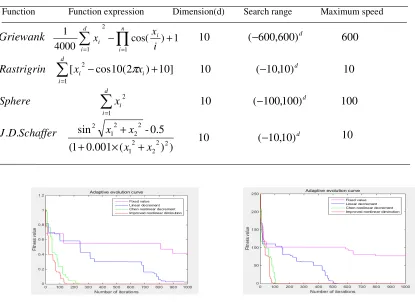
This paper uses 4 classic test function (such as Table 1) to test these algorithms, except that the global minimum value of the JDSchaffer test function is 1- , the global minimum values of the other 3 test functions are 0; The number of particles is 30, the dimension is 10,f1=0.5, f2 =2.2,
2
2
1 =c =
[image:3.612.82.497.356.658.2]c ,ws =0.95,we =0.4. The ending condition is that the number of iterations exceeds 1000.
Table 1. Four standard test functions.
Function Function expression Dimension(d) Search range Maximum speed
Griewank
∏
= = + − n i i d i i i x x 1 2 1 1 ) cos( 4000 1
10 (−600,600)d 600
Rastrigrin
= + − d i i i x x 1 2 ] 10 ) 2 ( 10 cos
[ π 10 (−10,10)d 10
Sphere
= d i i x 1 2
10 (−100,100)d 100
Schaffer D
J. .
) ) ( 001 . 0 1 ( 5 . 0 -sin 2 2 2 2 1 2 2 2 1 2 x x x x + × + +
10 (−10,10)d 10
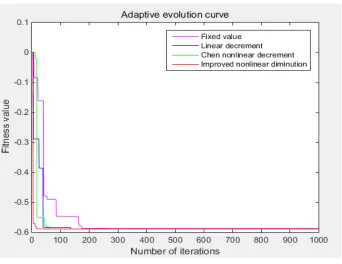
Figure 4. Sphere function. Figure 5. Schaffer function.
Result Analysis
Figure 2 shows that the convergence accuracy of the fixed weight is the worst and the convergence condition is not reached when the number of iterations is 1000. The inertia weight does not reach the convergence condition. Chen and the paper look at the overall optimization result, but this paper needs The number of iterations is small, which improves the speed and efficiency of convergence. Figure 3 shows that the line with fixed weight has the disadvantage of premature convergence, prematurely stops at the local best, and the convergence accuracy is far from the set accuracy. When the iteration number is 1000 times, the convergence condition is not reached. The convergence performance proposed in this paper is the best, followed by Chen, and the linear decrement is the worst. From Figure 4, we can see that the four algorithms are ideal, but the convergence of fixed weights. The speed is still poor, and the effect of introducing the inertia weight is better than that of the inertia weight; from Fig. 5, it can be seen that the four algorithms are closer to the set convergence precision when iterating to a certain number of times, and the line of fixed weight needs The number of iterations is the highest compared to the other three, and the overall optimization performance is still the worst, and the algorithm proposed in this paper still converges the fastest, the number of iterations is about 56, and the other 2 Algorithm in the intermediate state. In summary, the proposed nonlinear convergence rate is the fastest, the number of iterations required is the least, the convergence accuracy can be close to the algorithm, and the algorithm is not premature, which effectively improves the overall optimization performance of the algorithm.
Conclusion
In this paper, based on the research and analysis of the inertia weight of PSO particle swarm optimization algorithm, a nonlinear decreasing dynamic inertia weighting strategy is proposed. The algorithm sets a large weight in the early iteration, which is beneficial to jump out of local optimum; Weight, which is conducive to local optimization and speed up convergence. Through experiments on four standard test functions, we can see that the logarithmic nonlinear strategy proposed in this paper has faster convergence speed, higher convergence precision and fewer iterations, which better reflects the global search ability.
References
[image:4.612.115.280.65.197.2][4] Shi Y., Eberhart R.C. A modified particle swarm optimizer. Proceedings of the IEEE Conference on Evolutionary Computation, 1998: 69-73.