S T U D Y P R O T O C O L
Open Access
Efficacy of a 3 month training program on the
jump-landing technique in jump-landing sports.
Design of a cluster randomized controlled trial
Inne Aerts
1, Elke Cumps
1, Evert Verhagen
1,2, Romain Meeusen
1*Abstract
Background:With the relatively high rate of injuries to the lower extremity due to jump-landing movement patterns and the accompanied high costs, there is need for determining potential preventive programs. A program on the intervention of jump-landing technique is possibly an important preventative measure since it appeared to reduce the incidence of lower extremity injuries. In real life situations, amateur sports lack the infrastructure and funds to have a sports physician or therapist permanently supervising such a program. Therefore the current prevention program is designed so that it could be implemented by coaches alone.
Objective:The objective of this randomized controlled trial is to evaluate the effect of a coach supervised intervention program targeting jump-landing technique on the incidence of lower extremity injuries.
Methods:Of the 110 Flemish teams of the elite division, 24 teams are included and equally randomized to two study groups. An equal selection of female and male teams with allocation to intervention and control group is obtained. The program is a modification of other prevention programs previously proven to be effective. All exercises in the current program are adjusted so that a more progressive development in the exercise is presented. Both the control and intervention group continue with their normal training routine, while the intervention group carries out the program on jump-landing technique. The full intervention program has a duration of three months and is performed 2 times a week during warm-up (5-10 min). Injuries are registered during the entire season. Discussion:The results of this study can give valuable information on the effect of a coach supervised intervention program on jump-landing technique and injury occurrence. Results will become available in 2011. Trial registration:Trial registration number: NTR2560
Background
Different studies have pointed out that injuries in jump-landing sports are of frequent occurrence [1-4]. In vol-leyball, gymnastics and basketball respectively, a total of 2.8 [CI 95%: 2.0 -3.6], 2.2 [CI 95%: 1.6 - 2.9] and 9.8 [CI 95%: 8.5 - 11.1] injuries per 1,000 exposure hours have been reported [5,6]. The majority of the injuries in these sports occur at the lower extremity, accounting for more than 60% of all injuries [2-4]. Both overuse (e.g. shin splints, stress fractures [7], patellar tendinopathy (PT) [8,9], patellar femoral pain syndrome (PFPS)
[10,11] and acute injuries (e.g. ACL injury [12-14] and ankle sprains [15-17]) often occur in jump-landing sports.
Sports injuries often are accompanied by pain or other physical discomforts, which in turn result in use of healthcare resources and possibly also in absenteeism from work. The severity of sports injuries can be described based on different criteria including sporting time lost, permanent damage and cost [6]. In a study of Cumps et al. (2007) the number of basketball days for which the athlete was not able to play or train because of the injury sustained was set on 3 to 7 weeks [18]. This means that injury occurrence can put a stop to the athlete’s participation in his sport for a long time. From the study of Cumps et al. (2008)[6] it also can be * Correspondence: [email protected]
1
Vrije Universiteit Brussel, Faculty of Physical Education and Physical Therapy, Department of Human Physiology and Sports Medicine, Brussels, Belgium Full list of author information is available at the end of the article
concluded that the direct medical and the indirect costs in Flanders involved in acute injuries only, are respec-tively 15,027,423€ and 111,420,813 €. No information of the cost of overuse injuries was found, so it can be assumed that the actual cost of both acute and overuse injuries actually is much higher. Even more, important aspects of injury occurrence are the long term conse-quences. After, for example an ACL-injury or episodes of anterior knee pain, many athletes seem predisposed to osteoarthritis [19-21]. This can already occur at an early age and result in lifelong constraint in sport parti-cipation [19,20]. In order to reduce short and long term consequences, there is a need for sports injury prevention.
Arguably the most important injury mechanism for these lower extremity acute and overuse injuries is the jump-landing maneuver [1,3,5]. Proper jump-landing movement patterns are essential to absorb the generated impact forces efficiently, and are suggested to be strongly related to the athlete’s risk for injuries to the lower extre-mity [22,23]. Consequently, various jump-landing related risk factors, such as increased knee valgus during jump-landing technique, ankle instability or a stiff jump-landing tech-nique, appear to be related with injury occurrence [8,24-26]. For example, a stiff landing strategy increases the risk of sustaining injuries due to higher ground reac-tion forces and decreased shock absorpreac-tion during land-ing. Specific movement patterns such as dynamic valgus or stiff jump-landings technique can be a risk factor for respectively ACL injuries and PT [8,24,26,27].
With the relatively high rate of injuries of the lower extremity in jump-landing sports and the severity of these injuries, there is a need for practical preventive programs [28,29]. A program aiming at an improvement of jump-landing technique is potentially an important preventive measure while it is able to target a variety of risk factors for a variety of injuries. Previous attempts have been made to prevent specific injuries through improvement of jump-landing technique, e.g. recurrent ankle sprains [30] and ACL injuries [24]. However, most available prevention programs were supervised by sport physicians or physical therapists. This might work for (sub)elite sports were medical supervision is always available, but amateur sports lack the infrastructure and funds to have a sports physician or therapist perma-nently supervising such a program. Nevertheless, it is amateur sports where, in absolute sense, the injury bur-den is highest through high participation numbers. Therefore, the true effectiveness of available preventive programs in this important setting is questionable.
Objective
The objective of this randomized controlled trial is to evaluate the effectiveness of a coach supervised
intervention program targeting jump-landing technique on the incidence of lower extremity injuries.
Research questions
- What is the effectiveness of a coach supervised jump landing intervention program on the incidence of acute and overuse injuries to the lower extremity?
- What is the effect of a coach supervised jump land-ing intervention program on jump landland-ing technique of individual athletes?
Methods
The CONSORT statement was followed to describe the design of this study. This statement is a checklist intended to improve the quality of reports of rando-mized controlled trials [31].
Study outline
A two-way cluster randomized controlled trial with a follow-up period of one season (6 months) is used. The participation subjects are athletes from basketball teams of the national divisional, and, 1stand 2ndregional divi-sional basketball competitions.
The study protocol is accepted by the local ethical committee of the Free University Brussels (B.U.N. B14320071963) and a trial registration number was requested (NTR2560).
This study is financially supported by the Flemish Government through the establishment of the Policy Research Center Sports, Youth and Culture.
Participants
Athletes who are actively participating in the national division and, 1st and 2nd regional basketball teams in Flanders, Belgium, are eligible for inclusion in the study. Athletes are excluded if they do not master the Dutch language or have a current injury to the lower extremity at time of inclusion.
Written informed consent is obtained from each ath-lete and the study is conducted in accordance with the ethical institutional rules for human research and in reg-ulation with the Declaration of Helsinki for Medical Research involving human subjects.
Sample size
A power calculation is carried out for the main outcome variable lower extremity injury incidence. A difference of 50% in the incidence of lower extremity injuries between the intervention and control group after a follow up of one season is considered to be clinically relevant.
injuries, with a power of 90% and an alpha of 5%. Assuming a dropout rate of about 20% a total of 82 ath-letes are needed to detect a potentially clinically relevant effect of the intervention. However, as teams serve as unit of randomization, a cluster effect should be taken into account. Therefore, an intra-cluster correlation coefficient of 20% was considered, resulting in a total of 240 athletes from 24 teams is necessary at baseline.
Recruitment
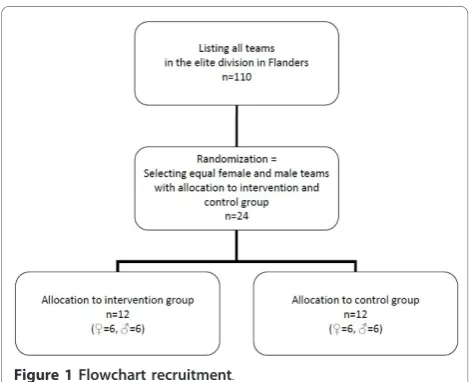
Of the 110 Flemish teams of the elite division, 24 teams are included and equally randomized to two study groups (Figure 1). Randomization and group allocation takes place before teams were contacted. This is done in order to avoid any spill over of the intervention while including teams. Through this method blinding of the teams to group allocation is secured.
Intervention program
After receiving informed consent and baseline question-naire of a team’s individual athletes, trainers are pro-vided with a package that enclosed the necessary information. Control gorup (CG) trainers are provided with a DVD containing general information on the study. Trainers of the intervention teams receive a dif-ferent DVD with general information on the study and specific information on the intervention program and the individual exercises. Also a written manual including the complete program and a detailed explanation for each individual exercise is provided.
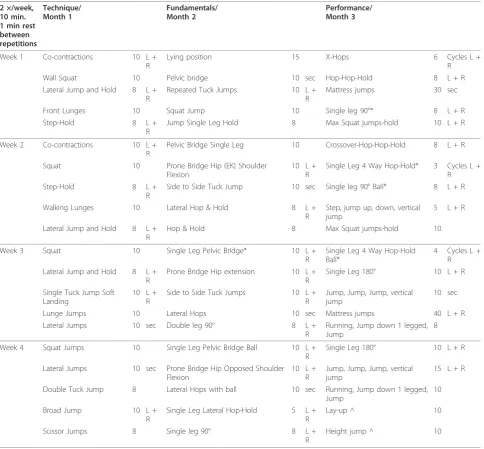
Both research groups continue their regular training routine. Teams of the intervention group (IG) receive an additional intervention program to be carried out during the regular warm-up (Table 1). This program targets at improving the athletes’jump-landing technique.
The program is a modification of two prevention pro-grams previously proven to be effective for the preven-tion of lower extremity injuries [24,32]. The exercises in the current program are adapted so that a more pro-gressive development is present. Furthermore, the mate-rials required to complete the exercises are limited. The program has a duration of three months and is per-formed twice a week during warm-up (5-10 min). All exercises are selected so that the jump-landing program difficulty is gradually increased. First, basic techniques are practiced and then fundamental exercises are trained. Hereafter, more difficult and sport specific exer-cises are given in the performance phase. The interven-tion is considered to be appropriate for all athletes and to have no negative side-effects.
Measurements
During the study period there are two fixed measure-ments, at baseline (T0) and after 3 months (T1). At T0 a questionnaire is completed by the athletes, and at both occasions the athletes’jump landing technique is assessed. Additionally, exposure hours and lower extre-mity injuries are continuously registered during the entire 2010-2011 basketball season (6 months).
Questionnaire
At T0 all athletes complete a questionnaire on demo-graphic data, previous injuries, sports history and cur-rent sports participation [33].
Jump landing technique
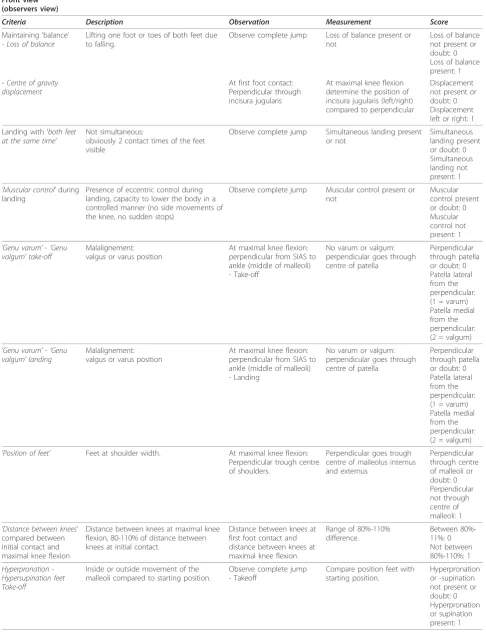
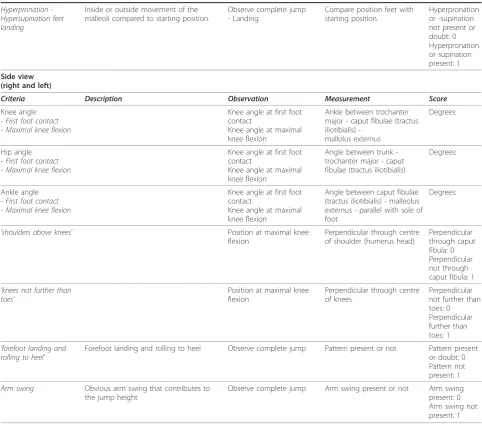
An improvement in jump-landing technique is deter-mined by registering jump-landing technique of athletes in the CG and IG. Athletes are asked to perform 3 sepa-rate maximal vertical jumps which are recorded on cam-era (SONY HDV 1080i). The researchers collect the jump-landing data at T0 and T1. These jumps are all analyzed through the computer program Darttrainer®. In addition, all jumps are evaluated through a predefined list of criteria, the JLS-System (Jump-landing Scorings system) (Table 2). This tool is developed as a field test to evaluate proper jump-landing technique.
Exposure time
[image:3.595.56.292.534.725.2]Exposure is recorded by the coach on an exposure form. Coaches note the total duration of each training session and match, and classify the level of participation of each player (that is, in terms of full, three quarters, one half, one quarter, or no participation). If the player does not participate fully, the coach note the reason–that is, being injured, ill, or absent for other reasons. Completed exposure forms are returned on a weekly basis. Every week trainers are contacted by phone and urged to fill out the exposure sheets, and, if necessary, the injury forms. In this, we followed the example of Verhagen et al.[2] who applied the same method of exposure registration.
Injury definition
To determine the effectiveness of the program for the prevention of injuries, all injuries that occur during the entire season are registered in both the IG and CG. Injuries are divided into two main categories: acute or overuse injuries. An acute injury is defined as a sports accident, with a sudden, direct cause/onset, which requires at least minimal (medical) care (e.g. ice or tap-ing) and which causes the injured subject to miss out on at least 1 training session. Exclusion criteria involve muscle cramps and mild bruises. A subject sustains an overuse injury if he or she experiences a physical
discomfort, with an insidious onset, that caused pain and/or stiffness of the musculoskeletal system, and that is present before, during and/or after the sports activity. The overuse injury is only registered if present for at least three consecutive sessions. Illness and fatigue are not registered as overuse injuries [18].
Injury registration
[image:4.595.57.542.99.548.2]Coaches receive injury forms at the start of the study. In case of injury, the coach completes in concordance with the injured player injury registration forms, which have to be completed within one week after injury onset. On this form the player is asked to provide information on
Table 1 Overview of the jump-landing technique program
2 ×/week, 10 min. 1 min rest between repetitions
Technique/ Month 1
Fundamentals/ Month 2
Performance/ Month 3
Week 1 Co-contractions 10 L +
R
Lying position 15 X-Hops 6 Cycles L +
R
Wall Squat 10 Pelvic bridge 10 sec Hop-Hop-Hold 8 L + R
Lateral Jump and Hold 8 L + R
Repeated Tuck Jumps 10 L +
R
Mattress jumps 30 sec
Front Lunges 10 Squat Jump 10 Single leg 90°* 8 L + R
Step-Hold 8 L +
R
Jump Single Leg Hold 8 Max Squat jumps-hold 10 L + R
Week 2 Co-contractions 10 L +
R
Pelvic Bridge Single Leg 10 Crossover-Hop-Hop-Hold 8 L + R
Squat 10 Prone Bridge Hip (EK) Shoulder
Flexion
10 L + R
Single Leg 4 Way Hop-Hold* 3 Cycles L + R
Step-Hold 8 L +
R
Side to Side Tuck Jump 10 sec Single leg 90° Ball* 8 L + R
Walking Lunges 10 Lateral Hop & Hold 8 L +
R
Step, jump up, down, vertical jump
5 L + R
Lateral Jump and Hold 8 L + R
Hop & Hold 8 Max Squat jumps-hold 10
Week 3 Squat 10 Single Leg Pelvic Bridge* 10 L +
R
Single Leg 4 Way Hop-Hold Ball*
4 Cycles L + R Lateral Jump and Hold 8 L +
R
Prone Bridge Hip extension 10 L + R
Single Leg 180° 10 L + R
Single Tuck Jump Soft Landing
10 L + R
Side to Side Tuck Jumps 10 L + R
Jump, Jump, Jump, vertical jump
10 sec
Lunge Jumps 10 Lateral Hops 10 sec Mattress jumps 40 L + R
Lateral Jumps 10 sec Double leg 90° 8 L +
R
Running, Jump down 1 legged, Jump
8
Week 4 Squat Jumps 10 Single Leg Pelvic Bridge Ball 10 L +
R
Single Leg 180° 10 L + R
Lateral Jumps 10 sec Prone Bridge Hip Opposed Shoulder Flexion
10 L + R
Jump, Jump, Jump, vertical jump
15 L + R
Double Tuck Jump 8 Lateral Hops with ball 10 sec Running, Jump down 1 legged, Jump
10
Broad Jump 10 L +
R
Single Leg Lateral Hop-Hold 5 L + R
Lay-up ^ 10
Scissor Jumps 8 Single leg 90° 8 L +
R
Height jump ^ 10
*Exercise on the mattress
Table 2 Scorings system Jump-landing Technique (JLS-system)
Front view (observers view)
Criteria Description Observation Measurement Score
Maintaining‘balance’ - Loss of balance
Lifting one foot or toes of both feet due to falling.
Observe complete jump Loss of balance present or not
Loss of balance not present or doubt: 0 Loss of balance present: 1 - Centre of gravity
displacement
At first foot contact: Perpendicular through incisura jugularis
At maximal knee flexion determine the position of incisura jugularis (left/right) compared to perpendicular
Displacement not present or doubt: 0 Displacement left or right: 1
Landing with‘both feet at the same time’
Not simultaneous:
obviously 2 contact times of the feet visible
Observe complete jump Simultaneous landing present or not
Simultaneous landing present or doubt: 0 Simultaneous landing not present: 1 ’Muscular control’during
landing
Presence of eccentric control during landing, capacity to lower the body in a controlled manner (no side movements of the knee, no sudden stops)
Observe complete jump Muscular control present or not
Muscular control present or doubt: 0 Muscular control not present: 1 ’Genu varum’-‘Genu
valgum’take-off
Malalignement: valgus or varus position
At maximal knee flexion: perpendicular from SIAS to ankle (middle of malleoli) - Take-off
No varum or valgum: perpendicular goes through centre of patella
Perpendicular through patella or doubt: 0 Patella lateral from the perpendicular: (1 = varum) Patella medial from the perpendicular: (2 = valgum) ’Genu varum’-‘Genu
valgum’landing
Malalignement: valgus or varus position
At maximal knee flexion: perpendicular from SIAS to ankle (middle of malleoli) - Landing
No varum or valgum: perpendicular goes through centre of patella
Perpendicular through patella or doubt: 0 Patella lateral from the perpendicular: (1 = varum) Patella medial from the perpendicular: (2 = valgum) ’Position of feet’ Feet at shoulder width. At maximal knee flexion:
Perpendicular trough centre of shoulders.
Perpendicular goes trough centre of malleolus internus and externus
Perpendicular through centre of malleoli or doubt: 0 Perpendicular not through centre of malleoli: 1 ’Distance between knees’
compared between initial contact and maximal knee flexion
Distance between knees at maximal knee flexion, 80-110% of distance between knees at initial contact.
Distance between knees at first foot contact and distance between knees at maximal knee flexion.
Range of 80%-110% difference.
Between 80%-11%: 0 Not between 80%-110%: 1
Hyperpronation -Hypersupination feet Take-off
Inside or outside movement of the malleoli compared to starting position.
Observe complete jump - Takeoff
Compare position feet with starting position.
the injury location, injury type, diagnosis of the injury, direct cause of the injury, preventive measures used at the time of the injury, first aid given, and subsequent medical treatment. If an injury is noted on the exposure form and no injury registration form is received within two weeks after the injury is logged, the coach is con-tacted and urged to let the player complete the injury registration form.
Process evaluation & Compliance
Coaches are contacted on a weekly basis by means of a telephone call. The goal of this call is to inquire about the ongoing of the study and to follow-up on any miss-ing exposure or injury registration forms. In addition, IG coaches are asked whether they followed the pre-scribed exercises for that particular week. If not, the
exercises that are carried are noted in order to gain insight into the compliance to the program.
At T1 coaches are required to complete a question-naire inquiring on their opinion of the intervention pro-gram, their compliance to the prescribed exercises, and to inquire about any difficulties in executing the program.
Statistical analyses
[image:6.595.56.539.100.527.2]The injury incidence density (IID) is calculated as the number of new injuries per 1,000 hours of participation, using exposure time of each individual participant until the first injury. The number of injuries divided by the total time at risk is the preferred measure of incidence because it can accommodate variations in the exposure time of individuals [34,35]. If an athlete suffers multiple
Table 2: Scorings system Jump-landing Technique (JLS-system)(Continued)
Hyperpronation -Hypersupination feet landing
Inside or outside movement of the malleoli compared to starting position.
Observe complete jump - Landing
Compare position feet with starting position.
Hyperpronation or -supination not present or doubt: 0 Hyperpronation or supination present: 1
Side view (right and left)
Criteria Description Observation Measurement Score
Knee angle - First foot contact - Maximal knee flexion
Knee angle at first foot contact
Knee angle at maximal knee flexion
Ankle between trochanter major - caput fibulae (tractus iliotibialis)
-mallolus externus
Degrees:
Hip angle - First foot contact - Maximal knee flexion
Knee angle at first foot contact
Knee angle at maximal knee flexion
Angle between trunk -trochanter major - caput fibulae (tractus iliotibialis)
Degrees:
Ankle angle - First foot contact -Maximal knee flexion
Knee angle at first foot contact
Knee angle at maximal knee flexion
Angle between caput fibulae (tractus iliotibialis) - malleolus externus - parallel with sole of foot
Degrees:
’shoulders above knees’ Position at maximal knee flexion
Perpendicular through centre of shoulder (humerus head)
Perpendicular through caput fibula: 0 Perpendicular not through caput fibula: 1 ’knees not further than
toes’
Position at maximal knee flexion
Perpendicular through centre of knees
Perpendicular not further than toes: 0 Perpendicular further than toes: 1 ’forefoot landing and
rolling to heel’
Forefoot landing and rolling to heel Observe complete jump Pattern present or not Pattern present or doubt: 0 Pattern not present: 1
Arm swing Obvious arm swing that contributes to the jump height
injuries, only the first injury will be considered in the analysis.
Because the unit of allocation was teams, we perform a multilevel Cox proportional hazard regression analysis, using the computer based software SPSS 17.0 (SPSS Inc, Chicago, Illinois, USA), to estimate the hazard ratios (HRs) and 95% confidence intervals (CIs). Teams will be used as cluster levels [36].
The difference between the CG and IG regarding the JLS-system is calculated using Repeated Measures ANOVA (p < 0.05) for normally distributed data and the Mann-Whitney-Utest (p < 0.05) for data which are not normally distributed.
Implications of this study
This study evaluates the effect of a coach supervised injury prevention program. If successful this will provide valuable information for sports injury prevention prac-tice. As the majority of injuries are sustained in amateur sports where medical guidance is limited, effective coach supervised prevention has a great potential impact on public health.
Acknowledgements
This study was financially supported by the Flemish Government through the establishment of the Policy Research Center Sports, Youth and Culture. The authors have no conflicts of interest directly relevant to its contents.
Author details
1Vrije Universiteit Brussel, Faculty of Physical Education and Physical Therapy,
Department of Human Physiology and Sports Medicine, Brussels, Belgium.
2EMGO Institute for Health and Care Research, Department of Public and
Occupational Health. VU University Medical Center, Amsterdam, the Netherlands.
Authors’contributions
IA, EC, EV, RM were involved in the conception and design of the study. IA is involved in study data collection. All authors were involved in drafting the manuscript and revising it for critically important content. All authors have read and approved the final manuscript.
Competing interests
The authors declare that they have no competing interests.
Received: 19 October 2010 Accepted: 13 December 2010 Published: 13 December 2010
References
1. Ferretti A, Papandrea P, Conteduca F, Mariani PP:Knee ligament injuries in volleyball players.American Journal of Sports Medicine1992,20(2):203-207. 2. Verhagen E, Van der Beek A, Bouter L, Bahr R, Van Mechelen W:A one
season prospective cohort study of volleyball injuries.Br J Sports Med 2004,38(4):477-481.
3. Agel J, Olson DE, Dick R, Arendt EA, Marshall SW, Sikka RS:Descriptive epidemiology of collegiate women’s basketball injuries: National Collegiate Athletic Association Injury Surveillance System, 1988-1989 through 2003-2004.J Athl Train2007,42(2):202-210.
4. Marshall SW, Covassin T, Dick R, Nassar LG, Agel J:Descriptive epidemiology of collegiate women’s gymnastics injuries: National Collegiate Athletic Association Injury Surveillance System, 1988-1989 through 2003-2004.J Athl Train2007,42(2):234-240.
5. Harringe M, Renstrom P, Werner S:Injury incidence, mechanism and diagnosis in top-level teamgym: a prospective study conducted over
one season.Scandinavian Journal of Medicine & Science in Sports2007, 115-119.
6. Cumps E, Verhagen E, Annemans L, Meeusen R:Injury rate and socioeconomic costs resulting from sports injuries in Flanders: data derived from sports insurance statistics 2003.British Journal of Sports Medicine2008,42(9):767-772.
7. Chockley C:Ground reaction force comparison between jumps landing on the full foot and jumps landing en pointe in ballet dancers.J Dance Med Sci2008,12(1):5-8.
8. Bisseling RW, Hof AL, Bredeweg SW, Zwerver J, Mulder T:Relationship between landing strategy and patellar tendinopathy in volleyball.Br J Sports Med2007,41(7):e8.
9. Richards DP, Ajemian SV, Wiley JP, Zernicke RF:Knee joint dynamics predict patellar tendinitis in elite volleyball players.Am J Sports Med 1996,24(5):676-683.
10. Duffey MJ, Martin DF, Cannon DW, Craven T, Messier SP:Etiologic factors associated with anterior knee pain in distance runners.Med Sci Sports Exerc2000,32(11):1825-1832.
11. Thomee R, Renstrom P, Karlsson J, Grimby G:Patellofemoral pain syndrome in young women. I. A clinical analysis of alignment, pain parameters, common symptoms and functional activity level.Scand J Med Sci Sports1995,5(4):237-244.
12. Malinzak RA, Colby SM, Kirkendall DT, Yu B, Garrett WE:A comparison of knee joint motion patterns between men and women in selected athletic tasks.Clinical Biomechanics2001,16(5):438-445.
13. Chappell JD, Creighton RA, Giuliani C, Yu B, Garrett WE:Kinematics and electromyography of landing preparation in vertical stop-jump - Risks for noncontact anterior cruciate ligament injury.American Journal of Sports Medicine2007,35(2):235-241.
14. Hughes G, Watkins J:A risk-factor model for anterior cruciate ligament injury.Sports Medicine2006,36(5):411-428.
15. Wikstrom EA, Powers ME, Tillman MD:Dynamic stabilization time after isokinetic and functional fatigue.Journal of Athletic Training2004,
39(3):247-253.
16. Ross SE, Guskiewicz KM, Yu B:Single-leg jump-landing stabilization times in subjects with functionally unstable ankles.Journal of Athletic Training 2005,40(4):298-304.
17. Verhagen E, van der Beek A, Twisk J, Bouter L, Bahr R, van Mechelen W:
The effect of a proprioceptive balance board training program for the prevention of ankle sprains - A prospective controlled trial.American Journal of Sports Medicine2004,32(6):1385-1393.
18. Cumps E, Verhagen E, Meeusen R:Prospective epidemiological study of basketball injuries during one competitive season: Ankle sprains and overuse knee injuries.Journal of Sports Science and Medicine2007,6(2):204-211. 19. Lohmander LS, Ostenberg A, Englund M, Roos H:High prevalence of knee osteoarthritis, pain, and functional limitations in female soccer players twelve years after anterior cruciate ligament injury.Arthritis Rheum2004,
50(10):3145-3152.
20. Hewett TE, Myer GD, Ford KR, Heidt RS Jr, Colosimo AJ, McLean SG, van den Bogert AJ, Paterno MV, Succop P:Biomechanical measures of neuromuscular control and valgus loading of the knee predict anterior cruciate ligament injury risk in female athletes: a prospective study.Am J Sports Med2005,33(4):492-501.
21. Thomas MJ, Wood L, Selfe J, Peat G:Anterior knee pain in younger adults as a precursor to subsequent patellofemoral osteoarthritis: a systematic review.BMC Musculoskeletal Disorders2010,11:201.
22. Bisseling RW, Hof AL, Bredeweg SW, Zwerver J, Mulder T:Are the take-off and landing phase dynamics of the volleyball spike jump related to patellar tendinopathy?British Journal of Sports Medicine2008,42(6):483-489. 23. Reeser JC, Verhagen E, Briner WW, Askeland TI, Bahr R:Strategies for the
prevention of volleyball related injuries.British Journal of Sports Medicine 2006,40(7):594-U520.
24. Hewett TE, Lindenfeld TN, Riccobene JV, Noyes FR:The effect of neuromuscular training on the incidence of knee injury in female athletes. A prospective study.Am J Sports Med1999,27(6):699-706. 25. Myer GD, Ford KR, Palumbo JP, Hewett TE:Neuromuscular training improves performance and lower-extremity biomechanics in female athletes.Journal of Strength and Conditioning Research2005,19(1):51-60. 26. Caulfield BM, Garrett M:Functional instability of the ankle: Differences in
27. Myer GD, Ford KR, Hewett TE:The effects of gender on quadriceps muscle activation strategies during a maneuver that mimics a high ACL injury risk position.J Electromyogr Kinesiol2005,15(2):181-189.
28. Parkkari J, Kujala UM, Kannus P:Is it possible to prevent sports injuries? Review of controlled clinical trials and recommendations for future work.Sports Med2001,31(14):985-995.
29. Harmer PA:Basketball injuries.Med Sport Sci2005,49:31-61.
30. Stasinopoulos D:Comparison of three preventive methods in order to reduce the incidence of ankle inversion sprains among female volleyball players.Br J Sports Med2004,38(2):182-185.
31. Schulz KF, Altman DG, Moher D, Grp C:CONSORT 2010 Statement: Updated guidelines for reporting parallel group randomised trials. Journal of Clinical Epidemiology2010,63(8):834-840.
32. Myer G, Chu D, Brent J, Hewett T:Trunk and hip control neuromuscular training for the prevention of knee joint injury.Clin Sports Med2008,
27(3):425-448, ix.
33. Knaepen K, Cumps E, Zinzen E, Meeusen R:Low-back problems in recreational self-contained underwater breathing apparatus divers: Prevalence and specific risk factors.Ergonomics2009,52(4):461-473. 34. Emery CA, Meeuwisse WH:Risk factors for injury in indoor compared
with outdoor adolescent soccer.American Journal of Sports Medicine2006,
34(10):1636-1642.
35. Emery CA:injury prevention and future research.Med Sports Sci2005,
49:170-191.
36. Gutierrez RG:Parametric frailty and shared frailty survival models.Stata J 2002,2:22-24.
Pre-publication history
The pre-publication history for this paper can be accessed here: http://www.biomedcentral.com/1471-2474/11/281/prepub
doi:10.1186/1471-2474-11-281
Cite this article as:Aertset al.:Efficacy of a 3 month training program on the jump-landing technique in jump-landing sports. Design of a cluster randomized controlled trial.BMC Musculoskeletal Disorders2010
11:281.
Submit your next manuscript to BioMed Central and take full advantage of:
• Convenient online submission
• Thorough peer review
• No space constraints or color figure charges
• Immediate publication on acceptance
• Inclusion in PubMed, CAS, Scopus and Google Scholar
• Research which is freely available for redistribution