2018 2nd International Conference on Modeling, Simulation and Optimization Technologies and Applications (MSOTA 2018) ISBN: 978-1-60595-594-0
The Multi-PUs Multiple Power Allocation Strategy Based on
Sensing/Transmission Frame Structure
Hao FU, Shou-yi YANG
*, Tian CHEN and Yan ZHENG
School of Information Engineering, Zhengzhou University, Zhengzhou, China *Corresponding author
Keywords: Cognitive radio, Multiple primary users, Power allocation, Spectrum sharing,
Throughput optimization.
Abstract. In traditional cognitive radio system, according to the problem of balancing the spectrum sensing and data transmission time with multiple primary users, it uses the multi-power distribution strategy based on sensing/transmission frame structure. This strategy adopts the sensing/transmission frame structure, in order to avoid the spectrum sensing and data transmission time trade-off problem. It can ensure the quality of service of the primary users, because the primary users can select the optimal channel with optimized transmission power to maximize the throughput. Simulation results show that compared with traditional frame structure under four state three power allocation strategy, the proposed power allocation strategy can reduce the interference of the primary users, improve the capacity of the cognitive system, and make full use of the advantages of multiple primary users and the frame structure.
Introduction
In recent years, with the development of wireless communication service, the requirements on transmission rate and transmission quality have been improved. More and more spectrum resources are occupied, and the limited spectrum resources are even more scarce.
Cognitive radio takes software radio as the platform to make software radio intelligent in order to use spectrum resources effectively[1]. At present, the three main methods for secondary users to access the authorized frequency bands are opportunity spectrum access, spectrum sharing access and spectrum sharing access based on spectrum sensing [2-4].
The power allocation strategy of Cognitive radio has many achievements. Most studies assume that the status of primary users remains unchanged in one frame and optimize the secondary user's transmission power.When the primary user is busy, it uses low power to access. Otherwise, it uses high power to access. In [5-6],it proposes the power distribution model using two-power access mode based on spectrum sensing. However, the status of the primary user may change in actual situation, so the two-power access mode will cause excessive interference or fail to make good use of the authorized channel. In [7],it introduces the influence of the activity of the primary user. The state of the primary user can change, but it is assumed that the state of the primary user can change at most once in a frame, which is closer to the actual situation. In [8],it proposes a new frame structure, which avoids the optimization problem of spectrum sensing time and data transmission time. Both spectrum sensing time and data transmission time are using simultaneously. In [9],it proposes the allocation two-power strategy using sensing/transmission frame structure, and extends the user state from two-state to four-state. In [10], it discusses the impact of multiple primary users with the traditional frame structure, and improves the system in terms of the number of the primary users. Most of the researches above are about single primary user scenarios with traditional frame structures, and only consider little impact situation in the system.
results show that the power allocation strategy proposed has improved the system throughput compared with the traditional frame structure strategy. It takes the advantages of sensing/transmission frame structure and multiple authorization channels. We analyze the effects of sensing time, signal-to-noise ratio and activity of the primary users.
System Model and Derivation
The system adopted mainly includes the primary user's transmitter PU-TX and receiver PU-RX, as well as the secondary user's transmitter SU-TX and receiver SU-RX. Suppose there are N primary users who can access the authorization channel at any time. A secondary user adopts different access strategies according to the status of the primary user.
The system model is shown in Figure 1. gps, gspand gss are the channel gain from PU-TX to SU-RX, SU-TX to PU-RX and SU-TX to SU-RX. It is assumed that the channel is flat fading channel, the noise interference is Gaussian white noise with mean zero, and variance N0.
PU-Tx1 PU-Tx2
…
PU-TxN
PU-Rx1 PU-Rx2
…
PU-RxN
SU-Tx SU-Rx
gps gsp
[image:2.595.195.403.265.343.2]gss
Figure 1. System model.
Sensing/Transmission Frame Structure
The frame structure is the sensing/transmission frame structure in [8]. Figure 2 shows the system structure, mainly using the decoding device as shown in Figure 3 in SU-RX.
Data transmission/spectrum sensing
Frame n Frame n+1
T T
Data transmission/spectrum sensing
Decoder
Spectrum Sensing y
Information from secondary user
Sensing decision
Figure 2. Decoder of secondary user receiver. Figure 3. Sensing/Transmission Frame Structure.
The received signal at the secondary user is given by
p s
yx x n (1)
θxp is the signal from primary user, xs denotes the signal from the secondary transmitter and n denotes noise.
The Four State Model Based On Sensing/Transmission Frame Structure
The primary user is 1-0 random process, where ‘1’ represents primary busy and ‘0’ represents primary idle. The duration ‘1’ state is the exponential distribution of parameter λ and the ‘0’ state is the exponential distribution of the parameter μ. The primary user is busy with probability
,
b
p
and idle with probability Pe 1 Pb.The transition probability is given by [9]
( ) ( )
00 01
( ) ( )
10 11
( ) ( ) 1
( )
( ) ( )
s s
s s
T T
s s
s T T
s s
p T p T e e
p T
p T p T e e
(2)
The probability of different state is given:
00
10
11
00
1 1
11 10 00
1
11
1 1
J
H s e s
J d J d
H s d b s s s
J
H s b s
J a J a
P T p p T
P T p p T p T p T
P T p p T
P T p p T p T p T
[image:2.595.73.521.418.464.2]2 00 1 2 2 10 1 1 2 11 1 2 2 01 1 1 , , ( ) , , ( ) , , ( ) , . J i i d J
pi i i
i i d
J
pi i i
a J
i pi i
i i a
n H
x n n H
y
x n H
n x n H
(4)Where J is the sampling times, xpi represents the signal of the primary user, ni represents the additive gaussian white noise in the sampling process, y represents the result of energy detection, a represents the state of a the primary user state change from idle to busy in a frame, and d represents the state of d the primary user state change from busy to idle in a frame.
Multi-Primary Users Power Allocation Strategy
When there are multiple primary users, first we get the state of each authorized channel and choose the most appropriate frequency band to access. The access order here is: H1,0> H0,0 > H1,1> H0,1 .The power allocation strategy is as follows.
Step 1: obtain the status of N primary users through spectrum sensing.
Step 2: determine whether any of the N primary users is in state H1,0. If so, the secondary user access the authorization band in state H1,0 and use high power to access. If not, go to step 3.
Step 3: determine whether any of the N primary users is in state H0,0. If so, the secondary user access the authorization band in state H0,0 and use medium power to access. If not, go to step 4.
Step 4: determine whether any of the N primary users is in state H1,1. If so, the secondary user access the authorization band in state H1,1 and use medium power to access. If not, go to step 5.
Step 5: all N primary users are in state H0,1, access the authorization band in state H0,1, and use low power to access.
False alarm probability and detection probability [9] are:
00 00 10 10
00 10 00 10
01 01
11 11
11 01 11 01
( ) ( , ) ( ) ( , ) ( , ) , ( ) ( ) ( ) ( ) ( ) ( , ) ( ) ( , ) ( , ) , ( ) ( ) ( ) ( )
H faH H faH
faN
H H H H
H dH
H dH
dN
H H H H
P T P J P T P J P J
P T P T P T P T P T P J P T P J
P J
P T P T P T P T
(5)
Therefore, the probability of the sensing result is given:
10 10
00 00 11 01
11 11 00 10
01 01 1 1 , , , , , , , 1 1 , H H s faN
H H s faN H s dN H s dN
H H s dN H s faN H s faN
H H s dN
p P T P
p P T P P T P P T P
p P T P P T P
J
J J J
J J P T P J
p P T P J (6)
When the number of primary users is N, the probability of each state existence is given respectively:
10 10
00 10 10 00
11 10 00 01
01 01 , , , , 1 1 1 1 1 N
H N H
N N
H N H H H
N N
H N H H H
N H N H
P p
P p p p
P p p p
P p (7)
H00 state: The status of the primary user does not change in the latter frame. If false alarm occurs, medium power is selected and the instantaneous channel capacity of the system is:
00 2
0
log (1 ss M) H
g p K
N
(8)
00 2
0
( ) log (1 ss M ), 0 H
ps u g p
K a a J
J a
N g p
J
(9) H10 state: The state of the primary user does not change in the latter frame. If false alarm occurs, high power is selected and the instantaneous channel capacity of the system is:
10
H 2
0
log (1 ss ) H
g p K
N
(10)
If false alarm does not occur, medium power is selected and the instantaneous channel capacity of the system is:
10 2
0
log (1 ss M) H
g p K
N
(11)
H1,1 state: The status of the primary user does not change in the latter frame. Medium power is selected and the instantaneous channel capacity of the system is:
11 2
0
log (1 ss M ) H
ps u g p K
N g p
(12)
In the latter frame, the primary user changes the state at the moment of d. Medium power is selected and the instantaneous channel capacity of the system is:
11 2
0
( ) log (1 ss M ), 0 H
ps u g p
K d d J
d
N g p
J
(13) H0,1 state: Therefore, the latter frame remains busy, and is not detected. The instantaneous channel capacity of the system is:
01 2
0
log (1 ss M ) H
ps u g p K
N g p
(14)
Therefore, the latter frame remains busy, and is detected. The instantaneous channel capacity of the system is:
01 2
0
log (1 ss L ) H
ps u g p K
N g p
(15)
The instantaneous channel capacity weighted average is divided into the following four conditions:
00 00 00 01 01 11
00 00 00 01 01 11
00 00 01
00
* * ( ) * * (1 )
* * ( * * 1 * * ) *
H H H H H H
H H H H H
H H H dN
H
dN H
P P P P P P
K K a K P
K
P
P P P P P P
(16)
11 11 11 10 10 00
11 11 11 10 10 00
11 11 10
11
* * ( ) * * *
* *
* *
* *
H H H H H H
H H H H H
H H H faN
H
faN H
P P P P
K K d K P
K
P
P P
P P P P P P
(17) 10 H 2 0
log (1 ss ) H
g p K
N
(18)
01 2
0
log (1 ss L ) H
ps u g p K
N g p
(19)
The total system throughput is as follows
00 01 11 10
N H H H H
R R R R R (20)
whereRH00PH00,N*KH00,RH10PH10,N*KH10,RH11PH11,N*KH11andRH01 PH01,N*KH01
(20) can be rewritten as:
10, 00, 11, 01,
, * * * *
ss sp H N H N H N H N
g g H M M L av
E P P P P P P P P p (22)
00 01 01 11 11 10 11 11 01,
, * * *(1 ) * * * * g * * g
ss sp H H H H H H sp H N sp
g g dN H H M L
E P P P P P P P P P P P P (23)
(22) and (23) respectively represents average transmit and interference power constraint. The Lagrangian function is given by
10 00 01
00 01 01 11 11 10 11 11 11
10, 00, 11, 01, 10, 00, 11, 01,
, ,
01,
, *
( , , , , )
* * * * * * *
* *(1 ) * * * *g * *
ss sp ss sp
ss sp H H H H H H H H H L M
H N H N H N H N H N H N H N H N
g g H H H H g g H M L av
sp H N
g g dN M L
L P P P
E P K P K P K P K E P P P P P P P p
E P P P P P P P P P P P P
gsp
(24)
whereas the dual function can be obtained by
, ,
, sup ( , , , , ) H M L
H M L P P P
d L P P P (25)
We use the Primal-Dual Algorithm [13] to decompose the joint optimization problem into three convex optimization problems as follows:
Subproblem 1:
10
0
10, 10,
1 , ,
max min
( ) * *
H
ss sp ss sp P
H N H N
H g g H g g H
i e
f P E P K E P P
(26)
Subproblem 2:
00 11
00 01 01 11 11 10 11 11
0
00, 11, 00, 11,
2 , , , * *(1
max min
( ) * * * * ) * * * *g
M
ss sp ss sp ss sp H H H H
P
H N H N H N H N sp
M g g H H g g M g g dN H H H H M
i e
f P E P K P K E P P P E P P P P P P P P P P
(27)
Subproblem 3:
01
0
01, 01, 01,
3 , , ,
max min
( ) * * * *g
L
ss sp ss sp ss sp P
H N H N H N sp
L g g H g g L g g L
i e
f P E P K E P P E P P
(28)
Under the karush-kuhn-tucker (KKT) condition, the optimal secondary user sending power are given respectively
0ln 2
= ln 2 ss H ss g N P g (29)
1 0 g *
=
* g ln 2
sp L sp ss N Pu P g
(30)
=0.5*
M H
P P (31) The calculation of medium power is simplified and the simulation is set to half of high power.
The ellipsoid method [14] is used to obtain the subgradient [D,E] of different and corresponding dual functions, so as to get the ideal λ and μ to calculate the optimal power.
10, 00, 11, 01,
, * * *
ss sp
H N H N H N H N
av g g H M L
Dp E P P P P P P P (32)
00 01 01 11 11 10 11 11 01,
, * * *(1 ) * * * * g * * g
ss sp H H H H H H H sp H N sp
g g P P P P dN P H M L
E E P P P P P P P (33)
Table 1. Power Optimization Strategy.
1. Initialize λ, μ. 2. Repeat:
-calculate PH , PM and PL using (29)—(31); -update λ, μ using the ellipsoid method; 3. Until λ, μ converge.
Simulation Results and Analysis
This section uses MATLAB simulation to analyze and verify the proposed access strategy. The system parameters are set as follows: noise variance N0=1, frame length T=100ms, sampling interval TS=1μs, detection probability Pd=0.9.
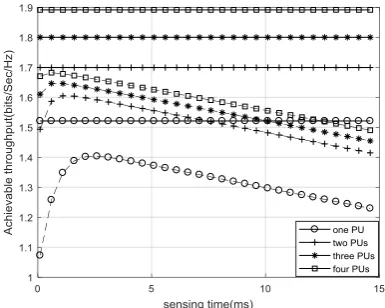
Figure 4 mainly analyzes and compares the influence of the number of primary users and sensing time changes on throughput in two different frame structures. The activity of the primary user is set to λ=μ=10, γp=-10dB. The new frame structure uses the entire time for sensing and transmission, so the throughput does not change with the set sensing time. It is shown as a straight line in the figure. Using the traditional frame structure model, there is a trade-off problem of sensing time and transmission time. So the throughput will change with the sensing time and the graph will be shown as a curve with a maximum value. As can be seen from the figure, when the number of primary users in the cognitive system increases, the throughput of both frame structures will be improved. This is because as the number of primary users increases, the probability of using high power access increases, so the system performance will be enhanced. At the same time, using the new frame structure, the sensing time and the transmission time is extended to a frame. Compared with the traditional frame structure, the probability of the correct sensing results increases and the transmission time is longer. The new frame structure throughput is superior to the traditional model when the number of primary users. At the same time, the three kinds of power adopted by secondary users are optimized to obtain the optimal power satisfying interference limitation and power limitation under different conditions. Compared with the unoptimized traditional frames, the throughput improves significantly when the number of primary users increase.
Figure 4. Cognitive system throughput varying with sensing time in different frame structures.
increases. Therefore, when there are more primary users in the system, the new strategy accesses the most appropriate channel, and the probability of high-power and medium-power access is improved, so as to improve the total throughput and reduce the impact of γp changes.
Figure 5. The system throughput changes with the signal-to-noise ratio (SNR) of the secondary users.
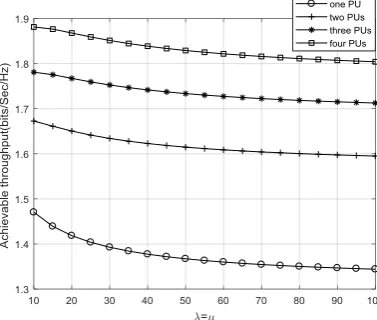
Figure 6 analyzes the impact of primary user activity on cognitive system throughput. Parameter Setting γp=10dB. λ and μ represents the duration time of the primary users’ state. The larger the value is, the more active it is, which means the higher possibility of the status change of the primary user. It can be seen from figure 6 that the throughput decreases as the value increases. This is because with the increase of active power, the probability of user state changes increases. When the secondary user executes sensing, the probability of the authorized frequency bands being idle reduces. In the new strategy, the secondary user will use more low power and medium power to send data. As the number of primary users increases, the new strategy accesses to the most appropriate channel. When optimizing the three transmission powers, the optimal power is used to access. According to the figure, with the increase of the number of main users, the influence of primary user activity on the system will be reduced.
Figure 6. The impact of primary user activity on cognitive system throughput.
Conclusions
[image:7.595.199.388.459.619.2]Acknowledgement
This research was financially supported by the National Natural Science Foundation of China (No.U1604159)
References
[1] M. Ben Rabha, M.F. Boujmil, M. Saadoun, B. Bessaïs, Eur. Phys. J. Appl. Phys. J. Mitola, and G. Q. Maguire, Jr., “Cognitive radios: Making software radio more personal,” IEEE Pers. Commun., vol. 6, no. 4, pp. 13-18, Aug. 1999
[2] Liang J C, Chen J C. Resource allocation in cognitive radio relay networks[J]. IEEE Journal on Selected Areas in Communications, 2013, 31(3):476-488.
[3] Hoang A T, Liang Y C, Zeng Y. Distributed opportunistic spectrum access with imperfect spectrum sensing[A].2010 IEEE International Conference on Communication Systems[C]. Singapore, 2010. 87-91.
[4] Zhao Q,Swami A.A decision-theoretic frame-work for opportunistic spectrum access [J].IEEE Wireless Commun, 2007, 14(4):14-20.
[5] Liang Y C, Zeng Y, Peh E C Y, et al. Sensing-throughput tradeoff for cognitive radio networks[J].IEEE Trans. Wireless Commun, 2008, 7(4):1326-1337.
[6] Wu X, Xu J L, Chen M, et al. Optimal Energy-Efficient Sensing and Power Allocation in Cognitive Radio Networks[J]. Mathematical Problems in Engineering, 2014, 2014(3): 1-7.
[7] Tang Liang, Chen Yunfei. Effect of primary user traffic on sensing-throughput tradeoff for cognitive radios[J]. IEEE Trans. Wireless Communication, 2011, 10(4):1063-1068.
[8] Stotas S, Nallanathan A. Over-coming the sensing-throughput trade off in cognitive radio networks [C]//Proc. IEEE International Conf. Communication. Cape Town, South Africa: IEEE Press, 2010:1-5.
[9] F. Yanan, Y. Shouyi, “Effect of primary user traffic on throughput for novel cognitive radios,” ISSN, 2013, 37 (23).
[10] Hrusikesha Pradhan, Sanket S. Kalamkar. Sensing-Throughput Tradeoff in Cognitive Radio With Random Arrivals and Departures of Multiple Primary Users [J].IEEE Communications Letters, Vol. 19, No. 3, March 2015.
[11] Kang X, Liang Y C, Garg HK, et al. Sensing-based spectrum sharing in cognitive radio networks. IEEE Transactions on Vehicular Technology, 2009, 58(8): 4649-4654.
[12] Stotas S, Nallanathan A. Optimal sensing time and power allocation in multiband cognitive radio networks[J]. IEEE Transactions on Communications, 2011, 59(1): 226-235.
[13] D. P. Palomar and M. Chiang, “A tutorial on decomposition methods for network utility maximization,” IEEE J. Sel. Areas Commun., vol.24, no. 8, pp. 1439- 1451. Aug. 2006.