http://dx.doi.org/10.4236/ojrd.2013.34024
Developments in Simulation Bronchoscopy Training
*
Jack A. Kastelik#, Faiza Chowdhury, Sega Pathmanathan, Imran Aslam, Joseph Hogg, Jaymin B. Morjaria
Department of Respiratory Medicine, Castle Hill Hospital, Hull and East Yorkshire Hospitals NHS Trust, Hull York Medical School, University of Hull, Hull, UK
Email: #[email protected]
Received August 6, 2013; revised September 6, 2013; accepted October 8, 2013
Copyright © 2013 Jack A. Kastelik et al. This is an open access article distributed under the Creative Commons Attribution License, which permits unrestricted use, distribution, and reproduction in any medium, provided the original work is properly cited.
ABSTRACT
Flexible bronchoscopy is a common procedure. Training in bronchoscopy is a complex process involving learning tech- nical skills, understanding indications and contraindications, risks and benefits of the procedure, working within the team and communicating with patients. It is expected that a competent bronchoscopist is able to maneuver the scope through the anatomically complex bronchial tree, take samples, manage the sedated patient and communicate with nursing staff. Learning the complex procedural skills in the clinical setting can be stressful, therefore current broncho- scopic training methodology should blend a number of learning methods including didactic lectures, web-based material, high and low fidelity simulators as well as supervised apprenticeship training. Simulation-based bronchoscopy training therefore has been explored as a mode of training bronchoscopy skills. In this article, the role of simulation-based bron- choscopy training is reviewed. The low fidelity and high fidelity virtual reality bronchoscopy models are described to- gether with the evidence available to support the use of simulation for bronchoscopy training.
Keywords: Bronchoscopy; Simulation; Training
1. Introduction
The first minimally invasive visualization using flexible bronchoscopy was performed in 1965 and since then has gained wide use with over 500,000 procedures being performed in the USA annually [1,2]. It is performed under awake sedation and permits not only examination but also sampling of the upper airways and bronchial tree [3]. Flexible fibreoptic bronchoscopy has a multitude of glass fibres transporting light from the light source to the end of the scope positioned in the bronchus and then bringing the image back to the high definition screen. Additionally, it has suctioning and instrumentation chan- nels for obtaining samples. The bronchoscopist is sup- ported by endoscopy nursing staff trained in the prepara- tion and working of the equipment, handling samples obtained during the procedure and managing sedated patients. It is expected that a competent bronchoscopist is able to manoeuvre the scope through the anatomically complex bronchial tree, take samples, manage the se- dated patient and communicate with nursing staff [4].
Training in bronchoscopy is a complex process involving learning technical skills, understanding indications and contraindications, risks and benefits of the procedure, working within the team and communicating with pa- tients [2]. Traditionally, acquiring the ability of conduct- ing this procedure is based on the apprenticeship model that requires the trainee to have the acumen to acquire the skill and the trainer to effectively teach it [3]. Learn- ing the complex procedural skills in the clinical setting can be stressful [5]. Therefore, current bronchoscopic training methodology should blend a number of learning methods including didactic lectures, web-based material, high and low fidelity simulators as well as supervised ap- prenticeship training. More recently, educational tech- nology including simulation-based bronchoscopy train- ing has become available and is gradually being inte- grated into respiratory medicine curriculum.
2. Training in Bronchoscopy Skills
Core curriculum training in many institutions includes a series of lectures and modular approach including a vari- ety of technological media describing the procedure, its indications, complications and consenting [6-9]. For
*The authors do not have any conflicts of interest related to this
manu-script.
155
example, trainees may watch a video of a procedure or use a web-based e-learning module such as that available at British Thoracic Society (www.brit-thoracic.org.uk) or Essential Bronchoscopist (www.bronchoscopy.org) web sites [10-12]. Evidence suggests that instructional video- taped, web-based educational material or even simple question and answer exercises can improve visual per- ception and discrimination skills of the learner, and pro- vide cognitive skills essential for performing the proce- dure most likely through acquisition of anatomical knowledge, recognition of pathological abnormalities, technical information such as consenting, or knowledge of sedation and use of local anesthesia [4,11,13]. Al- though there is some evidence contrary to this [12]. These conflicting results may be explained by variations in e-learning programs, use of inappropriate assessment tools, or trainees’ lack of time and motivation of receiv- ing the educational material due to clinical work pressure [12]. Despite the shortfalls there is suggestion that in order to achieve these challenges training e-learning modules, didactic lectures or video material are essential tools that may be combined with other modes of learning using educational technological developments such as simulation [14-16].
3. Simulation-Based Education
The concept of simulation was initially introduced in the airline industry as a cost-effective measure and reduces potential errors that may have catastrophic consequences [9]. Simulation permits trainees to acquire theoretical and technical skills through an interactive occasionally im- mersive educational activity through recreation of clini- cal experience without exposing patients to the associ- ated risks [17-19]. However, in order to provide most effective simulation training learners require to interact with the simulator and simulation environment as if they were real [20]. It can help trainees develop muscle mem- ory and hand-eye co-ordination [12]. A proportion of higher medical trainers may have chosen a career in res- piratory medicine in the hope of performing broncho- scopies [5]. Traditional bronchoscopic training is based on a master-apprentice model utilizing Halstedt’s ap- proach based on “see one, do one, teach one” principle, with trainees initially performing procedures on low-risk patients under close supervision and gradually progress- ing to more complex cases and independence [21,22]. However, this training model has its limitations. For example, from an educational perspective there is recog- nized variation in bronchoscopy training with reports suggesting that a fifth of the trainees not achieving the required number of procedures and skill [23-25]. More- over, the clinical setting may not be the ideal learning environment for novices to acquire bronchoscopic skills, and may be associated with anxiety, variable experience
and patient safety issues [5,26]. Hence, simulation has increasingly been used as an alternative mechanism of attaining bronchoscopy skills.
There is an ever increasing evidence base for the role of high fidelity virtual reality simulation bronchoscopy as a useful tool for novice trainees to acquire skills prior to performing the procedure on patients [6]. Moreover si- mulation may standardize assessing bronchoscopy com- petence, which currently is based on the record of num- ber of procedures performed, subjective educational su- pervisors report and the outcomes of work-based assess- ments; the direct observation of procedural skills (DOPS), which grade competency based on multiple stages vary- ing from performing the procedure under close supervi- sion to being independent [11]. Simulation training within the confines of a controlled environment of the skills laboratory provides a safe training environment of prac- tical procedures, enhances professional and learning experience, protects patients’ safety by reducing expo- sure to trainees’ deficiencies as well as protecting train- ees from deficient training environment. Simulation bronchoscopy training may be delivered either as low fidelity and high fidelity simulation depending on the types of technology used. Low fidelity simulation relies on the use of inanimate models of upper airways and bronchial tree whereas high fidelity simulation uses spe- cifically designed equipment based on computerized modules [27].
4. Low Fidelity Bronchoscopy Simulation
training has its limitations such as the artificial appear- ances and the lack of adaptation and application for spe- cific pathology [10,28]. A major pitfall of low fidelity bronchoscopy simulation is its lack of realism compared to the actual procedure. The reality aspect in the learning environment can be improved through incorporation of low fidelity inanimate models with a real bronchoscope [31]. Despite these limitations perceptions from learners and trainers however suggest that both low and high fi- delity bronchoscopy simulation provide equally enjoy- able learning experiences [31]. Interestingly, learners re- port that some aspects of low fidelity bronchoscopy com- pared to high fidelity models provide a more realistic experience as the former involves the use of a real bron- choscope rather than a proxy instrument that is incorpo- rated within the high fidelity model. However, the per- ception of trainers was that high fidelity simulators pro- vide a more enjoyable learning experience due to the “halo” effect related to the pre-conception of the novelty of a higher degree of technological sophistication [31]. Moreover, high fidelity virtual reality models can make the educational experience more realistic through their ability to simulate aspects of bronchoscopy procedures such as such as cough, breathing, display of vital signs or bleeding. Importantly, low fidelity simulators are less costly, reusable and can incorporate a real bronchoscope. Considering the pros and cons of low and high fidelity simulators it may suggest that the former may be more suited to task-based teaching with and the latter virtual reality models providing high degree of realism with modular functions that may better suit more complex tasks [9].
5. Virtual Reality Bronchoscopy Simulators
Virtual reality incorporates a combination of human and computer interfaces, which may include the use of gra- phics, sensor technology, computing, or networking to allow the trainee to become immersed in and interact with the artificial environment [32,33]. Virtual reality si- mulation (VRS) can be used as a didactic means of de- livering different training requirements incorporating a range of fidelity, teaching and assessment modes. Tech- nological advances in computer technology, graphics, processor speed have permitted the development of bron- choscopy VRS [34]. Other specialties such as surgery and gastroenterology have been using VRS for training in procedures such as sigmoidoscopy, colonoscopy, gas- troscopy and laparoscopic surgery [9,35,36]. In compa- rison there is limited evidence on the use of high fidelity simulation for bronchoscopy training. Due to the costs of the development and their production, only a small num-
ber of commercial bronchoscopy VRS are available (Ta-
ble 1). An example of a complex training system is the
Dexter™ (Replicant, Wellington, New Zealand), which is a modular, non-anatomical endoscopic dexterity train- ing system, composed of a series of channels and images [37,38]. Although not a true VRS model, this system has been shown to improve dexterity-related psychomotor skills essential for bronchoscopy. True VRS models in-
clude AccuTouch® (HT Medical and Immersion Corpo-
157
Table 1. Examples of virtual reality bronchoscopy simulators.
VR simulator Design Evidence/characteristics Studies
Dexter™ (Replicant, Wellington, New Zealand),
A modular non-anatomical, endoscopic dexterity training system, composed of a
series of channels and images
Improvement in psychomotor
skills required for bronchoscopy [33,37,38,40]
AccuTouch® HT Medical and Immersion Corporation (Gaithersburg, MD, USA)
Proxy bronchoscope, a robotic interface device, a monitor, and simulation software. Plastic face with nostrils to introduce proxy
bronchoscope.
Improved duration of the procedure, bronchial wall collisions, segmental
visualisation
[33,40]
BRONCH Mentor™ Simbionix (Cleveland, Ohio, USA)
Proxy bronchoscope, a robotic interface device, a monitor, and simulation software. Plastic face with nostrils to introduce
proxy bronchoscope
Modular training, virtual patient cases, tactile feedback
realistic visualization
-
EndoVR CAE Healthcare (Sarasota, FL, USA)
Proxy bronchoscope, a robotic interface device, a monitor, and simulation software. Plastic face with nostrils to introduce proxy
bronchoscope
Modular training, virtual patient cases, tactile feedback
realistic visualization
-
Computer based bronchoscopy simulator
Proxy bronchoscope Plastic face with nostrils to introduce
proxy bronchoscope PC and monitor
High level of satisfaction and realism of VR Novices compared with experts
had poor outcome in duration of the procedure, identification and entrance into bronchial segments, pathologies identified,
and collisions with airways
[39]
“Simulator” refers to a physical object or representation of the full or part task to be replicated [56].
6. VRS Bronchoscopy Studies
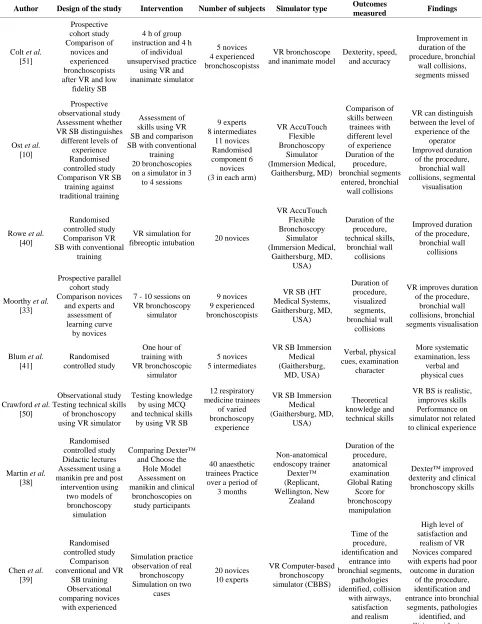
Bronchoscopy training is an area of respiratory medicine where an argument for VRS may be compelling. Whilst technical aspects of performing bronchoscopy are im- portant, the application of skills in the clinical context, and learner-centered and patient-focused training are of equal relevance. Currently, in the literature there are 12
studies that have used VRS bronchoscopy (Table 2).
Five of these were randomized clinical trials [10,38-41] and of those only two assessed intubation using simula- tion bronchoscopy [38,40]. Of the three studies that as- sessed the full bronchoscopy procedure, two included one session on a simulator [39,41] and the third 20 bron- choscopies on a simulator in three to four sessions [10]. A recent systematic review and meta-analysis of simula- tion based bronchoscopy training incorporated additional studies [42]. These studies included animal models, ma- nikins, designed artificial models or VRS bronchoscopy and endobronchial ultrasound training [26,43-49]. These studies used various differing models and demonstrated benefits from using simulation for purpose of broncho- scopy training. Moreover the systematic review and meta- analysis concluded that simulation based bronchoscopy as based on the limited available studies was effective when compared with no intervention [42].
The outcomes measured in the studies on simulation bronchoscopy training depended on the design, duration and the subjects participating in the study as well as the
Table 2. Studies using virtual reality (VR) simulation bronchoscopy (SB).
Author Design of the study Intervention Number of subjects Simulator type Outcomes
measured Findings
Colt et al. [51] Prospective cohort study Comparison of novices and experienced bronchoscopists after VR and low
fidelity SB
4 h of group instruction and 4 h
of individual unsupervised practice
using VR and inanimate simulator
5 novices 4 experienced bronchoscopistss
VR bronchoscope and inanimate model
Dexterity, speed, and accuracy
Improvement in duration of the procedure, bronchial
wall collisions, segments missed
Ost et al. [10]
Prospective observational study Assessment whether VR SB distinguishes different levels of
experience Randomised controlled study Comparison VR SB
training against traditional training
Assessment of skills using VR SB and comparison SB with conventional
training 20 bronchoscopies on a simulator in 3
to 4 sessions
9 experts 8 intermediates 11 novices Randomised component 6 novices (3 in each arm)
VR AccuTouch Flexible Bronchoscopy Simulator (Immersion Medical, Gaithersburg, MD) Comparison of skills between trainees with different level of experience Duration of the
procedure, bronchial segments
entered, bronchial wall collisions
VR can distinguish between the level of experience of the
operator Improved duration
of the procedure, bronchial wall collisions, segmental
visualisation
Rowe et al. [40]
Randomised controlled study Comparison VR SB with conventional
training
VR simulation for
fibreoptic intubation 20 novices
VR AccuTouch Flexible Bronchoscopy Simulator (Immersion Medical, Gaithersburg, MD, USA)
Duration of the procedure, technical skills,
bronchial wall collisions
Improved duration of the procedure, bronchial wall
collisions
Moorthy et al.
[33]
Prospective parallel cohort study Comparison novices
and experts and assessment of learning curve by novices
7 - 10 sessions on VR bronchoscopy
simulator
9 novices 9 experienced bronchoscopists
VR SB (HT Medical Systems, Gaithersburg, MD, USA) Duration of procedure, visualized segments, bronchial wall collisions
VR improves duration of the procedure,
bronchial wall collisions, bronchial segments visualisation
Blum et al. [41]
Randomised controlled study
One hour of training with VR bronchoscopic
simulator
5 novices 5 intermediates
VR SB Immersion Medical (Gaithersburg, MD, USA) Verbal, physical cues, examination character More systematic examination, less verbal and physical cues
Crawford et al.
[50]
Observational study Testing technical skills
of bronchoscopy using VR simulator
Testing knowledge by using MCQ and technical skills
by using VR SB
12 respiratory medicine trainees of varied bronchoscopy
experience
VR SB Immersion Medical (Gaithersburg, MD, USA) Theoretical knowledge and technical skills
VR BS is realistic, improves skills Performance on simulator not related to clinical experience
Martin et al.
[38]
Randomised controlled study Didactic lectures Assessment using a manikin pre and post
intervention using two models of bronchoscopy
simulation
Comparing Dexter™ and Choose the
Hole Model Assessment on manikin and clinical
bronchoscopies on study participants
40 anaesthetic trainees Practice over a period of
3 months Non-anatomical endoscopy trainer Dexter™ (Replicant, Wellington, New Zealand
Duration of the procedure, anatomical examination Global Rating Score for bronchoscopy manipulation Dexter™ improved dexterity and clinical
bronchoscopy skills
Chen et al. [39]
Randomised controlled study Comparison conventional and VR
SB training Observational comparing novices
with experienced
Simulation practice observation of real
bronchoscopy Simulation on two
cases 20 novices 10 experts VR Computer-based bronchoscopy simulator (CBBS)
Time of the procedure, identification and entrance into bronchial segments, pathologies identified, collision with airways, satisfaction and realism
High level of satisfaction and
realism of VR Novices compared with experts had poor
outcome in duration of the procedure, identification and entrance into bronchial
159
Continued
Davoudi et al.
[34] Observational study
30 - 45 minutes session on simulator
7 novices 8 intermediate 7 experienced
VR PreOp Endoscopy Simulator
(HT Medical Systems Gathersburg, MD,
USA)
Comparison of Bronchoscopy Skills and Tasks Assessment Tool and Bronchoscopy
Step-by Step Evaluation Tool
High validity and reliability of two assessment tools
Wahidi et al.
[12]
Prospective multicentre study
over period of 2 years
20 bronchoscopies on a simulator prior
to fifth human bronchoscopy versus conventional
training
22 Respiratory Medicine trainees
in conventional group and 25 trainees receiving simulation training
VR bronchoscopy simulator Immersion Medical (Gaithersburg, MD,
USA)
Bronchoscopy Skills and Tasks Assessment Tool an objective tool for assessment of bronchoscopy
skills
Variation in acquisition bronchoscopy skills
SB improves bronchoscopy learning curve
Davoudi 2010 [31]
Observational study Comparison low and high fidelity
simulators to learn trans-bronchial needle aspiration
2 hour session 45 minutes on low fidelity station, 45 minutes on high
fidelity station
44 Respiratory physicians of various
experience in bronchoscopy
Immersion AccuTouch® system
(Immersion Medical, San Jose, Calif.,
USA)
Survey comparing low fidelity and
high fidelity simulation for learning the procedure
Low fidelity model preferred by learners
and instructors for training in trans-bronchial needle aspiration
Davoudi 2012
[57] Observational study
Low and high fidelity training in endo-bronchial ultrasound skills
8 novices 8 intermediate
8 experts
Endo-bronchial ultrasound skills and tasks assessment
tool used with low and high fidelity
simulation
Endo-bronchial ultrasound skills and tasks assessment tool
Reliable classification of operators from
novice to expert
performing multicenter studies [12,31]. Furthermore, the studies used different designs either comparing trainees’ performance before and after a period on a simulator or against experienced operators, thus introducing bias re- lated to different speeds of learning the procedure, pref- erence of learning styles, experts’ perception of reality of the simulators and the difference in handling the proxy instruments on VRS with that of a real bronchoscope. Despite these limitations the studies have produced some common theme results.
7. Training Novices and the Learning Curve
There is good evidence to suggest that novice trainees can gain basic skills of bronchoscopy through simulation training [10,12,41]. VRS bronchoscopy can improve cognitive and technical skills [51]. Additionally, novice trainees who practiced on a bronchoscopy simulator when compared with those trained using conventional methods performed better with regards to procedure time, nurse observer perception and percentage of identified bronchial anatomy [10]. Studies using VRS broncho- scopy were able to assess the learning curve for skill ac- quisition of this procedure. Smith and colleagues have reported that during naso-tracheal intubation training using endoscopic video camera system and a bronchial tree model, the half-time learning curve was 9 procedures with time reduction between the first and the eighteenth procedure from 132 to 49 seconds [52]. Following simu- lation training the novices exhibited similar level of skill
as trainees who had performed ten naso-tracheal intuba- tion bronchoscopy procedures on real patients [40]. Simi- larly, novices improved their skills after performing 20 bronchoscopies on a simulator in terms of speed, per- centage of segments visualized, and collisions [10]. Oth- ers observed that 1 hour of practice on VRS broncho- scopy effectively trained novices’ basic bronchoscopy skills and anatomy [41]. In fact, there was no difference when novices’ skills were assessed on a real patient against trainees with 2 - 3 years experience in broncho- scopy [41]. When testing on a simulator there is a sig- nificant improvement in the performance in the novices between first and sixth sessions as percentage of visual- ized segments, time taken for the procedure and number of collisions with the bronchial wall [33].
learning curve and mastering of bronchoscopy skills which is dependent on hand-eye coordination [12]. There is good evidence that learning bronchoscopic procedural skills in a clinical skills laboratory using simulation tech- nology can be successfully transferred to patient care [41]. Also, manikin simulation skill correlates with real- life bronchoscopy performance suggesting increased like- lihood of transfer of endoscopic skills from bench to clinical procedure [38].
Simulation allows for a minimally-invasive procedure such as bronchoscopy to be conducted in a controlled environment using a simulator with no risk to the patient [34]. Moreover training can be tailored to individual trainees’ requirements with feedback being delivered in a timely fashion [53]. In contrast, bronchoscopy skill ac- quisition in clinical settings raises issues of patient safety, lack of consistency in delivery of standardized level of knowledge, skills and competency [7,18]. Thus training bronchoscopic skills in the clinical setting not only in- creases potential complications, but also procedure time by a third, besides the documentation and trainee as- sessments, which in turn culminates into financial ineffi- ciencies [54]. Furthermore, the clinical environment is not conducive to the variation in acquisition of broncho- scopy skills [7,23]. Presently, the markers of competency include duration of training and number of procedures performed. Progressively, there has been a trend to move training from numerical competency to a more objective competency based on knowledge and technical skills assessment. Thus, the theoretical knowledge can be ac- quired through didactic lectures with simulation bron- choscopy providing opportunity for practical skills ac- quisition both of which are relevant to comprehension, application and analysis components of learning as well as functioning as a tool for objective competency as- sessment [33]. Bronchoscopy competency can be defined as the use of knowledge, technical skills to perform the procedure and clinical reasoning for making decisions regarding the procedure and findings for the benefit of individual patients [55]. Whilst acquiring bronchoscopy skills, trainees progress through the stages of novice, advanced beginner, competent provider, proficient pro- vider and expert. VRS bronchoscopy is of relevance at the novice and advanced beginner stages during which trainees follow rigid rules with limited situation percep- tion [12,33].
There is good evidence to suggest that simulation training can address many of the flaws related to the cur- rent apprenticeship model, therefore justifying its use in learning bronchoscopy skills. Despite encouraging evi- dence, incorporation of simulation bronchoscopy into training has been relatively measured. Possible explana- tions for this may be related to a number of factors such as educators’ preference for traditional methods of bron-
choscopy training, costs of simulators, time involved in implementing a simulation bronchoscopy training pro- gram and perception of lack of good quality data to sup- port simulation bronchoscopy. There is no denying that VRS bronchoscopy equipment is currently expensive and that simulation training requires time and expertise of a trained faculty [31]. The argument for poor quality data is true in the context of low fidelity simulation broncho- scopy as the current evidence is not sufficient to advocate its use beyond the basic skills training [14,29]. In con- trast, there is quality evidence from randomized con- trolled studies for the use of VRS bronchoscopy being recommended; firstly, for acquisition of bronchoscopy skills with the aim to subsequently transfer of the simula- tion learned skills to the bedside and secondly, as a tool for development and assessment of competency [11,42]. Moreover, there is evidence that bronchoscopy skills ac- quired through simulation can be successfully transferred to patients’ care [12,38].
Current literature provides evidence that VRS bron- choscopy can address almost all of the twelve features of
medical simulation described by McGaghie et al. [27].
There is good evidence that VRS bronchoscopy can ad- dress issues of fidelity, deliberate practice and some as- pects of curriculum integration [42]. Besides VRS bron- choscopy can assess acquisition, mastering and mainte- nance of skills as the measured outcomes are objective and can differentiate between the novices and the experts [12,31]. Additionally, VRS bronchoscopy may have a role in competency assessment using validated tools such as Bronchoscopy Skills and Tasks Assessment (BSTAT) [12,50]. However, there is no evidence to support the use of VRS bronchoscopy for high stake testing such as spe- cialty examinations or providing team learning. Although the latter could easily be addressed through incorporation within simulation of different groups of health workers normally involved with bronchoscopy, which would tac- kle issues of team composition, interactions and skill maintenance. Similarly, there is little data on the use of VRS bronchoscopy for instructor training, as clinical ex- perience is not a proxy for VRS effectiveness, therefore highlighting need to establish mastery learning models for simulation instructors [27].
8. Conclusion
161
cacy and accuracy, and subsequent sustained improve- ment for procedures performed on patients. Whilst there are costs related to simulation training the benefits in the form of improved learning environment, standardized training and assessment, and patients’ safety greatly fa- vour and grossly justify the use of VRS bronchoscopy.
REFERENCES
[1] A. Ernst, G. A. Silvestri and D. Johnstone, “Interven- tional Pulmonary Procedures: Guidelines from the Ameri- can College of Chest Physicians,” Chest,Vol. 123, No. 5, 2003, pp. 1693-1717.
http://dx.doi.org/10.1378/chest.123.5.1693
[2] G. A. Silvestri, D. Feller-Kopman, A. Chen, M. Wahidi, K. Yasufuku and A. Ernst, “Latest Advances in Advanced Diagnostic and Therapeutic Pulmonary Procedures,” Chest, Vol.142, No. 6, 2012, pp. 1636-1644.
http://dx.doi.org/10.1378/chest.12-2326
[3] P. A. Kvale and A. C. Mehta, “Training Bronchoscopists for the New Era,” Clinics in Chest Medicine, Vol. 22, No. 2, 2001, pp. 365-372.
http://dx.doi.org/10.1016/S0272-5231(05)70050-2
[4] J. E. Rayl, J. M. Pittman and J. J. Shuster, “Preclinical Training in Bronchoscopic Diagnosis of Cancer,” Chest, Vol. 93, No. 4, 1988, pp. 824-827.
http://dx.doi.org/10.1378/chest.93.4.824
[5] G. A. Silvestri, “The Evolution of Bronchoscopy Train- ing,” Respiration; International Review of Thoracic Dis- eases,Vol. 76, No. 1, 2008, pp. 9-20.
[6] M. Davoudi and H. G. Colt, “Bronchoscopy Simulation: A Brief Review,” Advances in Health Sciences Educa- tion: Theory and Practice,Vol. 14, No. 2, 2009, pp. 287- 296. http://dx.doi.org/10.1007/s10459-007-9095-x
[7] E. F. Haponik, G. B. Russell, J. F. Beamis Jr., E. J. Britt, P. Kvale, P. Mathur and A. Mehta, “Bronchoscopy Train- ing: Current Fellows’ Experiences and Some Concerns for the Future,” Chest,Vol. 118, No. 4, 2000, pp. 625- 630. http://dx.doi.org/10.1378/chest.118.3.625
[8] M. R. Lucarelli, C. R. Lucey and J. G. Mastronarde, “Sur- vey of Current Practices in Fellowship Orientation,” Res- piration,Vol. 74, No. 4, 2007, pp. 382-386.
[9] W. C. McGaghie, V. J. Siddall, P. E. Mazmanian and J. Myers, “Lessons for Continuing Medical Education from Simulation Research in Undergraduate and Graduate Me- dical Education: Effectiveness of Continuing Medical Education: American College of Chest Physicians Evi- dence-Based Educational Guidelines,” Chest, Vol. 135, No. 3, 2009, pp. 62S-68S.
http://dx.doi.org/10.1378/chest.08-2521
[10] D. Ost, A. DeRosiers, E. J. Britt, A. M. Fein, M. L. Les- ser and A. C. Mehta, “Assessment of a Bronchoscopy Simulator,” American Journal of Respiratory and Critical Care Medicine,Vol. 164, No. 5, 2001, pp. 2248-2255. http://dx.doi.org/10.1164/ajrccm.164.12.2102087
[11] M. Davoudi, S. Quadrelli, K. Osann and H. G. Colt, “A Competency-Based Test of Bronchoscopic Knowledge Using the Essential Bronchoscopist: An Initial Concept
Study,” Respirology,Vol. 13, No. 5, 2008, pp. 736-743. http://dx.doi.org/10.1111/j.1440-1843.2008.01320.x
[12] M. M. Wahidi, G. A. Silvestri, R. D. Coakley, J. S. Fer- guson, R. W. Shepherd, L. Moses, J. Conforti, L. G. Que, K. J. Anstrom, F. McGuire, H. Colt and G. H. Downie, “A Prospective Multicenter Study of Competency Metrics and Educational Interventions in the Learning of Bron- choscopy among New Pulmonary Fellows,” Chest,Vol. 137, No. 5, 2010, pp. 1040-1049.
http://dx.doi.org/10.1378/chest.09-1234
[13] S. Quadrelli, M. Davoudi, F. Galindez and H. G. Colt, “Reliability of a 25-Item Low-Stakes Multiple-Choice Assessment of Bronchoscopic Knowledge,” Chest, Vol. 135, No. 2, 2009, pp. 315-321.
http://dx.doi.org/10.1378/chest.08-0867
[14] M. H. Dykes and A. Ovassapian, “Dissemination of Fi- breoptic Airway Endoscopy Skills by Means of a Work- shop Utilizing Models,” British Journal of Anaesthesia, Vol. 63, No. 5, 1989, pp. 595-597.
http://dx.doi.org/10.1093/bja/63.5.595
[15] A. Ovassapian, M. H. Dykes and M. E. Golmon, “A Training Programme for Fibreoptic Nasotracheal Intuba- tion. Use of Model and Live Patients,” Anaesthesia, Vol. 38, No. 8, 1983, pp. 795-798.
http://dx.doi.org/10.1111/j.1365-2044.1983.tb12207.x
[16] R. E. Wood and J. R. Pick, “Model Systems for Learning Pediatric Flexible Bronchoscopy,” Pediatric Pulmonol- ogy,Vol. 8, No. 3, 1990, pp. 168-171.
http://dx.doi.org/10.1002/ppul.1950080307
[17] N. J. Maran and R. J. Glavin, “Low- to High-Fidelity Simulation—A Continuum of Medical Education?” Medi- cal Education,Vol. 37, Suppl. 1, 2003, pp. 22-28. http://dx.doi.org/10.1046/j.1365-2923.37.s1.9.x
[18] I. Choy and A. Okrainec, “Simulation in Surgery: Per- fecting the Practice,” The Surgical Clinics of North Amer- ica,Vol. 90, No. 3, 2010, pp. 457-473.
http://dx.doi.org/10.1016/j.suc.2010.02.011
[19] R. J. Scalese, V. T. Obeso and S. B. Issenberg, “Simula- tion Technology for Skills Training and Competency As- sessment in Medical Education,” Journal of General In- ternal Medicine, Vol. 23, Suppl. 1, 2008, pp. 46-49. http://dx.doi.org/10.1007/s11606-007-0283-4
[20] R. H. Steadman, W. C. Coates, Y. M. Huang, R. Mat- evosian, B. R. Larmon, L. McCullough and D. Ariel, “Si- mulation-Based Training Is Superior to Problem-Based Learning for the Acquisition of Critical Assessment and Management Skills,” Critical Care Medicine,Vol. 34, No. 1, 2006, pp. 151-157.
http://dx.doi.org/10.1097/01.CCM.0000190619.42013.94
[21] W. T. Mason and P. W. Strike, “See One, Do One, Teach One—Is This Still How It Works? A Comparison of the Medical and Nursing Professions in the Teaching of Prac- tical Procedures,” Medical Teacher,Vol. 25, No. 6, 2003, pp. 664-666.
http://dx.doi.org/10.1080/01421590310001605705
No. 1, 2009, pp. 63-68.
[23] N. J. Pastis, P. J. Nietert and G. A. Silvestri, “Variation in Training for Interventional Pulmonary Procedures among Us Pulmonary/Critical Care Fellowships: A Survey of Fellowship Directors,” Chest,Vol. 127, No. 5, 2005, pp. 1614-1621. http://dx.doi.org/10.1378/chest.127.5.1614
[24] D. R. Stather, J. Jarand, G. A. Silvestri and A. Tremblay, “An Evaluation of Procedural Training in Canadian Res- pirology Fellowship Programs: Program Directors’ and Fellows’ Perspectives,” Canadian Respiratory Journal: Journal of the Canadian Thoracic Society,Vo. 16, No. 2, 2009, pp. 55-59.
[25] K. G. Torrington, “Bronchoscopy Training and Compe- tency: How Many Are Enough?” Chest,Vol. 118, No. 3, 2000, pp. 572-573.
http://dx.doi.org/10.1378/chest.118.3.572
[26] H. G. Colt, M. Davoudi, S. Murgu and N. Zamanian Ro- hani, “Measuring Learning Gain during a One-Day In- troductory Bronchoscopy Course,” Surgical Endoscopy, Vol. 25, No. 1, 2011, pp. 207-216.
http://dx.doi.org/10.1007/s00464-010-1161-4
[27] W. C. McGaghie, S. B. Issenberg, E. R. Petrusa and R. J. Scalese, “A Critical Review of Simulation-Based Medical Education Research: 2003-2009,” Medical Education, Vol. 44, No. 1, 2010, pp. 50-63.
http://dx.doi.org/10.1111/j.1365-2923.2009.03547.x
[28] B. Ram, M. Oluwole, R. L. Blair, R. Mountain, P. Dunk- ley and P. S. White, “Surgical Simulation: An Animal Tissue Model for Training in Therapeutic and Diagnostic Bronchoscopy,” The Journal of Laryngology and Otology, Vol. 113, No. 2, 1999, pp. 149-151.
http://dx.doi.org/10.1017/S0022215100143415
[29] A. Ovassapian, S. J. Yelich, M. H. Dykes and M. E. Gol- man, “Learning Fibreoptic Intubation: Use of Simulators v. Traditional Teaching,” British Journal of Anaesthesia, Vol. 61, No. 2, 1988, pp. 217-220.
[30] R. Goldberg, H. G. Colt, M. Davoudi and L. Cherrison, “Realistic and Affordable Lo-Fidelity Model for Learning Bronchoscopic Transbronchial Needle Aspiration,” Sur- gical Endoscopy,Vol. 23, No. 9, 2009, pp. 2047-2052. http://dx.doi.org/10.1007/s00464-008-9951-7
[31] M. Davoudi, M. M. Wahidi, N. Zamanian Rohani and H. G. Colt, “Comparative Effectiveness of Low- and High- Fidelity Bronchoscopy Simulation for Training in Con- ventional Transbronchial Needle Aspiration and User Pre- ferences,” Respiration,Vol. 80, No. 4, 2010, pp. 327-334. http://dx.doi.org/10.1159/000318674
[32] A. H. Meier, C. L. Rawn and T. M. Krummel, “Virtual Reality: Surgical Application—Challenge for the New Millennium,” Journal of the American College of Sur- geons,Vol. 192, No. 3, 2001, pp. 372-384.
http://dx.doi.org/10.1016/S1072-7515(01)00769-4
[33] K. Moorthy, S. Smith, T. Brown, S. Bann and A. Darzi, “Evaluation of Virtual Reality Bronchoscopy as a Learn- ing and Assessment Tool,” Respiration diseases,Vol. 70, No. 2, 2003, pp. 195-199.
[34] M. Davoudi, K. Osann and H. G. Colt, “Validation of Two Instruments to Assess Technical Bronchoscopic Skill Using Virtual Reality Simulation,” Respiration,Vol.
76, No. 1, 2008, pp. 92-101. http://dx.doi.org/10.1159/000126493
[35] R. Aggarwal, T. Grantcharov, K. Moorthy, J. Hance and A. Darzi, “A Competency-Based Virtual Reality Training Curriculum for the Acquisition of Laparoscopic Psycho- motor Skill,” American Journal of Surgery,Vol. 191, No. 1, 2006, pp. 128-133.
http://dx.doi.org/10.1016/j.amjsurg.2005.10.014
[36] S. Arora, D. Miskovic, L. Hull, K. Moorthy, R. Aggarwal, H. Johannsson, S. Gautama, R. Kneebone and N. Sevdalis, “Self vs Expert Assessment of Technical and Non-Tech- nical Skills in High Fidelity Simulation,” American Jour- nal of Surgery,Vol. 202, No. 4, 2011, pp. 500-506. http://dx.doi.org/10.1016/j.amjsurg.2011.01.024
[37] C. P. Marsland, B. J. Robinson, C. H. Chitty and B. J. Guy, “Acquisition and Maintenance of Endoscopic Skills: Developing an Endoscopic Dexterity Training System for Anesthesiologists,” Journal of Clinical Anesthesia, Vol. 14, No. 8, 2002, pp. 615-619.
http://dx.doi.org/10.1016/S0952-8180(02)00456-7
[38] K. M. Martin, P. D. Larsen, R. Segal and C. P. Marsland, “Effective Nonanatomical Endoscopy Training Produces Clinical Airway Endoscopy Proficiency,” Anesthesia and Analgesia,Vol. 99, No. 3, 2004, pp. 938-944.
http://dx.doi.org/10.1213/01.ANE.0000132998.19872.58
[39] J. S. Chen, H. H. Hsu, I. R. Lai, H. C. Tai, H. S. Lai, Y. C. Lee, J. S. Shaw, Y. P. Hung, P. H. Lee and K. J. Chang, “Validation of a Computer-Based Bronchoscopy Simula- tor Developed in Taiwan,” Journal of the Formosan Me- dical Association,Vol. 105, No. 7, 2006, pp. 569-576. http://dx.doi.org/10.1016/S0929-6646(09)60152-2
[40] R. Rowe and R. A. Cohen, “An Evaluation of a Virtual Reality Airway Simulator,” Anesthesia and Analgesia, Vol. 95, No. 1, 2002, pp. 62-66.
http://dx.doi.org/10.1097/00000539-200207000-00011
[41] M. G. Blum, T. W. Powers and S. Sundaresan, “Bron- choscopy Simulator Effectively Prepares Junior Residents to Competently Perform Basic Clinical Bronchoscopy,” The Annals of Thoracic Surgery,Vol. 78, No. 1, 2004, pp. 287-291.
http://dx.doi.org/10.1016/j.athoracsur.2003.11.058
[42] C. C. Kennedy, F. Maldonado and D. A. Cook, “Simula- tion-Based Bronchoscopy Training: Systematic Review and Meta-Analysis,” Chest, Vol. 144, No. 1, 2013, pp. 183-192. http://dx.doi.org/10.1378/chest.12-1786
[43] O. J. Hilmi, P. S. White, D. W. McGurty and M. Oluwole, “Bronchoscopy Training: Is Simulated Surgery Effec- tive?” Clinical Otolaryngology and Allied Sciences,Vol. 27, No. 4, 2002, pp. 267-269.
http://dx.doi.org/10.1046/j.1365-2273.2002.00577.x
[44] S. Ameur, K. Carlander, K. Grundstrom, P. Hallberg, K. Lundgren, P. G. Lundquist and T. Wikstrom, “Learning Bronchoscopy in Simulator Improved Dexterity Rather than Judgement,” Lakartidningen,Vol. 100, No. 35, 2003, pp. 2694-2699.
163
No. 2, 2005, pp. 215-216.
http://dx.doi.org/10.1007/BF03027742
[46] E. S. Deutsch, T. Christenson, J. Curry, J. Hossain, K. Zur and I. Jacobs, “Multimodality Education for Airway Endoscopy Skill Development,” The Annals of Otology, Rhinology, and Laryngology, Vol. 118, No. 2, 2009, pp. 81-86.
[47] N. Jabbour, T. Reihsen, R. M. Sweet and J. D. Sidman, “Psychomotor Skills Training in Pediatric Airway Endo- scopy Simulation,” Otolaryngology—Head and Neck Sur- gery,Vol. 145, No. 1, 2011, pp. 43-50.
http://dx.doi.org/10.1177/0194599811403379
[48] D. R. Stather, P. Maceachern, K. Rimmer, C. A. Hergott and A. Tremblay, “Assessment and Learning Curve Eva- luation of Endobronchial Ultrasound Skills Following Si- mulation and Clinical Training,” Respirology, Vol. 16, No. 4, 2011, pp. 698-704.
http://dx.doi.org/10.1111/j.1440-1843.2011.01961.x
[49] D. R. Stather, P. MacEachern, A. Chee, E. Dumoulin and A. Tremblay, “Evaluation of Clinical Endobronchial Ul- trasound Skills Following Clinical versus Simulation Training,” Respirology, Vol. 17, No. 2, 2012, pp. 291- 299. http://dx.doi.org/10.1111/j.1440-1843.2011.02068.x
[50] S. W. Crawford and H. G. Colt, “Virtual Reality and Written Assessments Are of Potential Value to Determine Knowledge and Skill in Flexible Bronchoscopy,” Respi- ration,Vol. 71, No. 3, 2004, pp. 269-275.
http://dx.doi.org/10.1159/000077425
[51] H. G. Colt, S. W. Crawford and O. Galbraith III, “Virtual Reality Bronchoscopy Simulation: A Revolution in Pro- cedural Training,” Chest, Vol. 120, No. 4, 2001, pp. 1333-1339. http://dx.doi.org/10.1378/chest.120.4.1333
[52] J. E. Smith, A. P. Jackson, J. Hurdley and P. J. Clifton, “Learning Curves for Fibreoptic Nasotracheal Intubation When Using the Endoscopic Video Camera,” Anaesthesia, Vol. 52, No. 2, 1997, pp. 101-106.
http://dx.doi.org/10.1111/j.1365-2044.1997.23-az023.x
[53] R. M. Fanning and D. M. Gaba, “The Role of Debriefing in Simulation-Based Learning,” Simulation in Healthcare, Vol. 2, No. 2, 2007, pp. 115-125.
http://dx.doi.org/10.1097/SIH.0b013e3180315539
[54] T. McCashland, R. Brand, E. Lyden and P. de Garmo, “The Time and Financial Impact of Training Fellows in Endoscopy. Cori Research Project. Clinical Outcomes Research Initiative,” The American Journal of Gastroen- terology,Vol. 95, No. 11, 2000, pp. 3129-3132.
http://dx.doi.org/10.1111/j.1572-0241.2000.03280.x
[55] R. M. Epstein, “The Costs of Making Practice More Cost-Effective,” JAMA: The Journal of the American Me- dical Association,Vol. 287, No. 13, 2002, pp. 1648-1649.
[56] J. B. Cooper and V. R. Taqueti, “A Brief History of the Development of Mannequin Simulators for Clinical Edu- cation and Training,” Postgraduate Medical Journal,Vol. 84, No. 997, 2008, pp. 563-570.
http://dx.doi.org/10.1136/qshc.2004.009886
[57] M. Davoudi, H. G. Colt, K. E. Osann, C. R. Lamb and J. J. Mullon, “Endobronchial Ultrasound Skills and Tasks As- sessment Tool: Assessing the Validity Evidence for a Test of Endobronchial Ultrasound-Guided Transbronchial Needle Aspiration Operator Skill,” American Journal of Respiratory and Critical Care Medicine,Vol. 186, No. 8, 2012, pp. 773-779.