Policy Advice Derived From Simulation
Models
Brenner, Thomas and Werker, Claudia
Delft University of Technology
1 January 2009
Online at
https://mpra.ub.uni-muenchen.de/13134/
Economics and Management of I nnovation
EMI Discussion Paper Series # 2009- 01
I SSN 1877-3834
P
OLICYA
DVICED
ERIVED FROMS
IMULATIONM
ODELSThomas Brenner and Claudia Werker*
Abstract
When advising policy we face the fundamental problem that economic processes are
connected with uncertainty and thus policy can err. In this paper we show how the use of
simulation models can reduce policy errors. We suggest that policy is best based on
so-called abductive simulation models, which help to better understand how policy
measures can influence economic processes. We show that abductive simulation models
use a combination of theoretical and empirical analysis based on different data sets. This
helps inferring empirically reliable and meaningful statements about how policy
measures influence economic processes. By way of example we show how research
subsidies by the government influence the likelihood that a regional cluster emerges.
Keywords
Policy Advice, Simulation Models, Uncertainty, Methodology
JEL Classification
B41, B52, C63, H89
* Corresponding author: Claudia Werker, Delft University of Technology, Jaffalaan 5, 2628BX Delft, The
1. Introduction
Economic processes are uncertain. Thus, the outcomes of policy measures are
uncertain as well. As a consequence policy measures might not meet the goals
intended by policy makers. To improve their measures and at the same time meet
criticism policy makers increasingly seek advice from scientific experts. However,
this does not seem to hinder policy from errors. Unfortunately, we need to accept the
fact that there is always a chance that policy measures will produce unintended and
undesirable outcomes as uncertainty lies in the very nature of economic processes
(Metcalfe, 1995). Nevertheless, advice from scientific experts can help reducing the
probability of policy errors by identifying the causal structures in economic processes
and distinguishing them from chance. The knowledge about the causal structure can
then be used to influence economic processes by adequate measures, though the
outcome remains uncertain (cf. Schwerin/Werker, 2003).
In the following we will concentrate on the question of how abductive simulation
models can be used for policy advice in order to decrease the likelihood of policy
errors. For this abductive simulation models are particularly well suited, because they
belong to models of heterodox economics. These models put (Knightenian)
uncertainty centre-stage, thereby mirroring the element of economic processes that
makes it impossible to implement policy measures that are successful in any instance.
Critical Realism is core to analysing uncertain economic processes as it helps to
identify underlying causal structures – namely by abduction.
We start providing a methodology for abductive simulation models that use a
combination of theoretical and empirical results employing insights of Critical
Realism (Section 2.). Based on that we show how abductive simulation models can be
used for policy advice (Section 3). By way of example we demonstrate that data and
the way it is used are crucial for the quality of policy advice and illustrate how
abductive simulation models can be best put to use for policy advice (Section 4.). We
conclude with a summary of our results and a discussion of their implications (Section
2. Heterodox Simulation Models Based on Critical Realism
In order to show which role inference plays in modelling, we first introduce the
elements of model building in general and then give a brief overview of principles of
inference (Section 2.1). Based on that we show how Critical Realism can provide us
with a methodology for abductive simulation models (Section 2.2).
2.1 Principles of Inferences in Modelling
Inference means that we need to discuss the relationship between the two major parts
that models contain, i.e. assumptions and implications. Generally spoken, principles
of inference help to derive implications from assumptions. To model the real world,
theories use different elements and abstract from what is actually going on in the part
of reality they want to describe, explain, or prognosticate. Sometimes the term
“model” is defined as being a “theory” that is expressed in equations. As this
distinction is not important for our reasoning, we use the terms “model” and “theory”
synonymically in the following.
The most important elements of models are premises, hypotheses, as well as data.
Every model starts from premises that limit the area of application of the model, e.g.
concerning time, place, and agents involved etc. Hypotheses are sentences about
causes and effects, i.e. causal relationships. These are often formulated in the form “if
… then …” (cf. Machlup, 1978, 455f). Hypotheses can say something about the
functioning of the real world in the past as well as in the future, i.e. they can serve to
explain past events or to prognosticate future ones. Data is particularly central to our
further discussions as it contains claims about parts of reality, which play a key role in
inference. When discussing how to derive data it is crucial to be aware that
"... (e)mpirical analysis in any research field is entwined in theoretical analysis. That
is, empirical work depends on theory for concepts, definitions and hypotheses, all of
which are used as foundations for empirical investigation" (Cowan/Foray, 2002, p.
This means, that we do not only use data to build our theories and to check their
implications but also that we use theory to produce data from the complex and
complicated processes going on in reality. Consequently, a number of problems
emerge from data collection. Collecting data requires making a couple of choices and
theorizing about how to observe and measure (cf. the following Machlup, 1978,
448-450). When researchers collect the data themselves they can make these choices.
Often researchers rely on data collected by others, which means that aspects important
for their research questions might not sufficiently be taken into consideration.
However, even if researchers collect the data themselves it might be difficult to
observe the relevant aspects, as some measurement problems might emerge.
In models implications are inferred from assumptions. Data can be used in two ways:
first of all, to construct reliable and meaningful assumptions. Second, it can be used to
test implications. Obviously, the quality and use of data determines and quality of the
resulting model and its reliability for testing policy measures.
Three different principles of inference can be distinguished: deduction, induction and
abduction. Each principle of inference works in different ways, although meeting the
same end, namely inferring implications from assumptions
Deduction is often summarized as inferring “from general to particular” (cf. Lawson,
1997, 24). In deduction assumptions contain all possible elements of models, like e.g.
premises or hypotheses. Therefore, it is often claimed that in deduction conclusions
stemming from the assumptions have to be true. However, this only holds in the
sense that implications inferred that way are logically correct. Here, our aim is to
correctly describe, explain and prognosticate reality, though. This can only be
achieved if assumptions are supported by appropriate and reliable data. Therefore, the
approach of abductive simulation models is based on the principle to include as much
data as possible in assumptions.
Induction is often summarized as inferring “from particular to general” (cf. Lawson,
1997, 24). Its assumptions describe a part of a larger population and then infer
conclusions about the characteristics of this larger population. As the inductive
information - however doubtful one. The inference in induction says something not
contained in the assumptions. Inductive inference is based on data. However, even if
the number of observations in the data set is huge it is in principle impossible to have
all observations available, not the least because future events cannot be observed. This
means that the implications derived from data are uncertain. In the future, the same
will only happen with an unknown probability. This probability is impossible to gain,
because future observations can by definition not be made now. It is important to note
that this uncertainty remains even if we are able to provide policy makers with a
reliable and meaningful abductive simulation model describing those economic
processes that policy makers want to influence.
Abduction - sometimes also called retroduction - classifies “particular events into
general patterns” (Lawson, 1997, 24). Abduction requires much more detailed
information to infer implications that are likely to hold when confronted with reality.
Abduction enables us to identify underlying structural elements, which explain
observations we make, and to develop a theory of the part of the world we are
investigating. This takes us a substantial step further than pure deduction or induction,
because abduction helps us to meet theory and data in a creative way. By using the
principle of abduction we are able to create new information. According to Peirce
(1867/1965, 5, 145f):
“(Induction) never can originate any idea whatever. No more can deduction. All the
ideas of science come to it by the way of abduction. Abduction consists in studying
the facts and devising a theory to explain them. Its only justification is that if we are
ever to understand things at all, it must be in this way.”
In the following, we are particularly interested in abduction as the principle of
inference that helps us identifying causal relationships that can guide policy decisions.
This is notwithstanding that the other two principles of inference have to be employed
2.2 Critical Realism as Methodology for Abductive Simulation Models
Most scholars from heterodox economics still use positivism as methodology to
derive their results. This is partly due to the fact that most economic scholars are
implicitly trained in Positivism. Moreover, there is a tendency to pretend that
methodology is independent from substantive theories and the other way around (cf.
Nielsen, 2002). As could already be seen from our discussion on principles of
inference (see Section 2.1) this is not the case, though. In the following, we will argue
that Critical Realism is a much better methodological basis for heterodox modelling –
in particular so, because these models include uncertainty and Critical Realism is able
to deal with this.
Positivists combine induction and deduction as principles of inference. They start
from general assumptions and infer implications for economic processes from them.
Therefore, models based on Positivism are often considered to be purely deductive.
However, in case data is included in the modeling, the implications from deduction
are confronted with inductively found results. The aim of such empirically founded
models is to objectively measure and quantify observable facts as well as to search for
empirical regularities that help to describe, explain and predict reality. Some criticize
these kinds of models for implicitly claiming that all knowledge is grounded in
experience and deny the existence of an unobservable deep or non-actual level of
reality (Lawson, 1997, 19).
Positivism has one problem that is particularly important for our discussion of how to
empirically calibrate simulation models, namely that heterodox models imply inherent
uncertainty. Therefore, we aim at developing a methodological basis for simulation
models used in heterodox economics that imply inherent uncertainty. This inherent
uncertainty leads to complex and complicated patterns of the economic processes to
be described, explained and prognosticated. These patterns cannot be covered by the
conditions of closure used by positivists, which suggest that one cause has one effect
“… have a notion of causality and connectedness in their theorising, though make
closure assumptions. Two forms of closure are central to this perspective. The
intrinsic condition of closure - which can be characterised loosely as implying that a
cause always produces the same effect ... The extrinsic condition of closure - which
loosely can be understood as implying that an effects always has the same cause ...”
(Downward et al., 2002, 482).
In contrast to Positivism, Critical Realism acknowledges that different causes can lead
to the same effect and that the same cause can lead to different effects. Critical
Realism, which we will suggest as an appropriate methodological basis for heterodox
simulation models, uses abduction as one major principle of inference and uses
so-called semi-closure to account for the fact that different reasons can have the same
effect and the other way around. Protagonists of this school of thought recognise that
the world is structured into different layers. For the discipline of economics
Downward et al., 2002 showed what Critical Realism means for the use of empirical
data and modeling. The aim of Critical Realism is to describe and explain empirical
facts in terms of their underlying structures, i.e. in terms of other layers of reality.
This approach uses abduction to infer from empirical facts and observations to the
general patterns underlying them, thereby giving a causal explanation on a deeper
level and distinguishing chance from structural elements.
This different view on how causes and effects are connected has severe implications
for how to deal with data. For Positivism dealing with data is rather clear-cut, because
according to its protagonists one cause is always connected with one effect and one
has only to identify these straightforward causal relationships. On the contrary, the
situation is much more difficult when using Critical Realism, because such a
straightforward connection between cause and effect is missing. However, it is this
feature of Critical Realism, which helps us to cover models with inherent uncertainty,
as in the context of uncertainty cause and effect are never connected in such a
clear-cut way.
It is, though, not completely clear which implications Critical Realism has for
empirical research methods (Downward et al., 2002), as in general protagonists of
“… (t)he measuring and recording of states of affairs, the collection, tabulation,
transformation and graphing of statistics about the economy, … detailed case studies,
oral reporting, including interviews, biographies, and so on.” (Lawson, 1997, 221).
Lawson approves of all kinds of ways to collect data but restricts its use to a local and
specific analysis (Brown et al., 2002, 782). The reason for this is that he and other
Critical Realists do not approve of using statistics and mathematics in order to
compare larger sets of cases in a systematic way or in order to test deductively
inferred models empirically. They believe that the use of statistics and mathematics
only serves to detect intrinsic and extrinsic conditions of closure, i.e. that one cause
has one effect and the other way around. However, this is quite jumping to
conclusions: As Reiss (2004) shows in a very convincing way the use of statistics and
mathematical modelling does by no means imply that these strict conditions of closure
are used. In particular, there are some mainstream modellers who employ statistics
and mathematics in such a way that they account for the historical context, i.e. that
their specific data only hold in the context of a particular time and place.
Critical Realists basically approach empirical data the way scholars carrying out case
studies do and therefore face the same kinds of problems: Data collected and analysed
lack the potential to generalize results. To overcome this problem one has to compare
larger sets of cases in a systematic way and to identify what they have in common
independent of their specific historical circumstances. In a first attempt to do so
Brown et al. (2002) suggested combining Critical Realism with “systematic
abstraction” as a means to achieve a historical level of generality and to identify the
inner connection of social phenomena. However, they do not provide a guideline how
to put their suggestion into practice. We will in the following employ and further
develop these insights in order to provide a methodological basis for the empirical
3. Abductive Simulation Models Used for Policy Advice
3.1 Policy Advice Based on Critical Realism
The general problem with policy advice based on models – of whatever type – is that
these models are not certainly correctly describing and explaining past and future.
This means that policy based on such advice might err. However, one needs to
consider that this holds anyway (Metcalfe, 1995) – despite the fact that policy makers
and probably also voters try to pretend that this is otherwise. Although policy can err
we can use the nature of economic processes – in particular the distinction between
chance and necessity – to design policy measures where the element of error is
reduced as far as possible (cf. Schwerin/Werker, 2003).
According to Critical Realism it is possible to model certain behaviours and then to
predict a reasonable range of possible outcomes (Lawson, 1997). The way Critical
Realists look at the world does by no means suggest that virtually everything is
possible. Quite the contrary, there are stabilizing features available. Critical Realists
point out, for example that institutions co-evolve with agents own mental models,
thereby providing a situation of quasi-closure, i.e. institutions provide stable
conditions upon which agents can base their behaviour for a certain period of time
(Downward et al., 2002, 481f). This means that a specific connection between cause
and effect might remain for a while but also changes over time (Downward et al.,
2002, 495). The same holds for processes and structures driving social systems
(Pinkstone, 1999). The goal of modelling can thus not be to detect insights into the
real world that hold forever but to detect structural elements of historical processes,
which hold for a while but than evolve further. To detect these more fundamental
periods of transitions of systems and the conditions for them is another goal of
3.2 Practical Guideline for Abductive Simulation Models
In line with Critical Realism, we argue that what we observe in reality is the result of
processes on a deeper level, which might be (partly) observable but is not the level on
which we observe the phenomenon that is to be studied, explained or predicted.
Therefore, it is not sufficient to describe the relationships on the observation level –
the level where the phenomenon that is to be studied occurs. We need to understand
these relationships on the basis of the processes of the underlying level. Critical
Realism asks for empirical data to be used but does not provide a clear practical
guideline. We will provide such a practical guideline in the following. Our suggestion
to calibrate simulation models relies on abduction as the major inference principle. In
the following, we call these models abductive simulation models (for a more detailed
discussion see Brenner/Werker, 2007). However, this does not mean that the other
principles of inference, i.e. induction and deduction, are not used. In fact, they are
used quite substantially in the first two steps to prepare the third abductive step.
Although abduction has been a popular concept since the seminal work by Peirce
(1867), until today scholars have remained relatively vague on how to implement
abduction in practical terms:
“Not much can be said about this process of retroduction independent of context other
than it is likely to operate under a logic of analogy or metaphor and to draw heavily
on the investigator’s perspective, beliefs and experience.” (Lawson, 1997, 212)
Abduction helps us to produce classes of models, which combine assumptions and
implications based on empirical findings (cf. the following Brenner/Werker, 2007).
Only those models are included, which are not rejected by confronting either their
assumptions or their implications with reality. Note that we do not aim to find one
simulation model that describes reality. We believe that this is impossible. As in
statistics, all that can be done with the help of empirical data are two things. First, we
can reject some models meaning that we restrict the parameters of the general model
to certain ranges. This means that only a subset of all model specifications is
correctness of these specifications with the help of empirical data on implications (see
below).
In the following, we use Critical Realism to provide a procedure for building and
carrying out abductive simulation models in four steps (cf. a more detailed discussion
of the three first steps Brenner/Werker, 2007). To do so we follow Pinkstone (1999)
by clearly stating what we believe to be realistic causal relationships, which are able
to inform policy makers, and to provide as robust evidence as possible for our claim.
Naturally, this kind of methodology is much more demanding than that of mainstream
modelling but at the same time is potentially much more fruitful as well. First, the
simulation model has to be set up using the available empirical knowledge about the
assumptions of the model. Critical Realism does not rule out deduction as long as the
assumptions from which implications are derived are realistic (Pinkstone, 1999).
Second, the model is run and the implications are compared to empirical data in order
to restrict the parameters ranges further, in fact an inductive step. Third, the most
important abductive step is carried out, i.e. the results are used to classify observations
in classes. This step is central for Critical Realism, because here empirical observation
and theory building meet to identify underlying regularities that hold under specific
circumstances (Pinkstone, 1999). Fourth, the resulting parameter ranges are used to
study the implications of policy measures. Parameter ranges of variables that can be
influenced by policy are varied and simulations are run to find out the most promising
policy measures by aiming at high effectiveness and efficiency as well as low risk of
failure – either by wasting money or by unintended negative side effects. Here, again
abduction might play a role.
In all these steps – depending on availability - we can rely on different sources of
empirical data, i.e. employ stylised facts, investigate case studies or compare larger
sets of cases in a systematic way. We suggest to make use of all these sources if
necessary. Like in the Bayesian simulation approach we assume that economic
dynamics are based on chance elements as well as causal relationships.Consequently
we recommend using larger sets of data to calibrate the model wherever possible,
thereby giving a broader empirical basis to the models. Where no larger sets of data
are available we suggest relying on either stylised facts or case studies in order to give
uncertainty, because empirical data is used to reduce the degrees of freedom of the
complex systems modeled, thereby identifying the structural elements, which drive
systems. This specific way of dealing with data in calibrating simulation models is
one element of the advanced methodology presented here. It helps to build on reliable
empirical data when categorizing empirical events into classes and to distinguish the
underlying structural elements of historical processes from chance elements using
abduction.
4. An Example of Policy Advice Based on an Abductive Simulation Model
In the following we show by way of example, based on an existing simulation model
(Brenner 2003), how the procedure proposed above can be used. In addition to the
original simulation studies (Brenner, 2001, 2003 and 2004), we conduct some new
analysis in line with the procedure proposed above. In particular, we address the
question of whether the support of private innovation activities and start-up activities
– e.g. by financing a related public research organization – in an industry in a specific
region for a limited period of time increases the chances that a local cluster emerges
and sustains in this industry and region. In line with the procedure described in
Section 3.2 we first discuss the set-up of the model (see Section 4.1), to then restrict
the parameters by empirical data on the economic processes the model describes
(Section 4.2). In a third step, we classify our results according to classes of industries
(Section 4.3) and finally show what effect public research organizations have on local
cluster building (Section 4.4).
4.1 Setting up the Model: Simulating spatial industrial dynamics
If we want to study the emergence of local clusters we have to build a simulation
model that describes the development of an industry in space. This is done in the
simulation model by Brenner (2001). A variant of this simulation model (described in
detail in Brenner 2003 and 2004) is used here. This model explicitly models the start
and liquidation of firms, their growth and the innovations they generate. The
public research and on qualified labour. The dynamics of the available labour in each
region is modelled by taking education within and outside of firms into account. The
impact of local policy and attitudes in the population are included as well as
interdependencies between neighbouring regions. Hence, the model includes the
processes that are assumed in the literature to be most important for the existence of
local clusters and is able to describe the dynamics of cluster formation (Brenner 2004,
Ch. 4).
As a consequence of the high complexity of the model, it contains many parameters
that determine the interaction between the variables, such as, e.g., two parameters that
determine how strongly innovation performance depends on firm size and whether
this dependence is linear or quadratic in form. Brenner (2001 and 2004) uses
empirical studies of various kinds to find empirically estimated ranges in which the
parameters fall. Sources of information are studies on firms' growth processes, on the
dependence of innovation rates on firm size and co-located other firms and public
research, on the spatial distribution of spillovers, on the impact of innovations on
sales, on the strength of economies of scale, on demand reactions on prices and
product specificity, on start-up activities and its dependence on local factors, on the
shares of qualified workers in firms, on the mobility of workers, and on the
dependence of wages on the supply and demand for labour. All these works provide
empirical estimates for parameters that are needed in the simulation model (see
Brenner 2001 and 2004 for details and sources). If possible, the parameter ranges are
according to these empirical estimates. In a few cases logical arguments (such as that
worker can remain in the workforce for a maximum of 50 years) are used to generate
ranges, which are, therefore, sometimes quite large.
In line with the arguments above, a simulation model is obtained that is very general,
because it includes a lot of different processes and mechanisms and which parameters
are only restricted according to empirical knowledge and some carefully used logical
4.2 Restricting Parameters: Comparison with Empirical Observations
The second step is to use empirical data or knowledge about the implications of the
model to restrict the parameter ranges further. In our case the implication of the
simulation model is the spatial dynamics of the industrial development that results
from the parameters chosen. The initial conditions with which the simulations are
started are also very important. We consider them part of the parameters.
Furthermore, the simulation model is stochastic, so that the same parameter set can
result in many different dynamics of the industry. This implies that we can conclude
that a parameter set is unrealistic only if repeatedly running the simulation model with
this parameter set never leads to the empirically observed dynamics.
In our case the only empirical observation that we will use to restrict the parameters
further is the fact that the literature identifies for all manufacturing industries, at least,
one local cluster somewhere (see the meta-study of cluster in Brenner/Mühlig 2007
which includes case studies of local clusters in all kinds of manufacturing industries).
Hence, we conclude that each considered parameter set has to allow our simulation to
generate local clusters. Otherwise, we can conclude that the parameter set is
unrealistic.
We repeatedly run the simulation and record the resulting dynamics. Each time a
different parameter set is used (Monte Carlo approach). This means that all initial
variables and all parameters are randomly chosen from their ranges for each
simulation run1. After the simulation is run, we check whether a local cluster has
emerged. Local clusters are defined in line with the literature (Sternberg/Litzenberger
2004) as regions with a location coefficient of above 3 for the studied industry –
meaning that the share of the region's employees who work in the studied industry is
three times as high as average share of employees working in this industry in the
whole country. If local clusters emerge, the recorded dynamics are used for the further
analysis. Otherwise, the results are ignored and the parameter set is not used in the
1
analysis because the parameter set does not lead to dynamics that are in line with what
we observe in reality.
4.3 Group Classification: Types of Industries
The simulation model that is used here describes the spatial dynamics of an industry.
It is evident that different industries show different developments (Malerba 2004).
Hence, different parameter sets are adequate for different industries.
Empirical evidence on the parameter values is not available for industries separately,
at least not for all parameters. Nevertheless, we might distinguish types of industries
according to some parameters. We might, for example, argue that we expect that
public research institutes play a stronger role in industries in which the innovation
process is based on an extensive use of external knowledge. In the simulation model
the number of innovations per employee in the firm is given by the parameter mL. The
effect of spillovers from other research activity in the region on the innovation
performance of a firm is given by the parameter s (see Brenner 2003). Hence,
industries with a high ratio s/mL are industries in which the firms rely in their
innovation activities strongly on external sources, while industries with a low ratio
s/mL contain firms that build their innovation activities mainly on internal sources.
One might go into details here and might use a taxonomy, such as the Pavitt
taxonomy (Pavitt, 1984), and determine all parameters separately for a number of
industry classes. One might also use separate empirical estimations of parameters for
different industries if available. To keep things simple and because we only want to
illustrate the procedure by an example, we restrict the approach here such that we
only define two classes of industries that we analyse separately below. One contains
those industries in which firms rely strongly on internal sources for innovations (with
a ratio s/mL>1.5). The other contains those industries in which firm rely more on
external sources in their innovation activities (with a ratio s/mL<0.667). This
distinction separates the total number of studied parameter sets into three groups of
an impact on the emergence of local clusters and on the effect of the studied policy
measure.
4.4 Estimation of Policy Impact: Effect of Innovation Support
To calculate the impact of policy measures we have to deal with two sources of
impreciseness in the results that we obtain. First, real processes are random and
different outcomes might result from a policy measure. Therefore, simulations have to
be repeatedly run to estimate the distribution of implications of policy measures.
Second, additional impreciseness in the results stems from our inability to fully
understand the mechanisms that govern the real dynamics. This problem might be
reduced by further research. However, at any given point in time we only have an
incomplete understanding of the relevant mechanisms. Consequently, we suggest that
abductive simulation models rely on parameter ranges instead of estimated parameter
values to calculate the impact of policy measures. Estimated parameters are estimates
and, hence, might be wrong. The results are more reliable if we use parameter ranges.
This implies that the impact of policy measures has to be calculated by simulating
different parameter sets. This means that we have to run many simulations – for the
same and for different parameter sets - to obtain information about the distribution of
the resulting dynamics.
The calculation of the impact of a policy measure works straightforward for each
simulation. We conduct one simulation run for a region and industry with a parameter
set taken from the parameter ranges. Then, we conduct another simulation with the
same parameter set except changing the parameters that describe the policy measure.
As an example we want to study here the policy measure of financing a public
research organization in a region, which we assume to have an impact on the number
of start-ups in the region and on the innovation activities of the firms there. There is
no empirical evidence available that would allow us to make exact predictions of the
impact of public research institute. We assume here two effects, an increase of the
number of start-ups (ten times the original value) and of the basic innovation activities
of firms (ten time the original value). Notice that we assume only an influence on
the simulation model assumes an innovation activity that is the sum of two parts, a
constant part that is caused by sheer existence of a firm and location factors and a
size-dependence part that increases if the firm becomes larger. Only the constant
innovation activity is assumed to be increased by the policy measure. Hence, mainly
small firms are influenced. Correctly stated, we do not study the effect of a public
research institute, but the effect of a policy measure that changes start-up rates and
innovation probabilities in the above defined manner. More research on the exact
effects of public research institutes would be necessary to go beyond this.
The measure is assumed to be applied industry-specifically to one region for a
duration of five years, at either the beginning of the industrial life cycle, after five
years – meaning during the expansion phase -, after ten years – meaning at a time
when the industry has just become mature, or after fifteen years during the mature
phase of the industry life cycle.
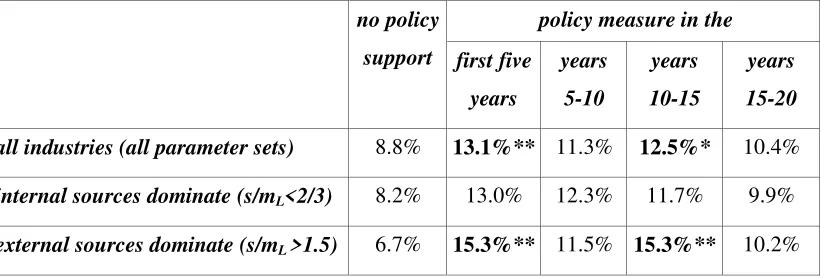
policy measure in the no policy
support first five
years
years
5-10
years
10-15
years
15-20
all industries (all parameter sets) 8.8% 13.1%** 11.3% 12.5%* 10.4%
internal sources dominate (s/mL<2/3) 8.2% 13.0% 12.3% 11.7% 9.9%
[image:19.595.98.510.382.521.2]external sources dominate (s/mL >1.5) 6.7% 15.3%** 11.5% 15.3%** 10.2%
Table 1: Probability of the emergence of a local cluster in a certain region with or
without specific policy measures (*/**=significant difference to the case without
policy measure on a significance level of 0.1/0.05)
What we want to know is whether the studied policy measure makes the emergence of
a local cluster in the supported region more likely. To this end, we compare the
probability that a local cluster emerges there (a local cluster is still defined by a
location coefficient above three) without any policy measure and the same probability
with the policy measure active in one of the four time periods (see Table 1). In total
we run simulations for 600 different parameter sets of which we excluded 99 from the
emerged (see Section 4.2). Thus, 501 different parameter sets are analysed, 171 of
which can be assigned to an industry in which internal sources dominate the
innovation processes and 164 of which can be assigned to an industry in which
external sources dominate the innovation processes.
The results in Table 1 show that the policy measure increases the likelihood of the
emergence of a local cluster. The impact is especially given for measures that are
applied at the beginning of the industry life cycle or when the industry becomes
mature. This means that a policy measure that is conducted outside of these windows
of opportunity, for example later in the industry life cycle, is unlikely to have a
significant effect on the emergence of a local cluster. A comparison with the results
obtained by Brenner (2003) suggests that the increase in the start-up activities has a
significant impact if it is caused very early in the industry life cycle and that the
increase in the innovation activities has a significant impact if it occurs when the
industry becomes mature. Nevertheless, independent of the measures taken the
likelihood for the emergence of a local cluster remains to be far below one.
We also find significant differences between the kinds of industries that we studied.
Without policy measures the likelihood to find a local cluster in a region is higher if
the innovation processes are mainly based on internal sources. This is caused by the
fact that for such industries co-location is less important, so that they are less
concentrated in space. As a consequence, more regions contain a local cluster.
However, the effect of our policy measure is much more pronounced in the case of
industries with a stronger importance of external sources. Due to the stronger
relevance of co-location and spillovers public research institutes seem to have a much
larger impact on the emergence of local clusters. This implies that policy makers
should focus policy measures that increase start-ups and innovation rates on industries
that are at the beginning of their life cycle or just becoming mature, respectively, and
in which firms rely strongly on external sources in their innovation activities.
The reliability of results of studies, such as the one conducted here, depend on the
availability and quality of the empirical data we use. The empirical studies used to fix
the parameter ranges and to determine the validity of the model in Sections 4.1 and
industries. Hence, this study provides a good indication of what is going on in
Western industrialized countries but a lesser indication for Asian countries or
developing countries. Moreover, we still know little about the way the service
industries function. However, this is a rather general problem, mostly stemming from
a lack of research done in this field. Furthermore, the empirical knowledge in the
literature on human capital accumulation and the interaction between local firms and
policy makers and the population's attitudes is very weak. We tried to keep the ranges
for the respective parameters very large (see Brenner 2001 and 2004), but this might
make the finding here less strong than they could be given better empirical data.
5. Conclusions
The purpose of our exercise was to show how simulation models could help to
improve policy advice. In order to do so we stepped into a methodological discussion,
i.e. into the question how models are designed and how empirical data is used to build
models and to infer results. We suggest that simulation models can serve as basis for
policy advice to different degrees depending on the kind of data used and the way it is
used in inferring results. Here, we provide a methodology for abductive simulation
models that is based on Critical Realism (Section 2.) to then show how a practical
guideline for abductive simulation models would look like (Section 3.) Generally
spoken, a combined use of theoretical and empirical analysis based on different data
sets in so-called abductive simulation models helps best to infer statements about
causal relationships and characteristics of a set of models. By way of example we use
a simulation model that describes the emergence of local clusters in space and study
the impact of a specific policy measure that increases start-up and innovation rates on
the probability that a local cluster emerges in a specific region (Section 4.). We find
that such a policy measure is most effective if it is applied to industries in which
innovation processes are heavily based on external sources and to industries that are
in early phases of their industry life cycle.
Obviously, compared with other approaches abductive simulation models are rather
simulation runs. Nevertheless, this methodology leads us beyond the common use of
simulation model, as we are able to infer characteristics of classes of systems that
have a general validity and are able to provide valuable advice for policy. At the end
of the day one needs to compare the costs of such a time- and resource consuming
abductive simulation model with the costs of a failure of policy measures wrongly
implemented that could have be avoided by using an abductive simulation model.
Thus, not only the availability of data and possibility to build a meaningful and
reliable simulation model but also the budget and impact of the planned policy
References
Brenner, T. (2001). Simulating the Evolution of Localised Industrial Clusters - An Identification of the Basic Mechanisms, Journal of Artificial Societies and Social
Simulation, 4 (3), 4.
Brenner, T. (2003). Policy Measures to Create Localised Industrial Clusters, in T. Brenner and D. Fornahl (eds.): Cooperation, Networks, and Institutions on Regional
Innovation Systems, Cheltenham: Edward Elgar, 325-349.
Brenner, T. (2004). Local Industrial Clusters: Existence, Emergence, and Evolution. London: Routledge.
Brenner, T. and A. Mühlig (2007). Factors and Mechanisms Causing the Emergence of Local Industrial Clusters – A Meta-Study of 159 Cases, mimeo, Max Planck Institute of Economics, Jena.
Brenner, T. and C. Werker (2007). A Taxonomy of Inference in Simulation Models, in: Journal of Computational Economics, forthcoming.
Brown, A., Slater, G. and Spencer, D.A. (2002). Driven to abstraction? Critical realism and the search for the ‘inner connection’ of social phenomena. Cambridge
Journal of Economics, 26, 773-788-
Cowan, R. and Foray, D. (2002). Evolutionary economics and the counterfactual threat: on the nature and role of counterfactual history as an empirical tool in economics. Journal of Evolutionary Economics, 12, 5, 539-562.
Downward, P.J., Finch, H. and Ramsay, J. (2002). Critical realism, empirical methods and inference: a critical discussion. Cambridge Journal of Economics, 26, 481-500.
Falk, R. (2007). Measuring the Effects of Public Support Schemes on Firms' Innovation Activities: Survey Evidence from Austria. Research Policy, 36, 665-679.
Lawson, T. (1997). Economics and Reality. London, New York: Routledge.
Machlup, F. (1978). Methodology of Economics and other Social Sciences. New York, San Francisco, London: Academic Press.
Malerba, F. (2004). Sectoral Systems of Innovation, Cambridge: Cambridge University Press.
Metcalfe, J.S. (1995). The Economic Foundations of Technology Policy: Equilibrium and Evolutionary Perspectives, in: Stoneman, P. (ed.) Handbook of the economics of
innovation and technological change, Oxford, Cambridge MA (Blackwell), 409-512
Nielsen, P. (2002). Reflections on critical realism in political economy, in: Cambridge
Pavitt, K. (1984) Sectoral Patterns of Technical Change: Towards a Taxonomy and a Theory. Research Policy, 13, 343-373.
Peirce, C.S. (1867/1965). Collected papers of Charles Sanders Peirce. Edited by Hartshorne C and P Weiss, 1-6, Cambridge (MA) US: Harvard University Press.
Pinkstone, B. (1999). Underlabouring Postkeynesian Economics, in: The Journal of
Postkeynesian Economics, 22 (1), 45-48.
Reiss, J. (2004) Roundtable: Tony Lawson’s Reorienting Economics. Journal of
Economic Methodology, 11, 3, 321-327.
Schwerin J. and C. Werker (2003). Learning Innovation Policy Based on Historical Experience, in: Structural Change and Economic Dynamics, 14 (4), 385-404.
Sternberg, R. and Litzenberger, T. (2004). Regional Clusters in Germany: Their Geography and their Relevance for Entrepreneurial Activities, in: European Planning