Munich Personal RePEc Archive
Chad: rural policy note
Loening, Josef L.
World Bank
7 October 2010
Report No. P121425
Chad
Rural Policy Note
Building a Sustainable Partnership
October 7, 2010
Agricultural and Rural Development Unit
Sustainable Development Department
Country Cluster AFCC1
Africa Region
______________________________________________________
Document of the World Bank
-ii-This policy note builds on a re-engagement mission in December 2009 and was prepared during April-September 2010 by a team comprising Josef Loening (AFTAR), Nancy Ruth Morgan (FAO) and Julien Vallet (consultant). The team is grateful for inputs received from Nicolas Ahouissoussi (ECSSD), Stephen Mink (AFTSD), Jean Kamanzi (ARD), Stephane Forman and Patricia Seex (AFTAR) as well as comments from the Chad country team. The peer reviewers were Ali Mahmoud Khadr (Senior Manager, IEGCR), Joseph Baah-Dwomoh (Country Manager, AFMBJ), and Mathurin Gbetibouo (Lead Agricultural Economist, LCSAR). This work was carried out under the overall guidance of Kathryn Hollifield (Acting Country Director, AFCCM), Karen McConnell Brooks (Sector Manager, AFTAR) and Michael Morris (Program Coordinator, AFTAR). The team would like to thank the Chadian authorities and donor community at all levels
-iii-
CURRENCY EQUIVALENTS
(Exchange rate effective September 8, 2010) Currency Unit = CFA (XAF)
US$ 1.00 = CFA 504.25 US$ 1.00 = SDR 0.66
FISCAL YEAR January 1 – December 31
WEIGHTS AND MEASURES Metric System
Abbreviations and Acronyms
AAA Analytical and Advisory Services
AFD French Development Agency (Agence Française de Développement)
AFTAR Agricultural and Rural Development Unit Africa Region
AGOA Africa Growth and Opportunity Act
ALSP Agriculture and Livestock Services Project (Projet de Services Agro-pastoral)
ARD Agricultural and Rural Development Anchor Unit
ARRSP Agricultural Rehabilitation and Recovery Support Project
ASPOP Agricultural Services and Producers Organization Project
CAADP Comprehensive Africa Agriculture Development Program (Programme
Détaillé de Développement de l’Agriculture Africaine)
CAS Country Assistance Strategy
CDD Community-Driven Development
CEBEVIRHA Economic Livestock Commission (Commission économique du bétail, de la viande et des ressources halieutiques)
CEEAC Economic Community of Central African States (Communauté Economique
des Etats d’Afrique Centrale)
CEMAC Economic and Monetary Community of Central Africa (Communauté
Economique et Monétaire d’Afrique Centrale)
CET Common External Tariff
CGE Computable General Equilibrium
CNAR National Center for Research Support (Centre National d’Appui à la
Recherche)
CNCPRT Chad National Federation of Rural Producers (Conseil National de Concertation des Producteurs Ruraux du Tchad)
CPI Consumer Price Index
CPIA Country Policy and Institutional Assessment
CST Chadian sugar company (Compagnie Sucrière du Tchad)
-iv-
DD Dutch Disease
DES Dietary Energy Supply
EC European Community
ECOSIT Survey on Household Consumption and the Informal Sector (Enquête sur la Consommation du Secteur Informel au Tchad)
ECSSD European and Central Asia Sustainable Development Department
ERR Economic Rate of Return
ESW Economic and Sector Work
FAO Food and Agriculture Organization of the United Nations
FEWS NET Famine Early Warning Systems Network
GAFSP Global Agriculture and Food Security Program
GDP Gross Domestic Product
GTZ German Development Cooperation (Deutsche Gesellschaft für Technische
Zusammenarbeit)
ICR Implementation and Completion and Result Report
IEGCR Independent Evaluation Group Country Evaluations
IFAD International Fund for Agricultural Development
IMF International Monetary Fund
INSEED National Statistical Institute (Institut National de la Statistique, des Études Économiques et Démographiques)
IRAM National Development Research Institute (Institut de Recherche et d’Application des Méthodes de Développement)
IRR Internal Rate of Return
ISA-LSMS Integrated Surveys on Agriculture - Living Standards Measurement Study
ISN Interim Strategy Note
ITRAD Chadian Institute of Agronomic Research for Development (Institut Tchadien de la Recherche Agronomique pour le Développement)
LCSAR Agricultural and Rural Development Unit Latin America Region
LPDR Rural Development Policy Letter (Lettre de Politique de Développement Rural)
MFI Microfinance Institution
M&E Monitoring and Evaluation
NGO Non-Governmental Organization
NPFS National Program for Food Safety
NPRS National Poverty Reduction Strategy
ONASA National Food Security Office (Office National Sécurité Alimentaire)
ONDR National Office of Rural Development (Office National du Développement
Rural)
-v-
PADUR Urban Development Project
PARCAFIP Public Finance Capacity Building Project (Project d'Appui au Renforcement des Capacités en Finances Publiques)
PIDR Rural Development Intervention Plan (Plan d’Intervention pour le
Développement Rural)
PNDE National Plan for Livestock Development (Programme National de
Développement de l’Elevage)
PNSA National Food Security Program (Programme National de la Sécurité
Alimentaire)
PROADEL Local Development Project Support Program (Projet de Développement Local)
PRODALKA Mayo Kebi National Rural Decentralization Development Program
(Programme de Développement Rural Décentralisé du Mayo Kebi)
PRSP Poverty Reduction Strategy Paper
PSAP Agricultural and Livestock Services Project (Projet de Services Agropastoral)
SAM Social Accounting Matrix
SCRD Sector-based Consultation for Rural Development
SDA Master Plan for Agriculture (Schéma Directeur Agricole)
SDEA Integrated Plan for Chad’s Water Development and Management (Schéma
Directeur de l’Eau et de l’Assainissement du Tchad)
SDR Special Drawing Rights
SPFS Special Program for Food Security
TI Transparency International
UNPCT Chad National Union of Cotton Producers (Union nationale des producteurs de coton du Tchad)
WBI World Bank Institute
WFP World Food Program
WHO World Health Organization
WTO World Trade Organization
Vice President: Obiageli Katryn Ezekwesili Acting Country Director: Kathryn Hollifield
Sector Manager: Karen McConnell Brooks Program Coordinator: Michael Morris
Task Team Leader: Josef L. Loening
-vi-
-vii-
Contents
EXECUTIVE SUMMARY ... ix
1. INTRODUCTION ... 1
Background and objectives ... 1
B. The Bank’s interim assistance strategy ... 1
C. Outline of the Rural Policy Note ... 2
2. COUNTRY CONTEXT ... 2
A. Recent economic developments ... 2
B. Structure of the rural sector ... 4
C. Extent and distribution of poverty ... 7
D. Chad’s vision for rural development ... 8
3. SUMMARY OF MAIN RURAL SECTOR ISSUES ... 11
A. Institutional environment ... 11
B. Public expenditures in the rural sector ... 11
C. Rural financial services ... 14
D. Research and extension ... 15
E. Output markets ... 16
F. Agricultural water and adaptation to climate change ... 18
G. Livestock ... 21
H. Cotton ... 22
4. POTENTIAL DRIVERS OF RURAL GROWTH ... 25
A. Water resources development for crops and livestock ... 25
B. Livestock value chain development ... 27
C. Cotton sector strengthening and diversification ... 29
5. THE BANK’S RURAL SECTOR STRATEGY DURING THE INS PERIOD ... 32
A. Strategic objectives ... 32
Pillar 1. Analytical work: Filling key knowledge gaps ... 32
Pillar 2. Diagnostic of Chad’s rural development strategy ... 34
Pillar 3. Deepening the policy dialogue ... 34
ANNEX I ... 36
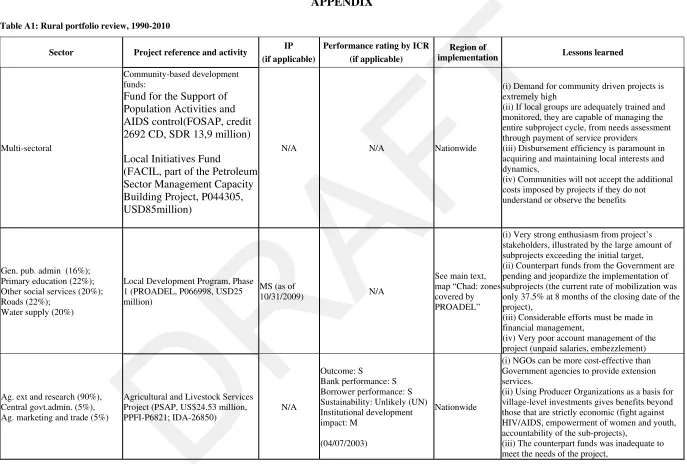
Main lessons from Bank operations in Chad ... 36
Main lessons learned from other donor operations ... 37
Indicative activities of major donors and technical agencies in rural sector, 2010 ... 38
APPENDIX ... 39
-viii-
Boxes
Box 1: Rural data issues ... 3
Box 2: Is Chad Affected by Dutch Disease? ... 6
Box 3: Chad’s rural development strategies are fragmented ... 10
Box 4: Research suggests investments in irrigation and roads as a priority ... 12
Box 5: Supporting access to financial services in remote rural areas ... 15
Box 6: Niger Private Irrigation Promotion Project ... 27
Box 7: Rural services — an innovative way to jointly deliver human health and veterinary services ... 29
Box 8: Local Development Program Support Project (PROADEL) ... 37
Figures
Figure 2: Rice and sorghum yields in Chad, West Africa, and Africa, 1961-2009 ... 4Figure 3: Agriculture and manufacturing share of GDP, 1980-2008... 6
Figure 4: Value added — manufacturing and agriculture, 1980-2008 (constant prices) ... 6
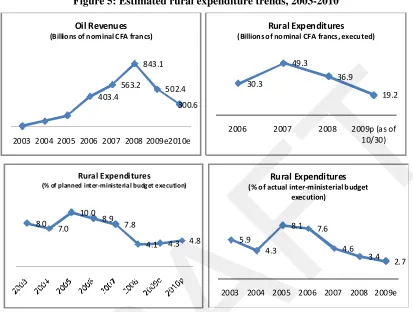
Figure 5: Estimated rural expenditure trends, 2003-2010 ... 13
Figure 6: Food inflation growth in N’Djamena, December 2007 to December 2009 ... 17
Figure 7: Cereal prices in N’Djamena and Moundou, January 2007 to February 2010 ... 17
Figure 8: Non-oil agricultural exports in Chad, 1994-2008, percent ... 18
Figure 9: Cotton production and yields, 2005-2009 ... 24
Maps
Map 1: Food economy zones ... 42Map 2: Market flows and road infrastructure ... 43
Map 3: Groundwater exploitability ... 44
Map 4: Agricultural water supply schemes ... 45
Map 5: Coverage of PROADEL ... 46
Tables
Table 1: Proportion of the population living in poverty, by region, 2003 ... 8Table 2: Relative share of different crops in rotation depending on the type of farm (expressed as a percentage of farm’s acreage), 2010 ... 24
-ix-
EXECUTIVE SUMMARY
Background and objectives
1. The Chad Rural Policy Note builds on the findings of a rural sector stocktaking mission carried out in Chad in December 2009. An initial draft of the Note was prepared as a ‘just-in-time’ desk study designed to contribute to the preparation of the Chad Interim Strategy Note (ISN), which was approved by the World Bank’s Board of Directors in June 2010. This finalized version of the Note intended mainly for an internal audience aims furthermore to establish a knowledge baseline that can be used to better position the Bank to design future activities in the rural sector of Chad. In that context, the objectives of the Note are to summarize existing information about the rural sector in Chad, identify knowledge gaps, and highlight key policy issues around which the dialogue in the rural sector might focus, with the objective of improving rural growth prospects and reducing poverty.
Country context
2. Chad is a low-income country with a population of about 11.2 million people, roughly 80 percent of whom live in rural areas. Living conditions are generally very poor: according to the 2009 UNDP Human Development Index, Chad ranks 175 out of 182 countries surveyed. GDP per capita currently stands at US$ 421, and the most recent household survey carried out in 2003 showed that 55 percent of the population was living below the poverty line. At that time, rural areas accounted for 87 percent of the national incidence of poverty.
3. Despite the recent emergence in Chad of a dynamic petroleum industry, overall GDP growth has declined. The agricultural sector has been hit particularly hard in recent years. The agricultural growth rate fell from minus 1.5 percent in 2008 to an estimated minus 26.8 percent in 2009. Nonetheless, the economy continues to be dominated by the rural sector, which employs about 72 percent of the population. The rural economy is relatively undiversified: two crops (cotton and gum Arabic) and livestock contribute about two-thirds of agricultural and rural GDP. Yields for the main staple crops are among the lowest in Africa.
4. Because the country’s agricultural potential remains largely unrealized, Chad regularly faces severe food security issues at the national level. Some 44 percent of the population, or approximately 5 million people, are considered food insecure. This figure is expected to increase in the future, because Chad is considered extremely vulnerable to climate change. Another dimension of poverty is nutrition, which remains a major concern. Chad currently has one of the highest chronic malnutrition rates, with 40 percent of children under 5 affected by stunting, with little significant improvement observed over the last decade.
5. Food security remains of particular concern. Following a prolonged period of unreliable rainfall that led to drought in many parts of the country, in 2010 cereal production is estimated to have fallen by 12-34 percent compared to the previous year. In addition, deteriorating pasture conditions have led to increased mortality in cattle, with death rates reported as high as 31 percent in some areas. Crop shortages are resulting in higher-than-average cereal prices. A nutritional survey conducted in late 2009 by the NGO Action Against Hunger revealed that acute
-x-
shipments, estimated at nearly 100,000 tons. Shipments of maize and sorghum will likely constitute over one-half of total imports.
6. The Government’s vision for agricultural development — as articulated in the first Poverty Reduction Strategy (adopted in June 2003) and embodied in the second National Poverty Reduction Strategy (adopted in April 2008) — is expressed in four sub-sectoral strategies: (i) the National Program for Food Security, (ii) the Master Plan for Agriculture, (iii) the National Plan for Livestock Development, and (iv) the Integrated Plan for Water Development and
Management. While the objectives of the Poverty Reduction Strategy are admirable (achieve sustainable growth, promote environmental conservation, and build rural capacity), in practice rural development policy in Chad is fragmented and lacks coordination. As a result, the Government’s ability to respond to the evolving crisis appears limited.
Main challenges facing the rural economy
7. The performance of the rural sector in Chad has been influenced by a range of factors:
(i)
Unfavorable institutional environment. Many of the institutions charged withservingthe rural economy are ineffective. Highly centralized line ministries, low levels of human capacity, weak governance structures, and judicial deficiencies impede the implementation of policies and programs targeting rural areas.
(ii)
Low level of public expenditure. Even though Government revenues have increasedsignificantly since the discovery of oil, and even though plans have been announced to increase public spending on non-security-related priority sectors, expenditures destined for the rural sector have decreased continuously since 2007. In addition, actual
allocations to the rural sector have been lower than planned allocations, which has adversely impacted rural expenditure efficiency.
(iii)
Lack of rural financial services. Rural financial services barely exist in Chad, with theexception of the agricultural credit system introduced under the national cotton parastatal, Cotontchad. Due to low penetration and a difficult overall operating environment for microfinance institutions, rural credit is expensive. In the informal sector, moneylenders may charge as much as 100 percent interest per month, and in the formal sector, village savings and loan associations and women’s savings associations charge 25 percent interest per month or more in many areas. Innovative instruments such as warehouse receipt systems, introduced on a pilot basis, have so far yielded limited results.
(iv)
Weak research and extension system. A weak agricultural research and extensionsystem contributes to low farm-level productivity. The agricultural research system is constrained by low levels of funding, limited involvement of farmers in the orientation of research, and weak dissemination of research products beyond the research stations. The extension system suffers from limited decentralization, weak capacity of regional extension institutions, lack of accountability by extension agents to farmers, and the remoteness of many villages.
(v)
Inefficient output markets. Sorghum, millet, rice, and maize are the most importantfood staples in Chad, accounting for more than one-half of the average daily intake of approximately 1,990 kilocalories. N’Djamena is the largest market for cereals, with Moundou a distant second. The heterogeneous nature of the nation’s main agricultural production zones, their physically dispersed nature, and the lack of connectivity due to poor roads, hampers food security and market effectiveness, resulting in persistent
-xi-
supply instability and price volatility. Cereal prices and yields in Chad are highly variable and support the need for actions aiming to stabilize domestic supply.
(vi)
Unreliability of agricultural water. Erratic rainfall and regular droughts regularly leadto food deficits. This is lamentable, because Chad is relatively well endowed with renewable water resources (4,050 cubic meters per inhabitant per year, compared to 2,380 in Niger and 1,595 in Sudan). Available water supplies should be adequate to meet the population’s needs. The potential exploitability of renewable groundwater resources is considered favorable, and 335,000 hectares are classified as easily irrigable. This potential is largely untapped; currently only 7,000 hectares have been developed for irrigation, mostly using traditional technologies, with only a few modern and privately-owned schemes in operation.
(vii)
Need for strategic investments. A wealth of experience from elsewhere in the Sahelshows that irrigation can serve as a powerful stimulus to agricultural growth by raising yield potential. Mobilizing groundwater resources, however, needs strategic
investments in simple technologies such as boreholes and pumps that have the potential to lift the groundwater, as well as institutional and management systems that will ensure the long-term sustainability of these investments.
(viii)
Low productivity of livestock systems. The livestock sector accounts for one-half ofagricultural GDP, supports the livelihoods of 40 percent of the rural population, and generates considerable foreign exchange earnings. Yet growth in the sector remains sluggish. Key barriers to accelerated growth include extensive livestock systems that are increasingly impeded by limited availability of water, lack of access to grazing lands, widely prevalent animal diseases, and conflicts that arise when cropping activities are hampered by arrival of pastoralists in search of water and pasture. Livestock exports ‘on the hoof’ are challenged by the lack of infrastructure and institutions needed to promote and regulate cross-border trade.
(ix)
Collapsing cotton sector. The cotton sector, which has long played a central role in therural economy, is mired in a deep and sustained crisis. Three out of four cotton producers are poor. Cotton production decreased from 270,000 metric tons in 1997 to only 33,000 metric tons in 2009. The cotton sector faces significant challenges: (i) collapsing world prices and an appreciating CFA relative to the US dollar, (ii) deep financial arrears of many producer organizations to Cotontchad, (iii) low productivity due to use of outdated agronomic practices and germplasm, and (iv) the dysfunctional institutional structure of Cotontchad, which is characterized by payment delays, untimely provision of input supplies, and delays in the removal of cotton from farms. After racking up heavy debts, many cotton producers exited the sector and diversified into food crops. Implementation of the 2005 cotton sector Road Map and structural reforms are still pending.
Potential drivers of rural growth
8. Despite the many challenges facing the rural economy in Chad, a number of areas show promise as potential future drivers of rural economic growth and poverty reduction:
(i)
Water resources development for crops and livestock. With droughts already frequent and water scarcity likely to increase in the future due to global climate change, exploiting water for agriculture and livestock has been identified as an urgent strategic priority for the country. Development of water resources for agriculture and livestock will be important for rural households individually and for the country as a-xii-
whole. Irrigation projects have generated attractive economic returns elsewhere in the Sahel, particularly in countries such as Niger and Burkina Faso, where agro-climatic conditions are similar to those found throughout much of central and southern Chad. Development of water resources for use in livestock production is particularly important from a social perspective. Competition between nomadic pastoralists and sedentary agro-pastoralists is growing as these two groups increasingly compete for access to scarce land and water resources. Appropriate investments in and management of agricultural water resources are needed to sustainably and equitably develop pastoral areas.
(ii)
Livestock value chain development. Stimulating increased growth of livestockproduction systems will not be possible unless pastoral systems can be sustainably developed and the livestock value chain can be oriented more toward
commercialization. For this to happen, a number of inter-related challenges will have to be overcome. The short term agenda includes ensuring strategic access to water resources, developing a pastoral code, and strengthening veterinary services. In the medium and long term, challenges include enhancing marketing transparency,
improving transport and logistics facilities, enhancing access to energy to improve cold storage and storage management, and responding to quality and food safety
requirements.
(iii)
Cotton sector strengthening and diversification. In the short run, there is an urgentneed to assist the many households that depend on cotton as a major livelihood source. For this reason, the Government should urgently pursue the agreed reforms in the cotton sector, particularly as these relate to addressing the two immediate priorities of reducing indebtedness and improving the availability and quality of production inputs. It should look seriously at disengaging from the sector and ceding increased
responsibility to the private sector and to farmer organizations. It should look at measures that would increase productivity at the farm level and boost profitability for farmers. Over the longer term, a different strategy will be required: cotton farmers will have to be helped to break their reliance on a crop whose prospects remain highly uncertain. Therefore, the Government also needs to explore ways to diversify the agricultural production base and reduce the dependence on cotton. Farmers are already exiting from the cotton sector and diversifying toward other promising crops; sesame, cowpea, groundnuts, and onions, together with spirulina, all appear to have potential. A Computable General Equilibrium simulation exercise carried out in 2007 concluded that a successful agricultural diversification strategy could mitigate the decline in agricultural GDP resulting from decreased cotton production.
The Bank’s rural development strategy during the INS period
9. Consistent with the vision laid out in the INS, the Bank’s strategy with regard to rural development in Chad will have to be built on three main pillars. The first pillar will consist of deepened analytical work and improved knowledge in strategic areas where the potential is greatest for payoff in terms of growth and poverty reduction. The second pillar will consist of a better understanding of how the Government’s current rural sector strategy is being implemented and what has been the level of coordination between the different ministerial departments that are responsible for implementing the different strategies that make up the rural development package. The third pillar will consist of stronger engagement between the Government, the Bank, and other
-xiii-
Three pillars for Bank re-engagement
10. Pillar 1. Analytical work.The literature review carried out during preparation of this Note identified three main areas where analytical work is urgently needed to fill critical knowledge gaps. These include: (i) identifying opportunities for improving the management of water resources for crop and livestock production (this would include a review of water needs in the livestock sector and how to manage these); (ii) putting in place a strategy for cotton sector reform; and (iii) identifying economically attractive and environmentally sustainable agricultural diversification possibilities.
(i)
Water resources development for crops and livestock. An assessment is needed toidentify and quantify the water resources (groundwater and surface) that can be exploited for crop and livestock production. The assessment should review the experience of past irrigation programs, including their effectiveness and efficiency. In addition to assessing the potential for irrigated crop production, the review would pay particular attention to how water resources could be used for sustainable management of livestock production systems. Given the abundance of underground water, the review would pay particular attention to measures that would: (i) improve access to agricultural water through boreholes and pumps to enhance agricultural productivity and incomes in vulnerable regions regarding food security; (ii) enhance sustainable livestock production, reduce social conflicts between pastoralists and agro-pastoralists; and (iii) strengthen the institutional and technical capacities of water users, producer organizations, Government institutions, and private sector support services
(ii)
Cotton sector reform. There is a need to update the knowledge base in the cottonsector and to identify the key elements necessary for cleaning up the sector and improving its productivity. The review would help identify the main steps of a reform program that could be implemented in the short to medium term. Key elements of the review would include: a clear definition of the future organization of the cotton filière; the roles of the different stakeholders, such as the government, the private sector, farmer organizations, and individual producers; the extent of farmer indebtedness to Cotontchad and how this can be absorbed; the accompanying measures including actions to improve the performance of producer organizations, actions on how to improve productivity, and how to finance the critical functions (road maintenance, research, extension, seeds, etc.);
(iii)
Agricultural diversification. Analytical work is needed to inform the design of a futurediversification strategy for the sector. This work would focus on identifying
commodities that could provide attractive alternatives to cotton and that could justify increased investments in irrigation. The Chadian cotton sector faces daunting
challenges, and difficult choices will have to be made to allow the sector to regain a sound footing. Many cotton farmers will require help in their diversification strategies. Developing irrigation may also require identifying high-value crops that may be able to support the cost of irrigation schemes. The sector would therefore benefit from a diversification strategy that would facilitate farmers’ transition toward food security crops (sorghum, millet, and cowpea) and irrigation for agribusiness development (spirulina, onions, and groundnuts, fruits and other vegetables).
11. Pillar 2. Diagnostic of Chad’s rural development strategy. A second area in which the
Bank could productively re-engage with the Government of Chad would be in assisting the Government to carry out a diagnostic study of the performance of the four current rural
development sub-strategies. Such an assessment might examine the levels of expenditure devoted
-xiv-
to each sub-strategy and describe the level of coordination between the different ministerial departments responsible for their implementations. The results of this diagnostic study would serve as an important input for the development of a national agricultural investment framework, which could form the basis for concrete multi-year expenditure plans with associated actions, modalities, and delivery channels.
12. Pillar 3. Deepened policy dialogue. A third area in which the Bank could productively
re-engage with the Government of Chad would be in the policy arena. The level and intensity of the dialogue on rural policy issues could and should be ramped up as additional knowledge is gained concerning critical issues affecting the sector. Issues around which the policy dialogue can begin immediately include the need to jump-start stalled reforms in the cotton sector, what should be the main elements of the cotton-sector reforms, how to absorb the large outstanding farmers’ debts to Cotontchad, what measures are needed to improve livestock trade and strengthen private veterinary services, and what interventions are needed to improve rural sector governance so as to leverage greater impacts from rural expenditures.
-xv-
RESUME EXECUTIF
1. Cette Note de Politique Sectorielle est basée sur les conclusions d’une mission
d’information sur le secteur rural conduite au Tchad en Décembre 2009. Une première ébauche avait été préparée afin de contribuer à l’élaboration de la Note de Stratégie Intérimaire de la Banque mondiale (ISN) pour le Tchad, qui a été approuvée par son Conseil d’Administration en juin 2010. La version finale de ce document à vocation interne vise à établir une première base de connaissances destinée à accompagner la conception des futures activités de la Banque dans le secteur rural du Tchad. Dans ce cadre, les principaux objectifs de cette Note de Politique
Sectorielle sont de : dresser un premier bilan non exhaustif des informations et données existantes sur le secteur rural ; identifier les lacunes au niveau des connaissances du secteur ; suggérer des thématiques autour desquelles il serait possible de relancer le dialogue sur le secteur rural afin d'améliorer les perspectives de croissance et de réduire la pauvreté en milieu rural.
Contexte national
2. Le Tchad, pays à faibles revenus, a une population avoisinant les 11,2 millions d’habitants, dont environ 80 pourcent vivent en zone rurale. Les conditions de vie sont
généralement très précaires et, selon l’indice de développement humain du PNUD pour 2009, le Tchad se classe 175ème position sur les 182 pays sous revue. Le PIB nominal par habitant est estimé à 421 dollars américains, et l'enquête auprès des ménages la plus récente (menée en 2003), a montré qu'environ 55 pourcent de la population vivent en dessous du seuil de pauvreté. À l’époque de l’enquête, 87 pourcent des pauvres résidaient en zone rurale.
3. Malgré la récente apparition d'une industrie pétrolière dynamique, la croissance globale du PIB a diminué. Le secteur agricole a été durement touché ces dernières années et son taux de croissance est passé de -1,5 pourcent en 2008 à -26,8 pourcent en 2009. L'économie continue néanmoins d'être dominée par le secteur rural, qui emploie environ 72 pourcent de la population. L'économie rurale est relativement peu diversifiée : deux cultures (coton et gomme arabique) ainsi que l'élevage contribuent à environ deux tiers du PIB agricole. Les rendements des principales cultures de base sont parmi les plus faibles d’Afrique subsaharienne.
4. Le potentiel agricole et hydraulique du pays demeurant en grande partie inexploité, le Tchad est régulièrement confronté à de graves enjeux de sécurité alimentaire au niveau national. Environ 44 pourcent de la population (environ 5 millions d’habitants) sont considérés comme étant en situation d’insécurité alimentaire. Cette proportion pourrait s’aggraver dans l'avenir, le Tchad étant considéré comme extrêmement vulnérable aux aléas du changement climatique. Une autre composante de la pauvreté est la malnutrition, qui reste une préoccupation majeure. Le Tchad a actuellement l'un des taux les plus élevés de malnutrition chronique au monde, 40 pourcent des enfants de moins de 5 ans étant touchés par des retards de croissance, alors qu’aucune amélioration significative n’a été observée au cours de la dernière décennie. 5. La sécurité alimentaire reste particulièrement préoccupante en 2010. À la suite d'une réduction significative de la production céréalière en raison de sécheresses et des pluies irrégulières, la production a connu un repli estimé entre 12 à 34 pour cent par rapport à l'année précédente. Par ailleurs, la détérioration des conditions de pâture a engendré un taux de mortalité atteignant 31 pourcent chez les bovins dans certaines régions. Les pénuries de production ont entraîné une augmentation du prix moyen des céréales, limitant l’approvisionnement des ménages pauvres des zones urbaines et périurbaines. Sur la même période, une enquête nutritionnelle menée fin 2009 par l’ONG Action Contre la Faim a révélé que la malnutrition aiguë a augmenté jusqu’à 27 pourcent dans certaines régions (Kanem, Ouaddai, Batha), bien au-dessus des niveaux d'urgence établis par l’OMS. Tenant compte de l’accélération de l’insécurité alimentaire dans certaines zones pastorales et des zones affectées par les conflits, une évaluation des besoins
-xvi-
menée par la FAO et le PAM estime que 2 millions de personnes auront besoin d'assistance au cours de l'année 2010. Cette assistance devrait être prise en charge par une aide alimentaire record, estimée à près de 100.000 tonnes, composée principalement de maïs et de sorgho, qui représentera probablement plus de la moitié des importations totales.
6. La politique de développement rural au Tchad est fragmentée et manque de
coordination. La vision du Tchad pour le développement de son secteur agricole, telle
qu’énoncée dans la première Stratégie Nationale de Réduction de la Pauvreté (adoptée en Juin 2003) et exprimée dans la deuxième Stratégie Nationale de Réduction de la Pauvreté (adoptée en avril 2008), est déclinée au travers de quatre stratégies sous-sectorielles: (i) le Programme National pour la Sécurité Alimentaire, (ii) le Schéma Directeur Agricole, (iii) le Plan National de Développement de l'Élevage, et (iv) le Schéma Directeur de l’Eau et de l’Assainissement. Les principaux objectifs sont de parvenir à une croissance durable de la production agricole, ainsi qu’à la conservation de l'environnement et au renforcement des capacités en milieu rural.
Principaux défis de l’économie rurale
7. La performance du secteur rural au Tchad est conditionnée par une série de facteurs, parmi lesquels on peut distinguer:
(i)
Un environnement institutionnel défavorable. Une gouvernance de faible qualité, des ministères sectoriels très centralisés, des retards dans le processus de décentralisation, la faible capacité des institutions et des carences dans la réglementation foncière, qui sont l'héritage d'un environnement institutionnel très imparfait.(ii)
Un faible niveau de dépenses publiques. En dépit de l'augmentation des recettespubliques suite à la découverte du pétrole et des plans de réalignement budgétaires pour augmenter les ressources des secteurs prioritaires non liés à la sécurité, les dépenses publiques en direction du secteur rural n'ont cessé de diminuer depuis 2007.
L’allocation inter-ministérielle est généralement plus faible que prévue, affectant l'efficacité des dépenses en milieu rural. Une réelle volonté politique, combinée avec de
l'assistance technique et un dialogue stratégique, pourraient améliorer l'impact des
revenus pétroliers du Gouvernement. Il y a par ailleurs peu d'information sur l'efficacité des dépenses du secteur public en milieu rural.
(iii)
Un manque de services financiers en faveur du monde rural. Les services financiersau Tchad sont insuffisamment développés à l'exception du système de crédit agricole accordé par la Cotontchad en faveur des producteurs de coton. En raison de la faible pénétration du secteur bancaire et d'un environnement d'exploitation très compliqué pour les institutions de microfinance, le crédit rural demeure coûteux. Les prêteurs peuvent céder à des taux d’intérêt de 100 pourcent, tandis que les associations villageoises et les associations de femmes proposant des services d'épargne et de prêt accordent des crédits à des taux de 25 pourcent par mois dans certaines régions. Les services financiers ruraux sont inégalement répartis sur le territoire, et des instruments novateurs tels que les systèmes warrantage introduits sur une base pilote ont produit des résultats décevants.
(iv)
Un faible système de recherche et de vulgarisation agricole. Au Tchad, la faiblesse dusystème de recherche et de vulgarisation explique en partie la faible productivité au niveau de l’exploitation. Le système de recherche est limité par : (i) la faiblesse des financements, (ii) l’implication limitée des agriculteurs dans la définition des choix stratégiques de recherche, et (iii) la faible diffusion des produits et résultats de la recherche au-delà des stations expérimentales. Le système de vulgarisation souffre : (i) d’une décentralisation limitée, (ii) d’une faible capacité des institutions régionales de
-xvii-
vulgarisation, (iii) du manque de responsabilisation des agents vis-à-vis des producteurs, et (iv) de l'éloignement de nombreux villages.
(v)
Des marchés agricoles insuffisamment développés. Le sorgho, le millet, le riz et lemaïs, apportant plus de la moitié des 1990 kilocalories nécessaires par jour, sont les principaux produits agricoles commercialisés au Tchad. N'Djamena s’avère être le plus grand marché pour les céréales, loin devant celui de Moundou. L’hétérogénéité et la dispersion géographique des principales zones de production agricole du pays, ainsi que le manque de connexion entre les marchés en raison du mauvais état des routes, entrave la sécurité alimentaire, enraye l'efficacité des marchés et explique une persistante instabilité des approvisionnements et la volatilité des prix. Les prix des céréales et les rendements apparaissent au Tchad comme très variables, ce qui renforce l’intérêt d’actions visant à stabiliser l'offre intérieure.
(vi)
Manque de fiabilité de l'eau agricole. Pluies erratiques et sécheresses persistantes sontla cause de déficits alimentaires. Paradoxalement, le Tchad demeure riche par ses ressources en eau renouvelable (4050 mètres cubes par habitant et par an, contre 2380 au Niger et 1595 au Soudan), et la mobilisation des ressources disponibles s’avèrerait largement suffisante pour répondre aux besoins de la population. Le potentiel
d’exploitation des ressources souterraines renouvelables est considéré comme favorable voire très favorable, et 335.000 hectares sont classés comme facilement irrigables. Ce potentiel est largement inexploité; actuellement seuls 7000 hectares ont été développés pour l'irrigation (essentiellement au moyen de technologies traditionnelles, avec seulement quelques périmètres modernes et privés en activité).
(vii)
Le besoin d’investissements stratégiques. Une panoplie d’expériences menées dansd’autres régions du Sahel montre que l'irrigation peut servir de puissant stimulant à la croissance agricole en augmentant le potentiel de rendement. Toutefois, la mobilisation des ressources en eau souterraine dépend d’investissements prioritaires dans des technologies simples et éprouvées telles que les forages et pompes, ainsi que de la mise en place de systèmes institutionnels et de gestion cohérents, qui assureraient la
durabilité des investissements initiaux.
(viii)
La faible productivité des systèmes d'élevage. Au Tchad, l’élevage génère près de lamoitié du PIB agricole, reste le moyen de subsistance de près de 40 pourcent de la population rurale, et génère une quantité importante de devises. Le secteur a été reconnu comme un catalyseur potentiel pour la croissance économique et un moyen d'assurer la sécurité alimentaire pour les populations vulnérables. Les principaux freins à la croissance sectorielle résident dans le fait que les systèmes d'élevage extensifs sont toujours plus entravés par une disponibilité limitée en eau et un manque d'accès aux pâturages, que l’incidence des maladies animales reste élevée, et que des conflits surviennent lorsque les activités agricoles sont entravées par l'arrivée d’éleveurs transhumants à la recherche de points d’eau et de pâturages. Enfin, les exportations de bétail sur pied sont limitées par le manque d'infrastructures et d’institutions ad hoc pour réglementer le commerce transfrontalier.
(ix)
L’effondrement du secteur coton. Le sous-secteur cotonnier, qui a longtemps joué unrôle central dans l'économie rurale, subit aujourd’hui une crise profonde et persistante. 3 producteurs sur 4 sont pauvres. Au cours de la dernière décennie, la production de coton a considérablement diminué, passant de 270.000 tonnes de coton graine en 1997 à 33.000 tonnes en 2009. Le secteur coton fait face à d’important défis, tels que: (i) la chute des prix mondiaux du coton accompagnée de l’appréciation du FCFA vis-à-vis du dollar, (ii) l’ampleur des arriérés financiers des organisations de producteurs
-xviii-
vis de la Cotontchad, (iii) la faible productivité due à des pratiques agronomiques désuètes et l’utilisation de semences de faible qualité, et (iv) les dysfonctionnements institutionnels de la Cotontchad (tels que les délais de paiement, une fourniture inappropriée d'intrants, des retards dans l’évacuation du coton vers les usines). De nombreux producteurs sont non seulement pauvres mais aussi souvent lourdement endettés et sortent progressivement du secteur en cherchant à diversifier leur production vers les cultures vivrières. Malgré le besoin urgent d’un plan d’action, l’exécution de la feuille de route du secteur coton établie en 2005 et les réformes structurelles restent toujours en attente.
Sources potentielles de croissance pour le secteur rural
8. Malgré les nombreux défis auxquels est confrontée l'économie rurale, certaines activités s’avèrent être des moteurs de croissance potentiels et prometteurs à même de réduire la pauvreté. On citera tout particulièrement :
(i)
Le développement des ressources en eau agricole. Avec des sécheresses fréquentes etdes pénuries en eau de surface risquant de s’aggraver en raison du changement climatique global, l'exploitation des ressources en eau est une priorité urgente et un impératif stratégique pour le pays. Le développement des ressources en eau pour l'agriculture et l'élevage sera bénéfique à la fois pour les populations rurales et pour le pays dans son ensemble. Les projets d'irrigation ont permis des activités économiques attractives et rentables dans d’autres régions du Sahel, en particulier au Niger et au Burkina Faso, qui comptent des zones agro-climatiques similaires à celles du centre et du sud du Tchad. Le développement des ressources en eau destinée à l’élevage est particulièrement importante sur le plan social. La concurrence entre éleveurs nomades et agro-pasteurs sédentaires pour l'accès à des ressources en terre et en eau limitées s’accroit. Des investissements appropriés dans la gestion des ressources en eau agricole sont nécessaires pour développer durablement et équitablement les espaces pastoraux.
(ii)
Le développement de la filière élevage. Stimuler la croissance des systèmes deproduction animale au Tchad ne sera pas possible sans une valorisation durable des systèmes pastoraux et une plus forte orientation de la filière bétail vers la
commercialisation. Pour ce faire, un certain nombre de défis interdépendants devront être surmontés. Dans le court terme, ces défis sont en particulier (i) d’assurer un accès stratégique aux ressources en eau, (ii) de développer le code pastoral, (iii) de renforcer les services vétérinaires. Dans le moyen terme, ces défis sont (i) d’accroître la
transparence de la commercialisation, (ii) de perfectionner les infrastructures de transports et de logistique, (iii) d’améliorer l'accès à l'énergie pour faciliter l'entreposage à froid et les pratiques de stockage, et enfin (iv) de répondre aux exigences de qualité et de sécurité alimentaire.
(iii)
Le renforcement du secteur cotonnier et la diversification agricole. Le Tchad devrait,de toute urgence, poursuivre les réformes dans le secteur du coton et traiter les priorités actuelles du secteur telles que l'endettement des producteurs envers la Cotontchad et la disponibilité et la qualité des intrants. Il convient de se pencher sérieusement sur le désengagement de l'Etat du secteur et de définir clairement les rôles pour le secteur privé, les organisations de producteurs et le gouvernement. Le Gouvernement devrait en particulier s’attacher à promouvoir des mesures améliorant la productivité du secteur et la rentabilité pour les agriculteurs. Le Tchad devrait ainsi revenir à la feuille de route de 2005 sur la réforme du secteur coton et aborder les priorités sectorielles telles que l'endettement des producteurs et la qualité des intrants. Le Tchad a
également besoin de diversifier sa production agricole afin de réduire sa dépendance au
-xix-
coton. Bien que les agriculteurs diversifient déjà leurs systèmes de production en réaction à la crise du secteur cotonnier, ils doivent cependant s’adapter à des cycles de production plus courts en raison du changement climatique. Le sésame, le niébé, l'arachide et les oignons, ainsi que la spiruline, semblent avoir un potentiel
considérable en tant que cultures vivrières ou de rente. L'analyse effectuée à l'aide de la Matrice de Comptabilité Sociale du Tchad suggère qu'une stratégie de diversification agricole réussie pourrait atténuer quelque peu la baisse du PIB agricole résultant de la chute de productivité du secteur coton.
La Stratégie de développement rural de la Banque pendant la période de mise en place de l’ISN
9. Conformément à la vision tracée dans l'ISN, la stratégie de la Banque en matière de développement rural au Tchad devrait être basée sur trois axes principaux. Le premier axe consisterait à approfondir le travail d'analyse et de renforcement des connaissances dans des domaines stratégiques où le potentiel de gain en termes de croissance et de réduction de la pauvreté sont importants. Le deuxième axe serait d’analyser les modalités de mise en œuvre des différentes stratégies gouvernementales pour le secteur rural et surtout le niveau de coordination entre les départements ministériels chargés du développement rural. Le troisième axe impliquerait un dialogue productif entre la Banque, le Gouvernement et les autres Partenaires au
Développement, sur les réformes clés dans le domaine rural.
Trois axes prioritaires pour le réengagement de la Banque
10. Pilier 1. Travaux analytiques. La revue bibliographique engagée lors de la préparation
de la présente note a identifié trois principaux domaines pour lesquels il serait important à court terme d'approfondir les connaissances. Ces domaines sont les suivants, dans l'ordre décroissant de priorité : (i) une analyse des possibilités d'irrigation et des autres utilisations des ressources en eau, notamment l'examen des besoins en eau pour l’élevage, et un état des lieux des options en matière de gestion des ressources disponibles ; (ii) l’identification des étapes nécessaires pour la mise en place d’une stratégie de réforme du secteur coton ; et ( iii) les possibilités de
diversification agricole.
(i) La Gestion des ressources en eau agricole. Cette évaluation permettrait de confirmer
les ressources en eau disponibles (à la fois les eaux souterraines et de surface) susceptibles d’être exploitées par le Tchad pour l'irrigation, ainsi que pour le développement pastoral et de l'élevage. L'examen devrait porter sur l'expérience acquise avec les programmes d'irrigation passés, y compris l'efficacité et l'efficience des projets d'irrigation. Au-delà du potentiel d'irrigation, l'examen porterait une attention particulière à la façon dont les ressources en eau peuvent être utilisées pour la gestion durable des ressources pastorales. Compte tenu de l'abondance des eaux souterraines, l'examen portera une attention particulière aux mesures visant à : (i) améliorer l'accès à l'eau agricole à travers les forages et pompes pour accroître la productivité agricole et les revenus dans les régions vulnérables en matière de sécurité alimentaire ; (ii) améliorer la production animale durable et réduire les conflits sociaux entre les pasteurs et agro-pasteurs ; et (iii) renforcer les capacités institutionnelles et techniques des usagers de l'eau, des organisations de producteurs, des institutions gouvernementales, du secteur privé et des services d’appui.
(ii) La réforme du secteur coton. Le deuxième domaine d’investissement analytique serait de mettre à jour la base de connaissances sur le secteur du coton et d'identifier les éléments clés nécessaires à l'assainissement du secteur et l'amélioration de sa
-xx-
productivité. L'examen devrait aider à identifier les principales étapes d'un programme de réforme qui peuvent être mises en œuvre dans le court et moyen terme. Certains des éléments clés devraient comprendre: une définition claire de la future organisation de la filière coton, les rôles des différents acteurs comme le gouvernement, le secteur privé, et les agriculteurs / organisations paysannes; l'ampleur de l'endettement des agriculteurs vis-à-vis de la Cotontchad et comment cette dette peut être absorbée; les mesures d'accompagnement des réformes y compris les actions pour améliorer la performance des organisations de producteurs, la
productivité, et pour assurer le financement des fonctions essentielles (entretien des routes, recherche, vulgarisation, semences, etc.);
(iii) La diversification agricole. Le troisième domaine de travail analytique pourrait
porter sur la diversification agricole, le développement des chaînes de valeur et d'éventuelles productions à haute valeur ajoutée qui pourraient justifier une
augmentation des investissements dans l'irrigation et simultanément supporter leurs couûts. Le secteur du coton tchadien actuellement fait face à des défis énormes et des choix difficiles devront être faits pour permettre au secteur de retrouver une base saine. Beaucoup de producteurs de coton auront besoin d'aide dans leurs stratégies de diversification. Un appui à la diversification faciliterait la transition des agriculteurs vers des cultures alimentaires (sorgho, mil, niébé), améliorant la de sécurité
alimentaire du pays, et un développement de l'irrigation pour le développement agro-alimentaire dédié au marché domestique et régional (spiruline, oignons, arachides, fruits et légumes).
11. Pilier 2. Diagnostic de la mise en œuvre de la stratégie de développement rural du Tchad. Le deuxième axe dans lequel la Banque pourrait renouer son dialogue avec le
gouvernement serait d`aider celui-ci à faire une étude de diagnostic de la performance des quatre sous-stratégies actuelles de développement rural. Un tel diagnostic pourrait examiner le niveau des dépenses consacrées à chaque sous-stratégie et d’analyser le niveau de coordination entre les différents départements ministériels en charge de leur mise en œuvre. Les résultats de cette étude pourraient constituer un apport important pour l'élaboration d'un cadre national d'investissement agricole susceptible d’être transformé en programmes de dépenses pluri-annuels associés à des actions concrètes de mise en œuvre.
12. Pilier 3. Renforcement du dialogue sur la politique de développement rural.Le
troisième et dernier axe de réengagement pourrait être dans le domaine du dialogue avec le gouvernement sur la politique de développement rural. Le niveau et l'intensité du dialogue pourrait et devrait être renforcé en même temps que nous approfondissons nos connaissances de certains problèmes critiques du secteur. Les domaines où le dialogue serait susceptible de commencer immédiatement sont : la relance de la réforme du secteur du coton et la révision de ses principales composantes ; la gestion des dettes des producteurs de coton envers la
Cotontchad ; l’amélioration du commerce du bétail et des services vétérinaires privés ; et le renforcement de la gouvernance du secteur rural destinée à améliorer l’efficacité des dépenses en
-1-
1. INTRODUCTION
Background and objectives
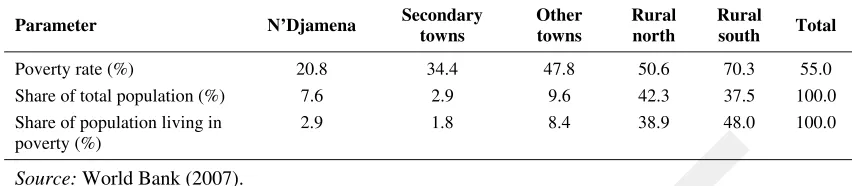
1. Chad is a low-income country with a population of about 11.2 million people, roughly 80 percent of whom live in rural areas. Living conditions are generally very poor: according to the 2009 UNDP Human Development Index, Chad ranks 175 out of 182 countries surveyed. GDP per capita currently stands at US$ 421, and the most recent household survey carried out in 2003 showed that 55 percent of the population was living below the poverty line. At that time, rural areas accounted for 87 percent of the national incidence of poverty.
2. Despite the recent emergence in Chad of a dynamic petroleum industry, overall GDP growth has declined. The agricultural sector has been hit particularly hard in recent years. The agricultural growth rate fell from minus 1.5 percent in 2008 to an estimated minus 26.8 percent in 2009. Nonetheless, the economy continues to be dominated by the rural sector, which employs about 72 percent of the population. The rural economy is relatively undiversified: two crops (cotton and gum Arabic) and livestock contribute about two-thirds of agricultural and rural GDP. Yields for the main staple crops are among the lowest in Africa.
3. Because the country’s agricultural potential remains largely unrealized, Chad regularly faces severe food security issues at the national level. Some 44 percent of the population, or approximately 5 million people, are considered food insecure. This figure is expected to increase in the future, because Chad is considered extremely vulnerable to climate change. Another dimension of poverty is nutrition, which remains a major concern. Chad currently has one of the highest chronic malnutrition rates, with 40 percent of children under 5 affected by stunting, with little significant improvement observed over the last decade.
4. The Chad Rural Policy Note builds on the findings of a rural sector stocktaking mission carried out in December 2009. An initial draft of the Note was prepared as a ‘just-in-time’ desk study designed to contribute to the preparation of the Chad Interim Strategy Note (ISN), which was approved by the World Bank’s Board of Directors in June 2010. This finalized version of the Note aims furthermore to establish a knowledge baseline that can be used to better position the Bank to design future activities in the rural sector of Chad. In that context, the main objectives of the Note are to summarize existing information about the rural sector in Chad, identify major knowledge gaps, and highlight key policy issues around which the dialogue in the rural sector might focus, with the objective of improving rural growth prospects and reducing poverty.
B. The Bank’s interim assistance strategy
5. The Bank’s assistance program in Chad during the period July 2010 to June 2012 will be guided by an Interim Strategy Note (ISN), presented to the Board on July 22, 2010. The main objectives for Bank engagement during the ISN period will be to re-establish a productive dialogue and working relationship with state and non-state actors, and strengthen the Bank’s knowledge base for further engagement. The Bank will therefore focus on the delivery of knowledge products and analytic and advisory services in various sectors. The ISN has three pillars: (i) strengthening governance, (ii) improving access to key social services, and (iii) promoting sustainable and diverse growth. The Bank will make use of a mix of knowledge products, analytical activities, and lending operations to implement the proposed strategy. Agricultural and rural activities during the ISN phase include increased planning and
management capacity at decentralized levels through a second phase of the existing PROADEL, as well as undertaking analytical work, to better understand the drivers of growth, agricultural
-2-
productivity increases, and rural poverty reduction. It is expected that the results of the further analytical work would help to eventually prepare a new lending operation. During the ISN period, the Bank will also pursue policy dialogue in the areas of better governance in the rural sector, including improving management of the cotton sector; increasing the allocation of resources to the rural sector; improving the effectiveness and the impact of public expenditure in rural areas; and institutional reform for sustainable growth.
C. Outline of the Rural Policy Note
6. Including this introduction, the Rural Policy Note includes five sections. Section 2 outlines the Country Context. Section 3 gives a Summary of Rural Sector Issues by synthesizing available information on the rural sector, touching on the overall institutional environment, rural expenditure trends, and reviews the status of several sub-sectors, including financial services, research and extension, cereal markets, water, and livestock. Section 4 examines three areas that can represent three Strategic Growth Pillars for the agricultural and rural sector: (i) water resources development for irrigation and livestock, (ii) livestock value chain development, and (iii) cotton sector strengthening and diversification. Section 5 summarizes proposals for further work in the rural sector to generate knowledge and fill gaps and to improve policy dialogue. We include in Annex a summary of Lessons Learned from past Bank-financed operations.
2. COUNTRY CONTEXT
A. Recent economic developments
7. Following a long period of very gradual decline, in 2009 Chad’s agricultural sector suffered a severe weather-related downturn. Year-on-year agricultural growth plummeted from minus 1.5 percent in 2008 to an estimated minus 12 to 34 percent in 2009 in the face of a severe drought that affected virtually all crops and was reflected in a particularly dismal performance of the cotton sector (IMF, 2010) (Figure 1). A modest rebound is expected in 2010-2012 based on anticipated better rainfall. Meanwhile, the livestock growth rate, which was 2.8 percent in 2008, will likely stagnate over the next few years as a result of high livestock mortality and continuing poor livestock production conditions, with the 2009 drought expected to lead to a severe decline in pasture conditions.
8. Official data in Chad are notoriously unreliable, especially as these relate to rural areas (Box 1). In the absence of reliable data, the decline in agricultural production that occurred in 2009 is difficult to estimate with precision. However, evidence of a severe decline comes from field observations suggesting that cereal production fell by 12 to 34 percent compared to the previous year, and that these declines were accompanied by a severe spike in livestock mortality (FAO/WFP/FEWSNET, 2009). The large production decreases has certainly called for record food aid shipments of maize and sorghum, which are estimated to account for over one-half of total cereal imports thus far in 2010. Further evidence of food production declines on this order of magnitude comes in the form of observed high inflation in cereal prices (see Figures 4 and 5 in
-3- Figure 1: Agricultural GDP growth, 2005-09
Source: IMF.
Box 1: Rural data issues
Survey data are outdated. The most recent LSMS-type rural survey is ECOSIT 2 (2003). It collected data from
about 7,000 households which were visited three times. The survey was co-financed by the Bank. Survey costs were US$ 300 per household.
There is no evidence about poverty trends in Chad. ECOSIT 1 (1996) had data issues and a poor sample frame,
and was not representative. It is therefore not comparable to ECOSIT 2. However, coverage of up-to-date rural data has somewhat improved since the launch of the ‘Survey on Structural Vulnerability’ (RoC, 2009b) conducted in mid-2009 – though to the late release not fully considered in this report.
Data are often ‘’guesstimated” rather than collected through surveys. Agricultural production data are collected
through the Office National de Développement Rural (ONDR). Yields and cultivated areas appear to be “estimated” by local ONDR agents but may not be rigorously measured. More work is needed to understand underlying procedures.
Last population census was conducted in 2009. The resulting data are currently being evaluated and should be
available soon. The data will include some basic information on economic activities. The new census will also allow establishing a new sample frame for ECOSIT 3 (planned for 2010-2011).
Official price data for the rural sector are not available. The National Statistical Institute, INSEED, collects
monthly price data for more than 300 items in five markets in N’Djamena and a rural market located about 25 kilometers outside the capital city. Prices are weighted using ECOSIT 2 data. Food items comprise more than 60 percent of the household consumption basket.
Last livestock census was in 1976. The Ministry of Livestock, with technical assistance from FAO, has
completed preparatory activities for a proposed new livestock census in 2009. The actual census has not started due to a lack of funds.
9. Crop yields have varied significantly around a flat long-term trend and lag significantly behind West African and Sub-Saharan African averages (Figure 2). Rice yields in neighboring countries, such as Cameroon and Niger, have historically been double those of Chad. Rice yields are low in Chad because of poor soil fertility resulting from excessive clearing and land
exploitation, lack of access to agricultural tools, underutilization of fertilizer, lack of improved seed varieties, substantial post-harvest losses, a weak research and extension system, and low irrigation capacity. These factors underlying low agricultural productivity are analyzed in more detail in Section 3.
‐3 0
‐2 0
‐1 0 0 1 0 2 0 3 0
2 0 0 5 2 0 0 6 2 0 0 7 2 0 0 8 2 0 0 9
An
nu
al
gr
owt
h
i
n
p
e
rc
e
nt
Ag GDP T otal GDP (including pe trol)
-4-
10. Over the past two years, persistently high domestic food prices, the global financial crisis, and a sharp drop in oil revenues have prompted the Government to re-focus attention on rural development as a catalyst to reduce poverty and enhance food security. However because of substantial fiscal deficits in 2009 and 2010, equivalent to about 6.5 percent of GDP in 2009 and 3.7 percent of GDP in 2010, these have negatively affected Government spending in priority sectors, including rural development and hence the focus on rural development is yet to be effective.
B. Structure of the rural sector
Socioeconomic characteristics of the rural sector
11. Until the discovery of oil in 2003, the rural sector dominated the economy. While the rise of the oil industry has changed the structure of GDP, the rural sector continues to occupy a significant place in the Chadian economy, and it still supports the livelihoods of 86 percent of the total population. As of 2007, 2.9 million economically active Chadians were working in the agriculture sector, of which 1.6 million were women.
12. In 2008, the most recent year for which final data are available, the primary non-oil sector in Chad generated an estimated 21 percent of GDP, industry generated 40 percent (of which the oil sector accounted for XX percent), and the service sector 39 percent. In the primary sector, 10.3 percent was contributed by food crops, and an additional 1.4 percent was contributed by agro-industrial products. Livestock generated 9 percent of GDP (IMF, 2010).
13. Chad’s agricultural sector could, if adequately developed, contribute to growth and to significant poverty reduction. The agro-climatic conditions however limit rain fed cropping activities to the relatively more favorable southern zones with the possibility of improving livestock activities in the drier Sahelian zones. Better exploitation of the country’s water resources remains a possibility since it is estimated that currently only 7,000 hectares out of an estimated potential 330,000 hectares are irrigated. Stagnating agricultural production and
heightened frequency and severity of drought (possibly linked to global climate change) have led to increased concerns about food security.
Figure 2: Rice and sorghum yields in Chad, West Africa, and Africa, 1961-2009
Rice yields
0 0.5 1 1.5 2 2.5 3
1960 1970 1980 1990 2000 2010
mT/ha
Sub-saharan Africa Chad
Western Africa
-5-
Sorghum yields
Source: FAOSTAT
Agricultural zones, farming systems, and producer organizations
14. The agricultural zones in Chad can be roughly grouped following their ecological and climatic conditions. From north to south, three main zones1 can be found in Chad: (i) the Saharan zone (northern regions, 47 percent of the country’s total area, less than 100 millimeters of rain per year); (ii) the Sahelian zone (middle belt, 43 percent of the country’s total area, from 100 to 600 millimeters of rain per year); and (iii) the Sudanian zone (southern regions, 10 percent of the country’s total area, from 600 to 1,200 millimeters of rain per year). While more than one-half of the land in the country has the capacity to support livestock, cropping activities are effectively restricted to the relatively more favorable southern zones:
In theSaharan zone, farming systems are based on complex oasis systems involving production
of dates, irrigated subsistence agriculture, small-scale farming, and extensive livestock activities such as nomadic camel and breeding of small ruminants.
In theSahelian zone, farming systems are based on the production of: (i) groundnuts, cereals, and
sorghum (central Sahelian zone); (ii) horticulture (onions, garlic and fruits) (Eastern Sahelian zone and peri-urban zones); (iii) maize and wheat (around Lake Chad); and (iv) irrigated rice along the Chari and the Logone rivers.
In the Sudanian zone, farming systems are based on the production of: (i) cotton (in rotation with
cereals), irrigated rice and sedentary farming in the western Sudanian zone; (ii) cotton (in rotation with cereals), vegetable crops, roots and tubers (cassava) in the central Sudanian zone; and (iii) groundnuts, rice, roots and tubers, along with transhumant herding in the Eastern Sudanian zone.
1. Nine agro-ecological zones are often described in Chad (CILSS and GTZ, 2009; see Map 1 Appendix): (i) the northern camel, date and salt zone; (ii) the northern transhumant herding zone; (iii) the central flood-retreat cultivation and fishing zone; (iv) the central agro-pastoral and fishing zone; (v) the Western agro-pastoral zone; (vi) the eastern rainfed cereals; (vi) the southeast flood retreat cultivation; (viii) the southern rice cash crops; and (ix) the southern cotton and groundnut cash crops.
0 0.2 0.4 0.6 0.8 1 1.2 1.4
1960 1970 1980 1990 2000 2010
mT/ha
Sub-Saharan Africa