Munich Personal RePEc Archive
Continuous supply chain collaboration :
Road to achieve operational excellence
Nakkeeran, Senthil kumar and Pugalendhi, Subburethina
Bharathi
Anna University Chennai, Hallmark Business School, Trichy
1 October 2010
Online at
https://mpra.ub.uni-muenchen.de/27558/
* Corresponding author. Tel./fax: +98402 57515
E-mail addresses: [email protected] (N.Senthilkumar)
Continuous supply chain collaboration : Road to achieve operational excellence
N. Senthil Kumar a* and P. Subburethina Bharathib
a
Department of Management Studies,Anna University, Chennai – 600 025, Tamilnadu, India.
b
Hallmark Business School, Tiruchirappalli – 620 102, Tamilnadu, India.
A R T I C L E I N F O A B S T R A C T
Keywords:
Continuous supply chain collaboration (CSCC) Supply chain management Continuous improvement Operational excellence Supply Chain Management
Supply chain management (SCM) is becoming critical as firms recognize that competition is shifting from company versus company to supply chain versus supply chain. In the present competitive scenario, the fierce competition has driven most companies to seek means of enhancing performance beyond their four wall boundaries. The firm’s ability in collaborating with its upstream and downstream partners determines its success in attaining better performance with supply chain collaboration; a firm is able to serve fragmented markets in which end customers require more product varieties and availability with shorter product life cycle and at the same time lower supply chain costs. Hence, this paper introduces the framework of continuous supply chain collaboration (CSCC), which extends the traditional frame of reference in strategic sourcing from a supplier centric to a supply-chain-scope as continuous improvement efforts to enhance the customer satisfaction. CSCC practices are rather exceptional, yet CSCC is believed to be the single most comprehensive framework for attaining operational excellence.
1. Introduction
2
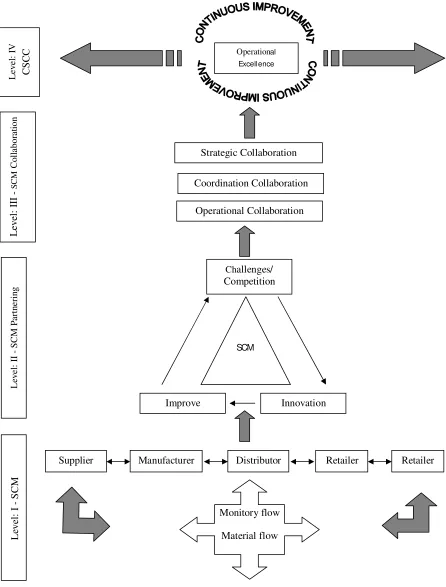
management initiatives can be positioned in a conceptual space made of four levels of supply chain integration.
2. Evolution of Supply Chain Management
A SCM is a large network of suppliers, factories, warehouses, distribution centers and retailers, through which raw materials are sourced processed and delivered to the customer. Being a complex network of several entities, the success of any supply chain management system depends on how well these system entities are managed and contributed. SCM now is a dynamic entity that is constantly changing in response to changes in technology, competitive actions, and customer demands. The “new” supply chain is characterized by three major traits: (a) strategic; (b) dynamic; and, (c) customer driven. It is strategic as it enhances the ability of a firm to develop and maintain strategic advantages in a competitive market. It is dynamic in that it is constantly evolving as a result of strategic changes in the firm, competitive actions, changes in technology, and shifts in customer needs. It is customer-driven as supply chains must focus on value propositions that are highly attractive to customers. The supply network that serves these customers must be optimized and react to supply uncertainties and demand variability.
2.1 Supply Chain Management Integration
Increasingly managers, researchers, and educators recognize the importance of SCM as both a strategic and tactical weapon. However, the practice of supply chain management is ever changing. Originally, the supply chain was viewed as an entity that was primarily concerned with the upstream and downstream management. By the mid 1990s, there was a change in orientation and the focus was shifted from the upstream to the entire supply chain. From the beginning this new century, there evolves a shift in focus from supply chain management to strategic supply chain management. As this transition occurs, there is a strong need for researchers, managers, and educators to reassess the current and future stages of supply chain management with the goal of identifying, presenting, and implementing a new set of agendas. These agendas are targeted at directing, motivating, and facilitating research, knowledge dissemination and management/practice in this area.
2.2 Supply chain partnering
Fynes and Voss (2005) stressed that adopting supply chain orientation requires establishing relationships among the channel partners. The successful partnering is important for companies to improve their business performance, as confirmed by Wong (2002) in his study on “Sustaining company performance through partnering with suppliers”. He identified that one of the concept of success in company performance is that they work closely with the suppliers. The empirical studies reveals that in the domain of SCM relationships have transformed to the relationship perspective which stresses interdependence, connectedness and intimate relationships from the transaction cost economizing dyadic perspective where business relationships are seen as isolated phenomena (Sako et al., 1994; Lamming, 1993, Fynes & Voss, 2005). Table 1 summarizes the history of SCM.
Table 1
The historical trend on SCM literature
Conceptual approaches of SCM Authors, years Integration of various functional areas of an organization to improve the flow
of goods from the direct strategic suppliers up to the end user, along the production and distribution chain
2.3 Supply Chain Collaboration
Extensive research literature on supply chain collaboration (SCC) is very wide-ranging in both business and academia, but not always on objective. The path to susscessful collaboration is to concentrate on the ways that entities in supply chains work together. Collaboration proves to be important since, as Cooper et al. (1997) formulate, sub-optimization occurs when each organization in the supply chain attempts to optimize its own results rather than integrate its goals and activities with other organizations to optimize the results of the whole chain. All entities in the supply chain must work togeather for successfully formulating the fitting strategy. Collaboration in business can be found both in inter and intra organization and ranges from the simplicity of a partnership to the complexity of a multinational corporation. According to Barratt (2004), there are a variety of forms of potential supply chain collaboration, which can be divided into two main categories, vertical and horizontal collaboration. Furthermore, Soosay et al. (2006) states the third form of collaboration namely ‘lateral collaboration’, where it combines the benefits and sharing capabilities of both vertical and horizontal integration.Blanchard, D (2007) observes that collaboration is cited as the single most A management philosophy that reflects a systemic view of SC (by viewing
the chain as a single entity) based on partnership concept that involves the joint efforts of several companies directed to total goods flow management, from supplier to final customer
Ellram & Cooper, 1990
Management of relationships between corporate functions and companies Ellram & Cooper, 1993
“Integration of key business processes from end user through original suppliers that provides products, services and information that add value for customers and other stakeholders”
Global supply chain forum (GSCF), cited in Lambert et al., 1998
A set of approaches used to efficiently integrate suppliers, manufacturers, warehouses, distribution and sales centers, implying the production and distribution of goods in adequate quantities, at the right place and the right time, in order to minimize overall system cost while satisfying the requested level of demand and customer service
Simchi-Levi et al., 2000
To improve the long term performance of the compaines and the supply chain as a whole systemic, strategic coordination of the traditional business functions and the tactics across these business functions within a particular company and across businesses within the supply chain is essential.
Mentzer et al., 2001
The proactive management of bidirectional coordination and movement of
goods, services, information and funds, from raw material to final user Trent, 2004
Since SC is a network of companies, or independent business units, from original supplier to end customers, management of this network is a complex task having the goal to implement cross-functional business processes and integrate them with other key members of the chain
Lambert et al., 2005
“Alliances with key partners, and information technology that allows supply chain partners to share accurate information on a timely basis are the building blocks of efficient and responsive supply chain operations. Upon this foundation, the introduction of lean manufacturing and lean logistics processes, together with the integration of key business processes up and down the supply chain create SCM”.
4
pressing need; but how to achieve it is not well understood. Hence, there exists a gap to strengthen the collaboration inside the SCM network. This research paper explores a new framework Continuous Supply Chain Collaboration (CSCC) dealt in the following sections.
The objective of this paper is to evolve the next level in the integration of the SCM elements, beyond partnership and collaboration, to attain operational excellences. Next section elaborates the several stages of integration in the global SCM arena.
3. Global trends in SCM
In order to highlight the path towards the current stage of development in the field of SCM in the global scenario, we summarize the different trends of SCM in 2010 (Table 2).
Table 2
The historical trends of SCM
Global SCM trends 2010
Liberalization, Privatization and Globalization (LPG) is picking up the pace, which leads to large
structural shifts for dynamic global supply chain organizations. Trend 1
Cost cutting and enhancing the accessability to local markets continue to drive globalization. Inspite of average cost reductions many companies have difficulty realizing savings in management costs.
Trend 2
Global Corporates are converging on India and China as the major target regions for
globalization. Trend 3
When supply chain initiatives are expanded across the globe supply chain delivery and security
are the most critical concerns. Trend 4
The major barriers in globalization of initiatives are the supply chain flexibility and inadequate
internal competency. Trend 5
Future globalization strategies will revolve around environment of sustainability and complying
on regulatory compliances, customer satisfaction and demand. Trend 6
The need for greater supply chain flexibility will go beyond product quality and customer service
as the vital initiative for improving supply chain strategy. Trend 7
The top management agenda across industries and geographic regions is converging on
improving supply chain flexibility and performance through continuous improvement. Trend 8
3.1 The tiger and the dragons of supply chain
more than $120bn in new consumer spending. In order to reach its full potential, India must launch a bold SCM strategy to enhance the customer satisfaction. The rise of India as a new economic powerhouse will further propel these changes, and at the same time introduce new models in the supply chain by combining innovative technologies and virtual networks to meet the country’s growing consumer demand. If properly leveraged, the complex challenges presented by the Indian market today can become unique opportunities for the future. With the world's largest youth population, India is uniquely positioned to convert investment in SCM infrastructure into dynamic economic growth. While China’s competitive advantage has been manufacturing, India’s advantage is in competitive indigenous technology. In a sense, China has been building highways, while India has been building virtual highways. India should now utilize its unique technological advantage to create entirely new models of supply chain networks to break through barriers and ensure sustained economic growth. The government has recently committed new investment in ports, airports, and highways; but Indian also needs new strategies to rapidly evolve to meet rising consumer expectations and satisfying them. A number of companies in India are creating new business models by intentionally focusing global best practices with unique knowledge of the local market. The next section explains the development of the CSCC framework to enhance the customer satisfaction through the four levels.
3.2 Climbing the ladder from SCM to CSCC
Fig. 1 shows the CSCC framework which is developed in this paper.
The CSCC framework consists of the flowing four levels:
Level I : SCM From 1960s to 1980s
Level II : SCM Partnering From 1980s to 2005
Level III: SCM Collaboration From 1990s to 2010
Level IV: CSCC 2010 and beyond
3.2.1 Level: I Supply Chain Management
6
[image:7.612.100.546.63.650.2]© N. Senthil Kumar and P. Subburethina Bharathi
Fig. 1. CSCC frame work showing the four levels of integration
SCM Challenges/ Competition Innovation Improve Operational Excellence Monitory flow Material flow
Manufacturer Distributor Retailer
3.2.2 Level: II Supply chain partnering
Supply-chain partnering has emerged as an important trend at the end of the last century. The effective management of supply chains is said to be characterized by developing close, long-term working relationships with a limited number of supply chain partners. The supply chain partnering (SCP) ensures a systematic process of developing, implementing and continuously improving corporate relationships across the supply chain.
SCP is an internal program aimed at improving overall effectiveness of SCM. The SCP focus is shifted from increasing the internal efficiency of organizations to the methods of reducing waste and adding value across the entire supply chain. Unless there exist a strong foundation of effective relationships, efforts to manage the flow of materials and information across the supply chain are likely to be unsuccessful. Building a partnership among the firms is one way to find and maintain competitive advantage. A blend of local and global excellence in operational initiatives provides the best means to make specific improvements and which ensures a common understanding among supply chain partners. Trust is considered to be a critical factor nurturing commitment among supply chain partners. The presence of mutual trust improves the chance of successful supply chain performance. A deficient in trust among supply chain partners results in inefficient and ineffective performance as the transaction costs climbsup (Kwon, 2004).
3.2.3 Level: III Supply chain collaboration
As a supply chain perspective entails looking beyond the supply chain partners, it is important to have a trusting relationship among them, where each party has mutual confidence with other members' capabilities and actions which leads to the collaboration in SCM. The levels of collaboration among business partners will vary depending upon the organizations perspective role in the supply chain. SCM collaboration was evolved in three stages as given below:
Stage I: Operational collaboration: deploy activities more efficiently within the existing logistic structure. Partners collaborate at an operational level in a short term horizon.
Stage II: Coordination collaboration: achieve savings by coordination between parties. Partners exchange information and planning together with a midterm horizon.
Stage III: Strategic collaboration: accomplish structural savings as a result of restructuring of the shared logistic structure.
Supply chain collaboration provides the efficient exchange of planning information among trading partners to ensure streamlined and optimized management of the flow of parts and materials into the plant. Types of information exchanged include material plans, inventory and capacity availability, performance scorecards, and key performance indicators. The real source of sustainable competitive advantage will rather be the ability to innovate on a continual basis. The main benefits of supply chain collaboration are summarized in two items of lowered inventory costs and increased customer responsiveness. Collaborative product introduction requires extremely strong relationships with suppliers to successfully execute on product design, sourcing, supplier selection, and production ramp up. To collaborate on demand planning successfully, business partners need to share and modify each other’s demand plans and forecast electronically. Once demand plans and forecasts are in place, replenishment plans are designed to assume adequate product availability would be jointly developed.
3.2.4 Level IV: CSCC
8
continuous improvement in all facets of the supply chain operation. Continuous improvement in supply chain is definitely a difficult task, but not an impossible task to attain. Most effective continuous improvement programs should comprehensively analyze performance, identify areas of weakness, and rapidly lead to the necessary improvements. Continuous improvement in SCM has been widely adopted and regarded as providing an important component of increased company competitiveness. CSCC stresses that lean, Six Sigma, theory of constraints, Benchmarking, and other continuous improvement programs are only tools. It is important to choose the right tool for the right problem. The steps to be adopted in the continuous improvement process in the SCM integration are:
1. Establish the supply chain performance baseline using benchmarking and best practices data. 2. Perform a gap analysis of current processes with the identified best practices.
3. identify the improvement opportunities that will significantly impact performance by drilling down the key supply chain processes.
4. Develop goals, objectives and a project plan for each improvement opportunity.
5. Channalize resources to make recommendations and implement justified improvements. (Start the process once again)
Conclusion
The driving forces of effective CSCC are partnering and collaboration. CSCC demands collaboration among all participants in the Supply chain, regardless of their size, function, or relative position. The CSCC framework insists on creating a shared vision for companies, suppliers, and customers can partner to achieve continuous improvement in continuous supply chain performance. The customer-supplier integration calls for commitment and trust over an extended time period which includes sharing of information, risks and rewards. CSCC is an unexplored sea of opportunity in the present competitive scenario. CSCC framework will develop greater efficiency in attaining operational excellence and customer satisfaction.
Reference
Anand, B. N., & Khanna, T. (2000). Do firms learn to create value? The case of alliances.
Strategic Management Journal, 21, 295-315.
Barrett, M. (2004), Understanding the meaning of collaboration in the supply chain, Supply
Chain Management: An International Journal, 9(1), 30-42.
Blanchard, D. (2007) Supply Chain Management Best Practices, John Wiley & Sons, New Jersey.
Bowman, R.J. (2004). More than a buzzword: Collaboration is the key to high-performing supply chains. Global Logistics & Supply Chain Strategies, 8(11), 52– 56.
Cooper, M. C., Lambert, D. M., & Pagh, J. D. (1997). Supply chain management: more than a new name for logistics. International Journal of Logistics Management, 8(2), 1-14.
Ellram, L. M., & Cooper M. C. (1990). Supply chain management, partnerships, and the shipper-third-party relationship. The International Journal of Logistics Management, 1(2), 1-10.
Ellram, L. M., & Cooper, M. C. (1990). The relationship between supply chain management and keiretsu, The International Journal of Logistics Management, 4(1), 1-12.
Research, 43(16), 3303-3320.
Houlihan, J. B. (1987). International supply chain management, International Journal of Physical Distribution & Materials Management, 17(2), 51-66.
Kwon, I.-W. G. and Suh, T. (2004), Factors Affecting the Level of Trust and Commitment in Supply Chain Relationships. Journal of Supply Chain Management, 40: 4–14.
Lambert DM, Garcia-Dastugue S, Croxton KL (2005). An evaluation of process-oriented supply chain management frameworks. Journal of Business Logistics; 26(1):25–57.
Lambert, D. M., Cooper, M. C., & Pagh, J. D. (1998). Supply Chain Management: Implementation Issues and Research Opportunities. The International Journal of
Logistics Management, 9(2), 1-19.
Lamming, R. (2003). Beyond partnership strategies for innovation and Lean supply, Prentice Hall.
Mentzer, J.T., DeWitt, W., Keebler, J.S., Min, S., Nix, N.W., Smith, C.D. and Zacharia, Z.G. (2001), “Defining supply chain management”, Journal of Business Logistics, 22(2), 1-25.
Min, S., Roath, A. S., Daugherty, P. J. Genchev, S. E., Chen, H., Arndt, A. D. & Richey, R. G. (2005). Supply chain collaboration: what’s happening. The International Journal of
Logistics Management, 16(2), 237-256.
Quinn, F. J. (1997). Team up for supply-chain success. Logistics Management, 36, 39-41.
Rich, N., & Hines, P. (1997). Supply-chain management and time-based competition: The role of the supplier association. International Journal of Physical Distribution &
Logistics Management, 27(3/4), 210-225.
Russell, S. H. (2007). Supply Chain Management: More Than Integrated Logistics, Air Force Journal of Logistics, 31(2), 55-63.
Sako, M., Lamming, R., Helper, S. R. (1994). Supplier relations in UK car industry: Good New and Bad News, European Journal of Purchasing and Supply Management, 1(4), 237-248.
Simchi-Levi, D., Kaminsky, P., Simchi-Levi, E. (2000). Designing and Managing the
Supply Chain: Concepts, Strategies, and Case Studies, Irwin McGraw-Hill, USA.
Soosay, C. A., Hyland, P. W, & Ferrer, M. (2006), Supply chain collaboration: capabilities for continuous innovation. Supply Chain Management: An International Journal, 13(2), 160–169.
Supply-Chain Council (2008). Supply Chain Operations Reference Model Version 9.0. Supply- Chain Council, Pittsburgh, USA.
Trent,R.J.(2004). What everyone needs to know about SCM. Supply Chain Management Review,8(2), 52.
Wong, A. (2002). Sustaining company performance through partnering with suppliers.