http://dx.doi.org/10.4236/ajps.2016.76084
How to cite this paper: Ayyub, C.M., Shaheen, M.R., Raza, S., Yaqoob, M.S., Qadri, R.W.K., Azam, M., Ghani, M.A., Khan, I. and Akhtar, N. (2016) Evaluation of Different Radish (Raphanus sativus) Genotypes under Different Saline Regimes. Ameri-can Journal of Plant Sciences, 7, 894-898. http://dx.doi.org/10.4236/ajps.2016.76084
Evaluation of Different Radish
(
Raphanus sativus
) Genotypes under
Different Saline Regimes
C. M. Ayyub1, Muhammad Rashid Shaheen1,2*, Samad Raza1,
Muhammad Sarwar Yaqoob2, Rashad Waseem Khan Qadri1, Muhammad Azam1,
M. Awais Ghani1, Imran Khan3,4, Naheed Akhtar2
1Institute of Horticultural Sciences, University of Agriculture, Faisalabad, Pakistan
2College of Agriculture and Environmental Sciences, TheIslamia University of Bahawalpur, Punjab, Pakistan 3Department of Agronomy, University of Agriculture, Faisalabad, Pakistan
4College of Agriculture, Dera Ghazi Khan, Pakistan
Received 20 January 2016; accepted 24 April 2016; published 27 April 2016
Copyright © 2016 by authors and Scientific Research Publishing Inc.
This work is licensed under the Creative Commons Attribution International License (CC BY). http://creativecommons.org/licenses/by/4.0/
Abstract
An effective and simple screening technique for identification of salt tolerant and salt sensitive ra-dish genotypes was observed. Sand is used as potting media. Six genotypes of rara-dish were used for screening against four salinity levels (0, 1, 3, 5 and 7 dS/m−1). Twenty days old seedlings of radish
were salinized with salt solution (NaCl). Morphological, physiological and ionic parameters were studied. Radish genotypes Laal-Pari and 40 Days executed the best performance in all the meas-ured attributes and categorized as salt tolerant genotype while Green Neck was the poorest in re-taining normal functioning at higher salinity levels thus grouped under salt sensitive cultivar.
Keywords
Radish, Salinity, Physiological, Morphological, Ionic Attributes, Genotypes
1. Introduction
Salinity is a key abiotic stress dropping the yield of extensive variety of crops all over the world [1]. Globally, more than 770,000 km2 of land is salt affected by secondary salinization: 20% of irrigated land, and about 2% of dry agricultural land [2]. The ceiling of plant growth and productivity due to soil salinity is especially critical in
arid and semiarid regions around the globe. Salinity is also a critical problem in many parts of Pakistan. The global appraisal for agricultural land already vanished by salinity goes above 900 million hectares [3].
Salinity may occur when there is unbalanced irrigation, derisory drainage, erroneous application of fertilizer, and it exceptionally increases predominantly in protected cultivation [4]. Generally plants growing in saline me-dia impose to major complications. The first is the increase in the osmotic stress due to high salt absorption of soil solution that declines water potential of soil. The second is increase in Na+ and Cl− level, exhibiting plant tissue accumulation of Na+ and Cl− and inhibition of essential nutrients uptake, thus disturbing ionic imbalance [5]. The growth of plants is finally reduced by salinity stress although plant species differ in their mechanism of tolerance to salinity [6]. High level soil salinity can obstruct seed germination and seedling growth, due to the collective effects of high osmotic potential and specific ion toxicity [7]. The decay in productivity observed for many plant species exposed to excess salinity is often connected with the reduction in photosynthesis capacity [8]. The decrease in photosynthesis under salinity can also be resulted to a decrease in chlorophyll content. Sa-linity reduces the chlorophyll contents, photosynthetic rate, transpiration rate and stomatal conductance in salt susceptible plants and increases in salt tolerant plants. Salinity indirectly checks plant’s growth by affecting tur-gor, photosynthesis or enzyme activities, and in old leaves, it may hasten leaf death [9].
Many efforts have been made to minimize the harsh effect of salt stress on growth and productivity, most aiming on chemical enhancement that involves developing salt resistant cultivars, leaching of excessive soluble salts to lower soil depths from upper soil, highlighting soils containing salt layers at the surface, decreasing salt by gathering salt accumulating aerial plant parts in areas with insignificant irrigation water or rainfall for leach-ing, and promoting of saline soils under cropping and leaching [10].
In Pakistan, crops like radish face a twofold risk of abiotic and biotic stresses. Pakistan’s canal system cannot achieve the farmers’ crop necessities of irrigation. So, to fulfill the needs of these crops, our farmers extract the underground salty water to irrigate their fields. In spite of that, addition of sewages to canals makes it more sa-line and flabby for irrigation. So keeping in mind the significance of salinity, an experiment was conducted to screen out the available radish (Raphanus sativus) germplasm to identify morpho-physiological and ionic attributes of salt sensitive and salt tolerant genotypes.
2. Materials and Methods
Seeds of six radish genotypes were sown in plastic pots containing fine sand individually as a growth medium. Half strength Hoagland solution was used as a nutrient solution. The seeds were watered @ 250 ml per pot.
Sodium chloride (NaCl) at different concentrations (0, 1, 3, 5 and 7 dS/m) was applied after 20 days of sow-ing. To avoid osmotic shock, the seedlings were adjusted to their final NaCl level by imposing the salinity in in-tervals (two days) while the control was without salt stress and irrigated only with half strength Hoagland’s so-lution.
Shoot and root samples were collected for the estimation of various indicators of salt stress after ten days of salinity application. These indicators were comprised of seedlings height, fresh and dry weight of seedlings. Af-ter measuring the fresh weights the shoots and roots of three randomly selected plants from each replicate were taken in paper bags and then placed in drying oven (Memmert-110, Schawabach) at 70˚C for 72 hours. The dry weights of both root and shoot were calculated on digital balance and average dry weight of each replicate was taken.
Chlorophyll contents of seedlings were measured with the help of chlorophyll meter. Measurement of trans-piration rate, stomatal conductance and photosynthetic rate were made on a fully youngest leaf of each seedling using an open system portable Infrared Gas Analyzer (IRGA).
Before the estimation of ionic attributes (Na+ and K+) the plant material was digested, so for this purpose the dried ground plant material (1 g) was digested with concentrated nitric acid (20 mL) in digestion tubes. The di-gested leaf samples of radish genotypes were analyzed for Na+ and K+ by Flame photometer (Jenway PFP-7, UK). A standard curve (SC) was drawn based on graded series of standards (ranging from 10 to 100 mg∙L−1) of Na+ and K+.
3. Result and Discussions
3.1. Effect of Salt Stress on Growth Attributes
Statistical analysis depicted that radish genotypes significantly responded to various salinity treatments. Salt stress decreased plant length in all tested genotypes (Table 1). The genotypes, Laal-Pari and 40 Days gave ex-cellent performance by maintaining the highest seedling height under saline conditions where as Green neck was the lowest in this regard. Minimum % reduction in fresh weight of seedling was recorded Laal-Pari while the maximum in Green Neck with respect to control (non-saline) (Table 1). High plant length and biomass in present study, contribute in their potential to resist the salt stress, so indirectly play a vital role for better growth and productivity [11]. Therefore, poor plant length and plant biomass in Green Neck might have been due to high accumulation of toxic salts i.e. Na+ and Cl−, which may lower their water absorption potential. Various re-ports indicate that salt tolerance is development stage specific processes because one developmental stage may be drastically affected while other exhibit tolerance to salts [12]. The results regarding the seedling height and seedlings fresh and dry weight confirmed these findings of Ahmad and Khan [13].
Salt stress induced an inhibiting effect on plant fresh and dry biomass. Salinized plants of all genotypes exhi-bited the decline in plant fresh and dry weights in comparison to the control (Table 1). Treatment means clearly indicates that plant fresh and dry weights were reduced with the increasing salinity levels from lower to higher levels. The genotype Laal-Pari showed maximum salt tolerance potential in terms of reduction in plant fresh and dry weights at 1, 3, 5 and 7dS∙m−1 NaCl. However, the genotype Green Neck proved to be highly salt sensitive due to the highest decrease in plant fresh and dry weights at 1, 3, 5 and 7 dS∙m−1
NaCl with respect to the control (Table 1).
3.2. Effect of Salt Stress on Physiological Attributes
Stomatal conductance decreased as salinity increased [14] and this decline occurred in all the treatments but highest was at 7 dS∙m−1
(Table 2). Stomatal conductance was low at 7 dS∙m−1 salinity level as compared to other salinity levels. Salinity stress significantly reduced stomatal conductance of all cultivars but highest reduction was found in Green Neck (Table 1). The major effect of salinity is reduction in photosynthetic processes [15]. Results showed that with decrease in stomatal conductance, photosynthetic rate was also decreased. At 5 dS∙m−1 and 7 dS∙m−1
salinity levels photosynthetic rate was significantly decreased in all cultivars, but in genotypes 40 Days and Laal-Pari it was not decreased at significant level. At 7 dS∙m−1 salinity level photosynthetic rate de-creased to very low level (Table 2). Chlorophyll contents decreased at high salinity stress [16]. Chlorophyll contents of leaves at 7 dS∙m−1
salinity level were significantly decreased as compared to control in all genotypes but 40 Days and Laal-Pari exhibited maximum contents of chlorophyll (Table 2).
3.3. Effect of Salt Stress on Ionic Attributes
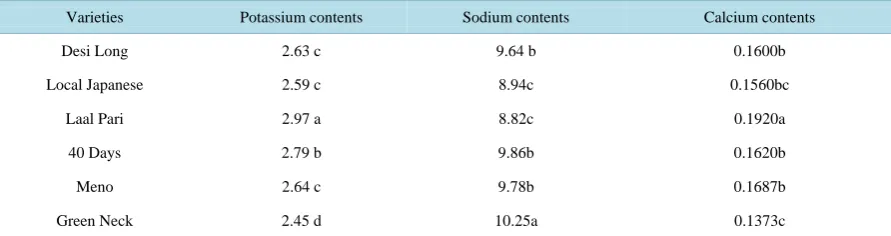
Salinity also has significant influence on the nutritional status of the plant, therefore, nutrient regulation is a vital process, which is closely linked with the salt tolerance potential. It is well documented that salt stress elevates the sodium (Na+) in plant parts while suppresses the concentration of potassium (K+) [13]. In the present inves-tigation, all the tested radish genotypes exhibited an increase of Na+ in the leaf (Table 3) while a reduction of K+ in
Table 1.Effect of salt stress on morphological characters of radish genotypes.
Varieties Shoot length (cm)
Root length (cm)
Shoot fresh weight (gm)
Root fresh weight (gm)
Shoot dry weight (gm)
Root dry weight (gm)
Desi Long 5.21ab 8.39 d 1.97 c 1.81 c 0.17 b 0.27 c
Local Japanese 4.87 b 8.87 cd 1.96 cd 1.86 bc 0.18 b 0.24 c
Laal Pari 5.69 A 10.70 a 2.36 a 2.03 a 0.22 a 0.41 a
40 Days 5.16ab 9.57 bc 2.24 ab 1.92 b 0.17 b 0.30 b
Meno 5.28Ab 10.0 ab 2.09 bc 1.93 b 0.15 c 0.24 cd
Table 2.Effect of salt stress on physiological characters of radish genotypes.
Varieties Chlorophyll contents Photosynthetic rate Stomatal conductance Transpiration rate
Desi Long 8.26 b 8.13 c 0.27 c 2.37 ab
Local Japanese 8.16 b 7.92 cd 0.27 c 2.35 bc
Laal Pari 13.08 a 8.45 b 0.37 a 2.56 a
40 Days 11.35 a 8.74 a 0.31 b 2.48 ab
Meno 6.52 b 7.80 d 0.27 c 2.30 bc
[image:4.595.91.537.249.367.2]Green Neck 4.21 c 7.30 e 0.22 d 2.15 a
Table 3. Effect of salt stress on biochemical characters of radish genotypes.
Varieties Potassium contents Sodium contents Calcium contents
Desi Long 2.63 c 9.64 b 0.1600b
Local Japanese 2.59 c 8.94c 0.1560bc
Laal Pari 2.97 a 8.82c 0.1920a
40 Days 2.79 b 9.86b 0.1620b
Meno 2.64 c 9.78b 0.1687b
Green Neck 2.45 d 10.25a 0.1373c
leaf contents. Since, Laal-Pari and 40 Days showed the minimum concentration of Na+ and maximum K+ in their leaves while on the other hand, genotype Green Neck showed highest Na+ in leaf and lowest K+ in leaf. There-fore, it is concluded that there is a negative correlation between Na+ and K+ in leaf, and salt tolerance is highly associated with ratios of these ions. This difference in Na+ and K+ of radish genotypes may be due to their ge-netic variability and root permeability for these ions. The salt tolerant plants might have been transported less amounts of toxic ions like Na+ to the upper parts (leaf and shoot) because they stored maximum amounts of these ions in their roots. It is an adaptation to withstand saline conditions while salt sensitive plants do not have such kind of mechanism. Similar kinds of observations were noted by Balal [17] in salinized citrus rootstocks. So, it may also be the reason of reduction of Na+ in leaf in Laal-Pari and 40 Days. It is concluded that high leaf level of leaf K+ and low level of leaf Na+ indicate the salt tolerance potential of radish genotypes, so this factor separates the Laal-Pari and 40 Days from Green Neck. This observation is in agreement with the findings of Khayat et al. [18]. Overall, it can be concluded that high morphological attributes, low ratios of toxic ions and high osmotic adjustment is the major difference between salt tolerant and salt sensitive radish genotypes.
References
[1] Ashraf, M. and Foolad, M.R. (2007) Roles of Glycine betaine and Proline in Improving Plant Abiotic Stress Tolerance.
Environmental and Experimental Botany, 59, 206-216. http://dx.doi.org/10.1016/j.envexpbot.2005.12.006
[2] FAO. http://www.fao.org/ag/AGL/agll/spush/intro.htm
[3] Flowers, T.J., Hajibagheri, M.A. and Clipson, N.J.W. (1986) Halophytes. The Quarterly Review of Biology, 61, 313- 337. http://dx.doi.org/10.1086/415032
[4] George, R., McFarlane, D. and Nulsen, B. (1997) Salinity Threatens the Viability of Agriculture and Ecosystems in Western Australia. Hydrogeology Journal, 5, 6-21. http://dx.doi.org/10.1007/s100400050103
[5] Marschner, H. (1995) Mineral Nutrition of Higher Plants. (2nd Edition, Academic Press Inc., London, 446.
[6] Munns, R. and Termaat, A. (1986) Whole Plant Responses to Salinity. Australian Journal of Plant Physiology, 13, 143-160. http://dx.doi.org/10.1071/PP9860143
[7] Grieve, C.M. and Suarez, D.L. (1997) Purslane (Portulaca oleracea L.) a Halophytic Crop for Drainage Water Reuse Systems. Plant and Soil, 192, 277-283. http://dx.doi.org/10.1023/A:1004276804529
Photosynthe-sis in Contrasting Environments, Elsevier, New York, 63-102.
[9] Munns, R. (1993) Physiological Processes Limiting Plant Growth in Saline Soil: Some Dogmas and Hypotheses. Plant,
Cell & Environment, 16, 15-24. http://dx.doi.org/10.1111/j.1365-3040.1993.tb00840.x
[10] Ghafoor, A., Qadir, M., Murtaza, G. and Ahmad, H.R. (2000) Strategies to Harvest Sustainable Rice and Wheat Yields Using Brackish Water for Irrigation. Journal of Arid Land Studies, 7, 165-169.
[11] Carpici, E.B., Celik, N. and Bayram, G. (2009) Effects of Salt Stress on Germination of Some Maize Cultivars. African Journal of Biotechnology, 8, 4918-4922.
[12] Johnson, D.W., Smith, S.E. and Dobrenz, A.K. (1992) Genetics and Phenotypic Relationships in Response to NaCl at Different Developmental Stages in Alfalfa. Theoretical and Applied Genetics, 83, 833-838.
http://dx.doi.org/10.1007/bf00226705
[13] Akram, M., Ashraf, M.Y., Ahmad, R., Waraich, E.A., Iqbal, J. and Mohsan, M. (2010) Screening for Salt Tolerance in Maize (Zea mays L.) Hybrids at an Early Seedling Stage. Pakistan Journal of Botany, 42, 141-154.
[14] Lawlor, D.W. (2002) Limition to Photosynthesis in Water Stressed Leaves: Stomata vs. Metabolism and Role of ATP.
Annals of Botany, 89, 871-885. http://dx.doi.org/10.1093/aob/mcf110
[15] Delfine, S., Alvino, A., Villani, M.C. and Loreto, F. (1999) Restrictions to Carbon Dioxide Conductance and Photo-synthesis in Spinach Leaves Recovering from Salt Stress. Plant Physiology, 119, 1101-1106.
http://dx.doi.org/10.1104/pp.119.3.1101
[16] Gomez, J.M., Jimenez, A., Olmos, E. and Sevilla, F. |(2004) Location and Effects of Long Term NaCI Stress on Supe-roxide Dismutase and Ascorbate Peroxidase Isoenzymes of Pea (Pisum sativum cv. Puget) Chloroplasts. Journal of Experimental Botany, 55, 119-130. http://dx.doi.org/10.1093/jxb/erh013
[17] Balal, R.M. (2010) Morpho-Physiological and Biochemical Characterization and in Vitro Propagation of Salt-Tolerant Citrus Rootstocks. Discussion PhD Thesis, University of Agriculture Faisalabad, Pakistan.