Simultaneous Control of Shape and Properties of AZ31 Magnesium Alloy
Sheets by Incremental Forming
Masaaki Otsu, Yusuke Kai
*and Kazuki Takashima
Graduate School of Science and Technology, Kumamoto University, Kumamoto 860-8555, Japan
In this study, simultaneous control of shape and hardness of AZ31 magnesium alloy sheets by incremental forming process was proposed. Influences of working temperature, giving strain and heat treatment temperature on hardness were investigated. AZ31 magnesium alloy sheets were formed into pyramidal shape by incremental forming process at 100C and 200C. Major strains given to the pyramidal faces were 0.1, 0.2
and 0.3. After forming, heat treatment was carried out at various temperatures. Combination of final shape and total equivalent plastic strain were changed by multi-step forming and hardness distribution was measured. From the experimental results, it was found that when heat treatment was done at 200C for 10 min after forming at 200C, hardness of the specimen became higher than that of as received one. When heat treatment
was carried out at 175C for 60 min after forming at 100C, hardness of the specimen also increased. In the case of multi-step forming, strain was
accumulated at forming temperature of 100C and hardness increased, but not at the forming temperature of 200C. By multi-step forming at
100C, asymmetric hardness distribution with symmetric shape was realized and simultaneous control of shape and hardness was
succeeded. [doi:10.2320/matertrans.MC2007102]
(Received October 18, 2007; Accepted February 4, 2008; Published April 25, 2008) Keywords: simultaneous control, shape, hardness, incremental forming
1. Introduction
In sheet metal forming, flat metal sheets are formed into desirable three-dimensional shape. Strain distribution of formed sheet is almost determined by formed shape, though strain distribution can control certainly by employing multi-step forming. Strain distribution governs product’s mechan-ical properties such as hardness in as formed state and microstructures such as grain size after heat treatment. If forming shape and strain distribution were given independ-ently during one forming process, products having desirable shape and distribution of mechanical properties and micro-structure would be manufactured.
Incremental forming process is one of sheet metal forming methods without punch and dies. In this process, only a simple stick tool is used for forming and the tool is moved along the contour lines of three-dimensional shape of product. Since the sheet is formed at only small region in this process, forming limit is improved comparing with the
conventional stamping process.1–4)By employing
incremen-tal forming process, it is easy to flatten the formed sheet although it is very difficult by the conventional stamping
methods.5)Thus, it is possible to deform the reversed sheet
already formed. This means that shape and strain distribu-tions can be controlled simultaneously and independently by introducing multi-step forming for forming several inter-mediate shapes.
In this study, simultaneous control of shape and mechan-ical properties by incremental forming were aimed, and effects of accumulated equivalent plastic strain, working temperature and heat treatment conditions on hardness were investigated.
2. Experimental Method 2.1 Equipment
Figure 1 shows a schematic illustration of experimental equipment. Specimen sheets were fixed to a blank holder and dies, and deformed by a stick tool having a hemispherical head with a radius of 3 mm mounted on a six-axis robot arm. The motion of the forming tool was controlled numerically by a personal computer. The specimen sheet was heated by a resistant heater and working temperature was controlled by adjusting the position of the heater using a jack. The temperature of the specimen sheet was measured by an infrared thermometer.
2.2 Conditions
Experimental conditions for incremental forming are shown in Table 1. AZ31B-O magnesium alloy sheets were used for specimens. An optical micrograph of as received one
is shown in Fig. 2, and the average grain size was 8.8mm.
The shape of the sheets was a right square of 100mm
Specimen
Heater
Blank holder Die Tool
Robot PC
Jack
Table
Fig. 1 Schematic illustration of experimental equipment.
*Graduate Student, Kumamoto University
Special Issue on Platform Science and Technology for Advanced Magnesium Alloys, IV
100mm and thickness was 0.4 mm. Formed shape was
pyramidal with a square base of 60mm60mm. By
changing the height of the pyramid, the strain of pyramidal
faces was controlled. Working temperature was 100C and
200C. Heat treatment after forming was also carried out at a
temperature of 150–250C which is near the recrystallization
temperature.6)
2.3 Procedure
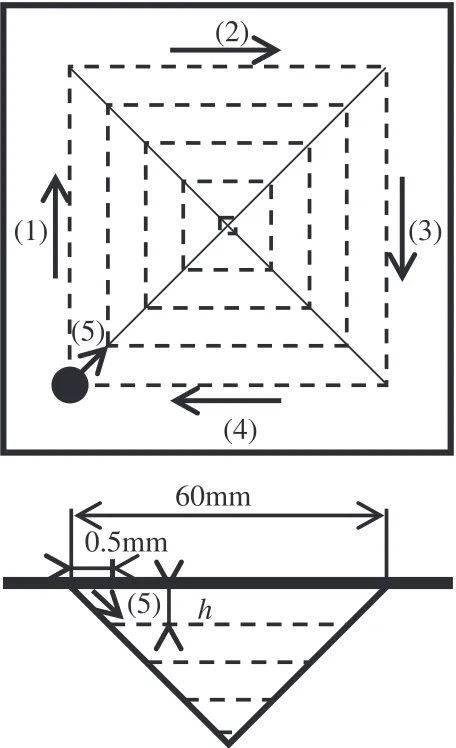
Procedure of moving the tool is expressed in Fig. 3. First,
the tool was pushed into the sheet forhmm and then moved
along the square path of60mm60mm first. After moving
along the square path, the tool was moved to the 0.5 mm inner
andhmm deeper position, linearly. This forming process was
repeated until pyramidal shape was finished.
To measure the strain of sheet, the circle grid method was employed. Estimated strain from forming condition and measured strain were obtained beforehand and calibration was performed. Forming was carried out for giving major
strain of 0.1 and 0.2 at working temperature of 100C, and
major strain of 0.1, 0.2 and 0.3 at 200C. After forming, heat
treatment was carried out at 150–250C for 60 min in a
muffle furnace. Observation of microstructure by optical microscope and measurement of vickers hardness were done for as formed and heat treated sheets. Hardness test was carried out for seven times and the average value was calculated from the five data except the minimum and the maximum values.
In this study, two types of forming, single step forming and multi-step forming, were performed. In single step forming, the final shape was formed with only one step. In multi-step forming, the sheet was deformed into an intermediate shape and the sheet was turned upside down as shown in Fig. 4. This process was repeated for several times and then, the final shape was formed.
3. Results
3.1 Single step forming
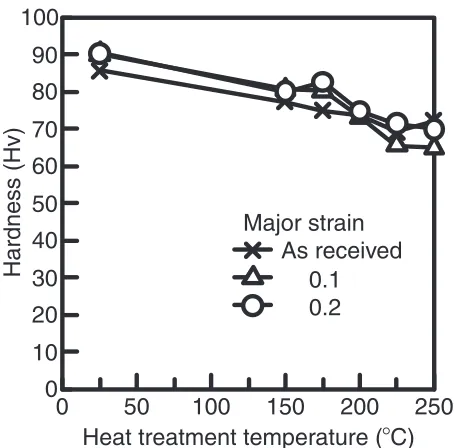
Relationship between hardness and heat treatment
temper-ature after forming at 100C is illustrated in Fig. 5. In the
case of working temperature of 100C, hardness increased by
forming, however, there were no significant difference between the cases that major strain were 0.1 and 0.2. Although hardness decreased as heat treatment temperature
became high, it increased a little at 175C. From the optical
microscope observation, many twin crystals were found but recrystallization did not occurred. When heat treatment
temperature was higher than 225C, hardness of formed one
became lower than that of as received one due to the recrystallization.
In Fig. 6, relationship between hardness and heat treatment
temperature after forming at 200C is shown. Hardness of as
Dimensions of specimens/mm 1001000:4
Forming shape Pyramidal
Base size of forming pyramid/mm 6060
Forming pitch/mm 0.5
Working temperature/C 100, 200
Heat treatment temperature/C 150–250
Heat treatment time/min 5–60
Fig. 2 Optical micrograph of as received AZ31-O sheet.
(1)
(2)
(3)
(4)
(5)
0.5mm
h
60mm
(5)
[image:2.595.313.541.73.447.2] [image:2.595.51.289.75.414.2]received sheets decreased as heat treatment temperature was
elevated, however, that of formed ones at 200C did not
change very much. When heat treatment was carried out at
200C, hardness increased and, especially, that with major
strain of 0.3 became higher than that of as received one. In addition, hardness became maximum when heat treatment time was 10 min as shown in Fig. 7 expressing the effect of heat treatment time on hardness. In all heat treatment temperature case, recrystallization was observed.
3.2 Multi-step forming
Hardness of sheet formed into different shape with same
equivalent strain at 100C is plotted in Fig. 8. The final shape
is expressed by the major strain. Equivalent strain was fixed to 0.35. Although hardness decreased if heat treatment was carried out, hardness was almost equal when the final shapes were different. This means that the forming was succeeded for different shape under constant hardness.
Hardness of sheet formed into same shape with different
equivalent strain at 100C is illustrated in Fig. 9. As
Large strain
Specimen
Tool
Small strain
(i)
(ii)
(iii)
(iv)
(v)
(vi)
Reverse
Fig. 4 Schematic illustration of multi-step forming.
0
0
10
20
30
40
50
60
70
80
90
100
0.1
0.2
Major strain
Heat treatment temperature (
°
C)
Hardness (Hv)
As received
250
200
150
100
50
Fig. 5 Hardness of sheets formed at 100C after heat treatment.
0
0
10
20
30
40
50
60
70
80
90
100
0.1
0.2
Major strain
Heat treatment temperature (
°
C)
Hardness (Hv)
As received
0.3
250
200
150
100
50
Fig. 6 Hardness of sheets formed at 200C after heat treatment.
0
60
0
10
20
30
40
50
60
70
80
90
100
Working temperature
Heat treatment time (min)
Hardness (Hv)
100 C
°
C
°
200
50
40
30
20
10
[image:3.595.311.540.74.293.2] [image:3.595.52.287.75.436.2] [image:3.595.313.541.336.559.2] [image:3.595.55.282.474.698.2]equivalent strain increased under same final shape, hardness slightly increased. This means that hardness was changed although the final shape did not change. The difference between minimum and maximum hardness was largest when
heat treatment temperature was 150C. From Figs. 8 and 9,
the final shape and hardness were controlled simultaneously. Hardness was decreased when heat treatment was carried out.
Next, forming was performed at 200C and hardness for
the cases of different shape with same equivalent strain and same shape with different equivalent strain was investigated. Figure 10 shows the relationship between hardness and the final shape with same equivalent strain of 0.35. After heat
treatment at 200C for 10 min, hardness became higher than
that of as formed one. In the case which major strain was 0.3, that is single step forming, hardness became much higher by employing heat treatment. However, in multi-step forming case, hardness was almost constant even if forming shape was changed. Since the final shapes were different and hardness of as formed sheet was constant in multi-step forming, hardness could not be controlled.
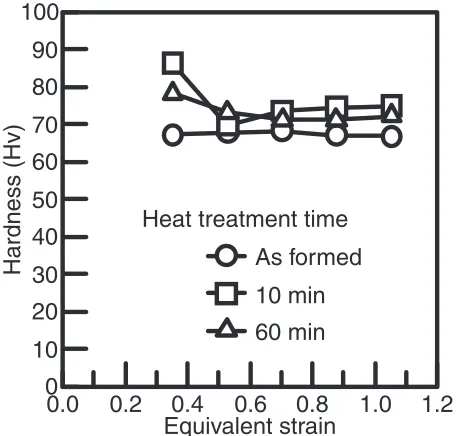
The result of hardness of sheet formed at 200C for same
final shape with different equivalent strain is shown in Fig. 11. As well as the former results, hardness was highest in the case of single step forming and hardness was constant although equivalent strain was changed. So shape and hardness could not be controlled simultaneously.
0
0.3
0
10
20
30
40
50
60
70
80
90
100
110
120
175
°
Heat treatment
Major strain
Hardness (Hv)
As formed
150
°
200
°
C
C
C
temperature
0.2
0.1
Fig. 8 Hardness of sheet formed at 100C for different shape with same
equivalent strain.
0.0
0
10
20
30
40
50
60
70
80
90
100
110
120
175
°
C
Heat treatment
Equivalent strain
Hardness (Hv)
As formed
150
°
C
200
°
C
temperature
1.0
0.8
0.6
0.4
0.2
Fig. 9 Hardness of sheet formed at 100C for same shape with different
equivalent strain.
0
0
10
20
30
40
50
60
70
80
90
100
60 min
Heat treatment time
Major strain
Hardness (Hv)
As formed
10 min
0.3
0.2
[image:4.595.55.284.73.294.2]0.1
Fig. 10 Hardness of sheet formed at 200C for different shape with same
equivalent strain.
0.0
1.2
0
10
20
30
40
50
60
70
80
90
100
60 min
Heat treatment time
Equivalent strain
Hardness (Hv)
As formed
10 min
1.0
0.8
0.6
0.4
0.2
Fig. 11 Hardness of sheet formed at 200C for same shape with different
[image:4.595.312.542.75.296.2] [image:4.595.55.286.353.578.2] [image:4.595.313.542.357.575.2]3.3 Control of hardness distribution
For an example of applying simultaneous control of shape and hardness, pyramid having symmetric shape with asym-metric hardness distribution was formed. In this case, asymmetric shape was formed as an intermediate shape and symmetric shape was formed as the final shape like shown in
Fig. 4. Working temperature was 100C, since simultaneous
control of shape and hardness was succeeded only this
working temperature. Heat treatment temperature was 150C
to enhance the difference of the hardness. Relationship between hardness and equivalent strain is plotted in Fig. 12. Although the pyramid was a symmetric shape, hardness of each pyramidal face had different hardness as a function of equivalent strain.
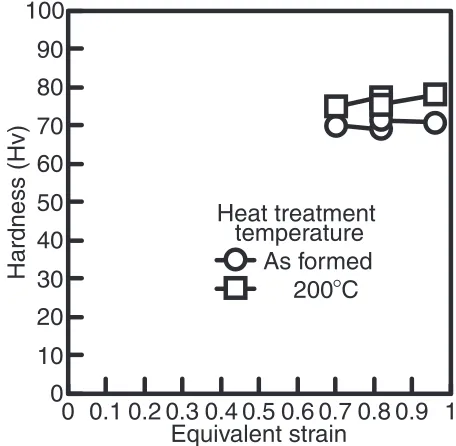
When forming was carried out at 200C, as shown in
Fig. 13, hardness of each pyramidal face was almost equal but hardness was improved by performing heat treatment at
200C.
4. Conclusions
In this study, a new forming process was proposed to realize the simultaneous control of shape and hardness by introducing multi-step forming and heat treatment after forming using incremental forming method. Effect of form-ing and heat treatment conditions on hardness distribution of
formed parts was examined by forming AZ31B-O magne-sium alloy sheets into pyramidal shape.
(1) In single step forming, hardness of the formed sheets
was improved by heat treatment at 175C for 60 min
after working at 100C. When heat treatment was
performed at 200C for 10 min after working at 200C,
hardness became higher than that of as received one. (2) In multi-step forming, simultaneous control of shape
and hardness was possible when working temperature
was 100C but, failed when working temperature was
200C.
(3) Asymmetric hardness distribution with symmetric shape was formed by proposed method.
REFERENCES
1) K. Kitazawa and S. Hayashi: Trans. JSME, Part C63-614 (1997) 3681– 3687.
2) T. J. Kim and D. Y. Yang: Int. J. Mech. Sci.42(2002) 1271–1286. 3) J. Jeswiet, F. Micari, G. Hirt, A. Bramley, J. Duflou and J. Allwood:
CIRP Ann.54-2 (2005) 623–649.
4) J. M. Allwood, D. R. Shouler and A. E. Tekkaya: Key Eng. Mater.344
(2007) 621–628.
5) K. Kitazawa and H. Hase: Proc. 55th Japanese Joint Conf. for Technol. Plasticity, (Japan Society for Technology of Plasticity, 2004) pp. 3–4. 6) The Japan Magnesium Association:Handbook of Advanced Magnesium
Technology, (Kallos Publishing, 2000) pp. 137.
0
0
10
20
30
40
50
60
70
80
90
100
Heat treatment
Equivalent strain
Hardness (Hv)
As formed
150
°
C
temperature
[image:5.595.55.284.72.299.2]1
0.9
0.8
0.7
0.6
0.5
0.4
0.3
0.2
0.1
Fig. 12 Hardness of each pyramidal face formed at 100C with
asym-metric intermediate shape.
0
0
10
20
30
40
50
60
70
80
90
100
Heat treatment
Equivalent strain
Hardness (Hv)
As formed
200
°
C
temperature
[image:5.595.311.539.75.298.2]1
0.9
0.8
0.7
0.6
0.5
0.4
0.3
0.2
0.1
Fig. 13 Hardness of each pyramidal face formed at 200C with