1. Determine the voltage at the generating station and the efficiency of the following system (Figure 1): Both transformers have ratio of 2kV/11kV. The resistance on LV side of both
Figure 1:
transformers is 0.04 ohm and that on HV side is 1.3 ohm. Reactance on LV and HV side of both transformers is 0.125 ohm and 4.5 ohm respectively. [Ans: Efficiency = 96.3%, Vs = 2168 Volts]
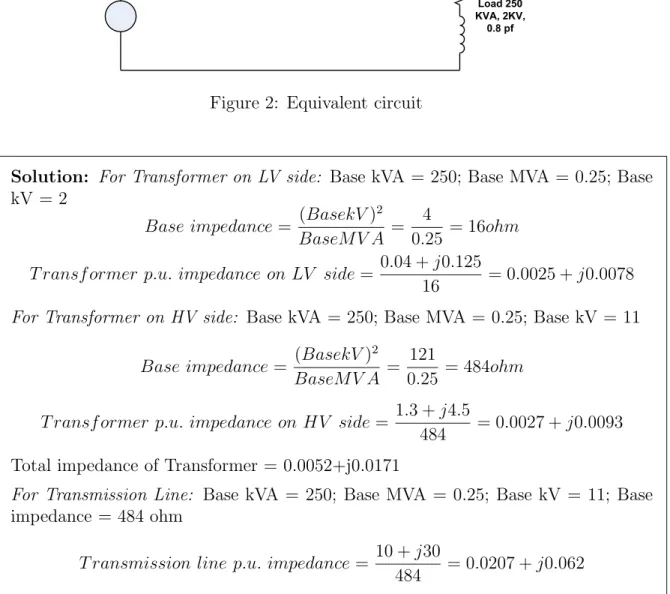
Figure 2: Equivalent circuit
Solution: For Transformer on LV side: Base kVA = 250; Base MVA = 0.25; Base kV = 2
Base impedance= (BasekV) 2 BaseMV A =
4
0.25 = 16ohm T ransf ormer p.u. impedance on LV side= 0.04 +j0.125
16 = 0.0025 +j0.0078 For Transformer on HV side: Base kVA = 250; Base MVA = 0.25; Base kV = 11
Base impedance= (BasekV) 2 BaseMV A =
121
0.25 = 484ohm T ransf ormer p.u. impedance on HV side= 1.3 +j4.5
484 = 0.0027 +j0.0093 Total impedance of Transformer = 0.0052+j0.0171
For Transmission Line: Base kVA = 250; Base MVA = 0.25; Base kV = 11; Base impedance = 484 ohm
T ransmission line p.u. impedance= 10 +j30
For Load: Base kVA = 250; Base MVA = 0.25; Base kV = 2 Base Current= 250×1000
2000 = 125amps p.u. MVA = 1.0; p.u. kV = 1.0; p.u. Current = 1.0
P ower Loss=I2 R = 12 ×(0.0052 + 0.0207 + 0.0052) = 0.0311p.u. %η= Outputrealpower outputrealpower+losses ×100 = 1×0.8 1×0.8 + 0.0311 ×100 = 96.26% Taking Vr as the reference, the sending end voltage
Vs =Vr+Ir6 φr(R+jX) =Vr+ (IrCosφr−jIrSinφr)(R+jX)
Vs= 1 + (0.8−j0.6)(0.0311 +j0.0962) = 1.0826 +j0.0583p.u= 1.08426 3.0825
Sending end voltage = 2000×1.0842 = 2168.4 Volts
2. A load of three impedances each (6+j9) is supplied through a line having an impedance of (1+j2) ohm. The line-to-line sending end voltage is 400 volts 50 Hz. Determine the power input and output when the load is
(a) star connected and, (b) delta connected.
[Ans: (a) 6591W, 5649W (b) 14124.9W, 9416W]
Solution: When load is star connected:
T he line to neutral voltage= 400√
3 = 231volts
T he impedance per phase= (6 +j9) + (1 +j2) = (7 +j11)ohm T he line current= 231
7 +j11 = 17.7amps P ower input = 3×17.72×7 = 6591watts P ower output= 3×17.72
×6 = 5649watts
For the same impedance (6+j9), the equivalent star impedance will be 1
3(6 +j9) = (2 +j3)ohm The impedance per phase = (2+j3) +(1+j2) = (3+j5)
T he line current= 231 3 +j5 = 39.6amps P ower input= 3×39.62 ×3 = 14124.9watts P ower output= 3×39.62 ×2 = 9416watts
3. Determine the efficiency and the regulation of a 3-phase, 100km, 50Hz transmission line delivering 20MW at a p.f. of 0.8 lagging and line-to-line voltage 66KV to a balanced load. The conductors are of copper, each having resistance 0.1 ohm per km, 1.5 cm outside diameter, spaced equilaterally 2 meters between centres. Neglect leakage and use nominal-T model. [Ans: % Regulation = 18.04%, % Efficiency = 93.54%]
Figure 3:
Solution: The total resistance of the line = 100 × 0.1 = 10 ohms
T he line inductance of the line= 2×10−7
×1000ln 200 0.7788×0.75 = 11.67×10 −2 H Inductive reactance= 314×11.67×10−2 = 36.67ohm z = 10 +j36.67ohm T he capacitance/phase = 2Π×8.854×10 −12 ln200 0.75 ×100×1000 = 9.959×10−7 = 0.9959µF
The nominal-T circuit for the problem is given in Figure 3. IR= √20×1000
VR= 66×√1000
3 = 38105volts Taking IR as reference, the voltage across the capacitor will be
Vc = (38105×0.8 + 218.68×5) +j(38105×0.6 + 218.68×18.335) = 31578 +j26873 T he current Ic =jωCVc =j314(31578 +j26873)×0.9959×10−6 =j9.88−8.41 Is = 218.69 +j9.88−8.41 = 210.29 +j9.88amps |Is|= 210.52 amps Vs =Vc+IsZ 2 = 31578 +j26873 + (210.29 +j9.88)(5 +j18.335) = 32448 +j30778 |Vs|= 44723volts The no load receiving end voltage will be
|Vs|(−j3196.2) 5 +j17.55−j3196.2 = 44723(−j3196.2) 5−j3178.65 = 44981volts %regulation= 44981−38105 38105 ×100 = 18.04%
To determine the efficiency, we evaluate transmission line losses as follows: 3 [218.692
×
5 + 210.522
×5] = 1.3822 MW
% Ef f iciency = 20
20 + 1.3822 ×100 = 93.54%
4. Determine the efficiency and the regulation for above problem using nominal-Π model. [Ans: % Regulation = 18.11%, % Efficiency = 93.51%]
Figure 4:
The nominal-Π circuit for the above problem is shown in Figure 4.
For nominal-Π it is preferable to take receiving end voltage as the reference phasor. The current IR = 218.69(0.8 - j0.6). Current Ic1 =jωCVr =j314×0.4977×10−6 ×38105 =j5.96amps Il =IR+Ic1 = 174.95−j131.21 +j5.96 = 174.95−j125.25 Vs =VR+IcZ = 38105 + (174.94−j125.25)(10 +j36.67) = 44448 +j5162.8volts |Vs| = 44746 volts.
The no load receiving end voltage will be 44746(−j6398) 10 +j36.67−j6392.4 = 44746(−j6398) 10−j6355.7 = 45005volts %regulation= 45005−38105 38105 ×100 = 18.11% The line current Il = 215.17 Loss = 3× 215.172 × 10 = 1.389 MW
%ef f iciency = 20×100
21.389 = 93.51%
Same problem can also be solved using generalized circuit constants for a nominal-Π model.
5. A three phase 50 Hz transmission line is 400 km long. The voltage at the sending end is 220 kV. The line parameters are r=0.0125 ohm/km, x=0.4 ohm/km and y = 2.8×10⁻⁶ mho/km. Find the sending end current and receiving end voltage when there is no-load on the line. Assume the line to be a medium length line. [Ans: Sending end current = 152A, Receiving end voltage = 241.7582 KV]
Solution: The total line parameters are: R=0.125 × 400 = 50 ohms X = 0.4 × 400 = 160 ohm Y = 2.8 × 10−6 × 400 6 90 = 1.12 × 10⁻³ 6 90 mho Z = R+jX = (50+j160)= 167.63 6 72.65 mho At no-load: Vs = A VR and Is = C VR
A= 1 + Y Z 2 = 1 + 0.18756 162.65 2 = 0.904 +j0.03 |A| = 0.9045 C =Y(1 + Y Z 4 ) = 1.12×10 −3 6 90(1 +0.1875 6 162.65 4 = 1.1×10 −3 6 90.8367 Now, |VR|line= 220 |A| = 220 0.9045 = 243.2295KV |Is|=|C||VR|= 1.1×10−3 × 243.2295√ 3 ×10 3 = 154.4989amps
It is to be noted that under no-load conditions, the receiving end voltage (243.2295KV) is more than the sending end voltage. This phenomenon is known as the Ferranti effect.