Virtual Organization
Author
Dr. David Gould [email protected]
Abstract
There are a number of terms describing various new ways of working together electronically–for example virtual organizations, virtual teams, remote teams, virtual universities, and virtual corporations. This paper looks at several reasons organizations may want to virtually organize and ways in which this could be accomplished. Virtual organizing can lead to an information marketplace–an electronic bazaar that is always open. Finally a list of benefits, examples, and enabling technologies are provided.
Virtual Organization
What is virtual organization? Virtual organization can be thought of as a way in which an organization uses information and communication technologies to replace or augment some aspect of the organization. People who are virtually organized primarily interact by electronic means. For example, many customer help desks link customers and consultants together via telephone or the Internet and problems may be solved without ever bringing people together face-to-face.
Drivers
What is driving organizations to virtually organize? Three basic reasons are to respond to rapid changes in the marketplace, the availability of enabling
technology, and the need to reduce costs.
The marketplace is changing dramatically and is expected to continue changing rapidly. Regarding environmental change, Huber and Glick (1993, p. 4) wrote.
The fast-changing nature oftoday’s organizationalenvironments is largely a consequence of two factors: (1) the increasing effectiveness of
information technology (both communications technology and computing technology) and (2) the increasing effectiveness of transportation
technology.
Huber and Glick (1993, p. 4) gave three examples of environmental change. Global markets could not be what they are if information, products, and
The decline of manufacturing employment in the United States is directly a
consequence ofautomation (read “information technology”)and across
-borders manufacturing and importation (read “transportation technology”).
The social issues that today affect organizations have much of their force because advances in communications technology (1) make social
injustices and environmental tragedies vivid and widely known and (2) enable many separate entities to communicate, coordinate, and cooperate in confronting organizations on such matters.
Other specific instances of change affecting organizations include: Organization-wide projects or initiatives.
Alliances with different organizations, some of which may be in other countries.
Mergers and acquisitions.
Emerging markets in different geographic locations–globalization. The desire of many people and government organizations for
telecommuting.
The continuing need for business travel and information and communications technologies available to support this travel. The need cycle time.
The need to innovate and improve existing products and develop new ones.
Enabling technology–computers, computing applications, and communications networks such as the Intranet are widely available and generally affordable. Of course, the need to reduce costs is common to all organizations.
Organizational Components
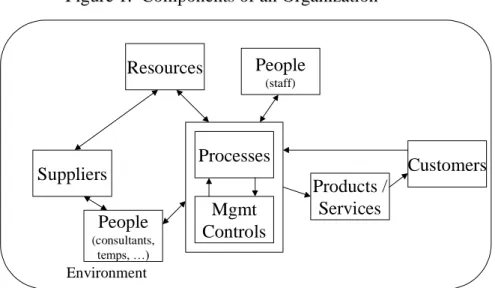
Organizations are made up of a number of components such as business processes, customers, suppliers, trading partners, resources, and people.
The following figure, figure 1, illustrates these components and their relationships using a model from systems theory. System inputs include suppliers, resources, and people. Processes are business processes and organizational controls. Processes transform inputs into outputs (products and services). The
organization’s managementcontrols provide direction and goals and influence
business processes. The business system resides in an ever-changing environment, which includes competition, financial markets, society, law, government, and technology.
Processes Mgmt Controls Products / Services Resources Suppliers People (staff)
Figure 1. Components of an Organization
Environment People (consultants, temps,…) Customers
Virtual Organizing
What aspects of an organization can be virtualized? There are five basic
dimensions that organizations can virtually organize along and each dimension is a continuum from physical to virtual.
Location
Organizational interfaces or boundaries Organizational processes
Organizational structures Products / services
Note: Not all organizations can virtualize on all of these dimensions. Virtual organizing is dependent on what the organization does. But most organizations can virtually organize on one or more dimensions.
Virtual Organization Dimension
This section provides a description and one or more examples for each dimension. The set of examples provided is not exhaustive.
Location
A permanent physical location of an organization may not actually exist. Instead, an organization may maintain an electronic presence in the marketplace.
Physical facilities could be leased or rented as needed. Manufacturing, if needed, could be outsourced.
Example
Verifone is a good example of an organization with few physical facilities. Many employees work out of their homes and keep in touch with each other and with company data via information and communication technologies.
Organizational Interface or Boundary
Organizational interfaces or boundaries are generally linked to their business processes. These interfaces include internal interfaces such as employee interfaces to business processes and external interfaces such as stockholder, customer, supplier, trading partners, and government agencies interfaces to business processes.
Example
Many organizations provide a virtual storefront, which customers can access, from the Internet and browse through a catalog, order, and pay for products. Amazon.com is a company that sells books through the Internet.
Organization Processes / Applications
An organization’s business processes are easily linked to organizational
interfaces for the acquisition of products and the distribution of information. The automation of business processes via computer applications has been a major industry over the last thirty-to-forty years.
Examples
Purchasing / Acquisition
Several companies have implemented an application to automate the purchase of office supplies. These applications have a web interface that employees interact with. The business process has not only been virtualized by being automated via software, but the access to it has been virtualized in that employees interact with the application electronically and not through other people. Amazon.com is an example of a company that has provided and linked its purchasing and acquisition business processes with its external customer interface.
Education & Training
A corporate training program or University can develop a set of training classes to be delivered on-demand to students at their desktop or laptop computers via the Internet / Intranet. Registration, payment, and assignments can be submitted
via the Internet / Intranet. Questions and answers can be facilitated through voice mail or email. Virtual Universities work in this manner.
RFP / RFI Process or Hiring Process
An organization could place a Request for Proposal (RFP), a Request for Information (RFI), or an ad for employment on the Internet along with response forms. Responding organizations or people simply complete the form and submit it for processing. A number of companies, Universities, and Colleges allow
prospective employees to submit resumes via the Internet. Customer Service
Customer service can be provided to customers via the Internet. Frequently asked questions, known problems with fixes, trouble reports, and so on are easily created and made available to customers. Electronic mail is another way to electronically reach out to customers.
Advertising
Products and services are easily advertised on the Internet. Advertising can be either static (e.g., a brochure) or dynamic where the advertisement can interact with customers. It seems as if every organization has a presence on the Internet. Many resorts, movie theaters, and major corporations advertise in some way on the Internet.
Products and Services
Products and services in the form of an electronic document, a video, an audio clip, a computer application, and in some cases consultation –can be ordered, paid for and delivered to customers over the Internet.
Images of physical products and services can be stored in an electronic catalog and be ordered and paid for electronically. The physical item would then be shipped to or picked up by the customer.
Example
An example of a virtualized service is a museum. Digitized images in a museum could become a pay-per-view type of show. Customers could select a museum, pay the admission fee, and browse through the electronic exhibits without leaving
home.Common examples ofvirtualized products include today’s radio and
television broadcasts.
Organizational structure
Organizational structure refers to the degree of complexity, formalization, and
centralization.Robbins (1993,p.487)defined organizationalcomplexity as “the
degree of vertical, horizontal, and spatial differentiation in the organization.” Many of the elements of communication, coordination, and collaboration among
these distributed elements can be addressed by information and communication technologies.
Examples
Virtual teams are teams of people that primarily interact electronically and may never meet face-to-face. Virtual teams may include members of the same organization or may include people from other organizations. It is immaterial where the team members physically reside. A good example is a team whose members telecommute.
Virtual corporations are corporations that have expanded their value chain to include suppliers and / or customers to deliver better value to their customers.
Rationale or benefit of virtuality
Some of the benefits of virtually organizing include the following: Reduced operational costs.
Reduced costs of providing information.
A global presence (accessible from anywhere). Always open for business (accessible at anytime).
Projects can be staffed with people based on competency regardless of physical location.
People can connect with each other regardless of time, space, or organizational boundaries.
Localized skills shortages can be overcome.
Implication or cost of virtuality
Some of the costs of virtually organizing include the following.
Additional hardware, software, and networks may have to be deployed. Additional security may be required.
Some people may be required to virtually meet at non-traditional work times. For example, people communicating in real-time but located in different parts
ofthe world may be severaltime zones apart.One person’s workday may be otherperson’s nighttime.
An organizational culture based on trust is a requirement for long-term viability.
People need to be trained in the technologies used.
Enabling Technologies
There are a wide variety of information and communication technologies available from a wide variety of suppliers, which provide the support for virtual organization.
Generic technologies include servers, personal computers, telephones, electronic mail, audio and video conferencing, Internet / Intranet, browsers,
databases, electronic catalogs, software development tools, and applications such as accounting, financial, and human resources packages.
The capability of these products is advancing rapidly. Some major trends that will enhance virtual work in the future are continued miniaturization, lower costs, higher speeds of processing and networking, increased storage capacity, and the convergence of voice, data, image, and video. For example, there is newly
available a cellular telephone that opens to a keyboard and screen with access to the Internet. It easily fits into an attaché case.
Conclusions
Organization needs and the enabling technology are now capable of creating new ways of organizing people, processes, products / services, and interfaces and boundaries. Information and communication technologies make it possible for organizations to virtual organize various aspects of their business. Outcomes include virtual teams, virtual corporations, virtual universities, virtual products, and virtual communities.
References
Davidow, W.H. and Malone, M.S. (1992). The virtual corporation. New York: HarperCollins, Publishers.
Dertouzos, M. (1998). What will be. New York: HarperCollins, Publishers. Grenier, R., & Metes, G. (1995). Going virtual. Upper Saddle River, NJ:
Prentice-Hall.
Hagel, J. and Armstrong, A.G. (1997). Net gain. Boston: Harvard Business School Press.
Hardwick, M. and Bolton, R. (1997, Sept.). The industrial virtual enterprise. Communications of the ACM, 40( 9), 59-60.
Huber, G. P., & Glick, W. H. (1993). Organizational change and redesign. New York: Oxford.
Lipnack, J., & Stamps, J. (1997). Virtual teams. New York: John Wiley & Sons Inc.
Mankin, D., Cohen, S.G., and Bikron, T.K. (1996). Teams and technology. Boston: Harvard Business School Press.
Metes, G., Gundry, J., and Bradish, P. (1998). Agile networking. Upper Saddle River, N.J.: Prentice-Hall.