C
ONNECTING THE
D
OTS
:
B
UILDING A
S
YSTEM
THAT
I
MPROVES
T
EACHER
Q
UALITY
Lucy Steiner and Julie Kowal, Public Impact
Mary O’Connell
Acknowledgements
This report was made possible by the generous support of The Joyce Foundation. The authors are grateful to Gretchen Crosby Sims, John Luczak, Charlie Boesel and Angela Rudolph for their guidance, as well as to Tim Daly, Kati Haycock, and Andy Rotherham for their helpful feedback and insights as the draft took shape. We are also indebted to Bryan Hassel, Emily Ayscue Hassel, Jacob Rosch, Joe Ableidinger, and Eli Valsing of Public Impact for their assistance and helpful feedback.
W
HY
T
EACHER
Q
UALITY
M
ATTERS
Every day, in classrooms across the United States, students crowd through the door, take their seats, and turn their attention to the teacher. As every parent, student and
community member knows, having an excellent teacher at the front of that classroom is the best way to ensure that students succeed.
Research backs that up: no other school factor has more impact on how much students learn than the quality of their teachers. In fact, students who are taught by a highly effective teacher can make as much as another half year’s gains in addition to expected annual grade-‐level progress. In other words, a child who starts third grade behind in math can, with the help of a highly effective teacher, master second and third grade material in the course of a single school year.
This finding has enormous implications. A wide achievement gap persists across our country, with many students – especially students of color in poorly functioning schools – starting each year ill-‐prepared to tackle challenging, grade-‐level work. But effective teachers can reduce or eliminate that gap. Consider, for example, the difference in grade level performance between African-‐American and white students, which experts estimate is roughly 34 percentile points. African-‐American students who have highly effective teachers several years in a row would rapidly close that gap.1
Ensuring that at-‐risk students are taught by highly effective teachers is critical for the well-‐ being of individual students, but it’s also critical for our country’s economic future.2 Right now, our system works the other way: highly qualified teachers teach advantaged
students, while their poor and minority peers sit in classrooms with teachers who are inexperienced or teaching subjects they were not trained to teach.
Why aren’t we working to close the achievement gap by providing highest-‐need students with the one asset we know can help them catch up: excellent teachers?
First, we simply do not have enough highly effective teachers.
Second, we do not allocate effective teachers to reach children most in need. Finally, we do not recognize or reward effectiveness in the classroom to keep the best teachers on the job and extend their reach to more students.
help among his top priorities. Many districts and states are focusing on new strategies. But there is still a long way to go.
This report summarizes the results of current research and practice on how to improve teacher supply, distribution and evaluation systems – what’s called “human capital management” in education. The overwhelming finding is that our current practices and policies provide inadequate support for high quality teaching. Most teachers are trained, selected, placed, evaluated and compensated under staffing models that were not built to ensure that teachers, especially those with the neediest students, are effective at promoting student learning. As the Teaching Commission, chaired by former IBM chairman and CEO Louis V. Gerstner, concluded in its 2006 report, “today’s teaching profession attracts and retains the most talented professionals by accident, not by design.”3
The research, and the work of pioneering educators, school districts and nonprofits, also make clear what it will take to deliver far better learning opportunities to the millions of children who continue to be “left behind.” The single most important strategy for improving education for these children is systematic implementation of research-based, effective human capital management practices in schools across America.
The report offers ten national imperatives to create a human capital management system that truly works for students. We hope it will be a primer for policymakers at all levels for transforming education and, finally, closing the achievement gap.
Teacher Quality: Ten National Imperatives
Improve the Pipeline
Improve training and certification to prepare teachers with the skills they need to be effective in the classroom
Identify Effectiveness
Redesign teacher evaluations to identify gradations of effectiveness, target development opportunities, and inform decisions about rewards or dismissal
Screen Effectively
Screen prospective teachers using criteria that correlate directly with teacher effectiveness
Hire Strategically
Redesign hiring and placement practices to direct the best teachers to the schools that need them most
Pay for Contribution
Redesign pay structures to create incentives and rewards for teachers who take on harder assignments, offer hard-‐to-‐find skills, and/or demonstrate greater success on the job
Support New Hires
Experiment to find the best models for supporting new teachers, and make sure that they are not routinely assigned to the most difficult classes
Develop Advanced Skills
Organize professional development to meet specific identified needs of individuals and schools; eliminate rewards for activities that have little proven impact on improving effectiveness Reconsider Tenure
Redesign tenure systems to include clear criteria for identifying teacher effectiveness and defensible systems for dismissing poor performers
Rework Retirement
Rework retirement systems to provide incentives for improved quality and to promote financial stability
Leverage Talent
Enable the best teachers to reach more children by reorganizing roles and time within schools and using technology to extend great teaching everywhere
I
MPROVE THE
P
IPELINE
Improve training and certification to prepare teachers with the skills they need to be effective in the classroom
R
ESEARCHThere is little evidence that current training and certification processes for teachers
contribute much to their effectiveness in the classroom. They do, however, narrow the pool of potential candidates by posing barriers to entry into the teaching profession.
All states require some type of education training and “certification” before college
graduates or mid-‐career professionals can take on responsibilities in the classroom. Many candidates participate in traditional education majors in college; others choose
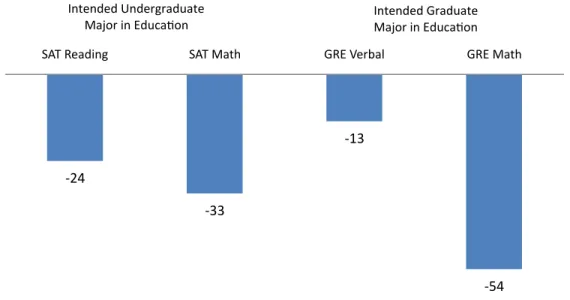
“alternative” programs, which require them to commit several months – and often several thousand dollars – to become eligible for a teaching position. Either way, certification is often not transferrable across state lines, effectively limiting the talent pool in each state. Traditional routes into teaching. In 2006, approximately 100,000 students were awarded a bachelors degree in education, making education the third most popular field of study behind business and social sciences. On average, college students who major in education have much lower academic aptitude than students in other majors. In 2007, high school seniors who intended to major in education averaged 24 points lower in critical reading on the SAT than their college-‐bound peers, and 33 points lower in math. Among all college-‐ bound seniors, those who intended to pursue a career in education scored in the bottom quartile of all test takers in both reading and math (see fig. 1).4 As they finish college, the pattern continues: those who major in education score significantly lower on the GRE, LSAT, and GMAT than students with other majors. 5
Such figures indicate that the talent pool for teachers is weak compared to that for other professional jobs. This contrasts sharply with talent pools in some other countries.6 Worse, over the past several decades, the quality has actually been declining.7 One study found that in 1971-‐74, one in four teachers scored in the top ten percent of their high school class on standardized achievement tests. By 2000, that number had dropped to one in ten.8
Figure 1: Does Education Attract Top Students?
Difference between Mean Score of Intended Education Majors and Mean Overall Test Scores, 2008
Source: Educational Testing Service (2008). Guide to the Use of Scores 2008-09; College Board SAT. (2008). College-Bound Seniors: Total Group Profile Report. The College Board.
The formal training program offered in colleges includes coursework in both education methodologies and content areas. Teachers who complete the program take a licensing test in order to be “certified” to teach in a public school, as required by every state except Montana and Nebraska.
Are teachers who participate in a formal training program and earn certification more effective at improving student learning than those who lack such training and certification? This makes intuitive sense, and some studies find a correlation between credentials and student outcomes.9 Another body of evidence, however, suggests this correlation is weak. Several studies that use strong research methods have found that teacher training may benefit some individuals, but that, on average, teachers with traditional certification are not more effective at helping students learn than teachers who take an alternative route to teaching. Other studies suggest that certification itself is not a strong predictor of student learning.10
States themselves have not done a thorough job of evaluating whether existing training programs are preparing teachers qualified to boost achievement.
-‐24
-‐33
-‐13
-‐54 SAT Reading SAT Math GRE Verbal GRE Math
Intended Undergraduate
• Information on successful models. Only Louisiana and Tennessee have systems to measure the characteristics of teacher training programs that drive student learning gains. Until states require education schools to systematically measure these characteristics, they won’t know how to better prepare their teacher graduates for the demands of 21st century classrooms.
Alternative routes into teaching. An increasing number of teachers enter public schools through alternative routes: estimates range from one in five to one in three new teachers nationwide.12 These routes were originally conceived as programs that operate outside a university setting, designed to enable talented college graduates and mid-‐career
professionals to enter public school classrooms with special – often fast-‐tracked – training, without the requirement of an education degree. However, recent research questions how
alternative these routes really are.
• Same course requirements. Almost 69 percent of alternative route programs are overseen by schools of education and 54 percent have the same course
requirements as traditional routes.13
• Same academic standards. Twenty-‐one states do not require alternate route candidates to meet any academic standard, and only 12 states require alternative route programs to be academically selective in enrolling students.14
• Same time commitment. A survey of 49 alternative certification programs found that the majority (67%) take more than one year to complete,15 similar to the time it takes to get an undergraduate teaching degree. For new teachers who are
managing classrooms during the day and taking classes at night, these course requirements can be especially burdensome.
Evidence on the effectiveness of alternative approaches is mixed. A recent study in New York City found that teachers who came through alternative routes (the New York City Teaching Fellows program and Teach for America) appear to have contributed to improved student achievement.16 On the other hand, a recent IES study suggests that, on average, students taught by teachers who went through alternative routes perform no better or worse than traditionally certified teachers.17
Such findings suggest that the route that teachers take – traditional or alternative – is not a decisive contributor to their effectiveness as teachers. There is far more variation in quality within each group than there is between the two groups. Neither route guarantees quality.
E
MERGINGS
OLUTIONSLeaders at both the state and district levels have significant opportunities to improve teacher training and certification that would yield results quickly. Broadly speaking, state
policymakers can reduce barriers that prohibit highly talented people from entering the profession, increase barriers that keep out less capable people, and insist that teacher training programs prove their value.18 District policymakers can become far more results-‐ focused in their recruitment. They must experiment more with alternative sourcing of teachers, use more predictive criteria and processes to evaluate candidates, and measure – and then further improve – the effectiveness of both hiring criteria and recruitment
sources.
I
DEAS FORP
OLICYMAKERSImprove the Pipeline
State policymakers can…
•Eliminate certification requirements entirely, or grant certification only after a teacher demonstrates effectiveness
•Set meaningful pass rates on licensure tests
(above the 30-‐40% most states allow) •Lower the costs for entering the profession
and offer reduced tuition for highly desirable candidates, including candidates in scarce fields or with scarce skills and characteristics •Fund research to identify assessable
characteristics that predict later success •Reduce barriers to certification acceptance
across state lines
•Enable multiple organizations (higher educational institutions, nonprofit organizations, districts) to offer teacher preparation programs
•Measure and report the teaching effectiveness of graduates of each program; tie program approval to these measures
•Use data on teacher effectiveness by program
to grow the strong programs and ensure that weak ones are fixed or closed
•Subsidize state teacher preparation programs
District policymakers can…
•Actively cultivate individual candidates and sources of candidates with high potential for teaching effectiveness
•Partner with entrepreneurial efforts to recruit
talented teachers from new sources •Create preparation programs, in-‐house or
through partnerships with higher education and nonprofits, that truly equip candidates for the district’s teaching roles
•Collect data on effectiveness of teacher preparation programs and act on results; don’t hire from ineffective programs •Collect information on applicants’ previous
academic performance and give it to principals before interviews
•Collect information on performance of student
teachers and make sure districts aggressively recruit for full-‐time positions those who show special promise
•Once rigor of tenure process has been
increased, publicize the tenure attainment rate for each pipeline program
I
DENTIFY
E
FFECTIVENESS
Redesign teacher evaluations to identify gradations of effectiveness, target development opportunities, and inform decisions about rewards or dismissal
R
ESEARCHTeacher evaluations, as currently designed, are rarely used to distinguish top performers from those who are reasonably good or barely adequate, or to improve the quality of individual teachers or of the faculty as a whole. As The New Teacher Project concluded in its 2009 report The Widget Effect, “teachers’ effectiveness – the most important factor for schools in improving student achievement – is not measured, recorded, or used to inform decision-‐making in any meaningful way.”19
Instead, in the great majority of schools:
• Evaluations are rarely based on teachers’ effectiveness in the classroom and their contributions to student learning.Teacher evaluations typically do not measure the work that teachers do in the classroom (except in the most cursory way) or student learning results.20 Some evaluations include items such as “teacher promotes anti-‐gang activity” but lack items directly related to learning. Several studies have also raised concerns about the accuracy of principals’ ratings,21 and whether they are fairly and consistently applied.22 One study found that principals could identify the best and worst teachers – the top 10 percent and the bottom 10 percent – as measured by student gains on standardized tests, but they were not able to accurately predict the effectiveness of most teachers who fell in the middle.23 Student progress on standardized tests can provide more objective information about a teacher’s effectiveness, especially with adjustments for factors outside of the teacher’s control (known as “value-‐added assessment”).
Early findings of the Measures of Effective Teaching (MET) project – a two-‐year study of multiple measures of teaching effectiveness involving over 3,000 teachers in six urban school districts – suggest that a teacher’s past “value-‐added” is one of the best predictors of his or her ability to increase student achievement on state tests in the future.24 But because the tests are only given in some subjects and at some grade levels, they cover only some teachers (by some estimates, about half).25 And only 23 states have testing and data systems that allow a “value-‐added”
assessment; a small but growing number use value-‐added data to evaluate teacher effectiveness.26
• Evaluations fail to differentiate teachers based on their performance. Most evaluations are based on scheduled classroom observations, during which administrators typically choose from ratings such as “satisfactory” or
“unsatisfactory” on a series of items. Surveys suggest that many teachers know it is easy to receive high ratings on their evaluations, even if students are not learning. “My perspective on the evaluation process is that it is a joke,” commented a Chicago teacher who received a rating of “superior.” “I have never seen or heard of someone getting anything less than superior.”27 One investigation found that only 1 out of every 930 evaluations of tenured teachers in Illinois results in an “unsatisfactory” rating.28 This mirrors findings in Chicago. A 2007 report found that 69 out of 87 failing schools in Chicago did not issue a single unsatisfactory teacher rating in three years.29
Figure 2: Do Ratings Mean What They Say?
Teacher Evaluations in a Chicago Middle School, 2007
Enrollment: PK – 8; 500 students
Students: 90% Low Income; 100% African-‐American
Performance: 18% proficient in Reading; 27% proficient in Math
No teachers were rated Unsatisfactory All 51 ratings were Superior (78%) or Excellent (22%)
Source: The New Teacher Project. (2007). Hiring, Assignment, and Transfer in Chicago Public Schools.
• Few if any consequences result from evaluations. Because administrators are reluctant to give teachers low ratings, current evaluation systems are rarely used to weed out low performers or reward high performance. A recent investigation found that of the nearly 100,000 tenured teachers in Illinois, on average only two are fired each year for poor performance.30 Evaluations are rarely if ever linked to
professional development; no targeted assistance is identified to address weak spots. Finally, in the great majority of districts, even positive evaluations are not used to reward or recognize high performers.
Because evaluations have so little weight, how long a teacher has served is often more important than how effective he or she has been for purposes of layoff or transfer decisions. District transfer and “last in, first out” rules mean that if a senior
districts it studied, anywhere from 10 to 50 percent of new teachers were at risk of losing their jobs if more senior teachers wanted to transfer into their position – regardless of their performance.31
• Once teachers are tenured, formal evaluations are rare.Even when teachers are just starting out, evaluations can take place as little as once per year. Once a teacher receives tenure, evaluations are even more rare. While there is no way to know how often principals informally observe teachers, according to the 2008 NCTQ database only 14 states require school districts to evaluate tenured teachers once a year. More commonly, tenured teachers are evaluated once every 2 – 3 years.32 Studies of collective bargaining contracts in the 50 largest U.S. school systems show that 17 districts have policies to evaluate tenured teachers once a year, and six districts only require evaluations every five years.33
Effective evaluations – the bedrock of any strong performance management system – could reap enormous benefits for students, prompting improvements in teacher recruitment, screening, training, professional development, and career management. But because it raises the possibility of removing ineffective teachers, revamping teacher evaluation is one of the most contentious issues in education.
E
MERGINGS
OLUTIONSDespite the barriers, many state and district policymakers recognize that better teacher evaluation systems are a critical step toward developing a human capital management system that encourages continuous improvement and selectively retains the highest performing teachers.34 Accurately measuring teacher effectiveness is one key to unlocking many of the other strategies that will lead to a higher performing system – improved hiring, placement, pay, tenure, and dismissal practices. For this reason, policy changes in this area should be an urgent priority.
State leaders are well-‐positioned to insist on the inevitability of improvements to teacher evaluation systems, and to provide support for district leaders willing to undertake reform. State leaders should prioritize their research and development investment to resolve the critical design challenges outlined above, particularly tying evaluation to student
performance and assessing non-‐quantitative aspects of teaching in a rigorous way. While these challenges are significant, they are by no means insurmountable. State policymakers can also work with key stakeholders, including teachers unions and teacher training
programs, to ensure that improved measurement systems are perceived as fair.
District leaders need to embrace and test new teacher evaluation practices and provide continuous feedback to the designers. District leaders must lead the way in establishing a
culture of continuous improvement and transparency that motivates teachers to receive feedback and improve their professional work. That said, district leaders also must use performance measurement to encourage and reward high performers and to identify struggling teachers for intervention or dismissal.
I
DEAS FORP
OLICYMAKERSIdentify Effectiveness
State policymakers can…
•Create data systems linking individual
teachers with their students’ academic results •Require annual effectiveness assessments of
all teachers with at least four rating categories, with student results the primary factor
•Report effectiveness data by school, district,
and student and school subgroups •Set consequences in state statute for any
teacher who gets multiple unsatisfactory ratings; use mandates or transparency requirements to induce districts to dismiss chronically ineffective teachers
•Require classroom observations as part of teacher assessments
•Support district efforts by providing funding
for third party evaluators
•Require that effectiveness data be reported
not as averages but as how many fall into different rating categories
•Encourage continuous improvement in
evaluations, constantly increasing the correlation between measures used and student learning results
District policymakers can…
•Assess teachers using at least four levels of performance that differentiate high and low performers
•Train school leaders, department heads and
master teachers to conduct rigorous evaluations
•Require principals to identify the strongest
and weakest teachers in their buildings •Insist that evaluations be backed up with
evidence of impact on student learning. Any mismatch should be cause for discussion; continued mismatches should be cause for action
•Base other teacher systems (induction,
professional development, evaluation, tenure) on results of evaluation
•Support principals in efforts to dismiss chronically low-‐performing teachers and provide options for underperformers to exit voluntarily
•Have third party observers conduct unannounced observations and assess
correlation with principal ratings; if principals are routinely ranking people incorrectly, hold them accountable
S
CREEN
E
FFECTIVELY
Screen prospective teachers using criteria that correlate directly with teacher effectiveness
R
ESEARCHEven if they want to (and many do), district leaders do not know how to choose the candidates who will make effective teachers.
In part because of ineffective teacher evaluations, we know far too little about which characteristics predict candidates’ future success in the classroom. One prominent
researcher has concluded that all of the readily available measures of teacher qualifications combined–including advanced degrees, experience, verbal ability, and performance on licensure exams–explain only 3 percent of the variation in their effectiveness with students.35 Because we do not know how to quantify or measure 97% of what makes a teacher effective, our current efforts focus on a few measures with limited impact. What do we know about the correlation between traditional, observable measures of teacher qualifications and their effectiveness in the classroom?
• Advanced degrees. In general, teachers with advanced degrees are not more effective at raising student achievement. The exception appears to be teachers with advanced degrees in science or math who teach these subjects in high school.36
• Experience. In the first few years, research suggests that experience does have a positive effect on student learning. After their first year of teaching, teachers typically show steady improvement for a few years, but the effect disappears after that. 37
• Verbal ability. Teachers’ verbal ability is more predictive of effective teaching than any other easily measured teacher characteristic; and yet districts do not always make it a high priority in their hiring decisions.38 Several studies conclude that teachers’ verbal ability, as measured by their performance on standardized tests such as the ACT, SAT, or GRE, accounts for significant variations in their students’ learning.39 (Given this correlation, it is particularly distressing that, as reported earlier, students who enter education have lower SAT scores, on average, than their peers.)
Clearly, we have a long way to go to understand what makes a good teacher or explaining the variation in teacher effectiveness.
E
MERGINGS
OLUTIONSTo create more rigorous forms of evidence to screen prospective teachers for effectiveness, states and districts should focus their initial efforts on collecting and analyzing data that links teacher characteristics with later effectiveness. At the state level, this could include information about past academic performance, training experiences, and licensing test results. Through interviews and work demonstrations, principals and district officials can gather qualitative information that could be critical to teachers’ future effectiveness. By widely sharing their findings on which characteristics predict future success, states and districts could rapidly improve screening processes and make big improvements in overall teacher quality.
I
DEAS FORP
OLICYMAKERSScreen Effectively
State policymakers can…
•Build statewide database that links teacher
characteristics with student achievement, to identify training, skills and experience that contribute to better teaching
•Disseminate research-‐based information
about competencies linked to teaching effectiveness
•Reserve certification for teachers until after
they have a demonstrated track record of effectiveness with students
District policymakers can…
•Collect and analyze data establishing links
between teacher characteristics and teacher effectiveness – for example, every district should know how many times a teacher has had to take a licensing test
•Select rigorously based on competencies linked to teaching effectiveness
•Create a feedback loop that uses information
about teacher effectiveness in the district to change the selection model for future teachers – and revisit annually
H
IRE
S
TRATEGICALLY
Redesign hiring and placement practices to direct the best teachers where they’re most needed
R
ESEARCHVery few districts prioritize staffing decisions to meet the needs of low-‐performing or high-‐ poverty schools; and principals of such schools often have relatively little opportunity to choose from a pool of strong candidates.
District human resource departments often play a larger role in selecting candidates than principals do. HR staff members prescreen applications and do initial interviews, often at job fairs or in the district office, then direct candidates to particular schools for school-‐level interviews. Candidates themselves have little or no say in where they are placed40 – and may not even see their future workplace until they set foot in the classroom.41 These practices undermine principals’ ability to find and persuade teachers to fill critical roles.
Ineffective hiring practices. On the surface, it seems far more efficient to have human resource offices screen applicants than to have principals poring over hundreds of applications and conducting dozens of interviews. But research suggests that district HR offices often suffer from serious mismanagement. Burdensome application processes, poor customer service, and inadequate data systems not only slow down the process, but can frustrate potential candidates.42
Even effective human resource offices often do not know how to match teachers with schools where they will be most effective. In addition, late hiring timelines are a serious barrier to placing talented candidates in positions where they are needed. In many
districts, the hiring timetable is driven by policies that allow current teachers to wait until the summer to notify the district that they are leaving or want to transfer. At one large district a few years ago, this meant district officials did not make a single job offer until August 12 – with the start of a new school year just days away.43
The New Teacher Project documents the detrimental effect of late hiring on teacher quality. In a study of four urban districts, between 30 and 60 percent of new teacher applicants withdrew from the pool, often to take jobs in higher-‐performing schools in the suburbs, where districts had an accelerated hiring timeline.44 In follow-‐up analysis, TNTP found evidence that the applicants who withdrew had significantly higher undergraduate GPAs and were 40 percent more likely to have a degree in their teaching field. One candidate from the study is quoted as saying, “The hiring process took too long. By the time I was able
to schedule a first interview… I already had four other interviews and offers.”45 In other words, districts lose candidates who have other options.
Internal transfers. In most districts, teachers who seek to move to a new school or those whose jobs are eliminated are guaranteed another job in the district by collective
bargaining and contractual agreements. This means that sometimes a more junior teacher who is more effective with students can be displaced by a transferring teacher with more seniority. It also means that a teacher who is not successful at one school can be passed among many other schools, rather than getting help or facing dismissal.
These “internal transfers,” which can constitute a large number of new hires in any given school, are typically made without principals’ input. A recent study of five large urban districts found that 40 percent of school-‐level vacancies were filled by transferring
teachers, with little or no say from the schools themselves.46 Many districts weigh teacher seniority and tenure over quality considerations (e.g., student outcomes, demonstrated expertise, or advanced training in a particular field) when accommodating internal
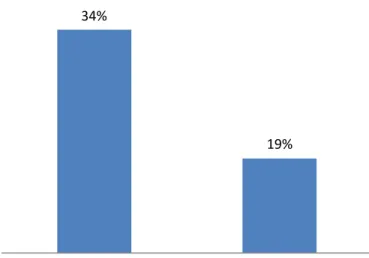
transfers.47 In one district, 64 percent of principals said they had not wanted one or more of these teachers in their school the previous year, but had been forced to hire them.48 When experienced teachers transfer, they often leave vacancies in the district’s most challenging schools. These policies exacerbate the staffing inequities that begin with the hiring process. Across the country, low-‐income students are more likely than their higher-‐ income peers to have teachers who are not certified, who performed poorly on college and licensure exams, and who are teaching outside of their field of study.49 A 2006 survey of school staffing practices in Ohio, Illinois and Wisconsin found that 34 percent of core academic classes in high-‐poverty schools were assigned to an out-‐of-‐field teacher,
compared with 19 percent in low-‐poverty schools (see fig. 3).50 Another study found that teachers in schools serving large numbers of poor and minority students tend to transfer more often or leave teaching altogether than teachers in more affluent schools.51
Figure 3: Who’s Teaching What?
Percentage Teaching Subjects Outside Their Field of Study
Source: Peske, H. G. & Haycock, K. (2006). Teaching Inequality: How Poor and Minority Students are Shortchanged on Teacher Quality. Washington, DC: The Education Trust.
E
MERGINGS
OLUTIONSIn 2008, districts across the country hired approximately 200,000 teachers.52 The large number of teachers leaving for retirement or other reasons will require districts to hire an estimated two to three million K-‐12 teachers over the next decade.53 Redesigning district policies and processes to ensure that highly effective teachers are directed to schools where they are most needed could have an immediate positive impact on student learning. This means setting aggressive goals for early hiring and placement, enabling high-‐need schools to vie successfully for the best candidates, and ensuring that all schools have the support they need to review applicants efficiently. Policymakers at the state level can make sure budgets are timed to allow districts to hire early and use discretionary measures to ensure that persistently low-‐performing schools are able to hire the teachers they need to improve student achievement.
34%
19%
I
DEAS FORP
OLICYMAKERSHire Strategically
State policymakers can…
•Using the best available proxies for teacher
quality, report data on the quality of new hires by school, district, and school and student subgroups
•Act on problems made clear in the data,
particularly when it is evident that poorest students are getting the least qualified teachers
•Prohibit district policies that result in late
hiring and forced placements, especially in failing schools
•Require districts to prioritize recruitment and
hiring for high-‐poverty schools over higher-‐ wealth schools in the same district
•Make sure budgets are finalized in time to
enable schools to meet staffing needs
District policymakers can…
•Move hiring timelines to late winter or early
spring and streamline processes to obtain the best candidates
•Hire based on mutual consent of candidates
and schools
•Offer training and supportive technology to
help school leaders hire
•Track the quality and date of hires to
determine when the candidate pool is strongest and when it begins to deteriorate •Make sure principals have value-‐added data
on teacher performance or teacher
evaluations before hiring veteran teachers
P
AY FOR
C
ONTRIBUTION
Redesign pay structures to create incentives and rewards for teachers who take on harder assignments, offer hard-‐to-‐find skills, and/or demonstrate greater success on the job
R
ESEARCHIn other professions, compensation is viewed as a powerful tool to improve employee performance and determine who stays and who leaves.54 Teacher pay does not work that way. In fact, the evidence suggests that current compensation systems actually work
against quality teaching, encouraging lower performers to enter the profession while giving higher performers reason to stay away or leave in higher numbers.
Almost all public school teachers are paid according to a single salary schedule. Teachers under this system get a salary bump for every year they teach and for earning an advanced degree. On average, districts pay 11 percent more for a master’s degree, 14 percent more for an education specialist's degree, and 17 percent more for a doctorate over what a teacher would earn with a bachelor's degree only.55 But these characteristics have a limited impact on teacher effectiveness.56 In 2004 alone, districts across the country spent over $8.5 billion paying for these advanced degrees that research overwhelmingly shows do not matter for student learning.57
On a single salary schedule all teachers with the same level of experience and education are paid the same, regardless of their effectiveness in the classroom, the level of challenge in their schools, or what the wider market would pay for their expertise. This pattern poses serious barriers to improving teacher quality:58
• Preventing districts from offering pay incentives. There are widespread
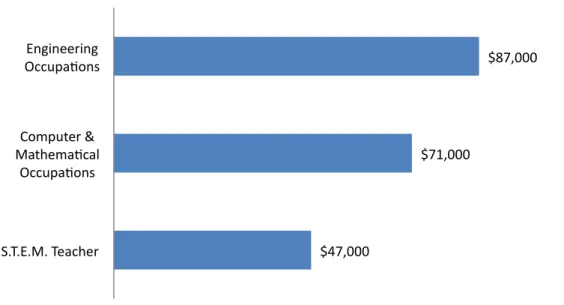
shortages of teachers in particular fields – including science, math, special education and programs for English-‐language learners.59 Very few districts offer premiums for these positions, even though candidates in these fields often have higher-‐paying options (see fig. 4).60
Nor do salary schedules typically include premiums for difficult assignments. Most districts do not deviate from the standard salary schedule to offer special
compensation to attract top teachers to challenging schools.61 That leaves high-‐ poverty schools with teachers who have fewer choices because they may not be certified, performed poorly on college and licensure exams, or are teaching outside
of their field of study.62 This may help explain the turnover rate, which is 20 percent in high poverty schools compared to 15 percent overall.63
Figure 4: How Does Science and Math Teaching Compete with Related Professions? Average Science, Technology, Engineering and Mathematics (STEM) Teachers’ Salaries vs. Comparable Private Sector Salaries
Source: Fuller, E. (2009). Secondary Mathematics and Science Teachers in Texas: Supply, Demand and Quality. Texas Business and Education Coalition.
• Failing to retain high performers. Current pay systems do not give district leaders or principals the flexibility to reward or retain high-‐performing teachers.64 Research across sectors indicates that the top 10 percent are most likely to leave because of lack of pay for superior performance and career advancement
opportunities.65 The fact that ineffective teachers are paid the same as exemplary teachers can undermine morale. Most teacher retirement plans also contain no incentives to retain top teachers – or encourage others to leave (for more on retirement, see below pages 34-‐36).66
• Failing to attract high-caliber candidates. In a recent survey 78 percent of new teachers said that salary was a drawback of the profession, although this ranked below other issues.67 Some research suggests that compensation packages that offer the same pay to all teachers with the same education and experience have a negative overall effect on the aptitude of teachers entering the profession. One
$47,000 $71,000 $87,000 S.T.E.M. Teacher Computer & MathemaAcal OccupaAons Engineering OccupaAons
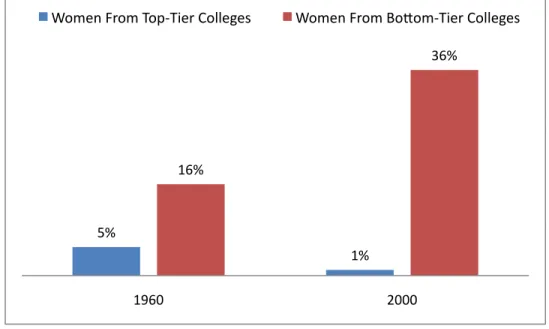
the same. During this same time period, the share of new female teachers from highly-‐selective colleges fell from 5 percent to 1 percent, while the share of new female teachers who came from the lowest tier of colleges rose from 16 to 36 percent (see fig. 5). 68
Figure 5: Is Teaching Attracting Promising Candidates?
Percentage of Female Teachers Coming from Top-Tier and Bottom-Tier Colleges, 1960 vs. 2000
Source: Hoxby, C. M., & Leigh, A. (2005). Wage Distortion. Education Next , 4(2).
• Failing to attract the next generation of teachers. In general, teacher
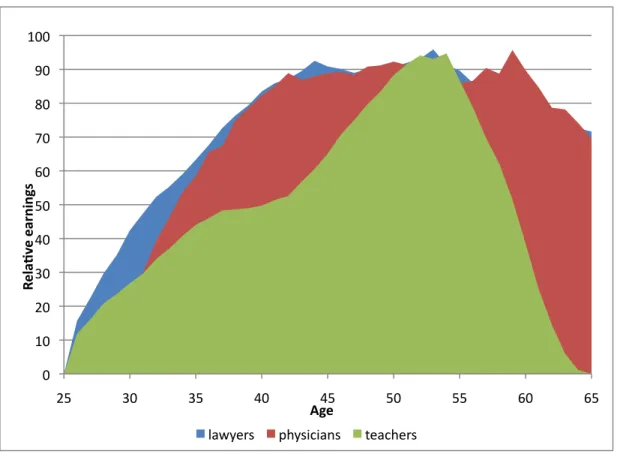
compensation is back-‐loaded, offering most of its rewards only near the end of a decades-‐long career69 (higher salaries) or at retirement (pension and retirement health benefits). But younger workers – so-‐called GenYers – are more likely to switch careers than earlier generations, not wait around for eventual rewards. They are likely to be more attracted by a system where teachers reach their top earning potential more quickly (see fig. 6).
5%
1% 16%
36%
1960 2000
Figure 6: How Long Does It Take to Reach the Top? When Teachers, Lawyers and Doctors Reach Peak Earnings*
Source: Vigdor, J. (2008). Scrap the Sacrosanct Salary Schedule. Education Next , 8(4).
*Note: This figure uses 5-‐year moving averages of annual reported earnings, relative to reported earnings at age 25 and peak earnings.
E
MERGINGS
OLUTIONSDesigning a pay system that addresses current deficiencies and improves teaching quality is possible, but it will require bold leadership at both the state and district levels. By tracking which changes have the greatest impact on teacher quality in the shortest amount of time, policymakers can continue to refine pay systems over time to make them
increasingly effective.
To make pay reform sustainable, policymakers should avoid short-‐term add-‐ons to the existing system to reward performance or other contributions. Instead, the aim should be to “re-‐slice the compensation pie” so that more existing dollars go to pay for contribution.70
0 10 20 30 40 50 60 70 80 90 100 25 30 35 40 45 50 55 60 65 Re la Cv e ea rn in gs Age
I
DEAS FORP
OLICYMAKERSPay for Contribution
State policymakers can…
•Set a goal for the proportion of teacher compensation that is “pay for contribution” and track progress toward it
•Eliminate restrictions that block district
experimentation with compensation
•Invest state funds in promising local pilots of
compensation reform, including ones that pay more for scarcity, effectiveness with kids, and include pension reforms
•Offer large performance-‐based awards to
teachers who succeed in hard-‐to-‐staff schools
District policymakers can…
• Engage in continuous adjustment of pay systems to find the right mix of incentives •Use special resources (state pilots, federal TIF
grants, private donations) to transition to new systems – not as temporary add-‐ons
•Phase out input-‐oriented differentials (e.g.
extra pay for master’s degrees) and redirect to fund higher salaries for effective and scarce teachers
•Make it possible for outstanding teachers to
reach the top of the pay scale no later than year 8, and for very good teachers to reach it by year 12
•Do not give annual salary increases to teachers
who are in the lowest third of effectiveness
S
UPPORT
N
EW
H
IRES
Experiment to find the best models for supporting new teachers, and make sure such teachers are not routinely assigned to the most difficult classes
R
ESEARCHBeginning teachers, however talented they are, by definition have less practice in knowing how to reach challenging students. Nevertheless, they are routinely assigned to the most difficult classes, with little or no effective support to succeed.
A recent national survey found that almost half of the new teachers in high-‐need schools had been assigned to the most challenging students (42 percent), compared to 25 percent of the new teachers in more affluent schools (see fig. 7).71 Thus, not only are new teachers more likely to be placed in hard-‐to-‐staff schools, but within schools they are assigned to the most challenging classes.
They also get little effective help in taking on that challenge. Although “induction”
programs for new teachers exist in most districts, research suggests that they rarely focus enough attention on improving instruction, nor do they meet teachers’ desire for support with classroom management. Research also indicates that very few teachers receive comprehensive induction that includes the help of a supportive mentor and opportunities to collaborate with other teachers. 72 A few national induction programs, such as that of the New Teacher Center, have tried to remedy this weakness with some promising results. But recent research suggests that our ability to deliver a high-‐quality induction program, particularly for teachers in high-‐needs schools, is far from complete.
Figure 7. Who Gets Assigned to Which Kids?
Percent of New Teachers Assigned to the Most Challenging Students
Source: Public Agenda. (2007). They’re Not Little Kids Anymore: The Special Challenges of New Teachers in High Schools and Middle Schools. Lessons Learned: New Teachers Talk About Their Jobs, Challenges and Long- Range Plans. A Report from the National Comprehensive Center for Teacher Quality and Public Agenda. Some research suggests that teachers who participate in high-‐quality mentoring programs are more likely to stay in teaching. One study found that after their first year of teaching, teachers who received no induction were twice as likely to leave teaching as those who had received a robust induction that included mentoring, opportunities to collaborate with colleagues, and additional resources.73 Another study found that teachers in Chicago who participated in high-‐quality induction programs were more likely to plan to stay in the profession.74 Of course, retention is not a sufficient end in itself: incapable teachers should be encouraged to leave. But induction appears to be a powerful way to help more teachers be successful and keep them longer in the classroom.
Even when states and districts do provide support for new teachers, the evidence of impact on student achievement is mixed. A recent study examining two comprehensive first-‐year induction programs did not find that these programs had a positive impact on student achievement, changed teacher’s instructional practices, improved teacher retention, or boosted student test scores any more than the less comprehensive programs in which teachers in a control group participated.75 This study focused only on first-‐year results; positive effects may show up later in a teacher’s career. Other research has shown that students taught by teachers who receive comprehensive induction support for at least two
years demonstrate significantly higher learning gains as a result.76 Taken together, these
findings suggest we still have a ways to go in designing an induction program that has an immediate, large impact on student learning.
42%
25%