A
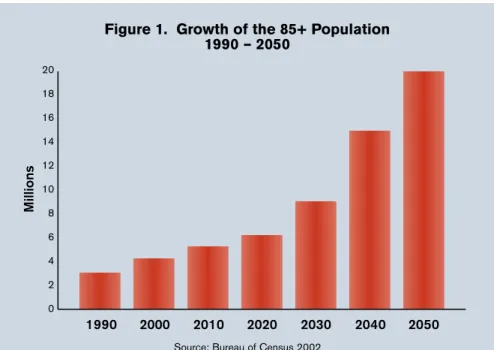
s the US popula-tion ages (the first baby boomers turned 60 in 2006), the social and economic implications are likely to be profound for society in gen-eral and, in particular, the senior health care industry.The group of individuals 85 and older is now the fastest grow-ing segment of the US population. The proportion of elderly people aged 80 years or older is project-ed to increase by 300% between now and the year 2040.1Figure 1 highlights the projected growth of our older citizens to the year 2050.
The provision of good care for residents with dementia is the fu-ture for the assisted living (AL) industry. Recent studies show that over 50% of residents living in assisted living facilities (ALFs) may have some form of dementia or cognitive impairment.2 Look-ing ahead, the increase in Alzheimer’s disease and other types of dementia will soar as the 85+ population increases, as the risk of developing some form of dementia for people 85 and older is almost 50%. Figure 2 shows the projected increase in
Alzheimer’s disease cases to the year 2050.
Providing adequate care for dementia residents living in AL
C
ase Management of
Dementia Residents:
Optimizing Outcomes
and Quality of Life
Anne Ellett, NP, MSN
Case Example: Myra S.
Myra S. is a 78-year-old woman who lives with her 85-year-old husband Stan in a 2-room suite in an ALF. Myra and Stan moved in 3 months ago at their son’s urging. Due to Stan’s decreasing vision, he was no longer able to drive and needed assistance, but there was no history of significant problems with activities of daily living (ADLs). Upon moving to the facility, the staff noted that Myra was often absent from meals in the dining room and didn’t participate in most social gatherings. Her clothing appeared mismatched at times, coming to the dining room with her dress on over her nightgown.
The AL nurse consultant began to do case management on Myra, concerned that she may have dementia. The nurse recommended that a physician visit to assess for possible dementia. The physician diagnosed a vascular dementia and the nurse completed the Functional Assessment Staging Scale (FAST). Myra’s FAST score was Stage 5, showing decreased organization abilities, inability to perform complex tasks, and the need for assistance in choosing appropriate clothing.
By identifying the stage of Myra’s dementia, the staff was better able to meet Myra’s and Stan’s needs in their AL environment. Stan had been providing a lot of the support to help maintain Myra’s ADLs. With the recognition of her dementia, the staff was able to offer Stan more assistance in getting Myra groomed and to the dining room for meals. Many aspects of her health and socialization were monitored, and staff was better prepared to engage her in social activities. Stan had more time to develop friendships and participate in areas of his own interest. The son was involved in a care plan meeting and appreciated the proactive approach and the regular case management of his mother to help ensure her quality of experience in the AL environment.
July/August 2006 17
settings can be a challenge. The needs of dementia residents for supervision, engagement, and clinical oversight may be greater than for cognitively intact resi-dents and resiresi-dents with dementia often are unable to adequately communicate their needs.
As health care providers and consumers become more sophis-ticated in their expectations of residential care for elderly indi-viduals with dementia, AL will need to develop effective pro-grams for the management of res-idents with dementia, while de-livering a good quality of life experience. In an effort to set standards of care for people with dementia, the Alzheimer’s Asso-ciation has already published ini-tial dementia care guidelines.3 These guidelines address the ar-eas of social engagement, food and fluid consumption, and pain management.
The Alzheimer’s Association guidelines are based on the results of a study that evaluated the quality of care for dementia resi-dents in long-term care facilities.4 The study found that over 50% of residents with dementia had low food and fluid intake during meals, 40% of residents with rec-ognized pain received no pain medication, and unrecognized de-pression was common.4
A system of case management of dementia residents, which in-cludes regular intervals of assess-ment, is an excellent method for AL communities to meet the Alzheimer’s Association’s guide-lines, as well as optimize positive health outcomes and quality of life for their dementia residents. Case management of dementia
residents can also benefit ALFs as a tool for risk management.
Effectively caring for this pop-ulation of residents can be very labor intensive and complex. A monthly case management pro-gram for dementia residents mon-itors both clinical and social out-comes. An organized approach of regular assessment and interven-tion of dementia residents avoids
crisis management and improves the quality of the resident’s expe-rience in the AL environment.
Case management also allows the staff to recognize the number of residents in their facility that have dementia. This can help fo-cus staff training on important topics, such as communication with dementia residents, behavior management, special program
Figure 2. Projected Increases in the Number of US Alzheimer’s Patients 16 14 12 10 8 6 4 2 0 2004
Sources: USA Today; New York Times Magazine
• Alzheimer’s disease is expected to grow to an estimated 16 million by 2050.
• At this time, there are under 70,000 centurions in the U.S. Researchers predict by the year 2050, there will be 700,000.
2050
Figure 1. Growth of the 85+ Population 1990 – 2050 20 18 16 14 12 10 8 6 4 2 0 1990 2000 2010 2020 2030 2040 2050
Source: Bureau of Census 2002
M il li o n s M il li o n s
development, etc. Another recog-nized need for case management of dementia residents is to help plan the successful transition of a person with dementia when they move into an AL environment from a higher level of care.5
An example of a case manage-ment tool for demanage-mentia residents is shown in Table 1, with a case example of how such a tool can benefit dementia residents’ expe-rience in ALFs. As part of the case management, many areas of dementia residents’ well-being is tracked and monitored:
• The stage and progression of the
dementia: These parameters are
tracked through the resident’s FAST (Functional Assessment Staging Scale) score.6 The FAST scale (Table 2) is a commonly ac-cepted scoring tool to follow the progression of dementia. The FAST scale follows the progres-sion of dementia from mild memory impairment through moderate to severe dementia. A FAST score of Stage 7 or greater is required for a person with de-mentia to receive Medicare-certi-fied hospice services.
• Weight changes: Both increases and decreases can be significant. A weight decrease may signal a decline in appetite due to pain, infection, dental problems, med-ication side effects, depression, food preferences, or an inability to manage the complexities of silverware and table etiquette. A weight increase may signal the success of the ALF’s dining pro-gram or, conversely, an exacer-bation of a chronic condition, such as heart failure with fluid retention.
• Infections: Residents with
de-mentia may not be able to artic-ulate to staff when they do not feel well. Tracking the frequency of infections, as well as the med-ical follow-up for each infection, helps staff ensure that adequate medical care is being delivered in a timely manner. Frequent infec-tions may signal increasing frailty of the resident.
• Falls and injuries: Falls may be the first sign of an acute infection. They also may signal gait changes due to other health problems or medication side effects.
• MD/ER visits: How often is the resident seen by their primary care provider, or have emergency room visits been a necessity? By tracking the dates of medical care, staff can be proactive in fa-cilitating regular care, helping to avoid medical crises.
• Pain assessment: Pain often may be unrecognized in dementia res-idents, especially as their demen-tia progresses. Staff, who know the residents well, can assess for verbal and nonverbal indications of pain.
• Medication changes: Tracking the number and types of medica-tions a resident receives can help avoid overmedication, duplica-tion of medicaduplica-tions, and medica-tion side effects.
• ADLs: Rapid declines in ambula-tion, hygiene, feeding, and toilet-ing may signal an acute problem, such an infection, pain, stroke, or medication side effects.
• Social engagement: How often does the resident engage in social activities? If the resident is not participating in offered activi-ties, the staff can develop pro-grams appropriate for the resi-dent’s interests and abilities.
Jan Feb Mar Apr
Resident name: BD: Move-in date: FAST Score Weight: (5 lb change needs care plan)
Infections/type: Follow-up care: Falls/injuries: Follow-up care: MD visits/ ER visits Reason/follow-up Pain assessment: Medication changes: ADL changes: Ambulation Hygiene/bathing Feeding/nutrition Toileting Social engagement: Behavior changes: Follow-up care: Other Table 1. Dementia Case Management Tool Monthly Wellness Assessment
July/August 2006 19
• Behavior changes: Sudden be-havior changes are often the re-sult of an acute problem, such as infection or pain. Anxiety, con-fusion, fear, and other emotional
issues also may result in difficult behaviors. Assessment of the po-tential cause of the behavior is necessary before any medication for the behavior is offered.
Dementia residents, by nature of their condition, often “disap-pear into the wall paper.” They may be that quiet, kind, elderly la-dy who never bothers anyone and is often seen sitting alone. In con-trast, a dementia resident may be a loud resident who everyone avoids because he interrupts and repeats himself. Either of these residents may not have received a thorough medical assessment and the correct diagnosis of dementia. Through good case management, AL staff may help facilitate these residents getting the correct med-ical diagnosis and care. Proper di-agnosis and medical care can help stabilize the resident’s condition and allow him or her to enjoy a better quality of life.
The challenge for ALFs is being able to successfully integrate many of these dementia residents into their environment, while suc-cessfully meeting their needs. The case management approach for dementia residents in AL environments helps ensure that their health and social needs are met. The case management tool allows the staff to be proactive, improving communication with involved family members and helping to avoid crises that may require the resident to move from
the AL environment. MPM
Anne Ellett, NP, MSN, is Health Services Vice President of Silverado Senior Living lo-cated in San Juan Capistrano, CA.
References
1. Wan H, Sengupta M, Velkoff VA, DeBarros KA. 65+ in the United States: 2005. Washington, DC: US Cen-sus Bureau. Current Population Report, P23-209. US Government Printing Office, 2005.
2. Hawes C, Phillips CD, Rose M. High Service or High Privacy Assisted Living Facilities, Their Residents and Staff: Results from a National Survey. National Center for Assisted Living, November 2000. Available
Resident’s Name:____________________________ Admit Date:______________
Date Date
Stage Function Admit
Choose Stage 1 thru 7 which best describes the resident’s abilities. 1 No difficulty either subjectively or objectively.
2 Complains of forgetting location of objects. Subjective work difficulties.
3 Decreased job functioning evident to co-workers. Difficulty in traveling to new locations. Decreased organization capacity. 4 Decreased ability to perform complex tasks, eg, planning dinner
for guests, handling personal finances (such as forgetting to pay bills), difficulty marketing, etc.
5 Required assistance in choosing proper clothing to wear for the day, season, or occasion (eg, patient may wear the same clothing repeatedly, unless supervised).
6 Decreased functional abilities:
A. Improperly putting on clothes without assistance or cueing (eg, may put street clothes on overnight clothes, put shoes on wrong feet, or have difficulty buttoning clothing). B. Unable to bathe properly (eg, difficulty adjusting bath water
temperature) occasionally or more frequently over the past weeks. C. Inability to handle mechanics of toileting (eg, forgets to flush
the toilet, does not wipe properly, or properly dispose of toilet tissue) occasionally or more frequently over the past weeks. D. Urinary incontinence occasionally or more frequently over the
past weeks.
E. Fecal incontinence occasionally or more frequently over the past weeks.
7 Required for Hospice Certification:
A. Ability to speak is limited to approximately a half dozen different intelligible words or fewer in an average day or in the course of an intensive interview.
B. Speech availability is limited to the use of a single intelligible word in an average day or in the course of an intensive interview (the person may repeat the word over and over). C. Ambulatory ability is lost (cannot walk without
assistance).
D. Cannot sit up without assistance (eg, the individual will fall over if there are not lateral rests on the chair).
E. Loss of ability to smile.
F. Loss of ability to hold up head independently.
Table 2.
at: http://aspe.hhs.gov/daltcp/reports/hshp.htm. Accessed March 25, 2006.
3. Alzheimer’s Association. Dementia Care Practice Recommendations for Assisted Living Residences and Nursing Homes. Chicago, IL: Alzheimer’s Association, 2005. Available at: http://www.alz.org/Downloads/De-mentiaCarePracticeRecommendations.pdf. Accessed March 25, 2006.
4. Alzheimer’s Association Press release: Residents with Alzheimer’s May Receive Inadequate Care in Nurs-ing Homes and Assisted LivNurs-ing. Available at: www.alz.org/Media/newsreleases/2003/112403. Ac-cessed March 25, 2006.
5. Lobsen N, Stackpole I. Discharge planning and managing early Alzheimer’s disease. Assisted Living Consult. 2005;1: 8-12.
6. Functional Assessment Staging Scale, developed by Barry Reisberg, MD, 1984.
Take-Away
Message
• The number of ALFs is growing and will soon surpass SNFs in number of residents. With over half of the residents in ALFs having some level of dementia, dementia care is a growing issue.
• There is a significant need for appropriate care management, with over 50% of residents with dementia having problems with food intake and pain management.
• Successful care management involves not only case managers, but physicians, pharmacists, therapists, and dietitians—in short all health care providers.
ROI
• There is an opportunity for physicians and other health care providers to play key roles in the care management of LTC residents with dementia.
• A successful care management team can improve outcomes for residents and facilities, providing rewards for all team members.
result in improved medication use, others may represent inappropri-ate barriers to medication access. Unfortunately, PDPs are silo’ed in being responsible only for direct medication costs. As a result, their goal is to reduce drug utilization— not to improve overall care— which will drive them to imple-ment barriers to access even appropriate medications.
The federal government, includ-ing CMS, has the ability to dictate formulary recommendations. As a result, some products have a forced inclusion on a Medicare Part D for-mulary, while others are excluded. Thus, under the Medicare Modern-ization Act, the federal government has developed a list of medications that are excluded from coverage un-der Medicare Part D (Table 4), while at the same time mandating that plans cover substantially all medica-tions in 6 drug classes (Table 5). The ultimate result of federal govern-ment involvegovern-ment, either through legislation or CMS regulations, is more or less access to certain drugs
for Medicare beneficiaries. This shift from prescribers having unobstruct-ed authority in deciding what drug is dispensed will continue, moving rapidly to the groups that control the dollars and rules.
So Where Is Medicare Part D Headed?
Unfortunately, the answer is not one that will be based on a sound clinical basis or a sensible health policy. Instead, it will be deter-mined by Washington politics and is very much dependent on the re-sults of the next few elections.
Much debate has centered on re-moval of the noninterference clause, which prohibits the federal government from negotiating prices with pharmaceutical com-panies. Whatever direction Medi-care Part D takes, clearly it will represent a change for all stake-holders involved in the care of
seniors. MPM
Richard G. Stefanacci, DO, MGH, MBA, AGSF, CMD, is Editor-in Chief of Medicare Patient Managementand the Founding Executive Di-rector of the Health Policy Institute of Univer-sity of the Sciences in Philadelphia, PA. He also held the position of CMS Health Policy Scholar 2003-2004.
Take-Away Message
• There are 3 groups that can still enroll in Medicare Part D beyond the May 15, 2006 deadline (dual eligibles, beneficiaries eligible for the low-income subsidy program, and Hurricane Katrina victims). • The channels controlling how medication is dispensed will move
away from physicians to PDPs and the federal government. • Legislative and regulatory changes are likely to have implications in
how practices operate.
ROI
• Ensuring that medications physicians want for their patients are dispensed in an efficient and effective manner requires:
— understanding the enrollment process;
— knowing the scope of coverage plus the appeals and prior authorization process, if needed; and
— keeping informed of legislative and regulatory changes to Medicare Part D.
Where is Medicare Part D Headed Now?