Cloud Application Management for
Platforms Version 1.1
Committee Specification Draft 01
09 January 2013
Specification URIs
This version: http://docs.oasis-open.org/camp/camp-spec/v1.1/csd01/camp-spec-v1.1-csd01.pdf (Authoritative) http://docs.oasis-open.org/camp/camp-spec/v1.1/csd01/camp-spec-v1.1-csd01.html http://docs.oasis-open.org/camp/camp-spec/v1.1/csd01/camp-spec-v1.1-csd01.doc Previous version: N/A Latest version: http://docs.oasis-open.org/camp/camp-spec/v1.1/camp-spec-v1.1.pdf (Authoritative) http://docs.oasis-open.org/camp/camp-spec/v1.1/camp-spec-v1.1.html http://docs.oasis-open.org/camp/camp-spec/v1.1/camp-spec-v1.1.doc Technical Committee:OASIS Cloud Application Management for Platforms (CAMP) TC
Chair:
Martin Chapman ([email protected]), Oracle
Editors:
Jacques Durand ([email protected]), Fujitsu Limited
Anish Karmarkar ([email protected]), Oracle
Adrian Otto ([email protected]), Rackspace Hosting, Inc.
Related work:
This specification replaces or supersedes:
Cloud Application Management for Platforms, Version 1.0, August 29, 2012.
http://cloudspecs.org/CAMP/CAMP_v1-0.pdf
Abstract:
This document defines the artifacts and APIs that need to be offered by a Platform as a Service (PaaS) cloud to manage the building, running, administration, monitoring and patching of
applications in the cloud. Its purpose is to enable interoperability among self-service interfaces to PaaS clouds by defining artifacts and formats that can be used with any conforming cloud and enable independent vendors to create tools and services that interact with any conforming cloud
“Send A Comment” button on the Technical Committee’s web page at http://www.oasis-open.org/committees/camp/.
For information on whether any patents have been disclosed that may be essential to implementing this specification, and any offers of patent licensing terms, please refer to the Intellectual Property Rights section of the Technical Committee web page ( http://www.oasis-open.org/committees/camp/ipr.php).
Citation format:
When referencing this specification the following citation format should be used: [CAMP-v1.1]
Cloud Application Management for Platforms Version 1.1. 09 January 2013. OASIS Committee Specification Draft 01. http://docs.oasis-open.org/camp/camp-spec/v1.1/csd01/camp-spec-v1.1-csd01.html.
Notices
Copyright © OASIS Open 2013. All Rights Reserved.
All capitalized terms in the following text have the meanings assigned to them in the OASIS Intellectual Property Rights Policy (the "OASIS IPR Policy"). The full Policy may be found at the OASIS website. This document and translations of it may be copied and furnished to others, and derivative works that comment on or otherwise explain it or assist in its implementation may be prepared, copied, published, and distributed, in whole or in part, without restriction of any kind, provided that the above copyright notice and this section are included on all such copies and derivative works. However, this document itself may not be modified in any way, including by removing the copyright notice or references to OASIS, except as needed for the purpose of developing any document or deliverable produced by an OASIS Technical Committee (in which case the rules applicable to copyrights, as set forth in the OASIS IPR Policy, must be followed) or as required to translate it into languages other than English.
The limited permissions granted above are perpetual and will not be revoked by OASIS or its successors or assigns.
This document and the information contained herein is provided on an "AS IS" basis and OASIS DISCLAIMS ALL WARRANTIES, EXPRESS OR IMPLIED, INCLUDING BUT NOT LIMITED TO ANY WARRANTY THAT THE USE OF THE INFORMATION HEREIN WILL NOT INFRINGE ANY
OWNERSHIP RIGHTS OR ANY IMPLIED WARRANTIES OF MERCHANTABILITY OR FITNESS FOR A PARTICULAR PURPOSE.
OASIS requests that any OASIS Party or any other party that believes it has patent claims that would necessarily be infringed by implementations of this OASIS Committee Specification or OASIS Standard, to notify OASIS TC Administrator and provide an indication of its willingness to grant patent licenses to such patent claims in a manner consistent with the IPR Mode of the OASIS Technical Committee that produced this specification.
OASIS invites any party to contact the OASIS TC Administrator if it is aware of a claim of ownership of any patent claims that would necessarily be infringed by implementations of this specification by a patent holder that is not willing to provide a license to such patent claims in a manner consistent with the IPR Mode of the OASIS Technical Committee that produced this specification. OASIS may include such claims on its website, but disclaims any obligation to do so.
OASIS takes no position regarding the validity or scope of any intellectual property or other rights that might be claimed to pertain to the implementation or use of the technology described in this document or the extent to which any license under such rights might or might not be available; neither does it
represent that it has made any effort to identify any such rights. Information on OASIS' procedures with respect to rights in any document or deliverable produced by an OASIS Technical Committee can be found on the OASIS website. Copies of claims of rights made available for publication and any
assurances of licenses to be made available, or the result of an attempt made to obtain a general license or permission for the use of such proprietary rights by implementers or users of this OASIS Committee Specification or OASIS Standard, can be obtained from the OASIS TC Administrator. OASIS makes no representation that any information or list of intellectual property rights will at any time be complete, or that any claims in such list are, in fact, Essential Claims.
The name "OASIS" is a trademark of OASIS, the owner and developer of this specification, and should be used only to refer to the organization and its official outputs. OASIS welcomes reference to, and
Table of Contents
1 Introduction ... 9 1.1 Overview ... 9 1.2 Purpose ... 9 1.3 Example (Non-normative) ... 10 1.4 Non-Goals ... 11 1.5 PaaS Roles ... 11 1.6 Terminology ... 12 1.7 Normative References ... 12 1.8 Non-Normative References ... 12 2 Architecture ... 13 2.1 Management Model ... 132.1.1 PaaS Resource Model ... 14
2.1.2 Resource Relationships ... 15
2.1.3 Management Model Diagrams ... 16
2.2 Importing a Platform Deployment Package ... 20
2.3 Exporting a Platform Deployment Package ... 21
3 Application Lifecycle ... 22
3.1 Uploaded... 22
3.2 Deployed ... 23
3.3 Instantiated ... 23
3.4 Suspended ... 23
4 Platform Deployment Package ... 24
4.1 PDP Package Structure ... 24
4.2 Deployment Plan ... 24
4.3 Deployment Plan Schema ... 24
5 Resources ... 25 5.1 Common Types ... 25 5.1.1 Boolean ... 25 5.1.2 String ... 25 5.1.3 URI ... 25 5.1.4 Timestamp ... 25 5.1.5 Link ... 25 5.1.6 ResourceState ... 25 5.2 Attribute Constraints ... 26 5.2.1 Cardinality ... 26 5.2.2 Mutability ... 26 5.2.3 Writeable ... 26
5.3 Common Resource Attributes... 26
5.3.1 uri ... 26
5.3.2 name ... 26
5.3.3 description ... 26
5.3.4 created ... 26
5.3.6 type ... 27
5.4 Error Response Message ... 27
5.5 Extensibility to the resource model ... 28
5.6 Platform ... 29 5.6.1 specificationVersion ... 29 5.6.2 implementationVersion ... 29 5.6.3 assemblyTemplates ... 30 5.6.4 assemblies ... 30 5.6.5 platformComponentTemplates ... 30 5.6.6 platformComponentCapabilities ... 30 5.6.7 platformComponents ... 30 5.6.8 resourceState ... 30 5.7 AssemblyTemplate ... 31 5.7.1 definition ... 31 5.7.2 applicationComponentTemplates ... 31 5.8 ApplicationComponentTemplate ... 31 5.8.1 definition ... 32 5.8.2 applicationComponentTemplates ... 32 5.8.3 platformComponentTemplates ... 32 5.8.4 applicationComponentRequirements ... 32 5.8.5 platformComponentRequirements ... 33 5.9 ApplicationComponentRequirement ... 33 5.9.1 definition ... 33 5.10 ApplicationComponentCapability ... 33 5.10.1 definition ... 34 5.11 PlatformComponentTemplate ... 34 5.11.1 definition ... 34 5.12 PlatformComponentRequirement ... 34 5.12.1 definition ... 35 5.13 PlatformComponentCapability ... 35 5.13.1 definition ... 35 5.14 Assembly ... 35 5.14.1 definition ... 36 5.14.2 applicationComponents ... 36 5.14.3 assemblyTemplate ... 36 5.14.4 resourceState ... 36 5.15 ApplicationComponent ... 37 5.15.1 definition ... 37
6 Protocol ... 40 6.1 Transport Protocol ... 40 6.2 URI Space... 40 6.3 Media Types ... 40 6.4 Request Headers ... 40 6.5 Request Parameters ... 40 6.6 Response Headers ... 41 6.7 HTTP Status Codes ... 41
6.8 Concurrent API versions ... 41
6.9 Registering a PDP ... 41
6.10 Instantiating an Application ... 42
6.11 Suspending and Resuming an Application ... 42
6.12 Deleting an Application Instance and a Deployed Application ... 43
7 Conformance ... 44
Appendix A. Acknowledgments ... 45
Appendix B. Glossary ... 46
Appendix C. Use Cases (Non-Normative) ... 47
C.1 Building the Application ... 47
C.1.1 Build Application and Package ... 47
C.1.2 Build Application in the Cloud and Optionally Package ... 48
C.2 Deploying and Managing the Application ... 49
C.2.1 Import Platform Deployment Package ... 50
C.2.2 Upload Application ... 50
C.2.3 Run/Stop/Suspend/Snapshot ... 51
C.2.4 Patch an Application Component Template ... 51
C.2.5 Patch a Created, Deployed or Running Application ... 51
Appendix D. Example Database Platform Component (Non-Normative) ... 52
D.1 Model ... 52 D.2 DatabaseCapability ... 52 D.2.1 definition ... 53 D.2.2 clusterTypes... 53 D.2.3 maxNumberNodes ... 53 D.2.4 maxCores ... 54 D.2.5 maxMemSize ... 54 D.2.6 maxDiskSize ... 54 D.2.7 backupAvailable ... 54 D.2.8 synchronousCopyAvailable ... 54 D.2.9 partitionAvailable ... 54 D.2.10 compressionAvailable ... 55 D.2.11 retentionAvailable ... 55 D.2.12 tunings ... 55 D.2.13 cachingAvailable ... 55 D.3 DatabaseRequirement ... 55 D.3.1 definition ... 56 D.3.2 clusterTypes... 56
D.3.3 numberNodesRange ... 56 D.3.4 coreRange ... 57 D.3.5 memSizeRange ... 57 D.3.6 diskSizeRange ... 57 D.3.7 backupEnabled ... 57 D.3.8 synchronousCopyEnabled ... 57 D.3.9 partitionEnabled ... 57 D.3.10 compressionEnabled ... 58 D.3.11 retentionEnabled ... 58 D.3.12 tunings ... 58 D.3.13 cachingEnabled ... 58 D.4 DatabaseTemplate ... 58 D.4.1 definition ... 59 D.4.2 clusterType ... 59 D.4.3 numberNodes ... 59 D.4.4 cores ... 59 D.4.5 memSize ... 60 D.4.6 diskSize ... 60 D.4.7 backupEnabled ... 60 D.4.8 synchronousCopyEnabled ... 60 D.4.9 partitionEnabled ... 60 D.4.10 compressionEnabled ... 60 D.4.11 retentionEnabled ... 61 D.4.12 tuning ... 61 D.4.13 cachingEnabled ... 61 D.5 Database ... 61 D.5.1 definition ... 62 D.5.2 externalManagementResource... 62 D.5.3 clusterType ... 62 D.5.4 numberNodes ... 63 D.5.5 cores ... 63 D.5.6 memSize ... 63 D.5.7 diskSize ... 63 D.5.8 backupEnabled ... 63 D.5.9 synchronousCopyEnabled ... 63 D.5.10 partitionEnabled ... 63 D.5.11 compressionEnabled ... 64 D.5.12 retentionEnabled ... 64
E.2 Scaling ... 67 Appendix F. Revision History ... 68
1 Introduction
1.1 Overview
Platform as a Service (PaaS) is a term that refers to a type of cloud computing in which the service provider offers customers/consumers access to one or more instances of a running application computing platform or application service stack. NIST defines PaaS [SP800-145] as a “service model” with the
following characteristics:
The capability provided to the consumer is to deploy onto the cloud infrastructure consumer-created or acquired applications consumer-created using programming languages and tools supported by the provider. The consumer does not manage or control the underlying cloud infrastructure including network, servers, operating systems, or storage, but has control over the deployed applications and possibly application hosting environment configurations.
There are multiple commercial PaaS offerings in existence using languages such as Java, Python and Ruby and frameworks such as Spring and Rails. Although these offerings differ in such aspects as programming languages, application frameworks, etc., there are inherent similarities in the way they manage the lifecycle of the applications that are targeted for, and deployed upon them. The core
proposition of this specification is that these similarities can be leveraged to produce a generic application and platform management API that is language, framework, and platform neutral.
For PaaS consumers this management API would have the following benefits:
“Portability between clouds” is emerging as one of the primary concerns of cloud computing. By standardizing the management API for the use cases around deploying, stopping, starting, and updating applications, this specification increases consumers’ ability to port their applications between PaaS offerings.
It is likely that implementations of this specification will appear as plugins for application
development environments (ADEs) and application management systems. Past experience has shown that, over time, such generic implementations are likely to receive more attention and be of higher quality than the implementations written for solitary, proprietary application management interfaces.
For PaaS providers this management API would have the following benefits:
Because the strength and features of a PaaS offering’s application management API are unlikely to be perceived as key differentiators from other PaaS offerings, the existence of a consensus management API allows providers to leverage the experience and insight of the specification’s contributors and invest their design resources in other, more valuable areas.
By increasing the portability of applications between PaaS offerings, this management API helps “grow the pie” of the PaaS marketplace by addressing one of the key pain points for PaaS consumers.
1.2 Purpose
Building an application in an ADE running in the cloud Importing a Platform Deployment Package into the cloud Uploading application artifacts into the cloud
Run, stop, suspend, snapshot, and patch an application
1.3 Example (Non-normative)
This example illustrates a scenario in which the application administrator wants to run and monitor an application. It assumes that the application package was previously made available to the platform, either because it was uploaded to the platform or developed directly on the platform.
The administrator starts by deploying the application package to the platform. This is done by sending an HTTP POST request to the platform entry point URL as shown below, where "/myPaaS" is the entry point and "/myPaas/pkgs/1" is the location of the application package.
POST /myPaaS HTTP/1.1 Host: example.org Content-Type: application/json Content-Length: ... { "pdp_uri": "/myPaaS/pkgs/1" }
On receiving such a request the platform deploys the application package and creates a new resource "/myPaas/templates/1" that represents the deployed application. The response from the platform is show below. HTTP/1.1 201 Created Location: http://example.org/myPaaS/templates/1 Content-Type: ... Content-Length: ... ...
Once the application is deployed, the administrator starts the application by sending an HTTP POST request to the resource that represents the deployed application, which was obtained in the previous step ("/myPaaS/templates/1").
POST /myPaaS/templates/1 HTTP/1.1 Host: example.org
On successful start the platform creates a new resource representing the running application and provides the URL of that resource "/myPaaS/apps/1" in the response as show below.
HTTP/1.1 201 Created
Location: http://example.org/myPaaS/apps/1 Content-Type: ...
Content-Length: ... ...
The administrator can now monitor the running application by sending an HTTP GET request to the resource that represents the running application, which was obtained in the previous step
("/myPaas/apps/1").
GET /myPaaS/apps/1 HTTP/1.1 Host: example.org
HTTP/1.1 200 OK
Content-Type: application/json Content-Length: ...
{
"uri": "http://example.org/myPaaS/apps/1", "name": "Hello Cloud App",
"type": "assembly",
"description": "Hello Cloud Application Running in a PaaS Env", "created": "2012-06-04T20:47Z", "definition": "...", "applicationComponents": [ { "href": "/myPaaS/apps/1/acs/1" }, { "href": "myPaaS/apps/1/acs/2" } ], "platformComponents": [ { "href": "/myPaaS/pcs/1" }, { "href": "myPaaS/pcs/2" } ], "assemblyTemplate": "/myPaaS/templates/1", "resourceState": { "state": "RUNNING" } }
1.4 Non-Goals
The specification of functional interfaces specific to services provided by individual components (see
Application Components and Platform Components, below) is out of scope for this document. This is because such interfaces may be quite diverse and differ significantly from platform to platform.
1.5 PaaS Roles
There are many roles that can be defined for a PaaS environment. For the purposes of this specification we identify four roles:
Application Developer: The person that builds and tests an application and presents the developed artifacts for deployment.
Application Administrator: The person that deploys applications and manages the application throughout its life-cycle.
Together these two roles make up the consumers of the management API described in this specification. This specification is intended mainly for Application Administrators, though it does constraint the artifacts that an Application Developer presents for deployment.
1.6 Terminology
The key words “MUST”, “MUST NOT”, “REQUIRED”, “SHALL”, “SHALL NOT”, “SHOULD”, “SHOULD NOT”, “RECOMMENDED”, “MAY”, and “OPTIONAL” in this document are to be interpreted as described in [RFC2119].
Only the lower case versions of these keywords are used in this document in accordance with RFC 2119 in order to conform to ISO document requirements.
All text except examples, unless otherwise labeled, is normative. All examples are non-normative.
1.7 Normative References
[RFC2119] Bradner, S., “Key words for use in RFCs to Indicate Requirement Levels”, BCP 14, RFC 2119, March 1997. http://www.ietf.org/rfc/rfc2119.txt.
[RFC2616] R. Fielding et al, “Hypertext Transfer Protcol – HTTP/1.1”, IETF RFC 2616, June 1999. http://www.w3.org/Protocols/rfc2616/rfc2616.txt
[RFC2617] J. Franks et al, “HTTP Authentication: Basic and Digest Access Authentication”, IETF RFC 2617, June 1999. http://www.ietf.org/rfc/rfc2617.txt
[RFC 3986] T.Berners-Lee et al, “Uniform Resource Identifiers (URI): Generic Syntax”, IETF RFC 3986, August 1998. http://www.ietf.org/rfc/rfc3986.txt
[RFC4346] T. Dierks, E. Rescorla, “The Transport Layer Security (TLS) Protocol Version 1.2”, IETF RFC 4346, April 2006. http://www.ietf.org/rfc/rfc4346.txt
[RFC4627] D. Crockford, “The application/json Media Type for JavaScript Object Notation (JSON)”, IETF RFC 4627, July 2006. http://www.ietf.org/rfc/rfc4627.txt
[RFC5246] T. Dierks, E. Rescorla, “The Transport Layer Security (TLS) Protocol Version 1.2”, IETF RFC 5246, August 2008. http://www.ietf.org/rfc/rfc5246.txt
[ISO 8601:20044] International Organization for Standardization, Geneva, Switzerland, “Data elements and interchange formats -- Information interchange - - Representation of dates and times”, March 2008. http://www.iso.org/iso/iso_catalogue/
catalogue_tc/catalogue_detail.htm?csnumber=40874
1.8 Non-Normative References
[SP800-145] Peter Mell, Timothy Grance, “The NIST Definition of Cloud Computing”, Special Publication 800-145, September 2011.
http://csrc.nist.gov/publications/nistpubs/800-145/SP800-145.pdf
[OVF] Distributed Management Task Force, “Open Virtualization Format Specification”, DSP0243, 12 January 2010.
http://www.dmtf.org/sites/default/files/standards/documents/DSP0243_1.1.0.pdf
[Git] The Software Freedom Conservancy, “Git, the fast version control system”, March 2012. http://git-scm.com/
2 Architecture
2.1 Management Model
This document specifies the self-service management API that a Platform as a Service offering presents to the consumer of the platform. The API is typically the interface into a platform implementation layer that controls the deployment of applications and their use of the platform.
environment rather than having to be a systems administrator, database administrator and middleware administrator as well (as is the case with IaaS).
The goal of the management interface is to provide the PaaS consumer with a model that is as simple as possible, and yet still provides the essential elements that give them control over the deployment, execution, administration and metering of their application and it’s deployment environment.
2.1.1 PaaS Resource Model
The model of resources manipulated through the interface, in combination with the protocol used to remotely accomplish this, constitutes the self-service PaaS management API. The model contains resource types corresponding to the artifacts discussed earlier.
2.1.1.1 Platform
The Platform resource is the primary view of the platform and what is running on it. The Platform references deployed applications (as Assembly Templates) as well as running applications (as
Assemblies) and enables discovery of the PaaS offering in terms of Platform Components and their capabilities. The Platform also determines the scope of access for sharing amongst multiple applications.
2.1.1.2 Assemblies
The Assembly Template resource represents a deployed application and its dependencies on the platform and other application components.
The Assembly resource represents a running application. Operations on an Assembly affect the components and elements of that application.
2.1.1.3 Components
There are two kinds of components, application components and platform components, each of which may exist in either template or instantiated forms.
The Application Component Template resource represents a discrete configuration of a deployed application component. The attributes of this resource represent the configuration values that will be applied to the component upon instantiation.
The Application Component resource represents an instantiated instance of an application component. The Platform Component Template resource represents a discrete configuration of a platform component. The attributes of this resource represent the configuration values that will be applied to the component upon instantiation.
The Platform Component resource represents an instantiated instance of a platform component in use by an application. In addition to the configuration metadata (derived from the corresponding Platform
Component Template on instantiation), the attributes of this resource also include metering information for this component. Such information is typically used in generating the consumer’s bill.
2.1.1.4 Capabilities and Requirements
Like Templates, Capability resources represent the configuration of instantiatable Components (Application Components or Platform Components). Unlike Templates, which delineate discrete configurations, Capabilities specify ranges of configuration values.
Requirement resources are created by the Application Developer or Application Administrator to express an application’s dependency on a component that is capable of satisfying a certain set of requirements. For example, an application component may depend upon a messaging service that supports a certain version of an AMQP API, can accept messages of up to 2MB in size, and which provides a persistent message store.
2.1.2 Resource Relationships
A Platform provides a set of Platform Components that may be used by the invoking applications. Examples of Platform Components include a servlet container, a web server, an LDAP store, and a database instance. The implementation and operation of Platform Components is managed by the Platform Administrator. Platforms may also provide higher-level business components such as a business rules manager to gain competitive advantage and developer loyalty.
An application is composed of a set of Application Components that depend on one or more Platform Components. Examples of Application Components include Ruby gems, Java libraries, and PHP modules. Application Components may also include non-code artifacts such as datasets and collections of identity information.
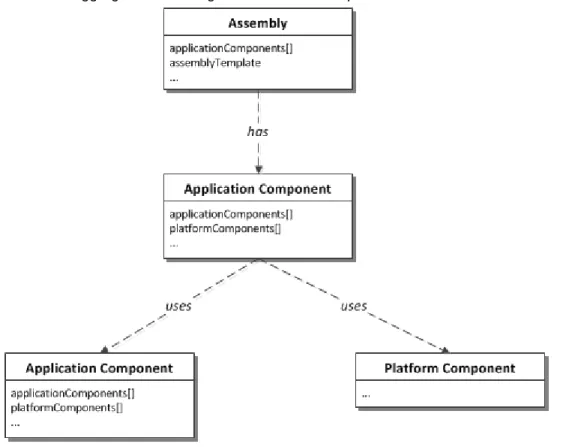
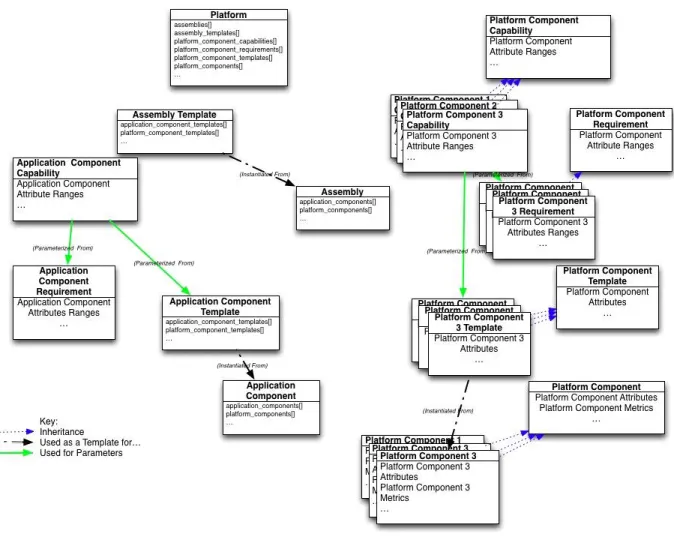
Application Components may also interact with other Application Components. Thus, an Application Component has two different sets of dependencies. It depends on the Components provided by the platform, and depends on services provided by other Application Components. Such Application
Components may be on the same platform or may reside at some other location. The Assembly resource is used to aggregate the management of these components as shown below:
Figure 2 - Runtime Management Resources
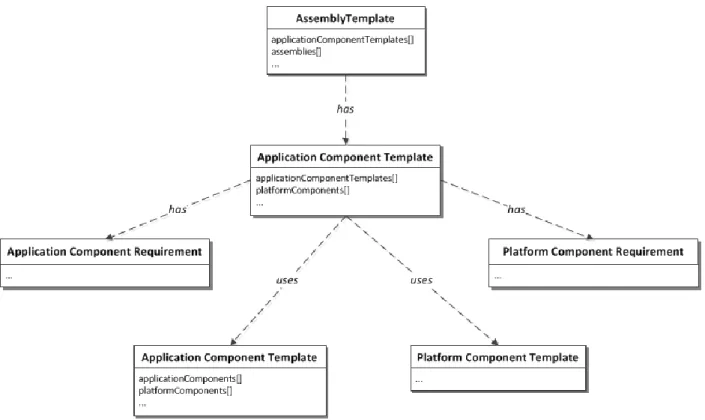
Platform Components have a set of Platform Component Capabilities that an application can choose from to meet its requirements. Applications can tailor Platform Component Requirements (a refinement or narrowing of the configuration ranges in the Capabilities) to meet their needs based on the range of parameters expressed in the Platform Component Capability.
Figure 3 - Template Management Resources
An Application Component can express the exact configuration of its dependency on other Components using one of the Component Template resources (either an Application Component Template or Platform Component Template). Alternatively, it can express a range of configuration values that are acceptable for that dependency by using one of the Component Requirement resources (either an Application Component Requirement or Platform Component Requirement). This might be done, for example, in an ADE when the existing Component Templates are not known. During the deployment, these
Requirements are matched with Capabilities that have attribute values that fall within the ranges specified by the Requirements.
An Application Component Template cannot be instantiated unless all of its dependencies are satisfied. An Assembly Template cannot be instantiated until all of its Application Component Templates are successfully instantiated.
When instantiated, an Assembly Template results in an Assembly. The Assembly resource references the Assembly Template it was instantiated from, although attributes of the Assembly can deviate from the original template. An Assembly can be snapshot at a point in time and the resulting snapshot can be used to create a new Assembly Template.
A Deployment Plan is packaging management meta-data that includes a serialized copy of the Assembly Template resource and all dependent management resources such as Application Component
Templates. Deployment Plans are an essential part of a Platform Deployment Package (PDP). A Platform Deployment Package is an archive of executable images, dependency descriptions and metadata (management resources) that can be used to move an Application and its Components from Platform to Platform, or between an Application Development Environment and a Platform. It can be thought of as a serialized form of an Assembly Template and all of its dependent management resources.
2.1.3 Management Model Diagrams
The figures in this section list attributes for various management resources. The attributes listed here are not exhaustive. For a comprehensive list of attributes for resources see Section 5.
2.1.3.1 Basic Platform Resources
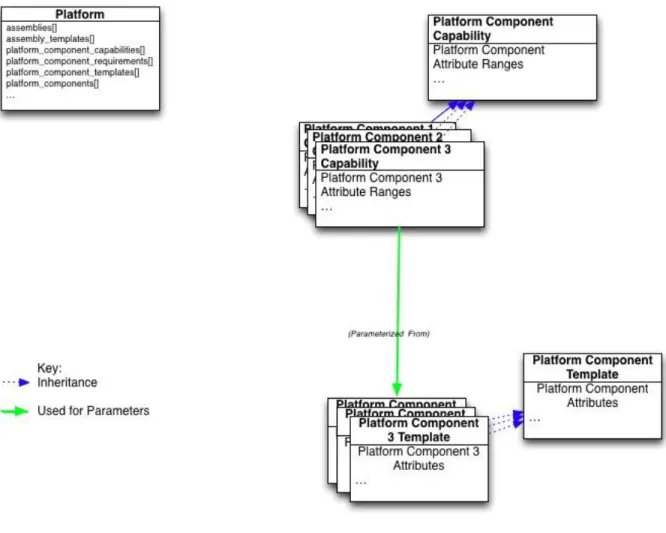
The CAMP model includes the resources below when no Assemblies have been created.
Figure 4 - Basic Platform Resources
An empty Platform will have a number of resources visible through the API when the Application Administrator first accesses a new account. The Platform resource is used to find the other resources in this diagram. The various Platform Component Capabilities allow for discovery of all the platform services that are available with value ranges for each service’s attributes. The various Platform Component Templates may represent pools of previously configured platform resources and represent this configuration as specific values for each of the attributes. These values are chosen from the range of values in the corresponding Platform Component Capability.
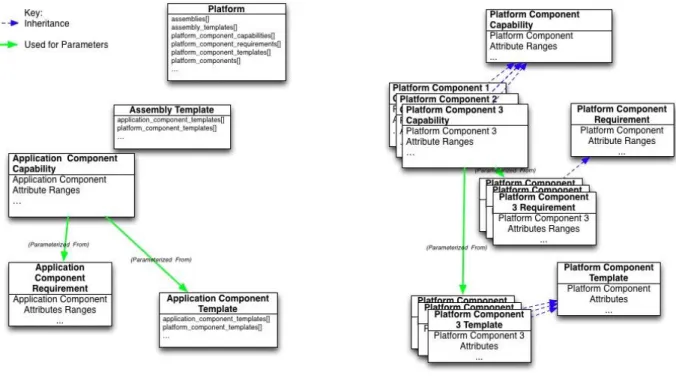
2.1.3.2 Resources Loaded
Figure 5 - Loaded Resources
An Assembly Template now is available with one or more Application Component Templates, Application Component Requirements and Platform Component Requirements. The Application Component
Template resources represent actual code that was loaded with the deployment plan. The Application Component Requirement resources were used to find Application Component Templates (pre-existing software libraries for example) that were not part of the deployment plan but are required for the application. The Application Component Capability resources show the range of configurable attributes that the loaded Application Components can take on, when reused by future Application Components. The Platform Component Requirement resources were used to find Platform Component Templates (pre-configured platform resources) that were part of the platform and required by the loaded Application Components, but perhaps unknown at the time the deployment plan was created (in an ADE for example).
2.1.3.3 Instantiated Resources
To start an application utilizing all of the previously configured Application Components and Platform Components, an Assembly is created using the Assembly Template. This also causes the Application Components and Platform Components corresponding to their respective templates to be created as shown below.
Figure 6 - Instantiated Resources
To manage the operation of the application, the Application Administrator interacts with the Assembly resource and the related Application Component and Platform Component resources.
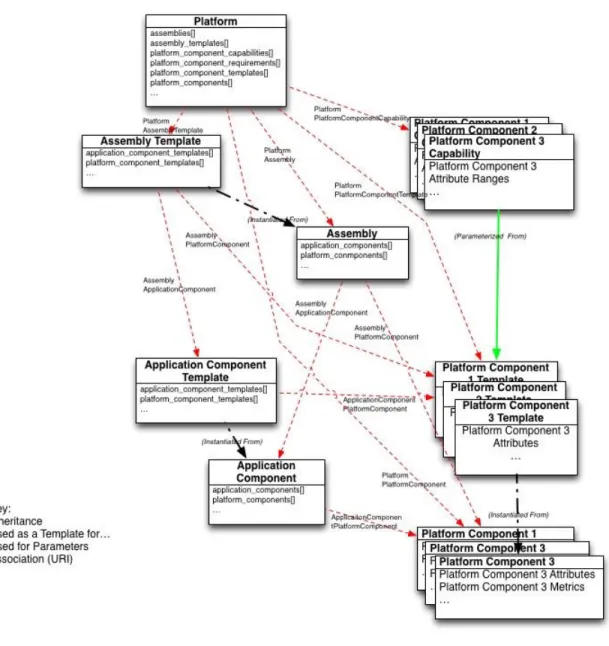
The traversal of the resources in the model can be accomplished by following arrays of URIs from each resource to the other resources it depends on as shown by the red arrows in the figure below:
Figure 7 - Traversing Resources
2.2 Importing a Platform Deployment Package
A Platform Deployment Package may be imported into the platform and as a result the following takes place:
1. One or more Assembly Templates are created with URIs to the other elements and with any binary executables installed onto the platform.
2. One or more Application Component Templates are created with URIs to the other elements and with and binary executables installed onto the platform.
3. Zero or more Platform Component Requirements are created, representing the requirements on the underlying platform components. Connections may be made to existing Platform Component Templates whose attribute values fall within the ranges specified by the requirements.
4. Zero or more Application Component Requirements are created, representing the requirements on previously installed Application Components. Connections may be made to existing
Application Component Templates whose attribute values fall within the ranges specified by the requirements.
2.3 Exporting a Platform Deployment Package
A Platform Deployment Package may be exported from the platform by an operation on an Assembly or an Assembly Template. The Assembly (Assembly Template), dependent Application Components (Application Component Templates) and Platform Components (Platform Component Templates) and associated Capabilities Requirements, if any, as well as all related images are then used to create the Deployment Plan and Platform Deployment Package. A URI to the Platform Deployment Package is returned as a result.
3 Application Lifecycle
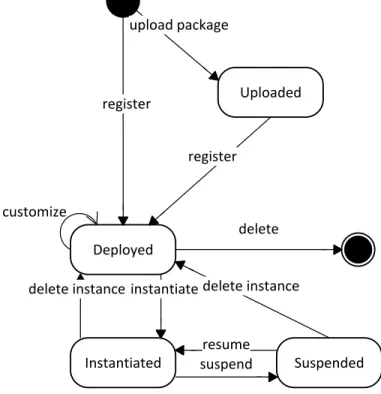
The following state diagram depicts lifecycle of an Application from the perspective of the PaaS Management API. Uploaded Deployed Instantiated Suspended upload package register register suspend resume delete instance delete delete instance customize instantiate
Figure 8 - Application Lifecycle
The following sections describe this diagram. It is important to note:
The states and transitions shown in this diagram are abstract and do not necessarily correspond in a one-to-one fashion with any specific information or activities maintained or performed by either the Consumer or the Provider.
The entities that define “the Application” vary between states. For example, in the “Deployed” state, the Application is represented by the graph of entities rooted in an Assembly Template. In in the “Instantiated” state, the Application is represented by the graph of entities rooted in an Assembly.
Platform-specific environments might add to or extend this lifecycle to accommodate the needs of a particular framework or language. Such extensions are outside the scope of this specification.
3.1 Uploaded
While the development of Applications and their components is outside the scope of this specification, nonetheless it is recognized that such development may occur either within the PaaS environment itself, or externally (i.e. on the Application Developer’s local machine). In the latter case, the executable images, and Deployment Plan, and other metadata that make up the Application shall be imported into the
platform in the form of a PDP. Because the PDP represents a significant interoperability point, the Uploaded state exists to depict the upload package transition. During this transition the PDP is un-archived, validated, and parsed (not necessarily in that order). Invalid PDPs will cause the upload
package transition to fail. Once uploaded, the Application/PDP may be persisted in some fashion outside the scope of this specification. The invocation of the register transition may occur either automatically or via some unspecified action on the part of the Application Administrator.
3.2 Deployed
The Application enters the Deployed state via one of the register transitions. During these transitions the Deployment Plan is parsed and validated and the corresponding Assembly Template, Application
Component Templates, Application Component Requirements, etc. are created as addressable entities in the Platform. The register transition also encompasses the process of dependency resolution in which Platform Component Requirements and Application Component Requirements are matched
(respectively) against candidate Platform Component Templates and Application Component Templates. Note this process may require interaction with the Consumer. If the required dependencies are not resolved or if the metadata is incomplete, the register transition shall not happen.
Once deployed, an Application may be customized by the Application Administrator. This is represented by the customize transition. Customization may include changes to configuration parameters, modifying dependencies, etc. Application Administrators may elect to copy or create new Assembly Templates – effectively creating a new Application.
Deployed Applications may be removed as represented by the delete transition. Deleting an Application removes its Assembly Template, Application Component Template, Platform Component Requirement, and Application Component Requirement entities.
3.3 Instantiated
The Instantiated state represents a running Application. The management entity for an Application in this state is the Assembly. The Assembly and its graph of dependent Application Components and Platform Components are created upon entry to this state via the instantiate transition and removed during the delete instance transition.
3.4 Suspended
The optional Suspended state represents an Application that has been suspended. During this state the Application is unavailable to its clients and does not process any requests. This specification does not specify whether the suspension is done at full scale with all its existing resources allocated, or scaled back with minimum resources necessary to preserve its runtime context, or something in between. An implementation can specify scale at which suspension is done or allow clients to specify the scale of suspension via extensions. The scale at which the suspension is done affects resource utilization and therefore cost during the suspension phase. It also affects the time it takes to resume processing client requests at roughly the same rate as before suspension.
Note the delete instance transition has the same effect as the delete instance transition for an Instantiated Application.
4 Platform Deployment Package
The Platform Deployment Package (PDP) ensures portability across platforms. It can be created by a platform to export to another platform, which then imports it. It can also be created by an Application Development Environment running locally or deployed as Software as a Service in the cloud.
4.1 PDP Package Structure
A PDP consists of the following files:
One Deployment Plan file with extension .dp Zero or one manifest file with the extension .mf Zero or one certificate with the extension .cert Zero or more language specific bundles Zero or more additional resource files
The manifest file contains a list of all the other files in the package and may contain file-related metadata such as checksums. The certificate is used to sign the package manifest. The PDP may be delivered as a single tar file consisting of the above items.
4.2 Deployment Plan
The Deployment Plan is an XML file that contains the templates, dependencies and platform component configurations that enables the platform to create the environment and instantiate all the components in order to launch the application. Attributes in the deployment plan are used by the platform to create the Assembly Template, Component Templates and Component Dependencies.
4.3 Deployment Plan Schema
This section will be completed when the resource encoding in section 4 is complete. The intent is to reuse that encoding in the Deployment Plan Schema such that implementations have a ready capability to generate Platform Deployment Plans from their internal representations.
5 Resources
The following sections describe the resources defined by this specification.
5.1 Common Types
Resource attributes are defined using the following types:
5.1.1 Boolean
As defined by JSON [RFC4627], a token having a literal value of either true or false.
5.1.2 String
A UNICODE string as defined by JSON [RFC4627].
5.1.3 URI
A String (see above) that conforms to the syntax defined in RFC 3986 [RFC3986].
5.1.4 Timestamp
A String (see above) that conforms to the syntax defined in ISO 8601 [ISO 8601:20044] with the
restriction that time stamps shall be expressed in UTC (Coordinated Universal Time), with a special UTC designator ("Z").
5.1.5 Link
The management model defined in this specification involves resource entity attribute values that link to other resource entities. For example, one of the Platform resource entity attribute values points to Assembly Templates. The “Link” type defined here is used for such attribute values.
Link has one or more attributes. The attribute href whose value is a URL MUST be present. Other attributes, not defined in this specification, MAY also be present. A JSON example is shown below:
"LinkName": {"href": "http://example.org/paas1/assemblies/1"}
5.1.6 ResourceState
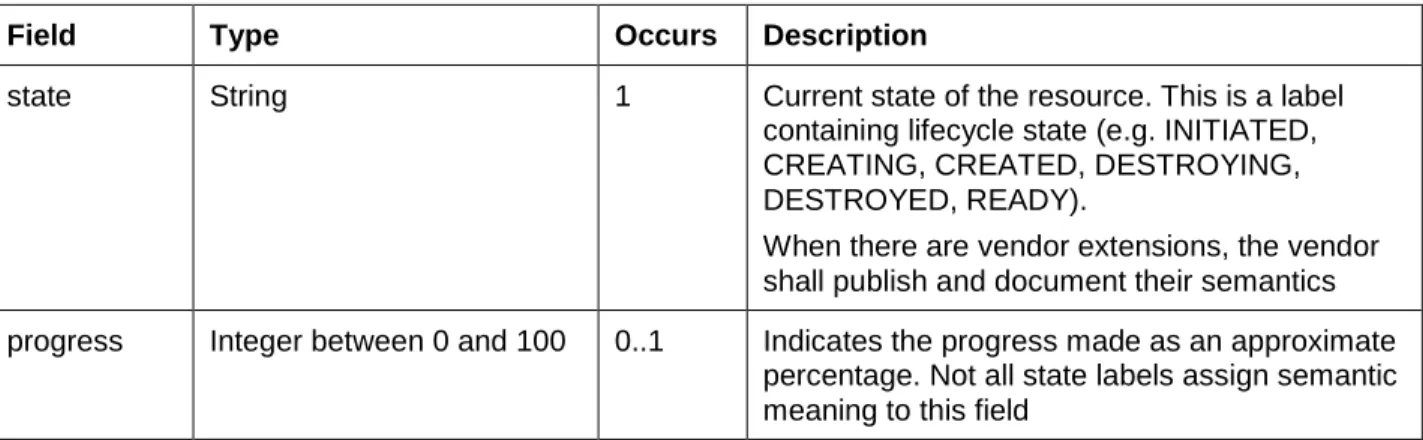
This type is used to denote the state of the resource within the lifecycle defined for that resource. The following table is the data model of this type.
Table 1 – ResourceState Data Model
Field Type Occurs Description
messages Message[] 0..1 Include the message data model instances to denote noteworthy communications
5.2 Attribute Constraints
Resource attributes are constrained along a number of axes. These are:
5.2.1 Cardinality
This constraint indicates the cardinality of the attribute.
5.2.2 Mutability
This constraint indicates the mutability of the attribute’s value(s). “immutable” indicates that the value of the attribute, once set, shall not change for the lifetime of the resource. “mutable” indicates that the value of the attribute may change due to the actions or activity of either the provider or the user.
5.2.3 Writeable
This constraint indicates the ability of a user to update the value of the attribute. It is only relevant for mutable attributes. “false” indicates that the value(s) of the attribute can only be changed by the provider. “true” indicates that users may change the value(s) of the attribute.
5.3 Common Resource Attributes
All the resources in this specification contain the following common attributes:
5.3.1 uri
Type: URI Cardinality: 1
Mutability: immutable
This attribute expresses the URI of the resource.
5.3.2 name
Type: String Cardinality: 1 Mutability: mutable Writeable: true
This attribute expresses the human-readable name of the resource.
5.3.3 description
Type: String Cardinality: 0..1 Mutability: mutable Writeable: true
This attribute expresses the human-readable description of the resource.
5.3.4 created
Cardinality: 1
Mutability: immutable
This attribute expresses the time which the resource was created.
5.3.5 tags
Type: String[] Cardinality: 0..1 Mutability: mutable Writeable: true
This attribute is an array of String values that may be assigned by the provider or the user. These values can be used for keywording and terms-of-interest.
5.3.6 type
Type: String Cardinality: 1
Mutability: immutable Writeable: false
This attribute expresses the CAMP resource type. Every CAMP resource type defined in this specification specifies the required value for this attribute.
5.4 Error Response Message
Successful requests will generally return an HTTP status code of 200 (OK), 201 (Created), 202
(Accepted), or 204 (No Content), to indicate that the requested action has been successfully performed or submitted. In addition, they might include a response message body containing a representation of the requested information. However, it is possible for a number of things to go wrong. The various underlying causes are described (as discussed in the previous section) by various HTTP status codes in the range 400-499 (for client side errors) or 500-599 (for server side problems).
If a response is returned with an error status code (400-499 or 500-599), where appropriate, the server is encouraged to include a response message body containing an ErrorMessage object (as defined below). The text values of such messages might be used, for example, to communicate with a human user of the client side application.
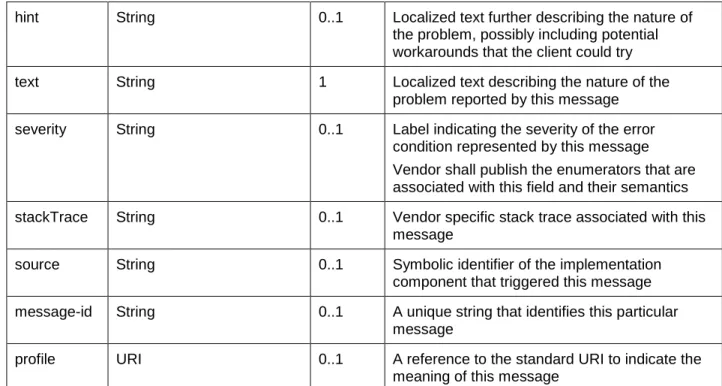
The list of messages included in a single error response is encapsulated in the ErrorMessage data model.
Table 2 – ErrorMessage Data Model
Field Type Occurs Description
message Message 0..n Zero or more message data for each individual
message. An individual message contains the following fields:
hint String 0..1 Localized text further describing the nature of the problem, possibly including potential workarounds that the client could try
text String 1 Localized text describing the nature of the
problem reported by this message
severity String 0..1 Label indicating the severity of the error
condition represented by this message Vendor shall publish the enumerators that are associated with this field and their semantics
stackTrace String 0..1 Vendor specific stack trace associated with this
message
source String 0..1 Symbolic identifier of the implementation
component that triggered this message
message-id String 0..1 A unique string that identifies this particular
message
profile URI 0..1 A reference to the standard URI to indicate the
meaning of this message
The profile attribute indicates the semantic meaning of the message which clients may handle
automatically. Messages with the same profile shall adhere to the semantic requirements of that profile, but the payload (hint, text, severity, stackTrace) may be different. In other words, given a profile, clients processing the message should be able to subsequently interact with the providers in a consistent manner across.
Each provider may extend the profile to include specific scenarios and use cases.
The information captured in the message data element should be complementary to the HTTP status code, and COULD provide more detailed information. However, it shall not contradict the HTTP status code that is returned with the request.
The following table outlines the common profiles that would accompany this specification.
Table 4 - Common Message Profiles
Profile Description
/msg/unknown Unknown error and information given is descriptive in nature
/msg/security Security issues
/msg/security/authentication An authentication error
/msg/access Access violation error
/msg/allocation Allocation related issues
/msg/allocation/insufficient Insufficient resource to satisfy the request /msg/infrastructure Infrastructure related issues
/msg/infrastructure/maintenance The request cannot be immediately responded due to the infrastructure being in maintenance status
5.5 Extensibility to the resource model
The attribute name of a resource shall contain alphanumeric characters with “_” and “-“. Thus, [a-zA-Z0-9_\-]
5.6 Platform
For a user, a Platform represents the user’s starting view of all accessible resources and deployed entities. This resource has the following, general representation:
{ "uri": URI, "name": String, "type": "platform", "description": String, "created": Timestamp, "tags": [ String, + ], ? "specificationVersion": String[], "implementationVersion": String, ? "assemblyTemplates": [ {"href": URI}, + ], ? "assemblies": [ {"href": URI}, + ], ? "platformComponentTemplates": [ {"href": URI}, + ], ? "platformComponentCapabilities": [ {"href": URI}, + ], ? "platformComponents": [ {"href": URI}, + ], ? "resourceState": { "state": String, "progress": String, ? "messages": [ { Message }, + ] ? } }
The Platform resource contains the following attributes:
5.6.1 specificationVersion
Type: String[] Cardinality: 1
Mutability: immutable
5.6.3 assemblyTemplates
Type: Link[] Cardinality: 0..1 Mutability: mutable Writeable: false
This attribute is an array of Links to the AssemblyTemplates that are accessible to the user.
5.6.4 assemblies
Type: Link[] Cardinality: 0..1 Mutability: mutable Writeable: false
This attribute is an array of Links to the Assembly resources that are accessible to the user.
5.6.5 platformComponentTemplates
Type: Link[] Cardinality: 0..1 Mutability: mutable Writeable: false
This attribute is an array of Links to the PlatformComponentRequirement resources that are accessible to the user.
5.6.6 platformComponentCapabilities
Type: Link[] Cardinality: 0..1 Mutability: mutable Writeable: falseThis attribute is an array of Links to the PlatformComponentCapability resources that are accessible to the user.
5.6.7 platformComponents
Type: Link[] Cardinality: 0..1 Mutability: mutable Writeable: falseThis attribute is an array of Links to the PlatformComponentCapability resources that are accessible to the user.
5.6.8 resourceState
Type: ResourceState Cardinality: 1 Mutability: mutable Writeable: false5.7 AssemblyTemplate
For an Application Administrator, an Assembly Template represents the definition of the deployable Application. Application Administrators can create an Assembly Instance by specifying the URI of a Assembly Template as a field in a deployment request. The platform shall instantiate the Application Components and their configurations as specified in the definition of the Assembly Template. This resource has the following, general representation:
{ "uri": URI, "name": String, "type": "assemblyTemplate", "description": String, "created": Timestamp, "tags": [ String, + ], ? "definition": String, "applicationComponentTemplates": [ {"href": URI}, + ], ? }
The AssemblyTemplate resource contains the following attributes:
5.7.1 definition
Type: String Cardinality: 1 Mutability: mutable Writeable: true
This attribute contains the definition of the AssemblyTemplate represented in some format, such as XML, that contains the metadata necessary for the platform to deploy the Application.
5.7.2 applicationComponentTemplates
Type: Link[] Cardinality: 0..* Mutability: mutable Writeable: true
This attribute is an array of Links to the ApplicationComponentTemplate resources that are part of this AssemblyTemplate. An AssemblyTemplate MAY have zero references to ApplicationComponentTemplate resources, but conformant CAMP server implementations MUST NOT instantiate an Assembly using an AssemblyTemplate that does not reference at least one ApplicationComponentTemplate.
5.8 ApplicationComponentTemplate
"type": "applicationComponentTemplate", "description": String, "created": Timestamp, "tags": [ String, + ], ? "definition": String, "applicationComponentTemplates" : [ {"href": URI}, + ], ? "platformComponentTemplates" : [ {"href": URI}, + ], ? "applicationComponentRequirements" : [ {"href": URI}, + ], ? "platformComponentRequirements" : [ {"href": URI}, + ], ? }
The ApplicationComponentTemplate resource contains the following attributes:
5.8.1 definition
Type: String Cardinality: 1 Mutability: mutable Writeable: true
This attribute contains the definition of the ApplicationComponentTemplate represented in some format, such as XML, that contains the metadata necessary for the platform to deploy the Application.
5.8.2 applicationComponentTemplates
Type: Link[] Cardinality: 0..1 Mutability: mutable Writeable: true
This attribute is an array of Links to ApplicationComponentTemplate resources. Each of these resources is a template for an Application Component that will be used by the Application Component that is instantiated from this template.
5.8.3 platformComponentTemplates
Type: Link[] Cardinality: 0..1 Mutability: mutable Writeable: true
This attribute is an array of Links to PlatformComponentTemplate resources. Each of these resources is a template for a Platform Component that will be used by the Application Component that is instantiated from this template.
5.8.4 applicationComponentRequirements
Cardinality: 0..1 Mutability: mutable Writeable: true
This attribute is an array of Links to ApplicationComponentRequirement resources.
5.8.5 platformComponentRequirements
Type: Link[] Cardinality: 0..1 Mutability: mutable Writeable: true
This attribute is an array of Links to PlatformComponentRequirement resources.
5.9 ApplicationComponentRequirement
For an Application Administrator, an Application Component Requirement represents an Application Component’s requirement on another Application Component and its required range of component capabilities. Each Application Component Requirement implements this class and adds its’ own Attribute Ranges to the list below. This resource has the following, general representation:
{ "uri": URI, "name": String, "type": "applicationComponentRequirement", "description": String, "created": Timestamp, "tags": [ String, + ], ? "definition": String }
The ApplicationComponentRequirement resource contains the following attributes:
5.9.1 definition
Type: String Cardinality: 1 Mutability: mutable Writeable: true
This attribute contains the definition of the ApplicationComponentRequirement represented in some format, such as XML, that contains the metadata necessary for the platform to deploy the Application.
5.10 ApplicationComponentCapability
"type": "applicationComponentCapability", "description": String, "created": Timestamp, "tags": [ String, + ], ? "definition": String }
Each Application Component Capability implements this class and adds its’ own Attributes to the list below.
5.10.1 definition
Type: String Cardinality: 1 Mutability: mutable Writeable: trueThis attribute contains the definition of the ApplicationComponentCapability represented in some format, such as XML, that contains the metadata necessary for the platform to deploy the Application.
5.11 PlatformComponentTemplate
For an Application Administrator, a Platform Component Template represents the desired configuration of a Platform Component with specific values for the component capabilities. The specified value for each component attribute shall be in the range defined in the corresponding Platform Component Capability. This resource has the following, general representation:
{ "uri": URI, "name": String, "type": "platformComponentTemplate", "description": String, "created": Timestamp, "tags": [ String, + ], ? "definition": String }
Each Platform Component implements this class and adds its own Component Attributes to the list below.
5.11.1 definition
Type: String Cardinality: 1 Mutability: mutable Writeable: true
This attribute contains the definition of the PlatformComponentTemplate represented in some format, such as XML, that contains the metadata necessary for the platform to deploy the Application.
5.12 PlatformComponentRequirement
For an Application Administrator, a Platform Component Requirement represents an Application Component’s requirement on a Platform Component and its required range of component capabilities. This resource has the following, general representation:
{ "uri": URI, "name": String, "type": "platformComponentRequirement", "description": String, "created": Timestamp, "tags": [ String, + ], ? "definition": String }
Each Platform Component Requirement implements this class and adds its own Attribute Ranges to the list below.
5.12.1 definition
Type: String Cardinality: 1 Mutability: mutable Writeable: trueThis attribute contains the definition of the PlatformComponentRequirement represented in some format, such as XML, that contains the metadata necessary for the platform to deploy the Application.
5.13 PlatformComponentCapability
For an Application Administrator, a Platform Component Capability represents the definition of Platform Component and its range of component capabilities. This resource has the following, general
representation: { "uri": URI, "name": String, "type": "platformComponentCapability", "description": String, "created": Timestamp, "tags": [ String, + ], ? "definition": String }
Each Platform Component Capability implements this class and adds its’ own Attributes to the list below.
5.13.1 definition
Type: String Cardinality: 1 Mutability: mutable
{ "uri": URI, "name": String, "type": "assembly", "description": String, "created": Timestamp, "tags": [ String, + ], ? "definition": String, "applicationComponents": [ {"href": URI}, + ], ?
"assemblyTemplate": {"href": URI}, ? "resourceState": { "state": String, "progress": String, ? "messages": [ { Message }, + ] ? } }
The Assembly resource contains the following attributes:
5.14.1 definition
Type: String Cardinality: 1
Mutability: immutable
This attribute contains the definition of the Assembly represented in some format, such as XML, that contains the metadata necessary for the platform to deploy the Application.
5.14.2 applicationComponents
Type: Link[] Cardinality: 1..* Mutability: immutable
This attribute is an array of Links to the ApplicationComponent resources that are part of this Assembly. An Assembly resource MUST have at least one reference to an ApplicationComponent resource.
5.14.3 assemblyTemplate
Type: Link Cardinality: 1
Mutability: immutable
This attribute is a Link to the AssemblyTemplate resource from which this Assembly was created.
5.14.4 resourceState
Type: ResourceState Cardinality: 1 Mutability: mutable Writeable: false
5.15 ApplicationComponent
For an Application Administrator, an Application Component represents the management of the deployed Component at runtime. This resource has the following, general representation:
{ "uri": URI, "name": String, "type": "applicationComponent", "description": String, "created": Timestamp, "tags": [ String, + ], ? "definition": String, "applicationComponents": [ {"href": URI} + ], ? "platformComponents": [ {"href": URI}, + ], ? "resourceState": { "state": String, "progress": String, ? "messages": [ { Message }, + ] ? } }
The ApplicationComponent resource contains the following attributes:
5.15.1 definition
Type: String Cardinality: 1
Mutability: immutable
This attribute contains the definition of the ApplicationComponent represented in some format, such as XML, that contains the metadata necessary for the platform to deploy the Application.
5.15.2 applicationComponents
Type: Link[] Cardinality: 0..* Mutability: immutable
This attribute is an array of Links to the ApplicationComponent resources that this ApplicationComponent depends on.
5.15.4 Type: ResourceState
Cardinality: 1 Mutability: mutable Writeable: false
This attribute expresses state of the resource within the lifecycle.
5.16 PlatformComponent
For an Application Administrator, a Platform Component represents the runtime instance of a platform component and its configuration of component attributes as well as metrics associated with those attributes. This resource has the following, general representation:
{ "uri": URI, "name": String, "type": "platformComponent", "description": String, "created": Timestamp, "tags": [ String, + ], ? "definition": String, "externalManagementResource": URI, ? "resourceState": { "state": String, "progress": String, ? "messages": [ { Message }, + ] ? } }
Each Platform Component implements this class and adds its own attributes and to the list below.
5.16.1 definition
Type: String Cardinality: 1
Mutability: immutable
This attribute contains the definition of the PlatformComponent represented in some format, such as XML, that contains the metadata necessary for the platform to deploy the Application.
5.16.2 externalManagementResource
Type: URI Cardinality: 0..1 Mutability: immutable
A URI to an external management interface to manage this platform component (such as an IaaS API to manage the virtual machines that support this component). This is platform dependent and requires external documentation to understand its meaning.
5.16.3 resourceState
Type: ResourceState Cardinality: 1 Mutability: mutable
Writeable: false
6 Protocol
6.1 Transport Protocol
All of The Platform APIs are based on the Hypertext Transfer Protocol, version 1.1 [RFC2616]. Each request will be authenticated using HTTP Basic Authentication [RFC2617] unless otherwise noted. Therefore, requests sent from clients across unsecured networks should use the HTTPS protocol. TLS 1.1 [RFC4346] shall be implemented by the provider and TLS 1.2 [RFC5246] is strongly encouraged. When TLS is implemented, the following cipher suites shall be supported to ensure a minimum level of security and interoperability between implementations:
TLS_RSA_WITH_AES_128_CBC_SHA (mandatory for TLS 1.1/1.2)
TLS_RSA_WITH_AES_256_CBC_SHA256 (addresses 112-bit security strength requirements) TLS_RSA_WITH_NULL_SHA (for TLS without encryption)
6.2 URI Space
The resources in the system are identified by URIs. To begin operations, a client shall know the URI for a resource. Dereferencing the URI will yield a representation of the resource containing resource attributes and links to associated resources.
Clients shall not make assumptions about the layout of the URIs or the structure of the URIs of the resources.
6.3 Media Types
In this specification, resource representations, request bodies, and error response messages are
encoded in JSON, as specified in [RFC4627]. The media-type associated with CAMP JSON resource and error response message representation is "application/json".
The Platform shall provide representations of all resources available in JSON, but other formats are allowed. This specification doesn't define any schemata or aid in validating an XML encoding. The Platform shall accept requests from clients encoded in JSON.
If alternative formats are supported they shall be supported uniformly for all resources.
6.4 Request Headers
This API does not impose any requirements on clients’ use of HTTP headers. All PUT requests that update a resource SHOULD contain the If-Match header field with a single entity tag value. If the If-Match header field value in the request does not match the one on the server-side, the server MUST send back a '412 Precondition Failed' status code.
6.5 Request Parameters
In order to address a subset of attributes in a resource, the client can use request parameters in GET and PUT requests to formulate the following
Table 5 – Request Parameters
Format Description Example
?SelectAttr=attr 1,attr2,…
Comma (“,”) separated attribute names of the resource to return.
If an attribute is not part of the resource, an HTTP 4XX status code shall be
Assembly132?SelectAttr =name,description,status
Would access only “name”, “description”, “status” attributes of Assembly132.
returned.
The “SelectAttr” query parameter may appear more than once (separated by an “&”). The client shall URL encode the request parameters.
When one or more request parameters are specified for a PUT request, a client shall not include
attributes in the request entity body that are not specified in the request parameter. Upon receiving such a request the server shall respond with a 400 status code.
6.6 Response Headers
Responses returned by the Platform makes standard use of HTTP headers. All HTTP responses that return representation of a resource SHOULD use strong ETag response header field indicating the current value of the entity tag for the resource.
6.7 HTTP Status Codes
The API returns standard HTTP response codes.
6.8 Concurrent API versions
Multiple API versions may be offered concurrently to allow backward compatibility for clients. To discover available versions a client issues a GET request for the <platform-url>/api/versions resource and may select one of the listed versions. Each available API version is assigned a namespace identified by a URL.
The response to a GET request for <platform-url>/api/versions will include a list of available API versions and the URL where each version may be accessed. The list of available versions shall be expressed using the common Link type with an additional name version added to the link and its corresponding value.
An example of client requests to the platform are as follows: GET / => {…, "links": […, "/api/versions", …], …} GET /api/versions => [
{"version" : "1.0", "href": "http://paas.example.org/"}, {"version" : "1.1", "href": "http://api.example.org/foo"}, ]
Only versions defined by a CAMP specification can be listed. Additional features not defined in this specification can be implemented using the extensibility features discussed in this specification.
6.9 Registering a PDP
As indicated in Section 3, registering a package moves it to the deployed state. To register a PDP, a client sends a POST HTTP request to the Platform URL. The entity body of the request contains the URI that identifies the PDP that is being registered. If the URI that identifies the PDP is a relative URI, its base URI is the Platform URI. The JSON serialization of the HTTP request entity body is:
POST /<platform-url> HTTP/1.1 Host: example.org Content-Type: application/json Content-Length: ... {"pdp_uri": "/paas/pdp/1"} HTTP/1.1 201 Created Location: http://example.org/paas/asm_template/1 Content-Type: ... Content-Length: ... ...
6.10 Instantiating an Application
Once the application is in the deployed state, a client can instantiate the application by sending a POST HTTP request to the corresponding AssemblyTemplate URL. The entity body of the request can be empty. Interpretation of a non-empty entity body of the request is implementation-dependent. On success the server creates an Assembly resource and sends a 201 Created HTTP status code with the Location header in the HTTP response. The Location header points to the newly created Assembly resource. The server also updates the AssemblyInstances attribute of the Platform resource to include a reference to the newly created assembly.
An example HTTP request-response is as follows: POST /paas/asm_template/1 HTTP/1.1 Host: example.org HTTP/1.1 201 Created Location: http://example.org/paas/assembly/1 Content-Type: ... Content-Length: ... ...
6.11 Suspending and Resuming an Application
To suspend, or resume an application, a client sends a POST HTTP request to the assembly resource URL. The entity body of the request contains the value of the new state for the application. The JSON serialization of the HTTP request entity body is:
{"new_state" : "<new-state-value>"}
Where, new_state specifies the new desired value for the application state. This specification defines two such values: "suspend", and "resume," whose semantics are as defined in Section 3. An implementation MAY have additional state values that it allows. The JSON object MAY contain additional name-value pairs that are not defined in this specification. An implementation can define additional state values or name-value pairs, to allow clients to specify the scale at which the application is suspended and resumed. An example HTTP request-response is as follows:
POST /<assembly-resource-url> HTTP/1.1 Host: example.org Content-Type: application/json Content-Length: ... {"new_state": "suspend"} HTTP/1.1 200 OK