Chapter
6Content-Based Image Retrieval Using
Metadata and Relaxation Techniques
W.W. Chu, C.-C. Hsu,
I.T. Ieong*, and R.K. Taira**
Department of Computer Science University of California, Los Angeles Los Angeles, CA 90024, USA [email protected] *NCR Corporation 100 N. Sepulveda Blvd. El Segundo, CA 90245, USA **Department of Radiological Sciences University of California, Los Angeles Los Angeles, CA 90024, USA
Abstract
In this chapter, a metadata approach is proposed for content-based image re-trieval. A three-layered data model is introduced which consists of a Represen-tation Layer (RL), a Semantic Layer (SL), and a Knowledge Layer (KL). Raw images and segmented objects (represented in contours) are represented in the RL. Hierarchical, spatial, temporal, and evolutionary semantics of the image content are captured in the SL. This layer mimics the user's conceptual view of the image content.Shape model(s)anddecomposition techniquesare introduced for extracting features for dierently shaped image objects. Knowledge of im-age feature characteristics is presented in the KL. An instance-based conceptual clustering technique is used to cluster conceptually similar image objects and features. A hierarchical knowledge representation, called type abstraction hier-archy, is used to represent the clustering of similar images based on a common set of features. A knowledge-based spatial evolutionary query language, KEQL, is developed to provide spatial and evolutionary constructs to query the image content with conceptual terms and approximate predicates. The knowledge base is used to relax query conditions when no answer or no satisfactory answer is re-turned. Further, the knowledge base is used to interpret the high level conceptual terms and approximate predicates.
148
Chapter 6
Using an object-oriented database, the proposed data model and query process-ing methodology have been implemented for a medical image database system at UCLA to demonstrate the validity of the metadata approach for retrieving medical images by features and content.
6.1 Introduction
Advances in medical imaging systems have revolutionized the acquisition of human images, providing views of cross sections and physiological states using a variety of modalities, including X-rays, computed tomography (CT), magnetic resonance (MR), etc. Currently, a medical picture archival and communication system (PACS) infrastructure is operational at UCLA to provide ecient archival, retrieval, communication, and display of the large repository of digital medical images [20, 39]. The digital image data is acquired automatically by PACS which contains two optical disk library units, each with a capacity of one terabyte. At present, image retrieval in these systems is based on le names or articial keys such as patient hospital identication numbers. There is a need to retrieve the images by content. For example, in therapy treatment planning, the therapist is often interested in retrieving historical cases which demonstrate diagnostic im-age features (object shape, size, location, extent, clustering patterns, etc.) similar to a current study of interest.
The knowledge of the spatial content of a medical image is important in surgical or radiation therapy of brain tumors since the location of a tumor has profound implications for a therapeutic decision. The evolutionary behavior of a tumor is important when studying the treatment-response eects to various therapies. Also, the temporal characteristics of image features help describe the behavior of disease processes. For example, what is the normal growth rate of tumors for a given classication of patients? How does this growth rate change with various regiments of drug/radiation therapy?
Several approaches have been proposed to retrieve images in pictorial databases. Features of image objects are often used to index the images. In such systems, retrieval is based on the indexed features [17]. The in-formation retrieval approach [34, 35] transforms the image and the query into signatures. The query is answered by matching the signatures. In ad-dition, there are approaches which store boundaries of image objects using minimum bounding box representations [36, 18]. Since a bounding box is merely an approximationof the boundary of the original image object, rep-resenting the image object with such structures may not allow the user to retrieve all the answers that satisfy the query specication. Image objects
Content-Based Image Retrieval
149
can also be represented in point sets [31]. Spatial relationships among the image objects are dynamically determined through pixel-level manipula-tion during query processing. The orthogonal relamanipula-tionships among objects can also be encoded into a 2D string [5]. As a result, user queries concerning the orthogonal relations of the objects can be answered.In addition, there are attempts to answer approximate queries concerning spatial objects. QBIC [29] uses object features such asareaandcircularity
to retrieve similarly shaped objects. VIMS [1] retrieves similar images by relaxing feature values of the image based on the standard deviation of the features.
Existing approaches to image retrieval often focus on a specic application domain and have limited query capabilities [17, 5, 34, 29]. Layered model has been proposed to represent the raw featuresand qualitative features
of video images (see Chapter 9). Biological objectsevolve,fuse,split, and change their spatial orientation over time. Few approaches support tempo-ral spatial query answering [31] or tempotempo-ral evolutionary query answering [11], and none support spatial evolutionary query answering. This is due to the lack of appropriate metadata that captures the spatial and evolu-tionary nature of image content for supporting image retrieval. organize the required metadata.
To remedy such shortcomings, in Section 6.2, we propose the use of meta-data to capture image content and knowledge for supporting spatial evo-lutionary query answering on image content. The metadata includes:
1. Raw-image-level metadatafor providing the characteristics of the raw images and pixel-level description of the image content (e.g., contours of interested image objects)
2. Spatial, shape, temporal, and evolutionary metadatafor modeling the spatial, shape, temporal, and evolutionary characteristics of the ob-jects in the images
3. Knowledge-level metadata for representing the knowledge of spatial, shape, temporal and evolutionary characteristics of the image content Section 6.3 describes our feature extraction of images for querying. Sec-tion 6.4 presents the modeling of medical image content with semantic-level metadata. A knowledge-based spatial evolutionary query language (KEQL) for expressing user queries is introduced in Section 6.5, and knowledge-level metadata for intelligent interpretation of image features and content is discussed in Section 6.6. The knowledge-based query pro-cessing is provided in Section 6.7, and nally the system implementation is provided in Section 6.9.
150
Chapter 6
6.2 A Multi-layered Metadata Model for
Representing Image Content
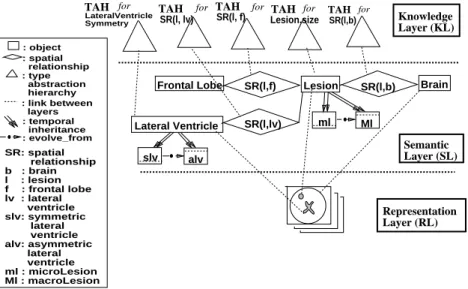
A three layered model is used to organize the image metadata which con-sists of the Representation Layer (RL), the Semantic Layer (SL), and the Knowledge Layer (KL) (see Figure 6-1).
Raw images and contours of the objects in the images are stored in the RL. Related images are organized and stored in various stacks for ecient access [6]. The RL includes two types of metadata: (1) characteristics of the acquired raw images and (2) contours of query-able objects in the images. The characteristics of raw images (e.g., pixel width, dimensionality of images, the height and angle that a brain MR image is taken, number of slices in an MR image set, the spacing between two MR image slices, the machine and technician acquiring the images, etc.) are contained in the header of the (medical) image.
forTAH
LateralVentricle Symmetry
Brain
Frontal Lobe Lesion
Lateral Ventricle SR(l,b) SR(l,lv) SR(l,f) for TAH SR(l,b)
for TAH Lesion.size forTAH SR(l, lv) forTAH SR(l, f) Semantic Layer (SL) Representation Layer (RL) Knowledge Layer (KL) slv alv ml Ml SR: spatial relationship b : brain l : lesion f : frontal lobe lv : lateral ventricle slv: symmetric lateral ventricle alv: asymmetric lateral ventricle ml : microLesion Ml : macroLesion
: object
: type abstraction hierarchy : link between layers : spatial relationship : temporal inheritance : evolve_from
Figure6-1 Modeling of metadata for image features and content
The SL stores metadata for object features and spatial relationships among objects. Techniques are developed to describe the shape of objects and their spatial relationships (e.g., Joined, Disjoined, etc.) and evolutionary relationships (e.g., Evolve, Split, Fuse). An object-oriented approach is used to model the features extracted from the contours of interested ob-jects. The model allows us to express spatial, temporal, and evolutionary
Content-Based Image Retrieval
151
objects. The metadata about these query-able objects and features are domain-dependent and application dependent.The knowledge layer (KL) stores the knowledge-level metadata for sup-porting approximate and conceptual query answering on image content. An instance-based conceptual clustering technique, MDISC [9], is used to cluster image objects based on user-specied conditions (e.g., shape descriptors and spatial relationships). The clustering of image objects is represented in a hierarchical knowledge structure, called Type Abstraction Hierarchy (TAH) [9], for supporting query answering involving similar-to predicates, spatial semantic operators (e.g., Nearby and Far Away), and conceptual terms (e.g.,LargeandSmall). These knowledge structures pro-vides domain-dependent ontologies for approximate and conceptual terms used in querying image content. These metadata also help restrict the vo-cabularies in querying spatial, temporal, and evolutionary object features.
6.3 Feature Extraction
6.3.1 Object Segmentation
Traditional image segmentation approaches are broadly categorized as based on intensity discrimination [3] or edge detection [2].
The intensity approach assumes that a fundamental relationship exists be-tween the pixel intensity and the physical substrate. Theoretically, imaging instruments are measuring specic physical properties such as tissue relax-ation time, electron density, or atomic number. However, numerous studies have shown that factors such as eld inhomogeneity,instrumentation noise, and partial volume eects all contribute to pixel intensity uctuation and create uncertainty in discrimination [3]. Thus, simple global thresholding methods usually fail due to inherent image noise [33].
Current edge-detection-based work shows some degrees of success [26], but in general requires user interaction. Most edge-detection systems cannot discriminate between true object edges, noise edges, and edges originating from, for example, a second overlapping structure. A fundamental under-standing of the nature of the basic signals and hence, edge characteristics, is somewhat lacking. Some success has been gained by the use of multi-scale edge analysis [25]. The overall strategy is that noise-free edges can be obtained from a coarse scale, while a true edge location is obtained from a ne scale. However, analyzing the multi-scale behavior of edges is gener-ally done by using heuristic rules. Visual interpretation plays an important part in correlating edges in dierent scales as well as in making decisions
152
Chapter 6
on determining a true or false edge. A lack of rigorous means for perform-ing multi-scale edge analysis as well as parsperform-ing has seriously limited the eectiveness of these kinds of methods for automated segmentation. Most of the successful semi-automatic image segmentation methods used in im-age manim-agement systems fall into this category, such as active contouring [13] and liquid transforms [29] where the coarse contour or seed point is manually provided.Most recent work in segmentation of anatomic objects involves guided knowledge-based methods. The important features of the model-guided, knowl-edge-based image segmentation approaches include [24]:
1. Physical models of each target image object (e.g., brain, lateral ven-tricle, cranium) are maintained within an attached knowledge-base which can be maintain:
Compositionalmodels: These models identify what substructures are part of a larger superstructure. These compositional mod-els allow the segmentation system to rst localize larger super-structures in the image and leverage on important landmarks of these superstructures to localize more specic target substruc-tures. (e.g., localizing the brain cranium constrains the spatial searching of lateral ventricle).
Grey-level models: These models provide statistical information regarding the expected gray-level distribution of various tissue components (e.g., brain gray matter, brain white matter, cere-bral spinal uid, bone, background, common artifacts) within a medical image superstructure (e.g., brain and hand).
Shape models: A shape contour analyzer decomposes complex object contours into more fundamental lines and curve segments. It is used by the system to verify that contoured objects conform to the general expected shape of the target object.
2. Object-oriented organization allows the system to attach specic pro-cessing methods, relationships, rules and data for each target object (e.g., brain objects, tumor objects, and hand objects).
3. Object models are used to identify important landmarks on object contours [16].
4. Models are used to verify the expected shape of extracted contours and localize any errors signifying gross dierence between object shape and extracted contour shape.
Content-Based Image Retrieval
153
6.3.2 Extracting Shape Features via
Decomposition
Shape is an important property for retrieving images. Global shape mea-surements such as area and perimeter only provide a coarse description of shape. In QBIC [29], global shape descriptors such as circularity are used with area and perimeter value to describe the shape of image objects. Global shape descriptors such as curveness, rectangularity, compactness, direction, elongatedness, and eccentricity [38] provide certain approxi-mate shape measures for contours of relatively simple shapes (i:e:; shape without irregular intrusions and/or protrusions). However, for contours of complex shapes (i.e., shapes with irregular intrusions and/or protrusions), these descriptors do not provide sucient expressive power for describing their specic shape content [23]. Therefore, we propose alandmark-based decomposition techniqueto decompose complex-shaped contours into shape descriptive sub-structures based on the content-related landmark(s) in the images.
Landmarks are characteristic points in an image which are easily recog-nizable on all images and can be used to decomposeeveryinstance of the complex object into descriptive sub-structures (e.g., the tips and webs of a hand are the landmarks for decomposing a hand contour for detailed shape description of a hand). Landmark points in a contoured object can be obtained, for example, by matching model segments with corresponding data segments as described in [16] and [24].
With the landmark identied, the complex-shaped contours are decom-posed into shape-descriptive sub-structures. The shape content of the complex-shaped object can be represented by the simpler shape and spa-tial relationships of the decomposed structures. Attributes of the sub-structures can be common spatial characteristics (such as area, length, and width) or shape descriptors of the decomposed sub-structures. Capturing these attributes provides a more precise description on the shape of the image objects.
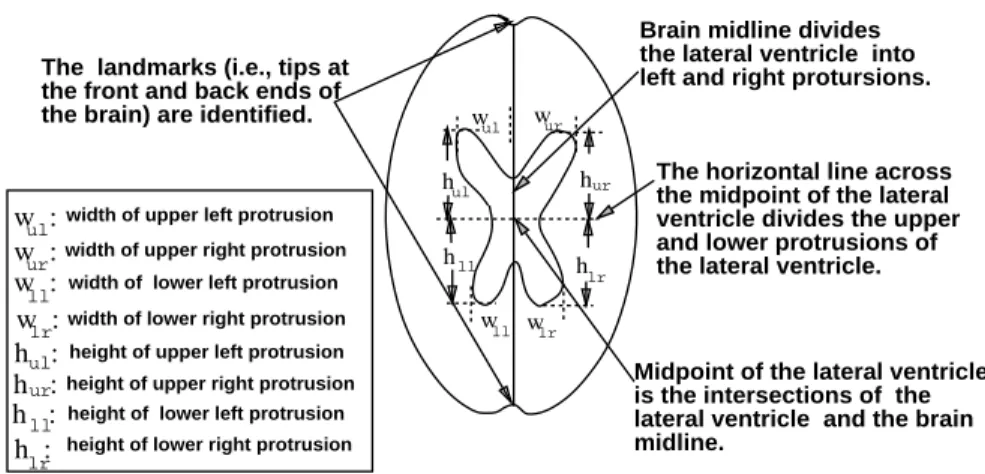
The lateral ventricle is used as an example object to illustrate landmark-based decomposition in studying the shape symmetry of the lateral ventri-cle. In medicine, the symmetry of the lateral ventricle is observed using the two tip notches of the brain contour as the landmarks. The brain contour is modeled using theshape contour modelto automatically identify the two tips. Then the lateral ventricle can be decomposed into four substructures as shown in Figure 6-2 to studying the symmetry of lateral ventricle. We can express the symmetry aspect of the lateral ventricle via the relative shape among these decomposed contours. In Figure 6-2, the height and
154
Chapter 6
Brain midline divides the lateral ventricle into left and right protursions.The horizontal line across the midpoint of the lateral ventricle divides the upper and lower protrusions of the lateral ventricle.
Midpoint of the lateral ventricle is the intersections of the lateral ventricle and the brain midline.
wll wlr wul wur
ul h lr h ur h ll h
width of upper left protrusion
w :ul
w :ur
w :ll w :lr ul
h :
ur
h :
ll
h :
lr
h :
width of lower right protrusion width of lower left protrusion width of upper right protrusion
height of upper left protrusion
height of lower right protrusion height of lower left protrusion height of upper right protrusion
The landmarks (i.e., tips at the front and back ends of the brain) are identified.
Figure6-2 For more precise shape description, the shape model decomposes
a lateral ventricle into four natural sub-structures: upper left substructure, upper right substructure, lower left substructure, and lower right substructure. width of the four components of a lateral ventricle are used to construct a shape featureto describe the left to right symmetry of the lateral ven-tricle as (upperLRWidthRatio (wul=wur), upperLRHeightRatio (hul=hur),
lowerLRWidthRatio (wll=wlr), lowerLRHeightRatio (hll=hlr)). Theleft to
right symmetry of the lateral ventricle is an important shape feature for detecting various brain diseases [15].
6.3.3 Extracting Spatial Relationship
Features
The primary concerns for a quantative description of spatial relationships include:
Containment relationships which describe the relative position and lo-cations of contact between a pair of objects. The detailed containment characteristics are further quantatively captured by features such as ratio of overlap, ratio of area, the shortest distance between their con-tours, etc.
Directional relationships describe the directional characteristics be-tween objects. These directional features can be quantatively captured by features such as relative distance of centroid onx axis, y axis, and
Content-Based Image Retrieval
155
Based on anatomical knowledge and physician diagnosis, the spatial re-lationships of an object with respect to its surrounding objects can be derived; we shall call them theprimary spatial relationshipsof the objects. We use primary spatial relationships to represent the semantics of the im-ages in the data model. In addition, the relationships of abnormal objects discovered in diagnosis with respect to their adjacent objects are also kept in the system. Due to the relatively small number of abnormal objects found, we only need to maintain a small fraction of spatial relations in the system.The number of spatial relations for n objects in an image is on the order of O(n2). Storing all the spatial relations not only increases the storage
but also lengthens the time needed to search for the objects. To limit the size of storage of spatial features and relations, only those most frequently inquired about are stored in the system. There is a storage/response time tradeo as to what spatial features and relations need to be stored.
6.4 Modeling of Objects in Medical Images
The metadata in the semantic layer (SL), which models the temporal, spatial, and evolutionary aspects of the image objects, is detailed in the following sections.
6.4.1 Representing Image Objects
Objects and their contours in the images are identied by segmentation software. Features and content representing object characteristics are ex-tracted and represented in the data model. Similar image objects are clas-sied in the same class. For example, the object class dened for the micro-lesion in our Gemstone implementation is:
Object subclass 'Microlesion' instVarNames: #['diameter',
'volume', 'eventTime', 'contourPointer', 'imagePointer'] constraints: #[ #diameter, Number],
#[ #volume, Number], #[ #eventTime, DateTime], #[ #contourPointer, Contour], #[ #imagePointer, Image].
Microlesionis a subclass of Object. The clause instVarNames denes the
156
Chapter 6
object feature
conceptual terms
lesion.size small, medium, large
lesion.roundness circular, non circular
lesion.surface smooth, coarse
lateral ventricle.left to right symmetry upper protrusion pressed to the right, upper protrusion pressed to the left, ...
...
...
Table6-1 A shape feature description table for the brain
following attributes: diameter, volume, eventTime, contourPointer, andimagePointerfor objectMicrolesion. Theconstraintsdenes the type of each attribute. For example, volume and diameter are of type Number.
MicroLesionSet is an object class in which each instance is a Microlesion, as shown in the following:
Set subclass 'MicroLesionSet' constraints: MicroLesion.
If an image in the database contains a micro-lesion, then there is an ob-ject instance inMicroLesionSetcorresponding to that micro-lesion which is represented by its features. An object class is created for each type of identiable object in all the images. Thus, such data structures provide a framework and guidelines to extract features from all images. The ob-ject instance maintains links that point to its contours and images. The collection of all feature values constructs a feature database. These pre-computed feature values in the feature database enable the conceptual feature clustering and also speed up the image retrieval by feature and content.
Our data model extends the object-oriented model and introduces new constructs to describe the spatial and evolutionary behavior of objects.
6.4.2 Modeling Shape
The proposed landmark-based decomposition technique provides an eec-tive quantitaeec-tive shape description when the image objects have limited numbers of shape components. The decomposed objects provides sucient image content to retrieve specically or similarly shaped image objects.
Content-Based Image Retrieval
157
Further, with image classication algorithms, such as MDISC [9], concep-tual terms can be dened to describe a shape feature. The shape feature description table(Table 6-1) lists the conceptual terms for describing the shape features. Thus, users can use conceptual terms for describing a spe-cic shape in a query: for example, \retrieving images with lateral ven-tricles whose upper protrusion are pressed to the right" (see Query 3 in Section 6.5 and the MTAH dening upper protrusion pressed to the rightin Color Figure-1).
6.4.3 Modeling Spatial Relationships
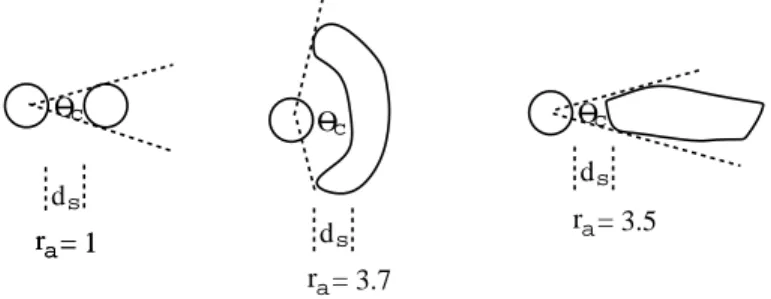
Modeling spatial relationships merely by simple semantic constructs such asseparatedandconnectedis insucient to express real-life spatial relation-ships (as illustrated in Figure 6-3). Additional parameters are needed to describe the spatial relationships more precisely. A set of required spatial relationship features should be specied by domain experts. Parameters are provided to describe the topological relationships between two objects (as shown in Figure 6-4). More important parameters for distinguishing the sub-types under a category are placed rst in the list, and parameters used in the higher branches may also be used in their descendant branches. In Figure 6-4,Borderingmeans that only the surfaces of the two objects are joined (i.e., rc > 0;rj = 0); Invading implies their areas are joined
(i.e., one of the object is deformed by the other, 0 < rj < 100% ), and
Circumjacent implies a full containment (i:e:; one object fully contains the other, rj = 100%). The required constructs/operators are necessary
for every spatial relationship. A spatial relationship description table(as shown in Table 6-2) lists the available parameters and semantic terms for describing the spatial relationships between two objects. The values of these spatial relationships are stored in the database.
This spatial modeling approach captures the containment and directional aspects of binary spatial relationships. Containment describes the relative position and possible joining relationship among objects while direction aspect describes the directional relationships from one contour to the other. The constructs for the spatial relationships are as follows:
158
Chapter 6
spatial
representative dened semantic
relationship features
terms
SR(l,b) (xc;yc;ra);(ai) Slightly Occupied,
Extremely Occupied SR(l,f) (xc;yc;rj) Slightly Touching,
Intimately Touching SR(l,lv) (c;dc;xc;yc) Nearby, Far Away
... ... ...
Table 6-2 A spatial relationship description table for the brain lesion (l:
lesion; b: brain; f: frontal lobe; lv: lateral ventricle)
ds ra= 1 ra= 1
Oc
ds ra= 3.7
ds ra= 3.5
Oc Oc
Figure6-3 An example showing that merely using semantic operators (e.g., SEPARATED) and/or single measurement (e.g., theshortestdistance(d
s )) is
insucient to capture the spatial relationship of two objects. We need addi-tional features such asangle ofcoverage(c) andratio ofarea(ra) to classify
the illustrated spatial relationship. 1. No containment
Disjoined: This spatial construct is used to describe two objects that are separated from one another. (For example, the micro-lesion is disjoined from the lateral ventricle as shown in Figure 6-8). The relationships under this construct are further quantied by the spatial relationship features such as ds, dc, ra, and c.
The values of these spatial relationship features can be conceptu-ally classied via clustering algorithms such as MDISC [9] to de-rive the meaning of the corresponding semantic terms under the DISJOINEDcategory, such as NEARBYand FAR AWAY. The reason for using an instance-based clustering algorithm to dene these corresponding semantic terms is that the semantics of these de-tailed spatial relationship terms are context-dependent (e.g., the
Content-Based Image Retrieval
159
SPECIALIZED CONSTRUCTS/ OPERATORS REQUIRED CONSTRUCTS/ OPERATORS Slightly OccupiedExtremelyOccupiedSlightly Occupied Extremely Occupied j r c d Oc Far_Away Nearby a r v r s d dcd xc yc Occ
a r ia
j r xc yc
c r Centrally Circumjacent Peripherally Circumjacent Nearly Engulfed Bulging Into Impinging Into Bordering Int−Ext Margins Partially Surround With Bordering Fully Surround With Bordering Oc Bordering Ext−Ext Margins Slightly Touching Intimately Touching c r Nearby but not Surrounding Nearby and Surrounding Oc Partially Surround Without Bordering Fully Surround Without Bordering Oc Circumjacent Invading Bordering Joined Disjoined c
r: ratio of the length of the contacted edge to the perimeter of a particular contour
j
r: ratio of the joined area to that of a particular contour
a
i : area of the inner contour
: is−a xc: distance of the centroids of the
two contours on x−axis yc: distance of the centroids of the
two contours on y−axis
s
d: shortest distance of the two contours
a
r : ratio of area of the two contours
Oc: angle of coverage, an angle centered at the centroid of one contour and spanned wide enough to cover the whole area of the other contour
c
dc
d: distance of the two centroids. a r
a i
Figure6-4 An ontology of spatial relationships (represented in a
generaliza-tion hierarchy) for dierent topological categories between two objects (with the representativeicons shown) for oncologicalmedical images. The parameters under a branch classify the sub-types under that category.
meaning of NEARBYin astrology is dierent from its meaning in medicine).
Bordering: Two objects contact one another at one or more locations. Bordering is a signicant event in the medical domain. The relationships under this construct are further quantied by spatial relationship features such as rc and c.
2. Containment
Circumjacent: An object contains another object (e.g., a micro-lesion develops inside the brain, as shown in Figure 6-8). The relationships under this construct are further quantied by the spatial relationship features such as dc, ra, and ia.
160
Chapter 6
3. Partial ContainmentInvading: This spatial construct is used to describe one object that invades the other which causes an object to deform. The relationships under this construct can be further quantied by the spatial relationship features such as rj and dc.
The directional information of spatial relationships is captured by spatial relationship features such as the relative distance of the centroids of two objects on the x-coordinate (denoted as xc), on the y-coordinate (denoted
as yc), and on the z-coordinate (denoted as zc).
To model a spatial relationship, domain experts need to identify the con-tainment categories of the modeled spatial relationship. Spatial relation-ship features are then identied to describe the spatial relationrelation-ship accord-ing to the topological categories of the two objects.
For example, in an image with a lesion and lateral ventricle, the spatial relationship instance between the lesion and lateral ventricle is classied as an instance of the class SR(lesion,lateral ventricle). The containment relationship covers theDISJOINEDandBORDERINGcategories and requires c, dc, xc, and yc as the features to describe this spatial relationship.
Color Figure-2 shows an image classication hierarchy for the images in the database. The hierarchy is generated by MDISC based on the col-lected values of spatial relationship features of SR(lesion,lateral ventricle) instances in the database.
6.4.4 Temporal Relationship Object
Constructs
Let us now consider the modeling of inter-object temporal relations. The constructs that represent the temporal relationships between an object and its supertype or its aggregated type are shown in Figure 6-5. These temporal relationships dene how the characteristics of the supertypes are temporally inherited.
Temporal inheritance
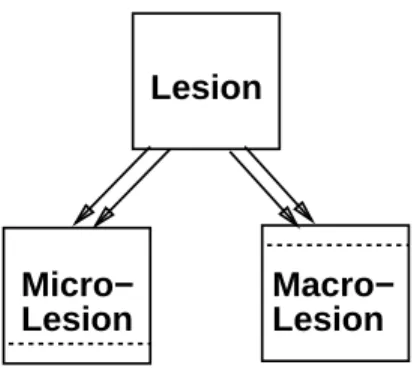
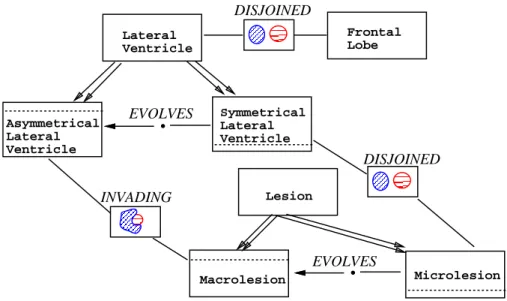
deals with the way time-dependent characteristics of a supertype are inherited by its subtypes. The general rule is that an object may only inherit characteristics from other objects which exist in its own space-time domain [11].To illustrate the use of the temporal relation object constructs, we apply them to the model describing brain lesion growth. For example, the life of a lesion includes its development from a micro-lesion to a macro-lesion. The temporal inheritance between these object types is expressed in Figure 6-6 (where the black solid line represents a temporal inheritance relationship).
Content-Based Image Retrieval
161
Case a: Case b:
The object exists with its supertype or aggregated type.
The life span of the object starts after and ends before its supertype or aggregated type.
Case c: Case d:
The life span of the object starts after and ends with its supertype or aggregated type.
The life span of the object starts with and ends before its supertype or aggregated type.
Figure6-5 Temporal object constructs
Lesion
Macro− Lesion Micro−
Lesion
Figure6-6 Temporal object constructs of lesion. Double arrows imply
inher-itance (is a) relationship.
6.4.5 Evolutionary Object Constructs
...
O1
O Om
Fusion: Object O1, ..., Om fuse into a new object
O O’
Evolution: Object O evolves into a new object O’
...
O
O1
On
Fission: Object O splits into object O1, ..., On
Figure6-7 Evolutionary object constructs
Existing approaches for modeling object evolution involves maintaining object versions [22]. We enhance these basic models to describe the
devel-162
Chapter 6
opment of objects usingstagesand theevolution,ssion, andfusionamong stages. A stage represents a distinguishable development status of an ob-ject, and a transition between stages represents a signicant change in the entropy or growth status of the evolutionary object. Evolution, fusion, and ssion are the three possible types of transitions among the evolutionary stages (Figure 6-7).1. Evolution: The characteristics of an object may evolve with time. For example, a micro-lesion evolves into a macro-lesion over a period of time, as shown in Figure 6-8.
2. Fusion: An object may fuse with other objects to form a new object with dierent characteristics than either of the constituent objects. 3. Fission: An object may split into two or more independent objects.
EVOLVES
EVOLVES DISJOINED
INVADING
DISJOINED
Symmetrical Lateral Ventricle Asymmetrical
Lateral Ventricle
Macrolesion Microlesion Frontal
Lobe Lateral
Ventricle
Lesion
Figure 6-8 The temporal evolutionary and spatial relationships for the
growth of a brain lesion
The clinical manifestations of a lesion depend on its position with re-spect to its surrounding brain structures. As an example, a brain lesion is modeled with the temporal, evolutionary, and spatial object constructs as shown in Figure 6-8. Micro-lesions develop
separately
from (modeled in Figure 6-4) the lateral ventricle. Micro-lesions may alsoevolve
(modeledContent-Based Image Retrieval
163
in Figure 6-7) into macro-lesions whichinvade
(modeled in Figure 6-4) the symmetrical lateral ventricle and make the lateral ventricle become asymmetrical.Based on the model constructs, we shall present a query language that can express the spatial evolutionary content of the images. The model shown in Figure 6-8 will help formulate the example queries in Section 6.5.
6.5 The Knowledge-Based Spatial
Evolutionary Query Language (KEQL)
Conventional query languages lack the capabilities to query on spatial evolutionary characteristics of medical images [21, 37, 28, 36]. To remedy this, we propose a declarative spatial evolutionary query language, KEQL, which operates on the spatial evolutionary domains of the medical images. In addition to alphanumeric predicates, KEQL contains constructs to spec-ify spatial, temporal, and evolutionary conditions with approximate and conceptual terms.
A KEQL query consists of the following ve optional clauses: [SELECT clause]
[WHERE clauses] [Operations]
The SELECTclause selects the desired data items.WHEREclauses describe the selection criteria using alphanumeric predicates, conceptual spatial predicates, predicates describing the evolutionary processes among object types, and predicates for selecting appropriate snapshot(s) of the database. Operationsspecify the system or user-dened operations such as display, rotate, and superimpose on the selected data.
6.5.1 SELECT and Operations
The SELECT clause identies the attributes and object types to be re-trieved for the query.
The operations in the Operations clauses can either be system-dened or user-dened data, image manipulation, or visualization operations [6], such as movie loop, display, contour, rotate, and superimpose.
6.5.2 WHERE
164
Chapter 6
Symbolic/Semantic Spatial Relationship Predicate
The user can query on the spatial relationship among objects. For example, to retrieve images of the macro-lesionnearbythe lateral ventricle, the user enters:
WHERE Macro-lesion Nearby LateralVentricle
To avoid ambiguity in specifying the operators, a pull-down menu is avail-able that displays the availavail-able spatial semantic operators, as in the spatial relationship description table (Table 6-2), for the user to select to use in the query.
Spatial Feature Predicate
Spatial feature queries involve the spatial characteristics of the image ob-jects. By inspecting the object classes, the user knows what spatial features are available for querying, and hence, if the user wants to retrieve images of macro-lesions with diameter equal or larger than 25mm, the user enters the following predicate:
WHERE Macro-lesion diameter >= 25mm
The user may also use the= operator to represent\approximately equal"
in the spatial feature predicate, and the query processor can automatically interpret the predicate to include a suitable value range based on the spe-cic feature and query context. The value range is discovered by the DISC algorithm [9] which provides a dierent value range for dierent feature value based on the value distribution of the feature. For example, if the user wants to retrieve the images with micro-lesions of approximately 9mm in diameter, the user writes the following predicate:
WHERE Micro-lesion diameter ~= 9mm
Based on the result of running DISC on Micor-lesion.diameter, 9mm will be relaxed to a suitable value range (such as 8mm to 12mm).
Predicate with Conceptual Terms
Spatial queries may involve conceptual terms, such as large and small in the query. For example:
Content-Based Image Retrieval
165
A pull-down menu is also used to display the available conceptual terms for the specied object attribute in the predicate as in the shape feature description table (Table 6-1). The conceptual term is to be interpreted by the knowledge residing in the KL.Similar-to Operator
Similar-to operators compare the similarity of image objects based on shape or spatial relationship features. The similar-to predicate rst selects a target image or object by constraining one of the operand variable to a specic image or object instance (e.g.,Image1.patient.name = "Mary Doe"in the following example) and then uses the BASED ONsubclause to specify the shape features and/or specic spatial relationships between objects that characterize the target image similarity for thesimilar to op-erator[12, 19]. For example:
WHERE Image1 SIMILAR_TO Image2
(Image1.patient.name = "Mary Doe")
BASED_ON macro-lesion.size and macro-lesion.location If no BASED ON subclause is presented, then the features supplied in the user model will be used (see next section).
Temporal Relationship Predicates
Temporal relationship predicates select the appropriate snapshot of the data of interest at particular points or periods in time. Temporal relation-ship predicates include:
Temporal functions
Temporal functions manipulate the time points: START TIME, END TIME,RECORD TIME, andEVENT TIME. They are the operators used in the query language to retrieve the start, end, record, and event times of objects.
Temporal ordering functions
Temporal ordering of an object history sorts the object versions in ascending order based on their time stamps, so that retrieval of object versions in a specic order can be identied. These functions include FIRST,LAST,N th, PRIOR, andNEXT.
166
Chapter 6
Temporal interval comparison operatorsTo specify a more complex temporal condition, the interval specied in the temporal relationship predicates may be subjected to tempo-ral interval comparison operators [37, 28], such asPRECEDES,FOLLOWS, CO-OCCURS, andDURING. These operators specify how the intervals fol-lowing the temporal relationship predicates are related to some other time intervals. The time point comparison operators such as BEFORE andAFTERare also included.
Evolutionary Predicates
The evolutionary predicate describes various evolutionary processes on a set of evolving object sequences. The evolution of a brain abnormality,such as a lesion, provides a good example of the use of evolutionary operators. The evolution of the lesion can be described as evolving from a micro-lesion to macro-micro-lesion. There are three kinds of evolutionary processes in general:EVOLUTION,FUSION, andFISSION.
The condition \object type1 EVOLVED FROM object type2" selects all
evo-lutionary sequences in which an object instance of object type2 evolves
into an object instance of object type1. For example, the following
evolu-tionary predicate applies the evolution operator EVOLVED FROMto retrieve sequences where macro-lesions evolve from micro-lesions:
WHERE macro-lesion EVOLVED_FROM microadenoma
All the growing instance sequences of lesion which developed from micro-lesion to macro-micro-lesion will be retrieved.
For a more complete discussion of fusion and ssion modeling constructs, the interested reader is referred to [11, 10].
6.5.3 Sample Queries
In this section, we shall present a set of sample queries to illustrate how to use KEQL constructs to express certain clinical queries associated with radiographic ndings.
Query 1: \Find patients with similar brain lesions to the patient named 'Mary Doe' based on the lesion size and whose lesion location is NEARBYthe lateral ventricle"
Content-Based Image Retrieval
167
SELECT I1
FROM Image I1, IT
WHERE I1 SIMILAR_TO IT (IT.patient.name = 'Mary Doe') BASED_ON (IT.lesion.size,IT.[lesion,lateral ventricle].(x
c;yc;c;dc))
Query 2: \Find a largelesion NEARBYthe lateral ventricle" SELECT Lesion.image
FROM Lesion, Lateral_Ventricle
WHERE Lesion Nearby Lateral_ventricle and Lesion.size IS 'Large'
Query 3: \Find the lateral ventricle whose upper protrusion is pressed to the right"
SELECT Lateral_Ventricle.image FROM Lateral_Ventricle
WHERE Lateral_ventricle.left_to_right_symmetry IS 'upper_protrusion_pressed_to_the_right'
The knowledge representing upper protrusions pressed to the right is provided in Figure Color Figure-1.
A brain surgeon wishes to retrieve patients in the database whose brain MR image has similar spatial characteristics to the target MR image. The query is expressed as follows:
Query 4: \Find images in the database that have similar spatial charac-teristics as the image shown on the screen"
SELECT P1, P1.image FROM Patient P1, PT
WHERE P1.image SIMILAR_TO PT.image
(PT.image SELECTED_ON_THE_SCREEN)
SELECTED ON THE SCREENis a special function to specify the image on the screen as the target image for matching. The intended features and spatial relationships ofQuery 4 are derived from the image content inPT.image and the user type (i.e., brain surgeon) according to the knowledge in the knowledge layer. The corresponding query expressed graphically is illus-trated in Figure Color Figure-4 in Section 6.7.
168
Chapter 6
Query 5: \Retrieve the image frames in which a micro-lesion is nearby the lateral ventricle and approximately 9 mm in diameter. The micro-lesion evolves into a macro-micro-lesion with diameter equal or larger than 25 mm and invades the lateral ventricle in one year"
This query involves lesion growth and its spatial characteristics with an adjacent object. Based on the object relationship captured in the data model (see Figure 6-8), as well as the object classes and their relationships dened for each object,Query 5can be expressed in the following KEQL query by using theAFTER,EVOLVED FROM,NEARBY, andINVADESoperators (the parentheses in the SELECT and DISPLAY clause enforce the pairing of the returned objects):
SELECT (Micro-lesion.Image, Macro-lesion.Image)
FROM Micro-lesion, Macro-lesion, Lateral_Ventricle LV1 LV2 WHERE Micro-lesion EVENT_TIME + 1 year AFTER
Macro-lesion EVENT_TIME AND Macro-lesion EVOLVED_FROM Micro-lesion AND LV1 Nearby Micro-lesion AND
Micro-lesion diameter ~= 9 mm AND Macro-lesion Invades LV2 AND Macro-lesion diameter >= 25mm AND LV1.patient = LV2.patient
DISPLAY SEQUENCES( (Micro-lesion.Image, Macro-lesion.Image) )
6.6 Knowledge-Level Metadata for
Intelligent Interpretation and Access
The knowledge-level metadata consists of the classication of images based on the selected features. The classication is context and user sensitive. The criteria of our image feature clustering algorithm is to minimize the averaged pair-wise Euclidean distance of image feature values in a cluster. Such a measure, known as therelaxation error[9], considers both the fre-quencyof the value occurrence and the dierence betweenvalues. Based on minimizing the summedrelaxation errorof all the newly partitioned clus-ters in each iteration, the clustering algorithm, MDISC, recursively parti-tions the data set to generate a multi-attribute feature type abstraction hierarchy (MTAH). Since both the feature value distribution and the cor-relation among dierent attributes of a feature are considered in MDISC, our clustering algorithm provides better image feature classication than if we used standard deviation to represent image similarity [1].
Content-Based Image Retrieval
169
This automatic generation of the knowledge-level metadata based on the selected features of images makes our knowledge-based query answering approach scalable.6.6.1 Query Interpretation via TAH
Yes Query
Query Processing
No Satisfactory answers?
Relaxation Manager
Query Modification
Post−processing
Answers
TAHs, User Model
a: Generalization and specialization via TAH b: The flow diagram of query processing with relaxation
Conceptual Query
generalization specialization More Conceptual
Query
Conceptual Query
Specific Query
Specific Query Specific
Query Specific Query
Figure6-9 Knowledge-based query relaxation
The classication of image features are represented in a hierarchical rep-resentation, calledtype abstraction hierarchies[8] for processingsimilar-to
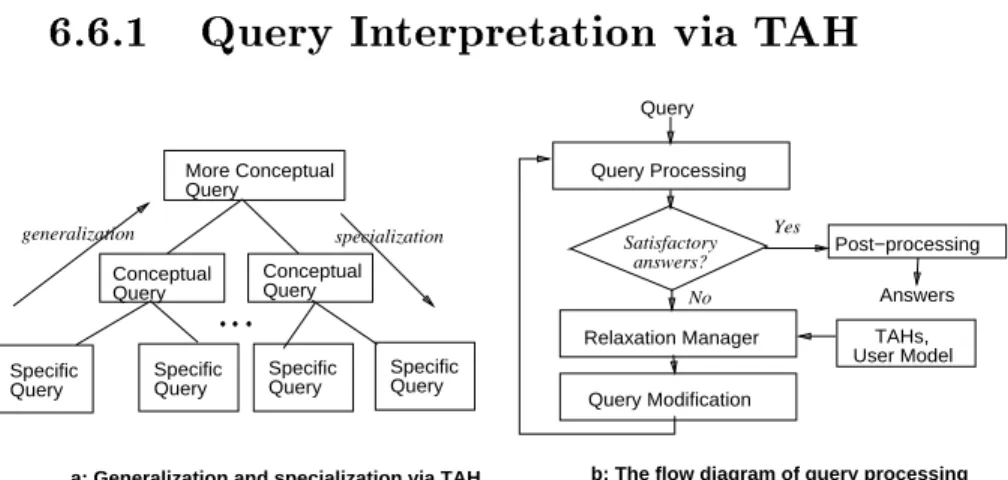
and semantic predicates. The concept in the TAH nodes is represented by the feature value ranges (see Figures Color 1 and Color Figure-2). These value ranges can be used to retrieve similar images. As shown in Figure 6-9(a), higher nodes in the TAH represent more generalized concepts (i.e., broader range of feature values) than that of the lower nodes (i.e., narrower range of the feature values). Based on the existing values of the representative spatial relationship features, MDISC can be used to classify image features to represent these semantic spatial rela-tionship operators. The resultant TAH nodes are labeled by domain ex-perts with the conceptual terms (e.g.,Nearby, Far Away,Large,Small, upper protrusion pressed to the right) to represent the specic do-main concept of the images under the node and the value range is used as the query constraint to retrieve the images satisfying the conceptual predicates1 These conceptual terms are selected from the domain
depen-dent descriptive ontologies. For example, Figure 6-4 is an ontology for
1The conceptual terms can also be labeled via other approach (e.g., neural networks,
vector computation (see Chapter 7), etc.). Our distribution-sensitive clustering algorithm, which is based on the selected features, provides sucient classication information for the domain experts to label the TAH nodes.
170
Chapter 6
various spatial relationships applicable to oncological medical images. A descriptive ontology in a generalization hierarchy for a specic image do-main which provides 1) the conceptual terms for labeling the TAH nodes, and 2) the shape, spatial relationship, and/or temporal features for clus-tering the object instances. These ontologies can be obtained from generic medical terminology (e.g., UMLS [40]) and domain experts. They pro-vide a restricted set of vocabularies for querying image content. Note that the proposed ontology for describing entities (e.g., size, color, distance) are dierent from the common sense generic ontologies such as Cyc and WordNet [27].To solve asimilar-toquery whose intended similarity includes the features or spatial relationship classied by the TAH, the lower TAH nodes are attached with more specic value ranges. In solving the similar-toquery, we shall rst locate the TAH node that has a value range closest to that of the target image based on these selected (spatial relationship) features. By traversing up (i.e., generalizing) and down (i.e., specializing) the selected TAH, the feature value range in the matched TAH node can be used for retrieving similar images from the database (Figure 6-9(b)). The traver-sal along the TAH nodes is controlled by the relaxation policy which is provided either directly from users or from the user model.
There is a TAH directoryin the system that stores such information as object names, sets of features, spatial relationships, user type of the TAH. Based on this information, the system (or user) selects and retrieves the appropriate TAHs for processing the query. If the retrieved TAH does not match the user's specication, the TAH can be edited to meet the user's requirement.
The time complexity to generate a multi-attribute hierarchy by MDISC is O(mnlog(n)), where m is the number of attributes and n is the number of distinct instances used in generating the TAH [9]. Our experiment reveals that generating a MTAH with about one hundred images based on four features takes a fraction of a second's processing time on a Sun Sparc 20 workstation.
6.6.2 User Model
The user model species the user preference for customizing a query so that it is context and user sensitive. The preference of a user under a query context is characterized in a user prole.
In a user prole, the query context to be matched is represented by two dierent types of objects: mandatorily matched objects and option-ally matched objects.Mandatorily matched objectsof a user prole specify
Content-Based Image Retrieval
171
the objects that must be matched with a given query for the user prole to interpret the query. Optionally matched objects provide guidelines for adding additional object feature constraints when the corresponding ob-jects are matched. Optional matching permits a partial matching of user proles based on the objects appearing in the query and increases the matching occurrences.The user preference species the set of interested features and spatial re-lationships for a given query context, and the policies for relaxing query conditions when no satisfactory answer is found.
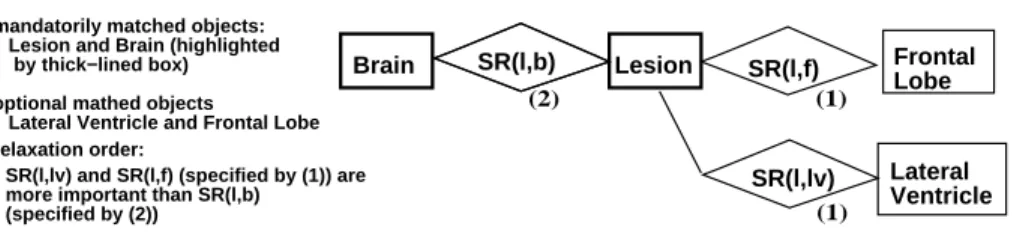
The relaxation policy describes how to relax the selected TAHs when no satisfactory answer is found, since classifying images may involve multiple attributes as well as multiple TAHs to provide more ecient and accu-rate query answering. Control operators such as therelaxation order(e.g., which TAHs should be relaxed rst), non-relaxable features, preference list, and relaxation levelcan be used to provide relaxation control. For example, given MR brain images with lesion(s), the features that are of interest to a typical brain surgeon include the lesion locations and the spatial relationships with other objects in the brain (such as lateral ven-tricles) as shown in Figure 6-10. The information in the user model can be used for selecting the interested features and the relaxation policy if they are not specied in the query (see Query 4). For a given image, dif-ferent types of users (e.g., radiologists, surgeons, and clinicians) may have dierent interests which can be specied in the user model.
SR(l,lv) and SR(l,f) (specified by (1)) are more important than SR(l,b)
(specified by (2)) relaxation order: user : brain surgeon mandatorily matched objects: Lesion and Brain (highlighted by thick−lined box) optional mathed objects
Lateral Ventricle and Frontal Lobe
(2)
(1) (1)
SR(l,b) Lesion SR(l,f)
Brain Frontal
Lobe
Lateral Ventricle SR(l,lv)
Figure6-10 A user prole for brain surgeons
6.7 Knowledge-based Query Processing
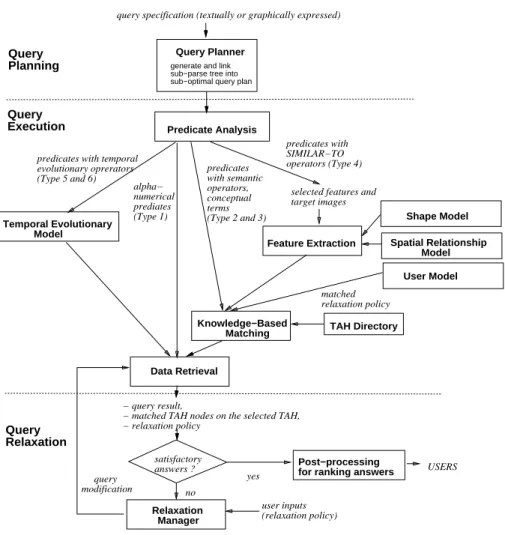
The knowledge-based query processing is divided into three phases: query planning, query execution, and query relaxation(Figure 6-11) as discussed in the following sections.
172
Chapter 6
selected features and target images predicates with semantic operators, conceptual terms (Type 2 and 3)
query specification (textually or graphically expressed)
Query Relaxation
matched relaxation policy
− query result,
− matched TAH nodes on the selected TAH, − relaxation policy
user inputs (relaxation policy) Relaxation Manager query modification Feature Extraction Predicate Analysis Spatial Relationship Model Shape Model Knowledge−Based
Matching TAH Directory
User Model Query
Planning
Query Execution
generate and link sub−parse tree into sub−optimal query plan
Query Planner
Data Retrieval
Post−processing for ranking answers
no
yes USERS
predicates with SIMILAR−TO operators (Type 4) predicates with temporal
evolutionary oprerators (Type 5 and 6)
Temporal Evolutionary Model alpha− numerical prediates (Type 1) satisfactory answers ?
Figure 6-11 Knowledge-based query processing ow diagram for KEQL
queries
6.7.1 Query Planning Phase
A KEQL query is parsed and transformed into a query execution graph, a directed acyclic graph (dag) [4] representing the execution plan for the query. The rst step is to generate asub-parse-treefor each predicate. Then a query execution graph is formed by linking together the sub-parse-trees by matching their input and output data variables.
Content-Based Image Retrieval
173
(e) Sub−parse−tree of temporal relationship predicate (type 6 predicate)
AFTER
+
1 year event_time
Micro−lesion
event_time
Macro−lesion
(Micro−lesion, Macro−lesion) sequence
(Micro−lesion) (Macro−lesion)
(Micro−lesion)
(Macro−lesion)
(d) Sub−parse−tree of evolutionary predicate (type 5 predicate)
EVOLVE_FROM
Macro−lesion Micro−lesion
(Micro−lesion, Macro−lesion) sequence
(Macro−lesion) (Micro−lesion)
(b) Sub−parse−tree of semantic spatial relationship predicate (type 3 predicate)
INVADES
Lateral_Ventricle >=
25 mm diameter
Macro−lesion
(Lateral_ventricle, Macro−lesion) pair
(Micro−lesion)
(Lateral_Ventricle)
(a) Sub−parse−tree of semantic spatial relationship predicate (type 3 predicate)
NEAR_BY
Lateral_Ventricle ~~
diameter
Micro−lesion 9 mm
(Lateral_ventricle, Micro−lesion) pair
(Micro−lesion)
(Micro−lesion) (Lateral_Ventricle)
SIMILAR_TO
BASED_ON
AND
Lesion.size NEAR_BY
Lesion Lateral_Ventricle <comparing with>
Patient: I1 =
"P000_001"
Patient: IT patient
(Patient: I1)
(Patient: I1)
(c) Sub−parse−tree of similar−to predicate (type 4 predicate)
Figure 6-12 The sub-parse-trees for dierent types of predicates. (a), (b),
(d), and (e) are based on predicates from Query 5 and (c) is based on the predicate from Query 1. The italic strings specify the format of the input and output variables and data type via variable populating for linking the sub-parse-trees together.
174
Chapter 6
Type1: alphanumeric predicates
Alphanumeric predicates contain arithmetic operators such as >, =, and < which specify the constraints for the objects. The input of this type of predicate is a set of extracted objects as specied in the predicate. The output is a set of objects satisfying the specied alphanumeric predicates.
Type 2: predicate with conceptual terms
This type of predicate is similar to the alphanumeric predicate ex-cept that the constraints are specied by the conex-ceptual terms (e.g.,
largetumor.size) [19]. The output is the set of objects that satisfy the conceptual terms.
Type 3: semantic spatial relationship predicates
Semantic spatial relationship predicates are used to specify the spatial relationship constrains for a pair of objects [19]. The input is two sets of spatial object instances which form a set of instance pairs of (spatial) objects for testing against the specied spatial relationship operator. The output is a set of object instance pairs from the two input sets that satises the specied spatial relationships. Example sub-parse-tree structures of such predicates are shown in Figure 6-12(a) and (b).
Type 4: similar-to predicates
In this type of predicate, a set of objects or image instances is com-pared with a target object or a target image instance [19]. The target image(s) can be derived from the additional predicates in the query (e.g., patient name isMary Doe). The predicate may also specify the features or spatial relationships characterizing the desired similarity of thesimilar-topredicate. The inputs are the target object, the set of objects to be compared, and the similar-to characteristics specica-tion. The output is the object instances similar to the target instance. The sub-parse-tree for the similar-topredicate is shown in Figure 6-12(c).
Type 5: evolutionary predicates
Evolutionary constraints are specied in this type of predicate. The input is two or more collections of objects where each collection con-tains object instances of the same evolutionary stage, and the objects of dierent stages are linked via the specied evolutionary constructs. The output is a set of evolutionary sequences satisfying the specied
Content-Based Image Retrieval
175
evolutionary operator. An example of such sub-parse-tree is illustrated in Figure 6-12(d).Type 6: temporal relationship predicates
Temporal relationship predicates specify the temporal relationship of two related objects. The two sets of temporal object inputs are to be evaluated by the temporal relationship operator. The output is a set of temporal object pairs which satises the specied temporal relationship operator. An example of such sub-parse-tree is illustrated in Figure 6-12(e).
The individual sub-parse-trees are linked together to form an execution plan based on: 1) the output (variables) of a sub-parse-tree should match the input (variables) of the linked sub-parse-tree, and 2) the derived query execution plan should minimize the execution cost (or a given performance requirement).
Optimizing KEQL query patterns yields the following heuristics: type 1 predicates are processed rst, then type 2 predicates, type 3 predicates, type 4 predicates, type 5 predicates, and lastly the type 6 predicates. Following this heuristic, the sub-parse-trees are linked together based on this pre-determined order. Figure 6-13 shows the result of linking the sub-parse-trees of Query 5 (shown in Figure 6-12) together. When more than two separate sub-parse-trees in the lower layer output the same variables and only one sub-parse-tree in the upper layer takes the specied variable as input, depending on the logical operators (i.e., AND and OR) connect-ing the two correspondconnect-ing lower-layer predicates, the results from the two sub-parse-trees are either unioned or joined based on their object ID or sequence ID before sending to the upper layer sub-parse-tree.
Optimizing frequently appearing query patterns with the above heuristics is based on the following observations. The semantic spatial relationship predicates and predicates with conceptual terms are converted into value ranges of the corresponding spatial features. Image retrieval using these pre-processed feature values takes less time than processing the evolution-ary and temporal predicates, since traditional indexing structures can be easily built to speed up this processing. Therefore, the alphanumeric pred-icates (Type 1), predpred-icates with conceptual terms (Type 2), and semantic spatial relationship predicates (Type 3) are placed at the bottom of the query plan. Processing the evolutionary and temporal predicates requires comparing the temporal occurrences of the specied objects. Navigating through the links among evolutionary objects usually requires loading the instances into memoryto inspect the links. Therefore more processing time
176
Chapter 6
is needed. Thus, the temporal and evolutionary predicates are placed above the semantic spatial relationship predicates and predicates with conceptual terms.Generating the optimal query execution plan depends on many factors. By expressing each type of predicate in an algebraic notation, equivalent query plans can be generated by algebraic permutation. These plans produce the same query result but with dierent execution cost. The one with the least execution cost can then be selected as the optimal query execution graph.
6.7.2 Query Execution Phase
The query processing can be performed based on the query execution plan. Depending on its type, each predicate is processed accordingly. Since the processing of alphanumeric predicates is well-known [30], we shall present the process of processing our proposed conceptual spatial, temporal, evo-lutionary predicates.
Processing Predicates with Conceptual Terms,
Semantic Spatial Relationship Operators, and
Similar-to Operator
To process predicates with conceptual terms, spatial relationship opera-tors and similar-to operaopera-tors, it requires reference to domain knowledge represented in TAHs. Processing such types of predicates requires predi-cate analysis and feature selection, andknowledge-based content matching. In the predicate analysis and feature selection, based on the target image, query context, and user type, the system analyzes and selects the relevant features and spatial relationships for processing these sub-parse-trees. In the knowledge-based content matching, the selected features, spatial rela-tionships, and user types are used to match the TAH(s) that resolve the conceptual terms, semantic spatial relationship operators, and/or similar-to predicates. The system uses the value ranges from the best matched TAH nodes to retrieve images from the image feature database.
To process the predicates with semantic spatial relationship operators and/or conceptual terms, the spatial relationship operators and conceptual terms are used to select the TAH(s) and the TAH node(s) for processing these queries. The TAH nodes that yield best matching of the semantic operators and/or conceptual terms (which are represented by value ranges) are used as the query conditions to retrieve the images. Their correspond-ing value ranges are used in the image retrievcorrespond-ing.
Content-Based Image Retrieval
177
Query Execution Graph
NEARBY INVADES
Lateral Ventricle
9mm
Micro−lesion Macro−lesion
Lateral Ventricle EVENT_TIME
+
1 year AFTER
EVENT_TIME
EVOLVED_FROM
~= macro−lesion micro−lesion
macroadenoma
micro−lesion
diameter 25mm
>=
diameter
Figure6-13 Query execution graph for Query 5. The execution is from
bot-tom up.
For thesimilar-topredicate, the features and spatial relationships specied in the BASED ON subclause are used to match with those of the target image. If no BASED ON subclause is specied, then the query processor uses the default features and spatial relationships specied in the user model.
The selected features, spatial relationships, and user types are used to choose the TAH(s) for query processing. The selected TAHs are traversed to locate the node(s) whose value range is closest to that of the target image as the best matched TAH node. The set of images contained in that TAH node represents the set of images similar to the target image.
Processing Evolutionary Predicates (Type 5)
There are three types of evolutionary operators, EVOLVE, FUSE, and
op-178
Chapter 6
erator which takes instances from two or more sets of object collec-tions (EVOLVE FROM takes two input collections and SPLIT TO andFUSED FROM take more than two input collections) as inputs and re-turns the set of evolving sequences that satisfy the query conditions. The matched evolving sequences will be returned as a collection of sequences. For more discussion on evolutionary query processing, the interested reader is referred to [11].
Processing Temporal Predicate (Type 6)
During the evaluation of a temporal predicate, if the two input collections are not evolutionary-related, then a cartesian product is applied to the in-stances of the two collections for constructing all possible object pairs for the evaluation. Every pairing of objects from the two input collections that satisfy the temporal predicate is a meaningful pairing. However, if the two input collections are evolutionary-related (i.e., two dierent collections of evolutionary instances from one set of evolutionary sequences), then the temporal predicate can be directly evaluated on the input evolutionary sequences embedded inside the two dierent collections of evolutionary instances. Temporal operators are applied to select the appropriate tem-poral objects where the temtem-poral relationships of their life span satisfy the required temporal constraints.
For example, inQuery 5, the event time of the micro-lesion and the macro-lesion are compared to determine whether the evolution took place in less than one year's time. Note only the object pairs appearing in the input evo-lutionary sequences are evaluated against the temporal predicateAFTER. The result ofQuery 5is shown in Color Figure-3.
6.7.3 Query Relaxation Phase
Within the query relaxation phase, when no answer is returned or the returned answer is not satisfactory, the query conditions are relaxed in accordance with the relaxation specication. For the queries requiring re-laxation, an appropriate TAH is selected to relax the query condition. The relaxation is performed by traversing up and down the selected TAH starting from the TAH nodes that best match the current query context. In every relaxation iteration, the query conditions are modied by the value from the TAH nodes. This relaxation process terminates when the answer set satises a given user requirement (e.g., number of similar images ob-tained, relaxation error, etc. [8]). The returned images can be ranked based on a relaxation error (RE), a similarity measure based on the weighted distance of the specied shape and spatial relationship features. Since the
Content-Based Image Retrieval
179
relaxation is conducted within a sub-parse-tree, it does not alter the query execution plan.Figure 6-14 illustrates the query processing for a spatial predicate with
similar-tooperator for the target image as shown in Color Figure-4. The system allows user relaxation control input to overwrite the one provided by the user model. Since neither relaxation control policy nor BASED ON subclause is provided by the user in this example, the relaxation con-trol and matching policy specied in the user model are used (details of the matched user model are shown in Figure 6-10). Thus, SR(lesion,late-ral ventricle) is the rst candidate TAH to be relaxed. Based on the TAH shown in Figure Color Figure-2, the value ranges for retrieving similar images are:
(43:91SR(lesion;lateral ventricle):d c
71:31),
(0:85SR(lesion;lateral ventricle): c
1:54),
(4:0SR(lesion;lateral ventricle):x c
49),
(?27SR(lesion;lateral ventricle):y c
57):
These conditions correspond to the value range of the TAH node two lev-els higher than the matched leaf node (see Figure Color Figure-2). The retrieved images are shown and ranked with therelaxation errorattached to each retrieved image (see Color Figure-4). There is anexplanation win-dow which displays the selected features and spatial relationships used for the matching, the relaxation level, and the number of matched images for this TAH node. During the relaxation process, if the relaxation of a TAH reaches a certainrelaxation error threshold, then the system, according to the relaxation policy, selects another TAH for relaxation. Users can also re-trieve images based on complex query conditions by selectively combining the TAHs with logical operations (e.g., AND, OR, etc.).
6.8 Implementation
Figure 6-15 illustrates the overall ow and key components of our system. Our raw data set is the images stored in the UCLA Picture Archiving and Communication System [20]. These images are sent through segmentation routines to generate contours of interested objects in the images. Methods of the proposed feature extraction technique (see Section 6.3) compute im-age features and spatial relationships from the object contours. These fea-tures are stored in afeature databaseand mapped with image objects and spatial relationships in the Semantic Layer. The evolutionary constructs are used to describe the temporal characteristics of object development.