DIFFERENTIAL PROGRAM FEE PROPOSALS
Background
At the April 2010 special meeting, the Board adopted provisions authorizing institutions to establish differential program fees under certain circumstances and mandated the Chancellor to develop policies and procedures concerning the implementation of such. The policy authorization provides that
programs that can be justified as high cost and/or high demand may be considered for differential program fees. Further, the policy limits the application of such fees to upper-division course work and graduate level programs only. (Title 4, Chapter 17, Section 20)
Differential Program Fee Proposals
In proposing a differential fee, institutions are required to provide the following information, based on the Board’s directive at the September 2010 meeting and out lined in the NSHE Procedures and Guidelines Manual (Chapter 7, Section 6):
Indicate how student involvement was obtained and how any concerns raised by students were addressed.
Identify all existing special course fees associated with the program, indicating those that will be eliminated. In accordance with Board policy, at the upper-division (300-400 level) and graduate level special course fees for consumables may be continued and continuing special course fees must identify the consumables covered by the fee. An institution may include the cost of consumables in the differential program fee. Special courses fees for lower division (100-200 level) course work may continue.
For high demand programs, indicate program demand by including program enrollments for the preceding five years and total number of students wait-listed or denied admission in the program during the preceding five years.
For high cost programs, indicate total annual program costs as a function of total revenues and expenditures for the preceding five years.
Indicate estimated revenue generated from the proposed program fee based on projected enrollments and how such funds will be expended in support of the program. Based on these guidelines, the following pages include the institutional proposal for differential program fees in Nursing at UNR.
University of Nevada, Reno
Differential Fees Proposal
For
Orvis School of Nursing Programs
(BSN, RN-to-BSN and MSN)
UNIVERSITY OF NEVADA, RENO
DIFFERENTIAL FEES (TUITION) PROPOSAL FOR
ORVIS SCHOOL OF NURSING Table of Contents
The Orvis School of Nursing ………. 3
Background Mission Vision Introduction ……… 3
Student Involvement ……….. 4
Special Course Fees ……… 4
High Demand Programs ………. 5
High Cost Programs ……… 7
Proposed Differential Fees ………….………... 8
Plan for Implementation of Differential Fees ………... 9
Projected Revenues and Expenditures ……….... 9
Distribution of Fees ……….……….……. 10
Summary of Planned Use of Projected Revenue ………... 11
Planned Program Outcomes ……….... 11
Comparative Program Costs ………... 12
UNIVERSITY OF NEVADA, RENO
DIFFERENTIAL FEES (TUITION) PROPOSAL FOR
ORVIS SCHOOL OF NURSING The Orvis School of Nursing
Background: The Orvis School of Nursing (OSN) was founded in 1957 and
became the first nursing program in the state of Nevada and the first program to offer a Bachelor of Science in Nursing (BSN) program, a Master of Science in Nursing (MSN) program, and a Registered Nurse (RN)-to-BSN program, which is totally online, for practicing nurses with Associate Degree nursing education. In collaboration with the school of nursing at UNLV, the Orvis School of Nursing also offers a Doctor of Nursing Practice degree. The Orvis School of Nursing remains the only nursing program in northern Nevada to offer baccalaureate and graduate degrees in nursing. In 2012, the Orvis School of Nursing has 8 tenured and tenure-track faculty and 15 non-tenure track faculty. Ten (43%) of the 23 full-time faculty hold a research-focused doctoral degree, and two of the full-time faculty are enrolled in PhD programs. The Orvis School of
Nursing student body consists of 200 undergraduate students, 63 master’s students and 12 Doctor of Nursing Practice students. As the Orvis School of Nursing has grown in relation to educational programs, growth has also been experienced in relation to
scholarship and research. In FY 2012, OSN faculty received approximately $500,000 in external research and program funding, including funding from the NIH-National
Institute of Nursing Research (NINR).
Mission: The mission of the Orvis School of Nursing at the University of Nevada, Reno is to prepare individuals for both entry-level and advanced nursing roles by providing excellent academic programs integrating recognized educational standards. The curriculum emphasizes nursing care of individuals, families and populations throughout the lifespan, among diverse cultures and beliefs, and across all socioeconomic groups in the context of their environments by providing a strong
foundation for evidence-based practice, critical thinking and leadership. In concert with the University’s mission as a land grant institution, the Orvis School of Nursing provides service to our local community, to the state of Nevada and to the professional
community at large.
Vision: The vision of the Orvis School of Nursing at the University of Nevada, Reno is to be a leader in quality nursing education, research and service in partnership with our community of interest, locally, statewide and worldwide.
Introduction
Implementation of differential fees, effective in January 2014, is proposed for all NURS-prefix courses required in the programs of study for the Bachelor of Science in Nursing (BSN), Registered Nurse (RN)-to-BSN and Master of Science in Nursing (MSN) degree programs offered through the Orvis School of Nursing at the
University of Nevada, Reno. The proposed differential fees will be in addition to the existing UNR general fees. In accordance with NSHE Board of Regents guidelines, it is also proposed that, for all courses with differential fees, special course fees for
“nonconsumables” currently paid by students be eliminated. In addition, 15% of all revenue generated by differential fees will be set aside for financial aid for students in the respective programs.
A significant investment of resources is required to educate nursing students to meet the challenges of a rapidly changing healthcare environment. The funds
generated from differential fees will be used solely to enhance the quality and growth of the nursing programs, and, hence, to continue to offer rigorous degrees that make our students highly competitive for Nevada’s healthcare workforce and fill the evolving and growing needs for nurses in entry-level practice, advanced practice, nursing education and leadership roles.
Student Involvement
All BSN and MSN students were contacted through face-to-face meetings with Dr. Patsy Ruchala, Director of the Orvis School of Nursing, during the first two weeks of classes in fall semester 2012. Since the RN-to-BSN program is a totally online
program, RN-to-BSN students were contacted via e-mail and meetings were held at two separate times on-campus for the RN-to-BSN students to attend. Students were also encouraged to contact Dr. Ruchala via e-mail or personal appointment to discuss the proposed differential fees with her.
All students acknowledged that fees at the University are lower than the national average. In particular, students in both the BSN and MSN programs who live in
California noted that paying for out-of-state tuition at the University of Nevada, Reno is a “better deal” than paying in-state tuition at California universities. No students,
however, want to pay increased fees, and they indicated that their preferences would be to stagger any increases with implementation only to new, incoming students or to delay implementation for at least one year. Several students indicated that they had planned their “academic budgets” on current fees and it would be a hardship for them to
continue in the program if they were faced with a differential fee increase. Other students, however, indicated that while a fee increase would not be to their liking, they would continue in the program and just find a way to pay the extra fees.
Special Course Fees
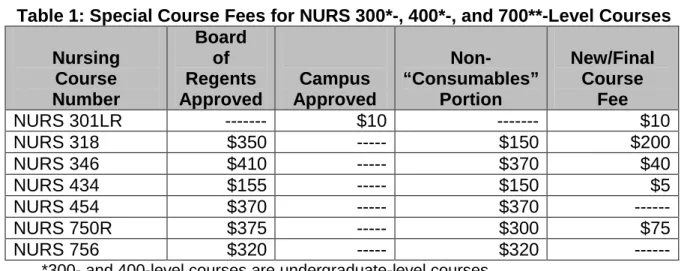
Table 1 lists information on the current special course fees for all courses affected by the proposed differential fees, along with proposed adjustments to assure that all remaining special course fees are for consumables only. Please note that Table 1 shows the Board of Regents approved special course fees (> $50) as well as the campus approved special course fees. All special course fees were reviewed as part of this analysis to assure that the only fees remaining would be for items used
(“consumed”) by students during the course of the semester that must be replaced for the next course offering.
The special course fees remaining for nursing will cover only consumable items used for nursing skills instruction. For example, undergraduate nursing students use consumable items such as gloves, dressings and bandages, syringes and catheters.
Graduate students use such items as pigs’ feet to practice suturing, suturing materials, alcohol wipes and connecters for ophthalmoscopes and otoscopes.
Table 1: Special Course Fees for NURS 300*-, 400*-, and 700**-Level Courses Nursing Course Number Board of Regents Approved Campus Approved Non- “Consumables” Portion New/Final Course Fee
NURS 301LR --- $10 --- $10
NURS 318 $350 --- $150 $200
NURS 346 $410 --- $370 $40
NURS 434 $155 --- $150 $5
NURS 454 $370 --- $370 ---
NURS 750R $375 --- $300 $75
NURS 756 $320 --- $320 ---
*300- and 400-level courses are undergraduate-level courses
**700-level courses included in this list are for the master’s program only High Demand Programs
OSN Program Enrollments
(NOTE: Nursing does not use “Wait Lists”)
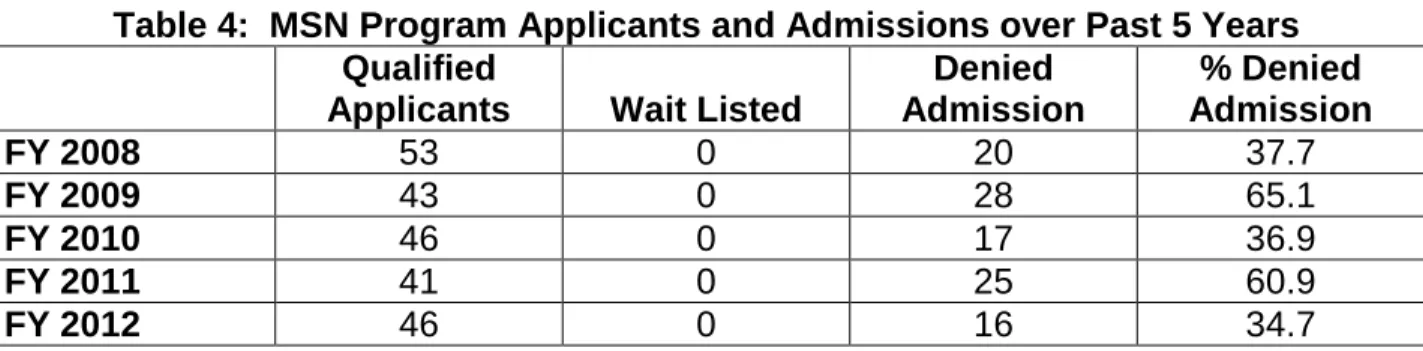
Tables 2, 3 and 4 indicate the demand related to total numbers of qualified applicants, numbers of applicants denied admission and subsequent percentage of applicants denied admission to the entry-level BSN program, RN-to-BSN program and MSN program, respectively, over the past five years. As indicated by the tables, all programs offered through the OSN are in much greater demand than our capacity to admit students.
Table 2: BSN Program Applicants and Admissions over Past 5 Years Qualified
Applicants Wait Listed
Denied Admission
% Denied Admission
FY 2008 167 0 71 43
FY 2009 201 0 105 52
FY 2010 218 0 122 56
FY 2011 207 0 111 54
FY 2012 217 0 121 56
Table 3: RN-to-BSN Program Applicants and Admissions over Past 5 Years Qualified
Applicants Wait Listed
Denied Admission
% Denied Admission
FY 2008 22 0 0 0
FY 2009 24 0 0 0
FY 2010 22 0 2 9
FY 2011 27 0 7 26
Table 4: MSN Program Applicants and Admissions over Past 5 Years Qualified
Applicants Wait Listed
Denied Admission
% Denied Admission
FY 2008 53 0 20 37.7
FY 2009 43 0 28 65.1
FY 2010 46 0 17 36.9
FY 2011 41 0 25 60.9
FY 2012 46 0 16 34.7
Orvis School of Nursing Program Demand:
According to the American Association of Colleges of Nursing (AACN, 2012), enrollment in baccalaureate, master’s, and doctoral nursing programs increased last year as more nurses answered the call to advance their education. AACN further identified that in the 2010-2011 academic year, 255,671 completed applications were received for entry-level baccalaureate nursing programs (a 5.6% increase from 2010) with 159,387 meeting admission criteria and 101,060 applications accepted, translating into an acceptance rate nationally of 39.5%. Nationally and in Nevada, admission to any school of nursing is highly competitive (Benner, Sutphen, Leonard & Day, 2009; RWJF, 2010). The Orvis School of Nursing currently has 724 pre-nursing students along with transfer students, who compete for 48 seats two times per year. Students turn to the for-profit education sector when unable to be admitted to an NSHE nursing program. In Reno, there is one local for-profit nursing program, which confers only an Associate degree in Nursing at a cost of $48,000 for the two-year program.
In addition to those students denied admission at the baccalaureate level, AACN (2012) found that across the nation the numbers of applicants also exceeds the capacity for admission to RN-to-BSN, master’s and doctoral programs in nursing. In 2010, the Institute of Medicine released its landmark report on The Future of Nursing, which called for increasing the number of baccalaureate-prepared nurses in the workforce to 80% by 2020. The Orvis School of Nursing is one of 650 nursing programs across the country (AACN, 2012), and one of three schools within the State of Nevada offering an RN-to-BSN program for nurses prepared with an Associate Degree to further their education. The largest healthcare system in northern Nevada, Renown Health, has only
approximately 50% of its nursing workforce minimally educated with a BSN degree. Renown Health’s administration is committed to following the recommendations set forth in The Future of Nursing report to increase their baccalaureate-prepared workforce to 80% by 2020. In addition, three nursing programs in the Reno and Carson City areas graduate approximately 150 students with Associate Degrees in Nursing annually. Therefore, the Orvis School of Nursing is uniquely positioned to meet the needs of the community to provide baccalaureate-level education to currently practicing nurses.
Nevada has one of the lowest ratios of nurse practitioners per capita in the nation at 15.2 nurse practitioners per 100,000 population, well below the national rate of 33.7. Nationally, there has been a 10.9% growth in students pursuing master’s-level nursing education, and approximately 13,198 qualified applicants nationally were denied
admission to master’s programs due to faculty and resource constraints (AACN, 2012). At the Orvis School of Nursing there were two to three applicants for every one position for the Family Nurse Practitioner track. In addition, one of the primary reasons indicated for denial of admission of applicants for all levels of nursing education is the lack of qualified faculty (AACN, 2012). Nurses must have a minimum of a master’s degree to serve as faculty in nursing programs in Nevada. In addition to its Family Nurse
Practitioner and Clinical Nurse Leader tracks, the Orvis School of Nursing also offers a master’s-level track for aspiring Nurse Educators.
As indicated in the Tables 2, 3 and 4 of this proposal, data for the past five years indicate that the Orvis School of Nursing continually has more applicants for its program offerings than can be handled by the current school capacity. The entry-level BSN and the MSN programs have consistently denied admission to a high percentage of
applicants over the past five years. The RN-to-BSN program, for registered nurses who currently are educated at the Associate Degree level, has seen a growing demand beyond our current capacity over the past two years. As the local healthcare organizations begin to comply with the recommendations of The Future of Nursing report (IOM, 2010) and require a higher level of education for nurses in their current workforce, it is projected that the demand for the RN-to-BSN program will continue to increase.
High Cost Programs
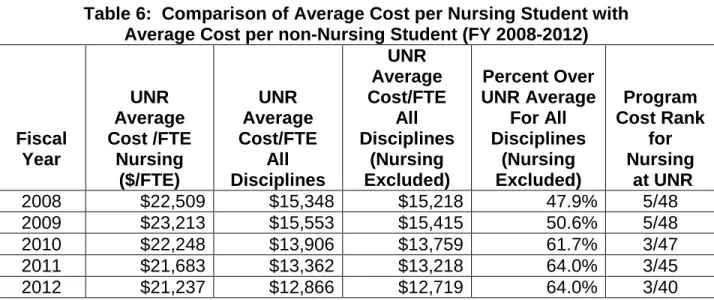
Tables 5 and 6 below provide information regarding the average cost per FTE student (for FY 2012 and for FY 2008- 2012, respectively) for the nursing program to the average cost per FTE student for the entire university. The projected total cost information below includes instructional costs and all other projected support costs within the total state budget.
Table 5: Nursing Program Cost/FTE Student and Program Cost Rank at UNR (FY 2012)
Program
Average Cost per FTE Student
Program Cost Rank at UNR
Institutional Average $12,866 N/A
Table 6: Comparison of Average Cost per Nursing Student with Average Cost per non-Nursing Student (FY 2008-2012)
Fiscal Year
UNR Average Cost /FTE Nursing
($/FTE)
UNR Average Cost/FTE
All Disciplines
UNR Average Cost/FTE
All Disciplines
(Nursing Excluded)
Percent Over UNR Average
For All Disciplines
(Nursing Excluded)
Program Cost Rank
for Nursing
at UNR
2008 $22,509 $15,348 $15,218 47.9% 5/48
2009 $23,213 $15,553 $15,415 50.6% 5/48
2010 $22,248 $13,906 $13,759 61.7% 3/47
2011 $21,683 $13,362 $13,218 64.0% 3/45
2012 $21,237 $12,866 $12,719 64.0% 3/40
As indicated by the above data, nursing is a high cost academic program and has ranked in the top five most costly programs at the University in relation to average cost per student FTE for the past five fiscal years.
Proposed Differential Fees
The proposed differential fees for the Orvis School of Nursing are presented in Table 7. Once approved, no changes can be made to these fees (for Academic Year and Summer Terms) unless the changes are approved by the NSHE Board of Regents (for Academic Year and Summer Terms). The differential fees will apply to courses with designators as noted below:
Table 7: Proposed Differential Fees (Fees Effective January 1, 2014) Discipline Course Prefix Course Level
Amount (per credit hour)
Nursing NURS 300-400* $156.75
Nursing NURS 500-700** $239.50
*Does not include NURS 300, which is a required pre-requisite course for the nursing major.
**Does not include NURS 700-level courses required for the Doctor of Nursing Practice program curriculum
Plan for Implementation of Differential Fees
Based on input from current students in the BSN, RN-to-BSN and MSN
programs, discussions with Orvis School of Nursing faculty and following the example used by the UNLV School of Nursing for implementation of differential fees at UNLV, the Orvis School of Nursing plans to wait one calendar year after Board of Regents
approval of this proposal to implement differential tuition. Therefore, pending approval of the aforementioned amounts proposed for differential fees, the differential fees will be assessed on all required NURS-prefix courses for the BSN, RN-to-BSN and MSN programs for all new and for all continuing nursing students effective January 1, 2014.
During the calendar year 2013, all new, continuing and prospective nursing students will be notified in a variety of ways (i.e, OSN website announcements,
admission letters, personal communication from the OSN Director via e-mail and written letters) regarding the amount of differential fees to be implemented for their respective programs and the date for implementation. This plan provides sufficient time for notification of new, matriculating and prospective students about the date of
implementation and provides them with an entire year to develop strategies to cover the additional cost for differential fees.
Projected Revenues and Expenditures
Table 8: Orvis School of Nursing Summary of Projected Annual Revenue and Expenses from Differential Fees (Based on FY12 Enrollment/SCH Data)
Projected Revenue Projected Expenditures
Program
Academic
Year Summer Total Program
Financial Aid
Non-Consumables
Special Course Fees
Offset
Other (Salaries,
Fringes, Operating,
etc.) Total
BSN $626,059 $221,017 $847,076 BSN $127,061 $133,510 $586,505 $847,076
RN-to-BSN
$ 75,553 0 $ 75,553
RN-to-BSN
$ 11,333 0 $ 64,220 $ 75,553
MSN $190,881 $ 21,555 $212,436 MSN $ 31,865 $ 12,925 $167,646 $212,436
TOTAL $892,493 $242,572 $1,135,065 TOTAL $170,259 $146,435 $818,351 $1,135,065 (NOTE: The estimates above are based on FY 12 enrollment/student credit hour numbers.
The implementation of the differential fees program could impact the total number of enrollments and therefore the total incremental revenue.)
Distribution of Differential Fees
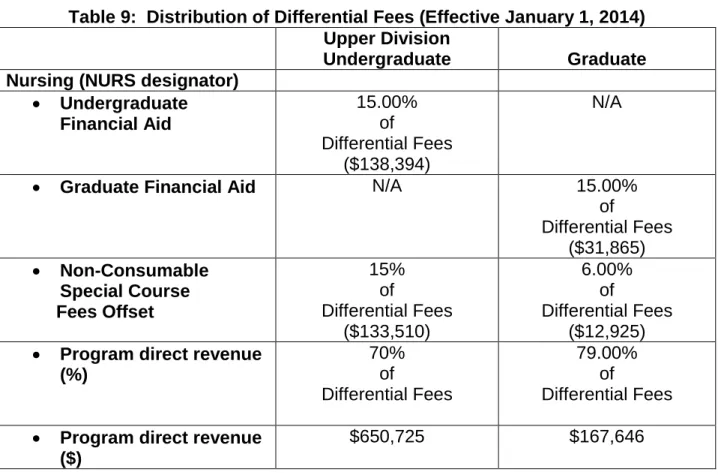
Using FY 2012 enrollment and student credit hour generation, Table 9 depicts the percentage and dollar amount of differential fees that would be generated for the undergraduate and graduate nursing programs, respectively, for student financial aid and non-consumable course fee offset and the percentage and dollar amount of direct revenue that would be generated by the differential fees for use by the Orvis School of Nursing. Implementation of the differential fee program would impact the total number of enrollments and, therefore, the total incremental revenue.
Table 9: Distribution of Differential Fees (Effective January 1, 2014) Upper Division
Undergraduate Graduate
Nursing (NURS designator) • Undergraduate
Financial Aid
15.00% of
Differential Fees ($138,394)
N/A
• Graduate Financial Aid N/A 15.00%
of
Differential Fees ($31,865) • Non-Consumable
Special Course Fees Offset
15% of
Differential Fees ($133,510)
6.00% of
Differential Fees ($12,925) • Program direct revenue
(%)
70% of
Differential Fees
79.00% of
Differential Fees • Program direct revenue
($)
Summary of Planned Use of Projected Revenue
The plan for use of the projected generated revenue indicated in Tables 8 and 9 is as follows:
• 15% of all revenue generated by differential fees will be set aside for financial aid for students in the respective programs.
• Additional operating costs associated with program growth
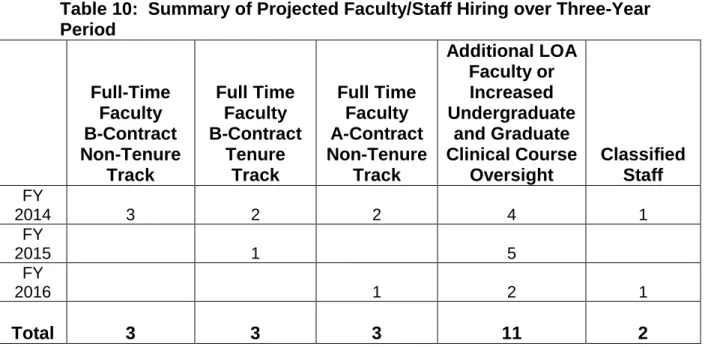
• Salaries and fringe benefits for additional faculty and staff (9 full-time and 11 part-time faculty and 2 classified staff) to be added over a three-year period
Table 10 indicates the plan for hiring additional nursing faculty and classified staff over a three-year period.
Table 10: Summary of Projected Faculty/Staff Hiring over Three-Year Period
Full-Time Faculty B-Contract Non-Tenure
Track
Full Time Faculty B-Contract
Tenure Track
Full Time Faculty A-Contract Non-Tenure
Track
Additional LOA Faculty or Increased Undergraduate
and Graduate Clinical Course
Oversight
Classified Staff FY
2014 3 2 2 4 1
FY
2015 1 5
FY
2016 1 2 1
Total 3 3 3 11 2
Projected Program Outcomes
If the proposed differential fees are approved, outcomes for the Orvis School of Nursing BSN, RN-to BSN and MSN programs will be to:
• Increase enrollment in the entry-level BSN program by 33% • Double enrollment in the RN-to-BSN program
• Increase enrollment in MSN-Nurse Educator Track
In addition, enrollment in the Family Nurse Practitioner (FNP) and Clinical Nurse Leader (CNL) tracks in the MSN program may be increased and additional tracks may be added to the MSN program pending sufficient revenue generation and community need.
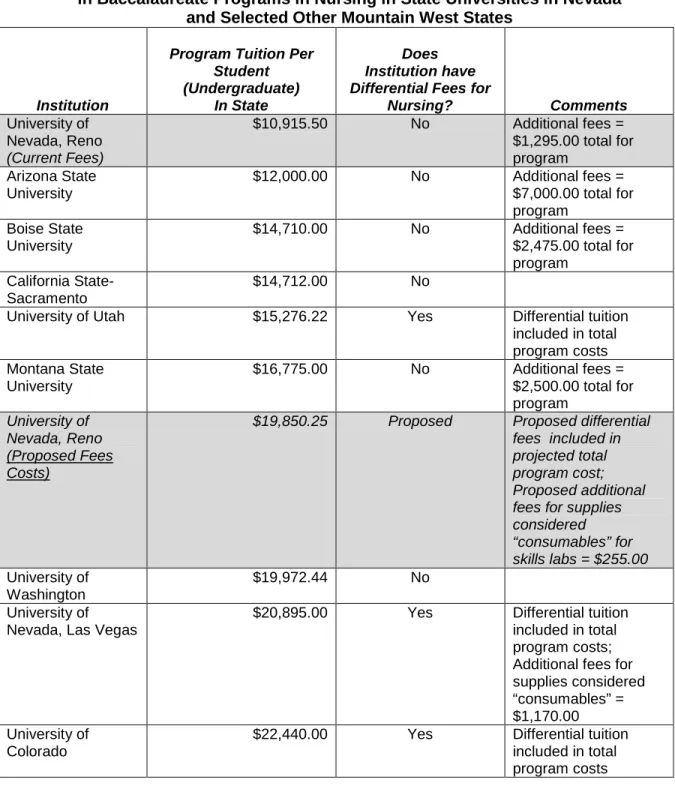
Comparative Program Costs
The table below provides cost comparisons for tuition for all courses taken within the respective program nursing major only (no cost for prerequisite courses are
included) in baccalaureate programs in nursing in Nevada and other Mountain West states. Tuition costs are based on rates for the 2012-1013 academic year.
Table 11: Baccalaureate Program Cost Comparisons: Total Nursing Major Tuition Costs in Baccalaureate Programs in Nursing in State Universities in Nevada
and Selected Other Mountain West States
Institution
Program Tuition Per Student (Undergraduate)
In State
Does Institution have Differential Fees for
Nursing? Comments
University of Nevada, Reno (Current Fees)
$10,915.50 No Additional fees = $1,295.00 total for program
Arizona State University
$12,000.00 No Additional fees = $7,000.00 total for program
Boise State University
$14,710.00 No Additional fees = $2,475.00 total for program
California State-Sacramento
$14,712.00 No
University of Utah $15,276.22 Yes Differential tuition included in total program costs Montana State
University
$16,775.00 No Additional fees = $2,500.00 total for program
University of Nevada, Reno (Proposed Fees Costs)
$19,850.25 Proposed Proposed differential fees included in projected total program cost; Proposed additional fees for supplies considered “consumables” for skills labs = $255.00 University of
Washington
$19,972.44 No University of
Nevada, Las Vegas
$20,895.00 Yes Differential tuition included in total program costs; Additional fees for supplies considered “consumables” = $1,170.00 University of
Colorado
$22,440.00 Yes Differential tuition included in total program costs
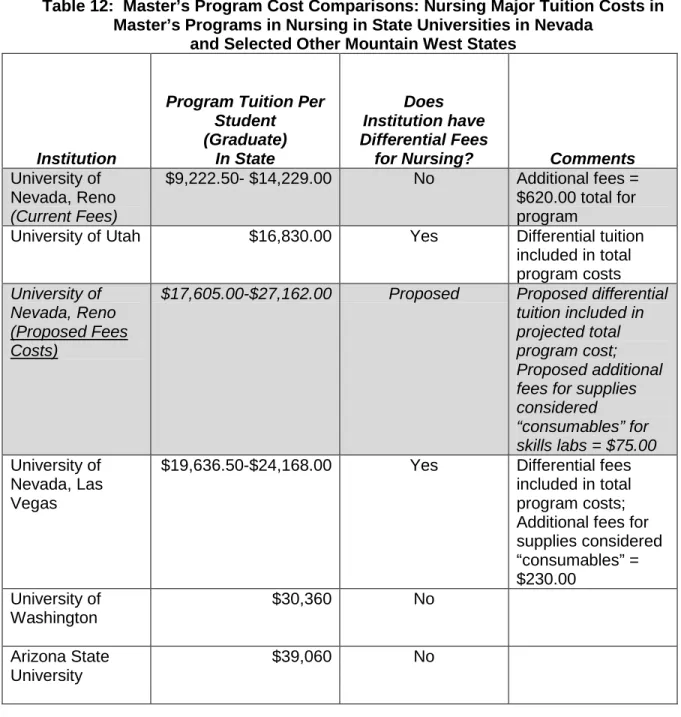
The table below provides cost comparisons for tuition for all courses taken within the respective program nursing major only (no cost for prerequisite courses are
included) in master’s programs in nursing in Nevada and other Mountain West states. Tuition costs are based on rates for the 2012-1013 academic year.
Table 12: Master’s Program Cost Comparisons: Nursing Major Tuition Costs in Master’s Programs in Nursing in State Universities in Nevada
and Selected Other Mountain West States
Institution
Program Tuition Per Student (Graduate)
In State
Does Institution have Differential Fees
for Nursing? Comments
University of Nevada, Reno
(Current Fees)
$9,222.50- $14,229.00 No Additional fees = $620.00 total for program
University of Utah $16,830.00 Yes Differential tuition
included in total program costs
University of Nevada, Reno (Proposed Fees Costs)
$17,605.00-$27,162.00 Proposed Proposed differential tuition included in projected total program cost; Proposed additional fees for supplies considered
“consumables” for skills labs = $75.00
University of Nevada, Las Vegas
$19,636.50-$24,168.00 Yes Differential fees included in total program costs; Additional fees for supplies considered “consumables” = $230.00
University of Washington
$30,360 No
Arizona State University
References
American Association of Colleges of Nursing (2012). 2011-2012 Enrollment and graduations in baccalaureate and graduate programs in nursing.
Washington, DC: Author
Benner, P., Sutphen, M., Leonard, V., and Day, L. (2009). Educating nurses: A call for radical transformation. San Francisco: Jossey-Bass.
Institute of Medicine (2010). The future of nursing: Leading change, advancing health. Washington, DC: The National Academies Press.
Robert Wood Johnson Foundation (2010). Expanding America’s capacity to educate nurses: Diverse, state-level partnerships are creating promising models and results. Princeton, NJ: Author
Section 7.
Differential Program Fees
The following differential program fees have been reviewed and approved by the Board of Regents. Rates are assessed in addition to registration fees.
Program Course Prefix Course Level Amount Effective Date
University of Nevada Las Vegas
Architecture AAD, AAE, ABS, AAL, LAND, AAI, AAP
300-400 $156.75/credit Spring 2012
Architecture AAE, AAD 500-700 $239.50/credit Spring 2012
Business MBA, FIN, MKT, MGT 500-700 $100.00/credit Spring 2012
Nursing NURS 300-400 $156.75/credit Spring 2012
Nursing NURS 500-700 $239.50/credit Spring 2012
Physical Therapy
DPT 500-700 $239.50/credit Spring 2012
Social Work SW 700 $125.00/credit Fall 2012
Urban Leadership
UBL 700 $150.00/credit Fall 2012
University of Nevada, Reno
Business ACC, BADM, BUS, ENT, GAM, FIN, IS, MGT, MKT
600-700 $100.00/credit Fall 2011 [Engineering] [BME, ENGR, CHE, CEE, CPE,
CS, EE, GE, ME, MINE, MSE]
[300-400] [$21.25/credit] [Fall 2011*] Engineering BME, ENGR, CHE, CEE, CPE,
CS, EE, GE, ME, MINE, MSE
300-400 $42.50/credit Fall 2012* Engineering BME, ENGR, CHE, CEE, CPE,
CS, EE, GE, ME, MINE, MSE
300-400 $85.00/credit Fall 2013* [Engineering] [BME, ENGR, CHE, CEE, CPE,
CS, EE, GE, ME, MINE, MSE]
[600-700] [$25.00/credit] [Fall 2011*] Engineering BME, ENGR, CHE, CEE, CPE,
CS, EE, GE, ME, MINE, MSE
600-700 $50.00/credit Fall 2012* Engineering BME, ENGR, CHE, CEE, CPE,
CS, EE, GE, ME, MINE, MSE
600-700 $100.00/credit Fall 2013*
Nursing NURS 300-400** $156.75/credit Fall 2013
Nursing NURS 500-700*** 239.50/credit Fall 2013
PROPOSED REVISIONS –
P&G MANUAL
CHAPTER 7, SECTION 7
Differential Fees
Nevada State College
Nursing-Accelerated Track Only
NURS 300-400 $113.25/credit Fall 2012
*Phase in of per credit fee over three years. (Added 12/10; A. 4/11, 12/11)
** Does not include NURS 300, which is a required pre-requisite course for the nursing program
*** Does not include NURS 700-level courses required for the Doctor of Nursing Practice Program curriculum
….
2. University of Nevada, Reno
NURS 318, Nursing Care of the Individual Part 1: Practice ($350.00/course) NURS 346, Care of Individuals and Family
$200.00/course
($410.00/course) NURS 434, Care of Community, Mental Health, Chronically
Ill: Practice
$40.00/course ($155.00/course) $5.00/course (NURS 454, Care of Clients with Complex Health
Problems: Practice)
($370.00/course)
NURS 750R, Advanced Health Assessment ($375.00/course)
$75.00/course
(NURS 756, Advanced Primary Care II $320.00/course)
….
PROPOSED REVISIONS –
P&G MANUAL
CHAPTER 7, SECTION 9.2 (UNR)
Special Course Fees
Additions appear in boldface italics; deletions are [stricken and bracketed]